
Psalms 78:51

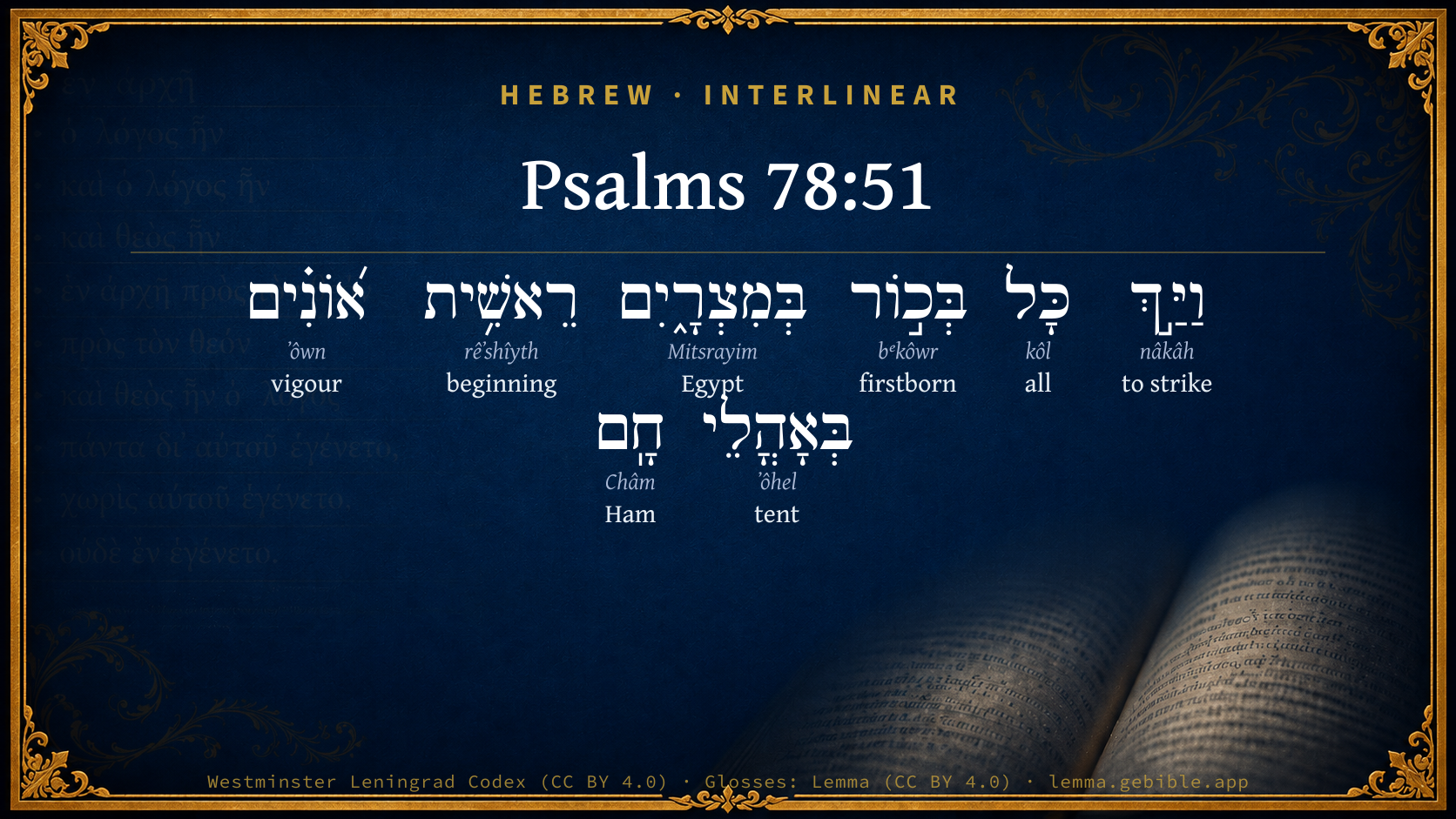
Hebrew (Westminster Leningrad Codex) Psalms 78:51 appears in the Hebrew Old Testament. The text above is from the Westminster Leningrad Codex. Each word links to its Strong’s number, a concise gloss, and parsing drawn from the Open Scriptures Hebrew Bible morphology. Click any word for its full Brown-Driver-Briggs (BDB) entry.
Download image
Cite this verse

Psalms 78:51 (World English Bible). Public Domain. Lemma interlinear Bible study tool, https://lemma.gebible.app/v/psalms/78/51.

Show BibTeX & RIS
BibTeX
RIS
English Translation
And struck all the firstborn in Egypt, The chief of their strength in the tents of Ham.
World English Bible · Public Domain
Download a study sheet

One document with this verse’s original text, its word-by-word gloss line, the meaning frame, cross-references with their text, attributed commentary, and full source and license credits — printable, and it pastes into notes with its structure intact.

This verse Autodidact and up

Study sheet (.html) Plain text (.txt)

A passage Seminary Student

Up to 50 verses in one chapter. A passage sheet keeps up to 6 commentary sources and 12 cross-references per verse, in the order this page ranks them, and says so on the sheet whenever that leaves anything out. Ask for a single verse and you get the Autodidact verse sheet above.

Everything on this page stays free to read, with no account — the sheet is a download of what is already on screen, not access to it.

Want to remove ads? Support Godless Engineer
Compare translations 3

The same verse in 3 English versions, stacked beneath the original-language interlinear above. Click any original word for its lexicon entry.

Each is an independent rendering of the whole verse — the interlinear is not word-aligned to these translations.

Highlighted words mark where these versions differ — a whole-verse word diff, not a word-by-word alignment.

  • World English Bible Public Domain
    And struck all the firstborn in Egypt, The chief of their strength in the tents of Ham.
  • King James Version Public Domain
    And smote all the firstborn in Egypt; the chief of their strength in the tabernacles of Ham:
  • unfoldingWord Literal Text CC BY-SA 4.0
    And he struck every firstborn in Egypt, the beginning of strength in the tents of Ham.

unfoldingWord Literal Text — © unfoldingWord, licensed CC BY-SA 4.0. Word-aligned USFM3 via Door43 (git.door43.org/unfoldingWord/en_ult).

Versions to compare (up to 4)

3 of 4 selected

Show all 18 translations

Every available English version of this verse, each an independent rendering of the whole verse.

  • World English Bible Public Domain
    And struck all the firstborn in Egypt, The chief of their strength in the tents of Ham.
  • Berean Standard Bible Public Domain
    He struck all the firstborn of Egypt, the virility in the tents of Ham.
  • Majority Standard Bible Public Domain
    He struck all the firstborn of Egypt, the virility in the tents of Ham.
  • King James Version Public Domain
    And smote all the firstborn in Egypt; the chief of their strength in the tabernacles of Ham:
  • American Standard Version (1901) Public Domain
    And smote all the first-born in Egypt, The chief of their strength in the tents of Ham.
  • Revised Version (1885) Public Domain
    And smote all the firstborn in Egypt, the chief of their strength in the tents of Ham:
  • Geneva Bible (1599) Public Domain
    And smote al the firstborne in Egypt, euen the beginning of their strength in the tabernacles of Ham.
  • Douay-Rheims (1899) Public Domain
    And he killed all the firstborn in the land of Egypt: the firstfruits of all their labour in the tabernacles of Cham.
  • Young's Literal Translation Public Domain
    And He smiteth every first-born in Egypt, The first-fruit of the strong in tents of Ham.
  • Literal Standard Version CC BY-SA 4.0
    And He strikes every firstborn in Egypt, || The first-fruit of the strong in tents of Ham.
  • Unlocked Literal Bible CC BY-SA 4.0
    He killed all the firstborn in Egypt, the firstborn of their strength in the tents of Ham.
  • unfoldingWord Literal Text CC BY-SA 4.0
    And he struck every firstborn in Egypt, the beginning of strength in the tents of Ham.
  • Darby Bible Public Domain
    And he smote all the firstborn in Egypt, the first-fruits of their vigour in the tents of Ham.
  • World Messianic Bible Public Domain
    and struck all the firstborn in Egypt, the chief of their strength in the tents of Ham.
  • Webster's Bible Public Domain
    And smote all the first-born in Egypt; the chief of their strength in the tabernacles of Ham:
  • Free Bible Version CC BY-SA 4.0
    He struck down all the firstborn of Egypt, the first to be conceived in the tents of Ham.
  • Bible in Basic English Public Domain
    He gave to destruction all the first sons of Egypt; the first-fruits of their strength in the tents of Ham;
  • JPS Tanakh (1917) Public Domain
    And smote all the first-born in Egypt, the first-fruits of their strength in the tents of Ham;

Literal Standard Version (2020), Covenant Press — licensed CC BY-SA 4.0. Text via the HelloAO Bible API (eBible.org). Unlocked Literal Bible (unfoldingWord) — licensed CC BY-SA 4.0. Text via the HelloAO Bible API (eBible.org). unfoldingWord Literal Text — © unfoldingWord, licensed CC BY-SA 4.0. Word-aligned USFM3 via Door43 (git.door43.org/unfoldingWord/en_ult). Free Bible Version, Dr. Jonathan Gallagher — licensed CC BY-SA 4.0. Text via the HelloAO Bible API (eBible.org).

Word by word

More ways to search: Search by grammar → Find every occurrence → Compare this word →

Practice this passage: Drill this verse → Learn its vocabulary →

About this verse

These counts appear in no published source. They are computed here, from the morphology-tagged text and Lemma’s own curated glosses. What Lemma adds →

8
words
8
distinct lemmas
Wisdom
section

Notable vocabulary

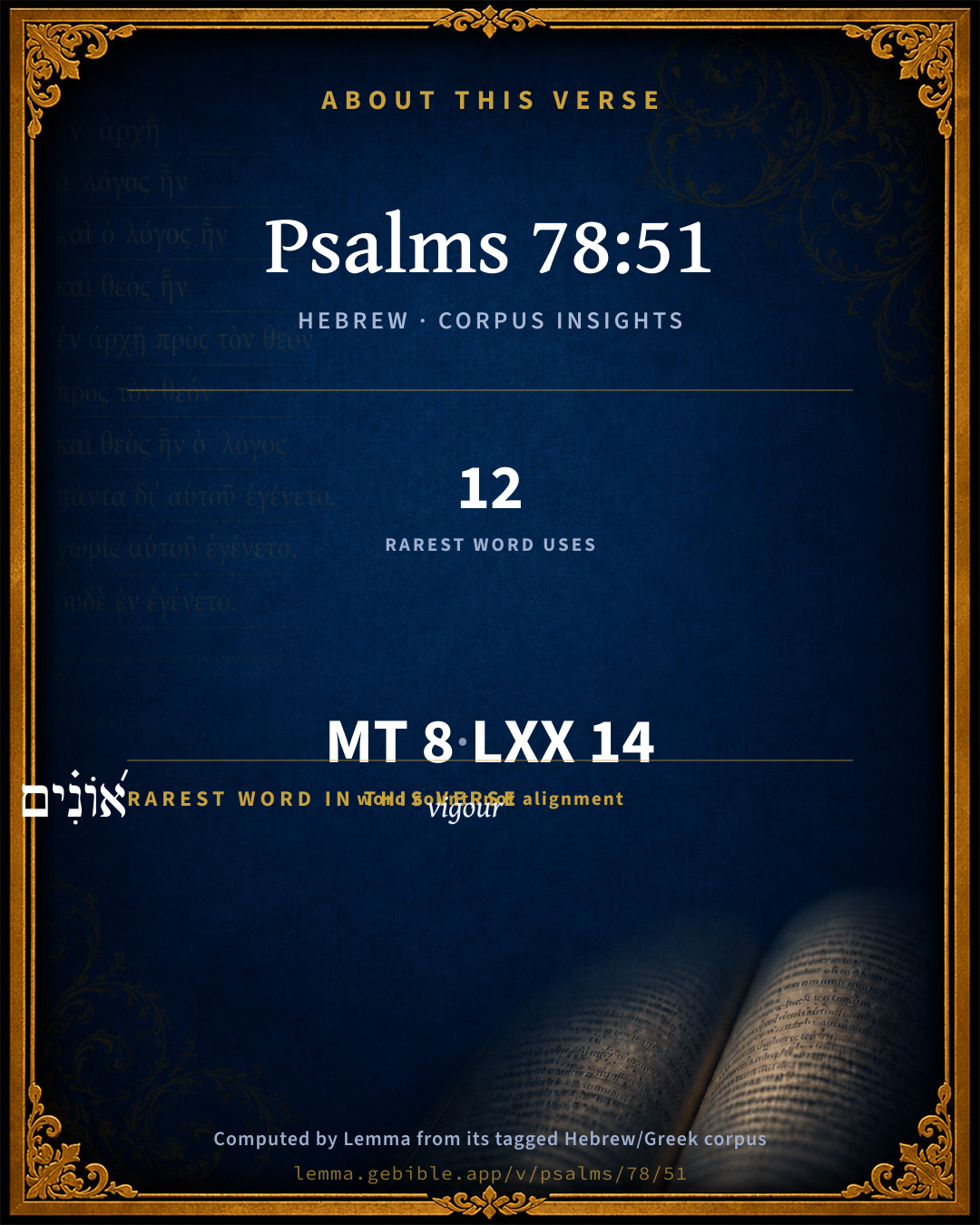
The rarest word here is א֝וֹנִ֗ים vigour H202 — appearing just 12 times in the whole Hebrew Bible.

Shared distinctive vocabulary

א֝וֹנִ֗ים vigour H202 occurs in 12 verses of the Hebrew Bible. Also found in:

Grammatical profile

  • 1 verb
  • 7 nouns

Verb forms

  • וַיַּ֣ךְ Hiphil · Sequential Imperfect

Hebrew & Septuagint length

In English translation the verse runs 17 words from the Hebrew and 20 from the Septuagint (LXX English) — closely comparable.

A rough comparison of the two English renderings, which tokenize alike — not a word-level alignment.

Word counts can differ between the Hebrew and the Greek without any difference in meaning — e.g. the Hebrew direct-object marker אֵת has no separate Greek word, and Greek often adds the article ὁ.

In the original languages it is 8 Hebrew tokens and 14 Greek tokens — but the two are counted differently (Hebrew bundles its prefixes and suffixes into one token; the Greek is in lemma form), so that isn’t a like-for-like length.

Cross-references

13

Topical passages linked to Psalms 78:51 in the Treasury of Scripture Knowledge — connected by theme and wording, ordered by reader-vote popularity; previews shown in the World English Bible.

  • Psalms 105:23 Israel also came into Egypt. Jacob sojourned in the land of Ham.
  • Psalms 106:22 Wondrous works in the land of Ham, And awesome things by the Red Sea.
  • Psalms 135:8 Who struck the firstborn of Egypt, Both of man and animal;
  • Psalms 105:36 He struck also all the firstborn in their land, The first fruits of all their manhood.
  • Psalms 136:10 To him who struck down the Egyptian firstborn; For his loving kindness endures forever;
  • Exodus 13:15 and it happened, when Pharaoh would hardly let us go, that Yahweh killed all the firstborn in the land of Egypt, both the firstborn of man, and the firstborn of animal. Therefore I sacrifice to Yahweh all that opens the womb, being males; but all the firstborn of my sons I redeem.'
  • Genesis 49:3 "Reuben, you are my firstborn, my might, and the beginning of my strength; The pre-eminence of dignity, and the pre-eminence of power.
  • Exodus 12:12 For I will go through the land of Egypt in that night, and will strike all the firstborn in the land of Egypt, both man and animal. Against all the gods of Egypt I will execute judgments: I am Yahweh.
  • Exodus 12:29–30 It happened at midnight, that Yahweh struck all the firstborn in the land of Egypt, from the firstborn of Pharaoh who sat on his throne to the firstborn of the captive who was in the dungeon; and all the firstborn of cattle.
  • Genesis 9:22–25 Ham, the father of Canaan, saw the nakedness of his father, and told his two brothers outside.
  • Genesis 10:6 The sons of Ham: Cush, Mizraim, Put, and Canaan.
  • Psalms 105:27 They performed miracles among them, And wonders in the land of Ham.
  • Hebrews 11:28 By faith, he kept the Passover, and the sprinkling of the blood, that the destroyer of the firstborn should not touch them.

Cross-references courtesy of OpenBible.info (CC BY 4.0).

Hebrew and Greek witnesses Masoretic Hebrew ↔ Greek Septuagint

The same verse in the two great witnesses to the Old Testament, shown verse-for-verse.

You’re reading Greek Psalm 77 (Hebrew Psalm 78). The Septuagint counts the superscription, so verse numbers can differ from the Hebrew — chapter-level alignment, not verse-by-verse. Numbering follows Rahlfs.

These are two independent witnesses, not word-aligned to each other, and the Septuagint is shown in lemma (dictionary) form.

Hebrew Psalms 78:51 Masoretic · Westminster Leningrad Codex

וַיַּ֣ךְ כָּל בְּכ֣וֹר בְּמִצְרָ֑יִם רֵאשִׁ֥ית א֝וֹנִ֗ים בְּאָהֳלֵי חָֽם

And struck all the firstborn in Egypt, The chief of their strength in the tents of Ham.

World English Bible · Public Domain

Greek LXX Greek Psalm 77:51 Septuagint · lemma form

καί πατάσσω πᾶς πρωτότοκος ἐν αἴγυπτος ἀπαρχή ὁ πόνος αὐτός ἐν ὁ σκήνωμα χαμ

and struck every firstborn in the land of Egypt; the first fruits of their labors in the tents of Cham.

LXX2012 (modern English Septuagint) · Public Domain

Hebrew: Westminster Leningrad Codex (CC BY 4.0). Greek: Septuagint (public domain); English from LXX2012 (modern English Septuagint) (Public Domain). How the Septuagint differs from the Hebrew →

Commentary

Notes on Psalms 78:51 from classic Christian and Jewish commentators (each source and its license shown beneath its notes). The classic Christian expositions comment on the surrounding passage and are grouped to its opening verse, so a note may address several verses; the Jewish commentaries on the Tanakh (Rashi and others) are per-verse, so they appear only where the commentator wrote on this verse.

Lemma curates 59 commentaries, every one of them public domain or Creative Commons licensed, each selected and text-cleaned for this edition rather than reprinted as found. About our sources →

Trapp's Complete Commentary

John Trapp

Psa 78:51 And smote all the firstborn in Egypt; the chief of [their] strength in the tabernacles of Ham:

Ver. 51. And smote all the firstborn in Egypt] Certo pestis genere perniciocissimo et acutissimo. The Rabbis say that in each house was a dead corpse, viz. the chieftain of the family, whether there were a firstborn in it or not, Exo 12:30.

In the tabernacle of Ham] Who was the father of Mizraim, the founder of the Egyptians, Gen 10:6, who vainly boasted that they were αυτοχθονες, as ancient as their land. Herodotus, the author of that story, tells us also of a certain great town in Egypt called Chemmim, from Cham likely.

John Trapp, A Commentary or Exposition upon All the Books of the Old and New Testament (1647–1656) — public domain. Text from a community e-Sword module.

The Biblical Illustrator

Joseph S. Exell

Psa_78:51-52

And smote all the firstborn in Egypt;. . . but made His own people to go forth like sheep.

Gods dealings with Egypt and Israel

I. The punishment of egypt. Egypt, through its kings, had become the determined adversary of God. Who is Jehovah, that I should obey His voice? was the challenge flung down by Pharaoh in defiance; and the Lord, who is a man of war, was not slow to accept it. Let us learn from this that, when God comes to try conclusions between Himself and His enemies, He may allow a certain time to elapse before He overthrows them, He may for a while smite gently, and so give opportunities for repentance; but if they be not accepted, we may depend upon it that God is not playing with sinners. In the case of Pharaoh, it was his own chickens that came home to roost; his sins brought their own punishment. He had slain many of the children of Israel, and God had, in effect, said to him, Israel is my firstborn; let my people go; and as he would not let Gods first-born go Gods stroke of judgment came upon his firstborn. This is, perhaps, the most dreadful truth about future retribution that a man will see his own sin in his suffering just as he sees his face in a glass. There is no escape from Gods judgment and no recovery from His blows.

II. The salvation of Israel (Psa_78:52).

1. God has His people to this day. Their distinguishing mark is faith.

2. God brings these people out from among all others. He brought Israel up out of Egypt; and if you are one of His people, He will fetch you out of the world. God did not drive His people out of Egypt, but He led them; they came willingly and gladly, for Egypt had become a place of misery to them. So does the world become, with all its sinful pleasures; its fine glories turn to emptiness and vanity to the true child of God, and God fetches him out of it all.

3. The Lord not only brings His people away from others, but He brings them to Himself: He made His own people to go forth like sheep, and guided them in the wilderness like a flock, He Himself going before them through the desert way like a shepherd, O poor wandering souls, come to God through Jesus Christ His Son, follow where He leads, and walk ever in His way!

4. Further, in bringing sinners to Himself, God will also bring them to one another. He made His own people to go forth like sheep, and guided them in the wilderness like a flock. He does not say that they should be like a solitary dog that comes at his masters whistle, but like a flock of sheep that move together in one direction. It is one of the marks of Gods people that they love each other; He leads them forth like a flock of sheep, He brings them into union with one another: gives them happy fellowship in His Church, and so guides them to heaven.

5. The Lord brings His people out from the world, and brings them to Himself, and to fellowship with one another, and then He guides them to a place of rest, even as He led Israel into Canaan. (C. H. Spurgeon.)

The Biblical Illustrator, edited by Joseph S. Exell (c. 1880s–1900s) — public domain. Text from a community e-Sword module.

J. A. Alexander on Psalms

Joseph Addison Alexander

51. (Psa 78:51) And smote all the first-born in Egypt, the first fruitsof strength in the tents of Ham. Compare the narrative in Exo 12:29-30. The poetical description of the first-born in the last clause is derived from Gen 49:3 (compare Deu 21:17), and that of Egypt from Gen 10:6.

Joseph Addison Alexander, The Psalms Translated and Explained (1850) — public domain. Text from a community e-Sword module.

Geneva Bible (1599)

Geneva Bible translators

The firstborn are so called, as Gen. 49:3.

That is, Egypt: for it was called Mizraim, or Egypt of Mizraim that was the son of Ham.

Geneva Bible (1599) marginal notes — public domain. Text via Bolls.life.

The Cambridge Bible for Schools and Colleges

gen. ed. J. J. S. Perowne

51. the chief of their strength] The beginning, or, firstlings of strength, a term applied to firstborn sons in Gen_49:3; Deu_21:17. So Psa_105:36.

in the tabernacles of Ham] R.V. tents. Ham was the ancestor of Mizraim, i.e. Egypt, Gen_10:6. Cp. Psa_105:23; Psa_105:27; Psa_106:22.

The Cambridge Bible for Schools and Colleges (gen. ed. J. J. S. Perowne; Cambridge University Press, 1878–1918) — public domain. Text from a community e-Sword module.

John Gill's Exposition

But made his own people to go forth like sheep,.... The people of Israel, whom the Lord chose to be his peculiar people above all others; these he caused to go forth out of Egypt, with a mighty hand and stretched out arm; like sheep, weak, timorous, unarmed, harmless, and inoffensive, not a dog daring to move his tongue at them: the power of God was wonderfully displayed in the delivery of his poor, helpless, and oppressed people, well may it be ascribed to him; for it was not their arm, but his, that brought them out:

and guided them in the wilderness like a flock; by the hands of Moses and Aaron, Psa 77:20, he also going before them as the Shepherd of the flock, in a pillar of cloud by day, and in a pillar of fire by night; he kept them together as a flock from scattering, straying, and being lost; and directed their way in the untrodden wilderness, through all the windings and turnings of it, and protected them from all dangers and enemies.

John Gill's Exposition of the Whole Bible (1746–1763) — public domain (CC PDM 1.0). Text via the HelloAO Bible API.

Albert Barnes' Notes on the Bible

And smote all the firstborn in Egypt - See Exo 11:4-5; Exo 12:29-30.

The chief of their strength - Those on whom they relied; their firstborn; their pride; their glory; their heirs. Compare Gen 49:3.

In the tabernacles of Ham - The tents; the dwelling-places of Ham; that is, of Egypt. Compare Gen 10:6; Psa 105:23, Psa 105:27; Psa 106:22,

Albert Barnes' Notes on the Bible (1834–1885) — public domain. Text from a community e-Sword/MySword module.

Matthew Poole's English Annotations

The chief of their strength; another expression noting the first-born, who are so called, Gen 49:3.

Of Ham; of the Egyptians, the posterity of Ham, Gen 10:6; which title he there gives them, to intimate that they were the cursed children of a cursed parent, Ham, Gen 9:25, and therefore were proper objects for Divine wrath and vengeance.

Matthew Poole's English Annotations on the Holy Bible (1683–1685) — public domain. Text from a community e-Sword/MySword module.

The Treasury of David

Charles H. Spurgeon

Ver. 51. And smote all the firstborn in Egypt. No exceptions were made, the monarch bewailed his heir as did the menial at the mill. They smote the Lord's firstborn, even Israel, and he smites theirs.

The chief of their strength in the tabernacles of Ham. Swinging his scythe over the field, death topped off the highest flowers. The tents of Ham knew each one its own peculiar sorrow, and were made to sympathise with the sorrows which had been ruthlessly inflicted upon the habitations of Israel. Thus curses come home to roost. Oppressors are repaid in their own coin, without the discount of a penny.

Ver. 51. The chief of their strength in the tabernacles of Ham. The sun of the last day of the sojourn of Israel in Egypt had set. It was the fourth day after the interview with Moses. Pharaoh, his princes, and the priests of his idols would doubtless take courage from this unwonted delay. Jehovah and his ministers are beaten at length, for now the gods of Egypt prevail against them. The triumph would be celebrated in pomps and sacrifices, in feasts and dances. Nothing is more likely than that the banquet halls of Pharaoh at Rameses were blazing with lamps, and that he and his princes were pouring forth libations of wine to their gods, and concerting schemes amid their revelry, for the perpetuation of the thraldom of Israel... Pharaoh Sethos started from his couch that night yelling in fierce and bitter agony, and gnawing at the sharp arrow that was rankling in his vitals, like a wounded lion. His son, his firstborn, his only son, just arrived at man's estate, just crowned king of Egypt, and associated with his father in the care of sovereignty, writhed before him in mortal throes, and died. His transports of grief were reechoed, and with no feigned voice, by the princes, the councillors, and the priest that partook of his revelry. Each one rends his garments and clasps to his bosom the quivering corpse of his firstborn son. On that fearful night "there was a great cry throughout the land of Egypt, "but if we have rightly read its history, the loudest, wildest wail of remorseful anguish would arise from Pharaoh's banquet hall! William Osburn, in "Israel in Egypt." 1856.

None.

Charles H. Spurgeon's The Treasury of David (1869–1885) — public domain. Psalms only. Text from a community e-Sword/MySword module.

Whedon's Commentary on the Bible

Daniel D. Whedon

51. Smote all the firstborn—The last and effectual plague. The greatness of the judgment, and its singular feature in falling only upon the “firstborn,” marked it as a direct visitation of God. It struck down the chief of their strength, and another step might have extinguished the nation. The firstborn of beast included their sacred animals; the goat, ram, calf, sacred bull, crocodile, all were smitten, and their gods and worship brought into contempt.

Tabernacles of Ham—A poetical designation of Egypt, called Ham, (or the dark skinned race,) after its ancestor, (Gen_10:6,) but otherwise in Hebrew always Mizraim, after the son of Ham, who settled the country. The ancients often designated nations according to their colour, the Hebrews after their ancestry. See on Psa_105:23

Daniel D. Whedon (gen. ed.), Commentary on the Old and New Testaments (1874–1909) — public domain. Text from a community e-Sword module.

The Pulpit Commentary

And smote all the firstborn in Egypt. (see Exo_12:29) The chief of their strength in the tabernacles of Ham; or, "the beginning (literally, firstfruits) of their strength". (comp. Gen_49:3) "The tabernacles of Ham" is a periphrasis for "Egypt the Egyptians, according to the author of Genesis, (Gen_10:6) being descendants of Ham. (comp. Psa_105:23, Psa_105:27) There are no sufficient grounds for connecting the name of Ham either with the Egyptian Kem, Kemi the native name for the country or with Khem, one of the principal Egyptian goes. The literation is, no doubt, close in the latter case; but etymologists lay it down that close approximations are especially deceptive.

The Pulpit Commentary (1880–1919), ed. H.D.M. Spence-Jones & Joseph S. Exell — public domain. Text from a community e-Sword module.

John Wesley's Explanatory Notes

Ham - Of the Egyptians, the posterity of Ham, the cursed children of a cursed parent.

John Wesley, Explanatory Notes Upon the Whole Bible (1754–1765) — public domain. Text via the GEBible commentary corpus.

Lesson kit

Teaching starters — assembled from the data on this page, not authored interpretation. Every prompt links to the verse data it draws on. Edit before teaching.

Psalms, in the Wisdom, opens this verse with 8 words (8 distinct Hebrew lemmas). Its most distinctive word is ʼôwn (“vigour”). A historical commentator’s framing appears above. Read the whole chapter for the surrounding context.

Discussion questions

  1. What does “vigour” (ʼôwn) contribute to the verse as a whole?
  2. How does Genesis 49:3, which shares the word «vigour», read alongside this verse?
  3. These translations render this verse differently; the difference is in the English rendering, not the original. What questions does that raise?
  4. «וַיַּ֣ךְ» is a Hiphil Sequential Imperfect verb. How does that grammatical form shape the action described?
  5. Compare how Trapp's Complete Commentary and The Biblical Illustrator read this verse. Where do they agree or differ?

Things to notice

Reading settings

Reading text

Shown beneath each verse's original-language words.

Old Testament
Old Testament edition

Read the OT as the Masoretic Hebrew (MT) or the Greek Septuagint (LXX).

English shown for the Greek Septuagint (in the Hebrew ↔ Greek comparison).

Comparing translations? Open the Compare panel on any verse page to stack up to four side by side.