
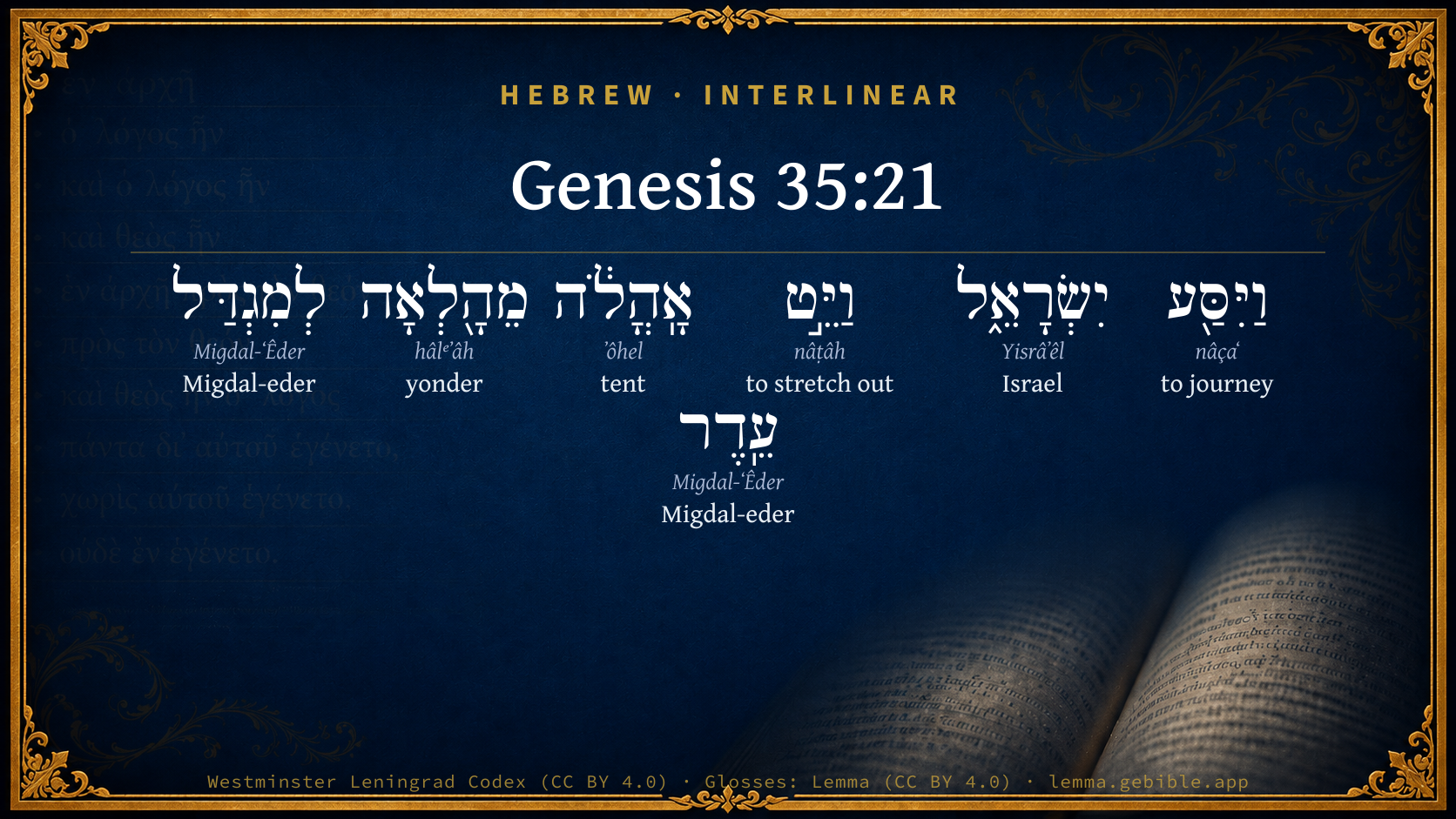
Genesis 35:21

Hebrew (Westminster Leningrad Codex) Genesis 35:21 appears in the Hebrew Old Testament. The text above is from the Westminster Leningrad Codex. Each word links to its Strong’s number, a concise gloss, and parsing drawn from the Open Scriptures Hebrew Bible morphology. Click any word for its full Brown-Driver-Briggs (BDB) entry.
Download image
Cite this verse

Genesis 35:21 (World English Bible). Public Domain. Lemma interlinear Bible study tool, https://lemma.gebible.app/v/genesis/35/21.

Show BibTeX & RIS
BibTeX
RIS
English Translation
Israel traveled, and spread his tent beyond the tower of Eder.
World English Bible · Public Domain
Highlights Full analysis ↓
Download a study sheet

One document with this verse’s original text, its word-by-word gloss line, the meaning frame, cross-references with their text, attributed commentary, and full source and license credits — printable, and it pastes into notes with its structure intact.

This verse Autodidact and up

Study sheet (.html) Plain text (.txt)

A passage Seminary Student

Up to 50 verses in one chapter. A passage sheet keeps up to 6 commentary sources and 12 cross-references per verse, in the order this page ranks them, and says so on the sheet whenever that leaves anything out. Ask for a single verse and you get the Autodidact verse sheet above.

Everything on this page stays free to read, with no account — the sheet is a download of what is already on screen, not access to it.

Want to remove ads? Support Godless Engineer
Compare translations 3

The same verse in 3 English versions, stacked beneath the original-language interlinear above. Click any original word for its lexicon entry.

Each is an independent rendering of the whole verse — the interlinear is not word-aligned to these translations.

Highlighted words mark where these versions differ — a whole-verse word diff, not a word-by-word alignment.

  • World English Bible Public Domain
    Israel traveled, and spread his tent beyond the tower of Eder.
  • King James Version Public Domain
    And Israel journeyed, and spread his tent beyond the tower of Edar.
  • unfoldingWord Literal Text CC BY-SA 4.0
    Then Israel set out and pitched his tents beyond Migdal Eder.

unfoldingWord Literal Text — © unfoldingWord, licensed CC BY-SA 4.0. Word-aligned USFM3 via Door43 (git.door43.org/unfoldingWord/en_ult).

Versions to compare (up to 4)

3 of 4 selected

Show all 18 translations

Every available English version of this verse, each an independent rendering of the whole verse.

  • World English Bible Public Domain
    Israel traveled, and spread his tent beyond the tower of Eder.
  • Berean Standard Bible Public Domain
    Israel again set out and pitched his tent beyond the Tower of Eder.
  • Majority Standard Bible Public Domain
    Israel again set out and pitched his tent beyond the Tower of Eder.
  • King James Version Public Domain
    And Israel journeyed, and spread his tent beyond the tower of Edar.
  • American Standard Version (1901) Public Domain
    And Israel journeyed, and spread his tent beyond the tower of Eder.
  • Revised Version (1885) Public Domain
    And Israel journeyed, and spread his tent beyond the tower of Eder.
  • Geneva Bible (1599) Public Domain
    Then Israel went forwarde, and pitched his tent beyond Migdal-eder.
  • Douay-Rheims (1899) Public Domain
    Departing thence, he pitched his tent beyond the Flock tower.
  • Young's Literal Translation Public Domain
    And Israel journeyeth, and stretcheth out his tent beyond the tower of Edar;
  • Literal Standard Version CC BY-SA 4.0
    And Israel journeys, and stretches out his tent beyond the Tower of Edar;
  • Unlocked Literal Bible CC BY-SA 4.0
    Israel traveled on and pitched his tent beyond the watchtower of the flock.
  • unfoldingWord Literal Text CC BY-SA 4.0
    Then Israel set out and pitched his tents beyond Migdal Eder.
  • Darby Bible Public Domain
    And Israel journeyed, and spread his tent on the other side of Migdal-Eder.
  • World Messianic Bible Public Domain
    Israel traveled, and spread his tent beyond the tower of Eder.
  • Webster's Bible Public Domain
    And Israel journeyed, and spread his tent beyond the tower of Edar.
  • Free Bible Version CC BY-SA 4.0
    Israel moved on and camped beyond the watch tower at Eder.
  • Bible in Basic English Public Domain
    And Israel went journeying on and put up his tents on the other side of the tower of the flock.
  • JPS Tanakh (1917) Public Domain
    And Israel journeyed, and spread his tent beyond Migdal-eder.

Literal Standard Version (2020), Covenant Press — licensed CC BY-SA 4.0. Text via the HelloAO Bible API (eBible.org). Unlocked Literal Bible (unfoldingWord) — licensed CC BY-SA 4.0. Text via the HelloAO Bible API (eBible.org). unfoldingWord Literal Text — © unfoldingWord, licensed CC BY-SA 4.0. Word-aligned USFM3 via Door43 (git.door43.org/unfoldingWord/en_ult). Free Bible Version, Dr. Jonathan Gallagher — licensed CC BY-SA 4.0. Text via the HelloAO Bible API (eBible.org).

Word by word

More ways to search: Search by grammar → Find every occurrence → Compare this word →

Practice this passage: Drill this verse → Learn its vocabulary →

About this verse

These counts appear in no published source. They are computed here, from the morphology-tagged text and Lemma’s own curated glosses. What Lemma adds →

7
words
6
distinct lemmas
Pentateuch
section

Notable vocabulary

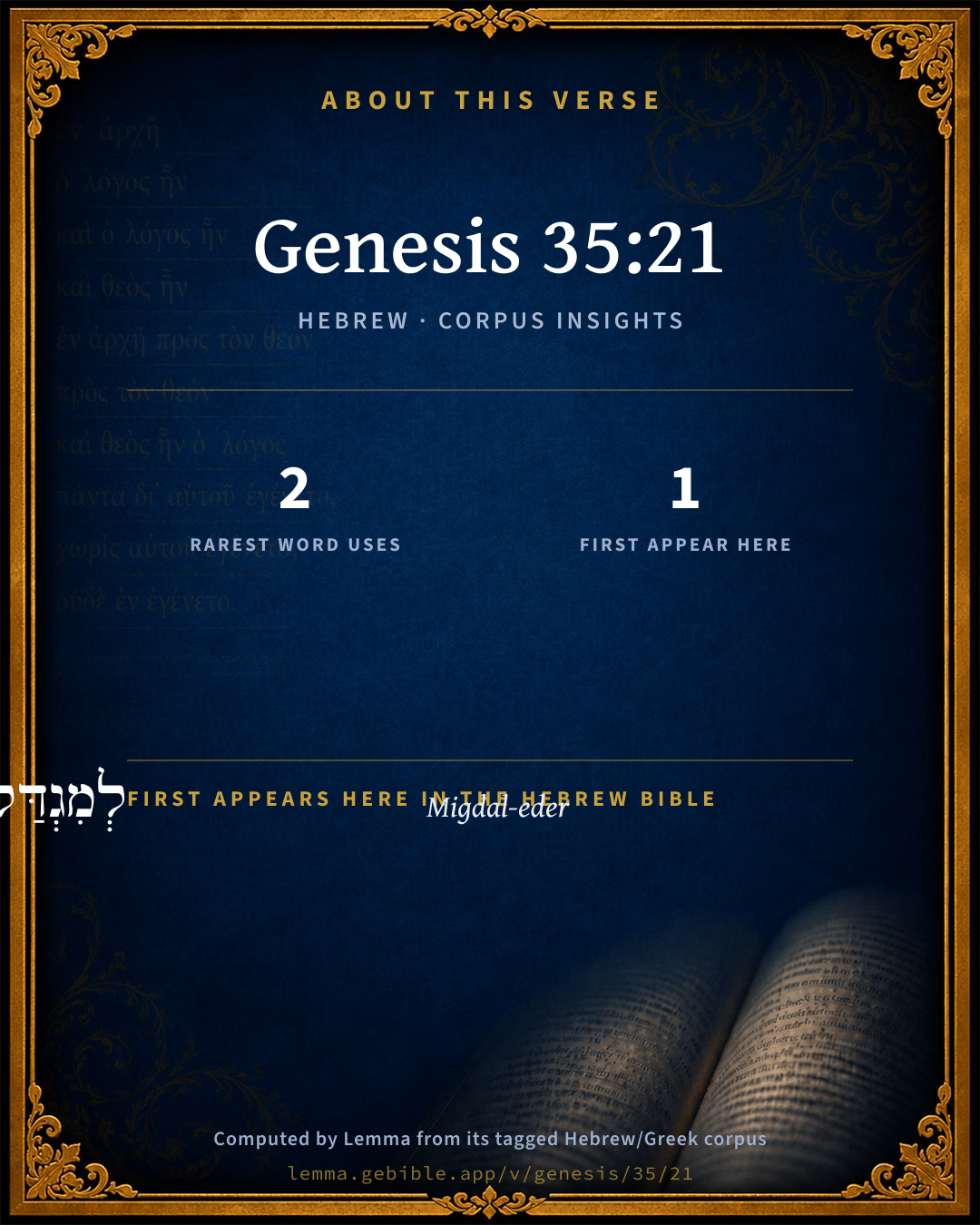
The rarest word here is לְמִגְדַּל Migdal-eder H4029 — appearing just 2 times in the whole Hebrew Bible.

First appearance in Scripture

This word makes its first canonical appearance in the Hebrew Bible here:

  • לְמִגְדַּל Migdal-eder H4029

Grammatical profile

  • 2 verbs
  • 4 nouns
  • 1 adverb

Verb forms

  • וַיִּסַּ֖ע Qal · Sequential Imperfect
  • וַיֵּ֣ט Qal · Sequential Imperfect

Repetition

A word recurs within this verse — often emphatic in Hebrew:

  • לְמִגְדַּל Migdal-eder H4029 ×2

Hebrew & Septuagint length

In English translation the verse runs 11 words from the Hebrew and 34 from the Septuagint (LXX English) — the Septuagint runs noticeably longer here. See the side-by-side →

A rough comparison of the two English renderings, which tokenize alike — not a word-level alignment.

Word counts can differ between the Hebrew and the Greek without any difference in meaning — e.g. the Hebrew direct-object marker אֵת has no separate Greek word, and Greek often adds the article ὁ.

Cross-references

2

Topical passages linked to Genesis 35:21 in the Treasury of Scripture Knowledge — connected by theme and wording, ordered by reader-vote popularity; previews shown in the World English Bible.

  • Micah 4:8 You, tower of the flock, the hill of the daughter of Zion, To you it will come, Yes, the former dominion will come, The kingdom of the daughter of Jerusalem.
  • Luke 2:8 There were shepherds in the same country staying in the field, and keeping watch by night over their flock.

Cross-references courtesy of OpenBible.info (CC BY 4.0).

Hebrew and Greek witnesses Masoretic Hebrew ↔ Greek Septuagint

The same verse in the two great witnesses to the Old Testament, shown verse-for-verse.

Here the Septuagint runs noticeably longer than the Hebrew — LXX2012 (modern English Septuagint) 34 words vs World English Bible 11. A rough length comparison of the two English translations, not a word-level alignment — read both below.

These are two independent witnesses, not word-aligned to each other, and the Septuagint is shown in lemma (dictionary) form.

Hebrew Genesis 35:21 Masoretic · Westminster Leningrad Codex

וַיִּסַּ֖ע יִשְׂרָאֵ֑ל וַיֵּ֣ט אָֽהֳלֹ֔ה מֵהָ֖לְאָה לְמִגְדַּל עֵֽדֶר

Israel traveled, and spread his tent beyond the tower of Eder.

World English Bible · Public Domain

Greek LXX Genesis 35:21 Septuagint · lemma form
And it came to pass when Israel lived in that land, that Ruben went and lay with Balla, the concubine of his father Jacob; and Israel heard, and the thing appeared grievous before him.

LXX2012 (modern English Septuagint) · Public Domain

On this verse, John Gill's Exposition discusses the Septuagint’s reading. Read the note in Commentary ↓

Hebrew: Westminster Leningrad Codex (CC BY 4.0). Greek: Septuagint (public domain); English from LXX2012 (modern English Septuagint) (Public Domain). How the Septuagint differs from the Hebrew →

Targum (Aramaic paraphrase)

2

The Targum is the ancient Jewish Aramaic paraphrase of the Hebrew Scriptures — an interpretive translation, not the Hebrew text itself. Onkelos (literal) and Pseudo-Jonathan (expansive) render the Torah, and Jonathan the Prophets. Coverage is partial: where no permissively-licensed English translation exists for a verse, only the Aramaic is shown. This is verse-level text, not a word-by-word alignment to the Hebrew.

  1. Targum Onkelos Torah (Genesis–Deuteronomy)
    וּנְטַל יִשְׂרָאֵל וּפְרַס מַשְׁכְּנֵהּ מִלְהַלָא לְמִגְדְלָא דְעֵדֶר

    (no public-domain English translation for this verse)

    Targum Onkelos — Aramaic: “Onkelos Genesis” (public domain); “Onkelos Exodus” (public domain); “Onkelos Leviticus” (public domain); “Onkelos Numbers” (public domain); “Onkelos Deuteronomy” (public domain). English: “Sefaria Community Translation” (CC0 1.0 (public-domain dedication)); “J.W. Etheridge. The Targums of Onkelos and Jonathan Ben Uzziel on the Pentateuch. London: Longmans, Green, 1862” (public domain). Text via Sefaria.

  2. Targum Pseudo-Jonathan Torah (Genesis–Deuteronomy)
    וּנְטַל יַעֲקב וּפְרַס לְמַשְׁכְּנֵיהּ מִן לְהַלָא לְמַגְדְלָא דְעֵדֶר אַתְרָא דְמִתַּמָן עָתִיד דְאִתְגְלֵי מַלְכָּא מְשִׁיחָא בְּסוֹף יוֹמַיָא

    And Jakob proceeded and spread his tent beyond the tower of Eder, the place from whence, it is to be, the King Meshiha will be revealed at the end of the days.

    Targum Pseudo-Jonathan — Aramaic: “Targum Jonathan on Genesis” (public domain); “Targum Jonathan on Exodus” (public domain); “Targum Jonathan on Leviticus” (public domain); “Targum Jonathan on Numbers” (public domain); “Targum Jonathan on Deuteronomy” (public domain). English: “The Targum of Jonathan ben Uzziel, trans. J. W. Etheridge, London, 1862” (public domain). Text via Sefaria.

Commentary

Notes on Genesis 35:21 from classic Christian and Jewish commentators (each source and its license shown beneath its notes). The classic Christian expositions comment on the surrounding passage and are grouped to its opening verse, so a note may address several verses; the Jewish commentaries on the Tanakh (Rashi and others) are per-verse, so they appear only where the commentator wrote on this verse.

Lemma curates 59 commentaries, every one of them public domain or Creative Commons licensed, each selected and text-cleaned for this edition rather than reprinted as found. About our sources →

Matthew Henry's Commentary

Here is, 1. Jacob's removal, Gen 35:21. He also, as his fathers, sojourned in the land of promise as in a strange country, and was not long in a place. Immediately after the story of Rachel's death he is here called Israel (Gen 35:21, Gen 35:22), and not often so afterwards: the Jews say, "The historian does him this honour here because he bore that affliction with such admirable patience and submission to Providence." Note, Those are Israel's indeed, princes with God, that support the government of their own passions. He that has this rule over his own spirit is better than the mighty. Israel, a prince with God, yet dwells in tents; the city is reserved for him in the other world. 2. The sin of Reuben. A piece of abominable wickedness it was that he was guilty of (Gen 35:22), that very sin which the apostle says (Co1 5:1) is not so much as named among the Gentiles, that one should have his father's wife. It is said to have been when Israel dwelt in that land; as if he were then absent from his family, which might be the unhappy occasion of these disorders. Though perhaps Bilhah was the greater criminal, and it is probable was abandoned by Jacob for it, yet Reuben's crime was so provoking that, for it, he lost his birthright and blessing, Gen 49:4. The first-born is not always the best, nor the most promising. This was Reuben's sin, but it was Jacob's affliction; and what a sore affliction it was is intimated in a little compass, and Israel heard it. No more is said - that is enough; he heard it with the utmost grief and shame, horror and displeasure. Reuben thought to conceal it, that his father should never hear of it; but those that promise themselves secresy in sin are generally disappointed; a bird of the air carries the voice. 3. A complete list of the sons of Jacob, now that Benjamin the youngest was born. This is the first time we have the names of these heads of the twelve tribes together; afterwards we find them very often spoken of and enumerated, even to the end of the Bible, Rev 7:4; Rev 21:12. 4. The visit which Jacob made to his father Isaac at Hebron. We may suppose he had visited him before since his return, for he sorely longed after his father's house; but never, till now, brought his family to settle with him, or near him, Gen 35:27. Probably he did this now upon the death of Rebekah, by which Isaac was left solitary, and not disposed to marry again. 5. The age and death of Isaac are here recorded, though it appears, by computation, that he died not till many years after Joseph was sold into Egypt, and much about the time that he was preferred there. Isaac, a mild quiet man, lived the longest of all the patriarches, for he was 180 years old; Abraham was but 175. Isaac lived about forty years after he had made his will, Gen 27:2. We shall not die an hour the sooner, but abundantly the better, for our timely setting our heart and house in order. Particular notice is taken of the amicable agreement of Esau and Jacob, in solemnizing their father's funeral (Gen 35:29), to show how wonderfully God had changed Esau's mind since he vowed his brother's murder immediately after his father's death, Gen 27:41. Note, God has many ways of preventing bad men from doing the mischief they intended; he can either tie their hands or turn their hearts.

Matthew Henry's Commentary on the Whole Bible (1708–1710) — public domain (CC PDM 1.0). Text via the HelloAO Bible API.

Trapp's Complete Commentary

John Trapp

Gen 35:21 And Israel journeyed, and spread his tent beyond the tower of Edar.

Ver. 22. Reuben went and lay with Bilhah.] A foul fault, in so good a family: but so it sometimes falls out, by the malice of Satan, for the discrediting of religion. Such ugly incest was committed at Corinth, as was hardly {a} "heard of among heathen, that a man should have his father’s wife." {1Co 5:1} Some such there were among the kings of Egypt; but not many. Ethelbald, king of West Saxons, with great infamy marrying his father’s widow Judith, enjoyed his kingdom but two years and a half. {b} But how hateful is that Spanish incest, by Papal dispensation! King Philip of Spain might call the Archduke Albert, both brother, cousin, nephew, and son: for all this was he unto him, either by blood or affinity; being uncle to himself, first cousin to his father, husband to his sister, and father to his wife. {c} Abhorred filth!

And Israel heard it.] And held his peace, because he saw God in it, chastising him for his polygamy. The punishment is sometimes so like the sin, that a man may boldly say, Such a sin was the mother of such a misery. And here is a pause in the Hebrew, to show Jacob’s great amazement at this sad tidings. Dolores ingentes stupent. He was even "dumb, and opened not his mouth, because God was in it." {Psa 39:9}

{a} Seleucus, Syriae rex, tradidit filio Antiocho novercam Stratonicen, cuius amore ille decumbebat. - Appian, in Syriacis.

{b} Dan., Chron., p. 12.

{c} Sandys’s Relation of West. Religion.

John Trapp, A Commentary or Exposition upon All the Books of the Old and New Testament (1647–1656) — public domain. Text from a community e-Sword module.

Joseph Benson's Commentary

Gen 35:21. Israel journeyed, and spread his tent — Though a prince with God, yet he dwells in tents; the city is reserved for him in the other world.

Joseph Benson's Commentary on the Old and New Testaments (1811–1818) — public domain. Text from a community e-Sword module.

Whedon's Commentary on the Bible

Daniel D. Whedon

REUBEN’S INCEST, Gen_35:21-22.

21. The tower of Edar — Or, Migdal-Edar, which means tower of the flock, so called, doubtless, from being a tower or eminence whence flocks at a distance could be watched. Comp. 2Ki_17:9; 2Ki_18:8; 2Ch_26:10.

Daniel D. Whedon (gen. ed.), Commentary on the Old and New Testaments (1874–1909) — public domain. Text from a community e-Sword module.

The Preacher's Complete Homiletical Commentary

Joseph S. Exell (gen. ed.)

CRITICAL NOTES.—

Gen_35:21. Tower of Edar.] Probably a watch-tower for the purpose of guarding the flocks. (2Ki_18:8; 2Ch_26:10; 2Ch_27:4.)

MAIN HOMILETICS OF THE PARAGRAPH.—Gen_35:21-26

JACOB’S TWELVE SONS

The number, twelve, of the sons of Jacob, in its typical significance. Twelve, the number of a life completed, or expanded to its full limits and development, Thus in the house of Ishmael and of Esau, but in a higher sense in the house of Israel. Hence the twelve sons are the types of the twelve tribes (Genesis 49; Deuteronomy 33), and the twelve tribes of the theocracy types of the twelve apostles of Christ, and these, again, types of the twelve fundamental forms of the New Testament Church. (Rev_21:12, etc.—(Lange).

The Preacher's Complete Homiletical Commentary (gen. ed. Joseph S. Exell; Funk & Wagnalls, c. 1892) — public domain (pre-1929). A full-Bible homiletical/sermon-outline anthology covering 65 of 66 books (2 John is absent from the source module). Text from a community e-Sword module.

Keil & Delitzsch

C. F. Keil & F. Delitzsch

Gen 35:21-22

Reuben's Incest. - As they travelled onward, Jacob pitched his tent on the other side of Migdal Eder, where Reuben committed incest with Bilhah, his father's concubine. It is merely alluded to her in the passing remark that Israel heard it, by way of preparation for Gen 49:4. Migdal Eder (flock-tower) was a watch-tower built for the protection of flocks against robbers (cf. Kg2 18:8; Ch2 26:10; Ch2 27:4) on the other side of Bethlehem, but hardly within 1000 paces of the town, where it has been placed by tradition since the time of Jerome. The piska in the middle of Gen 35:22 does not indicate a gap in the text, but the conclusion of a parashah, a division of the text of greater antiquity and greater correctness than the Masoretic division.

Gen 35:22-29

Jacob's Return to His Father's House, and Death of Isaac. - Jacob had left his father's house with no other possession than a staff, and now he returned with 12 sons. Thus had he been blessed by the faithful covenant God. To show this, the account of his arrival in his father's tent at Hebron is preceded by a list of his 12 sons, arranged according to their respective mothers; and this list is closed with the remark, "These are the sons of Jacob, which were born to him in Padan-Aram" (ילּד for ילּדוּ; Ges. 143, 1), although Benjamin, the twelfth, was not born in Padan-Aram, but on the journey back.

Keil & Delitzsch — Biblical Commentary on the Old Testament (1861–1891) — public domain (CC PDM 1.0). Text via the HelloAO Bible API. (Old Testament only.)

Lange's Commentary on the Holy Scriptures

EIGHTH SECTION

The station at the tower of Edar. Reuben’s crime. Jacob’s sons. His return to Isaac and Hebron (Rebekah no longer living). Isaac’s death. His burial by Esau and Jacob.

Gen_35:21-29

21And Israel journeyed, and spread his tent beyond the tower of Edar [flock]. 22And it came to pass, when Israel dwelt in that land, that Reuben went and lay with Bilhah his father’s concubine: and Israel heard it.6 Now the sons of Jacob were twelve: 23The sons of Leah; Reuben, Jacob’s first-born, and Simeon, and Levi, and Judah, and Issachar, and Zebulun: 24The sons of Rachel; Joseph, and Benjamin: 25And the sons of Bilhah, Rachel’s handmaid; Dan, and Naphtali: 26And the sons of Zilpah, Leah’s handmaid; Gad, and Asher. These are the sons of Jacob, which were born to him in Padan-aram [Mesopotamia].

27And Jacob came unto Isaac his father, unto Mamre, unto the city of Arbah (which is Hebron) where Abraham and Isaac sojourned. 28And the days of Isaac were an hundred and fourscore years. 29And Isaac gave up the ghost and died, and was gathered unto his people, being old and full of days; and his sons Esau and Jacob buried him.

EXEGETICAL AND CRITICAL

Gen_35:21-26.—Beyond the tower of Edar.—Had Rachel’s original burial taken place at Rama, we could not well have supposed that Jacob, who here, as Israel, rises above his grief for his loved wife, should have made his next station at Jerusalem. Moreover, the region immediately around Jerusalem was probably not suitable for a nomadic station. We adhere, however, to the tradition which fixes Rachel’s death north of Bethlehem, and the next station of Jacob, below Bethlehem, at the tower of Edar. The tower of the flock is a tower built for the protection of the flocks, and as their gathering place, in a region peculiarly fitted for pasturage (2Ki_18:8; 2Ch_26:10; 2Ch_27:4 f.). Jerome and the common tradition locate it south of Bethel, and not far from that place. From this tower Jacob could have easily and frequently visited his father Isaac, without prematurely mingling his household and possessions with the household economy at Hebron, which it is possible may yet have stood in strict relations with Esau. Such an absence might have favored Reuben’s criminal purpose and act.—Reuben went.—Bilhah was Rachel’s handmaid, not Leah’s; nevertheless, Reuben was guilty of incest; of a lustful deed of impiety, which occasioned his loss of the birthright (Gen_49:4). The characteristic weakness of Reuben, which appears in its praiseworthy aspect in other cases (see history of Joseph), here exposes him to the force of temptation.—And Israel heard it.—As if he was absent. Was he at Hebron, and does Reuben, as the temporary head of the household, assume special privileges to himself? Israel heard it, that he might reprove it in a suitable way, in his spiritual maturity, quiet, and dignity.—Now the sons of Jacob were twelve.—Jacob’s sons must also become sons of Israel through a divine discipline and training. They are, however, the rich blessing of the promise, with which he returns to his father, and are here enumerated by name after their several mothers, as if in presenting them to their grandfather. As a whole, they are said to have been born in Padan-aram; although this was not strictly true of Benjamin. We are thus prepared already, and introduced to Isaac’s point of view, for whom, it is true, Jacob brings all his sons from a strange land. Thus the exile Jacob returns home to his father Isaac, laden with the richest blessing of the promise. The dark days of this patriarch are followed by this joyful reappearance of the exile.

Gen_35:27-29.—Unto Mamre (see history of Abraham, above).—Isaac has thus changed his residence to Hebron during the absence of Jacob.—An hundred and fourscore years.—With the conclusion of the life of Isaac, the narrative hastens to the immediately following events (Genesis 37). Jacob was born in the sixtieth year of Isaac’s life (Gen_25:26), and was thus one hundred and twenty years old when Isaac died. But when he was presented to Pharaoh in Egypt, he was one hundred and thirty years old (Gen_47:9). Of this time there were seven fruitful and two unfruitful years since Joseph’s exaltation in Egypt (Gen_45:6), and thirteen years between the selling of Joseph and his exaltation, for he was sold when seventeen (Gen_37:2), and was thirty when he was raised to honor and power. Hence we must take twenty-three years from the one hundred and thirty years of Jacob, to determine his age at the time Joseph was sold; which is thus one hundred and seven. “Isaac, therefore, shared the grief of Jacob over the loss of his son for thirteen years.” In a similar way, Abraham had witnessed and sympathized with the long unfruitful marriage of Isaac. But Isaac could see in these sorrows of Jacob the hand of God, who will not allow that any one should anticipate him in a self-willed preference of a favorite son.—Old and full of days.—He recognized the close of his life-experiences and trials, and, like Abraham, departed in peace.—And Esau and Jacob buried him.—It is a beautiful, genuine historic feature, that Esau here precedes Jacob, while Isaac is mentioned before Ishmael at the burial of Abraham. Could we draw any inference from this, as to the external inheritance, the assertion of Keil, that Jacob heired the earthly goods of Isaac, is far too strong and confident. It is certain, indeed, that Esau received a considerable portion, and in external affairs merely he took a prominent part, to which the homage Jacob rendered him had given him an indirect claim. A certain degree of separation had already been made between the spiritual and earthly birthright. Isaac was buried in the cave of Machpelah (Gen_49:31).

DOCTRINAL AND ETHICAL

1. Jacob’s last station at the tower of Edar is also marked by a new heart-sorrow.

2. Reuben’s crime probably occasioned by his authority over the household during his father’s absence with Isaac at Hebron. The cause of his forfeiture of the right of the first-born (Genesis 49).

3. The number, twelve, of the sons of Jacob, in its typical significance. Twelve, the number of a life completed, or expanded to its full limits and development. Thus in the house of Ishmael and of Esau, but in a higher sense in the house of Israel. Hence the twelve sons are the types of the twelve tribes (Genesis 49; Deuteronomy 33), and the twelve tribes of the theocracy types of the twelve apostles of Christ, and these, again, types of the twelve fundamental forms of the New Testament Church (Rev_21:12 f.). That the number four is a factor of the number twelve, is here intimated by the four mothers; four is the number of the world, three the number of the sanctuary and of the spirit; and thus twelve is the number of a fulness or completeness, consecrated to God.

4. Jacob’s return to Isaac with his sons, the last ray of sunlight for the aged and blinded patriarch. This belonged to the complete satisfaction of the old man’s life, after which he could go to his people “full of days,” or satisfied. Thus Jacob’s soul was once more revived, when he saw the wagons sent by Joseph.

5. The brotherly union of Jacob and Esau at the burial of Isaac, a beautiful token of peace and reconciliation at his end. [“Esau and Jacob having shaken hands over the corpse of their father, their paths diverge to meet no more.” Delitzsch.—A. G.]

HOMILETICAL AND PRACTICAL

See Doctrinal paragraphs. Isaac’s long and patient waiting for Jacob’s return home, during the night of his blindness.—Light at the evening-time.—Isaac and Simeon (Luke 2).—Esau and Jacob, or the reconciling, peace-making efficacy of death and the grave.—Starke: Gen_35:22. (The Jewish Rabbis make this a small crime, and say Reuben overthrew the bed, when he saw that, after Rachel’s death, it was not borne into his mother Leah’s tent, but into that of Bilhah; because he inferred that Jacob loved Bilhah more than Leah).—Osiander: In the true Church also there arise at times great scandals.—Gerlach: Comp. 2Sa_16:22. Calwer Handbuch: Isaac reached the greatest age among the three patriarchs.—Schröder: Bilhah proved unfaithful; Reuben committed incest.—Jacob’s painful silence.—When he departed, nothing; when he returned, all (Drechsler).—Details as to the number twelve, also in regard to Jacob.—[Wordsworth: The record of these sins in the history is an evidence of the veracity of the historian. If it had been a human composition, designed to do honor to the Hebrew nation, assuredly it would have said little of these flagrant iniquities of Simeon, Levi, Dinah, and Reuben.—A. G.]

Footnotes:

[6][Gen_35:22.—The break in the MS. here, and the Masoretic note, “that there is a hiatus in the middle of the verse,” suits the sense better than the division into verses. It may have been, as Wordsworth suggests, designed to express the unutterable feelings of Jacob when he heard of this horrible act of his eldest son.—A. G.]

Lange's Commentary on the Holy Scriptures (Critical, Doctrinal, and Homiletical), ed. John Peter Lange, English translation edited by Philip Schaff (1864–1880) — public domain. Text from a community e-Sword module.

Adam Clarke's Commentary

Verse 21. Tower of Edar.] Literally, the tower of the flock, and so translated Mic 4:8. It is supposed that this tower was about a mile from Bethlehem, and to have been the place where the angels appeared to the shepherds. The Targum of Jonathan expressly says: "It is the place in which the King Messiah shall be manifested in the end of days." By the tower of the flock we may understand a place built by the shepherds near to some well, for the convenience of watering their flocks, and keeping watch over them by night.

Adam Clarke's Commentary on the Bible (1810–1826) — public domain. Text from a community e-Sword/MySword module.

Ellicott's Commentary for English Readers

(21) The tower of Edar.—Heb., Eder. Micah (Gen_4:8) calls it “the hill of the daughter of Zion;” but the word used often means a beacon-hill, a hill on which a tower for observation is erected, wrongly translated in the Authorised Version a stronghold. The tower may, therefore, have been a few miles south of Jerusalem; and as the word “beyond” includes the idea of up to, as far as, the meaning is that Jacob now occupied this region permanently with his cattle. Until Esau, with his possessions, withdrew to Seir, there would be no room for Jacob and his flocks and herds at Hebron, but he would at Eder be so near his father as to be able often to visit him. And thus his exile was now over, and he was at last at home.

A Bible Commentary for English Readers, edited by Charles John Ellicott (1878–1897) — public domain. Text from a community e-Sword module.

The Cambridge Bible for Schools and Colleges

gen. ed. J. J. S. Perowne

21. Israel] Observe the employment of the new name as an alternative for Jacob, with especial frequency in the J narrative.

the tower of Eder] i.e. “the tower of the flock.” It is uncertain whether “Eder” is a proper name or not. For a similar uncertainty, cf. Gen_33:18. The place is evidently situated between Ephrath (Gen_35:19) and Hebron (Gen_37:14). The identification of Eder with Jerusalem on the strength of Mic_4:8 (“O tower of the flock [or, “Eder”], the hill of the daughter of Sion”) is improbable.

22a. Reuben] The incest of Reuben is alluded to in Gen_49:3-4. The Compiler abbreviates what must have been a repulsive tradition. But, as in ch. 34, the tradition may possibly contain, in figurative language, some reminiscence of early tribal relations. Very little is known of the tribe of Reuben; but in Numbers 16 the tribe of Reuben endeavours to displace Moses on the strength of its primogeniture: and in Jos_15:6, “the stone of Bohan son of Reuben,” in the heart of Canaan, may contain the reminiscence of some early unrecorded tribal encroachment.

Israel heard of it] As in Gen_34:30-31, the tradition breaks off abruptly.

The Cambridge Bible for Schools and Colleges (gen. ed. J. J. S. Perowne; Cambridge University Press, 1878–1918) — public domain. Text from a community e-Sword module.

John Gill's Exposition

And it came to pass, when Israel dwelt in that land,.... In that part of it near Bethlehem:

that Reuben went and lay with Bilhah his father's concubine; his concubine wife; she was the maid that Rachel gave him, and this added to his affliction, and made it double, to lose Rachel by death, and to have her favourite maid, his concubine, defiled by his own son, and whom it is highly probable he abstained from hereafter. This, though a very heinous sin of his son's, yet might be suffered as a chastisement to Jacob, for making use of concubines:

and Israel heard it; though the crime was committed secretly, and was thought it would have been concealed, but by some means or other Jacob heard of it, and no doubt severely reproved his son for it; and though nothing is here related, as said by him on this occasion, it is certain it gave him great offence, grief and trouble, and he remembered it to his dying day, and took away the birthright from Reuben on account of it, Gen 49:3; an empty space here follows in the original text, and a pause in it, denoting perhaps the amazement Jacob was filled with when he heard it; and the great grief of his heart, which was such, that he was not able to speak a word; the Septuagint version fills up the space by adding, "and it appeared evil in his sight":

now the sons of Jacob were twelve; who were the heads of twelve tribes, Benjamin the last being born, and Jacob having afterwards no more children, they were all reckoned up under their respective mothers, excepting Dinah, a daughter, from whom there was no tribe, in the following verses.

John Gill's Exposition of the Whole Bible (1746–1763) — public domain (CC PDM 1.0). Text via the HelloAO Bible API.

Haydock's Catholic Bible Commentary

Tower. Hebrew, Heder, about a mile to the east of Bethlehem, where the angels appeared to announce the birth of Christ. St. Helen built a temple there in honour of the angels. (Tirinus) --- Shepherds had such places to keep watch. (Calmet) --- There was a tower of this name near Jerusalem. (Micheas iv. 8; St. Jerome, q. His.)

George Leo Haydock (1774–1849), Haydock's Catholic Family Bible and Commentary, 1859 edition — public domain. Excludes Psalms (Douay-Rheims chapter numbering differs from Protestant) and Deuterocanonical books (Catholic canon only).

Matthew Poole's English Annotations

Or, the tower of the flock; a place where were excellent pastures. See Mic 4:8.

Matthew Poole's English Annotations on the Holy Bible (1683–1685) — public domain. Text from a community e-Sword/MySword module.

The Pulpit Commentary

And Israel (or Jacob) journeyed (from Ephrath, after the funeral of Rachel), and spreadi.e. unfolded (Gen_12:8 Gen_26:25) his tent beyond the tower of Edar literally, to, i.e. not trans (Vulgate), ultra (Dathe), but ad, usque (Rosenm as far as Migdol Edar, the Tower of the Flock probably a turret, or watch-tower, erected for the convenience of shepherds in guarding their flocks (2Ki_18:8; 2Ch_26:10 2Ch_27:4) the site of which is uncertain, but which is commonly supposed to have Been a mile (Jerome) or more south of Bethlehem." The LXX omit this verse.

The Pulpit Commentary (1880–1919), ed. H.D.M. Spence-Jones & Joseph S. Exell — public domain. Text from a community e-Sword module.

John Wesley's Explanatory Notes

Israel, a prince with God, yet dwells in tents; the city is reserved for him in the other world.

John Wesley, Explanatory Notes Upon the Whole Bible (1754–1765) — public domain. Text via the GEBible commentary corpus.

unfoldingWord translationNotes

Door43 World Missions Community

Israel traveled on

It is implied that Israel's family and servants are with him. The full meaning of this information can be made explicit. (See: Assumed Knowledge and Implicit Information)

Bilhah

This is the name of Rachel's female servant. See how you translated this name in Genesis 29:29. (See: How to Translate Names)

Now Jacob had twelve sons

This sentence begins a new paragraph, which continues into the following verses.

twelve sons

"12 sons" (See: Numbers)

translationWords

Jacob

tent

Reuben

had relations with

concubine

unfoldingWord translationNotes — © Distant Shores Media and the Door43 World Missions Community, licensed CC BY-SA 4.0. Source: git.door43.org/Door43/en_tn.

Radak

Rabbi David Kimhi (Radak)

ויסע, on his way to his father’s house.

Radak on the Tanakh — English translations: “Sefaria Community Translation” (CC0 1.0 (public-domain dedication)); “Eliyahu Munk, HaChut Hameshulash” (CC BY 4.0); “Rabbi Mike Feuer, Jerusalem Anthology” (CC BY 4.0); and “R. David Kimhi on the first book of Psalms, Translated by R.G. Finch, London, 1919” (public domain). Text via Sefaria.

Lesson kit

Teaching starters — assembled from the data on this page, not authored interpretation. Every prompt links to the verse data it draws on. Edit before teaching.

Genesis, in the Pentateuch, opens this verse with 7 words (6 distinct Hebrew lemmas). Its most distinctive word is Migdal-ʻÊder (“Migdal-eder”). The Greek Septuagint runs longer here. A historical commentator’s framing appears above. Read the whole chapter for the surrounding context.

Discussion questions

  1. How does “Migdal-eder” (Migdal-ʻÊder) shape what this verse is saying?
  2. This is the first place “Migdal-eder” appears in Scripture (first appears here). What does its debut here establish?
  3. How does Micah 4:8, which shares this passage’s theme, read alongside this verse?
  4. What does the repetition of “Migdal-eder” (2× in this one verse) do in this verse?
  5. The Septuagint runs longer here than the Hebrew. What might account for the difference?
  6. These translations render this verse differently; the difference is in the English rendering, not the original. What questions does that raise?
  7. «וַיִּסַּ֖ע» is a Qal Sequential Imperfect verb. How does that grammatical form shape the action described?
  8. Compare how Matthew Henry's Commentary and Trapp's Complete Commentary read this verse. Where do they agree or differ?

Things to notice

  • 1 word makes its first canonical appearance in Scripture here.
  • These translations choose different wording for 12 words in this verse.
  • “Migdal-eder” occurs 2× in this single verse.
  • 6 distinct Hebrew lemmas span 7 words in this verse.

Reading settings

Reading text

Shown beneath each verse's original-language words.

Old Testament
Old Testament edition

Read the OT as the Masoretic Hebrew (MT) or the Greek Septuagint (LXX).

English shown for the Greek Septuagint (in the Hebrew ↔ Greek comparison).

Comparing translations? Open the Compare panel on any verse page to stack up to four side by side.