
Numbers 8:26

Hebrew (Westminster Leningrad Codex) Numbers 8:26 appears in the Hebrew Old Testament. The text above is from the Westminster Leningrad Codex. Each word links to its Strong’s number, a concise gloss, and parsing drawn from the Open Scriptures Hebrew Bible morphology. Click any word for its full Brown-Driver-Briggs (BDB) entry.
Download image
Cite this verse

Numbers 8:26 (World English Bible). Public Domain. Lemma interlinear Bible study tool, https://lemma.gebible.app/v/numbers/8/26.

Show BibTeX & RIS
BibTeX
RIS
English Translation
but shall minister with their brothers in the Tent of Meeting, to keep the charge, and shall do no service. Thus shall you do to the Levites concerning their duties."
World English Bible · Public Domain
Download a study sheet

One document with this verse’s original text, its word-by-word gloss line, the meaning frame, cross-references with their text, attributed commentary, and full source and license credits — printable, and it pastes into notes with its structure intact.

This verse Autodidact and up

Study sheet (.html) Plain text (.txt)

A passage Seminary Student

Up to 50 verses in one chapter. A passage sheet keeps up to 6 commentary sources and 12 cross-references per verse, in the order this page ranks them, and says so on the sheet whenever that leaves anything out. Ask for a single verse and you get the Autodidact verse sheet above.

Everything on this page stays free to read, with no account — the sheet is a download of what is already on screen, not access to it.

Want to remove ads? Support Godless Engineer
Compare translations 3

The same verse in 3 English versions, stacked beneath the original-language interlinear above. Click any original word for its lexicon entry.

Each is an independent rendering of the whole verse — the interlinear is not word-aligned to these translations.

Highlighted words mark where these versions differ — a whole-verse word diff, not a word-by-word alignment.

  • World English Bible Public Domain
    but shall minister with their brothers in the Tent of Meeting, to keep the charge, and shall do no service. Thus shall you do to the Levites concerning their duties."
  • King James Version Public Domain
    But shall minister with their brethren in the tabernacle of the congregation, to keep the charge, and shall do no service. Thus shalt thou do unto the Levites touching their charge.
  • unfoldingWord Literal Text CC BY-SA 4.0
    And he shall minister to his brothers in the tent of meeting to keep keeping, but he shall not serve service. Thus you shall do for the Levites in their keepings.”

unfoldingWord Literal Text — © unfoldingWord, licensed CC BY-SA 4.0. Word-aligned USFM3 via Door43 (git.door43.org/unfoldingWord/en_ult).

Versions to compare (up to 4)

3 of 4 selected

Show all 18 translations

Every available English version of this verse, each an independent rendering of the whole verse.

  • World English Bible Public Domain
    but shall minister with their brothers in the Tent of Meeting, to keep the charge, and shall do no service. Thus shall you do to the Levites concerning their duties."
  • Berean Standard Bible Public Domain
    After that, they may assist their brothers in fulfilling their duties at the Tent of Meeting, but they themselves are not to do the work. This is how you are to assign responsibilities to the Levites.”
  • Majority Standard Bible Public Domain
    After that, they may assist their brothers in fulfilling their duties at the Tent of Meeting, but they themselves are not to do the work. This is how you are to assign responsibilities to the Levites.”
  • King James Version Public Domain
    But shall minister with their brethren in the tabernacle of the congregation, to keep the charge, and shall do no service. Thus shalt thou do unto the Levites touching their charge.
  • American Standard Version (1901) Public Domain
    but shall minister with their brethren in the tent of meeting, to keep the charge, and shall do no service. Thus shalt thou do unto the Levites touching their charges.
  • Revised Version (1885) Public Domain
    but shall minister with their brethren in the tent of meeting, to keep the charge, and shall do no service. Thus shalt thou do unto the Levites touching their charges.
  • Geneva Bible (1599) Public Domain
    But they shall minister with their brethre in the Tabernacle of the Congregation, to keepe things committed to their charge, but they shall doe no seruice: thus shalt thou doe vnto the Leuites touching their charges.
  • Douay-Rheims (1899) Public Domain
    And they shall be the ministers of their brethren in the tabernacle of the covenant, to keep the things that are committed to their care, but not to do the works. Thus shalt thou order the Levites touching their charge.
  • Young's Literal Translation Public Domain
    and he hath ministered with his brethren in the tent of meeting, to keep the charge, and doth not do service; thus thou dost to the Levites concerning their charge.'
  • Literal Standard Version CC BY-SA 4.0
    and he has ministered with his brothers in the Tent of Meeting, to keep the charge, and does not do service; thus you do to the Levites concerning their charge.”
  • Unlocked Literal Bible CC BY-SA 4.0
    They may help their brothers who continue to work at the tent of meeting, but they must serve no more. You must direct the Levites in all these matters.”
  • unfoldingWord Literal Text CC BY-SA 4.0
    And he shall minister to his brothers in the tent of meeting to keep keeping, but he shall not serve service. Thus you shall do for the Levites in their keepings.”
  • Darby Bible Public Domain
    but he shall minister with his brethren in the tent of meeting, and keep the charge, but he shall not serve [in] the service. Thus shalt thou do unto the Levites with regard to their charges.
  • World Messianic Bible Public Domain
    but shall assist their brothers in the Tent of Meeting, to perform the duty, and shall perform no service. This is how you shall have the Levites do their duties.”
  • Webster's Bible Public Domain
    But shall minister with their brethren in the tabernacle of the congregation, to keep the charge, and shall do no service. Thus shalt thou do to the Levites concerning their charge.
  • Free Bible Version CC BY-SA 4.0
    They can still help their fellow Levites in their assignments, but they are not to do the actual work themselves. These are the arrangements in the case of the Levites.”
  • Bible in Basic English Public Domain
    But be with their brothers in the Tent of meeting, taking care of it but doing no work. This is what you are to do in connection with the Levites and their work.
  • JPS Tanakh (1917) Public Domain
    but shall minister with their brethren in the tent of meeting, to keep the charge, but they shall do no manner of service. Thus shalt thou do unto the Levites touching their charges.'

Literal Standard Version (2020), Covenant Press — licensed CC BY-SA 4.0. Text via the HelloAO Bible API (eBible.org). Unlocked Literal Bible (unfoldingWord) — licensed CC BY-SA 4.0. Text via the HelloAO Bible API (eBible.org). unfoldingWord Literal Text — © unfoldingWord, licensed CC BY-SA 4.0. Word-aligned USFM3 via Door43 (git.door43.org/unfoldingWord/en_ult). Free Bible Version, Dr. Jonathan Gallagher — licensed CC BY-SA 4.0. Text via the HelloAO Bible API (eBible.org).

Word by word

More ways to search: Search by grammar → Find every occurrence → Compare this word →

Practice this passage: Drill this verse → Learn its vocabulary →

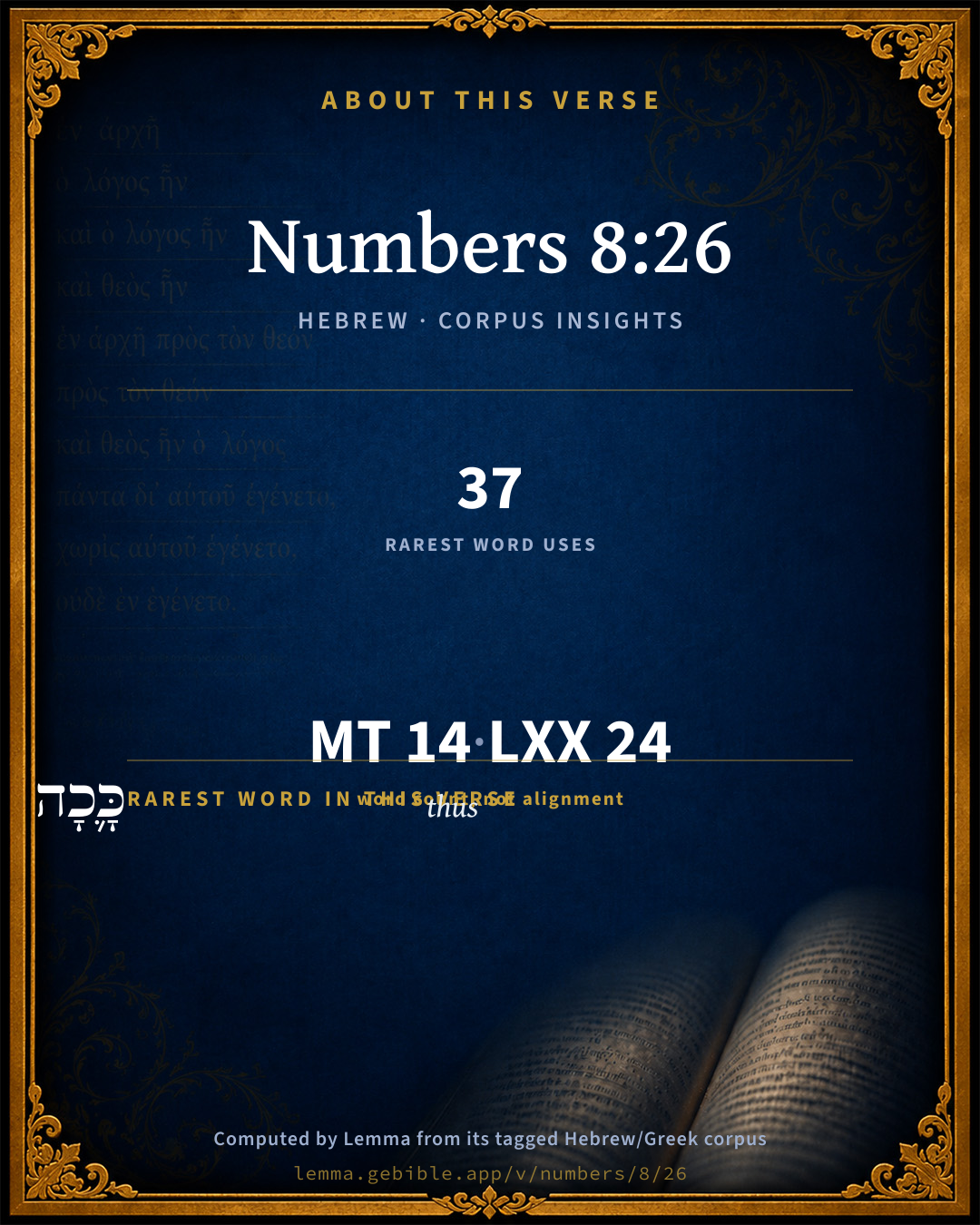
כָּ֛כָה
kâkâh
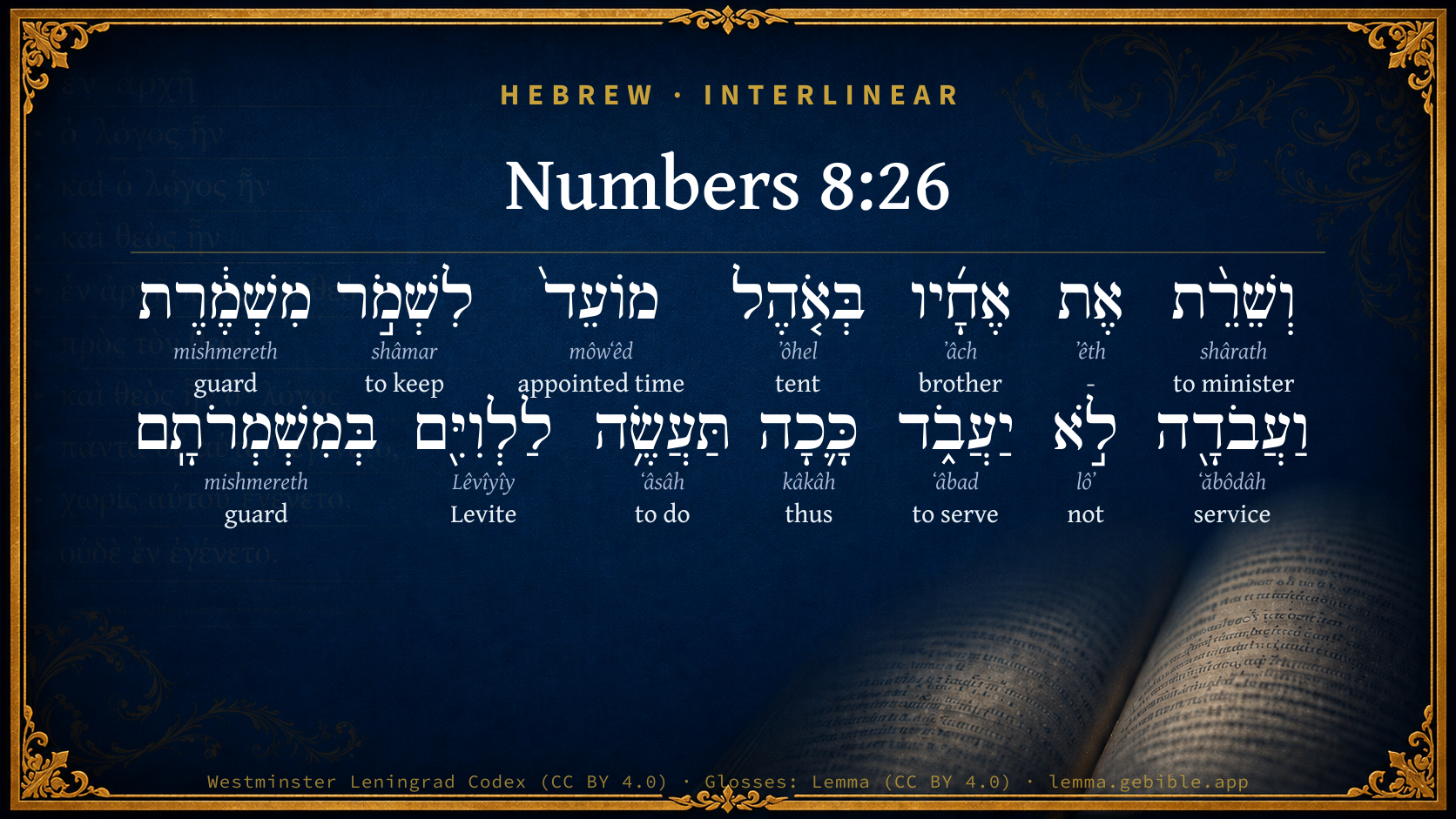
  1. וְשֵׁרֵ֨ת shârath H8334 “and · to minister” Conjunction + Verb, Piel, Sequential Perfect, 3rd Person, Masculine, Singular
  2. אֶת ʼêth H853 “-” Particle, Direct Object
  3. אֶחָ֜יו ʼâch H251 “brothers · his” Noun, Common, Masculine, Plural, Construct + Suffix, Personal, 3rd Person, Masculine, Singular
  4. בְּאֹ֤הֶל ʼôhel H168 “in/at · tent of” Preposition + Noun, Common, Masculine, Singular, Construct
  5. מוֹעֵד֙ môwʻêd H4150 “appointed time” Noun, Common, Masculine, Singular, Absolute
  6. לִשְׁמֹ֣ר shâmar H8104 “to keep” Preposition + Verb, Qal, Infinitive Construct
  7. מִשְׁמֶ֔רֶת mishmereth H4931 “guard” Noun, Common, Feminine, Singular, Absolute
  8. וַעֲבֹדָ֖ה ʻăbôdâh H5656 “and · service” Conjunction + Noun, Common, Feminine, Singular, Absolute
  9. לֹ֣א lôʼ H3808 “not” Particle, Negative
  10. יַעֲבֹ֑ד ʻâbad H5647 “to serve” Verb, Qal, Imperfect, 3rd Person, Masculine, Singular
  11. תַּעֲשֶׂ֥ה ʻâsâh H6213 “to do” Verb, Qal, Imperfect, 2nd Person, Masculine, Singular
  12. לַלְוִיִּ֖ם Lêvîyîy H3881 “to/for the · Levites” Preposition, Determined + Noun, Gentilic, Masculine, Plural, Absolute
  13. בְּמִשְׁמְרֹתָֽם mishmereth H4931 “in/at · guards · their” Preposition + Noun, Common, Feminine, Plural, Construct + Suffix, Personal, 3rd Person, Masculine, Plural

About this verse

These counts appear in no published source. They are computed here, from the morphology-tagged text and Lemma’s own curated glosses. What Lemma adds →

14
words
13
distinct lemmas
Pentateuch
section

Shared distinctive vocabulary

כָּ֛כָה thus H3602 occurs in 35 verses of the Hebrew Bible. Also found in:

Grammatical profile

  • 4 verbs
  • 7 nouns
  • 1 adverb
  • 2 particles

Verb forms

  • וְשֵׁרֵ֨ת Piel · Sequential Perfect
  • לִשְׁמֹ֣ר Qal · Infinitive Construct
  • יַעֲבֹ֑ד Qal · Imperfect
  • תַּעֲשֶׂ֥ה Qal · Imperfect

Repetition

A word recurs within this verse — often emphatic in Hebrew:

  • מִשְׁמֶ֔רֶת guard H4931 ×2

Hebrew & Septuagint length

In English translation the verse runs 30 words from the Hebrew and 29 from the Septuagint (LXX English) — closely comparable.

A rough comparison of the two English renderings, which tokenize alike — not a word-level alignment.

Word counts can differ between the Hebrew and the Greek without any difference in meaning — e.g. the Hebrew direct-object marker אֵת has no separate Greek word, and Greek often adds the article ὁ.

In the original languages it is 14 Hebrew tokens and 24 Greek tokens — but the two are counted differently (Hebrew bundles its prefixes and suffixes into one token; the Greek is in lemma form), so that isn’t a like-for-like length.

Cross-references

9

Topical passages linked to Numbers 8:26 in the Treasury of Scripture Knowledge — connected by theme and wording, ordered by reader-vote popularity; previews shown in the World English Bible.

  • Numbers 1:53 But the Levites shall encamp around the Tabernacle of the Testimony, that there may be no wrath on the congregation of the children of Israel: and the Levites shall be responsible for the Tabernacle of the Testimony."
  • Numbers 3:32 Eleazar the son of Aaron the priest shall be prince of the princes of the Levites, with the oversight of those who keep the charge of the sanctuary.
  • Numbers 18:4 They shall be joined to you, and keep the charge of the tent of meeting, for all the service of the Tent: and a stranger shall not come near to you.
  • Numbers 31:30 Of the children of Israel's half, you shall take one drawn out of every fifty, of the persons, of the oxen, of the donkeys, and of the flocks, [even] of all the cattle, and give them to the Levites, who keep the charge of the tent of Yahweh.
  • 1 Chronicles 23:32 and that they should keep the charge of the tent of meeting, and the charge of the holy place, and the charge of the sons of Aaron their brothers, for the service of the house of Yahweh.
  • 1 Chronicles 26:20–29 Of the Levites, Ahijah was over the treasures of the house of God, and over the treasures of the dedicated things.
  • Ezekiel 44:8 You have not kept the charge of my holy things; but you have set keepers of my charge in my sanctuary for yourselves.
  • Ezekiel 44:11 Yet they shall be ministers in my sanctuary, having oversight at the gates of the house, and ministering in the house: they shall kill the burnt offering and the sacrifice for the people, and they shall stand before them to minister to them.
  • 1 Timothy 4:15 Be diligent in these things. Give yourself wholly to them, that your progress may be revealed to all.

Cross-references courtesy of OpenBible.info (CC BY 4.0).

Hebrew and Greek witnesses Masoretic Hebrew ↔ Greek Septuagint

The same verse in the two great witnesses to the Old Testament, shown verse-for-verse.

These are two independent witnesses, not word-aligned to each other, and the Septuagint is shown in lemma (dictionary) form.

Hebrew Numbers 8:26 Masoretic · Westminster Leningrad Codex

וְשֵׁרֵ֨ת אֶת אֶחָ֜יו בְּאֹ֤הֶל מוֹעֵד֙ לִשְׁמֹ֣ר מִשְׁמֶ֔רֶת וַעֲבֹדָ֖ה לֹ֣א יַעֲבֹ֑ד כָּ֛כָה תַּעֲשֶׂ֥ה לַלְוִיִּ֖ם בְּמִשְׁמְרֹתָֽם

but shall minister with their brothers in the Tent of Meeting, to keep the charge, and shall do no service. Thus shall you do to the Levites concerning their duties."

World English Bible · Public Domain

Greek LXX Numbers 8:26 Septuagint · lemma form

καί λειτουργέω ὁ ἀδελφός αὐτός ἐν ὁ σκηνή ὁ μαρτύριον φυλάσσω φυλακή ἔργον δέ οὐ ἐργάζομαι οὕτως ποιέω ὁ λευίτης ἐν ὁ φυλακή αὐτός

And his brother shall serve in the tabernacle of witness to keep charges, but he shall not do works: so shall you do to the Levites in their charges.

LXX2012 (modern English Septuagint) · Public Domain

Hebrew: Westminster Leningrad Codex (CC BY 4.0). Greek: Septuagint (public domain); English from LXX2012 (modern English Septuagint) (Public Domain). How the Septuagint differs from the Hebrew →

Targum (Aramaic paraphrase)

2

The Targum is the ancient Jewish Aramaic paraphrase of the Hebrew Scriptures — an interpretive translation, not the Hebrew text itself. Onkelos (literal) and Pseudo-Jonathan (expansive) render the Torah, and Jonathan the Prophets. Coverage is partial: where no permissively-licensed English translation exists for a verse, only the Aramaic is shown. This is verse-level text, not a word-by-word alignment to the Hebrew.

  1. Targum Onkelos Torah (Genesis–Deuteronomy)
    וִישַׁמֵשׁ עִם אֲחוֹהִי בְּמַשְׁכַּן זִמְנָא לְמִטַּר מַטָרָא וּפוּלְחָנָא לָא יִפְלָח כְּדֵין תַּעֲבֵיד לְלֵוָאֵי בְּמַטְרַתְהוֹן

    (no public-domain English translation for this verse)

    Targum Onkelos — Aramaic: “Onkelos Genesis” (public domain); “Onkelos Exodus” (public domain); “Onkelos Leviticus” (public domain); “Onkelos Numbers” (public domain); “Onkelos Deuteronomy” (public domain). English: “Sefaria Community Translation” (CC0 1.0 (public-domain dedication)); “J.W. Etheridge. The Targums of Onkelos and Jonathan Ben Uzziel on the Pentateuch. London: Longmans, Green, 1862” (public domain). Text via Sefaria.

  2. Targum Pseudo-Jonathan Torah (Genesis–Deuteronomy)
    וִישַׁמֵשׁ עִם אָחוֹי בְּמַשְׁכַּן זִמְנָא לְמִטַר מַטְרָא וּפוּלְחָנָא לָא יִפְלַח הֵיכְדֵין תַּעֲבֵיד לְלֵיוָאֵי בְּמַטְרַתְהוֹן

    Yet he may minister with his brethren at the tabernacle of ordinance in keeping the watch; but he shall not do any of the service. So shall the Levites act in their charge.

    Targum Pseudo-Jonathan — Aramaic: “Targum Jonathan on Genesis” (public domain); “Targum Jonathan on Exodus” (public domain); “Targum Jonathan on Leviticus” (public domain); “Targum Jonathan on Numbers” (public domain); “Targum Jonathan on Deuteronomy” (public domain). English: “The Targum of Jonathan ben Uzziel, trans. J. W. Etheridge, London, 1862” (public domain). Text via Sefaria.

Commentary

Notes on Numbers 8:26 from classic Christian and Jewish commentators (each source and its license shown beneath its notes). The classic Christian expositions comment on the surrounding passage and are grouped to its opening verse, so a note may address several verses; the Jewish commentaries on the Tanakh (Rashi and others) are per-verse, so they appear only where the commentator wrote on this verse.

Lemma curates 59 commentaries, every one of them public domain or Creative Commons licensed, each selected and text-cleaned for this edition rather than reprinted as found. About our sources →

Geneva Bible (1599)

Geneva Bible translators

In singing Psalms, instructing, counseling and keeping the things in order.

Geneva Bible (1599) marginal notes — public domain. Text via Bolls.life.

Jamieson, Fausset & Brown

Robert Jamieson, A. R. Fausset & David Brown

But shall minister with their brethren--in the performance of easier and higher duties, instructing and directing the young, or superintending important trusts. "They also serve who only wait" [MILTON].

Next: Numbers Chapter 9

Jamieson, Fausset & Brown — Commentary Critical and Explanatory on the Whole Bible (1871) — public domain (CC PDM 1.0). Text via the HelloAO Bible API.

Adam Clarke's Commentary

Verse 26. To keep the charge, and shall do no service.] They shall no longer be obliged to perform any laborious service, but act as general directors and counsellors; therefore they were to be near the camp, sing praises to God, and see that no stranger or unclean person was permitted to enter. So the Jews and many other persons have understood this place.

1. IF it required so much legal purity to fit the Levites for their work in the tabernacle, can we suppose that it requires less spiritual purity to fit ministers of the Gospel to proclaim the righteousness of the Most High, and administer the sacred ordinances of Christianity to the flock of Christ? If these must be without spot, as the priests before without blemish, and these were only typical men, we may rest assured that a Christian minister requires no ordinary measures of holiness to prepare him for an acceptable and profitable discharge of his office.

2. If the Christian ministry be established to prepare men for the kingdom of God, of the holiness of which the purity of the camp was but a faint emblem, how can any man expect to enter that place of blessedness, who has not his heart sprinkled from an evil conscience, and his body washed with pure water; his life and conversation agreeable to the sacred precepts laid down in the Gospel of Christ? If the law of Moses were more read in reference to the Gospel, the Gospel itself and its requisitions would be much better understood.

Reader, however it may be with thee, Antinomianism is more general among religious people than is usually imagined. What multitudes of all denominations are expecting to enter into the kingdom of God without any proper preparation for the place! Without holiness none shall see the Lord; and from this decision of the Divine justice there shall never be any appeal.

Adam Clarke's Commentary on the Bible (1810–1826) — public domain. Text from a community e-Sword/MySword module.

Ellicott's Commentary for English Readers

(26) To keep the charge.—A clear distinction is here made between the service which involved heavy manual labour in carrying the furniture of the Tabernacle and in slaughtering the victims, and the charge or oversight of the furniture and the vessels of the Sanctuary.

A Bible Commentary for English Readers, edited by Charles John Ellicott (1878–1897) — public domain. Text from a community e-Sword module.

The Cambridge Bible for Schools and Colleges

gen. ed. J. J. S. Perowne

26. shall do no service] i.e. no necessary responsible service. They may assist their younger fellow-Levites as voluntary helpers.

their charges] their functions; the duties committed to their charge.

The Cambridge Bible for Schools and Colleges (gen. ed. J. J. S. Perowne; Cambridge University Press, 1878–1918) — public domain. Text from a community e-Sword module.

Haydock's Catholic Bible Commentary

Ministers. Hebrew, "to watch over," (Calmet) direct, and "train up their brethren," Samaritan. (Grotius)

George Leo Haydock (1774–1849), Haydock's Catholic Family Bible and Commentary, 1859 edition — public domain. Excludes Psalms (Douay-Rheims chapter numbering differs from Protestant) and Deuterocanonical books (Catholic canon only).

Matthew Poole's English Annotations

With their brethren, by way of advice, and assistance in lesser and easier works.

Matthew Poole's English Annotations on the Holy Bible (1683–1685) — public domain. Text from a community e-Sword/MySword module.

The Pulpit Commentary

Shall minister... to keep the charge, and shall do no service. The word "charge" (Hebrew, mishmereth) seems to signify the care of the furniture and belongings of the tabernacle, while "service" means the laborious work of transport, or of preparing sacrifice. The duties of the Levite over fifty were in fact honorary, given to him probably for his own sake, that he might have some place and post in the house of God. This careful provision for those who should attain the age of fifty shows that the commandment was designed for the promised land rather than for the wilderness.

The Pulpit Commentary (1880–1919), ed. H.D.M. Spence-Jones & Joseph S. Exell — public domain. Text from a community e-Sword module.

John Wesley's Explanatory Notes

In the tabernacle - By way of advice, and assistance in lesser and easier works.

John Wesley, Explanatory Notes Upon the Whole Bible (1754–1765) — public domain. Text via the GEBible commentary corpus.

Rashi

Rabbi Shlomo Yitzchaki (Rashi)

לשמר משמרת TO KEEP THE CHARGE — i.e. to encamp round about the tent of meeting in order to keep strangers away, and to erect and dismantle it at the time of finishing and beginning the journey.

Rashi on the Tanakh — English translations: “The Judaica Press complete Tanach with Rashi, translated by A. J. Rosenberg” (CC BY 4.0); “Pentateuch with Rashi's commentary by M. Rosenbaum and A.M. Silbermann, 1929-1934” (public domain); “The Metsudah Tanach series, Lakewood, N.J” (CC BY 4.0); and “The Book of Joshua, Metsudah Publications, 1997” (CC BY 4.0). Text via Sefaria.

Lesson kit

Teaching starters — assembled from the data on this page, not authored interpretation. Every prompt links to the verse data it draws on. Edit before teaching.

Numbers, in the Pentateuch, opens this verse with 14 words (13 distinct Hebrew lemmas). Its most distinctive word is kâkâh (“thus”). A historical commentator’s framing appears above. Read the whole chapter for the surrounding context.

Discussion questions

  1. What does “thus” (kâkâh) contribute to the verse as a whole?
  2. Exodus 12:11 shares the word «thus» with this verse. How do the two illuminate each other?
  3. “guard” occurs 2× in this one verse. What is the effect of the repetition?
  4. These translations render this verse differently; the difference is in the English rendering, not the original. What questions does that raise?
  5. The verb «וְשֵׁרֵ֨ת» is Piel Sequential Perfect. How does its form color the action?
  6. Reading how Geneva Bible (1599) and Jamieson, Fausset & Brown read this verse, where do the two commentators agree and where do they part?

Things to notice

Reading settings

Reading text

Shown beneath each verse's original-language words.

Old Testament
Old Testament edition

Read the OT as the Masoretic Hebrew (MT) or the Greek Septuagint (LXX).

English shown for the Greek Septuagint (in the Hebrew ↔ Greek comparison).

Comparing translations? Open the Compare panel on any verse page to stack up to four side by side.