
Numbers 4:23

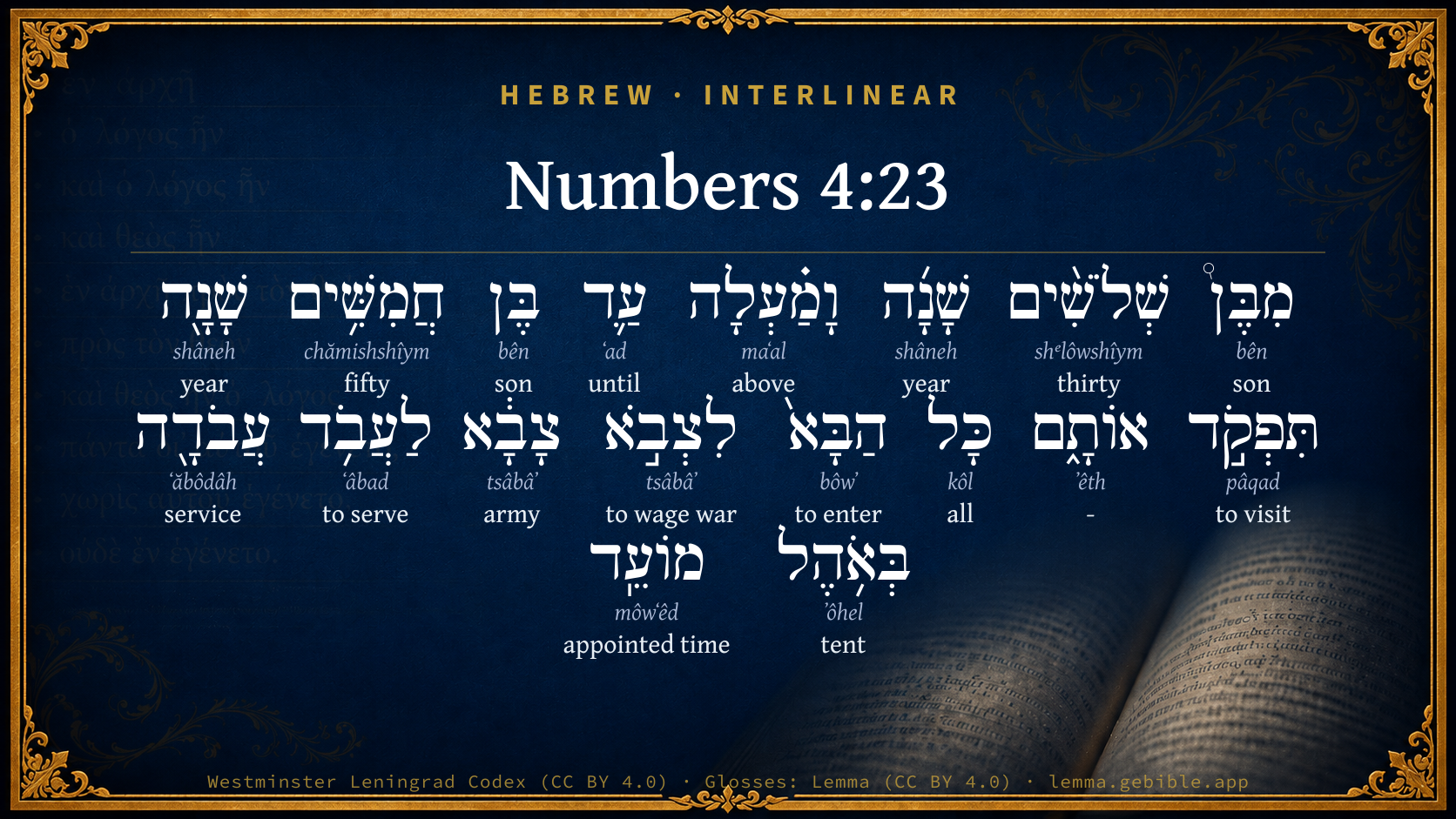
Hebrew (Westminster Leningrad Codex) Numbers 4:23 appears in the Hebrew Old Testament. The text above is from the Westminster Leningrad Codex. Each word links to its Strong’s number, a concise gloss, and parsing drawn from the Open Scriptures Hebrew Bible morphology. Click any word for its full Brown-Driver-Briggs (BDB) entry.
Download image
Cite this verse

Numbers 4:23 (World English Bible). Public Domain. Lemma interlinear Bible study tool, https://lemma.gebible.app/v/numbers/4/23.

Show BibTeX & RIS
BibTeX
RIS
English Translation
from thirty years old and upward until fifty years old shall you number them; all who enter in to wait on the service, to do the work in the Tent of Meeting.
World English Bible · Public Domain
Download a study sheet

One document with this verse’s original text, its word-by-word gloss line, the meaning frame, cross-references with their text, attributed commentary, and full source and license credits — printable, and it pastes into notes with its structure intact.

This verse Autodidact and up

Study sheet (.html) Plain text (.txt)

A passage Seminary Student

Up to 50 verses in one chapter. A passage sheet keeps up to 6 commentary sources and 12 cross-references per verse, in the order this page ranks them, and says so on the sheet whenever that leaves anything out. Ask for a single verse and you get the Autodidact verse sheet above.

Everything on this page stays free to read, with no account — the sheet is a download of what is already on screen, not access to it.

Want to remove ads? Support Godless Engineer
Compare translations 3

The same verse in 3 English versions, stacked beneath the original-language interlinear above. Click any original word for its lexicon entry.

Each is an independent rendering of the whole verse — the interlinear is not word-aligned to these translations.

Highlighted words mark where these versions differ — a whole-verse word diff, not a word-by-word alignment.

  • World English Bible Public Domain
    from thirty years old and upward until fifty years old shall you number them; all who enter in to wait on the service, to do the work in the Tent of Meeting.
  • King James Version Public Domain
    From thirty years old and upward until fifty years old shalt thou number them; all that enter in to perform the service, to do the work in the tabernacle of the congregation.
  • unfoldingWord Literal Text CC BY-SA 4.0
    From a son of 30 years and upward up to a son of 50 years you shall count them, everyone who comes to fight in the army, to serve service in the tent of meeting.

unfoldingWord Literal Text — © unfoldingWord, licensed CC BY-SA 4.0. Word-aligned USFM3 via Door43 (git.door43.org/unfoldingWord/en_ult).

Versions to compare (up to 4)

3 of 4 selected

Show all 18 translations

Every available English version of this verse, each an independent rendering of the whole verse.

  • World English Bible Public Domain
    from thirty years old and upward until fifty years old shall you number them; all who enter in to wait on the service, to do the work in the Tent of Meeting.
  • Berean Standard Bible Public Domain
    from thirty to fifty years old, counting everyone who comes to serve in the work at the Tent of Meeting.
  • Majority Standard Bible Public Domain
    from thirty to fifty years old, counting everyone who comes to serve in the work at the Tent of Meeting.
  • King James Version Public Domain
    From thirty years old and upward until fifty years old shalt thou number them; all that enter in to perform the service, to do the work in the tabernacle of the congregation.
  • American Standard Version (1901) Public Domain
    from thirty years old and upward until fifty years old shalt thou number them; all that enter in to wait upon the service, to do the work in the tent of meeting.
  • Revised Version (1885) Public Domain
    from thirty years old and upward until fifty years old shalt thou number them; all that enter in to wait upon the service, to do the work in the tent of meeting.
  • Geneva Bible (1599) Public Domain
    From thirtie yere old and aboue, vntil fiftie yere old shalt thou nomber them, al that enter into the assemblie for to do seruice in the Tabernacle of the Congregation.
  • Douay-Rheims (1899) Public Domain
    From thirty Sears old and upward, unto fifty years old. Number them all that go in and minister in the tabernacle of the covenant.
  • Young's Literal Translation Public Domain
    from a son of thirty years and upward, till a son of fifty years thou dost number them, every one who is going in to serve the host, to do the service in the tent of meeting.
  • Literal Standard Version CC BY-SA 4.0
    from a son of thirty years and upward, until a son of fifty years, you number them—everyone who is going in to serve the host, to do the service in the Tent of Meeting.
  • Unlocked Literal Bible CC BY-SA 4.0
    Count those who are thirty years old to fifty years old. Count all of them who will join the company to serve in the tent of meeting.
  • unfoldingWord Literal Text CC BY-SA 4.0
    From a son of 30 years and upward up to a son of 50 years you shall count them, everyone who comes to fight in the army, to serve service in the tent of meeting.
  • Darby Bible Public Domain
    From thirty years old and upward to fifty years old shalt thou number them; every one that cometh to labour in the work, to perform the service in the tent of meeting.
  • World Messianic Bible Public Domain
    you shall count them from thirty years old and upward until fifty years old: all who enter in to wait on the service, to do the work in the Tent of Meeting.
  • Webster's Bible Public Domain
    From thirty years old and upward until fifty years old shalt thou number them; all that enter in to perform the service, to do the work in the tabernacle of the congregation.
  • Free Bible Version CC BY-SA 4.0
    Count men aged thirty to fifty—all who are entitled to do the work of serving in the Tent of Meeting.
  • Bible in Basic English Public Domain
    All those from thirty to fifty years old who are able to do the work of the Tent of meeting.
  • JPS Tanakh (1917) Public Domain
    from thirty years old and upward until fifty years old shalt thou number them: all that enter in to wait upon the service, to do service in the tent of meeting.

Literal Standard Version (2020), Covenant Press — licensed CC BY-SA 4.0. Text via the HelloAO Bible API (eBible.org). Unlocked Literal Bible (unfoldingWord) — licensed CC BY-SA 4.0. Text via the HelloAO Bible API (eBible.org). unfoldingWord Literal Text — © unfoldingWord, licensed CC BY-SA 4.0. Word-aligned USFM3 via Door43 (git.door43.org/unfoldingWord/en_ult). Free Bible Version, Dr. Jonathan Gallagher — licensed CC BY-SA 4.0. Text via the HelloAO Bible API (eBible.org).

Word by word

More ways to search: Search by grammar → Find every occurrence → Compare this word →

Practice this passage: Drill this verse → Learn its vocabulary →

לִצְבֹ֣א
tsâbâʼ
H6633
“to wage war”
Preposition + Verb, Qal, Infinitive Construct
Part of Speech
Preposition + Verb
Stem
Qal
Form
Infinitive Construct
Full BDB Definition

Origin: a primitive root

TWOT: 1865

to go forth, wage war, fight, serve - (Qal) - to wage war, fight, go forth to war - to serve (at sacred tent) - (Hiphil) to cause to go forth, muster
  1. מִבֶּן֩ bên H1121 “from · son of” Preposition + Noun, Common, Masculine, Singular, Construct
  2. שְׁלֹשִׁ֨ים shᵉlôwshîym H7970 “thirty” Adjective, Cardinal number, Both, Plural, Absolute
  3. שָׁנָ֜ה shâneh H8141 “year” Noun, Common, Feminine, Singular, Absolute
  4. וָמַ֗עְלָה maʻal H4605 “and · above · toward” Conjunction + Adverb + Suffix, Demonstrative
  5. עַ֛ד ʻad H5704 “until” Preposition
  6. בֶּן bên H1121 “son of” Noun, Common, Masculine, Singular, Construct
  7. חֲמִשִּׁ֥ים chămishshîym H2572 “fifty” Adjective, Cardinal number, Both, Plural, Absolute
  8. שָׁנָ֖ה shâneh H8141 “year” Noun, Common, Feminine, Singular, Absolute
  9. תִּפְקֹ֣ד pâqad H6485 “to visit” Verb, Qal, Imperfect, 2nd Person, Masculine, Singular
  10. אוֹתָ֑ם ʼêth H853 “- · them” Particle, Direct Object + Suffix, Personal, 3rd Person, Masculine, Plural
  11. כָּל kôl H3605 “all of” Noun, Common, Masculine, Singular, Construct
  12. הַבָּא֙ bôwʼ H935 “the · entering” Particle, Definite Article + Verb, Qal, Participle Active, Masculine, Singular, Absolute
  13. צָבָ֔א tsâbâʼ H6635 “army” Noun, Common, Both, Singular, Absolute
  14. לַעֲבֹ֥ד ʻâbad H5647 “to serve” Preposition + Verb, Qal, Infinitive Construct
  15. עֲבֹדָ֖ה ʻăbôdâh H5656 “service” Noun, Common, Feminine, Singular, Absolute
  16. בְּאֹ֥הֶל ʼôhel H168 “in/at · tent of” Preposition + Noun, Common, Masculine, Singular, Construct
  17. מוֹעֵֽד môwʻêd H4150 “appointed time” Noun, Common, Masculine, Singular, Absolute

About this verse

These counts appear in no published source. They are computed here, from the morphology-tagged text and Lemma’s own curated glosses. What Lemma adds →

18
words
16
distinct lemmas
Pentateuch
section

Notable vocabulary

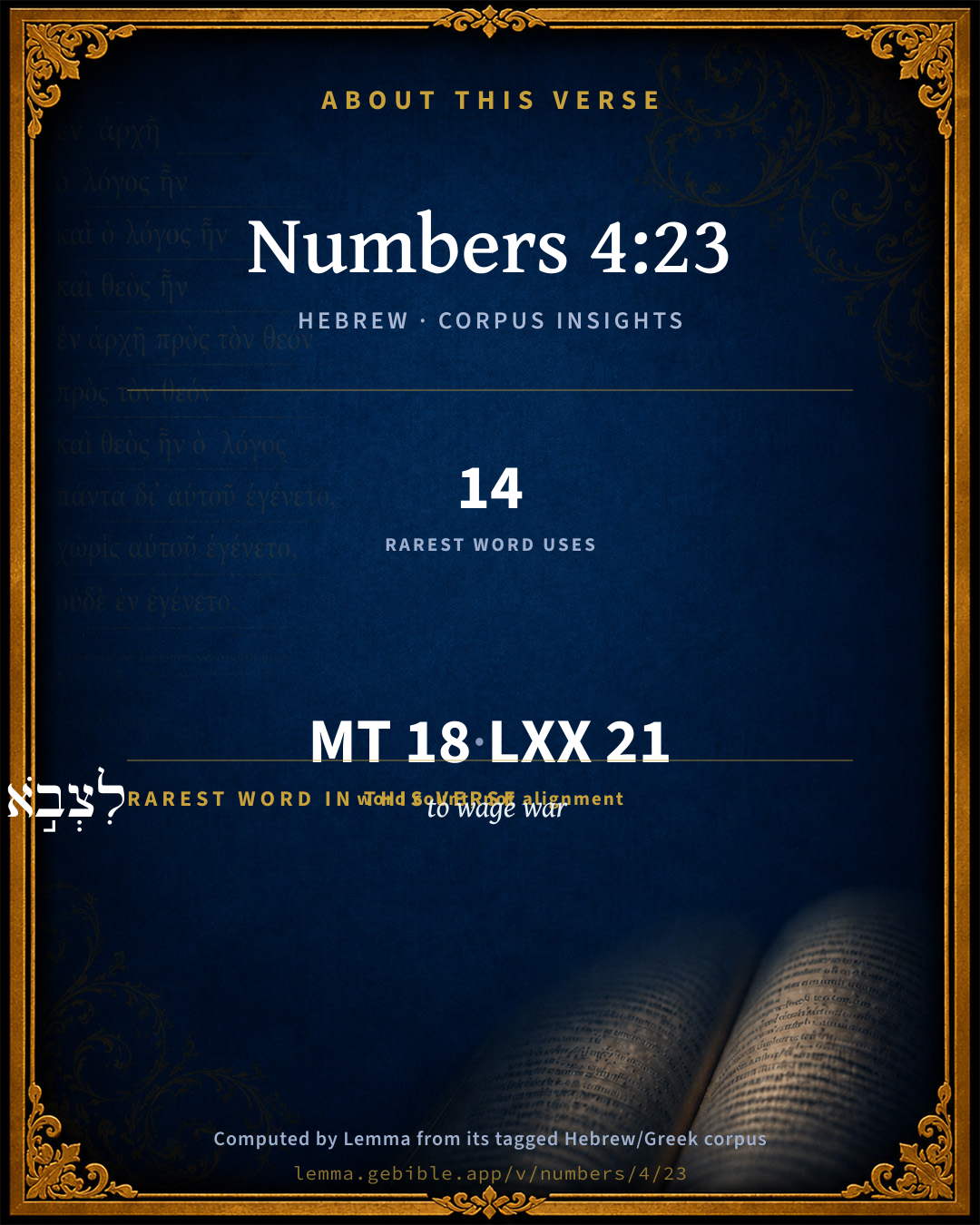
The rarest word here is לִצְבֹ֣א to wage war H6633 — appearing just 14 times in the whole Hebrew Bible.

Shared distinctive vocabulary

לִצְבֹ֣א to wage war H6633 occurs in 12 verses of the Hebrew Bible. Also found in:

Grammatical profile

  • 4 verbs
  • 9 nouns
  • 2 adjectives
  • 1 preposition
  • 1 adverb
  • 1 particle

Verb forms

  • תִּפְקֹ֣ד Qal · Imperfect
  • הַבָּא֙ Qal · Participle Active
  • לִצְבֹ֣א Qal · Infinitive Construct
  • לַעֲבֹ֥ד Qal · Infinitive Construct

Repetition

Words recur within this verse — often emphatic in Hebrew:

  • מִבֶּן֩ son H1121 ×2
  • שָׁנָ֜ה year H8141 ×2

Hebrew & Septuagint length

In English translation the verse runs 32 words from the Hebrew and 34 from the Septuagint (LXX English) — closely comparable.

A rough comparison of the two English renderings, which tokenize alike — not a word-level alignment.

Word counts can differ between the Hebrew and the Greek without any difference in meaning — e.g. the Hebrew direct-object marker אֵת has no separate Greek word, and Greek often adds the article ὁ.

In the original languages it is 18 Hebrew tokens and 21 Greek tokens — but the two are counted differently (Hebrew bundles its prefixes and suffixes into one token; the Greek is in lemma form), so that isn’t a like-for-like length.

Cross-references

15

Topical passages linked to Numbers 4:23 in the Treasury of Scripture Knowledge — connected by theme and wording, ordered by reader-vote popularity; previews shown in the World English Bible.

  • Numbers 4:3 from thirty years old and upward even until fifty years old, all who enter into the service, to do the work in the Tent of Meeting.
  • 1 Chronicles 23:3 The Levites were numbered from thirty years old and upward: and their number by their polls, man by man, was thirty-eight thousand.
  • 1 Chronicles 23:24 These were the sons of Levi after their fathers' houses, even the heads of the fathers' [houses] of those of those who were counted, in the number of names by their polls, who did the work for the service of the house of Yahweh, from twenty years old and upward.
  • 1 Chronicles 23:27 For by the last words of David the sons of Levi were numbered, from twenty years old and upward.
  • Isaiah 63:1–4 Who is this who comes from Edom, with dyed garments from Bozrah? this who is glorious in his clothing, marching in the greatness of his strength? I who speak in righteousness, mighty to save.
  • Romans 7:14–24 For we know that the law is spiritual, but I am fleshly, sold under sin.
  • 1 Corinthians 9:7 What soldier ever serves at his own expense? Who plants a vineyard, and doesn't eat of its fruit? Or who feeds a flock, and doesn't drink from the flock's milk?
  • 2 Corinthians 6:7 in the word of truth, in the power of God; by the armor of righteousness on the right hand and on the left,
  • 2 Corinthians 10:3–5 For though we walk in the flesh, we don't wage war according to the flesh;
  • Galatians 5:17 For the flesh lusts against the Spirit, and the Spirit against the flesh; and these are contrary to one other, that you may not do the things that you desire.
  • Galatians 5:24 Those who belong to Christ have crucified the flesh with its passions and lusts.
  • Ephesians 6:10–19 Finally, be strong in the Lord, and in the strength of his might.
  • 1 Timothy 1:18 This charge I commit to you, my child Timothy, according to the prophecies which led the way to you, that by them you may wage the good warfare;
  • 2 Timothy 2:3–4 You therefore must endure hardship, as a good soldier of Christ Jesus.
  • 2 Timothy 4:7 I have fought the good fight. I have finished the course. I have kept the faith.

Cross-references courtesy of OpenBible.info (CC BY 4.0).

Hebrew and Greek witnesses Masoretic Hebrew ↔ Greek Septuagint

The same verse in the two great witnesses to the Old Testament, shown verse-for-verse.

These are two independent witnesses, not word-aligned to each other, and the Septuagint is shown in lemma (dictionary) form.

Hebrew Numbers 4:23 Masoretic · Westminster Leningrad Codex

מִבֶּן֩ שְׁלֹשִׁ֨ים שָׁנָ֜ה וָמַ֗עְלָה עַ֛ד בֶּן חֲמִשִּׁ֥ים שָׁנָ֖ה תִּפְקֹ֣ד אוֹתָ֑ם כָּל הַבָּא֙ לִצְבֹ֣א צָבָ֔א לַעֲבֹ֥ד עֲבֹדָ֖ה בְּאֹ֥הֶל מוֹעֵֽד

from thirty years old and upward until fifty years old shall you number them; all who enter in to wait on the service, to do the work in the Tent of Meeting.

World English Bible · Public Domain

Greek LXX Numbers 4:23 Septuagint · lemma form

ἀπό καί ἐπάνω ἕως πεντηκονταετής ἐπισκέπτω αὐτός πᾶς ὁ εἰςπορεύομαι λειτουργέω καί ποιέω ὁ ἔργον αὐτός ἐν ὁ σκηνή ὁ μαρτύριον

Take the number of them from five and twenty years old and upwards until the age of fifty, every one that goes in to minister, to do his business in the tabernacle of witness.

LXX2012 (modern English Septuagint) · Public Domain

On this verse, Haydock's Catholic Bible Commentary discusses the Septuagint’s reading. Read the note in Commentary ↓

Hebrew: Westminster Leningrad Codex (CC BY 4.0). Greek: Septuagint (public domain); English from LXX2012 (modern English Septuagint) (Public Domain). How the Septuagint differs from the Hebrew →

Targum (Aramaic paraphrase)

2

The Targum is the ancient Jewish Aramaic paraphrase of the Hebrew Scriptures — an interpretive translation, not the Hebrew text itself. Onkelos (literal) and Pseudo-Jonathan (expansive) render the Torah, and Jonathan the Prophets. Coverage is partial: where no permissively-licensed English translation exists for a verse, only the Aramaic is shown. This is verse-level text, not a word-by-word alignment to the Hebrew.

  1. Targum Onkelos Torah (Genesis–Deuteronomy)
    מִבַּר תְּלָתִין שְׁנִין וּלְעֵלָא עַד בַּר חַמְשִׁין שְׁנִין תִּמְנֵי יַתְהוֹן כָּל דְאָתֵי לְחַיָלָא חֵילָא לְמִפְלַח פּוּלְחָנָא בְּמַשְׁכַּן זִמְנָא

    (no public-domain English translation for this verse)

    Targum Onkelos — Aramaic: “Onkelos Genesis” (public domain); “Onkelos Exodus” (public domain); “Onkelos Leviticus” (public domain); “Onkelos Numbers” (public domain); “Onkelos Deuteronomy” (public domain). English: “Sefaria Community Translation” (CC0 1.0 (public-domain dedication)); “J.W. Etheridge. The Targums of Onkelos and Jonathan Ben Uzziel on the Pentateuch. London: Longmans, Green, 1862” (public domain). Text via Sefaria.

  2. Targum Pseudo-Jonathan Torah (Genesis–Deuteronomy)
    מִבַּר תְּלָתִין שְׁנִין וּלְעֵילָא וְעַד בַּר חַמְשִׁין שְׁנִין תִּמְנֵי יַתְהוֹן כָּל דְאָתֵי לְחַיָילָא חֵילָא לְמֶעֱבַד עִבִידְתָּא בְּמַשְׁכַּן זִמְנָא

    from thirty years to fifty years, of all who come by bands to do the work of the tabernacle of ordinance.

    Targum Pseudo-Jonathan — Aramaic: “Targum Jonathan on Genesis” (public domain); “Targum Jonathan on Exodus” (public domain); “Targum Jonathan on Leviticus” (public domain); “Targum Jonathan on Numbers” (public domain); “Targum Jonathan on Deuteronomy” (public domain). English: “The Targum of Jonathan ben Uzziel, trans. J. W. Etheridge, London, 1862” (public domain). Text via Sefaria.

Commentary

Notes on Numbers 4:23 from classic Christian and Jewish commentators (each source and its license shown beneath its notes). The classic Christian expositions comment on the surrounding passage and are grouped to its opening verse, so a note may address several verses; the Jewish commentaries on the Tanakh (Rashi and others) are per-verse, so they appear only where the commentator wrote on this verse.

Lemma curates 59 commentaries, every one of them public domain or Creative Commons licensed, each selected and text-cleaned for this edition rather than reprinted as found. About our sources →

MacLaren's Expositions of Holy Scripture

Alexander MacLaren

Numbers

THE WARFARE OF CHRISTIAN SERVICE

Num 4:23.

These words occur in the series of regulations as to the functions of the Levites in the Tabernacle worship. The words ‘to perform the service’ are, as the margin tells us, literally, to ‘war the warfare.’ Although it may be difficult to say why such very prosaic and homely work as carrying the materials of the Tabernacle and the sacrificial vessels was designated by such a term, the underlying suggestion is what I desire to fix upon now-viz., that work for God, of whatever kind it be, which Christian people are bound to do, and which is mainly service for men for God’s sake, will never be rightly done until we understand that it is a warfare, as well as a work.

The phrase on which I am commenting occurs again and again in the regulations as to the Levitical service, and is applied, not only as in my text to those who were told off to bear the burdens on the march, but also to the whole body of Levites, who did the inferior services in connection with the ritual worship. They were not, as it would appear, sacrificing priests, but they belonged to the same tribe as these, and they had sacred functions to discharge. So we come to this principle, that Christian service is to be looked at as warfare.

Now, that is a principle which ought to be applied to all Christians. For there is no such thing as designating a portion of Christ’s Church to service which others have not to perform. The distinction of ‘priest’ and ‘layman’ existed in the Old Testament; it does not exist under the New Covenant, and there is no obligation upon any one Christian man to devote himself for Christ’s sake to Christ’s service and man’s help {which is Christ’s service}, that does not lie equally upon all Christian people. The function is the same for all; the methods of discharging it may be widely different. Within the limits of the priestly tribe there may still be those whose office it is to carry the vessels, and those whose office it is to act more especially as ministering priests; but they are all ‘of the tribe of Levi.’ We, if we are Christian people at all, are all bound to do this work of ‘the tabernacle,’ and war this warfare.

It is important that we Christian people should elevate our thoughts of our duties in the world to the height of this great metaphor. The metaphor of the Christian life as being a ‘warfare’ is familiar enough, but that is not exactly the point which I wish to dwell upon now. When we speak about ‘fighting the good fight of faith,’ we generally mean our wrestle and struggle with our own evils and with the things that hinder us from developing a Christlike character, and ‘growing in the grace and knowledge of our Lord and Saviour Jesus Christ.’ But it is another sort of warfare about which I am now speaking, the warfare which every Christian man has to wage who flings himself into the work of diminishing the world’s miseries and sins, and tries to make people better, and happier because they are better. That is a fight, and will always be so, if it is rightly done.

I. Think of the foes.

Speaking generally, society is constituted upon a non-Christian basis. We talk about ‘Christian’ nations. There is not one on the face of the earth. There is not a nation whose institutions and maxims and politics and the practices of its individual members are ruled and moulded predominantly by the Gospel of Jesus Christ. So every man that has come into personal touch with that Lord, and has felt that His commandments are the supreme authority in his own individual life, when he goes out into society, comes full tilt against a whole host of things that are in pronounced antagonism, or in real though unacknowledged contradiction, to the principles by which a Christian has to live for himself, and to commend to his brethren. So we have to fight. There are two things to be done-the imparting of good which will increase the sum of the world’s happiness, and the destruction of evil, which will subtract some of the world’s sorrows. The latter is always a conflict, for there are arrayed in defence of the evil vested interests, and the influence of habit, and the lowered vitality and sensitiveness of conscience which has come from breathing the polluted atmosphere which evil has vitiated. So that if we set ourselves, in humble, quiet, out-and-out dependence on Jesus Christ and submission to His will, to lead other people to submit to His will, there is nothing in the world more certain than that we shall find against us, starting up, as it were, out of the mist and taking form suddenly, a whole host of enemies. So we Christian men, as individuals, as members of a community and able to bring some influence to bear upon the conscience of society, have to fight against popular social evils, and to war for righteousness’ sake.

There is another foe. There is nothing that men dislike more than being lifted up into a clearer atmosphere and made to see truths which they do not see or care for. When we first become Christians we are all hot to go and teach and preach; and we fancy that we have only to stand up, with a Bible in our hand, and read two or three texts, and our fellows will grasp them as gladly as we have done. But soon we find out that it is not so easy to draw men to Christ as we thought it would be. We have to fight against gravitation and unwillingness, when we would lift a poor brother into the liberty and the light that we are in. We have to struggle with the men that we are trying to help. We have to war, in order to bring ‘the peace of God which passes understanding’ into their hearts.

But the worst of all our foes, in doing Christian service, is our own miserable selves, with our laziness, and our vanity, and our wondering what A, B, and C will think about us, and the mingling of impure motives with nobler ones, and our being angry with people because they are so insensible, not so much to Christ’s love as to our words and pleadings. Unless we can purge all that devil’s leaven out of ourselves, we have little chance of working ‘the work of the tabernacle,’ or warring the warfare of God. Ah! brethren, to do anything for this world of unbelief and sin, of which we ourselves are part, is a struggle. And I know of no work that needs more continual putting a firm heel upon self, in all its subtle manifestations, than the various forms of Christian service. Not only we preachers, but Sunday-school teachers, mothers in their nurseries, teaching their children, and all of us, if we are trying to do anything for men, for Christ’s sake, must feel, if we are honest with ourselves and about our work, that the first condition of success in it is to fight down self, and that only then, being emptied of ourselves, are we ready to be filled with the Spirit, by which we are made mighty to pull down the strongholds of sin.

II. The weapons of this warfare.

There are two great passages in the New Testament, both of which deal with the Christian life under this metaphor of warfare. One of these is the detailed description of the Christian armour in the Epistle to the Ephesians. There we have described the equipment for that phase of the fight of the Christian life which has to do mainly with the perfecting of the individual character. But somewhat different is the armour which is to be worn, when the Christian man goes out into the world to labour and to wage war there for Jesus Christ. We may turn, then, rather to the other of the two passages in question for the descriptions of the equipment, armour, and weapons of the Christian in his warfare for the spread of truth and goodness in the world. The passage to which I refer is in 2Co 6:1 What are the weapons that Paul specifies in that place? I venture to alter their order, because he seems to have put them down just as they came into his mind, and we can put some kind of logical sequence into them. ‘By the Word of God’-that is the first one. ‘By the Holy Ghost,’ which is otherwise given as ‘by the power of God,’ is the next. Get your minds and hearts filled with the truth of the Gospel, and dwell in fellowship with God, baptized with His Holy Spirit; and then you will be clothed ‘as with a vesture down to your heels’ with the power of God. These are the divine side, the weapons given us from above-’the Word of God’ which is ‘the sword of the Spirit,’ and the indwelling Holy Ghost manifesting Himself in power. Then follow a series of human qualities which, though they are ‘the fruit of the Spirit,’ are yet not produced in us without our own co-operation. We have to forge and sharpen these weapons, though the fire in which they are forged is from above, and the metal of which they are made is given from heaven, like meteoric iron. These are ‘kindness, long-suffering, love unfeigned.’ We have to dismiss from our minds the ordinary characteristics of warfare in thinking of that which Christians are to wage. Like the old Knights Templars, we must carry a sword which has a cross for its hilt, and must be clad in gentleness, and long-suffering, and unfeigned love. ‘The wrath of men worketh not the righteousness of God.’ You cannot bully people into Christianity, you cannot scold them into goodness. There must be sweetness in order to attract, and he imperfectly echoes the music of the voice that came from ‘the lips into which grace was poured,’ whose words are harsh and rough, and who preaches the Gospel as if he were thundering damnation into people’s ears.

Brethren, whatever be our warfare against sin, we must never lose our tempers. Harsh words break no bones indeed, but neither do they break hearts. A character like Jesus Christ-that is the victorious weapon. Let a man go and live in the world with these weapons that I have been naming, the truth of God in his heart, the Holy Spirit in his spirit, the power that comes therefrom animating his deadness and strengthening his weakness, and himself an emblem and an embodiment of the redeeming love of Christ-and though he spoke no word he would be sure to preach Christ; and though he struck no blow he would be a formidable antagonist to the hosts of evil, and the icebergs of sin and godlessness would run down into water before his silent and omnipotent shining. These are the weapons.

III. Note the temper, or disposition, of the Christian warrior-servant.

Courage goes without saying. If a man expects to be beaten, and to do nothing by his Christian witness but clear his conscience, he deserves nothing else than what he will get-viz. that his expectation will be fulfilled and he will do nothing else but clear his conscience, and that imperfectly. That is why so many preachers and Sunday-school teachers never see any conversions in their congregation or classes-because they do not expect any; because they go to their work without the enthusiastic boldness which would give power to their utterances.

I suppose concentration, too, goes without saying. When a man is on the battlefield with the swords whirling about his head, and the bayonets an inch from his breast, he does not go dreaming of scenes a hundred miles off, or think anything else than the one thing, how to keep a whole skin and wound an enemy. If Christian men will do their work in the dawdling, half-interested, and half-indifferent way in which so many of us promenade through our Christian service as if it was a review and not a fight, they are not likely to bring back many trophies of victory. You must put your whole selves into the battle. I said we must subdue ourselves ere we begin to fight. That is no contradiction to what I am saying now, for, as we all know, there is a distinction between the two selves in us-the self-centred self, which is to be crucified, and the God-centred self, which is to be nourished. You must put your whole selves into the battle.

There must, too, be discipline. One difference between a mob and an army is that the mob has as many wills as there are heads in it, and the army has only one will, that of the commander. He says to one man ‘Go!’ and he goes, and gets shot; and to another one ‘Come!’ and he comes; and to a third one ‘Do this!’ and, no matter what it is, straightway he goes and does it. So if we are soldiers we have to take orders from headquarters, and to be sure that we pay no attention to any other commands. Suppose a man is set at a certain post by his captain, and a corporal comes and says, ‘You go and do this other thing; never mind your post, I will look after that,’ to obey that is mutiny. If Jesus Christ tells you to do anything, and any others say ‘Do not do it just yet!’ neglect them, and obey Him. If your own heart says, ‘Stop a little while and try something other and easier before you tackle that task,’ be sure of the Captain’s voice, and then, whatever happens, obey, and obey at once. Warfare is a diabolical thing, but there is a divine beauty in one aspect of it-

Their’s not to make reply, Their’s not to reason why, Their’s but to do-

even if it mean ‘to die.’ Thus let us wage warfare.

IV. The Relieving Guard.

This metaphor of warfare is used in the Book of Job, in a passage where our English Version does not show it. So I venture to substitute the right translation for the one in the Authorised Version, ‘All the days of my warfare will I wait till my change comes.’ The guard will be relieved some day, and the private that has been tramping up and down in the dark or the snow, perhaps within rifle’s length of the enemy, will shoulder his gun and go into the comfortable guardhouse, and hang up his knapsack, and fling off his dirty boots, and sit down by the fire, and make himself comfortable. There is a ‘heavenly manner of relieving guard.’ Soon it will be the end of the sentry’s time, and then, as one of those that had done a good day’s work, and a long one, said with a sigh of relief, ‘I have fought a good fight.’ Henceforth the helmet is put off, which is ‘the hope of salvation,’ and the crown is put on, which is salvation in its fullness. ‘All the days of my warfare will I wait’-till my Captain relieves the guard.

Alexander MacLaren, Expositions of Holy Scripture (1904–1910) — public domain. Text from a community e-Sword module.

Geneva Bible (1599)

Geneva Bible translators

Which were received into the company of them that ministered in the Tabernacle of the Congregation.

Geneva Bible (1599) marginal notes — public domain. Text via Bolls.life.

John Gill's Exposition

And the hangings of the court,.... Which made the great court that surrounded the tabernacle, Exo 27:9,

and the hanging for the door of the gate of the court; the eastern gate that led into the court, an hanging of twenty cubits, Exo 27:16,

which is by the tabernacle, and by the altar round about; that is, which hangings that formed the court, and were round about the tabernacle, and the altar of burnt offering; See Gill on Exo 26:36,

and their cords; which fastened the hangings to pins or stakes fixed in the ground to keep them tight, that they might not be moved to and fro with the wind:

and all the instruments of their service; in the court, as the tables on which the sacrifices were laid, and the hooks, and cords, and pins, on which they were hung and fastened, as Aben Ezra; see Eze 40:39,

and all that is made for them; for the vessels of service, or for the tabernacle, or the altar, as the same writer intimates:

so shall they serve; by bearing them and carrying them.

John Gill's Exposition of the Whole Bible (1746–1763) — public domain (CC PDM 1.0). Text via the HelloAO Bible API.

Albert Barnes' Notes on the Bible

enter in to perform the service - literally, as in the margin, “to war the warfare,” or, as the same phrase in part is rendered, Num 4:3, “enter into the host to do the work.” The language is military. The service of God is a sacred warfare (Num 8:24-25 marginal reading).

Albert Barnes' Notes on the Bible (1834–1885) — public domain. Text from a community e-Sword/MySword module.

Haydock's Catholic Bible Commentary

Thirty. Septuagint, "25," as ver. 3. (Calmet) --- They began to be taught how to act, at 25; but did not officiate till 30. (Du Hamel)

George Leo Haydock (1774–1849), Haydock's Catholic Family Bible and Commentary, 1859 edition — public domain. Excludes Psalms (Douay-Rheims chapter numbering differs from Protestant) and Deuterocanonical books (Catholic canon only).

Lesson kit

Teaching starters — assembled from the data on this page, not authored interpretation. Every prompt links to the verse data it draws on. Edit before teaching.

Numbers, in the Pentateuch, opens this verse with 18 words (16 distinct Hebrew lemmas). Its most distinctive word is tsâbâʼ (“to wage war”). A historical commentator’s framing appears above. Read the whole chapter for the surrounding context.

Discussion questions

  1. What does “to wage war” (tsâbâʼ) contribute to the verse as a whole?
  2. How does Exodus 38:8, which shares the word «to wage war», read alongside this verse?
  3. What does the repetition of “son” (2× in this one verse) do in this verse?
  4. The translations on this page render this verse differently — a whole-verse word diff, not a word-by-word alignment. What might account for the different wordings?
  5. «תִּפְקֹ֣ד» is a Qal Imperfect verb. How does that grammatical form shape the action described?
  6. Compare how MacLaren's Expositions of Holy Scripture and Geneva Bible (1599) read this verse. Where do they agree or differ?

Things to notice

Reading settings

Reading text

Shown beneath each verse's original-language words.

Old Testament
Old Testament edition

Read the OT as the Masoretic Hebrew (MT) or the Greek Septuagint (LXX).

English shown for the Greek Septuagint (in the Hebrew ↔ Greek comparison).

Comparing translations? Open the Compare panel on any verse page to stack up to four side by side.