Leviticus 9:5

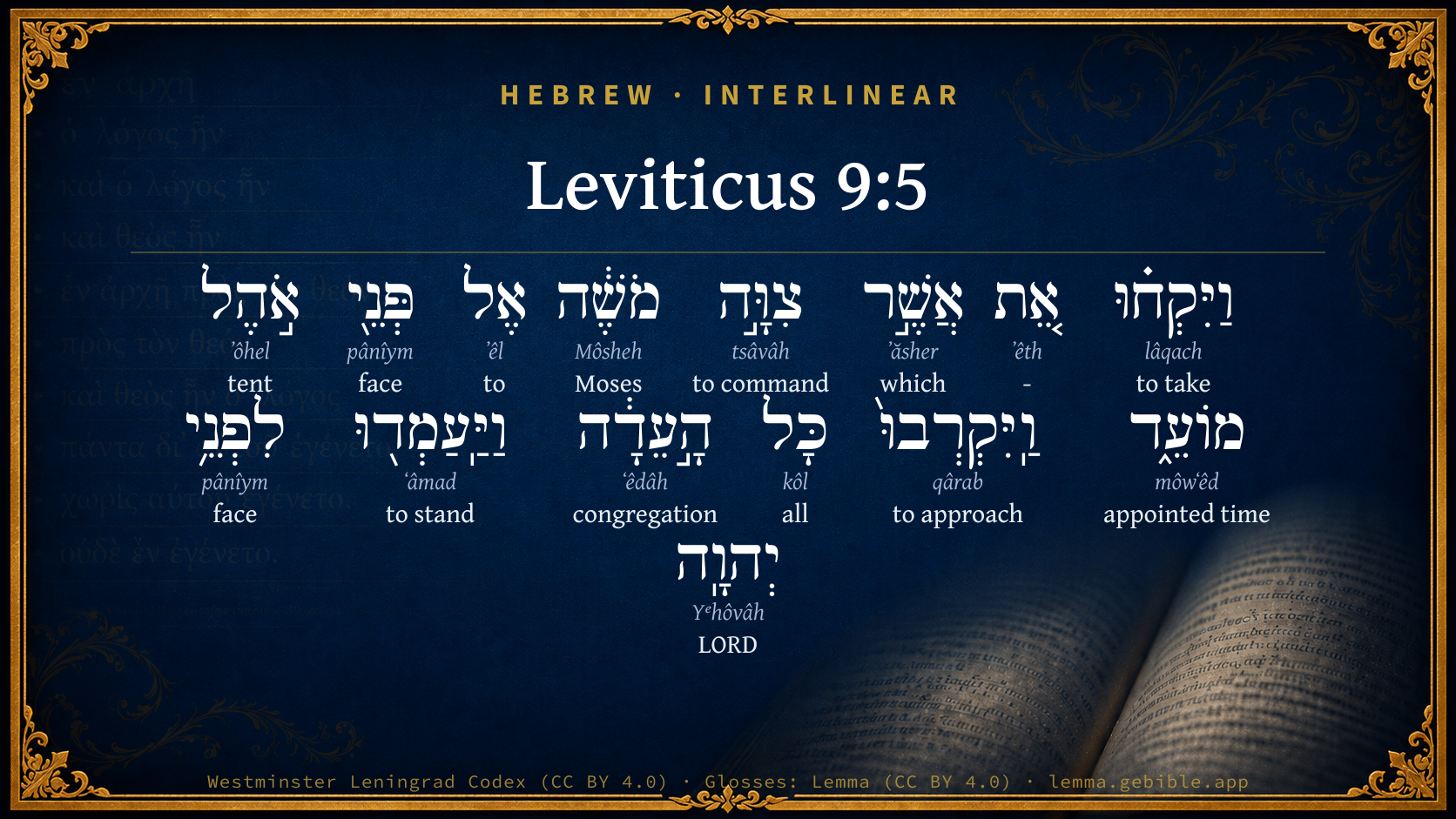
Hebrew (Westminster Leningrad Codex) Leviticus 9:5 appears in the Hebrew Old Testament. The text above is from the Westminster Leningrad Codex. Each word links to its Strong’s number, a concise gloss, and parsing drawn from the Open Scriptures Hebrew Bible morphology. Click any word for its full Brown-Driver-Briggs (BDB) entry.
Download image
Cite this verse

Leviticus 9:5 (World English Bible). Public Domain. Lemma interlinear Bible study tool, https://lemma.gebible.app/v/leviticus/9/5.

Show BibTeX & RIS
BibTeX
RIS
English Translation
They brought what Moses commanded before the Tent of Meeting: and all the congregation drew near and stood before Yahweh.
World English Bible · Public Domain
Download a study sheet

One document with this verse’s original text, its word-by-word gloss line, the meaning frame, cross-references with their text, attributed commentary, and full source and license credits — printable, and it pastes into notes with its structure intact.

This verse Autodidact and up

Study sheet (.html) Plain text (.txt)

A passage Seminary Student

Up to 50 verses in one chapter. A passage sheet keeps up to 6 commentary sources and 12 cross-references per verse, in the order this page ranks them, and says so on the sheet whenever that leaves anything out. Ask for a single verse and you get the Autodidact verse sheet above.

Everything on this page stays free to read, with no account — the sheet is a download of what is already on screen, not access to it.

Want to remove ads? Support Godless Engineer
Compare translations 3

The same verse in 3 English versions, stacked beneath the original-language interlinear above. Click any original word for its lexicon entry.

Each is an independent rendering of the whole verse — the interlinear is not word-aligned to these translations.

Highlighted words mark where these versions differ — a whole-verse word diff, not a word-by-word alignment.

  • World English Bible Public Domain
    They brought what Moses commanded before the Tent of Meeting: and all the congregation drew near and stood before Yahweh.
  • King James Version Public Domain
    And they brought that which Moses commanded before the tabernacle of the congregation: and all the congregation drew near and stood before the LORD.
  • unfoldingWord Literal Text CC BY-SA 4.0
    And they brought that which Moses commanded to the face of the tent of meeting. And the whole congregation presented, and they stood to the face of Yahweh.

unfoldingWord Literal Text — © unfoldingWord, licensed CC BY-SA 4.0. Word-aligned USFM3 via Door43 (git.door43.org/unfoldingWord/en_ult).

Versions to compare (up to 4)

3 of 4 selected

Show all 18 translations

Every available English version of this verse, each an independent rendering of the whole verse.

  • World English Bible Public Domain
    They brought what Moses commanded before the Tent of Meeting: and all the congregation drew near and stood before Yahweh.
  • Berean Standard Bible Public Domain
    So they took what Moses had commanded to the front of the Tent of Meeting, and the whole congregation drew near and stood before the LORD.
  • Majority Standard Bible Public Domain
    So they took what Moses had commanded to the front of the Tent of Meeting, and the whole congregation drew near and stood before the LORD.
  • King James Version Public Domain
    And they brought that which Moses commanded before the tabernacle of the congregation: and all the congregation drew near and stood before the LORD.
  • American Standard Version (1901) Public Domain
    And they brought that which Moses commanded before the tent of meeting: and all the congregation drew near and stood before Jehovah.
  • Revised Version (1885) Public Domain
    And they brought that which Moses commanded before the tent of meeting: and all the congregation drew near and stood before the LORD.
  • Geneva Bible (1599) Public Domain
    Then they brought that which Moses commanded before the Tabernacle of the Congregation, and all the assembly drewe neere and stood before the Lord.
  • Douay-Rheims (1899) Public Domain
    They brought therefore all things that Moses had commanded before the door of the tabernacle: where when all the multitude stood,
  • Young's Literal Translation Public Domain
    And they take that which Moses hath commanded unto the front of the tent of meeting, and all the company draw near and stand before Jehovah;
  • Literal Standard Version CC BY-SA 4.0
    And they take that which Moses has commanded to the front of the Tent of Meeting, and all the congregation draws near and stands before YHWH;
  • Unlocked Literal Bible CC BY-SA 4.0
    So they brought all that Moses commanded to the tent of meeting, and all the assembly of Israel approached and stood before Yahweh.
  • unfoldingWord Literal Text CC BY-SA 4.0
    And they brought that which Moses commanded to the face of the tent of meeting. And the whole congregation presented, and they stood to the face of Yahweh.
  • Darby Bible Public Domain
    And they brought what Moses commanded before the tent of meeting; and all the assembly approached and stood before Jehovah.
  • World Messianic Bible Public Domain
    They brought what Moses commanded before the Tent of Meeting. All the congregation came near and stood before the LORD.
  • Webster's Bible Public Domain
    And they brought that which Moses commanded before the tabernacle of the congregation: and all the congregation drew near and stood before the LORD.
  • Free Bible Version CC BY-SA 4.0
    Following Moses' orders they brought what he'd said to the front of the Tent of Meeting. Everyone came and stood before the Lord.
  • Bible in Basic English Public Domain
    And they took the things ordered by Moses, before the Tent of meeting, and all the people came near, waiting before the Lord.
  • JPS Tanakh (1917) Public Domain
    And they brought that which Moses commanded before the tent of meeting; and all the congregation drew near and stood before the LORD.

Literal Standard Version (2020), Covenant Press — licensed CC BY-SA 4.0. Text via the HelloAO Bible API (eBible.org). Unlocked Literal Bible (unfoldingWord) — licensed CC BY-SA 4.0. Text via the HelloAO Bible API (eBible.org). unfoldingWord Literal Text — © unfoldingWord, licensed CC BY-SA 4.0. Word-aligned USFM3 via Door43 (git.door43.org/unfoldingWord/en_ult). Free Bible Version, Dr. Jonathan Gallagher — licensed CC BY-SA 4.0. Text via the HelloAO Bible API (eBible.org).

Word by word

More ways to search: Search by grammar → Find every occurrence → Compare this word →

Practice this passage: Drill this verse → Learn its vocabulary →

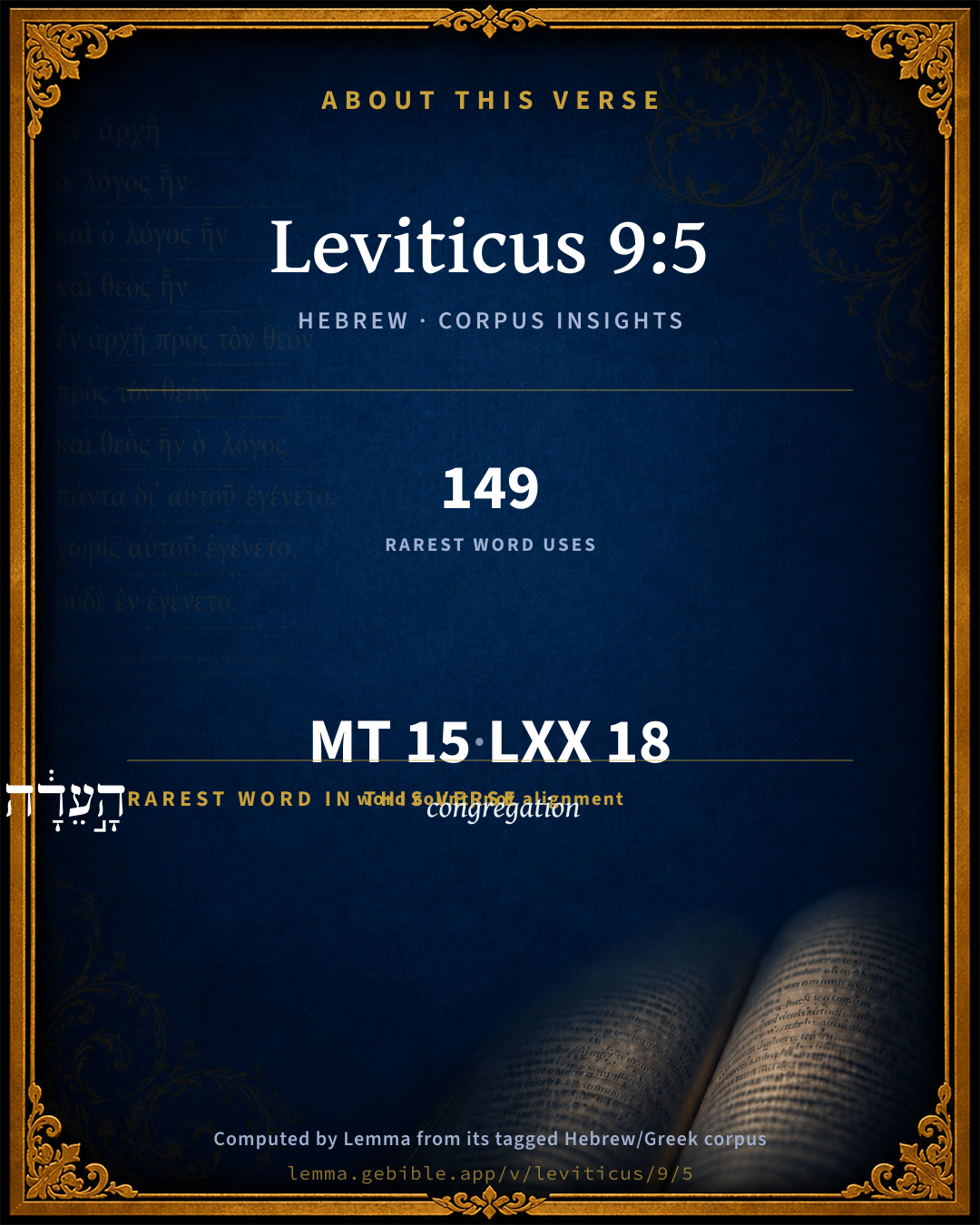
הָ֣עֵדָ֔ה
ʻêdâh
H5712
“the · congregation”
Particle, Definite Article + Noun, Common, Feminine, Singular, Absolute
Part of Speech
Particle + Noun
Type
Common
Gender
Feminine
Number
Singular
State
Absolute
Full BDB Definition

Origin: from H5707 in the original sense of fixture

TWOT: 878a

congregation, gathering
  1. וַיִּקְח֗וּ lâqach H3947 “and · to take” Conjunction + Verb, Qal, Sequential Imperfect, 3rd Person, Masculine, Plural
  2. אֵ֚ת ʼêth H853 “-” Particle, Direct Object
  3. אֲשֶׁ֣ר ʼăsher H834 “which” Particle, Relative
  4. צִוָּ֣ה tsâvâh H6680 “to command” Verb, Piel, Perfect, 3rd Person, Masculine, Singular
  5. מֹשֶׁ֔ה Môsheh H4872 “Moses” Noun, Proper
  6. אֶל ʼêl H413 “to” Preposition
  7. פְּנֵ֖י pânîym H6440 “face(s) of” Noun, Common, Both, Plural, Construct
  8. אֹ֣הֶל ʼôhel H168 “tent of” Noun, Common, Masculine, Singular, Construct
  9. מוֹעֵ֑ד môwʻêd H4150 “appointed time” Noun, Common, Masculine, Singular, Absolute
  10. וַֽיִּקְרְבוּ֙ qârab H7126 “and · to approach” Conjunction + Verb, Qal, Sequential Imperfect, 3rd Person, Masculine, Plural
  11. כָּל kôl H3605 “all of” Noun, Common, Masculine, Singular, Construct
  12. וַיַּֽעַמְד֖וּ ʻâmad H5975 “and · to stand” Conjunction + Verb, Qal, Sequential Imperfect, 3rd Person, Masculine, Plural
  13. לִפְנֵ֥י pânîym H6440 “to/for · face(s) of” Preposition + Noun, Common, Both, Plural, Construct
  14. יְהוָֽה Yᵉhôvâh H3068 “LORD” Noun, Proper

About this verse

These counts appear in no published source. They are computed here, from the morphology-tagged text and Lemma’s own curated glosses. What Lemma adds →

15
words
14
distinct lemmas
Pentateuch
section

Grammatical profile

  • 4 verbs
  • 8 nouns
  • 1 preposition
  • 2 particles

Verb forms

  • וַיִּקְח֗וּ Qal · Sequential Imperfect
  • צִוָּ֣ה Piel · Perfect
  • וַֽיִּקְרְבוּ֙ Qal · Sequential Imperfect
  • וַיַּֽעַמְד֖וּ Qal · Sequential Imperfect

Repetition

A word recurs within this verse — often emphatic in Hebrew:

  • פְּנֵ֖י face H6440 ×2

Hebrew & Septuagint length

In English translation the verse runs 20 words from the Hebrew and 24 from the Septuagint (LXX English) — closely comparable.

A rough comparison of the two English renderings, which tokenize alike — not a word-level alignment.

Word counts can differ between the Hebrew and the Greek without any difference in meaning — e.g. the Hebrew direct-object marker אֵת has no separate Greek word, and Greek often adds the article ὁ.

In the original languages it is 15 Hebrew tokens and 18 Greek tokens — but the two are counted differently (Hebrew bundles its prefixes and suffixes into one token; the Greek is in lemma form), so that isn’t a like-for-like length.

Cross-references

5

Topical passages linked to Leviticus 9:5 in the Treasury of Scripture Knowledge — connected by theme and wording, ordered by reader-vote popularity; previews shown in the World English Bible.

  • Exodus 19:17 Moses led the people out of the camp to meet God; and they stood at the lower part of the mountain.
  • Deuteronomy 31:12 Assemble the people, the men and the women and the little ones, and your foreigner who is within your gates, that they may hear, and that they may learn, and fear Yahweh your God, and observe to do all the words of this law;
  • 1 Chronicles 15:3 David assembled all Israel at Jerusalem, to bring up the ark of Yahweh to its place, which he had prepared for it.
  • 2 Chronicles 5:2–3 Then Solomon assembled the elders of Israel, and all the heads of the tribes, the princes of the fathers' [houses] of the children of Israel, to Jerusalem, to bring up the ark of the covenant of Yahweh out of the city of David, which is Zion.
  • Nehemiah 8:1 All the people gathered themselves together as one man into the broad place that was before the water gate; and they spoke to Ezra the scribe to bring the book of the law of Moses, which Yahweh had commanded to Israel.

Cross-references courtesy of OpenBible.info (CC BY 4.0).

Hebrew and Greek witnesses Masoretic Hebrew ↔ Greek Septuagint

The same verse in the two great witnesses to the Old Testament, shown verse-for-verse.

These are two independent witnesses, not word-aligned to each other, and the Septuagint is shown in lemma (dictionary) form.

Hebrew Leviticus 9:5 Masoretic · Westminster Leningrad Codex

וַיִּקְח֗וּ אֵ֚ת אֲשֶׁ֣ר צִוָּ֣ה מֹשֶׁ֔ה אֶל פְּנֵ֖י אֹ֣הֶל מוֹעֵ֑ד וַֽיִּקְרְבוּ֙ כָּל הָ֣עֵדָ֔ה וַיַּֽעַמְד֖וּ לִפְנֵ֥י יְהוָֽה

They brought what Moses commanded before the Tent of Meeting: and all the congregation drew near and stood before Yahweh.

World English Bible · Public Domain

Greek LXX Leviticus 9:5 Septuagint · lemma form

καί λαμβάνω καθό ἐντέλλομαι μωυσῆς ἀπέναντι ὁ σκηνή ὁ μαρτύριον καί προςἔρχομαι πᾶς συναγωγή καί ἵστημι ἔναντι κύριος

And they took as Moses commanded them before the tabernacle of witness, and all the congregation drew near, and they stood before the Lord.

LXX2012 (modern English Septuagint) · Public Domain

Hebrew: Westminster Leningrad Codex (CC BY 4.0). Greek: Septuagint (public domain); English from LXX2012 (modern English Septuagint) (Public Domain). How the Septuagint differs from the Hebrew →

Targum (Aramaic paraphrase)

2

The Targum is the ancient Jewish Aramaic paraphrase of the Hebrew Scriptures — an interpretive translation, not the Hebrew text itself. Onkelos (literal) and Pseudo-Jonathan (expansive) render the Torah, and Jonathan the Prophets. Coverage is partial: where no permissively-licensed English translation exists for a verse, only the Aramaic is shown. This is verse-level text, not a word-by-word alignment to the Hebrew.

  1. Targum Onkelos Torah (Genesis–Deuteronomy)
    וּנְסִיבוּ יָת דִי פַקִיד מֹשֶׁה לָקֳדָם מַשְׁכַּן זִמְנָא וּקְרִיבוּ כָּל כְּנִישְׁתָּא וְקָמוּ קֳדָם יְיָ

    (no public-domain English translation for this verse)

    Targum Onkelos — Aramaic: “Onkelos Genesis” (public domain); “Onkelos Exodus” (public domain); “Onkelos Leviticus” (public domain); “Onkelos Numbers” (public domain); “Onkelos Deuteronomy” (public domain). English: “Sefaria Community Translation” (CC0 1.0 (public-domain dedication)); “J.W. Etheridge. The Targums of Onkelos and Jonathan Ben Uzziel on the Pentateuch. London: Longmans, Green, 1862” (public domain). Text via Sefaria.

  2. Targum Pseudo-Jonathan Torah (Genesis–Deuteronomy)
    וְאִזְדַרְזוּן אַהֲרן וּבְנוֹי וְכָל בְּנֵי יִשְרָאֵל וּנְסִיבוּ יַת מַה דְפַּקֵיד משֶׁה וְהַיְיתִיוּ לִקֳדָם מַשְׁכַּן זִימְנָא וּקְרִיבוּ כָּל כְּנִישְׁתָּא וְקָמוּן בְּלֵב שְׁלִים קֳדָם יְיָ

    And Aharon and his sons, and all the sons of Israel, hastened and took what Mosheh commanded, and presented them in front of the tabernacle of ordinance; and the whole congregation drew near, and lifted up their heart fully before the Lord.

    Targum Pseudo-Jonathan — Aramaic: “Targum Jonathan on Genesis” (public domain); “Targum Jonathan on Exodus” (public domain); “Targum Jonathan on Leviticus” (public domain); “Targum Jonathan on Numbers” (public domain); “Targum Jonathan on Deuteronomy” (public domain). English: “The Targum of Jonathan ben Uzziel, trans. J. W. Etheridge, London, 1862” (public domain). Text via Sefaria.

Commentary

Notes on Leviticus 9:5 from classic Christian and Jewish commentators (each source and its license shown beneath its notes). The classic Christian expositions comment on the surrounding passage and are grouped to its opening verse, so a note may address several verses; the Jewish commentaries on the Tanakh (Rashi and others) are per-verse, so they appear only where the commentator wrote on this verse.

Lemma curates 59 commentaries, every one of them public domain or Creative Commons licensed, each selected and text-cleaned for this edition rather than reprinted as found. About our sources →

Geneva Bible (1599)

Geneva Bible translators

Before the Altar where his glory appeared.

Geneva Bible (1599) marginal notes — public domain. Text via Bolls.life.

Ellicott's Commentary for English Readers

(5) And they brought.—That is, Aaron and his sons, according to the command of Moses, and the elders on behalf of the people, and according to the order of Aaron, who was directed by Moses so to do, brought the aforenamed sacrifices.

And all the congregation . . . —That is, the elders who represented the people, whom Moses summoned (see Lev_9:1), and as many of the people as could find room assembled before the sanctuary in the court-yard to witness the newly-installed priests officiating for the first time.

A Bible Commentary for English Readers, edited by Charles John Ellicott (1878–1897) — public domain. Text from a community e-Sword module.

John Gill's Exposition

And they brought that which Moses commanded before the tabernacle of the congregation,.... That is, Aaron and his sons, and all the children of Israel, as the Targum of Jonathan paraphrases it. All the above sacrifices they brought into the court of the tabernacle to be offered up:

and all the congregation drew near, and stood before the Lord; that is, the elders of Israel, who were called together, Lev 9:1, the heads of the tribes who represented the people; as many as well could be admitted into the court no doubt were, to be spectators of Aaron and his sons officiating first in their new office, and to see their own sacrifices offered; and they stood over against where was the symbol of the divine Presence; and the Targum of Jonathan says, they stood with a perfect heart; and no doubt but they were heartily sincere and upright in their sacrifices, as they had been in their donations toward the building the tabernacle, and providing things belonging to it; and they stood with all humility, reverence, and devotion.

John Gill's Exposition of the Whole Bible (1746–1763) — public domain (CC PDM 1.0). Text via the HelloAO Bible API.

Matthew Poole's English Annotations

Before the tabernacle where God dwelt.

Matthew Poole's English Annotations on the Holy Bible (1683–1685) — public domain. Text from a community e-Sword/MySword module.

John Wesley's Explanatory Notes

Before the tabernacle where God dwelt.

John Wesley, Explanatory Notes Upon the Whole Bible (1754–1765) — public domain. Text via the GEBible commentary corpus.

Lesson kit

Teaching starters — assembled from the data on this page, not authored interpretation. Every prompt links to the verse data it draws on. Edit before teaching.

Leviticus, in the Pentateuch, opens this verse with 15 words (14 distinct Hebrew lemmas). Its most distinctive word is ʻêdâh (“congregation”). A historical commentator’s framing appears above. Read the whole chapter for the surrounding context.

Discussion questions

  1. What does “congregation” (ʻêdâh) contribute to the verse as a whole?
  2. Exodus 19:17 shares this passage’s theme. How do the two illuminate each other?
  3. “face” occurs 2× in this one verse. What is the effect of the repetition?
  4. These translations render this verse differently. What is at stake in choosing one wording over another?
  5. The verb «וַיִּקְח֗וּ» is Qal Sequential Imperfect. How does its form color the action?
  6. Reading how Geneva Bible (1599) and Ellicott's Commentary for English Readers read this verse, where do the two commentators agree and where do they part?

Things to notice

Reading settings

Reading text

Shown beneath each verse's original-language words.

Old Testament
Old Testament edition

Read the OT as the Masoretic Hebrew (MT) or the Greek Septuagint (LXX).

English shown for the Greek Septuagint (in the Hebrew ↔ Greek comparison).

Comparing translations? Open the Compare panel on any verse page to stack up to four side by side.