Numbers 12:5

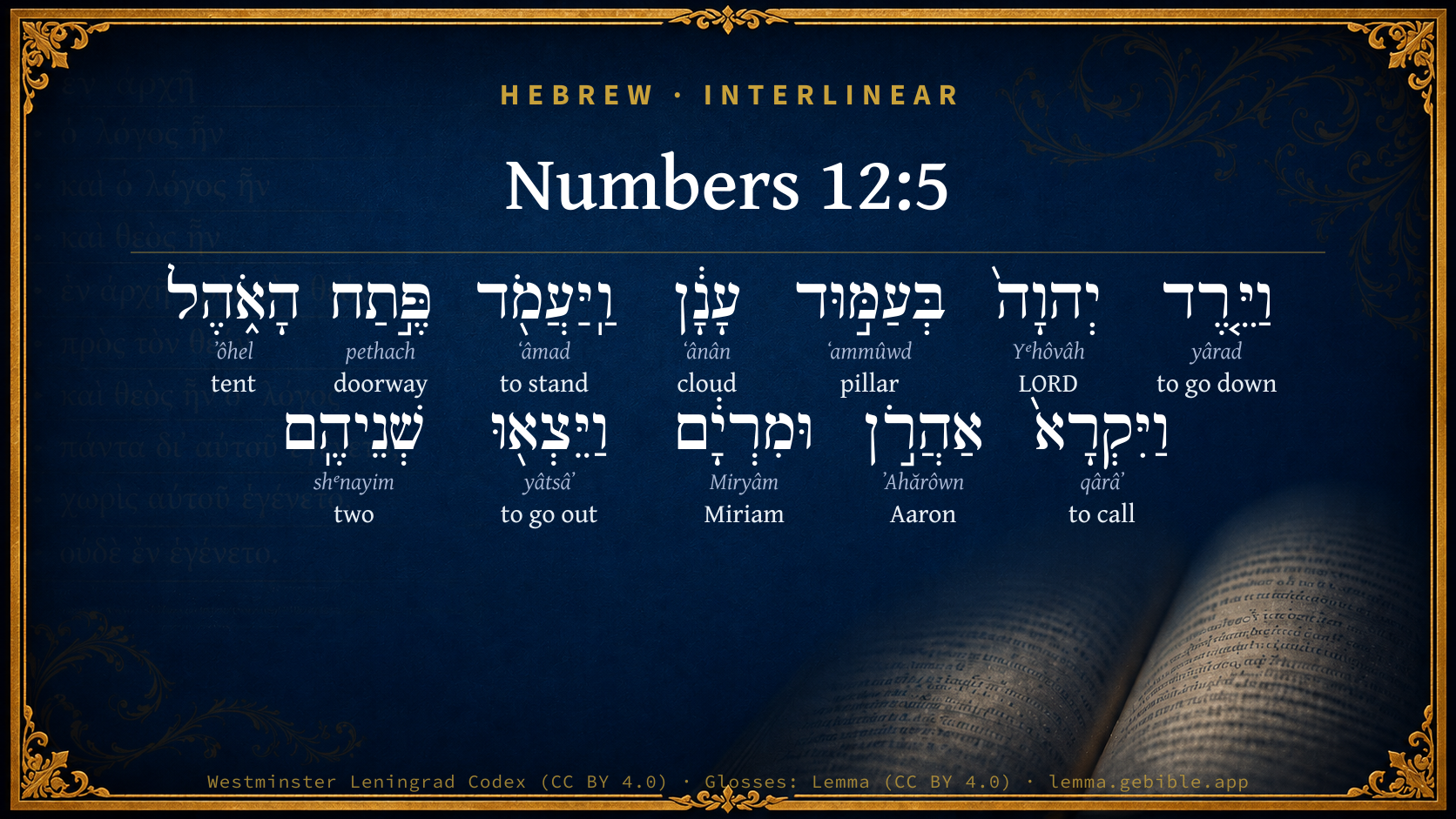
Hebrew (Westminster Leningrad Codex) Numbers 12:5 appears in the Hebrew Old Testament. The text above is from the Westminster Leningrad Codex. Each word links to its Strong’s number, a concise gloss, and parsing drawn from the Open Scriptures Hebrew Bible morphology. Click any word for its full Brown-Driver-Briggs (BDB) entry.
Download image
Cite this verse

Numbers 12:5 (World English Bible). Public Domain. Lemma interlinear Bible study tool, https://lemma.gebible.app/v/numbers/12/5.

Show BibTeX & RIS
BibTeX
RIS
English Translation
Yahweh came down in a pillar of cloud, and stood at the door of the Tent, and called Aaron and Miriam; and they both came forth.
World English Bible · Public Domain
Download a study sheet

One document with this verse’s original text, its word-by-word gloss line, the meaning frame, cross-references with their text, attributed commentary, and full source and license credits — printable, and it pastes into notes with its structure intact.

This verse Autodidact and up

Study sheet (.html) Plain text (.txt)

A passage Seminary Student

Up to 50 verses in one chapter. A passage sheet keeps up to 6 commentary sources and 12 cross-references per verse, in the order this page ranks them, and says so on the sheet whenever that leaves anything out. Ask for a single verse and you get the Autodidact verse sheet above.

Everything on this page stays free to read, with no account — the sheet is a download of what is already on screen, not access to it.

Want to remove ads? Support Godless Engineer
Compare translations 3

The same verse in 3 English versions, stacked beneath the original-language interlinear above. Click any original word for its lexicon entry.

Each is an independent rendering of the whole verse — the interlinear is not word-aligned to these translations.

Highlighted words mark where these versions differ — a whole-verse word diff, not a word-by-word alignment.

  • World English Bible Public Domain
    Yahweh came down in a pillar of cloud, and stood at the door of the Tent, and called Aaron and Miriam; and they both came forth.
  • King James Version Public Domain
    And the LORD came down in the pillar of the cloud, and stood in the door of the tabernacle, and called Aaron and Miriam: and they both came forth.
  • unfoldingWord Literal Text CC BY-SA 4.0
    And Yahweh came down in a pillar of cloud, and it stood the opening of the tent, and he called Aaron and Miriam, and the two of them went out.

unfoldingWord Literal Text — © unfoldingWord, licensed CC BY-SA 4.0. Word-aligned USFM3 via Door43 (git.door43.org/unfoldingWord/en_ult).

Versions to compare (up to 4)

3 of 4 selected

Show all 18 translations

Every available English version of this verse, each an independent rendering of the whole verse.

  • World English Bible Public Domain
    Yahweh came down in a pillar of cloud, and stood at the door of the Tent, and called Aaron and Miriam; and they both came forth.
  • Berean Standard Bible Public Domain
    and the LORD came down in a pillar of cloud, stood at the entrance to the Tent, and summoned Aaron and Miriam. When both of them had stepped forward,
  • Majority Standard Bible Public Domain
    and the LORD came down in a pillar of cloud, stood at the entrance to the Tent, and summoned Aaron and Miriam. When both of them had stepped forward,
  • King James Version Public Domain
    And the LORD came down in the pillar of the cloud, and stood in the door of the tabernacle, and called Aaron and Miriam: and they both came forth.
  • American Standard Version (1901) Public Domain
    And Jehovah came down in a pillar of cloud, and stood at the door of the Tent, and called Aaron and Miriam; and they both came forth.
  • Revised Version (1885) Public Domain
    And the LORD came down in a pillar of cloud, and stood at the door of the Tent, and called Aaron and Miriam: and they both came forth.
  • Geneva Bible (1599) Public Domain
    Then the Lord came downe in the pillar of the cloude, and stoode in the doore of the Tabernacle, and called Aaron and Miriam, and they both came forth.
  • Douay-Rheims (1899) Public Domain
    The Lord came down in a pillar of the cloud, and stood in the entry of the tabernacle calling to Aaron and Mary. And when they were come,
  • Young's Literal Translation Public Domain
    And Jehovah cometh down in the pillar of the cloud, and standeth at the opening of the tent, and calleth Aaron and Miriam, and they come out both of them.
  • Literal Standard Version CC BY-SA 4.0
    And YHWH comes down in the pillar of the cloud, and stands at the opening of the tent, and calls Aaron and Miriam, and both of them come out.
  • Unlocked Literal Bible CC BY-SA 4.0
    Then Yahweh came down in a pillar of cloud. He stood at the entrance to the tent and called Aaron and Miriam. They both came forward.
  • unfoldingWord Literal Text CC BY-SA 4.0
    And Yahweh came down in a pillar of cloud, and it stood the opening of the tent, and he called Aaron and Miriam, and the two of them went out.
  • Darby Bible Public Domain
    And Jehovah came down in the pillar of the cloud, and stood at the entrance of the tent, and called Aaron and Miriam; and they both came forth.
  • World Messianic Bible Public Domain
    The LORD came down in a pillar of cloud, and stood at the door of the Tent, and called Aaron and Miriam; and they both came forward.
  • Webster's Bible Public Domain
    And the LORD came down in the pillar of the cloud, and stood in the door of the tabernacle, and called Aaron and Miriam: and they both came forth.
  • Free Bible Version CC BY-SA 4.0
    The Lord came down in a pillar of cloud and stood in the entrance to the Tent. He called Aaron and Miriam and they came forward.
  • Bible in Basic English Public Domain
    And the Lord came down in a pillar of cloud, taking his place at the door of the Tent, and made Aaron and Miriam come before him.
  • JPS Tanakh (1917) Public Domain
    And the LORD came down in a pillar of cloud, and stood at the door of the Tent, and called Aaron and Miriam; and they both came forth.

Literal Standard Version (2020), Covenant Press — licensed CC BY-SA 4.0. Text via the HelloAO Bible API (eBible.org). Unlocked Literal Bible (unfoldingWord) — licensed CC BY-SA 4.0. Text via the HelloAO Bible API (eBible.org). unfoldingWord Literal Text — © unfoldingWord, licensed CC BY-SA 4.0. Word-aligned USFM3 via Door43 (git.door43.org/unfoldingWord/en_ult). Free Bible Version, Dr. Jonathan Gallagher — licensed CC BY-SA 4.0. Text via the HelloAO Bible API (eBible.org).

Word by word

More ways to search: Search by grammar → Find every occurrence → Compare this word →

Practice this passage: Drill this verse → Learn its vocabulary →

וּמִרְיָ֔ם
Miryâm
H4813
“and · Miriam”
Conjunction + Noun, Proper
Part of Speech
Conjunction + Noun
Type
Proper
Full BDB Definition

Origin: from H4805

TWOT: None

Miriam = "rebellion" - elder sister of Moses and Aaron - a woman of Judah
  1. וַיֵּ֤רֶד yârad H3381 “and · to go down” Conjunction + Verb, Qal, Sequential Imperfect, 3rd Person, Masculine, Singular
  2. יְהוָה֙ Yᵉhôvâh H3068 “LORD” Noun, Proper
  3. בְּעַמּ֣וּד ʻammûwd H5982 “in/at · pillar of” Preposition + Noun, Common, Masculine, Singular, Construct
  4. עָנָ֔ן ʻânân H6051 “cloud” Noun, Common, Masculine, Singular, Absolute
  5. וַֽיַּעֲמֹ֖ד ʻâmad H5975 “and · to stand” Conjunction + Verb, Qal, Sequential Imperfect, 3rd Person, Masculine, Singular
  6. פֶּ֣תַח pethach H6607 “doorway of” Noun, Common, Masculine, Singular, Construct
  7. הָאֹ֑הֶל ʼôhel H168 “the · tent” Particle, Definite Article + Noun, Common, Masculine, Singular, Absolute
  8. וַיִּקְרָא֙ qârâʼ H7121 “and · to call” Conjunction + Verb, Qal, Sequential Imperfect, 3rd Person, Masculine, Singular
  9. אַהֲרֹ֣ן ʼAhărôwn H175 “Aaron” Noun, Proper
  10. וַיֵּצְא֖וּ yâtsâʼ H3318 “and · to go out” Conjunction + Verb, Qal, Sequential Imperfect, 3rd Person, Masculine, Plural
  11. שְׁנֵיהֶֽם shᵉnayim H8147 “two · their” Adjective, Cardinal number, Masculine, Dual, Construct + Suffix, Personal, 3rd Person, Masculine, Plural

About this verse

These counts appear in no published source. They are computed here, from the morphology-tagged text and Lemma’s own curated glosses. What Lemma adds →

12
words
12
distinct lemmas
Pentateuch
section

Notable vocabulary

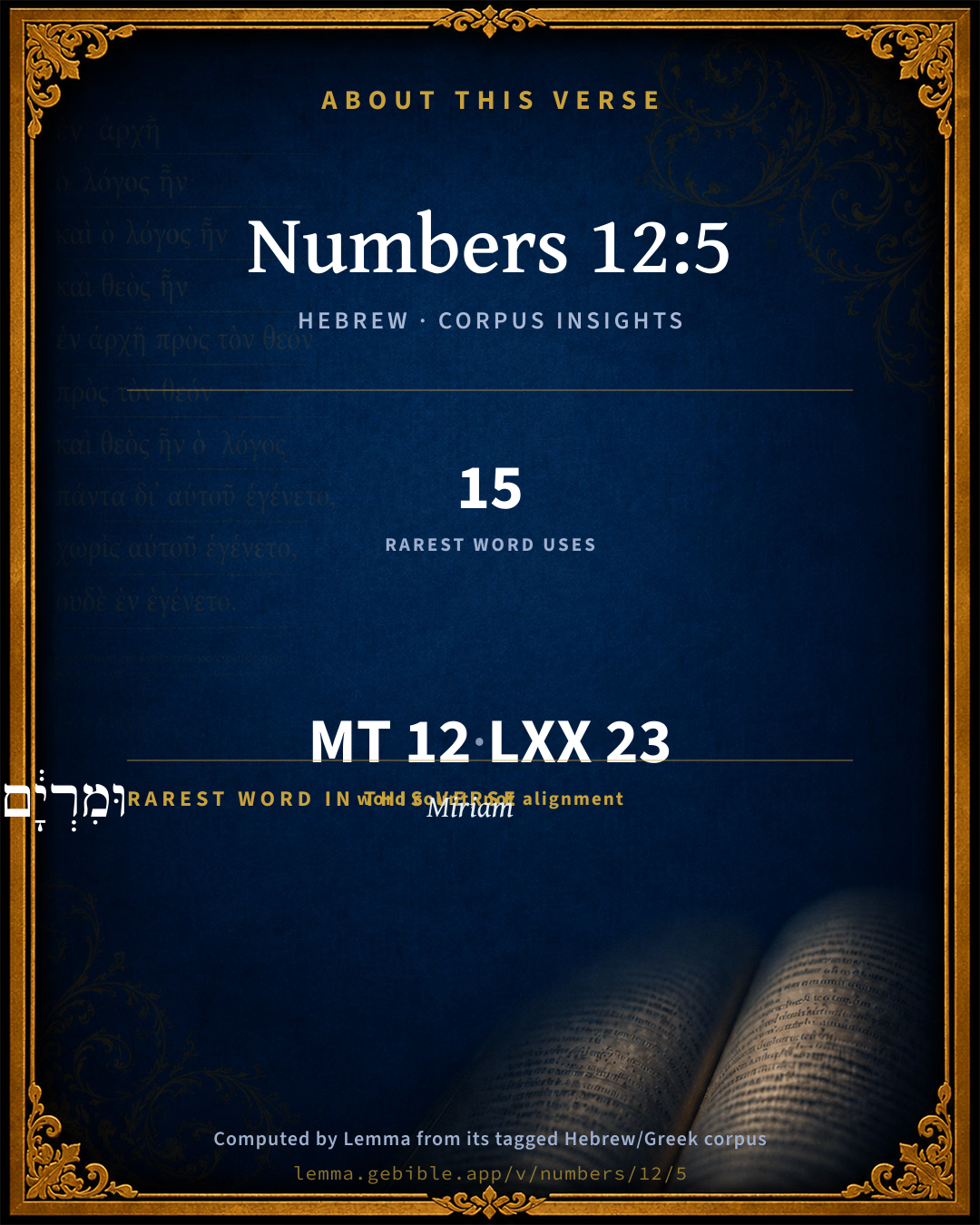
The rarest word here is וּמִרְיָ֔ם Miriam H4813 — appearing just 15 times in the whole Hebrew Bible.

Shared distinctive vocabulary

וּמִרְיָ֔ם Miriam H4813 occurs in 13 verses of the Hebrew Bible. Also found in:

Grammatical profile

  • 4 verbs
  • 7 nouns
  • 1 adjective

Verb forms

  • וַיֵּ֤רֶד Qal · Sequential Imperfect
  • וַֽיַּעֲמֹ֖ד Qal · Sequential Imperfect
  • וַיִּקְרָא֙ Qal · Sequential Imperfect
  • וַיֵּצְא֖וּ Qal · Sequential Imperfect

Hebrew & Septuagint length

In English translation the verse runs 26 words from the Hebrew and 40 from the Septuagint (LXX English) — the Septuagint runs noticeably longer here. See the side-by-side →

A rough comparison of the two English renderings, which tokenize alike — not a word-level alignment.

Word counts can differ between the Hebrew and the Greek without any difference in meaning — e.g. the Hebrew direct-object marker אֵת has no separate Greek word, and Greek often adds the article ὁ.

In the original languages it is 12 Hebrew tokens and 23 Greek tokens — but the two are counted differently (Hebrew bundles its prefixes and suffixes into one token; the Greek is in lemma form), so that isn’t a like-for-like length.

Cross-references

4

Topical passages linked to Numbers 12:5 in the Treasury of Scripture Knowledge — connected by theme and wording, ordered by reader-vote popularity; previews shown in the World English Bible.

  • Numbers 11:25 Yahweh came down in the cloud, and spoke to him, and took of the Spirit that was on him, and put it on the seventy elders: and it happened that when the Spirit rested on them, they prophesied, but they did so no more.
  • Exodus 34:5 Yahweh descended in the cloud, and stood with him there, and proclaimed the name of Yahweh.
  • Exodus 40:38 For the cloud of Yahweh was on the tent by day, and there was fire in the cloud by night, in the sight of all the house of Israel, throughout all their journeys.
  • Psalms 99:7 He spoke to them in the pillar of cloud. They kept his testimonies, The statute that he gave them.

Cross-references courtesy of OpenBible.info (CC BY 4.0).

Hebrew and Greek witnesses Masoretic Hebrew ↔ Greek Septuagint

The same verse in the two great witnesses to the Old Testament, shown verse-for-verse.

Here the Septuagint runs noticeably longer than the Hebrew — LXX2012 (modern English Septuagint) 40 words vs World English Bible 26. A rough length comparison of the two English translations, not a word-level alignment — read both below.

These are two independent witnesses, not word-aligned to each other, and the Septuagint is shown in lemma (dictionary) form.

Hebrew Numbers 12:5 Masoretic · Westminster Leningrad Codex

וַיֵּ֤רֶד יְהוָה֙ בְּעַמּ֣וּד עָנָ֔ן וַֽיַּעֲמֹ֖ד פֶּ֣תַח הָאֹ֑הֶל וַיִּקְרָא֙ אַהֲרֹ֣ן וּמִרְיָ֔ם וַיֵּצְא֖וּ שְׁנֵיהֶֽם

Yahweh came down in a pillar of cloud, and stood at the door of the Tent, and called Aaron and Miriam; and they both came forth.

World English Bible · Public Domain

Greek LXX Numbers 12:5 Septuagint · lemma form

καί καταβαίνω κύριος ἐν στῦλος νεφέλη καί ἵστημι ἐπί ὁ θύρα ὁ σκηνή ὁ μαρτύριον καί καλέω ἀαρών καί μαριαμ καί ἐκἔρχομαι ἀμφότεροι

And the three came forth to the tabernacle of witness; and the Lord descended in a pillar of a cloud, and stood at the door of the tabernacle of witness; and Aaron and Mariam were called; and both came forth.

LXX2012 (modern English Septuagint) · Public Domain

Hebrew: Westminster Leningrad Codex (CC BY 4.0). Greek: Septuagint (public domain); English from LXX2012 (modern English Septuagint) (Public Domain). How the Septuagint differs from the Hebrew →

Targum (Aramaic paraphrase)

2

The Targum is the ancient Jewish Aramaic paraphrase of the Hebrew Scriptures — an interpretive translation, not the Hebrew text itself. Onkelos (literal) and Pseudo-Jonathan (expansive) render the Torah, and Jonathan the Prophets. Coverage is partial: where no permissively-licensed English translation exists for a verse, only the Aramaic is shown. This is verse-level text, not a word-by-word alignment to the Hebrew.

  1. Targum Onkelos Torah (Genesis–Deuteronomy)
    וְאִתְגְלֵי יְיָ בְּעַמוּדָא דַעֲנָנָא וְקָם בִּתְרַע מַשְׁכְּנָא וּקְרָא אַהֲרֹן וּמִרְיָם וּנְפָקוּ תַּרְוֵיהוֹן

    (no public-domain English translation for this verse)

    Targum Onkelos — Aramaic: “Onkelos Genesis” (public domain); “Onkelos Exodus” (public domain); “Onkelos Leviticus” (public domain); “Onkelos Numbers” (public domain); “Onkelos Deuteronomy” (public domain). English: “Sefaria Community Translation” (CC0 1.0 (public-domain dedication)); “J.W. Etheridge. The Targums of Onkelos and Jonathan Ben Uzziel on the Pentateuch. London: Longmans, Green, 1862” (public domain). Text via Sefaria.

  2. Targum Pseudo-Jonathan Torah (Genesis–Deuteronomy)
    וְאִתְגְלֵי יְקָרָא דַיְיָ בְּעַמוּדָא דַעֲנַן יְקָרָא וְקָם בִּתְרַע מַשְׁכְּנָא וּקְרָא אַהֲרן וּמִרְיָם וּנְפָקוּ תַּרְוֵיהוֹן

    And the Glory of the Lord was revealed in the Cloud of Glory, and He stood at the door of the tabernacle, and called Aharon and Miriam: and those two came forth.

    Targum Pseudo-Jonathan — Aramaic: “Targum Jonathan on Genesis” (public domain); “Targum Jonathan on Exodus” (public domain); “Targum Jonathan on Leviticus” (public domain); “Targum Jonathan on Numbers” (public domain); “Targum Jonathan on Deuteronomy” (public domain). English: “The Targum of Jonathan ben Uzziel, trans. J. W. Etheridge, London, 1862” (public domain). Text via Sefaria.

Commentary

Notes on Numbers 12:5 from classic Christian and Jewish commentators (each source and its license shown beneath its notes). The classic Christian expositions comment on the surrounding passage and are grouped to its opening verse, so a note may address several verses; the Jewish commentaries on the Tanakh (Rashi and others) are per-verse, so they appear only where the commentator wrote on this verse.

Lemma curates 59 commentaries, every one of them public domain or Creative Commons licensed, each selected and text-cleaned for this edition rather than reprinted as found. About our sources →

Trapp's Complete Commentary

John Trapp

Num 12:5 And the LORD came down in the pillar of the cloud, and stood [in] the door of the tabernacle, and called Aaron and Miriam: and they both came forth.

Ver. 5. Out of the cloud.] As from the throne of his glory.

John Trapp, A Commentary or Exposition upon All the Books of the Old and New Testament (1647–1656) — public domain. Text from a community e-Sword module.

The Biblical Illustrator

Joseph S. Exell

Num_12:5-10

The Lord came down.

Gods vindication of Moses

There are several circumstances of the Lords proceedings laid down in the text.

1. As, first, His speed. By and by the Lord called them; so showing us how fitting a thing, yea, how pleasing to Him, convenient expedition is in justice, and how displeasing, needless, and sinister delays. It showeth also what a tender feeling God hath of the wrongs of His children, not only of some, but by name of magistrates and governors wrongs, when they are spoken against without cause. Surely He so feeleth it, that even by and by He will undertake the righting of them, and cannot hold from punishing such offenders as so lightly regard His holy ordinance. We think that unless we keep ado in our own causes it is not well (and I condemn not all care this way), but certainly none have been sooner and better righted than such as patiently have endured a time and committed things to the justice of God.

2. He calleth the two offenders by themselves, leaving Moses to hear and see for his comfort the Lords care for him. And this also is a great point of justice, to call persons that have done amiss, not carrying matters in secret and condemning without hearing.

3. He speaketh to them and biddeth them hear His words as He had heard theirs. Which likewise showeth that true justice chargeth men, and doth not hoard up in heart what cutteth off love and liking; giving good words outwardly, and yet inwardly thinking most evil things. Oh, let us hear your words if you have conceived any offence, and then will either confession or true purgation give satisfaction? The contrary course may have policy in it, but who shall justify it for piety, charity, or any virtue?

4. In His words He setteth down the difference of prophets, showing that all have not alike measure vouchsafed of Him, and therefore may not argue, I am a prophet as well as he; ergo, as good as he. Such kind of reasonings have in all times disquieted the Church and peace of the godly. The differences which God layeth down you see in the text. To some by vision; to some by dream; to some in darker words, to some in plainer; but to Moses mouth to mouth; that is in a more excellent measure of grace, and familiar favour than ever to any. Therefore, although the Lord had also spoken by them; yet forasmuch as it was not in that degree as to Moses, they should not have compared themselves with him, but yielded him a reverence above themselves. Yea, how were ye not afraid, saith the Lord, to speak against My servant Moses, even against Moses? So showing that imparity of grace and gifts from the Lord should work ever an imparity of honour and regard by all that will walk rightly, though in some other respect there may be a parity. (Bp. Babington.)

The Biblical Illustrator, edited by Joseph S. Exell (c. 1880s–1900s) — public domain. Text from a community e-Sword module.

Jamieson, Fausset & Brown

Robert Jamieson, A. R. Fausset & David Brown

the Lord came down in the pillar of the cloud, and stood the door of the tabernacle--without gaining admission, as was the usual privilege of Aaron, though it was denied to all other men and women. This public exclusion was designed to be a token of the divine displeasure.

Jamieson, Fausset & Brown — Commentary Critical and Explanatory on the Whole Bible (1871) — public domain (CC PDM 1.0). Text via the HelloAO Bible API.

The Cambridge Bible for Schools and Colleges

gen. ed. J. J. S. Perowne

5. they both came forth] i.e. probably from the tent, not from the camp. In Exo_33:8 f. it is said that Moses used habitually to enter the tent, and God talked with him there. The same thing may have occurred in the present case. Aaron and Miriam, in vaunting their claim to equality, imitated the action of Moses and entered with him; and they were then summoned to come forth to hear Jehovah’s oracle. His previous command ‘Come out ye three unto the tent of meeting’ was a challenge to Aaron and Miriam to do as Moses did, and to experience the result. Compare the similar challenge made by Aaron in Num_16:6 f. (P ).

The Cambridge Bible for Schools and Colleges (gen. ed. J. J. S. Perowne; Cambridge University Press, 1878–1918) — public domain. Text from a community e-Sword module.

John Gill's Exposition

The Lord came down in the pillar of the cloud,.... Which was over the most holy place of the tabernacle, and which was a symbol of the presence of the Lord; and who is said to come down, because that was above the tabernacle; whereas he came, as is next expressed:

and stood in the door of the tabernacle; where he set up his tribunal, and called them to his bar, courts of judicature being usually held in the gate; not suffering them to go into the tabernacle as they were wont to do, being delinquents:

and called Aaron and Miriam; to come nearer to him, and hear what he had to say to them; Moses keeping at a greater distance, it not being so proper that he should be within hearing of those commendations which were about to be given of him:

and they both came forth; Aaron and Miriam, and stood before the Lord.

John Gill's Exposition of the Whole Bible (1746–1763) — public domain (CC PDM 1.0). Text via the HelloAO Bible API.

Haydock's Catholic Bible Commentary

Come to the door of the tabernacle, where Moses also was standing.

George Leo Haydock (1774–1849), Haydock's Catholic Family Bible and Commentary, 1859 edition — public domain. Excludes Psalms (Douay-Rheims chapter numbering differs from Protestant) and Deuterocanonical books (Catholic canon only).

Matthew Poole's English Annotations

In the door of the tabernacle, where they stood without, not being admitted into the tabernacle, as Aaron used to be; which is noted as a sign of God’s displeasure.

Matthew Poole's English Annotations on the Holy Bible (1683–1685) — public domain. Text from a community e-Sword/MySword module.

Whedon's Commentary on the Bible

Daniel D. Whedon

5. The Lord came down — This anthropomorphic expression is to be understood as an accommodation of the mystery of divine revelation to human comprehension. Though God is everywhere, there is a sense in which he draws near to man when he wishes to communicate with him.

They both came forth — Leaving the company of Moses, the two placed themselves near the door of the tabernacle, in the doorway of which the cloud stood, to hear what the Lord had to say to them.

Daniel D. Whedon (gen. ed.), Commentary on the Old and New Testaments (1874–1909) — public domain. Text from a community e-Sword module.

The Pulpit Commentary

The Lord came down in the pillar of the cloud. The cloud which had been soaring above the tabernacle descended upon it. (see Num_11:25 and Num_12:10) And stood in the door of the tabernacle. It would seem most natural to understand by these words the entrance to the holy place itself, and this would manifestly accord best with the movements of the cloud, as here described; for the cloud seems to have sunk down upon the sacred tent in token that the Lord was in some special sense present within it. On the other hand, the phrase must certainly be understood to mean the entrance of the court, or sacred enclosure, in Lev_8:3, Lev_8:31, Lev_8:33, and probably in other places. As it is hardly possible that the phrase can have had both meanings, the latter must be preferred. And they both came forth. Not out of the sanctuary, into which Miriam could not have entered, but out of the enclosure. The wrath which lay upon them both, and the punishment which was about to be inflicted upon one, were sufficient reasons for calling them out of the holy ground.

The Pulpit Commentary (1880–1919), ed. H.D.M. Spence-Jones & Joseph S. Exell — public domain. Text from a community e-Sword module.

John Wesley's Explanatory Notes

In the door - While they stood without, not being admitted into the tabernacle, as Aaron used to be; a sign of God's displeasure.

John Wesley, Explanatory Notes Upon the Whole Bible (1754–1765) — public domain. Text via the GEBible commentary corpus.

Rashi

Rabbi Shlomo Yitzchaki (Rashi)

בעמוד ענן [AND THE LORD CAME DOWN] IN THE COLUMN OF THE CLOUD — He came alone to punish them, not as is the manner of human beings: when a human king goes to war, he goes with numerous troops, but when he goes forth peaceably, he goes forth with only a few. But the manner of the Holy One, blessed be He, is that He goes to war alone — as it is said, (Exodus 15:3) “The Lord alone is the man of war, but He goes forth for peace accompanied by His hosts, as it is said, (Psalms 68:18) “The chariots of God are twenty thousands, even thousands of angels of peace (שנאן)” (Sifrei Bamidbar 102).

ויקרא אהרן ומרים AND HE CALLED: “AARON AND MIRIAM!” — that they should proceed further, and go forth from the court towards God (more lit., the Divine Speech) (Sifrei Bamidbar 102).

ויצאו שניהם AND THEY BOTH WENT FORTH — And why did He bid them go further and so separate them from Moses? Because there is a rule that one should utter only a part of a man’s good qualities in his presence, but that the whole of them should be told only in his absence. Similarly we find in the case of Noah, that in his absence (i.e. when Scripture speaks about him) it says of him: “a righteous and whole-hearted man” (Genesis 6:9), whilst in his presence (i.e. where God is speaking to Noah) it states, (Genesis 7:1) “for thee I have seen righteous before me”, (and it does not add: whole-hearted) (Sifrei Bamidbar 102). — Another explanation is: God bid only Aaron and Miriam to draw near in order that he (Moses) should not hear the reprimand administered to Aaron.

Rashi on the Tanakh — English translations: “The Judaica Press complete Tanach with Rashi, translated by A. J. Rosenberg” (CC BY 4.0); “Pentateuch with Rashi's commentary by M. Rosenbaum and A.M. Silbermann, 1929-1934” (public domain); “The Metsudah Tanach series, Lakewood, N.J” (CC BY 4.0); and “The Book of Joshua, Metsudah Publications, 1997” (CC BY 4.0). Text via Sefaria.

Lesson kit

Teaching starters — assembled from the data on this page, not authored interpretation. Every prompt links to the verse data it draws on. Edit before teaching.

Numbers, in the Pentateuch, opens this verse with 12 words (12 distinct Hebrew lemmas). Its most distinctive word is Miryâm (“Miriam”). The Greek Septuagint runs longer here. A historical commentator’s framing appears above. Read the whole chapter for the surrounding context.

Discussion questions

  1. The word Miryâm carries the sense “Miriam.” How does it shape the verse?
  2. Exodus 15:20 shares the word «Miriam» with this verse. How do the two illuminate each other?
  3. Compared with the Hebrew, the Septuagint runs longer here. What questions does that raise?
  4. The translations on this page render this verse differently — a whole-verse word diff, not a word-by-word alignment. What might account for the different wordings?
  5. The verb «וַיֵּ֤רֶד» is Qal Sequential Imperfect. How does its form color the action?
  6. Reading how Trapp's Complete Commentary and The Biblical Illustrator read this verse, where do the two commentators agree and where do they part?

Things to notice

Reading settings

Reading text

Shown beneath each verse's original-language words.

Old Testament
Old Testament edition

Read the OT as the Masoretic Hebrew (MT) or the Greek Septuagint (LXX).

English shown for the Greek Septuagint (in the Hebrew ↔ Greek comparison).

Comparing translations? Open the Compare panel on any verse page to stack up to four side by side.