
Deuteronomy 31:14

Hebrew (Westminster Leningrad Codex) Deuteronomy 31:14 appears in the Hebrew Old Testament. The text above is from the Westminster Leningrad Codex. Each word links to its Strong’s number, a concise gloss, and parsing drawn from the Open Scriptures Hebrew Bible morphology. Click any word for its full Brown-Driver-Briggs (BDB) entry.
Download image
Cite this verse

Deuteronomy 31:14 (World English Bible). Public Domain. Lemma interlinear Bible study tool, https://lemma.gebible.app/v/deuteronomy/31/14.

Show BibTeX & RIS
BibTeX
RIS
English Translation
Yahweh said to Moses, Behold, your days approach that you must die: call Joshua, and present yourselves in the tent of meeting, that I may give him a charge. Moses and Joshua went, and presented themselves in the tent of meeting.
World English Bible · Public Domain
Download a study sheet

One document with this verse’s original text, its word-by-word gloss line, the meaning frame, cross-references with their text, attributed commentary, and full source and license credits — printable, and it pastes into notes with its structure intact.

This verse Autodidact and up

Study sheet (.html) Plain text (.txt)

A passage Seminary Student

Up to 50 verses in one chapter. A passage sheet keeps up to 6 commentary sources and 12 cross-references per verse, in the order this page ranks them, and says so on the sheet whenever that leaves anything out. Ask for a single verse and you get the Autodidact verse sheet above.

Everything on this page stays free to read, with no account — the sheet is a download of what is already on screen, not access to it.

Want to remove ads? Support Godless Engineer
Compare translations 3

The same verse in 3 English versions, stacked beneath the original-language interlinear above. Click any original word for its lexicon entry.

Each is an independent rendering of the whole verse — the interlinear is not word-aligned to these translations.

Highlighted words mark where these versions differ — a whole-verse word diff, not a word-by-word alignment.

  • World English Bible Public Domain
    Yahweh said to Moses, Behold, your days approach that you must die: call Joshua, and present yourselves in the tent of meeting, that I may give him a charge. Moses and Joshua went, and presented themselves in the tent of meeting.
  • King James Version Public Domain
    And the LORD said unto Moses, Behold, thy days approach that thou must die: call Joshua, and present yourselves in the tabernacle of the congregation, that I may give him a charge. And Moses and Joshua went, and presented themselves in the tabernacle of the congregation.
  • unfoldingWord Literal Text CC BY-SA 4.0
    And Yahweh said to Moses, “Behold, your dying day is approaching; call Joshua and present yourselves in the tent of meeting, and I will command him.” And Moses and Joshua went and presented themselves in the tent of meeting.

unfoldingWord Literal Text — © unfoldingWord, licensed CC BY-SA 4.0. Word-aligned USFM3 via Door43 (git.door43.org/unfoldingWord/en_ult).

Versions to compare (up to 4)

3 of 4 selected

Show all 18 translations

Every available English version of this verse, each an independent rendering of the whole verse.

  • World English Bible Public Domain
    Yahweh said to Moses, Behold, your days approach that you must die: call Joshua, and present yourselves in the tent of meeting, that I may give him a charge. Moses and Joshua went, and presented themselves in the tent of meeting.
  • Berean Standard Bible Public Domain
    Then the LORD said to Moses, “Behold, the time of your death is near. Call Joshua and present yourselves at the Tent of Meeting, so that I may commission him.” So Moses and Joshua went and presented themselves at the Tent of Meeting.
  • Majority Standard Bible Public Domain
    Then the LORD said to Moses, “Behold, the time of your death is near. Call Joshua and present yourselves at the Tent of Meeting, so that I may commission him.” So Moses and Joshua went and presented themselves at the Tent of Meeting.
  • King James Version Public Domain
    And the LORD said unto Moses, Behold, thy days approach that thou must die: call Joshua, and present yourselves in the tabernacle of the congregation, that I may give him a charge. And Moses and Joshua went, and presented themselves in the tabernacle of the congregation.
  • American Standard Version (1901) Public Domain
    And Jehovah said unto Moses, Behold, thy days approach that thou must die: call Joshua, and present yourselves in the tent of meeting, that I may give him a charge. And Moses and Joshua went, and presented themselves in the tent of meeting.
  • Revised Version (1885) Public Domain
    And the LORD said unto Moses, Behold, thy days approach that thou must die: call Joshua, and present yourselves in the tent of meeting, that I may give him a charge. And Moses and Joshua went, and presented themselves in the tent of meeting.
  • Geneva Bible (1599) Public Domain
    Then the Lord saide vnto Moses, Beholde, thy dayes are come, that thou must die: Call Ioshua, and stande ye in the Tabernacle of the Congregation that I may giue him a charge. So Moses and Ioshua went, and stoode in the Tabernacle of the Congregation.
  • Douay-Rheims (1899) Public Domain
    And the Lord said to Moses: Behold the days of thy death are nigh: call Josue, and stand ye in the tabernacle of the testimony, that I may give him a charge. So Moses and Josue went and stood in the tabernacle of the testimony:
  • Young's Literal Translation Public Domain
    And Jehovah saith unto Moses, `Lo, thy days have drawn near to die; call Joshua, and station yourselves in the tent of meeting, and I charge him;' and Moses goeth -- Joshua also -- and they station themselves in the tent of meeting,
  • Literal Standard Version CC BY-SA 4.0
    And YHWH says to Moses, “Behold, your days have drawn near to die; call Joshua, and station yourselves in the Tent of Meeting, and I charge him”; and Moses goes—Joshua also—and they station themselves in the Tent of Meeting,
  • Unlocked Literal Bible CC BY-SA 4.0
    Yahweh said to Moses, “Look, the day is coming when you must die; call Joshua and present yourselves in the tent of meeting, so that I may give him a command.” Moses and Joshua went and presented themselves in the tent of meeting.
  • unfoldingWord Literal Text CC BY-SA 4.0
    And Yahweh said to Moses, “Behold, your dying day is approaching; call Joshua and present yourselves in the tent of meeting, and I will command him.” And Moses and Joshua went and presented themselves in the tent of meeting.
  • Darby Bible Public Domain
    And Jehovah said to Moses, Lo, the days are near for thee to die; call Joshua, and present yourselves at the tent of meeting, that I may give him a charge. And Moses and Joshua went and presented themselves at the tent of meeting.
  • World Messianic Bible Public Domain
    The LORD said to Moses, “Behold, your days approach that you must die. Call Joshua, and present yourselves in the Tent of Meeting, that I may commission him.” Moses and Joshua went, and presented themselves in the Tent of Meeting.
  • Webster's Bible Public Domain
    And the LORD said to Moses, Behold, thy days approach that thou must die: call Joshua, and present yourselves in the tabernacle of the congregation, that I may give him a charge. And Moses and Joshua went and presented themselves in the tabernacle of the congregation.
  • Free Bible Version CC BY-SA 4.0
    Then the Lord told Moses, “Listen, you are soon going to die. Tell Joshua to meet you, and then both of you are to come and stand before me at the Tent of Meeting, so that I may appoint him as leader.” Moses and Joshua went to stand before the Lord at the Tent of Meeting.
  • Bible in Basic English Public Domain
    At that time the Lord said to Moses, The day of your death is near: send for Joshua, and come to the Tent of meeting so that I may give him his orders. So Moses and Joshua went to the Tent of meeting.
  • JPS Tanakh (1917) Public Domain
    And the LORD said unto Moses: 'Behold, thy days approach that thou must die; call Joshua, and present yourselves in the tent of meeting, that I may give him a charge.' And Moses and Joshua went, and presented themselves in the tent of meeting.

Literal Standard Version (2020), Covenant Press — licensed CC BY-SA 4.0. Text via the HelloAO Bible API (eBible.org). Unlocked Literal Bible (unfoldingWord) — licensed CC BY-SA 4.0. Text via the HelloAO Bible API (eBible.org). unfoldingWord Literal Text — © unfoldingWord, licensed CC BY-SA 4.0. Word-aligned USFM3 via Door43 (git.door43.org/unfoldingWord/en_ult). Free Bible Version, Dr. Jonathan Gallagher — licensed CC BY-SA 4.0. Text via the HelloAO Bible API (eBible.org).

Word by word

More ways to search: Search by grammar → Find every occurrence → Compare this word →

Practice this passage: Drill this verse → Learn its vocabulary →

וְהִֽתְיַצְּב֛וּ
yâtsab
H3320
“and · stand”
Conjunction + Verb, Hithpael, Imperative, 2nd Person, Masculine, Plural
Part of Speech
Conjunction + Verb
Stem
Hithpael
Form
Imperative
Person
2nd Person
Gender
Masculine
Number
Plural
Full BDB Definition

Origin: a primitive root

TWOT: 894

to place, set, stand, set or station oneself, present oneself - (Hithpael) to station oneself, take one's stand, stand, present oneself, stand with someone
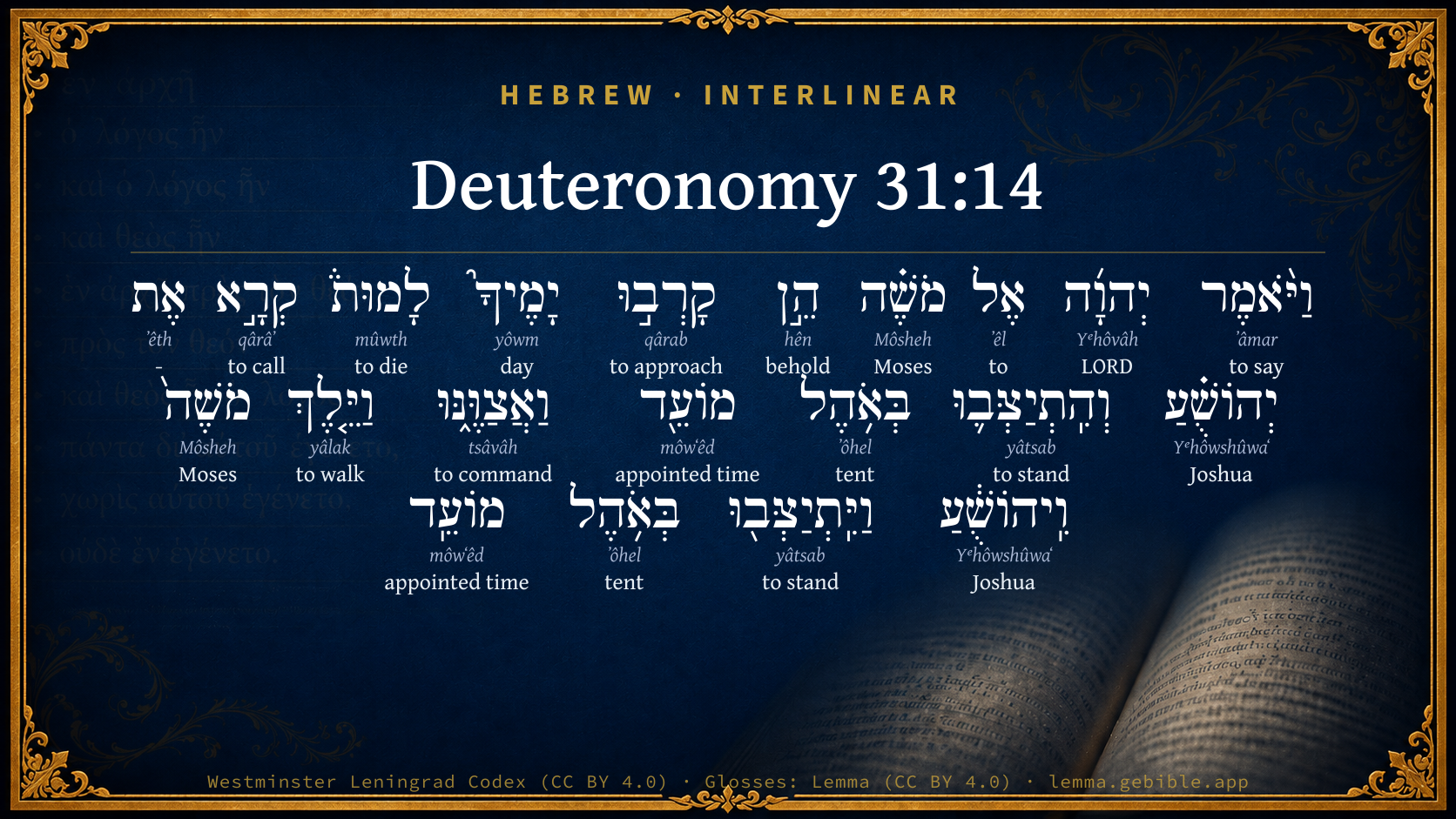
  1. וַיֹּ֨אמֶר ʼâmar H559 “and · to say” Conjunction + Verb, Qal, Sequential Imperfect, 3rd Person, Masculine, Singular
  2. יְהוָ֜ה Yᵉhôvâh H3068 “LORD” Noun, Proper
  3. אֶל ʼêl H413 “to” Preposition
  4. מֹשֶׁ֗ה Môsheh H4872 “Moses” Noun, Proper
  5. הֵ֣ן hên H2005 “behold” Particle, Demonstrative
  6. קָרְב֣וּ qârab H7126 “to approach” Verb, Qal, Perfect, 3rd Person, Common, Plural
  7. יָמֶיךָ֮ yôwm H3117 “days · your” Noun, Common, Masculine, Plural, Construct + Suffix, Personal, 2nd Person, Masculine, Singular
  8. לָמוּת֒ mûwth H4191 “to die” Preposition + Verb, Qal, Infinitive Construct
  9. קְרָ֣א qârâʼ H7121 “call” Verb, Qal, Imperative, 2nd Person, Masculine, Singular
  10. אֶת ʼêth H853 “-” Particle, Direct Object
  11. יְהוֹשֻׁ֗עַ Yᵉhôwshûwaʻ H3091 “Joshua” Noun, Proper
  12. בְּאֹ֥הֶל ʼôhel H168 “in/at · tent of” Preposition + Noun, Common, Masculine, Singular, Construct
  13. מוֹעֵ֖ד môwʻêd H4150 “appointed time” Noun, Common, Masculine, Singular, Absolute
  14. וַאֲצַוֶּ֑נּוּ tsâvâh H6680 “and · to command · him” Conjunction + Verb, Piel, Sequential Imperfect, 1st Person, Common, Singular + Suffix, Personal, 3rd Person, Masculine, Singular
  15. וַיֵּ֤לֶךְ yâlak H3212 “and · to walk” Conjunction + Verb, Qal, Sequential Imperfect, 3rd Person, Masculine, Singular
  16. מֹשֶׁה֙ Môsheh H4872 “Moses” Noun, Proper
  17. וִֽיהוֹשֻׁ֔עַ Yᵉhôwshûwaʻ H3091 “and · Joshua” Conjunction + Noun, Proper
  18. וַיִּֽתְיַצְּב֖וּ yâtsab H3320 “and · to stand” Conjunction + Verb, Hithpael, Sequential Imperfect, 3rd Person, Masculine, Plural
  19. בְּאֹ֥הֶל ʼôhel H168 “in/at · tent of” Preposition + Noun, Common, Masculine, Singular, Construct
  20. מוֹעֵֽד môwʻêd H4150 “appointed time” Noun, Common, Masculine, Singular, Absolute

About this verse

These counts appear in no published source. They are computed here, from the morphology-tagged text and Lemma’s own curated glosses. What Lemma adds →

21
words
16
distinct lemmas
Pentateuch
section

Shared distinctive vocabulary

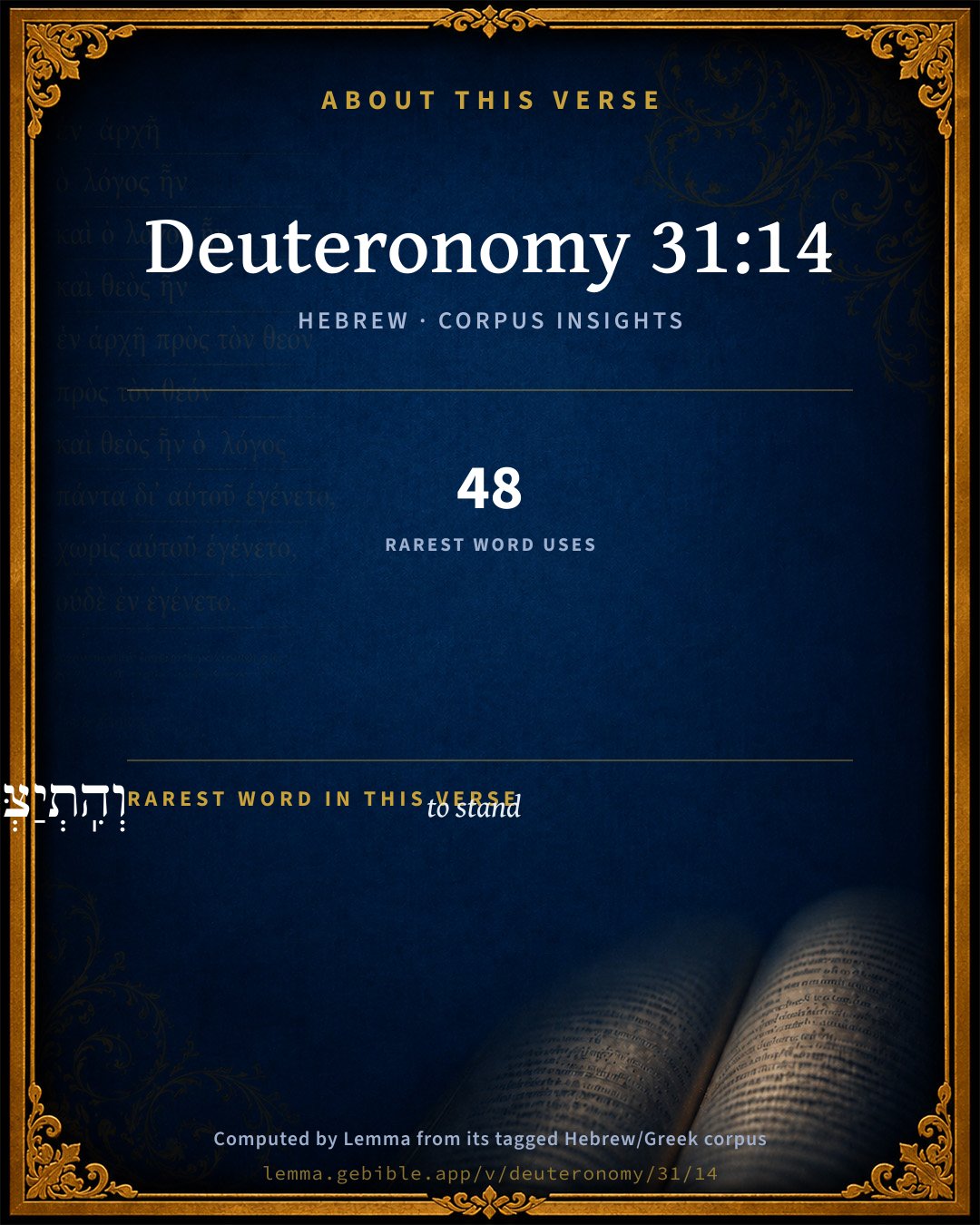
וְהִֽתְיַצְּב֛וּ to stand H3320 occurs in 45 verses of the Hebrew Bible. Also found in:

Grammatical profile

  • 8 verbs
  • 10 nouns
  • 1 preposition
  • 2 particles

Verb forms

  • וַיֹּ֨אמֶר Qal · Sequential Imperfect
  • קָרְב֣וּ Qal · Perfect
  • לָמוּת֒ Qal · Infinitive Construct
  • קְרָ֣א Qal · Imperative
  • וְהִֽתְיַצְּב֛וּ Hithpael · Imperative
  • וַאֲצַוֶּ֑נּוּ Piel · Sequential Imperfect
  • וַיֵּ֤לֶךְ Qal · Sequential Imperfect
  • וַיִּֽתְיַצְּב֖וּ Hithpael · Sequential Imperfect

Repetition

Words recur within this verse — often emphatic in Hebrew:

  • מֹשֶׁ֗ה Moses H4872 ×2
  • יְהוֹשֻׁ֗עַ Joshua H3091 ×2
  • וְהִֽתְיַצְּב֛וּ to stand H3320 ×2
  • בְּאֹ֥הֶל tent H168 ×2
  • מוֹעֵ֖ד appointed time H4150 ×2

Hebrew & Septuagint length

In English translation the verse runs 41 words from the Hebrew and 55 from the Septuagint (LXX English) — closely comparable.

A rough comparison of the two English renderings, which tokenize alike — not a word-level alignment.

Word counts can differ between the Hebrew and the Greek without any difference in meaning — e.g. the Hebrew direct-object marker אֵת has no separate Greek word, and Greek often adds the article ὁ.

Cross-references

19

Topical passages linked to Deuteronomy 31:14 in the Treasury of Scripture Knowledge — connected by theme and wording, ordered by reader-vote popularity; previews shown in the World English Bible.

  • Numbers 27:13 When you have seen it, you also shall be gathered to your people, as Aaron your brother was gathered;
  • Deuteronomy 31:23 He gave Joshua the son of Nun a charge, and said, Be strong and of good courage; for you shall bring the children of Israel into the land which I swore to them: and I will be with you.
  • 1 Samuel 10:19 but you have this day rejected your God, who himself saves you out of all your calamities and your distresses; and you have said to him, [No], but set a king over us. Now therefore present yourselves before Yahweh by your tribes, and by your thousands.
  • Job 2:1 Again it happened on the day when the sons of God came to present themselves before Yahweh, that Satan came also among them to present himself before Yahweh.
  • Ecclesiastes 9:5 For the living know that they will die, but the dead don't know anything, neither do they have any more a reward; for the memory of them is forgotten.
  • 2 Timothy 4:1–4 I charge you therefore before God and the Lord Jesus Christ, who will judge the living and the dead at his appearing and his Kingdom:
  • Jude 1:24 Now to him who is able to keep them from stumbling, and to present you faultless before the presence of his glory in great joy,
  • Exodus 34:2 Be ready by the morning, and come up in the morning to Mount Sinai, and present yourself there to me on the top of the mountain.
  • Numbers 27:19–20 and set him before Eleazar the priest, and before all the congregation; and give him a charge in their sight.
  • Deuteronomy 31:2 He said to them, I am one hundred twenty years old this day; I can no more go out and come in: and Yahweh has said to me, You shall not go over this Jordan.
  • Deuteronomy 32:50 and die on the mountain where you go up, and be gathered to your people, as Aaron your brother died on Mount Hor, and was gathered to his people:
  • Deuteronomy 34:5 So Moses the servant of Yahweh died there in the land of Moab, according to the word of Yahweh.
  • Joshua 23:14 Behold, this day I am going the way of all the earth: and you know in all your hearts and in all your souls, that not one thing has failed of all the good things which Yahweh your God spoke concerning you; all are happen to you, not one thing has failed of it.
  • Joshua 24:1 Joshua gathered all the tribes of Israel to Shechem, and called for the elders of Israel, and for their heads, and for their judges, and for their officers; and they presented themselves before God.
  • 2 Kings 1:4 Now therefore thus says Yahweh, You shall not come down from the bed where you are gone up, but shall surely die. Elijah departed.
  • Job 1:6 Now it happened on the day when the sons of God came to present themselves before Yahweh, that Satan also came among them.
  • Isaiah 38:1 In those days was Hezekiah sick to death. Isaiah the prophet the son of Amoz came to him, and said to him, Thus says Yahweh, Set your house in order; for you shall die, and not live.
  • Acts 20:28–31 Take heed, therefore, to yourselves, and to all the flock, in which the Holy Spirit has made you overseers, to shepherd the assembly of the Lord and God which he purchased with his own blood.
  • Romans 12:1 Therefore I urge you, brothers, by the mercies of God, to present your bodies a living sacrifice, holy, acceptable to God, which is your spiritual service.

Cross-references courtesy of OpenBible.info (CC BY 4.0).

Hebrew and Greek witnesses Masoretic Hebrew ↔ Greek Septuagint

The same verse in the two great witnesses to the Old Testament, shown verse-for-verse.

These are two independent witnesses, not word-aligned to each other, and the Septuagint is shown in lemma (dictionary) form.

Hebrew Deuteronomy 31:14 Masoretic · Westminster Leningrad Codex

וַיֹּ֨אמֶר יְהוָ֜ה אֶל מֹשֶׁ֗ה הֵ֣ן קָרְב֣וּ יָמֶיךָ֮ לָמוּת֒ קְרָ֣א אֶת יְהוֹשֻׁ֗עַ וְהִֽתְיַצְּב֛וּ בְּאֹ֥הֶל מוֹעֵ֖ד וַאֲצַוֶּ֑נּוּ וַיֵּ֤לֶךְ מֹשֶׁה֙ וִֽיהוֹשֻׁ֔עַ וַיִּֽתְיַצְּב֖וּ בְּאֹ֥הֶל מוֹעֵֽד

Yahweh said to Moses, Behold, your days approach that you must die: call Joshua, and present yourselves in the tent of meeting, that I may give him a charge. Moses and Joshua went, and presented themselves in the tent of meeting.

World English Bible · Public Domain

Greek LXX Deuteronomy 31:14 Septuagint · lemma form

καί εἶπον κύριος πρός μωυσῆς ἰδού ἐγγίζω ὁ ἡμέρα ὁ θάνατος σύ καλέω ἰησοῦς καί ἵστημι παρά ὁ θύρα ὁ σκηνή ὁ μαρτύριον καί ἐντελέω αὐτός καί πορεύομαι μωυσῆς καί ἰησοῦς εἰς ὁ σκηνή ὁ μαρτύριον καί ἵστημι παρά ὁ θύρα ὁ σκηνή ὁ μαρτύριον

And the Lord said to Moses, Behold, the days of your death are at hand; call Joshua, and stand you⌃ by the doors of the tabernacle of testimony, and I will give him a charge. And Moses and Joshua went to the tabernacle of testimony, and stood by the doors of the tabernacle of testimony.

LXX2012 (modern English Septuagint) · Public Domain

Hebrew: Westminster Leningrad Codex (CC BY 4.0). Greek: Septuagint (public domain); English from LXX2012 (modern English Septuagint) (Public Domain). How the Septuagint differs from the Hebrew →

Targum (Aramaic paraphrase)

2

The Targum is the ancient Jewish Aramaic paraphrase of the Hebrew Scriptures — an interpretive translation, not the Hebrew text itself. Onkelos (literal) and Pseudo-Jonathan (expansive) render the Torah, and Jonathan the Prophets. Coverage is partial: where no permissively-licensed English translation exists for a verse, only the Aramaic is shown. This is verse-level text, not a word-by-word alignment to the Hebrew.

  1. Targum Onkelos Torah (Genesis–Deuteronomy)
    וַאֲמַר יְיָ לְמֹשֶׁה הָא קְרִיבוּ יוֹמָיךְ לִמְמַת קְרָא יָת יְהוֹשֻׁעַ וְאִתְעֲתָּדוּ בְּמַשְׁכַּן זִמְנָא וֶאֱפַקְדִנֵהּ וַאֲזַל מֹשֶׁה וִיהוֹשֻׁעַ וְאִתְעַתָּדוּ בְּמַשְׁכַּן זִמְנָא

    (no public-domain English translation for this verse)

    Targum Onkelos — Aramaic: “Onkelos Genesis” (public domain); “Onkelos Exodus” (public domain); “Onkelos Leviticus” (public domain); “Onkelos Numbers” (public domain); “Onkelos Deuteronomy” (public domain). English: “Sefaria Community Translation” (CC0 1.0 (public-domain dedication)); “J.W. Etheridge. The Targums of Onkelos and Jonathan Ben Uzziel on the Pentateuch. London: Longmans, Green, 1862” (public domain). Text via Sefaria.

  2. Targum Pseudo-Jonathan Torah (Genesis–Deuteronomy)
    תְּלָתָא צַדִיקַיָא אִתְאַמָרַת קְרֵיבוּתָא בְּמִיתַתְהוֹן מְטוֹל דְלָא מָטוּ לְיוֹמֵי אַבְהַתְהוֹן וְכָל חַד וְחַד מַנֵי פַּרְנָסָא בְּיוֹמֵיהּ יַעֲקב אָבוּנָן וְדָוִד מַלְכָּא וּמשֶׁה נְבִיָא דְהָכִין כְּתִיב וַאֲמַר יְיָ לְמשֶׁה הָא קְרִיבַן יוֹמָךְ לִמְמַת קְרֵי יַת יְהוֹשֻׁעַ וְתִתְעַתְּדוּן בְּמַשְׁכַּן זִמְנָא וְאַפְקְדִינֵיהּ וַאֲזַל משֶׁה וִיהוֹשֻׁעַ וְאִתְעַתָּדוּ בְּמַשְׁכַּן זִמְנָא

    Unto three of the just was it told that the time of their death was drawing nigh, and that they should not attain to the days of their fathers; and each of them had been appointed a prince in his days; Jakob our father, David the king, and Mosheh the prophet; for thus it is written: And the Lord said unto Mosheh, Behold, thy day approacheth when thou must die. Call Jehoshua, and stand both of you in the tabernacle of ordinance, that I may give him charge. And Mosheh and Jehoshua went, and stood in the tabernacle of ordinance.

    Targum Pseudo-Jonathan — Aramaic: “Targum Jonathan on Genesis” (public domain); “Targum Jonathan on Exodus” (public domain); “Targum Jonathan on Leviticus” (public domain); “Targum Jonathan on Numbers” (public domain); “Targum Jonathan on Deuteronomy” (public domain). English: “The Targum of Jonathan ben Uzziel, trans. J. W. Etheridge, London, 1862” (public domain). Text via Sefaria.

Commentary

Notes on Deuteronomy 31:14 from classic Christian and Jewish commentators (each source and its license shown beneath its notes). The classic Christian expositions comment on the surrounding passage and are grouped to its opening verse, so a note may address several verses; the Jewish commentaries on the Tanakh (Rashi and others) are per-verse, so they appear only where the commentator wrote on this verse.

Lemma curates 59 commentaries, every one of them public domain or Creative Commons licensed, each selected and text-cleaned for this edition rather than reprinted as found. About our sources →

Matthew Henry's Commentary

Here, I. Moses and Joshua are summoned to attend the divine majesty at the door of the tabernacle, Deu 31:14. Moses is told again that he must shortly die; even those that are most ready and willing to die have need to be often reminded of the approach of death. In consideration of this, he must come himself to meet God; for whatever improves our communion with God furthers our preparation for death. He must also bring Joshua with him to be presented to God for a successor, and to receive his commission and charge. Moses readily obeys the summons, for he was not one of those that look with an evil eye upon their successors, but, on the contrary, rejoiced in him.

II. God graciously gives them the meeting: He appeared in the tabernacle (as the shechinah used to appear) in a pillar of a cloud, v. 15. This is the only time in all this book that we read of the glory of God appearing, whereas we often read of it in the three foregoing books, which perhaps signifies that in the latter days, under the evangelical law, such visible appearances as these of the divine glory are not to be expected, but we must take heed to the more sure word of prophecy.

III. He tells Moses that, after his death, the covenant which he had taken so much pains to make between Israel and their God would certainly be broken. 1. That Israel would forsake God, v. 16. And we may be sure that if the covenant between God and man be broken the blame must lie on man, it is he that breaks it; we have often observed it, That God never leaves any till they first leave him. Worshipping the gods of the Canaanites (who had been the natives, but henceforward were to be looked upon as the strangers of that land) would undoubtedly be counted a deserting of God, and, like adultery, a violation of the covenant. Thus still those are revolters from Christ, and will be so adjudged, who either make a god of their money by reigning covetousness or a god of their belly by reigning sensuality. Those that turn to other gods (v. 18) forsake their own mercies. This apostasy of theirs is foretold to be the effect of their prosperity (v. 20): They shall have eaten and filled themselves; this is all they will aim at in eating, to gratify their own appetites, and then they will wax fat, grow secure and sensual; their security will take off their dread of God and his judgments; and their sensuality will incline them to the idolatries of the heathen, which made provision for the flesh to fulfil the lusts of it. Note, God has a clear and infallible foresight of all the wickedness of the wicked, and has often covenanted with those who he knew would deal very treacherously (Isa 48:8), and conferred many favours on those who he knew would deal very ungratefully. 2. That then God would forsake Israel; and justly does he cast those off who had so unjustly cast him off (v. 17): My anger shall be kindled against them, and I will forsake them. His providence would forsake them, no longer to protect and prosper them, and then they would become a prey to all their neighbours. His spirit and grace would forsake them, no longer to teach and guide them, and then they would be more and more bigoted, besotted, and hardened in their idolatries. Thus many evils and troubles would befal them. (v. 17, 21), which would be such manifest indications of God's displeasure against them that they themselves would be constrained to own it: Have not these evils come upon us because our God is not among us? Those that have sinned away their God will find that thereby they pull all mischiefs upon their own heads. But that which completed their misery was that God would hide his face from them in that day, that day of their trouble and distress, v. 18. Whatever outward troubles we are in, if we have but the light of God's countenance, we may be easy. But, if God hide his face from us and our prayers, we are undone.

IV. He directs Moses to deliver them a song, in the composing of which he should be divinely inspired, and which should remain a standing testimony for God as faithful to them in giving them warning, and against them as persons false to themselves in not taking the warning, v. 19. The written word in general, as well as this song in particular, is a witness for God against all those that break covenant with him. It shall be for a testimony, Mat 24:14. The wisdom of man has devised many ways of conveying the knowledge of good and evil, by laws, histories, prophecies, proverbs, and, among the rest, by songs; each has its advantages. And the wisdom of God has in the scripture made use of them all, that ignorant and careless men might be left inexcusable. 1. This song, if rightly improved, might be a means to prevent their apostasy; for in the inditing of it God had an eye to their present imagination, now, before they were brought into the land of promise, Deu 31:21. God knew very well that there were in their hearts such gross conceits of the deity, and such inclinations of idolatry, that they would be tinder to the sparks of that temptation; and therefore in this song he gives them warning of their danger that way. Note, The word of God is a discerner of the thoughts and intents of men's hearts, and meets with them strangely by its reproofs and corrections, Heb 4:12. Compare Co1 14:25. Ministers who preach the word know not the imaginations men go about, but God, whose word it is, knows perfectly. 2. If this song did not prevent their apostasy, yet it might help to bring them to repentance, and to recover them from their apostasy. When their troubles come upon them, this song shall not be forgotten, but may serve as a glass to show them their own faces, that they may humble themselves, and return to him from whom they have revolted. Note, Those for whom God has mercy in store he may leave to fall, yet he will provide means for their recovery. Medicines are prepared before-hand for their cure.

Matthew Henry's Commentary on the Whole Bible (1708–1710) — public domain (CC PDM 1.0). Text via the HelloAO Bible API.

Ellicott's Commentary for English Readers

Deu_31:14-23. JOSHUA IS APPOINTED BY JEHOVAH TO MOSES’ PLACE.

(14) Thy days approach that thou must die: call Joshua, and present yourselves.—What Moses had already done before Israel (Deu_31:1-8) is now ratified by Jehovah to Joshua and Moses.

Moses and Joshua went.—We may compare this scene with that which is described in Num_20:25-28, when Aaron and Eleazar went up to Mount Hor, in order that the priesthood might be transferred from one to the other. Elijah and Elisha, in like manner, went together over Jordan, when Elijah was about to depart (2 Kings 2). For the last time it is recorded here that Jehovah met Moses face to face in the tabernacle. Their next meeting was on Mount Nebo, and the next “within the veil !”

A Bible Commentary for English Readers, edited by Charles John Ellicott (1878–1897) — public domain. Text from a community e-Sword module.

The Cambridge Bible for Schools and Colleges

gen. ed. J. J. S. Perowne

14. And the Lord said unto Moses, Behold] No parallel passage in Deut. (Deu_1:42, Deu_2:9, Deu_3:2; Deu_3:26, Deu_4:10, Deu_5:28, Deu_9:13, Deu_10:1; cp. Deu_2:3; Deu_2:17) includes behold except Deu_31:16.

thy days, etc.] Lit. thy days for dying draw near. Only here and in J, Gen_47:29, and 1Ki_2:1.

present yourselves] Lit. take your stand, elsewhere in Deut. of standing up to a foe (Deu_7:24, Deu_9:2, Deu_11:25, Jos_1:5), but in JE as here of taking up one’s position before the presence of God (Exo_19:17; Exo_34:5, Num_11:16; Num_23:3; Num_23:15, Jos_24:1), or before Pharaoh (Exo_8:16; Exo_9:13).

tent of meeting] Heb. mo‘ed denotes what is fixed, ordained either, as in Deu_31:10 (q.v.), of time, or, as here, of place, where by appointment God meets with man, see Exo_25:22, virtually therefore tent of revelation (Germ. ‘Offenbarungszelt’); both in E, Exo_33:7, Num_11:16; Num_12:4, and no fewer than 132 times in P; not elsewhere in Deut., in which indeed the Tabernacle is mentioned only here.

that I may give him a charge] In Deu_3:28 Moses is commanded to charge Joshua.

14–23. Again Joshua’s Commission, with Introduction to Moses’ Song

The composition is very curious. In Deu_31:14-15; Deu_31:23 we have an account of the charge to Joshua, which is in substance not the continuation of the deuteronomic one in Deu_31:1-8, but parallel to that, and is couched in a phraseology resembling that of E (see notes), to which source it is generally assigned. It is interrupted by Deu_31:16-22, which have nothing to do with Joshua, but are an address of the Lord to Moses, and without connection with Deu_31:14-15, except that the motive in both cases is the imminent death of Moses. The language, while containing some phrases of E and some deuteronomic formulas, gives to the latter a peculiar turn, and contains besides elements not elsewhere found in the Hex. and speaks of Israel in the masc. sing. in a fashion confined to itself. The passage forms an introduction to the Song in ch. 32. Its source is uncertain.

The Cambridge Bible for Schools and Colleges (gen. ed. J. J. S. Perowne; Cambridge University Press, 1878–1918) — public domain. Text from a community e-Sword module.

Trapp's Complete Commentary

John Trapp

Deu 31:14 And the LORD said unto Moses, Behold, thy days approach that thou must die: call Joshua, and present yourselves in the tabernacle of the congregation, that I may give him a charge. And Moses and Joshua went, and presented themselves in the tabernacle of the congregation.

Ver. 14. In the tabernacle,] i.e., Before the door of it; and this was before the Lord himself. {Deu 31:11}

John Trapp, A Commentary or Exposition upon All the Books of the Old and New Testament (1647–1656) — public domain. Text from a community e-Sword module.

The Biblical Illustrator

Joseph S. Exell

Deu_31:14

Thy days approach that thou must die.

The approach of death

I. Those who live chiefly for this world try not to think of death, because they would like nothing better than to live on here forever. But the shutting of our eyes to the approach of death does not make him turn away from us, and therefore our wisest and safest course is to prepare for his coming, whether it be near or far off.

II. Death does not occupy that place in the Word of God which it does occupy in that religion of ours which professes to be derived from the Word of God. In the New Testament death is simply treated as an abolished thing. The second coming of Christ is always, in the exhortations of the New Testament, substituted for death. Death, in the eye of faith, is not the end, but the beginning, of all; it is the commencement of the life that knows no ending.

III. If Christ has robbed death of its sting, it does not behove us to look at death as if he had not done so. Let us view the approach of death as something which He means should bring us nearer to Him. We must pray Him, since the days approach in which we must die, that death may not find us unprepared. And as we look forward to the future we must commit our way and ourselves into His keeping. (F. E. Paget.)

Nearing the end

There is no day fixed; it is an approach that is spoken of. The word may therefore be addressed to every man well advanced in life. There is a period at which the road becomes a slope downwards, and at the foot of the hill is the last earthly resting place. This is the way of God. He tells them that the end is approaching. Now and again He seems to cut them off suddenly as with an unexpected stroke; yet perhaps the suddenness is in appearance rather than in reality. To be born is to have notice to quit; to live is to die. Every sin takes out of us some portion of life; we cannot have an evil thought without the quantity of life within us being diminished. We cannot think a noble thought, or find a free way in our hearts for a sublime impulse, without increasing the sum total of our life--without beginning our immortality. Thus is a man stronger after prayer than before; thus does every sweet and holy hymn send a thrill of gladness through the soul that sings. Let every man take notice that he must die. From a literary point of view that is a pitiful commonplace; but from the point of view of actual experience and all the issues of death it is a sublime and an appalling announcement. But Moses must die. We have never associated the idea of death with Moses. He has always been so strong: the camp never halted because of his ill health; he was always at the head; his voice was clear and mellow; his eye was bright and darting, and yet so genial--as if it could not conceal the smile that was in his heart. Yet the strongest trees yield to silent time; the mightiest strength bows down itself in weakness and trouble: Samson dies, Hercules becomes but a figure in ancient history; there is no man who abideth forever. Now that Moses is walking up the mountain, we cannot but think of the life-long hardship he has endured. Read the history of his association with Israel, and say if there is one Thank you in all the tumultuous story. Does one man speak out of the host and say, In the name of Israel I give thee thanks? We do not know some men until we see them wandering away from us. What a strain there was also upon the religious side of his nature! He had no recreation: the bow was never unbent; he was always being called up to hear the Lord communicate some new law, some new charge or address. To his veneration a continual appeal was addressed. What wonder if his face wore the aspect of solemnity? What wonder if his eye was alight with the very splendours he had beheld? Then is Moses not to see Canaan? Moses would not care now to see any land flowing with milk and honey. He shall see the upper Canaan--the happy land where the flowers never wither, where the summer is guaranteed to last eternally. Thus God educates men. Moses goes upon the mountain to die. It is well; such a man ought to die upon a mountain. The scene is full of symbolism; it is quick with spiritual suggestiveness. Men may die upon mountains if they will; or men may perish in dark valleys if they like. To die upon the mountain is to die into heaven. The place of our death, as to its significance and honour, will be determined by the life we lead. We die just as we live, and, so to say, where we live. Moses lived a mountain life: he was a highlander; he lived on the hills, and on the hills he died. May it not be so with us? By well-done duty, by well-endured affliction, by well-tested patience, by complete self-surrender, by continual imitation and following of Christ, we may die on some lofty hill, cool with dew or bright with sunshine, the point nearest to the skies. To die at such an elevation is to begin to live. (J. Parker, D. D.)

The Biblical Illustrator, edited by Joseph S. Exell (c. 1880s–1900s) — public domain. Text from a community e-Sword module.

Joseph Benson's Commentary

Deu 31:14. That I may give him a charge — Immediately from myself, for his great encouragement, and to gain him more authority with the people.

Joseph Benson's Commentary on the Old and New Testaments (1811–1818) — public domain. Text from a community e-Sword module.

Tyndale Open Study Notes

Tyndale Open Resources

31:14 Tabernacle (literally Tent of Meeting): At first, the Tent of Meeting was a provisional place of encounter between God and his people (especially Moses). Later, the term became synonymous with the Tabernacle (see Exod 28:43; 33:7-11; 40:2; Num 11:16, 24, 26; 12:4). See study note on Lev 1:1.

Tyndale Open Study Notes — © Tyndale Open Resources, licensed CC BY-SA 4.0. Text via the HelloAO Bible API.

Geneva Bible (1599)

Geneva Bible translators

Or, commandment.

Geneva Bible (1599) marginal notes — public domain. Text via Bolls.life.

Jamieson, Fausset & Brown

Robert Jamieson, A. R. Fausset & David Brown

the Lord said unto Moses, . . .call Joshua, and present yourselves in the tabernacle of the congregation--Joshua had been publicly designated to the office of commander by Moses [Num 27:22-23]; and God was pleased to confirm his appointment by the visible symbols of His presence and approval. As none but the priests were privileged to enter the sanctuary, it is probable that this significant manifestation of the cloudy pillar was made while the leaders stood at the door of the tabernacle.

Jamieson, Fausset & Brown — Commentary Critical and Explanatory on the Whole Bible (1871) — public domain (CC PDM 1.0). Text via the HelloAO Bible API.

John Gill's Exposition

And the Lord appeared in the tabernacle in a pillar of cloud,.... As he was wont to do, see Exo 33:9; in which cloud there was a lustre, a brightness, a glory visible, which showed that he was there:

and the pillar of the cloud stood over the door of the tabernacle; it seems to have appeared first in the tabernacle, and then it came out of it, and stood over the door of it, near to which Moses and Joshua were: the Targum of Jonathan adds,"Moses and Joshua stood without;''

though the former clause, according to Noldius (b), should be "over the tabernacle", or above where the cloud was wont to be.

(b) Concord. Ebr. Part. p. 164. No. 737.

John Gill's Exposition of the Whole Bible (1746–1763) — public domain (CC PDM 1.0). Text via the HelloAO Bible API.

Albert Barnes' Notes on the Bible

The transaction recorded in these verses may be regarded as the solemn inauguration of Joshua to the office to which he had some time before Num 27:22 been called, and his recognition in it by God, which were manifested by his being summoned into the tabernacle with Moses while the Lord appeared in the pillar of cloud (compare Num 11:25; Num 12:5).

Deu 31:16

The future apostasy of the people is announced in the presence of Joshua that the latter might be fully aware of the danger and strive in his day to avert it. This he faithfully did (compare Jos 24:31); but we find him in his own last address to Israel repeating Jos 23:15-16 the self-same prediction and warning.

Deu 31:19

A witness for me against them - i. e., an attestation from their own mouths at once of God’s benefits, their own duties, and their deserts when they should fall away. Being in verse it would be the more easily learned and kept in memory. The use of songs for such didactic purposes was not unknown to the legislators of antiquity. Compare also the advice of Paul, “teaching and admonishing one another in psalms and hymns and spiritual songs” Col 3:16.

Deu 31:23

He gave - i. e., the Lord gave.

Albert Barnes' Notes on the Bible (1834–1885) — public domain. Text from a community e-Sword/MySword module.

Haydock's Catholic Bible Commentary

In the court, as none but priests were allowed to enter the tabernacle. (Menochius)

George Leo Haydock (1774–1849), Haydock's Catholic Family Bible and Commentary, 1859 edition — public domain. Excludes Psalms (Douay-Rheims chapter numbering differs from Protestant) and Deuterocanonical books (Catholic canon only).

Matthew Poole's English Annotations

In the tabernacle; either properly so called, for though the priests only might ordinarily enter there, yet others might go in upon a call and command from God, which here they had; or in the court of the tabernacle, at the door of which God stood in the cloudy pillar, Deu 31:15, the court coming here under the name of the tabernacle, as elsewhere it comes under the name of the temple.

That I may give him a charge, immediately from myself, for his greater encouragement, and to gain him more authority with the people.

Matthew Poole's English Annotations on the Holy Bible (1683–1685) — public domain. Text from a community e-Sword/MySword module.

Whedon's Commentary on the Bible

Daniel D. Whedon

14. Call Joshua,… that I may give him a charge — Moses and Joshua at the direction of Jehovah present themselves in the tabernacle of the congregation, that Joshua may be solemnly installed in the responsible position he is to occupy after the death of the great leader. Jehovah appears in the pillar of cloud which stood before the door of the tabernacle. At this solemn moment Moses is told that after his death the nation will abandon Jehovah for the gods of the heathen, and then the terrible retribution that has been threatened will come upon them.

Daniel D. Whedon (gen. ed.), Commentary on the Old and New Testaments (1874–1909) — public domain. Text from a community e-Sword module.

The Pulpit Commentary

Vers. 14-23. After nominating Joshua as his successor, and assigning the keeping of the Law to the priesthood and body of elders, Moses was summoned by the Lord to appear with Joshua in the tabernacle, that Joshua might receive a charge and appointment to his office. At the same time, God announced to Moses that after his death the people would go astray, and turn to idolatry, and violate the covenant, so that God"s anger should be kindled against them, and he would leave them to suffer the consequences of their folly and sin. In view of this, Moses was directed to write a song and teach it to the people, that it might abide with them as a witness against them, rising up, as songs will do, in the memory of the nation, even after they had apostatized from the path in which the author of the song had led them.

The tabernacle of the congregation; properly, the tent of meeting. (cf. Exo_33:7 Exo_39:32) May give him a charge; may constitute him (hWxi cf. Num_27:19; "and constitute him in their sight," Gesenius), appoint and confirm him in this office.

Vers. 14-23. The Lord"s charge to Moses and Joshua.

Moses, in making over the leadership to Joshua, was only anticipating a more formal assignment of it by God himself. He directs the old leader and his successor to repair to the tabernacle, and there to receive their respective charges. The Shechinah appeared to convince the people of the reality of the Divine interview with the leaders. Moses is first informed of his own approaching end, of the certain apostasy of the people, and of the desirability of laying before them a song which would testify to the wickedness of the apostasy when it took place. Then Joshua is encouraged by the Lord himself and promised his presence.

I LET US NOTICE THE EXPRESSION THAT MOSES IS TO "SLEEP WITH HIS FATHERS." The words ( bkevo) are literally, "lie down with thy fathers," and in this connection are surely significant. They point assuredly to fellowship and rest with the fathers in another life. They cannot refer to any depositing of the remains of Moses in the same tomb as his fathers. His sepulcher was solitary and sacred; his lying down with his fathers, therefore, can only refer to the fellowship in a future life. This is the only place in the Pentateuch where this particular expression occurs, although we meet it in the Books of the Kings no less than twenty-six times. It was undoubtedly an intimation to Moses that he was about to enter into restful fellowship with his fathers, and was most welcome consolation at this peculiarly trying time.

II APOSTASY NEVER TAKES GOD BY SURPRISE. He foresees it and makes provision for it, preparing his servants for its appearance, and preparing a proper recompense for the apostates themselves. It must be a remarkable experience to be in such a position as God, and to have prevision of all the future, so that there can be no element of surprise for him. His resources are so adequate that he is outside the region of finite surprises and difficulties.

III SKEPTICISM IS THE DAUGHTER OF ABUNDANCE RATHER THAN OF WANT. It will be, the Lord says, when Israel has entered into the Promised Land, and enjoyed its milk and honey, and when they have waxed fat, that they shall turn to other gods and be guilty of apostasy. In the same way, our modern skeptics are men for the most part in comfortable worldly circumstances, and out of these spring doubts about the existence of God and suspicions that we can do very well without him, and with minor majesties. "It is on the bed of luxury," says Mr. Martineau, "not on the rock of nature, that skepticism has its birth And while from the center of comforts many a sad fear goes forth, and the warmest lot becomes often filled with the chillest doubts, hidden within it like a heart of ice that cannot melt, you may find toiling misery that trusts the more the more it is stricken, and amid the secret prayers of mourners hear the sweetest tones of hope.

IV PROPHECY IS A WITNESS SUBPOENAED BEFOREHAND AGAINST GOD"S ENEMIES. We have here God giving a certain song which is to be a witness against Israel in the coming apostasy. And prophecy is the retaining of a witness long beforehand for the coming trial. It is proof positive that no varying moods of men can ever surprise God or thwart his magnificent designs. The substance of this song we are presently to consider.

V JOSHUA RECEIVES ENCOURAGEMENT ABOUT A SUCCESSFUL LEADERSHIP AND THE PERPETUAL PRESENCE OF GOD. This means immediate success as a set-off to the sad intelligence about ultimate apostasy. Joshua is assured that God will be with him and ensure the success of the invasion. Hence Joshua is only to be a lieutenant-general under the invisible Leader and King. And Joshua desired nothing higher. The great honor was in being a fellow-soldier with God. It was God"s battles he was going to fight, and it would be God"s victories which Israel would win.

VI IT IS A GREAT BLESSING AT LIFE"S CLOSE TO HAVE A SUCCESSOR TO CARRY ON OUR WORK, AND AN ASSURANCE THAT WE OURSELVES ARE SAFE BEYOND THE BORDER. There was much sadness about the close of Moses" career. He was reminded of his sin in his exclusion from Canaan. But he had compensation in Joshua taking up his work, and in the assurance of" rest beyond the river." He was going over to a better land than lay beyond the Jordan. He was passing on to peace with the sainted fathers who had preceded him. He had thus calmness and blessing given in the midst of his pain.

May we have work worth carrying on after us, and some one to succeed us in it; and may we have rest like that of Moses after our demise! R.M.E.

Vers. 14, 15, 23. The official investiture of Joshua.

It was fitting that a public transference of authority should be made from Moses to Joshua. The nobleness of Moses comes prominently into view. As John said of Jesus, so substantially Moses said of Joshua, "He must increase, but I must decrease.

I THE OCCASION. The occasion had an aspect of mournfulness. Moses was about to die; nevertheless, no tinge of grief is in his words. He contemplates the event with calm serenity. His chief concern is a competent successor. The good of others was still Moses" uppermost desire. Promptly he responded to the Divine call.

II THE PLACE. God had appointed the meeting to take place in the tabernacle. All great enterprises should be consecrated in the sanctuary. Here we touch the fountain head of effectual blessing. God has engaged to be found by us here. "This is my rest forever " here will I dwell!

III THE APPEARANCE "The Lord appeared in a pillar of a cloud." So ineffably dazzling is the native glory of God, that no mortal eye can look upon it. We should be blinded by the excess of light. In accommodation to human weakness, God tempers his brightness by an attendant cloud. Such was the form in which he was pleased to appear upon the mercy-seat. Such was the mode of his manifestation on the Mount of Transfiguration. In our present imperfect state we need the intervention of the cloud.

IV THE CHANCE. God"s charge came to Joshua through human lips, yet none the less was it God"s charge. We must suppose that Joshua was lacking that susceptibility of soul which is essential for the hearing of God"s voice. Some can hear that voice direct; some can hear it only through transmission of others" speech. God"s charge and Moses" charge were one, "Be strong and of a good courage." What God commands, God first gives. Says he to men, "Here is my entrusted strength: use it well! More is ready as soon as it is needed." Best of all, he adds, "I will be with thee. D.

The Pulpit Commentary (1880–1919), ed. H.D.M. Spence-Jones & Joseph S. Exell — public domain. Text from a community e-Sword module.

John Wesley's Explanatory Notes

Give him a charge - Immediately from myself for his greater encouragement, and to gain him more authority with the people.

John Wesley, Explanatory Notes Upon the Whole Bible (1754–1765) — public domain. Text via the GEBible commentary corpus.

Keil & Delitzsch

C. F. Keil & F. Delitzsch

After handing over the office to Joshua, and the law to the priests and elders, Moses was called by the Lord to come to the tabernacle with Joshua, to command him (צוּה), i.e., to appoint him, confirm him in his office. To this end the Lord appeared in the tabernacle (Deu 31:15), in a pillar of cloud, which remained standing before it, as in Num 12:5 (see the exposition of Num 11:25). But before appointing Joshua, He announced to Moses that after his death the nation would go a whoring after other gods, and would break the covenant, for which it would be visited with severe afflictions, and directed him to write an ode and teach it to the children of Israel, that when the apostasy should take place, and punishment from God be felt in consequence, it might speak as a witness against the people, as it would not vanish from their memory. The Lord communicated this commission to Moses in the presence of Joshua, that he also might hear from the mouth of God that the Lord foreknew the future apostasy of the people, and yet nevertheless would bring them into the promised land. In this there was also implied an admonition to Joshua, not only to take care that the Israelites learned the ode and kept it in their memories, but also to strive with all his might to prevent the apostasy, so long as he was leader of Israel; which Joshua did most faithfully to the very end of his life (vid., Josh 23 and 24). - The announcement of the falling away of the Israelites from the Lord into idolatry, and the burning of the wrath of God in consequence (Deu 31:16-18), serves as a basis for the command in Deu 31:19. In this announcement the different points are simply linked together with "and," whereas in their actual signification they are subordinate to one another: When thou shalt lie with thy fathers, and the people shall rise up, and go a whoring after other gods: My anger will burn against them, etc. קוּם, to rise up, to prepare, serves to bring out distinctly the course which the thing would take. The expression, "foreign gods of the land," indicates that in the land which Jehovah gave His people, He (Jehovah) alone was God and Lord, and that He alone was to be worshipped there. בּקרבּו is in apposition to שׁמּה, "whither thou comest, in the midst of it." The punishment announced in Deu 31:17 corresponds most closely to the sin of the nation. For going a whoring after strange gods, the anger of the Lord would burn against them; for forsaking Him, He would forsake them; and for breaking His covenant, He would hide His face from them, i.e., withdraw His favour from them, so that they would be destroyed. לאכל היה, it (the nation) will be for devouring, i.e., will be devoured or destroyed (see Ewald, 237, c.; and on אכל in this sense, see Deu 7:16, and Num 14:9). "And many evils and troubles will befall it; and it will say in that day, Do not these evils befall me, because my God is not in the midst of me?" When the evils and troubles broke in upon the nation, the people would inquire the cause, and would find it in the fact that they were forsaken by their God; but the Lord ("but I" in Deu 31:18 forms the antithesis to "they" in Deu 31:17) would still hide His face, namely, because simply missing God is not true repentance.

Keil & Delitzsch — Biblical Commentary on the Old Testament (1861–1891) — public domain (CC PDM 1.0). Text via the HelloAO Bible API. (Old Testament only.)

Kretzmann's Popular Commentary

Paul E. Kretzmann

The Lord’s Charge to Moses and to the Levites

v. 14. And the Lord said unto Moses, Behold, thy days approach that thou must die. Call Joshua, and present yourselves in the Tabernacle of the Congregation that I may give him a charge, the direct divine appointment to his office as leader of the people. And Moses and Joshua went and presented themselves in the Tabernacle of the Congregation.

v. 15. And the Lord appeared in the Tabernacle in a pillar of a cloud, Exo 33:9; and the pillar of the cloud stood over the door of the Tabernacle, in demonstration of God’s majesty and power.

v. 16. And the Lord said unto Moses, in a special discourse addressed to him alone, although in the presence of Joshua, Behold, thou shalt sleep with thy fathers, lie down in the sleep of death to await the great day of resurrection; and this people will rise up and go a-whoring, in every loathsome form of spiritual adultery, after the gods of the strangers of the land whither they go to be among them, it being implied that they would not exterminate all the Canaanitish tribes, and will forsake Me, and break My covenant which I have made with them.

v. 17. Then My anger shall be kindled against them in that day, and I will forsake them, and I will hide My face from them, thus shutting them out from all mercy; and they shall be devoured, and many evils and troubles shall befall them, literally "find them," as though after a deliberate search; so that they will say in that day, Are not these evils come upon us because our God is not among us? This realization would be forced upon them, and they would pronounce their judgment with their own mouths.

v. 18. And I will surely hide My face in that day for all the evils, in punishment of all the sins and transgressions, which they shall have wrought, in that they are turned unto other gods, the sin of idolatry being the basis of all other transgressions of God’s holy Law.

v. 19. Now, therefore, write ye, Moses and Joshua, this song for you, and teach it the children of Israel, in the form inspired and dictated by the Lord; put it in their mouths, that this song, which follows in the nest Chapter, may be a witness for Me against the children of Israel. The manner in which the song should be used as a witness is now explained.

v. 20. For when I shall have brought them into the land which I sware unto their fathers, that floweth with milk and honey, and they shall have eaten and filled themselves, and waxen fat, under the rich blessings of Jehovah, then will they turn unto other gods and serve them, as the Lord foresees and knows, and provoke Me, and break My covenant, by a particularly contemptuous, insulting rejection.

v. 21. And it shall come to pass, when many evils and troubles are befallen them, that this song shall testify against them as a witness, for in singing the praises of God’s mercy it would remind them of their base ingratitude, and in holding out mercy to them in case they would repent, it would put them to shame; for it shall not be forgotten out of the mouths of their seed, being transmitted after the manner of a folk-song, it would live on among the people; for I know their imagination which they go about, even now, before I have brought them into the land which I sware; the Lord was aware, by virtue of His omniscience, that they would realize their evil intentions and perform their idolatrous purpose.

v. 22. Moses therefore wrote this song the same day, obeying the divine command, as narrated in detail below, and taught it the children of Israel.

v. 23. And He, Jehovah, gave Joshua, the son of Nun, a charge and said, Be strong and of a good courage; for thou shalt bring the children of Israel into the land which I sware unto them; and I will be with thee. Thus the Lord Himself, formally and solemnly, inducted Joshua, into office, by assuring him of His permanent assistance.

v. 24. And it came to pass, when Moses had made an end of writing the words of this Law in a book until they were finished,

v. 25. that Moses commanded the Levites, which bare the ark of the Covenant of the Lord, the priests of the tribe of Levi charged with this special work, saying,

v. 26. Take this book of the Law, the five books of Moses, the Pentateuch, as Moses had written it to this point, and put it in the side of the Ark of the Covenant of the Lord, your God, to be stored and kept safe in that sacred chest, that it may be there for a witness against thee. It was a commentary upon the Decalog, and would testify against Israel in the case of every transgression.

v. 27. For I know thy rebellion and thy stiff neck, the callous and disobedient disposition of the people. Behold, while I am yet alive with you this day, ye have been rebellious against the Lord; and how much more after my death? Moses now formally gave the book of the Law into the charge of the Levitical priests, together with the song which he composed by the inspiration of Jehovah.

v. 28. Gather unto me all the elders of your tribes and your officers, as the representatives of the people, that I may speak these words in their ears, and call heaven and earth to record against them, Deu 30:19.

v. 29. for I know that after my death ye will utterly corrupt yourselves, for so Moses had just been informed by Jehovah, and turn aside from the way which I have commanded you; and evil will befall you in the latter days, because ye will do evil in the sight of the Lord, to provoke Him to anger through the work of your hands, their idols and their idolatrous practices.

v. 30. And Moses spake in the ears of all the congregation of Israel the words of this song, as given in the next Chapter, until they were ended. The great leader of Israel was faithful to the end, as a shining example to all whom the Lord places into positions of authority.

Paul E. Kretzmann, Popular Commentary of the Bible (1921–1924) — public domain. Text from a community e-Sword module.

unfoldingWord translationNotes

Door43 World Missions Community

Look, the

"Pay attention to what I am about to tell you. The"

a pillar of cloud

This was a thick cloud of smoke in the shape of an upright column.

translationWords

Moses

die

Joshua

tent of meeting

command

column

unfoldingWord translationNotes — © Distant Shores Media and the Door43 World Missions Community, licensed CC BY-SA 4.0. Source: git.door43.org/Door43/en_tn.

Rashi

Rabbi Shlomo Yitzchaki (Rashi)

ואצונו means, THAT I MAY EXHORT HIM.

Rashi on the Tanakh — English translations: “The Judaica Press complete Tanach with Rashi, translated by A. J. Rosenberg” (CC BY 4.0); “Pentateuch with Rashi's commentary by M. Rosenbaum and A.M. Silbermann, 1929-1934” (public domain); “The Metsudah Tanach series, Lakewood, N.J” (CC BY 4.0); and “The Book of Joshua, Metsudah Publications, 1997” (CC BY 4.0). Text via Sefaria.

Ramban (Nachmanides)

Rabbi Moshe ben Nachman (Ramban / Nachmanides)

THAT I MAY GIVE HIM [Joshua] A CHARGE. “This means that I may exhort him.” This is Rashi’s language. But there is no need for this, because G-d’s statement [to Joshua] for thou shalt bring [the children of Israel into the Land] is a command, and, if he were to be indolent and not do so, he would be liable to the death-penalty. It is possible that the meaning of that I may give him a charge is that I will appoint him a prince and commander over Israel, and thou shalt give him a charge in their sight.

Ramban (Nachmanides) on the Tanakh — English translation: “Commentary on the Torah by Ramban (Nachmanides). Translated and annotated by Charles B. Chavel. New York, Shilo Pub. House, 1971-1976” (CC BY 4.0). Text via Sefaria.

Lesson kit

Teaching starters — assembled from the data on this page, not authored interpretation. Every prompt links to the verse data it draws on. Edit before teaching.

Deuteronomy, in the Pentateuch, opens this verse with 21 words (16 distinct Hebrew lemmas). Its most distinctive word is yâtsab (“to stand”). A historical commentator’s framing appears above. Read the whole chapter for the surrounding context.

Discussion questions

  1. What does “to stand” (yâtsab) contribute to the verse as a whole?
  2. Exodus 2:4 shares the word «to stand» with this verse. How do the two illuminate each other?
  3. “Moses” occurs 2× in this one verse. What is the effect of the repetition?
  4. These translations render this verse differently; the difference is in the English rendering, not the original. What questions does that raise?
  5. The verb «וַיֹּ֨אמֶר» is Qal Sequential Imperfect. How does its form color the action?
  6. Reading how Matthew Henry's Commentary and Ellicott's Commentary for English Readers read this verse, where do the two commentators agree and where do they part?

Things to notice

Reading settings

Reading text

Shown beneath each verse's original-language words.

Old Testament
Old Testament edition

Read the OT as the Masoretic Hebrew (MT) or the Greek Septuagint (LXX).

English shown for the Greek Septuagint (in the Hebrew ↔ Greek comparison).

Comparing translations? Open the Compare panel on any verse page to stack up to four side by side.