
Isaiah 54:2

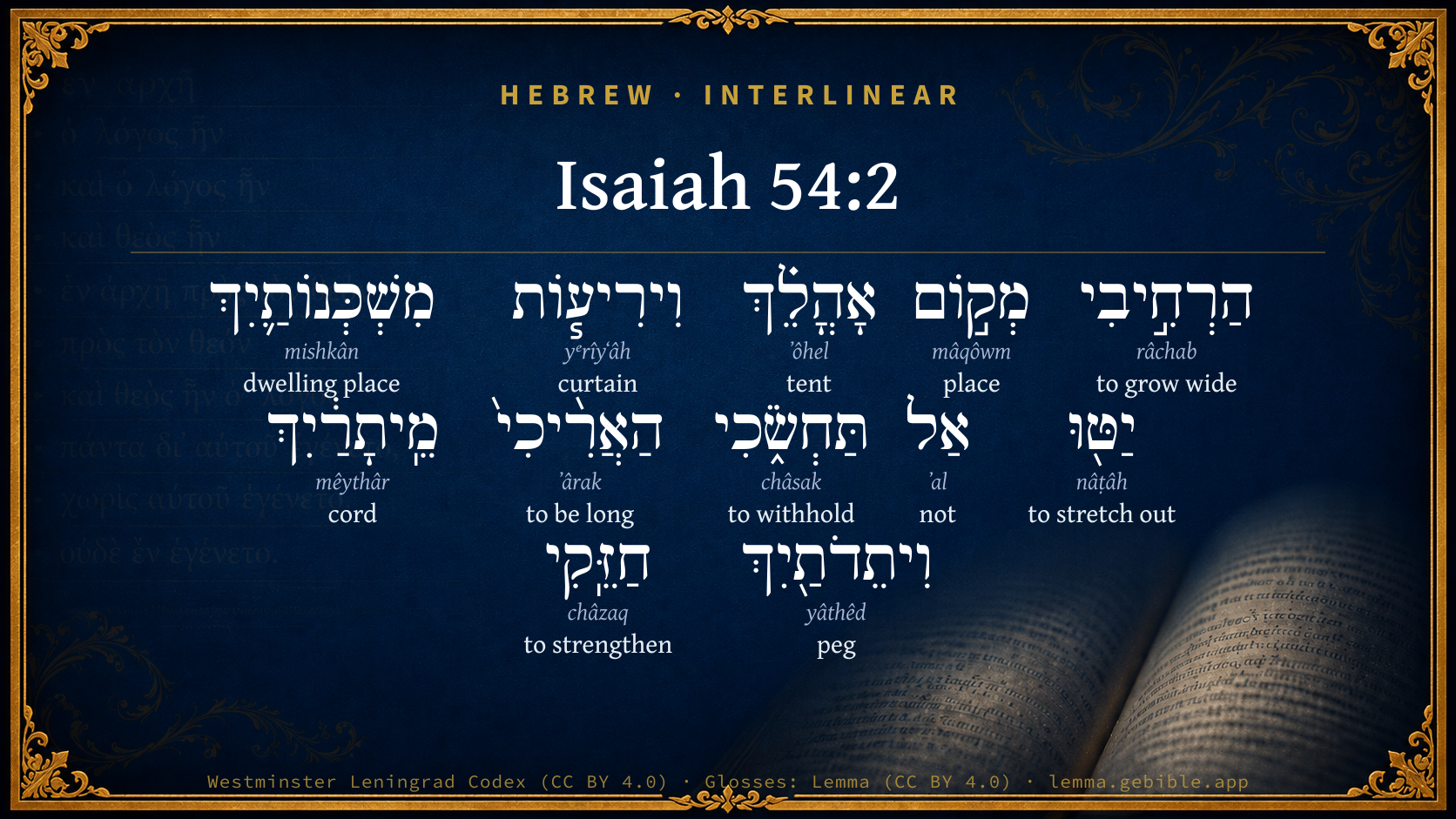
Hebrew (Westminster Leningrad Codex) Isaiah 54:2 appears in the Hebrew Old Testament. The text above is from the Westminster Leningrad Codex. Each word links to its Strong’s number, a concise gloss, and parsing drawn from the Open Scriptures Hebrew Bible morphology. Click any word for its full Brown-Driver-Briggs (BDB) entry.
Download image
Cite this verse

Isaiah 54:2 (World English Bible). Public Domain. Lemma interlinear Bible study tool, https://lemma.gebible.app/v/isaiah/54/2.

Show BibTeX & RIS
BibTeX
RIS
English Translation
Enlarge the place of your tent, and let them stretch forth the curtains of your habitations; don't spare: lengthen your cords, and strengthen your stakes.
World English Bible · Public Domain
Download a study sheet

One document with this verse’s original text, its word-by-word gloss line, the meaning frame, cross-references with their text, attributed commentary, and full source and license credits — printable, and it pastes into notes with its structure intact.

This verse Autodidact and up

Study sheet (.html) Plain text (.txt)

A passage Seminary Student

Up to 50 verses in one chapter. A passage sheet keeps up to 6 commentary sources and 12 cross-references per verse, in the order this page ranks them, and says so on the sheet whenever that leaves anything out. Ask for a single verse and you get the Autodidact verse sheet above.

Everything on this page stays free to read, with no account — the sheet is a download of what is already on screen, not access to it.

Want to remove ads? Support Godless Engineer
Compare translations 3

The same verse in 3 English versions, stacked beneath the original-language interlinear above. Click any original word for its lexicon entry.

Each is an independent rendering of the whole verse — the interlinear is not word-aligned to these translations.

Highlighted words mark where these versions differ — a whole-verse word diff, not a word-by-word alignment.

  • World English Bible Public Domain
    Enlarge the place of your tent, and let them stretch forth the curtains of your habitations; don't spare: lengthen your cords, and strengthen your stakes.
  • King James Version Public Domain
    Enlarge the place of thy tent, and let them stretch forth the curtains of thine habitations: spare not, lengthen thy cords, and strengthen thy stakes;
  • unfoldingWord Literal Text CC BY-SA 4.0
    “Broaden the place of your tent, and may they stretch out the curtains of your dwellings; may you not refrain. Lengthen your ropes, and strengthen your stakes.

unfoldingWord Literal Text — © unfoldingWord, licensed CC BY-SA 4.0. Word-aligned USFM3 via Door43 (git.door43.org/unfoldingWord/en_ult).

Versions to compare (up to 4)

3 of 4 selected

Show all 18 translations

Every available English version of this verse, each an independent rendering of the whole verse.

  • World English Bible Public Domain
    Enlarge the place of your tent, and let them stretch forth the curtains of your habitations; don't spare: lengthen your cords, and strengthen your stakes.
  • Berean Standard Bible Public Domain
    “Enlarge the site of your tent, stretch out the curtains of your dwellings, do not hold back. Lengthen your ropes and drive your stakes in deep.
  • Majority Standard Bible Public Domain
    “Enlarge the site of your tent, stretch out the curtains of your dwellings, do not hold back. Lengthen your ropes and drive your stakes in deep.
  • King James Version Public Domain
    Enlarge the place of thy tent, and let them stretch forth the curtains of thine habitations: spare not, lengthen thy cords, and strengthen thy stakes;
  • American Standard Version (1901) Public Domain
    Enlarge the place of thy tent, and let them stretch forth the curtains of thy habitations; spare not: lengthen thy cords, and strengthen thy stakes.
  • Revised Version (1885) Public Domain
    Enlarge the place of thy tent, and let them stretch forth the curtains of thine habitations; spare not: lengthen thy cords, and strengthen thy stakes.
  • Geneva Bible (1599) Public Domain
    Enlarge the place of thy tents, and let them spread out the curtains of thine habitations: spare not, stretch out thy cords and make fast thy stakes.
  • Douay-Rheims (1899) Public Domain
    Enlarge the place of thy tent, and stretch out the skins of thy tabernacles, spare not: lengthen thy cords, and strengthen thy stakes.
  • Young's Literal Translation Public Domain
    Enlarge the place of thy tent, And the curtains of thy tabernacles they stretch out, Restrain not -- lengthen thy cords, And thy pins make strong.
  • Literal Standard Version CC BY-SA 4.0
    “Enlarge the place of your tent, || And they stretch out the curtains of your dwelling places, || Do not restrain—lengthen your cords, || And make your pins strong.
  • Unlocked Literal Bible CC BY-SA 4.0
    “Make your tent larger and spread your tent curtains farther out, unsparingly; lengthen your ropes and strengthen your stakes.
  • unfoldingWord Literal Text CC BY-SA 4.0
    “Broaden the place of your tent, and may they stretch out the curtains of your dwellings; may you not refrain. Lengthen your ropes, and strengthen your stakes.
  • Darby Bible Public Domain
    Enlarge the place of thy tent, and let them stretch forth the curtains of thy habitations: spare not, lengthen thy cords, and strengthen thy stakes.
  • World Messianic Bible Public Domain
    “Enlarge the place of your tent, and let them stretch out the curtains of your habitations; don’t spare; lengthen your cords, and strengthen your stakes.
  • Webster's Bible Public Domain
    Enlarge the place of thy tent, and let them extend the curtains of thy habitations: spare not, lengthen thy cords, and strengthen thy stakes;
  • Free Bible Version CC BY-SA 4.0
    Make the tent where you live bigger; stretch the fabric to enlarge your home. Don't try and save space—extend your tent cords and make your tent pegs stronger.
  • Bible in Basic English Public Domain
    Make wide the place of your tent, and let the curtains of your house be stretched out without limit: make your cords long, and your tent-pins strong.
  • JPS Tanakh (1917) Public Domain
    Enlarge the place of thy tent, and let them stretch forth the curtains of thy habitations, spare not; lengthen thy cords, and strengthen thy stakes.

Literal Standard Version (2020), Covenant Press — licensed CC BY-SA 4.0. Text via the HelloAO Bible API (eBible.org). Unlocked Literal Bible (unfoldingWord) — licensed CC BY-SA 4.0. Text via the HelloAO Bible API (eBible.org). unfoldingWord Literal Text — © unfoldingWord, licensed CC BY-SA 4.0. Word-aligned USFM3 via Door43 (git.door43.org/unfoldingWord/en_ult). Free Bible Version, Dr. Jonathan Gallagher — licensed CC BY-SA 4.0. Text via the HelloAO Bible API (eBible.org).

Word by word

More ways to search: Search by grammar → Find every occurrence → Compare this word →

Practice this passage: Drill this verse → Learn its vocabulary →

מֵֽיתָרַ֔יִךְ
mêythâr
H4340
“cords · your”
Noun, Common, Masculine, Plural, Construct + Suffix, Personal, 2nd Person, Feminine, Singular
Part of Speech
Noun
Type
Common
Gender
Masculine
Number
Plural
State
Construct
Full BDB Definition

Origin: from H3498

TWOT: 936h

cord, string
  1. הַרְחִ֣יבִי râchab H7337 “grow wide” Verb, Hiphil, Imperative, 2nd Person, Feminine, Singular
  2. מְק֣וֹם mâqôwm H4725 “place of” Noun, Common, Masculine, Singular, Construct
  3. אָהֳלֵ֗ךְ ʼôhel H168 “tent · your” Noun, Common, Masculine, Singular, Construct + Suffix, Personal, 2nd Person, Feminine, Singular
  4. וִירִיע֧וֹת yᵉrîyʻâh H3407 “and · curtains of” Conjunction + Noun, Common, Feminine, Plural, Construct
  5. מִשְׁכְּנוֹתַ֛יִךְ mishkân H4908 “dwelling places · your” Noun, Common, Masculine, Plural, Construct + Suffix, Personal, 2nd Person, Feminine, Singular
  6. יַטּ֖וּ nâṭâh H5186 “to stretch out” Verb, Hiphil, Imperfect, 3rd Person, Masculine, Plural
  7. אַל ʼal H408 “not” Particle, Negative
  8. תַּחְשֹׂ֑כִי châsak H2820 “to withhold” Verb, Qal, Jussive, 2nd Person, Feminine, Singular
  9. הַאֲרִ֨יכִי֙ ʼârak H748 “be long” Verb, Hiphil, Imperative, 2nd Person, Feminine, Singular
  10. וִיתֵדֹתַ֖יִךְ yâthêd H3489 “and · pegs · your” Conjunction + Noun, Common, Feminine, Plural, Construct + Suffix, Personal, 2nd Person, Feminine, Singular
  11. חַזֵּֽקִי châzaq H2388 “strengthen” Verb, Piel, Imperative, 2nd Person, Feminine, Singular

About this verse

These counts appear in no published source. They are computed here, from the morphology-tagged text and Lemma’s own curated glosses. What Lemma adds →

12
words
12
distinct lemmas
Prophets
section

Notable vocabulary

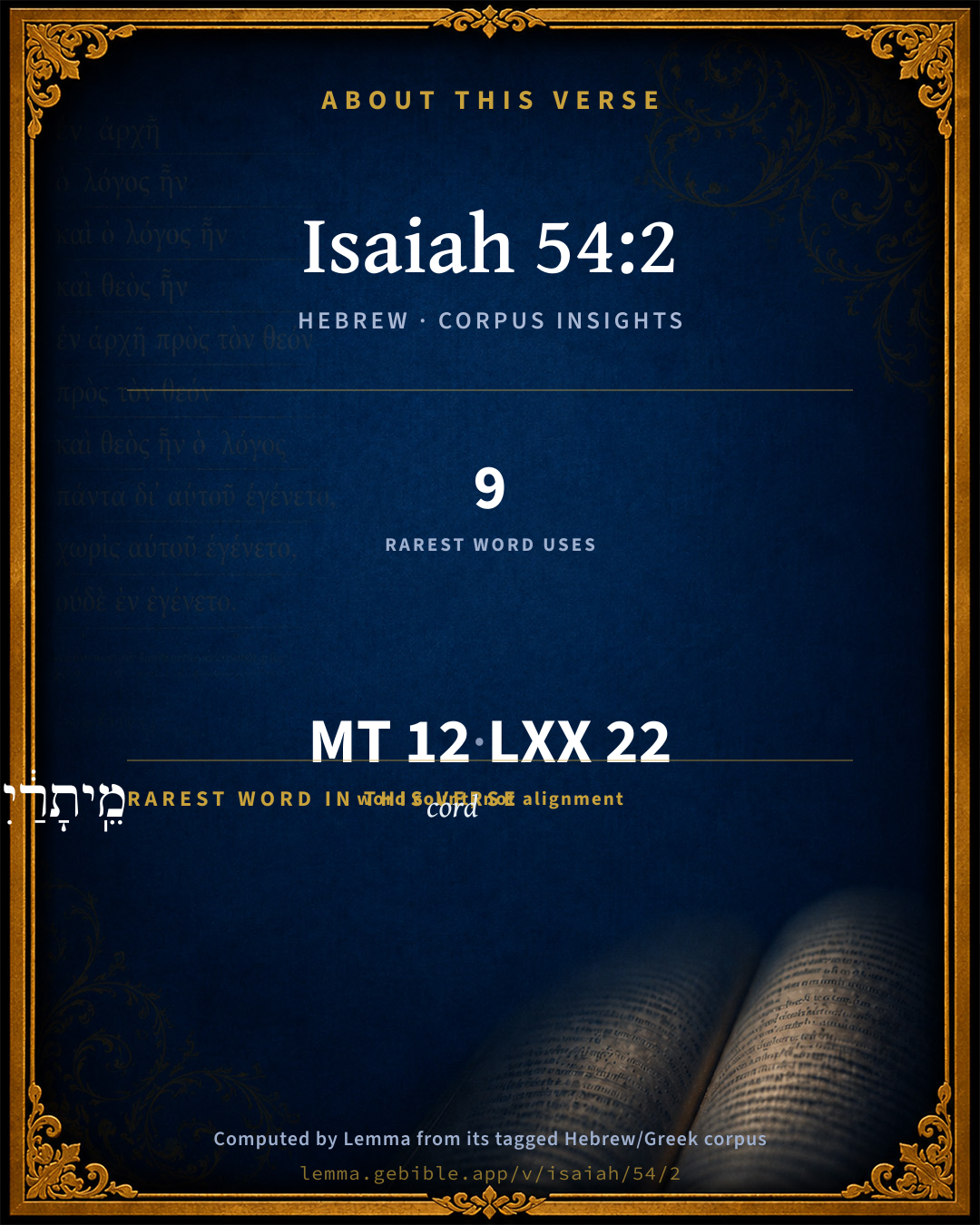
The rarest word here is מֵֽיתָרַ֔יִךְ cord H4340 — appearing just 9 times in the whole Hebrew Bible.

Shared distinctive vocabulary

מֵֽיתָרַ֔יִךְ cord H4340 occurs in 9 verses of the Hebrew Bible. Also found in:

Grammatical profile

  • 5 verbs
  • 6 nouns
  • 1 particle

Verb forms

  • הַרְחִ֣יבִי Hiphil · Imperative
  • יַטּ֖וּ Hiphil · Imperfect
  • תַּחְשֹׂ֑כִי Qal · Jussive
  • הַאֲרִ֨יכִי֙ Hiphil · Imperative
  • חַזֵּֽקִי Piel · Imperative

Hebrew & Septuagint length

In English translation the verse runs 25 words from the Hebrew and 22 from the Septuagint (LXX English) — closely comparable.

A rough comparison of the two English renderings, which tokenize alike — not a word-level alignment.

Word counts can differ between the Hebrew and the Greek without any difference in meaning — e.g. the Hebrew direct-object marker אֵת has no separate Greek word, and Greek often adds the article ὁ.

In the original languages it is 12 Hebrew tokens and 22 Greek tokens — but the two are counted differently (Hebrew bundles its prefixes and suffixes into one token; the Greek is in lemma form), so that isn’t a like-for-like length.

Cross-references

5

Topical passages linked to Isaiah 54:2 in the Treasury of Scripture Knowledge — connected by theme and wording, ordered by reader-vote popularity; previews shown in the World English Bible.

  • Isaiah 33:20 Look on Zion, the city of our solemnities: your eyes shall see Jerusalem a quiet habitation, a tent that shall not be removed, the stakes of it shall never be plucked up, neither shall any of the cords of it be broken.
  • Isaiah 49:19–20 For, as for your waste and your desolate places, and your land that has been destroyed, surely now shall you be too small for the inhabitants, and those who swallowed you up shall be far away.
  • Jeremiah 10:20 My tent is destroyed, and all my cords are broken: my children are gone forth from me, and they are no more: there is none to spread my tent any more, and to set up my curtains.
  • Exodus 39:40 the hangings of the court, its pillars, its sockets, the screen for the gate of the court, its cords, its pins, all the instruments of the service of the tent, for the tent of meeting,
  • Exodus 35:18 the pins of the tent, the pins of the court, and their cords;

Cross-references courtesy of OpenBible.info (CC BY 4.0).

Hebrew and Greek witnesses Masoretic Hebrew ↔ Greek Septuagint

The same verse in the two great witnesses to the Old Testament, shown verse-for-verse.

These are two independent witnesses, not word-aligned to each other, and the Septuagint is shown in lemma (dictionary) form.

Hebrew Isaiah 54:2 Masoretic · Westminster Leningrad Codex

הַרְחִ֣יבִי מְק֣וֹם אָהֳלֵ֗ךְ וִירִיע֧וֹת מִשְׁכְּנוֹתַ֛יִךְ יַטּ֖וּ אַל תַּחְשֹׂ֑כִי הַאֲרִ֨יכִי֙ מֵֽיתָרַ֔יִךְ וִיתֵדֹתַ֖יִךְ חַזֵּֽקִי

Enlarge the place of your tent, and let them stretch forth the curtains of your habitations; don't spare: lengthen your cords, and strengthen your stakes.

World English Bible · Public Domain

Greek LXX Isaiah 54:2 Septuagint · lemma form

πλατύνω ὁ τόπος ὁ σκηνή σύ καί ὁ αὐλαία σύ πήγνυμι μή φείδομαι μακρύνω ὁ σχοίνισμα σύ καί ὁ πάσσαλος σύ καταἰσχύω

Enlarge the place of your tent, and of your curtains: fix the pins, spare not, lengthen your cords, and strengthen your pins;

LXX2012 (modern English Septuagint) · Public Domain

Hebrew: Westminster Leningrad Codex (CC BY 4.0). Greek: Septuagint (public domain); English from LXX2012 (modern English Septuagint) (Public Domain). How the Septuagint differs from the Hebrew →

Targum (Aramaic paraphrase)

1

The Targum is the ancient Jewish Aramaic paraphrase of the Hebrew Scriptures — an interpretive translation, not the Hebrew text itself. Onkelos (literal) and Pseudo-Jonathan (expansive) render the Torah, and Jonathan the Prophets. Coverage is partial: where no permissively-licensed English translation exists for a verse, only the Aramaic is shown. This is verse-level text, not a word-by-word alignment to the Hebrew.

  1. Targum Jonathan Prophets (Joshua–Malachi)
    אַפְתִּי אֲתַר בֵּית מֵישְׁרָךְ וּמִקִרְוֵי אַרְעִיךְ יָתְבֵי לָא תִמְנְעִין אַסְגָא עַם מַשִׁרְיָתִיךְ וְשִׁלְטוֹנָיִךְ תַּקִיפִי:

    Enlarge the place of the house of thy dwelling, and from the cities of the land do not keep back the inhabitants; multiply the people of the camp, and increase the number of thy governors.

    Targum Jonathan — Aramaic: “Mikraot Gedolot” (public domain). English: “Sefaria Community Translation” (CC0 1.0 (public-domain dedication)); “London "Chaldee Paraphrase," 1871” (public domain). Text via Sefaria.

Commentary

Notes on Isaiah 54:2 from classic Christian and Jewish commentators (each source and its license shown beneath its notes). The classic Christian expositions comment on the surrounding passage and are grouped to its opening verse, so a note may address several verses; the Jewish commentaries on the Tanakh (Rashi and others) are per-verse, so they appear only where the commentator wrote on this verse.

Lemma curates 59 commentaries, every one of them public domain or Creative Commons licensed, each selected and text-cleaned for this edition rather than reprinted as found. About our sources →

Trapp's Complete Commentary

John Trapp

Isa 54:2 Enlarge the place of thy tent, and let them stretch forth the curtains of thine habitations: spare not, lengthen thy cords, and strengthen thy stakes;

Ver. 2. Enlarye the place of thy tent.] Thus he speaketh after the custom of those countries wherein was frequent use of tents; neither is it without a mystery, since we are all strangers in this world, neither have we here any continuing city. Justin Martyr saith {a} of the Christians of his time, that every strange land was to them a country, and every country a strange land. They looked upon themselves as citizens of the new Jerusalem.

{a} Epist. ad Diog.

John Trapp, A Commentary or Exposition upon All the Books of the Old and New Testament (1647–1656) — public domain. Text from a community e-Sword module.

The Biblical Illustrator

Joseph S. Exell

Isa_54:2-3

Enlarge the place of thy tent.

-

An enlarged Church

The Jewish nation, after its return from captivity, never attained so remarkable a degree of prosperity and power as fully to answer all the terms of this prophecy. It is true that they became a very numerous people; so that from forty-two thousand, the number of those that went out of Babylon, they had increased to nearly three millions at the time of our Saviours death; but they can hardly be said, in respect of territorial limits, to have broken forth on the right hand and on the left, nor to have inherited the Gentiles. We must therefore look for another interpretation of the prophecy; and we can be in no doubt as to its application to the Church of God. (C. J. Blomfield, D. D.)

Jew and Gentile in one Church

He shall see of the travail of His soul, and shall be satisfied, are words of comfort interposed amidst forebodings of suffering and woe; and the mode of their accomplishment is more clearly pointed out by an image drawn from the habits of pastoral life, familiar to the people of eastern countries, where the nomad chief, as his family, and cattle, and goods increase, finds it necessary to enlarge the place of his tent, and to stretch forth the curtains of his habitation. Under this image is represented the gradual increase of the Church, from the moment when, to human eyes, it appeared to have been crushed by the disgrace and death of its Founder, to the time when the fulness of the Gentiles shall have come in, and Gods ancient people shall be brought back to the same fold with them, and all the kingdoms of this world shall become the kingdoms of our Lord, and of His Christ. (C. J. Blomfield, D. D.)

Enlargement

According to the prophet the relation of God to His people is a relation that assures enlargement of beneficence on every hand. God and His Church are not locked up together, in some secret place, enjoying spiritual luxuries, whilst all the world is dying of starvation. If we could find such a hint in the Scripture we should burn the book. The Scripture is all for enlargement. The feast cannot be increased; but if it were needful to increase the space within which the guests are to be accommodated God would thrust back the horizon, rather than any man should starve for want of room to sit down in. If any messenger shall return, saying, Yet there is room, God would send that messenger out again to compel the hungering and homeless to come that they might enjoy a Fathers gracious bounty. So we find in the opening verses of this chapter--enlargement. (Dr. Parker, D. D.)

William Carey and missions

William Careys sermon on this text, preached at Nottingham, marked an epoch in the history of Christianity, for it aroused the Church of Christ to a sense of its responsibility for the conversion of the heathen and the evangelization of the world. The interest awakened by that sermon led to the formation of the Baptist Missionary Society, and to the ushering in of the Evanglistic era, which has already brought a great revenue of glory to Christ, and priceless blessings to every branch of His Church. From this remarkable text Carey deduced and enforced two important practical principles, which were afterwards embodied in the motto of the Baptist Mission--Attempt great things for God. Enlarge, stretch forth, lengthen, strengthen. Expect great things from God (Isa_54:4). If Carey had done nothing but shape this formula for evangelistic work, he would have achieved much for the cause he loved so dearly. It is easily remembered. Rather, it is not easily forgotten. (J. T.McGaw, D. D.)

The enlargement of the Church

The tent is the simplest and most primitive form of the human habitation. Wherever a pole can be found, with cords or strips of leather, a little bark or cloth or canvas or skin, a tent can be set up--as easily struck as pitched, and almost as easily enlarged; for when the growing necessities of a family demand larger shelter and room, all you have to do is to get a little longer pole, a little thicker cords, a little more bark or skin or canvas, and you can stretch forth the curtains of your habitation to accommodate the needs of the growing family. And so this is made the type of the enlargement of the canopy of the Church over her growing family of children. Thou shalt burst forth, as the Hebrew is--the grand old Hebrew--Thou shalt burst forth on the right and on the left. A symmetrical growth in this direction and that direction alike; not like a family that has a one-sided development--she is going to gather her children from east and west and north and south, and every clime and every tongue and every people; and because her family is to come from all quarters of the earth, her canopy must stretch to every quarter of the earth to cover her increasing family. (A. T. Pierson, D. D.)

Lengthen and strengthen

What is the duty of the Church in these days? Lengthen and strengthen. The word lengthen suggests extensity; the word strengthen suggests intensity, and there is always danger in extensive movement that is not accompanied by intensive movement. You are lengthening your cords, but if you do not strengthen your stakes what will happen? Your lengthening your cords will be a disaster to you and the tent itself.

1. How shall we lengthen cords? By sending out our organizations in every direction--a cord here to Europe, another cord to Asia, another to Africa, and another to the islands of the sea. Towards the North Pole and the South Pole; in every direction, from the great centres of Christendom, let your missionary organizations reach! With the enterprise that has dash and push in it let these cords be carried to the ends of the earth, until the network of missions overspreads the whole family of man! And, if we are going to have this lengthened cord you must add your own length to it. As, when we rescue a man from a burning building, and the ladder will not reach those that are in peril, the fireman stands on the top rung of the ladder and adds his own length, over which men and women climb down into safety, so if you are going to have this organization reach over the world in a spirit of hallowed enterprise till the canopy is co-extensive with the family of man, your length has got to be added to the cord. You have read of the self-sacrifice of the Carthaginian maidens when they cut off their raven ringlets that they might be braided into bowstrings for Hannibals archers; or of the Tyrian maidens when they sacrificed their golden hair for cordage for the Tyrian navy. The cords of enterprise by which this Gospel is to be carried to the ends of the earth are woven out of the very fibres of human hearts! You cannot make them with money, and you cannot make them with commercial interests, and you cannot make them with public enthusiasm. They are woven on the loom of personal consecration in the secret place with God.

2. We must not only have lengthened cords, but strengthened stakes. If there is one weak stake on the circumference of a tent, and it pulls out or is broken, then it puts a greater stress on the other tent-pegs round it, and one by one they are loosened or pulled out, until the whole tent collapses. What does that mean? It means that any Church on the circumference of Christian effort that does not plant itself firmly to hold up the cord of organization is responsible for the collapse of Christian missions. And it means that any man or woman or child in the Church of God, among Gods professed believing children, that does not become a stake down deep into the ground and holding on, is responsible for any disaster that comes to the whole work of Christ by lack of personal co-operation. (A. T.Pierson, D. D.)

Strengthening the stakes

How are you going to strengthen the stakes?

1. By faith in Almighty God. This is His work.

2. By the power of believing prayer. A beloved Japanese convert and trainer of native teachers said with his dying breath, Advance on your knees.

3. By a firm confidence in this Gospel as the Gospel of Christ, and that this Word is the Word of God.

4. We must have sanctified giving.

5. Holy living. Stanley says that he owes to the months he spent with Livingstone the transformation of his character; and yet Livingstone never said a word to him about his souls salvation. (A. T. Pierson, D. D.)

The Churchs duty and encouragements

I. THE DUTY OF THE CHURCH.

II. HER ENCOURAGEMENTS. (A. W. Brown, M. A.)

Foreign missions

I. THE MAGNITUDE AND SUPREME IMPORTANCE OF OUR OBJECT. The conversion of the world. We know that the conversion of the world is not our work, but Gods. But we also know that the Lord works with suitable instruments, and that the degree of our success may be influenced by our devotedness, and the skill with which we adapt our efforts to our end. The conversion of the world! Who can realize what that means? I think of one soul living and dying in rebellion against God--of its possibilities for misery and for mischief--how much it may itself endure, how much injury it may inflict, how much grief occasion, throughout Gods holy universe? I think of that soul as converted! of the blessedness it may experience, the beneficent influence it may exert, the joy its conversion will diffuse throughout the ranks of sinless intelligences. Of the sublime satisfaction with which He will regard it, who for its sake endured the Cross and despised the shame, when it becomes a jewel in His crown, a trophy of His saving love and power, fruit of His souls travail. Then I extend the thought to the countless myriads of the human race whom that soul represents, and of whom the same thing may be predicated. The thought is to me absolutely overpowering. Oh, the magnitude--the momentous importance of the object at which we aim! Oh, the miserable smallness of the means we use for such a purpose.

III. THE VASTNESS OR THE FIELD NOW OPEN TO US; With more force than at any previous period of the worlds history we can say if missions, The field is the world.

III. THE FACILITIES WE NOW HAVE FOR CARRYING ON OUR WORK. The Lord in His high providence has furnished the Church with most favourable opportunities of conducting her great enterprise in all parts of the earth.

IV. THE MISERABLE CONDITION AND URGENT CLAIMS OF THE HEATHEN.

V. THE DIVINE INTEREST IN THIS GREAT ENTERPRISE.

VI. THE OBLIGATIONS UNDER WHICH WE ARE LAID BECAUSE OF THE FAVOURS WE HAVE RECEIVED. Forgiven rebels as we are, our forgiveness having been procured for us by the sufferings and death of our Lord, and granted to us as the gift of His grace; redeemed by His blood as we are from the destruction which was pending over us; admitted as we are to all the privileges of loyal and obedient subjects, free access into the Divine presence, not only permission, but encouragement to make known to God the desire of our hearts, with the assurance that He hears us always; born as we are of the Spirit into the Divine family, made children and heirs of God, entitled to call God Father; delivered as we are from the fear of hell, and animated by the hope of a glorious immortality; indebted as we are to the influence of the Gospel even for those temporal blessings which are so conducive to our comfort and enjoyment during the present life, and in respect of which we can truly say, The lines have fallen to us in pleasant places, and we have a goodly heritage; honoured by God in being called as we are to share in His great work of winning the world to Himself, by which He shows how completely He has forgiven us, and what confidence He places in us; assured, too, that they that be wise shall shine as the brightness of the firmament, and they that turn many to righteousness as the stars for ever and ever--is not ours confessedly a position of unspeakable privilege? What are we doing? Compare our actions with our object and our obligations. (W. Landels, D. D.)

Arguments for missions

1. Christ owns the whole world.

2. The Gospel of Christ is adapted to all men.

3. Our Lords commission to the apostles contemplates a universal kingdom. (J. T. McGaw, D. D.)

Modern missions

1. This great utterance fell from the lips of a man who had newly seen God, and caught thereby an original conception of His redemptive work for the world through captive and desolate Israel. No one can miss the meaning of this joyous outburst. It is an evangel. Sursum corda, he cries. Do not give way to repining though you are lonely and heartsore as a childless woman.

Say not my tent is destroyed and all my tent-pins are plucked up: my children are gone away and there is none to spread out my tent any more, or to set up my tent-curtains (Jer_10:20). Get up and make your tent-.pins strong: lengthen your cords and fasten your plugs. Be not content with a little space. Roominess and magnificence befit your prospects. Your expulsion will be your expansion, your desolation your increase, your captivity your exaltation. The area covered by your race shall be larger than of yore. The prophet could speak that word of hope and endeavour because he had received his new vision of God. Insight was the warrant for utterance. He knew the meaning of the Exile through his purer conception of the character and purposes of Jehovah. He saw the supreme and universal sovereignty of God; the universal brotherhood of man; the essential spirituality of the Hebrew religion, that it could and would exist without a temple and without a priest, without an altar and without a land, without anything save the soul and God; that it was to cease to be a local religion and become universal, and instead of remaining a national luxury would become an aggressive missionary and world-caving agency. He looked along the highways of the future, and saw the approach of the delivering God, and cried, Behold your God! Man has a fatal and pathetic facility both for losing himself and his best treasures. Apostolic Christianity went everywhere preaching the Word. It was essentially aggressive. It placed itself by the side of the ancient religions of Greece and Rome, always absorbent of their good, but finally replacing them by its richer ideas and stronger spiritual impulses. The fires of the Christ-given passion to save all men burnt on, although alas l with diminishing intensity, for more than two centuries. The Reformation itself had little or no missionary passion, and the desponding leader said, with unfathomable sadness--a fore-gleam of the agony and pity that stirred the Churches at a later date: Asia and Africa have no Gospel; another hundred years and all will be over. Gods Word will disappear for want of any to preach it. Surely not, O prophet of God! The Word of the Lord endureth for ever. When the night is darkest, then up leap the stars. The living God is always at work. An astronomer gazed so long on the sun that he could see nothing else. The image was burned into him. For years before May 81, 1792, the vision of God as the God of Missions had arrested, held, moulded, and swayed the soul of Carey. Isaiah repeats Micah, Luther repeats the psalmist, Carey repeats the prophet, and so the Word of the Lord has flee course and is multiplied.

2. It is a revealing fact that, though Carey gained his messagefrom the words of prophecy, he expressed it in the simple and characteristic language of the closing years of the eighteenth century--the century of the expansion of England and of the great evangelical revival. Expect great things, said he that he that he voiced the thought of his generation; expect them from God--in that he expressed the knowledge and insight of men taught by the Spirit.

3. George Sand reminds us: It is the heart that governs the world; it is feeling that performs the real miracles of history. Careys persistent determination that the Church should evangelize the world was fed by what Vinet calls the passion for souls. His perception of evil was acute. His sense of sin strong. His reliance on Christ unhesitatingly entire. He scarcely seems to have had a thought apart from Christ and His salvation. And yet at the root of all, and over all, and through all was a self-consuming love of men, of all men, and of heathen men most of all; and therefore forgetting himself this one thing he did, he founded modern missions by the gift of himself, out and out, in serving and suffering so that he might save men. Ah! it is here we fail. We do not love men for their own sake or for Gods sake. We need to change our style; it is cramped and fettered. (J. Clifford, D. D.)

Spare not, lengthen thy cords and strongthen thy stakes

Happy influence of foreign missions on the Church

The whole passage refers to the conversion of the heathen; and furnishes the important suggestion, that there is no system of means so well calculated to give expansion and stability to the Church of Christ as foreign missionary operation. There are several reasons which are supposed by many to favour the opinion, that Christian exertion is less productive among pagan nations than at home.

1. There are preliminary barriers which oppose the efforts of the missionary, and which do not exist in Christian lands. The most important are strange languages, and strong prejudices. There is also the systematic and stubborn opposition which the Gospel meets from the established forms of civil government and pagan superstition. Further, there is the risk and waste of life which foreign missionary labour involves. This, however, is but one view of the subject. There are arguments which favour the opposite opinion--that the direct results of Gospel efforts are greater in pagan than in Christian lands. Among the reasons for such an opinion, is that one which induces almost all ministers of the sanctuary to exchange the sphere of their labour at home; and which would, if they were consistent with their principles, send great numbers of them abroad. The souls to be saved are much more numerous--much more needy. Another reason is, the means of usefulness are both more various and extensively operative. A further reason is the activity of native converts.

2. We believe that foreign missions are the best means of lengthening the cords and strengthening the stakes of the Church, because they establish and promote an action and reaction between themselves and the Churches, which is most powerful and advantageous to both parties. This may be demonstrated by several facts.

I. MISSIONARY LABOUR INCREASES THE PIETY AND ENERGY OF THE CHURCHES. The missionary spirit includes among its essential endowments, faith, prayer, self-denial, deadness to the world, charity, beneficence, heavenly-mindedness, a willingness to submit to sufferings and hazards, and a supreme regard for the glory of God.

1. There is the stimulus of example, than which nothing is more influential. Hold up to the Churches those with whom they are under equal obligations, but who have far exceeded them in the work of faith, and labour of love, and you bring a motive to bear upon them which piety cannot resist.

2. It operates through sympathy. Our work, our aim, our strongest desires, our highest honour, our dearest interests, our eternal recompense are the same.

3. There is the duty and blessedness of necessary co-operation.

4. It diverts the mind from those unimportant points of doctrinal difference, and metaphysical distinction and abstruse speculation, which squander the time and pervert the talents, and ruin the souls of thousands.

5. It operates, too, through the influence of its own greatness. It expands the mind, liberalizes the soul, elevates the aim; arouses faculties and feelings which nothing else could have addressed; and produces effects and results which no other object could command.

II. MISSIONARY OPERATIONS NOT ONLY INCREASE THE PIETY AND ENERGY OF THE CHURCHES, BUT GREATLY ASSIST IN SUPPLYING THEIR DOMESTIC

DESTITUTION. Many a converted youth has had his attention directed to the ministry through the reading of missionary journals. When we speak of the vigour which missionary exertions throw into our domestic institutions, we refer to a very natural operation. That man who has courage to attempt a great enterprise, despises the difficulties of a small one. The energy produced by the one, overlooks all the appalling trifles of the other.

III. THE CHURCH, THROUGH MISSIONARY EFFORTS, PLACES HERSELF IN THE BEST, AND, INDEED, IN THE ONLY POSITION FOR RECEIVING THE MOST ABUNDANT SPIRITUAL BLESSINGS.

1. These efforts have a direct tendency to remove the most serious obstructions to piety and efficiency. Where the work of evangelizing the world is carried on with energy, it indicates and produces self-denial and liberality. We need not stop to show that nothing is more repugnant to eminent holiness, or usefulness, than a selfish parsimonious spirit. It is abhorrent in the eyes of a holy God (Isa_57:17).

2. They secure to us those promises which are connected with enlarged exertions (Pro_11:25; Isa_58:10-11).

IV. IT MUST ENCOURAGE AND ENABLE THE CHURCH STILL MORE TO EXTEND HER LIMITS, AND THUS TO RETURN TO THE HEATHEN WORLD THE FULL INFLUENCE OF HER IMPROVED CONDITION. Application This subject teaches, that lengthening the cords of the Church is strengthening her stakes. (D. Abeel.)

The Biblical Illustrator, edited by Joseph S. Exell (c. 1880s–1900s) — public domain. Text from a community e-Sword module.

Joseph Benson's Commentary

Isa 54:2-3. Enlarge the place of thy tent — That it may be capable of receiving the Gentiles, who shall flock to thee in great numbers, and desire to associate themselves with thee. And let them — Those to whom that work belongs; stretch forth the curtains, &c. — The meaning is, the curtains must and shall be stretched out. Spare not — Fear not lest thou shouldest prepare more room than will be occupied; for very large accessions are to be expected. And strengthen thy stakes — That they may be able to support the great weight which the tent, thus enlarged, shall be upon them. For thou shalt break forth, &c. — Thou shalt bring forth a multitude of children; for the word פרצ, here rendered break forth, is commonly used of any great and extraordinary propagation of living creatures, whether beasts or men; on the right hand and on the left — On every side, in all parts of the world. Or, thy children shall be so numerous that they can no longer be contained within narrow bounds. And thy seed — Thy spiritual seed, the members of the New Testament church, and especially the apostles and other ministers of Christ; shall inherit the Gentiles — Shall bring the Gentile world to the obedience of the faith; and make the desolate cities to be inhabited — Shall cause those cities and countries which, in a spiritual sense, were desolate, being destitute of all good, to be filled with members of the church.

Joseph Benson's Commentary on the Old and New Testaments (1811–1818) — public domain. Text from a community e-Sword module.

Geneva Bible (1599)

Geneva Bible translators

Signifying, that for the great number of children that God should give her, she should seem to lack room to lodge them.

Geneva Bible (1599) marginal notes — public domain. Text via Bolls.life.

Jamieson, Fausset & Brown

Robert Jamieson, A. R. Fausset & David Brown

(Isa 49:19-20; Jer 31:31-36, Jer 31:38-39). Thy children shall be so many that thy borders must be extended to contain them.

curtains--the cloth forming the covering of the tent.

spare not--give abundantly the means for the enlargement of the Church (Co2 9:5-7).

cords . . . stakes--The more the tent is enlarged by lengthening the cords by which the cloth covering is fastened to the ground, the more the stakes supporting the tent need to be strengthened; the Church is not merely to seek new converts, but to strengthen those she has in the faith. The image is appropriate, as the tabernacle was the symbol of the old Israelitish Church (see on Isa 33:20).

Jamieson, Fausset & Brown — Commentary Critical and Explanatory on the Whole Bible (1871) — public domain (CC PDM 1.0). Text via the HelloAO Bible API.

Ellicott's Commentary for English Readers

(2) Enlarge the place of thy tent.—Interesting parallels are found in Isa_33:20; Jer_10:20.

A Bible Commentary for English Readers, edited by Charles John Ellicott (1878–1897) — public domain. Text from a community e-Sword module.

The Cambridge Bible for Schools and Colleges

gen. ed. J. J. S. Perowne

2. The idea of the verse is expressed in Isa_49:20-21; for the figure of the tent (in an opposite sense) cf. Jer_10:20.

The curtains are the tent-hangings (Jer_49:29; Hab_3:7), the stakes, the tent-pegs (ch. Isa_33:20).

The words spare not should, according to the accents, be joined to the preceding clause.

The Cambridge Bible for Schools and Colleges (gen. ed. J. J. S. Perowne; Cambridge University Press, 1878–1918) — public domain. Text from a community e-Sword module.

John Gill's Exposition

Enlarge the place of thy tent,.... To which the church is compared, because of its uncertain and movable condition, being sometimes in one place, and sometimes in another; and because of its outward meanness and weakness, as well as its small extent; but now it is signified that it should be enlarged, and room be made for an accession of in habitants to it; or, in other words, that the Gospel church state should not be confined to Jerusalem, but should take place in other parts of Judea, and in Galilee, and in Samaria; hence we read of churches in those places, Act 9:31,

and let them stretch forth the curtains of thine habitation; alluding to the curtains of which tents or tabernacles were made, which used to be stretched out on poles or stakes, in order to make more room, and hold more people. This may respect the spreading of the Gospel by the apostles, who may be here meant, and the success of it, especially among the Gentiles; who may be said to stretch out the curtains of the tent, the church, when, according to their commission, they went and preached the Gospel to every creature. First they travelled as far as Phoenicia, Cyprus, and Antioch, preaching to the Jews only; but when they wholly rejected the Gospel, they turned to the Gentiles, and went everywhere preaching the word, Act 11:19, and their ministry was blessed to the conversion of multitudes, and Gospel churches were set up in all parts of the world. The Apostle Paul was an eminent instrument of stretching these curtains, who went from Jerusalem, round about to Illyricum, fully preaching the Gospel of Christ, Rom 15:19,

spare not: any cost or pains, to spread the Gospel, enlarge the interest of Christ, and increase his church and people; as did not the apostles of Christ, who may be supposed to be the persons here addressed:

lengthen thy cords, and strengthen thy stakes; the curtains being stretched out, it was necessary the cords, to which they were fastened, should be lengthened, that they might reach further, and take in a greater compass; and the wider the tent is made by such means, the stronger should be the staves, and the more surely should they be drove and fixed in the earth, to hold the cords with the curtains bound unto them; all which express the enlargement of the church in the Gentile world, by means of the Gospel ministry and discipline. The Targum is,

"multiply the people of thy camp, and strengthen the governors.''

John Gill's Exposition of the Whole Bible (1746–1763) — public domain (CC PDM 1.0). Text via the HelloAO Bible API.

Albert Barnes' Notes on the Bible

Enlarge the place of thy tent - The same idea occurs in Isa 49:19-20 (see the notes at that chapter). The curtains of thy habitations. The word ‘curtain’ does not quite express the sense here. It is commonly with us used to denote the cloth hanging round. a bed or at a window, which may be spread or drawn aside at pleasure, or the hanging in theaters to conceal the stage from the spectators. The word here, however, denotes the canopy or cloth used in a tent; and the idea is, that the boundaries of the church were to be greatly enlarged, in order to accommodate the vast accession from the pagan world.

Spare not - Do not be parsimonious in the provision of the materials for greatly enlarging the tent to dwell in.

Lengthen thy cords - (See the note at Isa 33:20).

Albert Barnes' Notes on the Bible (1834–1885) — public domain. Text from a community e-Sword/MySword module.

Haydock's Catholic Bible Commentary

Stakes, to receive so great a family. All the Israelites did not return, and it does not appear that many embraced their religion, as they have done that of Christ.

George Leo Haydock (1774–1849), Haydock's Catholic Family Bible and Commentary, 1859 edition — public domain. Excludes Psalms (Douay-Rheims chapter numbering differs from Protestant) and Deuterocanonical books (Catholic canon only).

Matthew Poole's English Annotations

Enlarge the place of thy tent, that it may be capable of the Gentiles, which shall flock to thee in great numbers, and desire to associate themselves with thee.

Let them, those to whom that work belongs, stretch forth. The meaning is, they must and shall be stretched out.

Lengthen thy cords, and strengthen thy stakes, that they may be able to support that great weight which the tents this enlarged shall be upon them.

Matthew Poole's English Annotations on the Holy Bible (1683–1685) — public domain. Text from a community e-Sword/MySword module.

Whedon's Commentary on the Bible

Daniel D. Whedon

2, 3. Enlarge… thy tent — It is now due that Zion be alert to extend her dwelling-place, her tabernacle area, in every direction.

Spare not — Spare no pains, grudge no labour. Spread the canopy indefinitely; make the tent cords longer and tent pins stronger. On every hand larger space is requisite for the occupancy of her children, which are to so abound as to include populations far into Gentile lands.

Inherit the Gentiles… desolate cities… inhabited — Cities far abroad, and long desolate, are to be filled with new people.

Daniel D. Whedon (gen. ed.), Commentary on the Old and New Testaments (1874–1909) — public domain. Text from a community e-Sword module.

The Pulpit Commentary

Enlarge the place of thy tent. (comp. Isa_33:20 and Jer_10:20) The memory of the old nomadic life caused the "tent" to be the symbol and representative of the dwelling-place. (comp. 1Ki_12:16) Israel will have so many more children that her "tent" will need enlarging. The curtains; i.e. the tent-cloth. (comp. Ex 26 and Ex 36, where the word used occurs repeatedly) Thy cords... thy stakes. (comp. Exo_35:18 Exo_39:40, etc.) The ropes and tent-pegs, which kept the tent-cloth in place, are intended. The enlargement of the tent would make longer ropes and larger pegs necessary.

HOMILIES BY W. CLARKSON Ver. 2. Enlargement and consolidation.

"Spare not, lengthen thy cords, and strengthen thy stakes." Applying these words to the Church of Christ in its attitude of holy expectation, and its sacred duty under all circumstances, but particularly in the time of growth, we learn of it

I THAT IT SHOULD CONSTANTLY BE ANTICIPATING ENLARGEMENT. The challenge comes from its Lord, "Spare not, lengthen thy cords;" i.e. take the attitude and the action of those who are looking for increase, for the incoming of those who are outside. The Church of Christ is well warranted in doing this; for it has:

1. Ample scope in a vast unredeemed world beyond its borders; souls that are capable of brotherhood, of sonship, of heirship.

2. All the materials it wants for successful enterprise, in authority to work and win, in truth perfectly fitted to the deepest wants of the human heart, in the potency of Christian love and zeal.

3. Divine promise that its labour shall not be in vain.

II THAT IT SHOULD CONTINUALLY BE ENGAGED IN CONSOLIDATION. AS a multitude of armed men do not make an army, so a number of people with Christian words on their lips and Christian ordinances in their practice do not make a Christian Church after Christ"s ideal. The accession of numbers is not everything; it may prove to be very little; before now, in certain cases, it has proved to be "less than nothing and vanity." The Church must strengthen its stakes" as well as lengthen its cords." It must not spare its strength in providing for permanence and stability as well as increase. It must aim at, and must pray and labour for:

1. The intelligent acceptance of the truth of Christ in its integrity.

2. Spirituality in worship.

3. Consistency of conduct and consequent illustration of a large part of Christ"s will in its daily life.

4. Order and discipline in its regular action. C.

HOMILIES BY R. TUCK Ver. 2. Divine enlargements.

The figure employed is taken from tent-life, and it is used in a similar way by Jeremiah. "My tabernacle is spoiled, and all my cords are broken: my children are gone forth of me, and they are not: there is none to stretch forth my tent any more, and to set up my curtains." The (Jer_10:20) Orientals have two kinds of tents the one larger, and the other smaller; but both constructed much in the same way. They are sustained by poles, more or fewer in number, according to the size of the tent, but the tallest is always in the midst, while the others suspend the covering round the sides. This covering is made of a stuff woven from wool and camel"s hair; it hangs down like a curtain over the side poles, and is fastened by cords to wooden pegs, which are firmly driven into the ground. Other cords, fastened at one end to the top of the poles, and at the other to pegs or stakes, keep the tent steady, and secure it against the violence of storms. As the family increases, it is proportionally enlarged, and requires the cords to be longer and the stakes to be stronger in proportion. One cause of depression, at the time of the return, was that so few of the Israelites responded to the Divine call, and it seemed hopeless work to attempt to revive the old glories of Jerusalem with such a feeble company. The divinely comforting assurances of the text are designed to revive hope and renew confidence. "The little one shall become a thousand, and the small one a strong nation." And the promise was fulfilled. Those that first came out of Babylon were but forty-two thousand, (Ezr_2:64) about a fifteenth part of their number when they came out of Egypt; many came dropping to them afterwards, but we may suppose that to be the greatest number that ever came in a body; and yet, above five hundred years after, a little before their destruction by the Romans, a calculation was made by the number of the Paschal lambs, and the lowest computation by that rule (allowing only ten to a lamb, whereas there might be twenty) made the nation to be nearly three millions. Further reference may be found to the enlargement of the Christian Church after Pentecost, and especially after the martyrdom of Stephen, and the scattering of the disciples which followed upon that sad event. The general topic suggested for consideration is the duty of cheerfully following on, when God opens before us wider and larger spheres of influence and usefulness, and the following points may be illustrated.

I IT IS WRONG TO FORCE OURSELVES INTO ENLARGEMENTS BEFORE GOD CALLS. II IT IS WRONG TO HOLD BACK WHEN GOD DOES CALL.

III LARGER SPHERES, AND WIDER INFLUENCE, ARE GOD"S SIGNS OF ACCEPTANCE AND APPROVAL OF THE WORK WHICH WE HAVE DONE.

IV THOSE WHO ENTER ON ENLARGED SPHERES NEED TO BE THEMSELVES ENLARGED. R.T.

The Pulpit Commentary (1880–1919), ed. H.D.M. Spence-Jones & Joseph S. Exell — public domain. Text from a community e-Sword module.

John Wesley's Explanatory Notes

Enlarge - That it may be capable of the Gentiles, who shall flock to thee in great numbers. Strengthen - That they may be able to support that great weight which the tents thus enlarged, shall be upon them.

John Wesley, Explanatory Notes Upon the Whole Bible (1754–1765) — public domain. Text via the GEBible commentary corpus.

Keil & Delitzsch

C. F. Keil & F. Delitzsch

With this prospect before her, even her dwelling-place would need enlarging. "Enlarge the space of thy tent, and let them stretch out the curtains of thy habitations; forbid not! lengthen thy cords, and fasten thy plugs." She is to widen out the space inside her tent, and they (יטּוּ has no definite subject, which is often the case where some subordinate servant is to be thought of) are to spread out far and wide the coverings of the framework of her dwelling, which is called mishkenōth (in the plural) on account of its roominess and magnificence: she is not to forbid it, thinking in her weakness of faith, "It is good enough as it is; it would be too large." The cords which hold up the walls, she is to lengthen; and the plugs, to which the cords are fastened, she is to ram fast into the earth: the former because the tent (i.e., the holy city, Jer 31:38-40, and the dwelling-place of the church generally, Isa 26:15) has to receive a large number of inhabitants; the latter because it will not be broken up so soon again (Isa 33:20).

Keil & Delitzsch — Biblical Commentary on the Old Testament (1861–1891) — public domain (CC PDM 1.0). Text via the HelloAO Bible API. (Old Testament only.)

J. A. Alexander on Isaiah

Joseph Addison Alexander

“Widen the place of thy tent, and the curtains of thy dwellings let them stretch out; spare not (or hinder it not); lengthen thy cords and strengthen (or make fast) thy stakes.” As in the parallel passage (Isa 49:19-20) the promise of increase is now expressed by the figure of enlarged accommodations. The place may be either the area within the tent or the spot on which it is erected. The curtains are the tent-cloths stretched upon the poles to form the dwelling. The stakes are the tent pins, to which the tent-cloths are attached by cords. The last clause may either mean, take stronger pins, or fix them more firmly in the ground; both implying an enlargement of the tent and a consequently greater stress upon the cords and stakes.

Joseph Addison Alexander, The Prophecies of Isaiah (1846–1847; New York: Scribner, 1870–1878) — public domain. Text from a community e-Sword module.

unfoldingWord translationNotes

Door43 World Missions Community

General Information:

Yahweh continues speaking to the people of Jerusalem.

Make your tent larger ... strengthen your stakes

This continues the metaphor that began in Isaiah 54:1. Yahweh telling the people of Jerusalem to prepare because Yahweh will greatly increase their people is spoken of as if he is telling a woman to make her tent bigger to make room for many children. (See: Metaphor)

For you will spread out

Here "you" is singular and refers to the barren woman. She represents herself and all of her descendants. AT: "For you and your descendants will spread out" (See: Forms of You and Synecdoche)

will conquer nations

Here "nations" represents the people. AT: "will conquer the people of other nations" (See: Metonymy)

translationWords

tent

descend

nation

desolate

unfoldingWord translationNotes — © Distant Shores Media and the Door43 World Missions Community, licensed CC BY-SA 4.0. Source: git.door43.org/Door43/en_tn.

Rashi

Rabbi Shlomo Yitzchaki (Rashi)

and let them stretch forth far off.

lengthen your cords These are thin ropes that hang at the bottom of tents, and that are tied to stakes called ‘chevills’ in French, which are thrust into the ground.

Rashi on the Tanakh — English translations: “The Judaica Press complete Tanach with Rashi, translated by A. J. Rosenberg” (CC BY 4.0); “Pentateuch with Rashi's commentary by M. Rosenbaum and A.M. Silbermann, 1929-1934” (public domain); “The Metsudah Tanach series, Lakewood, N.J” (CC BY 4.0); and “The Book of Joshua, Metsudah Publications, 1997” (CC BY 4.0). Text via Sefaria.

Ibn Ezra

Rabbi Abraham ibn Ezra

Enlarge the place of thy tent, because of the larger number of thy children.

יטו Let them stretch forth. Let the children of the desolate stretch forth, or let people stretch forth; comp. ויאמר and one said (Gen. 48:1).

אל תחשכי Prevent not, the people from stretching forth the curtains of thy tent.

Thy cords. The cords of thy tent.—The restoration of the towns and villages is meant by this figure.

Ibn Ezra on the Tanakh — English translations: “Sefaria Community Translation” (CC0 1.0 (public-domain dedication)); “Yalkut, Sifsei Chachomim Chumash, Metsudah Publications, 2009” (CC BY 4.0); and “Commentary of Ibn Ezra on Isaiah - trans. by M. Friedlander, 1873” (public domain). Text via Sefaria.

Lesson kit

Teaching starters — assembled from the data on this page, not authored interpretation. Every prompt links to the verse data it draws on. Edit before teaching.

Isaiah, in the Prophets, opens this verse with 12 words (12 distinct Hebrew lemmas). Its most distinctive word is mêythâr (“cord”). A historical commentator’s framing appears above. Read the whole chapter for the surrounding context.

Discussion questions

  1. The word mêythâr carries the sense “cord.” How does it shape the verse?
  2. Exodus 35:18 shares the word «cord» with this verse. How do the two illuminate each other?
  3. The translations on this page render this verse differently — a whole-verse word diff, not a word-by-word alignment. What might account for the different wordings?
  4. The verb «הַרְחִ֣יבִי» is Hiphil Imperative. How does its form color the action?
  5. Reading how Trapp's Complete Commentary and The Biblical Illustrator read this verse, where do the two commentators agree and where do they part?

Things to notice

Reading settings

Reading text

Shown beneath each verse's original-language words.

Old Testament
Old Testament edition

Read the OT as the Masoretic Hebrew (MT) or the Greek Septuagint (LXX).

English shown for the Greek Septuagint (in the Hebrew ↔ Greek comparison).

Comparing translations? Open the Compare panel on any verse page to stack up to four side by side.