
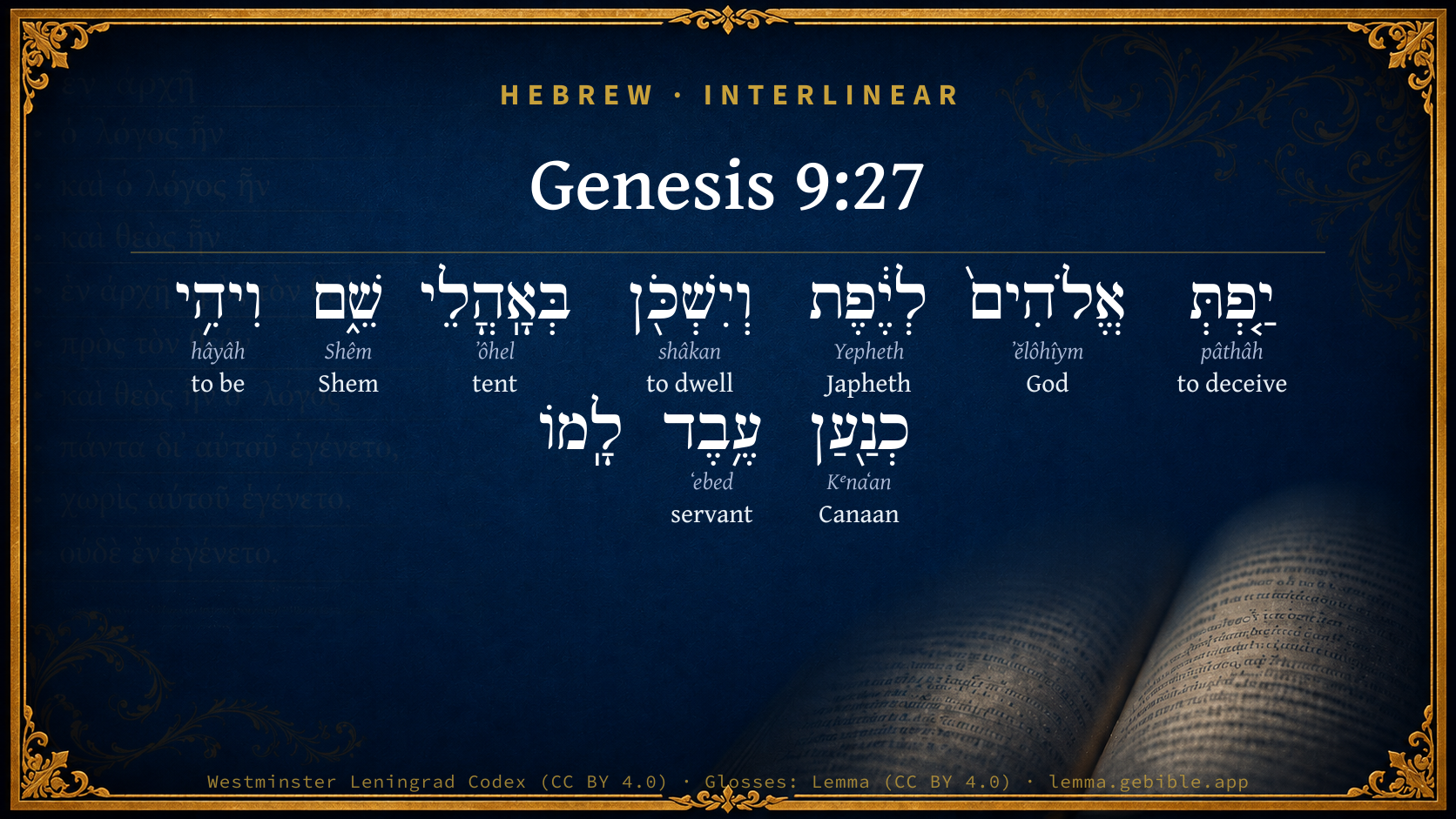
Genesis 9:27

Hebrew (Westminster Leningrad Codex) Genesis 9:27 appears in the Hebrew Old Testament. The text above is from the Westminster Leningrad Codex. Each word links to its Strong’s number, a concise gloss, and parsing drawn from the Open Scriptures Hebrew Bible morphology. Click any word for its full Brown-Driver-Briggs (BDB) entry.
Download image
Cite this verse

Genesis 9:27 (World English Bible). Public Domain. Lemma interlinear Bible study tool, https://lemma.gebible.app/v/genesis/9/27.

Show BibTeX & RIS
BibTeX
RIS
English Translation
God enlarge Japheth, Let him dwell in the tents of Shem; Let Canaan be his servant."
World English Bible · Public Domain
Highlights
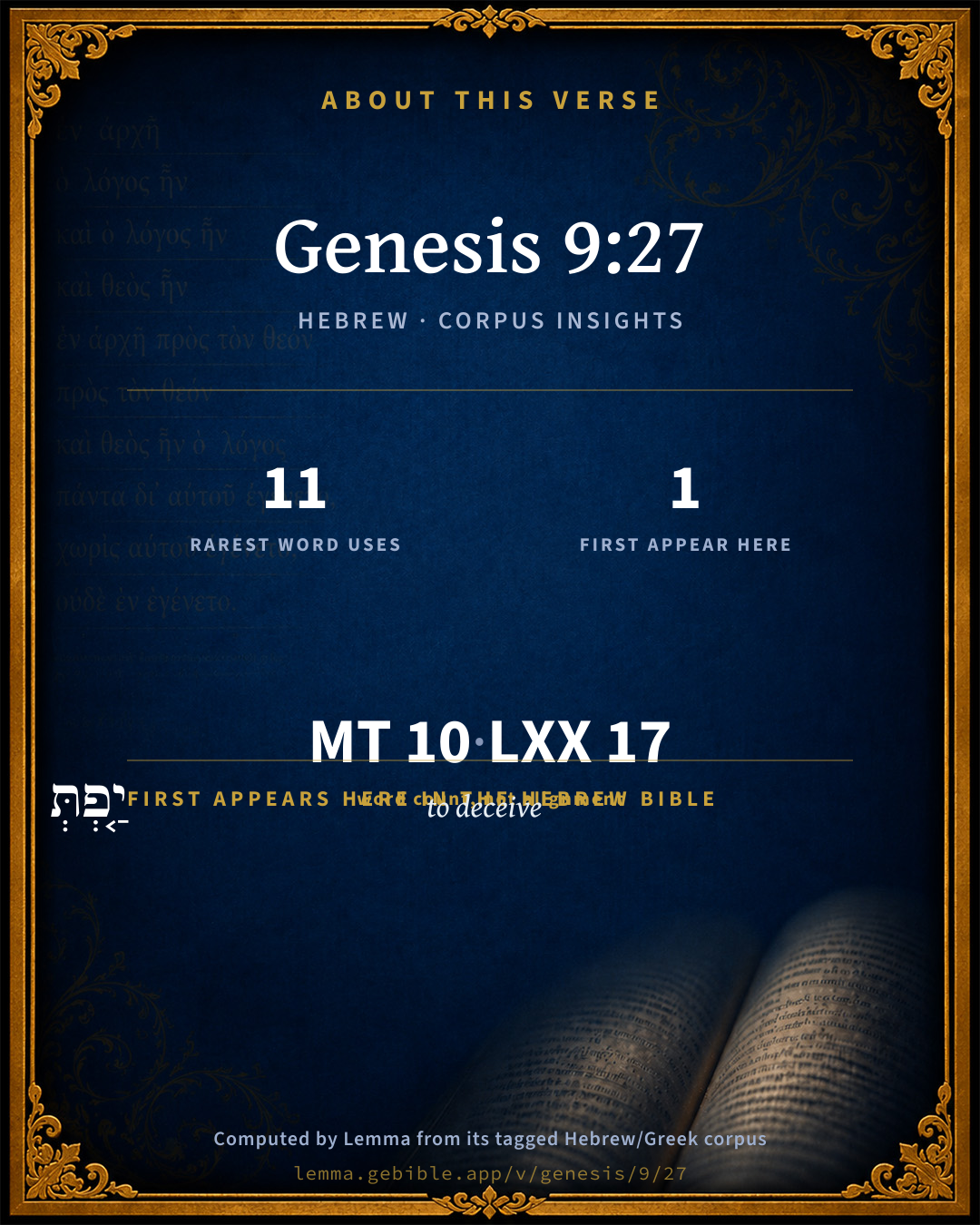
  • 1 first appearance in the Hebrew Bible
Full analysis ↓
Download a study sheet

One document with this verse’s original text, its word-by-word gloss line, the meaning frame, cross-references with their text, attributed commentary, and full source and license credits — printable, and it pastes into notes with its structure intact.

This verse Autodidact and up

Study sheet (.html) Plain text (.txt)

A passage Seminary Student

Up to 50 verses in one chapter. A passage sheet keeps up to 6 commentary sources and 12 cross-references per verse, in the order this page ranks them, and says so on the sheet whenever that leaves anything out. Ask for a single verse and you get the Autodidact verse sheet above.

Everything on this page stays free to read, with no account — the sheet is a download of what is already on screen, not access to it.

Want to remove ads? Support Godless Engineer
Compare translations 3

The same verse in 3 English versions, stacked beneath the original-language interlinear above. Click any original word for its lexicon entry.

Each is an independent rendering of the whole verse — the interlinear is not word-aligned to these translations.

Highlighted words mark where these versions differ — a whole-verse word diff, not a word-by-word alignment.

  • World English Bible Public Domain
    God enlarge Japheth, Let him dwell in the tents of Shem; Let Canaan be his servant."
  • King James Version Public Domain
    God shall enlarge Japheth, and he shall dwell in the tents of Shem; and Canaan shall be his servant.
  • unfoldingWord Literal Text CC BY-SA 4.0
    May God enlarge Japheth, and may he live in the tents of Shem. And may Canaan be a slave for him.”

unfoldingWord Literal Text — © unfoldingWord, licensed CC BY-SA 4.0. Word-aligned USFM3 via Door43 (git.door43.org/unfoldingWord/en_ult).

Versions to compare (up to 4)

3 of 4 selected

Show all 18 translations

Every available English version of this verse, each an independent rendering of the whole verse.

  • World English Bible Public Domain
    God enlarge Japheth, Let him dwell in the tents of Shem; Let Canaan be his servant."
  • Berean Standard Bible Public Domain
    May God expand the territory of Japheth; may he dwell in the tents of Shem, and may Canaan be his servant.”
  • Majority Standard Bible Public Domain
    May God expand the territory of Japheth; may he dwell in the tents of Shem, and may Canaan be his servant.”
  • King James Version Public Domain
    God shall enlarge Japheth, and he shall dwell in the tents of Shem; and Canaan shall be his servant.
  • American Standard Version (1901) Public Domain
    God enlarge Japheth, And let him dwell in the tents of Shem; And let Canaan be his servant.
  • Revised Version (1885) Public Domain
    God enlarge Japheth, And let him dwell in the tents of Shem; And let Canaan be his servant.
  • Geneva Bible (1599) Public Domain
    God perswade Iapheth, that he may dwell in the tentes of Shem, and let Canaan be his seruant.
  • Douay-Rheims (1899) Public Domain
    May God enlarge Japheth, and may he dwell in the tents of Sem, and Chanaan be his servant.
  • Young's Literal Translation Public Domain
    God doth give beauty to Japheth, And he dwelleth in tents of Shem, And Canaan is servant to him.'
  • Literal Standard Version CC BY-SA 4.0
    God gives beauty to Japheth, || And he dwells in tents of Shem, || And Canaan is servant to him.”
  • Unlocked Literal Bible CC BY-SA 4.0
    May God extend the territory of Japheth, and let him make his home in the tents of Shem. May Canaan be his servant.”
  • unfoldingWord Literal Text CC BY-SA 4.0
    May God enlarge Japheth, and may he live in the tents of Shem. And may Canaan be a slave for him.”
  • Darby Bible Public Domain
    Let God enlarge Japheth, and let him dwell in the tents of Shem, And let Canaan be his bondman.
  • World Messianic Bible Public Domain
    May God enlarge Japheth. Let him dwell in the tents of Shem. Let Canaan be his servant.”
  • Webster's Bible Public Domain
    God shall enlarge Japheth, and he shall dwell in the tents of Shem; and Canaan shall be his servant.
  • Free Bible Version CC BY-SA 4.0
    May God give Japtheth plenty of space to accommodate his many descendants, and may they live at peace among Shem's people, and may Canaan also be his slave.”
  • Bible in Basic English Public Domain
    May God make Japheth great, and let his living-place be in the tents of Shem, and let Canaan be his servant.
  • JPS Tanakh (1917) Public Domain
    God enlarge Japheth, and he shall dwell in the tents of Shem; and let Canaan be their servant.

Literal Standard Version (2020), Covenant Press — licensed CC BY-SA 4.0. Text via the HelloAO Bible API (eBible.org). Unlocked Literal Bible (unfoldingWord) — licensed CC BY-SA 4.0. Text via the HelloAO Bible API (eBible.org). unfoldingWord Literal Text — © unfoldingWord, licensed CC BY-SA 4.0. Word-aligned USFM3 via Door43 (git.door43.org/unfoldingWord/en_ult). Free Bible Version, Dr. Jonathan Gallagher — licensed CC BY-SA 4.0. Text via the HelloAO Bible API (eBible.org).

Word by word

More ways to search: Search by grammar → Find every occurrence → Compare this word →

Practice this passage: Drill this verse → Learn its vocabulary →

לְיֶ֔פֶת
Yepheth
H3315
“to/for · Japheth”
Preposition + Noun, Proper
Part of Speech
Preposition + Noun
Type
Proper
Full BDB Definition

Origin: from H6601

TWOT: None

Japheth = "opened" - the 3rd son of Noah whose descendants after the flood settled on the coastal lands of the Mediterranean spreading north into Europe and parts of Asia
  1. יַ֤פְתְּ pâthâh H6601 “to deceive” Verb, Hiphil, Jussive, 3rd Person, Masculine, Singular
  2. אֱלֹהִים֙ ʼĕlôhîym H430 “God(s)” Noun, Common, Masculine, Plural, Absolute
  3. וְיִשְׁכֹּ֖ן shâkan H7931 “and · to dwell” Conjunction + Verb, Qal, Jussive, 3rd Person, Masculine, Singular
  4. בְּאָֽהֳלֵי ʼôhel H168 “in/at · tents of” Preposition + Noun, Common, Masculine, Plural, Construct
  5. שֵׁ֑ם Shêm H8035 “Shem” Noun, Proper
  6. וִיהִ֥י hâyâh H1961 “and · to be” Conjunction + Verb, Qal, Jussive, 3rd Person, Masculine, Singular
  7. כְנַ֖עַן Kᵉnaʻan H3667 “Canaan” Noun, Proper
  8. עֶ֥בֶד ʻebed H5650 “servant” Noun, Common, Masculine, Singular, Absolute

About this verse

These counts appear in no published source. They are computed here, from the morphology-tagged text and Lemma’s own curated glosses. What Lemma adds →

10
words
9
distinct lemmas
Pentateuch
section

Notable vocabulary

The rarest word here is לְיֶ֔פֶת Japheth H3315 — appearing just 11 times in the whole Hebrew Bible.

First appearance in Scripture

This word makes its first canonical appearance in the Hebrew Bible here:

  • יַ֤פְתְּ to deceive H6601

Shared distinctive vocabulary

לְיֶ֔פֶת Japheth H3315 occurs in 11 verses of the Hebrew Bible. Also found in:

Grammatical profile

  • 3 verbs
  • 6 nouns
  • 1 preposition

Verb forms

  • יַ֤פְתְּ Hiphil · Jussive
  • וְיִשְׁכֹּ֖ן Qal · Jussive
  • וִיהִ֥י Qal · Jussive

Hebrew & Septuagint length

In English translation the verse runs 16 words from the Hebrew and 21 from the Septuagint (LXX English) — closely comparable.

A rough comparison of the two English renderings, which tokenize alike — not a word-level alignment.

Word counts can differ between the Hebrew and the Greek without any difference in meaning — e.g. the Hebrew direct-object marker אֵת has no separate Greek word, and Greek often adds the article ὁ.

In the original languages it is 10 Hebrew tokens and 17 Greek tokens — but the two are counted differently (Hebrew bundles its prefixes and suffixes into one token; the Greek is in lemma form), so that isn’t a like-for-like length.

Cross-references

10

Topical passages linked to Genesis 9:27 in the Treasury of Scripture Knowledge — connected by theme and wording, ordered by reader-vote popularity; previews shown in the World English Bible.

  • Romans 11:12 Now if their fall is the riches of the world, and their loss the riches of the Gentiles; how much more their fullness?
  • Romans 15:12 Again, Isaiah says, "There will be the root of Jesse, He who arises to rule over the Gentiles; On him will the Gentiles hope."
  • Ephesians 2:13–14 But now in Christ Jesus you who once were far off are made near in the blood of Christ.
  • Ephesians 3:6 that the Gentiles are fellow heirs, and fellow members of the body, and fellow partakers of his promise in Christ Jesus through the Gospel,
  • Hebrews 11:9–10 By faith, he lived as an alien in the land of promise, as in a land not his own, dwelling in tents, with Isaac and Jacob, the heirs with him of the same promise.
  • Isaiah 11:10 It shall happen in that day, that the root of Jesse, who stands for an ensign of the peoples, to him shall the nations seek; and his resting-place shall be glorious.
  • Hosea 2:14 "Therefore, behold, I will allure her, And bring her into the wilderness, And speak tenderly to her.
  • Malachi 1:11 For from the rising of the sun even to the going down of the same, my name is great among the nations, and in every place incense will be offered to my name, and a pure offering: for my name is great among the nations," says Yahweh of Hosts.
  • Ephesians 2:19 So then you are no longer strangers and foreigners, but you are fellow citizens with the saints, and of the household of God,
  • Ephesians 3:13 Therefore I ask that you may not lose heart at my troubles for you, which are your glory.

Cross-references courtesy of OpenBible.info (CC BY 4.0).

Hebrew and Greek witnesses Masoretic Hebrew ↔ Greek Septuagint

The same verse in the two great witnesses to the Old Testament, shown verse-for-verse.

These are two independent witnesses, not word-aligned to each other, and the Septuagint is shown in lemma (dictionary) form.

Hebrew Genesis 9:27 Masoretic · Westminster Leningrad Codex

יַ֤פְתְּ אֱלֹהִים֙ לְיֶ֔פֶת וְיִשְׁכֹּ֖ן בְּאָֽהֳלֵי שֵׁ֑ם וִיהִ֥י כְנַ֖עַן עֶ֥בֶד לָֽמוֹ

God enlarge Japheth, Let him dwell in the tents of Shem; Let Canaan be his servant."

World English Bible · Public Domain

Greek LXX Genesis 9:27 Septuagint · lemma form

πλατύνω ὁ θεός ὁ ιαφεθ καί καταοἰκέω ἐν ὁ οἶκος ὁ σημ καί γίγνομαι χανααν παῖς αὐτός

May God make room for Japheth, and let him dwell in the habitations of Sem, and let Chanaan be his servant.

LXX2012 (modern English Septuagint) · Public Domain

On this verse, The Pulpit Commentary discusses the Septuagint’s reading. Read the note in Commentary ↓

Hebrew: Westminster Leningrad Codex (CC BY 4.0). Greek: Septuagint (public domain); English from LXX2012 (modern English Septuagint) (Public Domain). How the Septuagint differs from the Hebrew →

Targum (Aramaic paraphrase)

2

The Targum is the ancient Jewish Aramaic paraphrase of the Hebrew Scriptures — an interpretive translation, not the Hebrew text itself. Onkelos (literal) and Pseudo-Jonathan (expansive) render the Torah, and Jonathan the Prophets. Coverage is partial: where no permissively-licensed English translation exists for a verse, only the Aramaic is shown. This is verse-level text, not a word-by-word alignment to the Hebrew.

  1. Targum Onkelos Torah (Genesis–Deuteronomy)
    יַפְתֵּי יְיָ לְיֶפֶת וְיִשְׁרֵי שְׁכִינְתֵּהּ בְּמַשְׁכְּנֵהּ דְּשֵׁם וִיהֵי כְנַעַן עַבְדָא לְהוֹן

    The Lord shall enlarge Yapheth, and he shall make his Shekinah to dwell in the tabernacles of Shem: and Kenaan shall be servant unto them.

    Targum Onkelos — Aramaic: “Onkelos Genesis” (public domain); “Onkelos Exodus” (public domain); “Onkelos Leviticus” (public domain); “Onkelos Numbers” (public domain); “Onkelos Deuteronomy” (public domain). English: “Sefaria Community Translation” (CC0 1.0 (public-domain dedication)); “J.W. Etheridge. The Targums of Onkelos and Jonathan Ben Uzziel on the Pentateuch. London: Longmans, Green, 1862” (public domain). Text via Sefaria.

  2. Targum Pseudo-Jonathan Torah (Genesis–Deuteronomy)
    יַשְׁפַּר יְיָ תְּחוּמֵיהּ דְיֶפֶת וְיִתְגַיְירוּן בְּנוֹי וְיִשְׁרוּן בְּמֶדְרָשָׁא דְשֵׁם וִיהֵי כְנָעַן עֲבִיד לְהוֹן

    The Lord shall beautify the borders of Japhet, and his sons shall be proselyted and dwell in the schools of Shem, and Kenaan shall be a servant to them.

    Targum Pseudo-Jonathan — Aramaic: “Targum Jonathan on Genesis” (public domain); “Targum Jonathan on Exodus” (public domain); “Targum Jonathan on Leviticus” (public domain); “Targum Jonathan on Numbers” (public domain); “Targum Jonathan on Deuteronomy” (public domain). English: “The Targum of Jonathan ben Uzziel, trans. J. W. Etheridge, London, 1862” (public domain). Text via Sefaria.

Commentary

Notes on Genesis 9:27 from classic Christian and Jewish commentators (each source and its license shown beneath its notes). The classic Christian expositions comment on the surrounding passage and are grouped to its opening verse, so a note may address several verses; the Jewish commentaries on the Tanakh (Rashi and others) are per-verse, so they appear only where the commentator wrote on this verse.

Lemma curates 59 commentaries, every one of them public domain or Creative Commons licensed, each selected and text-cleaned for this edition rather than reprinted as found. About our sources →

Trapp's Complete Commentary

John Trapp

Gen 9:27 God shall enlarge Japheth, and he shall dwell in the tents of Shem; and Canaan shall be his servant.

Ver. 27. God persuade Japhet.] For none else can do it. Men may speak persuasively, but to persuade is proper to God alone. He "speaks to the heart"; {Hos 2:14} we to the ear only. He persuadeth and allureth, not only by a moral persuasion, but by an irresistible inward drawing. {Act 11:17} In the Hebrew there is a sweet alliteration; q.d., God shall persuade the persuasible. He shall draw them to faith and obedience, Monendo potius quam minando, docendo quam ducendo , saith St Austin; by informing, not enforcing. He brings in his elect by a merciful violence. He sent forth at first, not swordsmen but fishermen; and prevailed by them in those places where the Romans could never come with all their forces. {a} Elisha could do more with a kiss than his man could do with a staff, in raising the dead child. "Let him kiss me with the kisses of his mouth," {Son 1:2} and then follows, "Draw me; we will run after thee."

And he shall dwell in the tents of Shem.] The Church’s abode here, is but in tents; she hath "no continuing city, on earth, but seeks one to come". {Heb 13:14} This, whether prophecy or prayer, was fulfilled when "God was manifested in the flesh, preached unto the Gentiles, and believed on in the world," {1Ti 3:16} some thousands of years after. The Gentiles were converted by virtue of this prayer, as Paul was by St Stephen’s, and as we enjoy the gospel by Latimer’s "yet once more," and the prayers of other martyrs.

{a} Britannorum inaccessa Romanis loca, Christo tamen subdita . - Tertul.

John Trapp, A Commentary or Exposition upon All the Books of the Old and New Testament (1647–1656) — public domain. Text from a community e-Sword module.

Joseph Benson's Commentary

Gen 9:27. God shall enlarge Japheth — Most of the inhabitants of Europe, termed in the next chapter, the isles of the Gentiles, and those of the northern parts of Asia, were descended from Japheth; and if, as is generally supposed, America was peopled from the north-east of Asia, the original inhabitants of that country also were his offspring. And he shall dwell in the tents of Shem — His seed shall be so numerous, and so victorious, that they shall be masters of the tents of Shem. This was fulfilled when the people of the Jews, the most eminent of Shem’s race, were subjected and made tributaries, first to the Grecians, and afterward to the Romans, both of Japheth’s seed. This also signifies the conversion of the Gentiles, and the bringing of them into the Church of God; and with a reference to this, the words should be rendered, as they properly may, God shall persuade Japheth; and being so persuaded, he shall dwell in the tents of Shem: that is, the Jews and Gentiles shall be united together in the church of God. And after many of the Gentiles shall be proselyted to the Jewish religion, both Jews and Gentiles shall be one in Christ. And Canaan shall be his servant — Servant to Shem, and servant to Japheth; for it is affirmed with respect to both. And a very slight acquaintance with ancient or modern history will be sufficient to convince any serious inquirer of the exact accomplishment of the prediction. For the descendants of Canaan have been under subjection to those of Shem and Japheth through many generations. In this wonderful prophecy, therefore, which includes an outline of the history of all nations and ages, we have a demonstration of the divine inspiration of him who uttered it, as well as of him who recorded it, as Bishop Newton has shown in his most admirable Exposition of the Prophecies: a decisive proof this, of the certainty and importance of these records of eternal truth!

Joseph Benson's Commentary on the Old and New Testaments (1811–1818) — public domain. Text from a community e-Sword module.

Keil & Delitzsch

C. F. Keil & F. Delitzsch

"Wide let God make it to Japhet, and let him dwell in the tents of Shem." Starting from the meaning of the name, Noah sums up his blessing in the word יפתּ (japht), from פּתה to be wide (Pro 20:19), in the Hiphil with ל, to procure a wide space for any one, used either of extension over a wide territory, or of removal to a free, unfettered position; analogous to ל הרחיב, Gen 26:22; Psa 4:1, etc. Both must be retained here, so that the promise to the family of Japhet embraced not only a wide extension, but also prosperity on every hand. This blessing was desired by Noah, not from Jehovah, the God of Shem, who bestows saving spiritual good upon man, but from Elohim, God as Creator and Governor of the world; for it had respect primarily to the blessings of the earth, not to spiritual blessings; although Japhet would participate in these as well, for he should come and dwell in the tents of Shem. The disputed question, whether God or Japhet is to be regarded as the subject of the verb "shall dwell," is already decided by the use of the word Elohim. If it were God whom Noah described as dwelling in the tents of Shem, so that the expression denoted the gracious presence of God in Israel, we should expect to find the name Jehovah, since it was as Jehovah that God took up His abode among Shem in Israel. It is much more natural to regard the expression as applying to Japhet, (a) because the refrain, "Canaan shall be his servant," requires that we should understand Gen 9:27 as applying to Japhet, like Gen 9:26 to Shem; (b) because the plural, tents, is not applicable to the abode of Jehovah in Israel, inasmuch as in the parallel passages "we read of God dwelling in His tent, on His holy hill, in Zion, in the midst of the children of Israel, and also of the faithful dwelling in the tabernacle or temple of God, but never of God dwelling in the tents of Israel" (Hengstenberg); and (c) because we should expect that act of affection, which the two sons so delicately performed in concert, to have its corresponding blessing in the relation established between the two (Delitzsch). Japhet's dwelling in the tents of Shem is supposed by Bochart and others to refer to the fact, that Japhet's descendants would one day take the land of the Shemites, and subjugate the inhabitants; but even the fathers almost unanimously understand the words in a spiritual sense, as denoting the participation of the Japhetites in the saving blessings of the Shemites. There is truth in both views. Dwelling presupposes possession; but the idea of taking by force is precluded by the fact, that it would be altogether at variance with the blessing pronounced upon Shem. If history shows that the tents of Shem were conquered and taken by the Japhetites, the dwelling predicted here still relates not to the forcible conquest, but to the fact that the conquerors entered into the possessions of the conquered; that along with them they were admitted to the blessings of salvation; and that, yielding to the spiritual power of the vanquished, they lived henceforth in their tents as brethren (Psa 133:1). And if the dwelling of Japhet in the tents of Shem presupposes the conquest of the land of Shem by Japhet, it is a blessing not only to Japhet, but to Shem also, since, whilst Japhet enters into the spiritual inheritance of Shem, he brings to Shem all the good of this world (Isa 60). "The fulfilment," as Delitzsch says, "is plain enough, for we are all Japhetites dwelling in the tents of Shem; and the language of the New Testament is the language of Javan entered into the tents of Shem." To this we may add, that by the Gospel preached in this language, Israel, though subdued by the imperial power of Rome, became the spiritual conqueror of the orbis terrarum Romanus, and received it into his tents. Moreover it is true of the blessing and curse of Noah, as of all prophetic utterances, that they are fulfilled with regard to the nations and families in question as a whole, but do not predict, like an irresistible fate, the unalterable destiny of every individual; on the contrary, they leave room for freedom of personal decision, and no more cut off the individuals in the accursed race from the possibility of conversion, or close the way of salvation against the penitent, than they secure the individuals of the family blessed against the possibility of falling from a state of grace, and actually losing the blessing. Hence, whilst a Rahab and an Araunah were received into the fellowship of Jehovah, and the Canaanitish woman was relieved by the Lord because of her faith, the hardened Pharisees and scribes had woes pronounced upon them, and Israel was rejected because of its unbelief.

In Gen 9:28, Gen 9:29, the history of Noah is brought to a close, with the account of his age, and of his death.

Keil & Delitzsch — Biblical Commentary on the Old Testament (1861–1891) — public domain (CC PDM 1.0). Text via the HelloAO Bible API. (Old Testament only.)

Tyndale Open Study Notes

Tyndale Open Resources

9:27 May Japheth share the prosperity of Shem: Japheth’s descendants would live among Shem’s descendants and share Shem’s prosperity (cp. Rom 11:17-18).

Tyndale Open Study Notes — © Tyndale Open Resources, licensed CC BY-SA 4.0. Text via the HelloAO Bible API.

Geneva Bible (1599)

Geneva Bible translators

Or, enlarge, or cause to return.

He declareth that the Gentiles, which came of Japheth, and were separated from the Church, should be joined to the same by the persuasion of God’s Spirit, and preaching of the Gospel.

Geneva Bible (1599) marginal notes — public domain. Text via Bolls.life.

Jamieson, Fausset & Brown

Robert Jamieson, A. R. Fausset & David Brown

God shall enlarge Japheth--pointing to a vast increase in posterity and possessions. Accordingly his descendants have been the most active and enterprising, spread over the best and largest portion of the world, all Europe and a considerable part of Asia.

he shall dwell in the tents of Shem--a prophecy being fulfilled at the present day, as in India British Government is established and the Anglo-Saxons being in the ascendancy from Europe to India, from India over the American continent. What a wonderful prophecy in a few verses (Isa 46:10; Pe1 1:25)!

Next: Genesis Chapter 10

Jamieson, Fausset & Brown — Commentary Critical and Explanatory on the Whole Bible (1871) — public domain (CC PDM 1.0). Text via the HelloAO Bible API.

John Calvin's Commentaries

27. God shall enlarge Japheth. In the Hebrew words יפת (japhte) and יפת (japheth,) there is an elegant allusion. For the root of the word is פתה (pathah,) which, among the Hebrews, signifies to entice with smooth words, or to allure in one direction or another. Here, however, nearly all commentators take it as signifying to enlarge. If this exposition be received, the meaning will be, that the posterity of Japheth, which for a time would be scattered, and removed far from the tents of Shem, would at length be increased, so that it should more nearly approach them, and should dwell together with them, as in a common home. But I rather approve the other version, ‘God shall gently bring back, or incline Japheth.’ Moreover, whichever interpretation we follow, Noah predicts that there will be a temporary dissension between Shem and Japheth, although he retains both in his family and calls both his lawful heirs; and that afterwards the time will come, in which they shall again coalesce in one body, and have a common home. It is, however, most absolutely certain, that a prophecy is here put forth concerning things unknown to man, of which, as the event, at length, shows God alone was the Author. Two thousand years and some centuries more, elapsed before the Gentiles and the Jews were gathered together in one faith. Then the sons of Shem, of whom the greater part had revolted and cut themselves off from the holy family of God, were collected together, and dwelt under one tabernacle. Also the Gentiles, the progeny of Japheth, who had long been wanderers and fugitives were received into the same tabernacle. For God, by a new adoption, has formed a people out of those who were separated, and has confirmed a fraternal union between alienated parties. This is done by the sweet and gentle voice of God, which he has uttered in the gospel; and this prophecy is still daily receiving its fulfillment, since God invites the scattered sheep to join his flock, and collects, on every side, those who shall sit down with Abraham, Isaac and Jacob, in the kingdom of heaven. It is truly no common support of our faith, that the calling of the Gentiles is not only decreed in the eternal counsel of God, but is openly declared by the mouth of the Patriarch; lest we should think it to have happened suddenly or by chance, that the inheritance of eternal life was offered generally to all. But the form of the expression, ‘Japheth shall dwell in the tabernacles of Shem,’ commends to us that mutual society which ought to exist, and to be cherished among the faithful. For whereas God had chosen to himself a Church from the progeny of Shem, he afterwards chose the Gentiles together with them, on this condition, that they should join themselves to that people, who were in possession of the covenant of life.

John Calvin's Commentaries (1540-1563) — public domain. Text from the Calvin Translation Society English edition (1840s-50s) via the Christian Classics Ethereal Library (ccel.org). Calvin's coverage is partial (roughly two-thirds of the Bible); uncommented books and verses are honest gaps, never fabricated. The 19th-century editor's footnotes and remarks are omitted so the notes are faithfully Calvin's own voice.

Ellicott's Commentary for English Readers

(27) God shall enlarge Japheth.—First, the Deity is here Elohim, following upon Jehovah in the preceding verse, and that with extraordinary exactness. Jehovah has never been the special name of the Deity worshipped by the race of Japheth, though doubtless it is the Greek Zeus and the Latin Jove. But it soon became the proper title of God in covenant with the race of Shem. It is plainly impossible to divide this most ancient poem into Elohistic and Jehovistic sections, and the theory, however plausible occasionally, fails in a crucial place like this. Next, there is a play upon the name of Japheth, or rather, Yepheth, our translators having made the same mistake as in changing Hebel into Abel. The Hebrew is Yapheth Elohim l’Yepheth, “God enlarge the enlarger” (not “God shall enlarge”). While, then, it is the special blessing of Shem that through him the voice of thanksgiving is to ascend to Jehovah, the God of grace; it is Elohim, the God of nature and of the universe, who gives to Japheth wide extension and the most numerous posterity. If the most ancient civilisation and the earliest empires in Egypt and on the Tigris were Hamite, the great world- powers of history, the Chaldean, the Medo-Persian, the Greek and Roman, the Hindoo, were all of Japhetic origin, as are also the modern rulers of mankind.

He shall dwell in the tents of Shem.—(Rather, let him dwell). In one sense Shem now dwells in the tents of Japheth: for the Jews, the noblest representatives of Shem, dwell dispersed in Aryan countries; and except in the Arabian peninsula, once Cushite, the Shemites have no home of their own. But the religious privileges of their race now belong to the family of Japheth. Carried by Jewish missionaries, like St. Paul, throughout the Roman world, they have become the property of the leading members of the Aryan race; and thus Japheth takes possession of the tents which by right of primogeniture belonged to Shem. For “to dwell in the tents of Shem” is not so much to share them as to own them; and if the Jews retain some degree of faith, it has lost with them all expansive power; while the right interpretation of their Scriptures, and as well the maintenance as the propagation of the religion of their Messiah, are now in the hands of the descendants of Japheth. Yet Shem does not lose all pre-eminence: for again we read—

Canaan shall be his servant (rather, their).—If Shem lose the foremost place of primogeniture, he is still a brother, and Canaan but a slave.

A Bible Commentary for English Readers, edited by Charles John Ellicott (1878–1897) — public domain. Text from a community e-Sword module.

The Cambridge Bible for Schools and Colleges

gen. ed. J. J. S. Perowne

27. God] The blessing on Japheth is introduced with the name not of “Jehovah,” but of “Elohim.” Jehovah is the God who reveals Himself through the descendants of Shem. The blessing of Japheth shall come from God; but Japheth will not know God by His name Jehovah.

enlarge] The word in the Hebrew, yapht, is employed on account of its resemblance in sound to the name of Japheth. The blessing means, “May God extend the rule of Japheth,” i.e. may the meaning of his name be realized in the extension of his power!

let him dwell] Better than he shall. The “he” in this clause is not God, but Japheth. The clause contains the prayer that Japheth may ever continue on terms of peace with Shem, and that his descendants, dwelling as guests among the Israelites, may partake of their privileges. That “to dwell in the tents of Shem” should mean “to dispossess the Shemites and occupy their homes” (following the analogy of the phrase in Psa_78:55), is an explanation quite unsuited to a clause of blessing.

The conjecture that “Shem” in this verse is not a proper name, but is the Hebrew word meaning “name” or “renown” (as in Gen_6:4), so that the meaning is “and let him dwell in the tents of renown,” would hardly have been suggested, unless the clause had been one of some obscurity.

his] Better, as R.V. marg., their. See note on Gen_9:26.

28 (P). And Noah lived] This and the following verses are the conclusion of P’s account of the Deluge. In contents and character they belong to the genealogy of the Sethite patriarchs in ch. 5.

The Cambridge Bible for Schools and Colleges (gen. ed. J. J. S. Perowne; Cambridge University Press, 1878–1918) — public domain. Text from a community e-Sword module.

John Gill's Exposition

God shall enlarge Japheth,.... Or give him a large part of the earth, and large dominions in it, as his posterity have had; for, as Bochart (r) observes, to them belonged all Europe, and lesser Asia, Media, Iberia, Albania, part of Armenia, and all those vast countries to the north, which formerly the Scythians, and now the Tartars inhabit; not to say anything of the new world (America), into which the Scythians might pass through the straights of Anian:

and he shall dwell in the tents of Shem; inhabit the countries belonging to the posterity of Shem: this was verified by the Medes, who were the descendants of Japheth, together with the Babylonians seizing upon the Assyrian empire and overthrowing that, for Ashur was of Shem; and in the Greeks and Romans, who sprung from Japheth, when they made conquests in Asia, in which were the tents of Shem's posterity; and who, according to the prophecy in Num 24:24 that ships from the coast of Chittim, Greece, or Italy, or both, should afflict Ashur and Eber, the Assyrians and the Hebrews, or those beyond the river Euphrates, who all belonged to Shem; and particularly this was fulfilled when the Romans, who are of Japheth, seized Judea, which had long been the seat of the children of Shem, the Jews; and at this day the Turks (s), who are also Japheth's sons, literally dwell in the tents of Shem, or inhabit Judea: the Targums understand this in a mystical sense. Onkelos thus:"God shall cause his Shechinah or glorious Majesty to dwell in the tents of Shem;''which was remarkably true, when Christ, the brightness of his Father's glory, the Word, was made flesh, and tabernacled in Judea: Jonathan Ben Uzziel thus;"and his children shall be proselytes, and dwell in the school of Shem;''and many Christian writers interpret them of the conversion of the Gentiles, and of their union and communion with the believing Jews in one Gospel church state, which was very evidently fulfilled in the first times of the Gospel: and they read these words in connection with the former clause thus, "God shall persuade Japheth (t), and he shall dwell in the tents of Shem"; that is, God shall persuade the Gentiles, the posterity of Japheth, by the sweet alluring voice of his Gospel, and through the power of his grace accompanying it, to embrace and profess Christ and his Gospel, and join with his churches, and walk with them in all the commandments and ordinances of Christ; and at this day all the posterity of Japheth, excepting Magog, or the Turks, bear the name of Christians: the Talmudists (u) interpret the passage of the language of Japheth being spoken in the tents of Shem; which had its accomplishment when the apostles of Christ spoke and wrote in Greek, one of the languages of Japheth's sons. Some understand this of God himself, he shall dwell in the tents of Shem, or in Israel, as Jarchi, and was verified remarkably in the incarnation of the Son of God:

and Canaan shall be his servant; the posterity of Canaan servants to the posterity of Japheth; as they were when Tyre, which was built by the Sidonians, and Sidon, which had its name from the eldest son of Canaan, fell into the hands of Alexander the Grecian, who sprung from Japheth; and when Carthage, a colony of the Phoenicians of Canaan's race, was taken and demolished by the Romans of the line of Japheth, which made Hannibal, a child of Canaan, say, "agnoscere se fortunam Carthaginis" (w), that he owned the fate of Carthage; and in which some have thought that he refers to this prophecy.

(r) Phaleg. l. 3. c. 1. col. 149. (s) This was written about 1750. Ed. (t) "alliciet", Junius & Tremellius, Piscator; "persuadebit", Cocceius; so Ainsworth. (u) T. Hieros. Megillah, fol. 71. 2. T. Bab. Megillah, fol. 9. 2. Bereshit Rabba, sect. 36. fol. 32. 1. (w) Liv. Hist. l. 27. c. 51.

John Gill's Exposition of the Whole Bible (1746–1763) — public domain (CC PDM 1.0). Text via the HelloAO Bible API.

Haydock's Catholic Bible Commentary

Enlarge Japheth. His name signifies latitude or enlargement. (Worthington) --- May he, God, according to some; but more probably Japheth, of whom the rest of the sentence speaks. (Haydock) --- This was verified by the extensive dominion of the children of Japheth, both in the islands and on the continent; more particularly, when the Romans subdued the Jews, and posterity of Sem. (Menochius) --- Referring all this to the Church, the Gentiles entered in, upon the refusal of the Jews, though preachers of that nation were the instruments of their conversion. Chanaan, in the mean time, cherished his slavery, and seeks not to obtain the liberty and glory of the sons of God, in which he is a figure of heretics, (Haydock) who serve to make Christians more upon their guard, and by persecuting them, exercise their patience and increase their crown. (Worthington)

George Leo Haydock (1774–1849), Haydock's Catholic Family Bible and Commentary, 1859 edition — public domain. Excludes Psalms (Douay-Rheims chapter numbering differs from Protestant) and Deuterocanonical books (Catholic canon only).

Matthew Poole's English Annotations

God shall enlarge Japheth; or, enlarge to Japheth. Understand here his place, as Gen 26:22; Psa 4:1, or his border; which was very literally made good to him, because he had a very numerous posterity; and by them he possessed the largest part of the world, even all Europe, a great part of Asia, and it is probable America also. Or, God shall persuade Japheth to do what follows, to dwell in Shem’s tents, where God dwelleth; and so to be reunited to his brother Shem both in affection and in religion, in both which the Gentiles, the greatest part of whom were Japheth’s posterity, were for a long time at an irreconcilable distance from the Jews.

He shall dwell in the tents of Shem, i.e. shall be of the same church with Shem, i.e. of the church, which is called in Scripture the tents or tabernacles of Judah, or of Jacob, or in general of the saints, Zec 12:7; Mal 2:12; Rev 20:9, and here of Shem, in whose posterity the church was first and longest settled. And to dwell with another notes friendly association and communion with him, as when God is said to dwell with men; and when the wolf is said to dwell with the lamb, Isa 11:6. Possibly this may note Japheth’s succession into Shem’s tents, or coming into their place and stead, or the calling of the Gentiles, together with the rejection of the Jews; as the Reubenites are said to dwell in the tabernacles of the Hagarite, whom they subdued and expelled, 1Ch 5:10.

Canaan shall be his servant. This was eminently accomplished; for though Shem and Japheth, in their posterity, did successively conquer and rule one over the other, yet none of Ham’s posterity did ever bear rule over Japheth; but Ham, though for a time he bore sway in his son Nimrod, yet that dominion soon expired, and the Assyrians, Chaldeans, Grecians, and Romans ruled the world for a succession of many ages, and Ham’s people were constantly their servants and subjects.

Matthew Poole's English Annotations on the Holy Bible (1683–1685) — public domain. Text from a community e-Sword/MySword module.

Whedon's Commentary on the Bible

Daniel D. Whedon

27. God — Elohim, the generic, not the covenant name, as used with Shem.

Shall — Rather, let.

Enlarge Japheth — Japheth goes forth to conquer worlds of matter and worlds of thought. The Shemitic nations are spiritual and contemplative, preferring a pastoral or agricultural life; the Japhetic nations are intellectual, enterprising, nomadic. Intellectual activity characterizes them, as spiritual insight characterizes the descendants of Shem. The conquests of Xerxes, Alexander, the Cesars, and Napoleon — the logic and philosophy of the Sanscrit, the Greek, the German, the English — the vast migrations of the Tartars and Goths — the colonies and the commerce of the Greeks, the Romans, and the English, show how deeply prophetic is the name of Japheth.

He shall dwell in the tents of Shem — Let him dwell in the tents of Shem. Many commentators, following the Targum of Onkelos, make Elohim the subject here, but most follow the Targum of Jonathan, and consider Japheth the subject. The first interpretation destroys the unity of the prophecy, and is harsh and forced. As Japheth and Shem had united in this work of filial piety, so should their children be united in participating in world-wide blessings. The aggressive, intellectual Japheth shall dwell in the tents of the quiet, spiritual Shem, and share in the wondrous promises which he inherits. Each shall share the strength and glory of the other. The Hebrew religion was poured upon the world through the languages, the logic, and rhetoric of the Greek and Roman. The words of Jesus (who bore the “NAME above every name,” typified by Shem) come to us in a language of Japheth. Paul, a Hebrew of the Hebrews, preached and wrote in Greek, yet was protected in his work as a Roman citizen, and carried the glad tidings over Roman roads and in Roman ships.

Daniel D. Whedon (gen. ed.), Commentary on the Old and New Testaments (1874–1909) — public domain. Text from a community e-Sword module.

The Pulpit Commentary

God. Elohim. If vers. 18-27 are Jehovistic (Tuch, Bleek, Colenso, et alii), why Elohim? Is this a proof that the Jehovistic document was revised by the Elohistic author, as the presence of Jehovah in any so-called Elohistic section is regarded as an interpolation by the supplementer? To obviate this inference Davidson assigns vers. 20-27 to his redactor. But the change of name is sufficiently explained when we remember that "Jehovah, as such, never was the God of Japheth"s descendants, and that the expression would have been as manifestly improper if applied to him as it is in its proper place applied to Shem" (Quarry, p. 393). Shall enlarge Japheth. tpyl Tpy; literally, shall enlarge or make room for the one that spreads abroad; or, "may God concede an ample space to Japheth" (Gesenius). "Wide let God make it for Japheth" (Keil). "God give enlargement to Japheth" (Lange). So LXX, Vulgate, Chaldee, Syriac, Arabic. The words form a paronomasia, both the verb and the noun being connected with the root ht; p; to spread abroad; Hiph., to cause to lie open, hence to make room for, and refer to the widespread diffusion and remarkable prosperity of the Japhetic nations. The familiar interpretation which renders "God will persuade Japheth, the persuadable," i.e. incline his heart by the gospel so that he may dwell in the tents of Shem (Junins, Vatablus, Calvin, Willet, Ainsworth), is discredited by the facts

(1) that the verb never means to persuade, except in a bad sense (cf., 1Ki_22:20) and

(2) that in this sense it is never followed by l, but always by the accusative (vide Gesenius, sub. nom.; cf. Bush, p. 109). The fulfillment of the prophecy is apparent from the circumstance that "praeter Europam (eujrwkh wide, extensive) "maximam Asiae pattern, totum demique novum orbem, veluti immensae maguitudinis auctarium, Japheto posterique ejus in perpetuam possessionem obtigisse" (Fuller, Sac. Miscel., lib. 2. c. 4, quoted by Glass); cf. Gen_10:2-5, in which Japheth is given as the progenitor of fourteen peoples, to which are added the inhabitants of the lands washed by the sea. The expansive power of Japheth "refem not only to the territory and the multitude of the Japhethites, but also to their intellectual and active faculties. The metaphysics of the Hindoos, the philosophy of the Greeks, the military prowess of the Romans, and the modern science and civilization of the world are due to the race of Japheth" (Murphy) And he not Elohim (Philo., Theodoret, Onkelos, Dathe, Baumgarten, et alii), which

(1) substantially repeats the blessing already given to Shem, and

(2) would introduce an allusion to the superiority of Shem"s blessing in what the context requires should be an unrestricted benediction of Japheth; but Japheth (Calvin, Rosenm Delitzsch, Keil, Lange, Kaliseh, Murphy, Wordsworth, "Speaker"s Commentary")shall dwell. kvyi, from kv to dwell; used of God inhabiting the heavens, (Isa_57:15) dwelling in the bush, (Deu_30:16) residing, or causing his name to dwell, in the tabernacle; (Deu_12:11) hence supposed to favor the idea that Elohim is the subject; but it was as Jehovah (not Elohim) that God abode between the cherubim. (Exo_40:34) In the tents of Shem. Not the tents of celebrity (Gesenius, Vater, Michaelis, De Wette, Knobel), but the tents of the Shemitic races, with allusion not to their subjugation by the Japhethites (Clericus, Von Bohlen, Bochart), which would not be in keeping with the former blessing pronounced upon them (Murphy), but to their subsequent contiguity to, and even commingling with, but especially to their participation in the religious privileges of, the Shemites (the Fathers, Targum Jonathan, Hisronymus, Calvin, Keil, Lange, "Speaker"s Commentary," Murphy, Candlish). The fulfillment of the prophecy is too obvious to call for illustration. And Canaan shall be his servant.

The Pulpit Commentary (1880–1919), ed. H.D.M. Spence-Jones & Joseph S. Exell — public domain. Text from a community e-Sword module.

John Wesley's Explanatory Notes

God shall enlarge Japheth, and he shall dwell in the tents of Shem - His seed shall be so numerous and so victorious, that they shall be masters of the tents of Shem, which was fulfilled when the people of the Jews, the most eminent of Shem's race, were tributaries to the Grecians first, and after to the Romans, both of Japhet's seed. This also speaks the conversion of the Gentiles, and the bringing of them into the church; and then we should read it, God shall persuade Japheth; (for so the word signifies) and being so persuaded, he shall dwell in the tents of Shem - That is, Jews and Gentiles shall be united together in the gospel-fold: after many of the Gentiles shall have been proselyted to the Jewish religion, both shall be one in Christ, Eph. ii, 14, 15. When Japheth joins with Shem, Canaan falls before them both: when strangers become friends, enemies become servants.

John Wesley, Explanatory Notes Upon the Whole Bible (1754–1765) — public domain. Text via the GEBible commentary corpus.

Rashi

Rabbi Shlomo Yitzchaki (Rashi)

יפת אלהים ליפת MAY GOD ENLARGE JAPHETH — The Targum renders the verb by יפתי meaning, “may He extend”.

וישכון באהלי שם AND MAY HE DWELL IN THE TENTS OF SHEM — may He make His Divine Presence (Shechinah) dwell in Israel. According to the Midrashic exposition of the Sages (Yoma 10a) it means: Although God enlarged Japheth inasmuch that Cyrus, who was a descendant of Japheth, built the second Temple, yet the Shechinah did not dwell in it. Where, then, did it dwell? In the first Temple which Solomon, a descendant of Shem, built.

ויהי כנען עבד למו AND MAY CANAAN BE SERVANT TO THEM — Even when the children of Shem be in exile, children of Canaan will be sold to them as slaves.

Rashi on the Tanakh — English translations: “The Judaica Press complete Tanach with Rashi, translated by A. J. Rosenberg” (CC BY 4.0); “Pentateuch with Rashi's commentary by M. Rosenbaum and A.M. Silbermann, 1929-1934” (public domain); “The Metsudah Tanach series, Lakewood, N.J” (CC BY 4.0); and “The Book of Joshua, Metsudah Publications, 1997” (CC BY 4.0). Text via Sefaria.

Radak

Rabbi David Kimhi (Radak)

יפת אלוקים, this expression is appropriately translated as “may He expand,” the root of the word יפת being פתח, an opening. It is in the transitive mode, as for instance Isaiah 41,2 ומלכים ירד, from the root רדה “to rule.” Noach prays that Yaphet’s share of the earth will be enlarged. Even though Noach promises quantity to Yaphet, he reserves quality for Shem, saying that G’d will make His home in the portion of the earth allocated to Shem’s descendants. (see Exodus 29,45) Moses also specifically prays for a renewal of this blessing after the sin of the golden calf in Exodus 33,16) when he pleads for the Jewish people to enjoy this distinction.

ויהי כנען עבד למו, also to the descendants of Yaphet.

Radak on the Tanakh — English translations: “Sefaria Community Translation” (CC0 1.0 (public-domain dedication)); “Eliyahu Munk, HaChut Hameshulash” (CC BY 4.0); “Rabbi Mike Feuer, Jerusalem Anthology” (CC BY 4.0); and “R. David Kimhi on the first book of Psalms, Translated by R.G. Finch, London, 1919” (public domain). Text via Sefaria.

Lesson kit

Teaching starters — assembled from the data on this page, not authored interpretation. Every prompt links to the verse data it draws on. Edit before teaching.

Genesis, in the Pentateuch, opens this verse with 10 words (9 distinct Hebrew lemmas). Its most distinctive word is Yepheth (“Japheth”). A historical commentator’s framing appears above. Read the whole chapter for the surrounding context.

Discussion questions

  1. What does “Japheth” (Yepheth) contribute to the verse as a whole?
  2. The word “to deceive” first appears here in Scripture. What is being introduced at this debut?
  3. Genesis 5:32 shares the word «Japheth» with this verse. How do the two illuminate each other?
  4. These translations render this verse differently. What is at stake in choosing one wording over another?
  5. The verb «יַ֤פְתְּ» is Hiphil Jussive. How does its form color the action?
  6. Reading how Trapp's Complete Commentary and Joseph Benson's Commentary read this verse, where do the two commentators agree and where do they part?

Things to notice

Reading settings

Reading text

Shown beneath each verse's original-language words.

Old Testament
Old Testament edition

Read the OT as the Masoretic Hebrew (MT) or the Greek Septuagint (LXX).

English shown for the Greek Septuagint (in the Hebrew ↔ Greek comparison).

Comparing translations? Open the Compare panel on any verse page to stack up to four side by side.