
Numbers 7:5

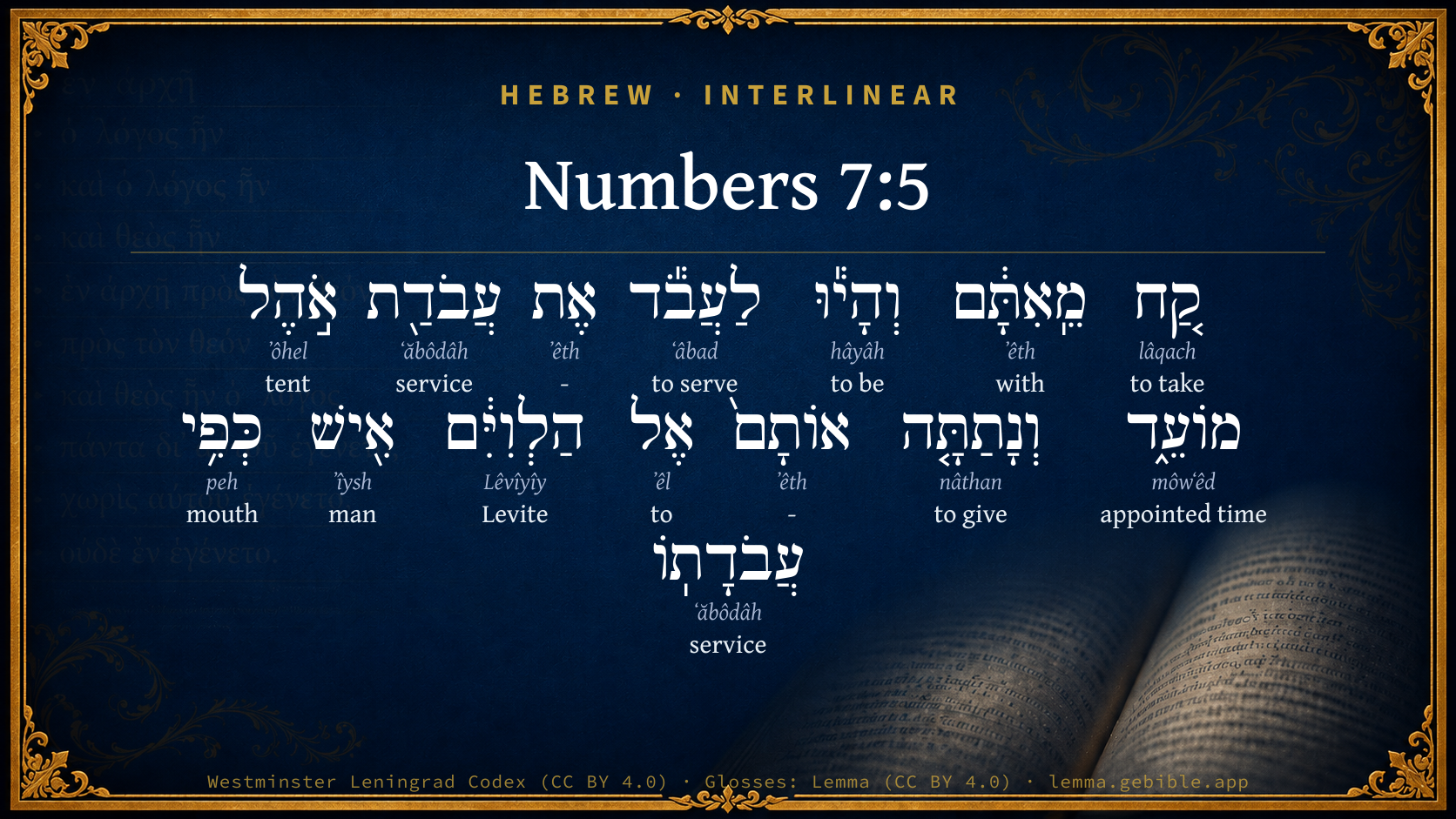
Hebrew (Westminster Leningrad Codex) Numbers 7:5 appears in the Hebrew Old Testament. The text above is from the Westminster Leningrad Codex. Each word links to its Strong’s number, a concise gloss, and parsing drawn from the Open Scriptures Hebrew Bible morphology. Click any word for its full Brown-Driver-Briggs (BDB) entry.
Download image
Cite this verse

Numbers 7:5 (World English Bible). Public Domain. Lemma interlinear Bible study tool, https://lemma.gebible.app/v/numbers/7/5.

Show BibTeX & RIS
BibTeX
RIS
English Translation
"Accept these from them, that they may be used in doing the service of the Tent of Meeting; and you shall give them to the Levites, to every man according to his service."
World English Bible · Public Domain
Download a study sheet

One document with this verse’s original text, its word-by-word gloss line, the meaning frame, cross-references with their text, attributed commentary, and full source and license credits — printable, and it pastes into notes with its structure intact.

This verse Autodidact and up

Study sheet (.html) Plain text (.txt)

A passage Seminary Student

Up to 50 verses in one chapter. A passage sheet keeps up to 6 commentary sources and 12 cross-references per verse, in the order this page ranks them, and says so on the sheet whenever that leaves anything out. Ask for a single verse and you get the Autodidact verse sheet above.

Everything on this page stays free to read, with no account — the sheet is a download of what is already on screen, not access to it.

Want to remove ads? Support Godless Engineer
Compare translations 3

The same verse in 3 English versions, stacked beneath the original-language interlinear above. Click any original word for its lexicon entry.

Each is an independent rendering of the whole verse — the interlinear is not word-aligned to these translations.

Highlighted words mark where these versions differ — a whole-verse word diff, not a word-by-word alignment.

  • World English Bible Public Domain
    "Accept these from them, that they may be used in doing the service of the Tent of Meeting; and you shall give them to the Levites, to every man according to his service."
  • King James Version Public Domain
    Take it of them, that they may be to do the service of the tabernacle of the congregation; and thou shalt give them unto the Levites, to every man according to his service.
  • unfoldingWord Literal Text CC BY-SA 4.0
    “Take from with them, and they shall be to serve the service of the tent of meeting. And you shall give them to the Levites, a man according to the mouth of his service.”

unfoldingWord Literal Text — © unfoldingWord, licensed CC BY-SA 4.0. Word-aligned USFM3 via Door43 (git.door43.org/unfoldingWord/en_ult).

Versions to compare (up to 4)

3 of 4 selected

Show all 17 translations

Every available English version of this verse, each an independent rendering of the whole verse.

  • World English Bible Public Domain
    "Accept these from them, that they may be used in doing the service of the Tent of Meeting; and you shall give them to the Levites, to every man according to his service."
  • Berean Standard Bible Public Domain
    “Accept these gifts from them, that they may be used in the work of the Tent of Meeting. And give them to the Levites, to each man according to his service.”
  • Majority Standard Bible Public Domain
    “Accept these gifts from them, that they may be used in the work of the Tent of Meeting. And give them to the Levites, to each man according to his service.”
  • King James Version Public Domain
    Take it of them, that they may be to do the service of the tabernacle of the congregation; and thou shalt give them unto the Levites, to every man according to his service.
  • American Standard Version (1901) Public Domain
    Take it of them, that they may be `used' in doing the service of the tent of meeting; and thou shalt give them unto the Levites, to every man according to his service.
  • Revised Version (1885) Public Domain
    Take it of them, that they may be to do the service of the tent of meeting; and thou shalt give them unto the Levites, to every man according to his service.
  • Geneva Bible (1599) Public Domain
    Take these of them, that they may be to doe the seruice of the Tabernacle of the Congregation, and thou shalt giue them vnto the Leuites, to euery man according vnto his office.
  • Young's Literal Translation Public Domain
    `Receive from them, and they have been to do the service of the tent of meeting, and thou hast given them unto the Levites, each according to his service.'
  • Literal Standard Version CC BY-SA 4.0
    “Receive [these] from them, and they have been [used] for doing the service of the Tent of Meeting, and you have given them to the Levites, each according to his service.”
  • Unlocked Literal Bible CC BY-SA 4.0
    “Accept the offerings from them and use the offerings for the work in the tent of meeting. Give the offerings to the Levites, to each one as his work needs them.”
  • unfoldingWord Literal Text CC BY-SA 4.0
    “Take from with them, and they shall be to serve the service of the tent of meeting. And you shall give them to the Levites, a man according to the mouth of his service.”
  • Darby Bible Public Domain
    Take it of them, and they shall be for the performance of the service of the tent of meeting, and thou shalt give them unto the Levites, to each according to his service.
  • World Messianic Bible Public Domain
    “Accept these from them, that they may be used in doing the service of the Tent of Meeting; and you shall give them to the Levites, to every man according to his service.”
  • Webster's Bible Public Domain
    Take it of them, that they may be to perform the service of the tabernacle of the congregation; and thou shalt give them to the Levites, to every man according to his service.
  • Free Bible Version CC BY-SA 4.0
    “Accept what they're giving you and use them in the work of the Tent of Meeting. Give them to the Levites to use as required.”
  • Bible in Basic English Public Domain
    Take the things from them, to be used for the work of the Tent of meeting; and give them to the Levites, to every man what is needed for his work.
  • JPS Tanakh (1917) Public Domain
    'Take it of them, that they may be to do the service of the tent of meeting; and thou shalt give them unto the Levites, to every man according to his service.'

Literal Standard Version (2020), Covenant Press — licensed CC BY-SA 4.0. Text via the HelloAO Bible API (eBible.org). Unlocked Literal Bible (unfoldingWord) — licensed CC BY-SA 4.0. Text via the HelloAO Bible API (eBible.org). unfoldingWord Literal Text — © unfoldingWord, licensed CC BY-SA 4.0. Word-aligned USFM3 via Door43 (git.door43.org/unfoldingWord/en_ult). Free Bible Version, Dr. Jonathan Gallagher — licensed CC BY-SA 4.0. Text via the HelloAO Bible API (eBible.org).

Word by word

More ways to search: Search by grammar → Find every occurrence → Compare this word →

Practice this passage: Drill this verse → Learn its vocabulary →

עֲבֹדַ֖ת
ʻăbôdâh
H5656
“service of”
Noun, Common, Feminine, Singular, Construct
Part of Speech
Noun
Type
Common
Gender
Feminine
Number
Singular
State
Construct
Full BDB Definition

Origin: from H5647

TWOT: 1553c

labour, service - labour, work - labour (of servant or slave) - labour, service (of captives or subjects) - service (of God)
  1. קַ֚ח lâqach H3947 “take” Verb, Qal, Imperative, 2nd Person, Masculine, Singular
  2. מֵֽאִתָּ֔ם ʼêth H854 “from · with · them” Preposition + Preposition + Suffix, Personal, 3rd Person, Masculine, Plural
  3. וְהָי֕וּ hâyâh H1961 “and · to be” Conjunction + Verb, Qal, Sequential Perfect, 3rd Person, Common, Plural
  4. לַעֲבֹ֕ד ʻâbad H5647 “to serve” Preposition + Verb, Qal, Infinitive Construct
  5. אֶת ʼêth H853 “-” Particle, Direct Object
  6. אֹ֣הֶל ʼôhel H168 “tent of” Noun, Common, Masculine, Singular, Construct
  7. מוֹעֵ֑ד môwʻêd H4150 “appointed time” Noun, Common, Masculine, Singular, Absolute
  8. וְנָתַתָּ֤ה nâthan H5414 “and · to give” Conjunction + Verb, Qal, Sequential Perfect, 2nd Person, Masculine, Singular
  9. אוֹתָם֙ ʼêth H853 “- · them” Particle, Direct Object + Suffix, Personal, 3rd Person, Masculine, Plural
  10. אֶל ʼêl H413 “to” Preposition
  11. הַלְוִיִּ֔ם Lêvîyîy H3881 “the · Levites” Particle, Definite Article + Noun, Gentilic, Masculine, Plural, Absolute
  12. אִ֖ישׁ ʼîysh H376 “man” Noun, Common, Masculine, Singular, Absolute
  13. כְּפִ֥י peh H6310 “like/as · mouth of” Preposition + Noun, Common, Masculine, Singular, Construct
  14. עֲבֹדָתֽוֹ ʻăbôdâh H5656 “service · his” Noun, Common, Feminine, Singular, Construct + Suffix, Personal, 3rd Person, Masculine, Singular

About this verse

These counts appear in no published source. They are computed here, from the morphology-tagged text and Lemma’s own curated glosses. What Lemma adds →

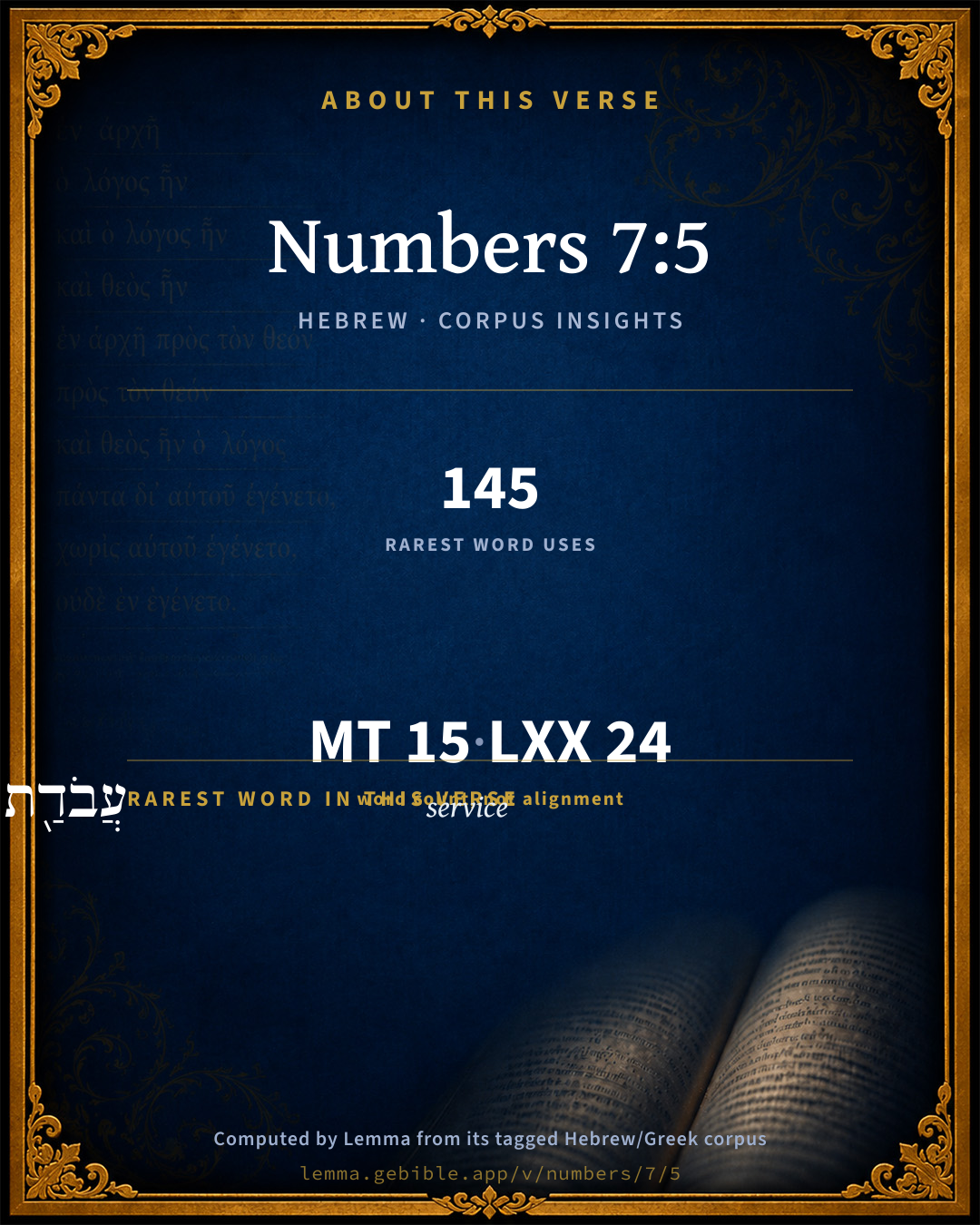
15
words
13
distinct lemmas
Pentateuch
section

Grammatical profile

  • 4 verbs
  • 7 nouns
  • 2 prepositions
  • 2 particles

Verb forms

  • קַ֚ח Qal · Imperative
  • וְהָי֕וּ Qal · Sequential Perfect
  • לַעֲבֹ֕ד Qal · Infinitive Construct
  • וְנָתַתָּ֤ה Qal · Sequential Perfect

Repetition

A word recurs within this verse — often emphatic in Hebrew:

  • עֲבֹדַ֖ת service H5656 ×2

Hebrew & Septuagint length

In English translation the verse runs 33 words from the Hebrew and 33 from the Septuagint (LXX English) — the same length.

A rough comparison of the two English renderings, which tokenize alike — not a word-level alignment.

Word counts can differ between the Hebrew and the Greek without any difference in meaning — e.g. the Hebrew direct-object marker אֵת has no separate Greek word, and Greek often adds the article ὁ.

In the original languages it is 15 Hebrew tokens and 24 Greek tokens — but the two are counted differently (Hebrew bundles its prefixes and suffixes into one token; the Greek is in lemma form), so that isn’t a like-for-like length.

Cross-references

7

Topical passages linked to Numbers 7:5 in the Treasury of Scripture Knowledge — connected by theme and wording, ordered by reader-vote popularity; previews shown in the World English Bible.

  • Exodus 25:1–11 Yahweh spoke to Moses, saying,
  • Exodus 35:4–10 Moses spoke to all the congregation of the children of Israel, saying, "This is the thing which Yahweh commanded, saying,
  • Isaiah 42:1–7 Behold, my servant, whom I uphold; my chosen, in whom my soul delights: I have put my Spirit on him; he will bring forth justice to the Gentiles.
  • Isaiah 49:1–8 Listen, isles, to me; and listen, you peoples, from far: Yahweh has called me from the womb; from the bowels of my mother has he made mention of my name:
  • Ephesians 4:11–13 He gave some to be apostles; and some, prophets; and some, evangelists; and some, shepherds and teachers;
  • Titus 3:8 This saying is faithful, and concerning these things I desire that you affirm confidently, so that those who have believed God may be careful to maintain good works. These things are good and profitable to men;
  • Psalms 16:2–3 My soul, you have said to Yahweh, "You are my Lord. Apart from you I have no good thing."

Cross-references courtesy of OpenBible.info (CC BY 4.0).

Hebrew and Greek witnesses Masoretic Hebrew ↔ Greek Septuagint

The same verse in the two great witnesses to the Old Testament, shown verse-for-verse.

These are two independent witnesses, not word-aligned to each other, and the Septuagint is shown in lemma (dictionary) form.

Hebrew Numbers 7:5 Masoretic · Westminster Leningrad Codex

קַ֚ח מֵֽאִתָּ֔ם וְהָי֕וּ לַעֲבֹ֕ד אֶת עֲבֹדַ֖ת אֹ֣הֶל מוֹעֵ֑ד וְנָתַתָּ֤ה אוֹתָם֙ אֶל הַלְוִיִּ֔ם אִ֖ישׁ כְּפִ֥י עֲבֹדָתֽוֹ

"Accept these from them, that they may be used in doing the service of the Tent of Meeting; and you shall give them to the Levites, to every man according to his service."

World English Bible · Public Domain

Greek LXX Numbers 7:5 Septuagint · lemma form

λαμβάνω παρά αὐτός καί εἰμί πρός ὁ ἔργον ὁ λειτουργικός ὁ σκηνή ὁ μαρτύριον καί δίδωμι αὐτός ὁ λευίτης ἕκαστος κατά ὁ αὐτός λειτουργία

Take of them, and they shall be for the works of the services of the tabernacle of witness: and you shall give them to the Levites, to each one according to his ministration.

LXX2012 (modern English Septuagint) · Public Domain

Hebrew: Westminster Leningrad Codex (CC BY 4.0). Greek: Septuagint (public domain); English from LXX2012 (modern English Septuagint) (Public Domain). How the Septuagint differs from the Hebrew →

Targum (Aramaic paraphrase)

2

The Targum is the ancient Jewish Aramaic paraphrase of the Hebrew Scriptures — an interpretive translation, not the Hebrew text itself. Onkelos (literal) and Pseudo-Jonathan (expansive) render the Torah, and Jonathan the Prophets. Coverage is partial: where no permissively-licensed English translation exists for a verse, only the Aramaic is shown. This is verse-level text, not a word-by-word alignment to the Hebrew.

  1. Targum Onkelos Torah (Genesis–Deuteronomy)
    קַבֵּל מִנְהוֹן וִיהוֹן לְמִפְלַח יָת פּוּלְחַן מַשְׁכַּן זִמְנָא וְתִתֵּן יָתְהוֹן לְלֵוָאֵי גְבַר כְּמִסַת פּוּלְחָנֵהּ

    (no public-domain English translation for this verse)

    Targum Onkelos — Aramaic: “Onkelos Genesis” (public domain); “Onkelos Exodus” (public domain); “Onkelos Leviticus” (public domain); “Onkelos Numbers” (public domain); “Onkelos Deuteronomy” (public domain). English: “Sefaria Community Translation” (CC0 1.0 (public-domain dedication)); “J.W. Etheridge. The Targums of Onkelos and Jonathan Ben Uzziel on the Pentateuch. London: Longmans, Green, 1862” (public domain). Text via Sefaria.

  2. Targum Pseudo-Jonathan Torah (Genesis–Deuteronomy)
    קַבֵּל מִנְהוֹן וִיהוֹן צִיבִי לִצְרוֹךְ סִדוּרָא וְתוֹרִין וְעִיגְלִין יְהוֹן לְמִפְלַח יַת פּוּלְחַן מַשְׁכַּן זִמְנָא וְתִתֵּן יַתְהוֹן לְלֵיוָאֵי גְבַר כְּמֵיסַת פּוּלְחָנֵיהּ

    Take them, and let them be used for the need of the appointed (work), and let the oxen and the wagons be for the work of the service of the tabernacle of ordinance, and give them to the Levites, to each according to the measure of his work.

    Targum Pseudo-Jonathan — Aramaic: “Targum Jonathan on Genesis” (public domain); “Targum Jonathan on Exodus” (public domain); “Targum Jonathan on Leviticus” (public domain); “Targum Jonathan on Numbers” (public domain); “Targum Jonathan on Deuteronomy” (public domain). English: “The Targum of Jonathan ben Uzziel, trans. J. W. Etheridge, London, 1862” (public domain). Text via Sefaria.

Commentary

Notes on Numbers 7:5 from classic Christian and Jewish commentators (each source and its license shown beneath its notes). The classic Christian expositions comment on the surrounding passage and are grouped to its opening verse, so a note may address several verses; the Jewish commentaries on the Tanakh (Rashi and others) are per-verse, so they appear only where the commentator wrote on this verse.

Lemma curates 59 commentaries, every one of them public domain or Creative Commons licensed, each selected and text-cleaned for this edition rather than reprinted as found. About our sources →

The Biblical Illustrator

Joseph S. Exell

Num_7:5-9

Give them unto the Levites, to every man according to his service.

Divine bestowment varied and proportionate

I. That Gods gifts are varied.

1. Men differ widely in many things--parentage, birthplace, physical vigour, mental capacity, education, spiritual gifts, &c.

2. For many of these differences they are themselves largely accountable. Some are crippled by their own indolence, extravagance, neglect, intemperance; others advance by their thrift, sobriety, perseverance, economy, and indomitable industry, to large influence and wealth.

3. But though the way in which men bear themselves may account for many of the differences between them, there are a thousand discrepancies which cannot be thus explained. No child is born in Alyssinia, or on the banks of the Ganges, or in crowded London because it wills it. Men are sick without being to blame for it, and women poor through no fault of their own. We must refer these problems to the Divine sovereignty. There is no other solution for many of lifes mysteries. Even so Father, for so it seemed good in Thy sight. If Gershon and Kohath complain that Merari has more than they, Moses sufficient answer will be, God ordained it so.

4. This truth, apprehended and believed, would destroy a thousand seeds of discontent, envy, and socialistic heresy. It is God who bestows wealth (Deu_8:18), honours (Psa_75:6-7), power (Rom_13:1). We receive gracefully the assignment of an earthly superior; why not as gracefully what God appoints?

II. Gods gifts are proportionate. In each case He proportions the means of transportation to the burden assigned.

1. That which is well proportioned is not excessive. This is true of a book, speech, building; eminently true of Gods work. God is bountiful, but never wasteful. We possess no talents or opportunities to be counted superfluous. Christs sufferings are proportioned to the sinners guilt.

2. Not defective.

(1) Let those who are called to trust in Christ remember that His sacrifice, if indispensable, is also fully sufficient.

(2) Let Christian workers remember that with the call will come the qualifications. (W. T. Sabine.)

Endowments and requirements:

I. As Moses appointed to the sons of Levi certain facilities, so the creator has endowed man with certain capabilities for work in his service.

1. Understanding.

2. Invention.

3. Will-power.

4. Judgment.

5. Affections.

6. Physical organs.

II. As Moses required the sons of levi to use their facilities, so God demands the exercise of our capabilities.

1. Yet how much indifference on the part of man in exercising and developing his faculties in useful and honourable employment! Many, instead of gaining their livelihood in the intended way, by the sweat of their face, study all manner of trickery and sin to satisfy their wants.

2. And how many professing Christians become so absorbed in worldly affairs as to neglect the business of the soul. God has claims superior to all claims of the world.

III. Gods requirements are no greater than our endowments. If we cannot give thousands, we can at least devote our two mites. A beautifully tinted leaf in the wood cannot be seen at a distance, yet it contributes its part to the glorious autumnal picture.

IV. Man must use his capabilities according to divine appointment. It is a solemn thing to trifle with the plans of God. Every man has a special power or gift, and he who lives by other laws than those that wrapt his genius at his birth, defeats, in a measure, the object of his creation. (W. G. Thrall.)

An ancient offering, and its modern lessons

I. They who hold the most honourable positions should be most liberal in contributions to worthy objects.

II. They who are not entirely engaged in religious ministries should seek to help those who are so engaged.

III. God is graciously pleased to accept of mans offerings.

IV. Gifts for religious purposes should be used in accordance with the will of God.

V. In the divine arrangements help is granted unto men according to their respective needs. (W. Jones.)

The Biblical Illustrator, edited by Joseph S. Exell (c. 1880s–1900s) — public domain. Text from a community e-Sword module.

Joseph Benson's Commentary

Num 7:5-8. According to his service — More or fewer, as the nature of their service, and of the things to be carried required. And as the Gershonites had the less burdensome things to carry, (Num 4:25,) they had the fewer carriages allowed them. Four wagons to the sons of Merari — Proportionable to their great burden, Num 4:28; Num 4:33.

Under the hand (or inspection) of Ithamar — For he had the care both of the Gershonites and Merarites, Num 4:28; Num 4:33.

Joseph Benson's Commentary on the Old and New Testaments (1811–1818) — public domain. Text from a community e-Sword module.

Geneva Bible (1599)

Geneva Bible translators

That is, to carry things and stuff in.

Geneva Bible (1599) marginal notes — public domain. Text via Bolls.life.

Adam Clarke's Commentary

Verse 5. According to his service.] That is, distribute them among the Levites as they may need them, giving most to those who have the heaviest burdens to bear.

Adam Clarke's Commentary on the Bible (1810–1826) — public domain. Text from a community e-Sword/MySword module.

John Gill's Exposition

Take it of them,.... The present of the wagons and oxen, by which it appears that this freewill offering of the princes was according to his mind and will, and what they were influenced and guided to by his Spirit, and was well pleasing in his sight, and acceptable to him:

that they may be to do the service of the tabernacle of the congregation; be made use of, and employed in carrying the tabernacle, and the things of it, from place to place, when the Israelites journeyed:

and thou shalt give them to the Levites; to ease them, whose business it was to bear and carry the several parts of the tabernacle, and the vessels of it:

to every man according to his service; whether lighter or heavier, for such difference there was in the three divisions of the Levites; and according as their work was, they had more or fewer wagons and oxen given them, as it follows, Num 7:7.

John Gill's Exposition of the Whole Bible (1746–1763) — public domain (CC PDM 1.0). Text via the HelloAO Bible API.

Matthew Poole's English Annotations

i.e. More or fewer of them, as the nature of their service and of the things to be carried required.

Matthew Poole's English Annotations on the Holy Bible (1683–1685) — public domain. Text from a community e-Sword/MySword module.

Whedon's Commentary on the Bible

Daniel D. Whedon

5. To every man — These gifts were to be distributed among the Levites as they needed them, giving the most to those families which were required to bear the heaviest burdens. See Num_4:21-28, notes.

Daniel D. Whedon (gen. ed.), Commentary on the Old and New Testaments (1874–1909) — public domain. Text from a community e-Sword module.

The Pulpit Commentary

Take it of them. It was the first absolutely voluntary offering made for the service of God, and as such altogether acceptable. Former "free-will offerings" had been at the least invited this had not.

The Pulpit Commentary (1880–1919), ed. H.D.M. Spence-Jones & Joseph S. Exell — public domain. Text from a community e-Sword module.

John Wesley's Explanatory Notes

According to his service - More or fewer, as the nature of their service and of the things to be carried required.

John Wesley, Explanatory Notes Upon the Whole Bible (1754–1765) — public domain. Text via the GEBible commentary corpus.

Lesson kit

Teaching starters — assembled from the data on this page, not authored interpretation. Every prompt links to the verse data it draws on. Edit before teaching.

Numbers, in the Pentateuch, opens this verse with 15 words (13 distinct Hebrew lemmas). Its most distinctive word is ʻăbôdâh (“service”). A historical commentator’s framing appears above. Read the whole chapter for the surrounding context.

Discussion questions

  1. What does “service” (ʻăbôdâh) contribute to the verse as a whole?
  2. Exodus 25:1–11 shares this passage’s theme. How do the two illuminate each other?
  3. “service” occurs 2× in this one verse. What is the effect of the repetition?
  4. The translations on this page render this verse differently — a whole-verse word diff, not a word-by-word alignment. What might account for the different wordings?
  5. The verb «קַ֚ח» is Qal Imperative. How does its form color the action?
  6. Reading how The Biblical Illustrator and Joseph Benson's Commentary read this verse, where do the two commentators agree and where do they part?

Things to notice

Reading settings

Reading text

Shown beneath each verse's original-language words.

Old Testament
Old Testament edition

Read the OT as the Masoretic Hebrew (MT) or the Greek Septuagint (LXX).

English shown for the Greek Septuagint (in the Hebrew ↔ Greek comparison).

Comparing translations? Open the Compare panel on any verse page to stack up to four side by side.