Numbers 14:10

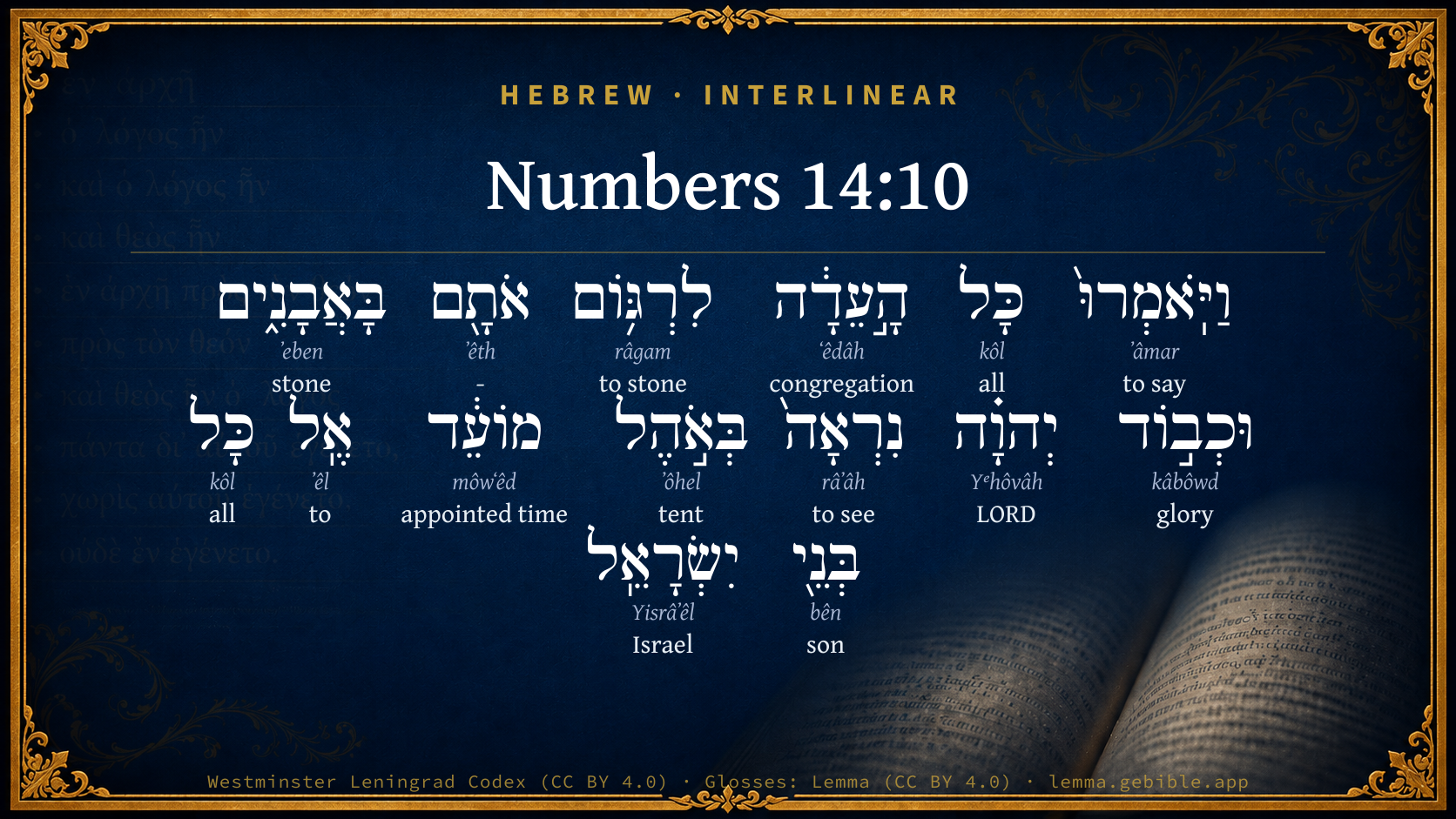
Hebrew (Westminster Leningrad Codex) Numbers 14:10 appears in the Hebrew Old Testament. The text above is from the Westminster Leningrad Codex. Each word links to its Strong’s number, a concise gloss, and parsing drawn from the Open Scriptures Hebrew Bible morphology. Click any word for its full Brown-Driver-Briggs (BDB) entry.
Download image
Cite this verse

Numbers 14:10 (World English Bible). Public Domain. Lemma interlinear Bible study tool, https://lemma.gebible.app/v/numbers/14/10.

Show BibTeX & RIS
BibTeX
RIS
English Translation
But all the congregation bade stone them with stones. The glory of Yahweh appeared in the tent of meeting to all the children of Israel.
World English Bible · Public Domain
Download a study sheet

One document with this verse’s original text, its word-by-word gloss line, the meaning frame, cross-references with their text, attributed commentary, and full source and license credits — printable, and it pastes into notes with its structure intact.

This verse Autodidact and up

Study sheet (.html) Plain text (.txt)

A passage Seminary Student

Up to 50 verses in one chapter. A passage sheet keeps up to 6 commentary sources and 12 cross-references per verse, in the order this page ranks them, and says so on the sheet whenever that leaves anything out. Ask for a single verse and you get the Autodidact verse sheet above.

Everything on this page stays free to read, with no account — the sheet is a download of what is already on screen, not access to it.

Want to remove ads? Support Godless Engineer
Compare translations 3

The same verse in 3 English versions, stacked beneath the original-language interlinear above. Click any original word for its lexicon entry.

Each is an independent rendering of the whole verse — the interlinear is not word-aligned to these translations.

Highlighted words mark where these versions differ — a whole-verse word diff, not a word-by-word alignment.

  • World English Bible Public Domain
    But all the congregation bade stone them with stones. The glory of Yahweh appeared in the tent of meeting to all the children of Israel.
  • King James Version Public Domain
    But all the congregation bade stone them with stones. And the glory of the LORD appeared in the tabernacle of the congregation before all the children of Israel.
  • unfoldingWord Literal Text CC BY-SA 4.0
    And all the congregation said to stone them with stones. But the glory of Yahweh appeared in the tent of meeting to all the sons of Israel.

unfoldingWord Literal Text — © unfoldingWord, licensed CC BY-SA 4.0. Word-aligned USFM3 via Door43 (git.door43.org/unfoldingWord/en_ult).

Versions to compare (up to 4)

3 of 4 selected

Show all 18 translations

Every available English version of this verse, each an independent rendering of the whole verse.

  • World English Bible Public Domain
    But all the congregation bade stone them with stones. The glory of Yahweh appeared in the tent of meeting to all the children of Israel.
  • Berean Standard Bible Public Domain
    But the whole congregation threatened to stone Joshua and Caleb. Then the glory of the LORD appeared to all the Israelites at the Tent of Meeting.
  • Majority Standard Bible Public Domain
    But the whole congregation threatened to stone Joshua and Caleb. Then the glory of the LORD appeared to all the Israelites at the Tent of Meeting.
  • King James Version Public Domain
    But all the congregation bade stone them with stones. And the glory of the LORD appeared in the tabernacle of the congregation before all the children of Israel.
  • American Standard Version (1901) Public Domain
    But all the congregation bade stone them with stones. And the glory of Jehovah appeared in the tent of meeting unto all the children of Israel.
  • Revised Version (1885) Public Domain
    But all the congregation bade stone them with stones. And the glory of the LORD appeared in the tent of meeting unto all the children of Israel.
  • Geneva Bible (1599) Public Domain
    And all the multitude saide, Stone them with stones: but the glory of the Lord appeared in the Tabernacle of the Congregation, before all the children of Israel.
  • Douay-Rheims (1899) Public Domain
    And when all the multitude cried out, and would have stoned them, the glory of the Lord appeared over the tabernacle of the covenant to all the children of Israel.
  • Young's Literal Translation Public Domain
    And all the company say to stone them with stones, and the honour of Jehovah hath appeared in the tent of meeting unto all the sons of Israel.
  • Literal Standard Version CC BY-SA 4.0
    And all the congregation says to stone them with stones, and the glory of YHWH has appeared in the Tent of Meeting to all the sons of Israel.
  • Unlocked Literal Bible CC BY-SA 4.0
    Then all the congregation said to stone them with stones. But the glory of Yahweh appeared at the tent of meeting to all the people of Israel.
  • unfoldingWord Literal Text CC BY-SA 4.0
    And all the congregation said to stone them with stones. But the glory of Yahweh appeared in the tent of meeting to all the sons of Israel.
  • Darby Bible Public Domain
    And the whole assembly said that they should be stoned with stones. And the glory of Jehovah appeared in the tent of meeting to all the children of Israel.
  • World Messianic Bible Public Domain
    But all the congregation threatened to stone them with stones. The LORD’s glory appeared in the Tent of Meeting to all the children of Israel.
  • Webster's Bible Public Domain
    But all the congregation required to stone them with stones: and the glory of the LORD appeared in the tabernacle of the congregation before all the children of Israel.
  • Free Bible Version CC BY-SA 4.0
    In reply all the people shouted out, “Stone them!” But the glory of the Lord suddenly appeared in the Tent of Meeting, right in the middle of the Israelites.
  • Bible in Basic English Public Domain
    But all the people said they were to be stoned. Then the glory of the Lord was seen in the Tent of meeting, before the eyes of all the children of Israel.
  • JPS Tanakh (1917) Public Domain
    But all the congregation bade stone them with stones, when the glory of the LORD appeared in the tent of meeting unto all the children of Israel.

Literal Standard Version (2020), Covenant Press — licensed CC BY-SA 4.0. Text via the HelloAO Bible API (eBible.org). Unlocked Literal Bible (unfoldingWord) — licensed CC BY-SA 4.0. Text via the HelloAO Bible API (eBible.org). unfoldingWord Literal Text — © unfoldingWord, licensed CC BY-SA 4.0. Word-aligned USFM3 via Door43 (git.door43.org/unfoldingWord/en_ult). Free Bible Version, Dr. Jonathan Gallagher — licensed CC BY-SA 4.0. Text via the HelloAO Bible API (eBible.org).

Word by word

More ways to search: Search by grammar → Find every occurrence → Compare this word →

Practice this passage: Drill this verse → Learn its vocabulary →

לִרְגּ֥וֹם
râgam
H7275
“to stone”
Preposition + Verb, Qal, Infinitive Construct
Part of Speech
Preposition + Verb
Stem
Qal
Form
Infinitive Construct
Full BDB Definition

Origin: a primitive root [compare H7263 , H7321 , H7551 ]

TWOT: 2114

to stone, slay or kill by stoning - (Qal) to stone
  1. וַיֹּֽאמְרוּ֙ ʼâmar H559 “and · to say” Conjunction + Verb, Qal, Sequential Imperfect, 3rd Person, Masculine, Plural
  2. כָּל kôl H3605 “all of” Noun, Common, Masculine, Singular, Construct
  3. הָ֣עֵדָ֔ה ʻêdâh H5712 “the · congregation” Particle, Definite Article + Noun, Common, Feminine, Singular, Absolute
  4. אֹתָ֖ם ʼêth H853 “- · them” Particle, Direct Object + Suffix, Personal, 3rd Person, Masculine, Plural
  5. בָּאֲבָנִ֑ים ʼeben H68 “in/at the · stones” Preposition, Determined + Noun, Common, Feminine, Plural, Absolute
  6. וּכְב֣וֹד kâbôwd H3519 “and · glory of” Conjunction + Noun, Common, Both, Singular, Construct
  7. יְהוָ֗ה Yᵉhôvâh H3068 “LORD” Noun, Proper
  8. נִרְאָה֙ râʼâh H7200 “to see” Verb, Niphal, Perfect, 3rd Person, Masculine, Singular
  9. בְּאֹ֣הֶל ʼôhel H168 “in/at · tent of” Preposition + Noun, Common, Masculine, Singular, Construct
  10. מוֹעֵ֔ד môwʻêd H4150 “appointed time” Noun, Common, Masculine, Singular, Absolute
  11. אֶֽל ʼêl H413 “to” Preposition
  12. כָּל kôl H3605 “all of” Noun, Common, Masculine, Singular, Construct
  13. בְּנֵ֖י bên H1121 “sons of” Noun, Common, Masculine, Plural, Construct
  14. יִשְׂרָאֵֽל Yisrâʼêl H3478 “Israel” Noun, Proper

About this verse

These counts appear in no published source. They are computed here, from the morphology-tagged text and Lemma’s own curated glosses. What Lemma adds →

15
words
14
distinct lemmas
Pentateuch
section

Notable vocabulary

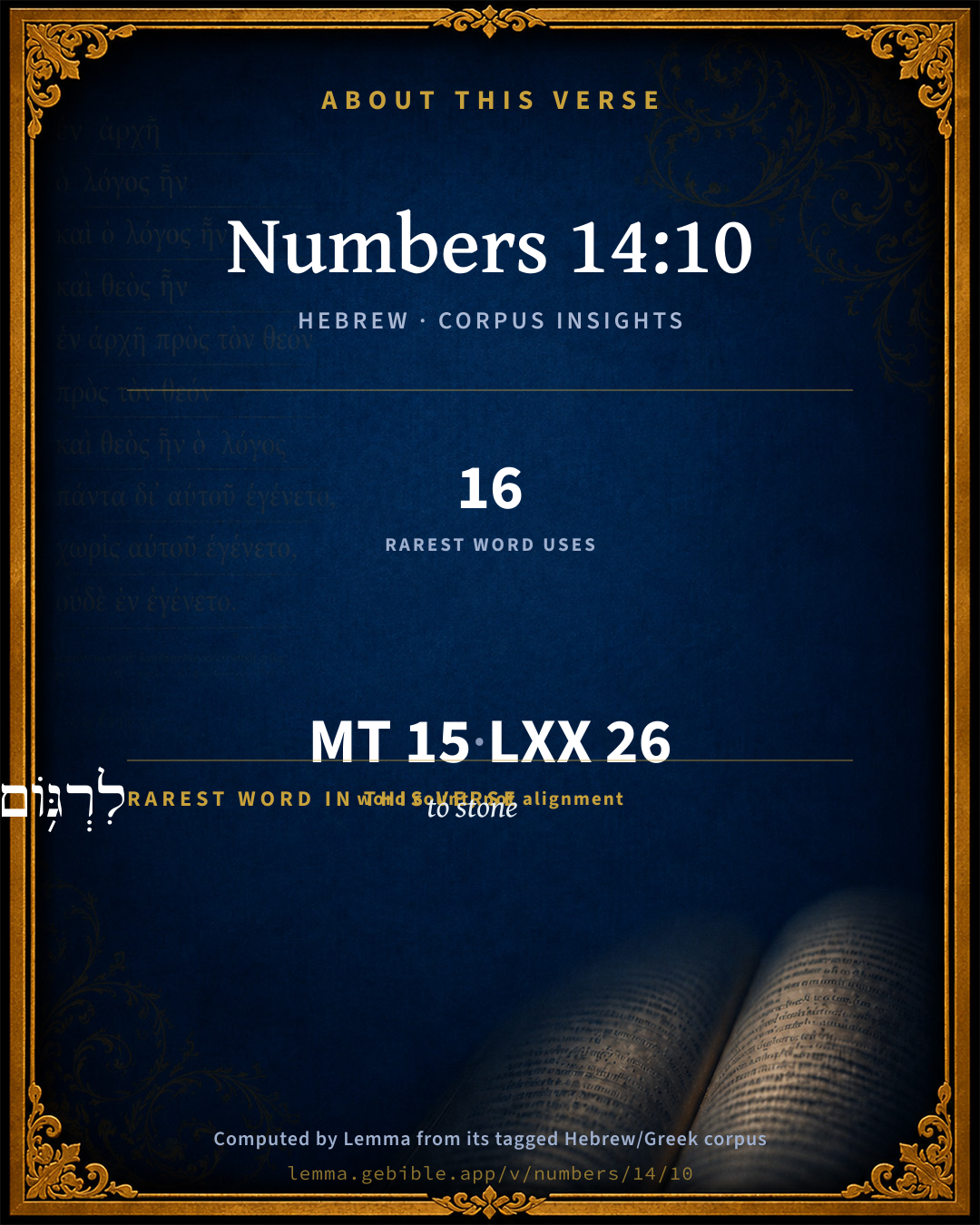
The rarest word here is לִרְגּ֥וֹם to stone H7275 — appearing just 16 times in the whole Hebrew Bible.

Shared distinctive vocabulary

לִרְגּ֥וֹם to stone H7275 occurs in 15 verses of the Hebrew Bible. Also found in:

Grammatical profile

  • 3 verbs
  • 10 nouns
  • 1 preposition
  • 1 particle

Verb forms

  • וַיֹּֽאמְרוּ֙ Qal · Sequential Imperfect
  • לִרְגּ֥וֹם Qal · Infinitive Construct
  • נִרְאָה֙ Niphal · Perfect

Repetition

A word recurs within this verse — often emphatic in Hebrew:

Hebrew & Septuagint length

In English translation the verse runs 25 words from the Hebrew and 30 from the Septuagint (LXX English) — closely comparable.

A rough comparison of the two English renderings, which tokenize alike — not a word-level alignment.

Word counts can differ between the Hebrew and the Greek without any difference in meaning — e.g. the Hebrew direct-object marker אֵת has no separate Greek word, and Greek often adds the article ὁ.

In the original languages it is 15 Hebrew tokens and 26 Greek tokens — but the two are counted differently (Hebrew bundles its prefixes and suffixes into one token; the Greek is in lemma form), so that isn’t a like-for-like length.

Cross-references

13

Topical passages linked to Numbers 14:10 in the Treasury of Scripture Knowledge — connected by theme and wording, ordered by reader-vote popularity; previews shown in the World English Bible.

  • Exodus 17:4 Moses cried to Yahweh, saying, "What shall I do with these people? They are almost ready to stone me."
  • Leviticus 9:23 Moses and Aaron went into the Tent of Meeting, and came out, and blessed the people: and the glory of Yahweh appeared to all the people.
  • 1 Samuel 30:6 David was greatly distressed; for the people spoke of stoning him, because the soul of all the people was grieved, every man for his sons and for his daughters: but David strengthened himself in Yahweh his God.
  • Exodus 16:10 It happened, as Aaron spoke to the whole congregation of the children of Israel, that they looked toward the wilderness, and, behold, the glory of Yahweh appeared in the cloud.
  • Exodus 16:7 and in the morning, then you shall see the glory of Yahweh; because he hears your murmurings against Yahweh. Who are we, that you murmur against us?"
  • Numbers 16:19 Korah assembled all the congregation against them to the door of the tent of meeting: and the glory of Yahweh appeared to all the congregation.
  • Numbers 16:42 It happened, when the congregation was assembled against Moses and against Aaron, that they looked toward the tent of meeting: and, behold, the cloud covered it, and the glory of Yahweh appeared.
  • Numbers 20:6 Moses and Aaron went from the presence of the assembly to the door of the tent of meeting, and fell on their faces: and the glory of Yahweh appeared to them.
  • Matthew 23:37 "Jerusalem, Jerusalem, who kills the prophets, and stones those who are sent to her! How often would I have gathered your children together, even as a hen gathers her chickens under her wings, and you would not!
  • Exodus 24:16–17 The glory of Yahweh settled on Mount Sinai, and the cloud covered it six days. The seventh day he called to Moses out of the midst of the cloud.
  • Exodus 40:34 Then the cloud covered the tent of meeting, and the glory of Yahweh filled the tent.
  • Acts 7:52 Which of the prophets didn't your fathers persecute? They killed those who foretold the coming of the Righteous One, of whom you have now become betrayers and murderers.
  • Acts 7:59 They stoned Stephen as he called out, saying, "Lord Jesus, receive my Spirit!"

Cross-references courtesy of OpenBible.info (CC BY 4.0).

Hebrew and Greek witnesses Masoretic Hebrew ↔ Greek Septuagint

The same verse in the two great witnesses to the Old Testament, shown verse-for-verse.

These are two independent witnesses, not word-aligned to each other, and the Septuagint is shown in lemma (dictionary) form.

Hebrew Numbers 14:10 Masoretic · Westminster Leningrad Codex

וַיֹּֽאמְרוּ֙ כָּל הָ֣עֵדָ֔ה לִרְגּ֥וֹם אֹתָ֖ם בָּאֲבָנִ֑ים וּכְב֣וֹד יְהוָ֗ה נִרְאָה֙ בְּאֹ֣הֶל מוֹעֵ֔ד אֶֽל כָּל בְּנֵ֖י יִשְׂרָאֵֽל

But all the congregation bade stone them with stones. The glory of Yahweh appeared in the tent of meeting to all the children of Israel.

World English Bible · Public Domain

Greek LXX Numbers 14:10 Septuagint · lemma form

καί εἶπον πᾶς ὁ συναγωγή καταλιθοβολέω αὐτός ἐν λίθος καί ὁ δόξα κύριος ὁράω ἐν νεφέλη ἐπί ὁ σκηνή ὁ μαρτύριον ἐν πᾶς ὁ υἱός ἰσραήλ

And all the congregation bade stone them with stones; and the glory of the Lord appeared in the cloud on the tabernacle of witness to all the children of Israel.

LXX2012 (modern English Septuagint) · Public Domain

On this verse, Ellicott's Commentary for English Readers discusses the Septuagint’s reading. Read the note in Commentary ↓

Hebrew: Westminster Leningrad Codex (CC BY 4.0). Greek: Septuagint (public domain); English from LXX2012 (modern English Septuagint) (Public Domain). How the Septuagint differs from the Hebrew →

Targum (Aramaic paraphrase)

2

The Targum is the ancient Jewish Aramaic paraphrase of the Hebrew Scriptures — an interpretive translation, not the Hebrew text itself. Onkelos (literal) and Pseudo-Jonathan (expansive) render the Torah, and Jonathan the Prophets. Coverage is partial: where no permissively-licensed English translation exists for a verse, only the Aramaic is shown. This is verse-level text, not a word-by-word alignment to the Hebrew.

  1. Targum Onkelos Torah (Genesis–Deuteronomy)
    וַאֲמָרוּ כָּל כְּנִשְׁתָּא לְמִרְגַם יַתְהוֹן בְּאַבְנַיָא וִיקָרָא דַיְיָ אִתְגְלֵי בְּמַשְׁכַּן זִמְנָא לְכָל בְּנֵי יִשְׂרָאֵל

    (no public-domain English translation for this verse)

    Targum Onkelos — Aramaic: “Onkelos Genesis” (public domain); “Onkelos Exodus” (public domain); “Onkelos Leviticus” (public domain); “Onkelos Numbers” (public domain); “Onkelos Deuteronomy” (public domain). English: “Sefaria Community Translation” (CC0 1.0 (public-domain dedication)); “J.W. Etheridge. The Targums of Onkelos and Jonathan Ben Uzziel on the Pentateuch. London: Longmans, Green, 1862” (public domain). Text via Sefaria.

  2. Targum Pseudo-Jonathan Torah (Genesis–Deuteronomy)
    וַאֲמָרוּ כָּל כְּנִישְׁתָּא לְאַטָלָא יַתְהוֹן בְּאַבְנַיָא וְאִיקַר שְׁכִינְתָּא דַיְיָ אִתְגְלֵי בַּעֲנָנֵי יְקָרָא בְּמַשְׁכַּן זִמְנָא

    But all the congregation said they would stone them with stones. And the glorious Shekinah of the Lord was revealed in bright clouds at the tabernacle.

    Targum Pseudo-Jonathan — Aramaic: “Targum Jonathan on Genesis” (public domain); “Targum Jonathan on Exodus” (public domain); “Targum Jonathan on Leviticus” (public domain); “Targum Jonathan on Numbers” (public domain); “Targum Jonathan on Deuteronomy” (public domain). English: “The Targum of Jonathan ben Uzziel, trans. J. W. Etheridge, London, 1862” (public domain). Text via Sefaria.

Commentary

Notes on Numbers 14:10 from classic Christian and Jewish commentators (each source and its license shown beneath its notes). The classic Christian expositions comment on the surrounding passage and are grouped to its opening verse, so a note may address several verses; the Jewish commentaries on the Tanakh (Rashi and others) are per-verse, so they appear only where the commentator wrote on this verse.

Lemma curates 59 commentaries, every one of them public domain or Creative Commons licensed, each selected and text-cleaned for this edition rather than reprinted as found. About our sources →

Trapp's Complete Commentary

John Trapp

Num 14:10 But all the congregation bade stone them with stones. And the glory of the LORD appeared in the tabernacle of the congregation before all the children of Israel.

Ver. 10. But all the congregation bade stone them.] This is merces mundi, this is the fruit of ochlocratie, that rule of rascality, as one calls it.

John Trapp, A Commentary or Exposition upon All the Books of the Old and New Testament (1647–1656) — public domain. Text from a community e-Sword module.

Joseph Benson's Commentary

Num 14:10. The glory of the Lord appeared — Now, in the extremity of danger, to rescue his faithful servants, and to stop the rage of the people.

In the tabernacle — Upon or above the tabernacle, where the cloud usually resided, in which the glory of God appeared now in a more illustrious manner. When they reflected upon God, his glory appeared not, to silence their blasphemies: but when they threatened Caleb and Joshua, they touched the apple of his eye, and his glory appeared immediately. They who faithfully expose themselves for God are sure of his special protection.

Joseph Benson's Commentary on the Old and New Testaments (1811–1818) — public domain. Text from a community e-Sword module.

Tyndale Open Study Notes

Tyndale Open Resources

14:10 Joshua and Caleb, with their encouragement and expression of trust in God, brought even more opposition; the protests against the leaders were converted into threats of violence against the faithful spies. All of the Israelites’ objections came to a sudden stop when the Lord’s glorious presence (Hebrew kabod; see Exod 24:15-18; Ezek 1) appeared at the Tabernacle, the site of divine communication.

Tyndale Open Study Notes — © Tyndale Open Resources, licensed CC BY-SA 4.0. Text via the HelloAO Bible API.

Geneva Bible (1599)

Geneva Bible translators

This is the condition of them that would persuade in God’s cause, to be persecuted of the multitude.

Geneva Bible (1599) marginal notes — public domain. Text via Bolls.life.

Jamieson, Fausset & Brown

Robert Jamieson, A. R. Fausset & David Brown

the glory of the Lord appeared--It was seasonably manifested on this great emergency to rescue His ambassadors from their perilous situation.

Jamieson, Fausset & Brown — Commentary Critical and Explanatory on the Whole Bible (1871) — public domain (CC PDM 1.0). Text via the HelloAO Bible API.

Adam Clarke's Commentary

Verse 10. The glory of the Lord appeared] This timely appearance of the Divine glory prevented these faithful servants of God from being stoned to death by this base and treacherous multitude. "Every man is immortal till his work is done," while in simplicity of heart he is following his God.

Adam Clarke's Commentary on the Bible (1810–1826) — public domain. Text from a community e-Sword/MySword module.

Ellicott's Commentary for English Readers

(10) But all the congregation bade stone them with stones.—All the congregation here, as elsewhere, seems to denote the princes or chief men of the congregation; otherwise it is difficult to understand to whom the order was addressed to stone Joshua and Caleb. Stoning appears to have been a mode of death commonly adopted in Egypt (Exo_8:26). Under the Jewish law stoning was the ordinary, and, as some think, the only prescribed mode of death, and was inflicted as the punishment for crimes such as adultery (Deu_22:22; Deu_22:24), idolatry (Deu_13:10), witchcraft (Lev_20:27), sabbath-breaking (Num_15:35), and blasphemy (Lev_24:16). Moses had apprehended the same outbreak of popular violence on a former occasion (Exo_17:4), and, at a later period, David was threatened in a similar manner (1Sa_30:6).

And the glory of the Lord appeared in the tabernacle of the congregation.—The meaning probably is in the court of the Tabernacle, or, as some think, above the Tabernacle. (See the Targum of Jonathan and the Vulgate and Septuagint Versions.) The children of Israel could not have seen the glory of the Lord had it been manifested within the Tabernacle.

A Bible Commentary for English Readers, edited by Charles John Ellicott (1878–1897) — public domain. Text from a community e-Sword module.

The Cambridge Bible for Schools and Colleges

gen. ed. J. J. S. Perowne

10. bade stone them] i.e. Joshua and Caleb, and perhaps also Moses and Aaron. For the same form of mutiny cf. 1Sa_30:6, 1Ki_12:18.

the glory of Jehovah] The visible manifestation of His presence, which, as described by the priestly writers, took the form of fire. It appeared on Mt Sinai (Exo_24:16), it filled the Tabernacle when it was erected (Exo_40:34), and appeared from time to time during the wanderings (Exo_16:10 [reading Dwelling for wilderness], Lev_9:23, Num_16:19; Num_16:42; Num_20:6). In later Jewish writings the ‘Glory’ came to be considered almost as a personal representation of God, and was known as the Shekînah—‘that which dwells [sc. among men].’ This thought was taken up and given its fullest depth of meaning in the N.T., e.g. S. Joh_1:14.

The Cambridge Bible for Schools and Colleges (gen. ed. J. J. S. Perowne; Cambridge University Press, 1878–1918) — public domain. Text from a community e-Sword module.

John Gill's Exposition

But all the congregation bade stone them with stones,.... Namely, Joshua and Caleb, who had made such a faithful report of the good land, and had delivered such an animating and encouraging speech to the people. This is not to be understood of the body of the people, and of all the individuals thereof, for who then should they bid to stone Joshua and Caleb? unless the sense is, that they stirred up and animated one another to it; but rather it means the princes and heads of the congregation, who commanded the common people to rise up and stone them; for notwithstanding the affecting behaviour of Moses and Aaron, and the arguments of Joshua and Caleb, they still persisted in their mutiny and rebellion, until the Lord himself appeared as he did:

and the glory of the Lord appeared in the tabernacle of the congregation, before all the children of Israel; the Shechinah, or divine Majesty, which dwelt between the cherubim in the most holy place, came into the court of the tabernacle; for neither in the holy nor in the most holy place could the people see it, or the token of it: in Deu 31:15 it is said, "the pillar of cloud stood over the door of the tabernacle"; and Noldius (s) renders it here, "and the glory of the Lord appeared above the tabernacle of the congregation"; with which agree the Targum of Jonathan and the Vulgate Latin and Septuagint versions; and so Jarchi says, the cloud descended there, and from thence very probably some coruscations, or flashes of lightning came forth, which plainly showed the Lord was there; and this was done to terrify the people, and restrain them from their evil, purposes; and to encourage the servants of the Lord, who hereby might expect the divine protection.

(s) Concord. Ebr. Part. p. 164. No. 737.

John Gill's Exposition of the Whole Bible (1746–1763) — public domain (CC PDM 1.0). Text via the HelloAO Bible API.

Haydock's Catholic Bible Commentary

Cried out, &c. Hebrew, "said stone them."

George Leo Haydock (1774–1849), Haydock's Catholic Family Bible and Commentary, 1859 edition — public domain. Excludes Psalms (Douay-Rheims chapter numbering differs from Protestant) and Deuterocanonical books (Catholic canon only).

Matthew Poole's English Annotations

Now in the extremity of danger, to rescue his faithful servants, and to stop the rage of the people.

In the tabernacle, i.e. upon or above the tabernacle, where the cloud usually resided, in which the glory of God did appear upon occasion, and now in a more illustrious manner, as the state of things required.

Matthew Poole's English Annotations on the Holy Bible (1683–1685) — public domain. Text from a community e-Sword/MySword module.

Whedon's Commentary on the Bible

Daniel D. Whedon

10. Stone them with stones — This was the ordinary mode of executing a sentence of capital punishment. It requires an extraordinary effort to fathom the wickedness of men who clamoured for the blood of their brethren simply because of their fidelity to God. Yet it is the testimony of history that no hatred is so intense and merciless as that of rebels toward those who still are loyal to the government. Myriads have been put to death in civil wars for the crime of allegiance to the old flag. The picture before us is not overdrawn. This outbreak was not only a religious apostasy, but a civil revolution.

The glory of the Lord appeared — The shekinah, the visible symbol of the majesty of Jehovah, flashed forth suddenly to strike the people with terror in their rebellion, and to deter them from their wicked design. For a similar purpose the glory flashed out upon the Egyptians, (Exo_14:24,) “and troubled” or confounded their host. Philo says, “The fiery appearance of the Deity shone forth from the cloud.” How wonderfully the moral government of the world adapts itself to the different conditions of the same nation! Jesus Christ, in his preaching, endeavoured to deter the Jews from sin by motives addressed to their intellects and consciences. He pointed to the judgment to come and to the rewards and punishments there dispensed. He appealed to their hopes and fears. But Jehovah marshalled the terrific elements of nature before the eyes of the Hebrews to make an impression upon their hearts through their senses. In the first case the doctrine of immortality and future accountability had taken full possession of the popular mind. In the case of the Israelites in the wilderness these notions were for the most part yet to be created by the gradual unfolding of religious truth.

In the tabernacle — The Septuagint paraphrase is better: “In the cloud over the tabernacle.”

If the supernatural resplendence had been within the tent, it would not have been seen by all the people. Since Jehovah had made his abode in the tabernacle and in the pillar towering above it, the outbeaming glory could not be mistaken for any natural phenomenon.

Daniel D. Whedon (gen. ed.), Commentary on the Old and New Testaments (1874–1909) — public domain. Text from a community e-Sword module.

The Pulpit Commentary

Bade stone them with stones. Angry people cannot endure the counsels of calm reason, and perhaps the hostility which they felt against Moses they were very ready to vent upon his "minister." The glory of the Lord appeared., before all the children of Israel. At the moment when they were about to proceed to violence, the Divine glory filled the tabernacle, and flashed forth with a brilliancy which compelled their awe. struck attention.

The Pulpit Commentary (1880–1919), ed. H.D.M. Spence-Jones & Joseph S. Exell — public domain. Text from a community e-Sword module.

John Wesley's Explanatory Notes

Appeared - Now in the extremity of danger to rescue his faithful servants, and to stop the rage of the people. In the tabernacle - Upon or above the tabernacle, where the cloud usually resided, in which the glory of God appeared now in a more illustrious manner. When they reflected upon God, his glory appeared not, to silence their blasphemies: but when they threatened Caleb and Joshua, they touched the apple of his eye, and his glory appeared immediately. They who faithfully expose themselves for God, are sure of his special provision.

John Wesley, Explanatory Notes Upon the Whole Bible (1754–1765) — public domain. Text via the GEBible commentary corpus.

Rashi

Rabbi Shlomo Yitzchaki (Rashi)

לרגום אתם [BUT ALL THE CONGREGATION BADE] TO OVERWHELM THEM WITH STONES — them viz., Joshua and Caleb.

וכבוד ה׳ AND THE GLORY OF THE LORD [APPEARED IN THE APPOINTED TENT] — i.e. the cloud descended there (Sotah 35a).

Rashi on the Tanakh — English translations: “The Judaica Press complete Tanach with Rashi, translated by A. J. Rosenberg” (CC BY 4.0); “Pentateuch with Rashi's commentary by M. Rosenbaum and A.M. Silbermann, 1929-1934” (public domain); “The Metsudah Tanach series, Lakewood, N.J” (CC BY 4.0); and “The Book of Joshua, Metsudah Publications, 1997” (CC BY 4.0). Text via Sefaria.

Lesson kit

Teaching starters — assembled from the data on this page, not authored interpretation. Every prompt links to the verse data it draws on. Edit before teaching.

Numbers, in the Pentateuch, opens this verse with 15 words (14 distinct Hebrew lemmas). Its most distinctive word is râgam (“to stone”). A historical commentator’s framing appears above. Read the whole chapter for the surrounding context.

Discussion questions

  1. How does “to stone” (râgam) shape what this verse is saying?
  2. Leviticus 20:2 shares the word «to stone» with this verse. How do the two illuminate each other?
  3. “all” occurs 2× in this one verse. What is the effect of the repetition?
  4. These translations render this verse differently. What is at stake in choosing one wording over another?
  5. The verb «וַיֹּֽאמְרוּ֙» is Qal Sequential Imperfect. How does its form color the action?
  6. Reading how Trapp's Complete Commentary and Joseph Benson's Commentary read this verse, where do the two commentators agree and where do they part?

Things to notice

Reading settings

Reading text

Shown beneath each verse's original-language words.

Old Testament
Old Testament edition

Read the OT as the Masoretic Hebrew (MT) or the Greek Septuagint (LXX).

English shown for the Greek Septuagint (in the Hebrew ↔ Greek comparison).

Comparing translations? Open the Compare panel on any verse page to stack up to four side by side.