Leviticus 15:29

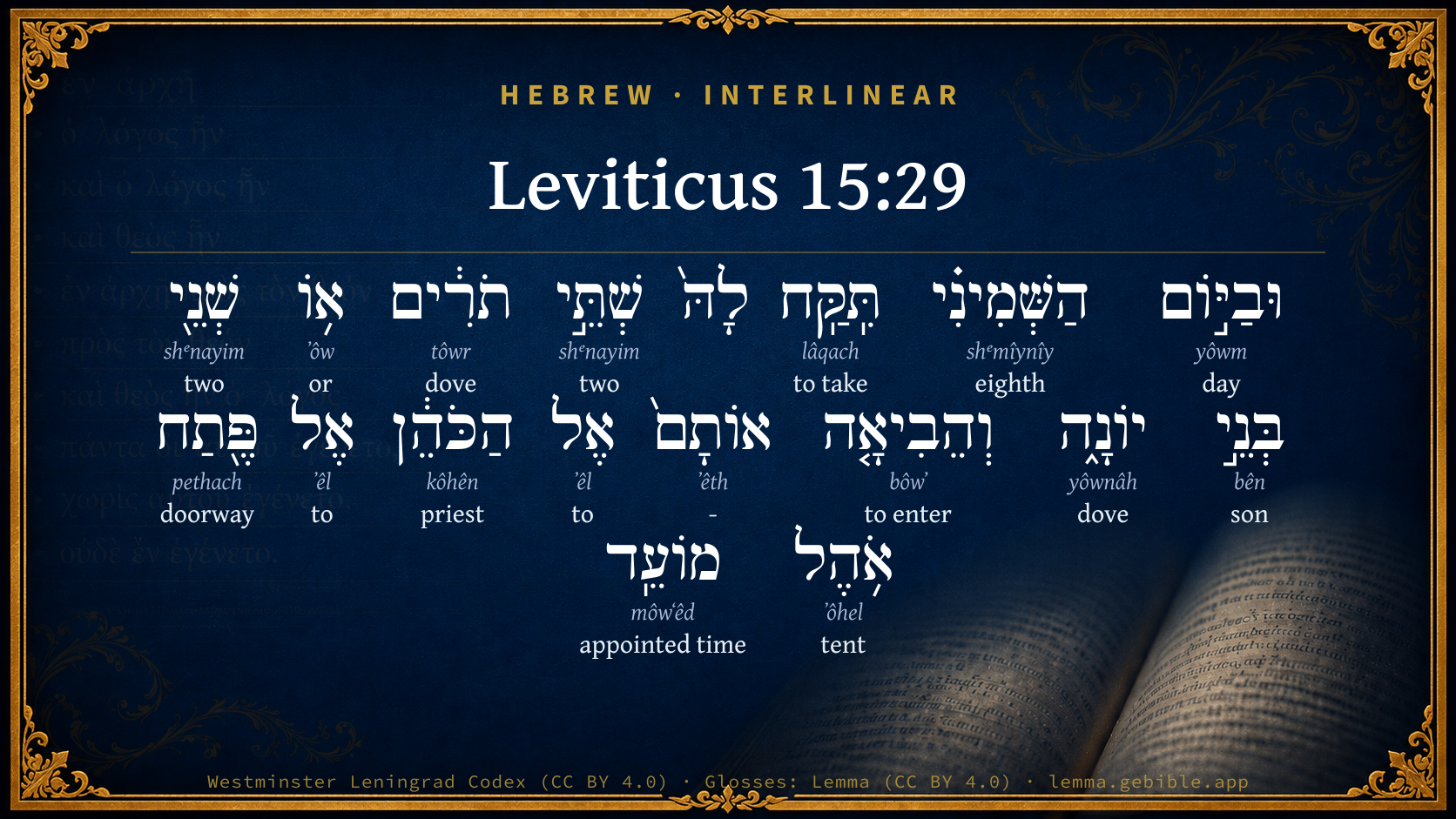
Hebrew (Westminster Leningrad Codex) Leviticus 15:29 appears in the Hebrew Old Testament. The text above is from the Westminster Leningrad Codex. Each word links to its Strong’s number, a concise gloss, and parsing drawn from the Open Scriptures Hebrew Bible morphology. Click any word for its full Brown-Driver-Briggs (BDB) entry.
Download image
Cite this verse

Leviticus 15:29 (World English Bible). Public Domain. Lemma interlinear Bible study tool, https://lemma.gebible.app/v/leviticus/15/29.

Show BibTeX & RIS
BibTeX
RIS
English Translation
On the eighth day she shall take two turtledoves, or two young pigeons, and bring them to the priest, to the door of the Tent of Meeting.
World English Bible · Public Domain
Download a study sheet

One document with this verse’s original text, its word-by-word gloss line, the meaning frame, cross-references with their text, attributed commentary, and full source and license credits — printable, and it pastes into notes with its structure intact.

This verse Autodidact and up

Study sheet (.html) Plain text (.txt)

A passage Seminary Student

Up to 50 verses in one chapter. A passage sheet keeps up to 6 commentary sources and 12 cross-references per verse, in the order this page ranks them, and says so on the sheet whenever that leaves anything out. Ask for a single verse and you get the Autodidact verse sheet above.

Everything on this page stays free to read, with no account — the sheet is a download of what is already on screen, not access to it.

Want to remove ads? Support Godless Engineer
Compare translations 3

The same verse in 3 English versions, stacked beneath the original-language interlinear above. Click any original word for its lexicon entry.

Each is an independent rendering of the whole verse — the interlinear is not word-aligned to these translations.

Highlighted words mark where these versions differ — a whole-verse word diff, not a word-by-word alignment.

  • World English Bible Public Domain
    On the eighth day she shall take two turtledoves, or two young pigeons, and bring them to the priest, to the door of the Tent of Meeting.
  • King James Version Public Domain
    And on the eighth day she shall take unto her two turtles, or two young pigeons, and bring them unto the priest, to the door of the tabernacle of the congregation.
  • unfoldingWord Literal Text CC BY-SA 4.0
    And on the eighth day, she shall take for herself two doves or two sons of a pigeon and she shall bring them to the priest, to the entrance of the tent of meeting.

unfoldingWord Literal Text — © unfoldingWord, licensed CC BY-SA 4.0. Word-aligned USFM3 via Door43 (git.door43.org/unfoldingWord/en_ult).

Versions to compare (up to 4)

3 of 4 selected

Show all 18 translations

Every available English version of this verse, each an independent rendering of the whole verse.

  • World English Bible Public Domain
    On the eighth day she shall take two turtledoves, or two young pigeons, and bring them to the priest, to the door of the Tent of Meeting.
  • Berean Standard Bible Public Domain
    On the eighth day she is to take two turtledoves or two young pigeons and bring them to the priest at the entrance to the Tent of Meeting.
  • Majority Standard Bible Public Domain
    On the eighth day she is to take two turtledoves or two young pigeons and bring them to the priest at the entrance to the Tent of Meeting.
  • King James Version Public Domain
    And on the eighth day she shall take unto her two turtles, or two young pigeons, and bring them unto the priest, to the door of the tabernacle of the congregation.
  • American Standard Version (1901) Public Domain
    And on the eighth day she shall take unto her two turtle-doves, or two young pigeons, and bring them unto the priest, to the door of the tent of meeting.
  • Revised Version (1885) Public Domain
    And on the eighth day she shall take unto her two turtledoves, or two young pigeons, and bring them unto the priest, to the door of the tent of meeting.
  • Geneva Bible (1599) Public Domain
    And in the eight day shee shall take vnto her two Turtles or two yong pigeons, and bring them vnto the Priest at the doore of the Tabernacle of the Congregation.
  • Douay-Rheims (1899) Public Domain
    And on the eighth day she shall offer for herself to the priest, two turtles, or two young pigeons, at the door of the tabernacle of the testimony:
  • Young's Literal Translation Public Domain
    and on the eighth day she taketh to herself two turtle-doves, or two young pigeons, and hath brought them in unto the priest, unto the opening of the tent of meeting;
  • Literal Standard Version CC BY-SA 4.0
    and on the eighth day she takes two turtle-doves or two young pigeons for herself, and has brought them to the priest, to the opening of the Tent of Meeting;
  • Unlocked Literal Bible CC BY-SA 4.0
    On the eighth day she will take to her two doves or two young pigeons and bring them to the priest at the entrance to the tent of meeting.
  • unfoldingWord Literal Text CC BY-SA 4.0
    And on the eighth day, she shall take for herself two doves or two sons of a pigeon and she shall bring them to the priest, to the entrance of the tent of meeting.
  • Darby Bible Public Domain
    And on the eighth day she shall take two turtle-doves, or two young pigeons, and bring them unto the priest, unto the entrance of the tent of meeting.
  • World Messianic Bible Public Domain
    On the eighth day she shall take two turtledoves, or two young pigeons, and bring them to the priest, to the door of the Tent of Meeting.
  • Webster's Bible Public Domain
    And on the eighth day she shall take to her two turtles, or two young pigeons, and bring them to the priest, to the door of the tabernacle of the congregation.
  • Free Bible Version CC BY-SA 4.0
    On the eighth day she must take two turtledoves or two young pigeons, come before the Lord at the entrance to the Tent of Meeting, and give them to the priest.
  • Bible in Basic English Public Domain
    And on the eighth day let her get two doves or two young pigeons and take them to the priest to the door of the Tent of meeting,
  • JPS Tanakh (1917) Public Domain
    And on the eighth day she shall take unto her two turtle-doves, or two young pigeons, and bring them unto the priest, to the door of the tent of meeting.

Literal Standard Version (2020), Covenant Press — licensed CC BY-SA 4.0. Text via the HelloAO Bible API (eBible.org). Unlocked Literal Bible (unfoldingWord) — licensed CC BY-SA 4.0. Text via the HelloAO Bible API (eBible.org). unfoldingWord Literal Text — © unfoldingWord, licensed CC BY-SA 4.0. Word-aligned USFM3 via Door43 (git.door43.org/unfoldingWord/en_ult). Free Bible Version, Dr. Jonathan Gallagher — licensed CC BY-SA 4.0. Text via the HelloAO Bible API (eBible.org).

Word by word

More ways to search: Search by grammar → Find every occurrence → Compare this word →

Practice this passage: Drill this verse → Learn its vocabulary →

תֹרִ֔ים
tôwr
H8449
“doves”
Noun, Common, Both, Plural, Absolute
Part of Speech
Noun
Type
Common
Gender
Both
Number
Plural
State
Absolute
Full BDB Definition

Origin: probably the same as H8447

TWOT: 2500c

dove, turtledove
  1. וּבַיּ֣וֹם yôwm H3117 “and · in/at the · day” Conjunction + Preposition, Determined + Noun, Common, Masculine, Singular, Absolute
  2. הַשְּׁמִינִ֗י shᵉmîynîy H8066 “the · eighth” Particle, Definite Article + Adjective, Ordinal number, Masculine, Singular, Absolute
  3. תִּֽקַּֽח lâqach H3947 “to take” Verb, Qal, Imperfect, 3rd Person, Feminine, Singular
  4. שְׁתֵּ֣י shᵉnayim H8147 “two” Adjective, Cardinal number, Feminine, Dual, Construct
  5. א֥וֹ ʼôw H176 “or” Conjunction
  6. שְׁנֵ֖י shᵉnayim H8147 “two” Adjective, Cardinal number, Masculine, Dual, Construct
  7. בְּנֵ֣י bên H1121 “sons of” Noun, Common, Masculine, Plural, Construct
  8. יוֹנָ֑ה yôwnâh H3123 “dove” Noun, Common, Feminine, Singular, Absolute
  9. וְהֵבִיאָ֤ה bôwʼ H935 “and · to enter” Conjunction + Verb, Hiphil, Sequential Perfect, 3rd Person, Feminine, Singular
  10. אוֹתָם֙ ʼêth H853 “- · them” Particle, Direct Object + Suffix, Personal, 3rd Person, Masculine, Plural
  11. אֶל ʼêl H413 “to” Preposition
  12. הַכֹּהֵ֔ן kôhên H3548 “the · priest” Particle, Definite Article + Noun, Common, Masculine, Singular, Absolute
  13. אֶל ʼêl H413 “to” Preposition
  14. פֶּ֖תַח pethach H6607 “doorway of” Noun, Common, Masculine, Singular, Construct
  15. אֹ֥הֶל ʼôhel H168 “tent of” Noun, Common, Masculine, Singular, Construct
  16. מוֹעֵֽד môwʻêd H4150 “appointed time” Noun, Common, Masculine, Singular, Absolute

About this verse

These counts appear in no published source. They are computed here, from the morphology-tagged text and Lemma’s own curated glosses. What Lemma adds →

18
words
15
distinct lemmas
Pentateuch
section

Notable vocabulary

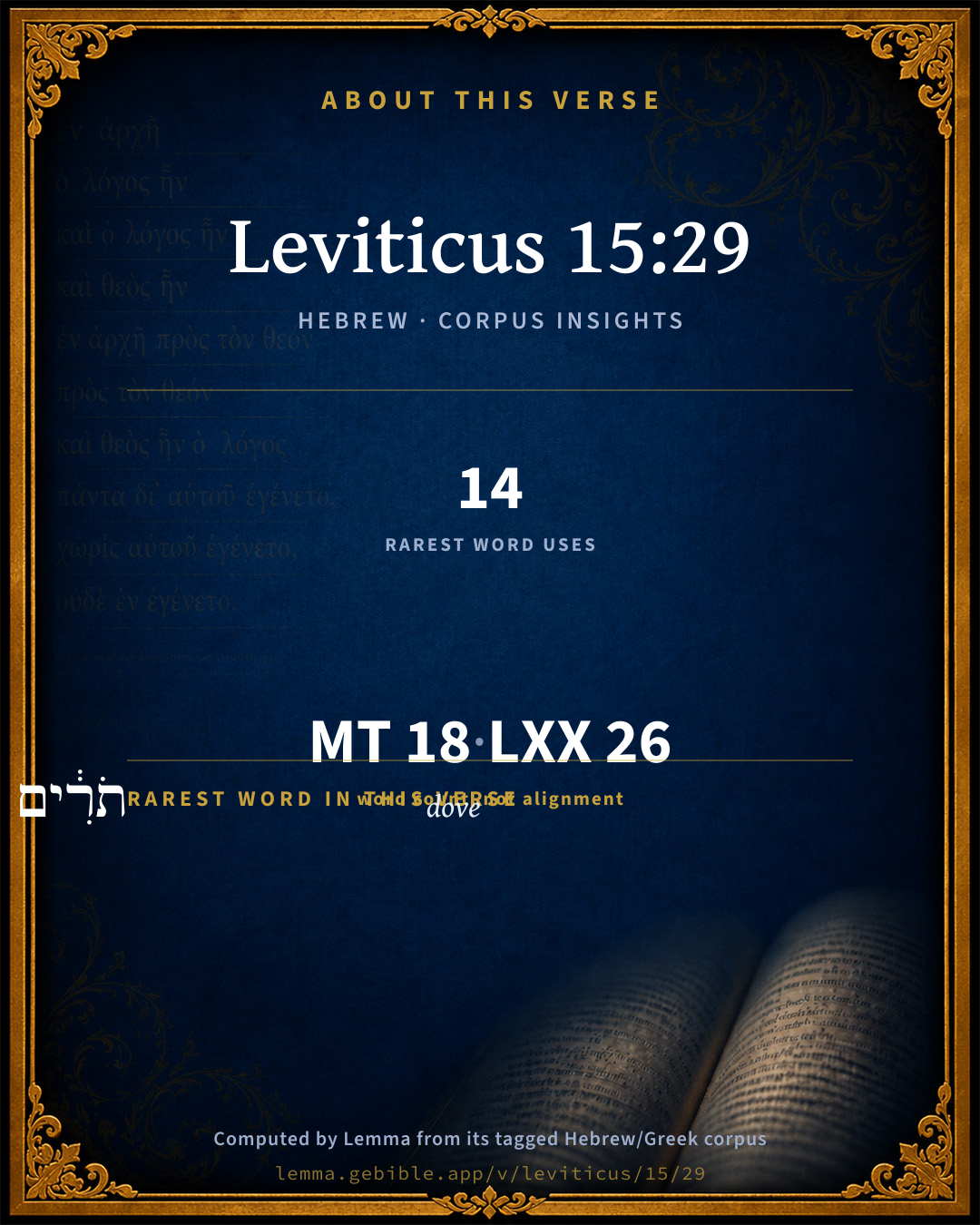
The rarest word here is תֹרִ֔ים dove H8449 — appearing just 14 times in the whole Hebrew Bible.

Shared distinctive vocabulary

תֹרִ֔ים dove H8449 occurs in 14 verses of the Hebrew Bible. Also found in:

Grammatical profile

  • 2 verbs
  • 8 nouns
  • 3 adjectives
  • 3 prepositions
  • 1 conjunction
  • 1 particle

Verb forms

  • תִּֽקַּֽח Qal · Imperfect
  • וְהֵבִיאָ֤ה Hiphil · Sequential Perfect

Repetition

Words recur within this verse — often emphatic in Hebrew:

  • שְׁתֵּ֣י two H8147 ×2
  • אֶל to H413 ×2

Hebrew & Septuagint length

In English translation the verse runs 27 words from the Hebrew and 29 from the Septuagint (LXX English) — closely comparable.

A rough comparison of the two English renderings, which tokenize alike — not a word-level alignment.

Word counts can differ between the Hebrew and the Greek without any difference in meaning — e.g. the Hebrew direct-object marker אֵת has no separate Greek word, and Greek often adds the article ὁ.

In the original languages it is 18 Hebrew tokens and 26 Greek tokens — but the two are counted differently (Hebrew bundles its prefixes and suffixes into one token; the Greek is in lemma form), so that isn’t a like-for-like length.

Hebrew and Greek witnesses Masoretic Hebrew ↔ Greek Septuagint

The same verse in the two great witnesses to the Old Testament, shown verse-for-verse.

These are two independent witnesses, not word-aligned to each other, and the Septuagint is shown in lemma (dictionary) form.

Hebrew Leviticus 15:29 Masoretic · Westminster Leningrad Codex

וּבַיּ֣וֹם הַשְּׁמִינִ֗י תִּֽקַּֽח לָהּ֙ שְׁתֵּ֣י תֹרִ֔ים א֥וֹ שְׁנֵ֖י בְּנֵ֣י יוֹנָ֑ה וְהֵבִיאָ֤ה אוֹתָם֙ אֶל הַכֹּהֵ֔ן אֶל פֶּ֖תַח אֹ֥הֶל מוֹעֵֽד

On the eighth day she shall take two turtledoves, or two young pigeons, and bring them to the priest, to the door of the Tent of Meeting.

World English Bible · Public Domain

Greek LXX Leviticus 15:29 Septuagint · lemma form

καί ὁ ἡμέρα ὁ ὄγδοος λαμβάνω αὐτός δύο τρυγών ἤ δύο νεοσσός περιστερά καί φέρω αὐτός πρός ὁ ἱερεύς ἐπί ὁ θύρα ὁ σκηνή ὁ μαρτύριον

And on the eighth day she shall take two turtledoves, or two young pigeons, and shall bring them to the priest, to the door of the tabernacle of witness.

LXX2012 (modern English Septuagint) · Public Domain

Hebrew: Westminster Leningrad Codex (CC BY 4.0). Greek: Septuagint (public domain); English from LXX2012 (modern English Septuagint) (Public Domain). How the Septuagint differs from the Hebrew →

Targum (Aramaic paraphrase)

2

The Targum is the ancient Jewish Aramaic paraphrase of the Hebrew Scriptures — an interpretive translation, not the Hebrew text itself. Onkelos (literal) and Pseudo-Jonathan (expansive) render the Torah, and Jonathan the Prophets. Coverage is partial: where no permissively-licensed English translation exists for a verse, only the Aramaic is shown. This is verse-level text, not a word-by-word alignment to the Hebrew.

  1. Targum Onkelos Torah (Genesis–Deuteronomy)
    וּבְיוֹמָא תְמִינָאָה תִּסַב לָהּ תַּרְתֵּין שַׁפְנִינִין אוֹ תְרֵין בְּנֵי יוֹנָה וְתַיְתִי יָתְהוֹן לְוָת כַּהֲנָא לִתְרַע מַשְׁכַּן זִמְנָא

    (no public-domain English translation for this verse)

    Targum Onkelos — Aramaic: “Onkelos Genesis” (public domain); “Onkelos Exodus” (public domain); “Onkelos Leviticus” (public domain); “Onkelos Numbers” (public domain); “Onkelos Deuteronomy” (public domain). English: “Sefaria Community Translation” (CC0 1.0 (public-domain dedication)); “J.W. Etheridge. The Targums of Onkelos and Jonathan Ben Uzziel on the Pentateuch. London: Longmans, Green, 1862” (public domain). Text via Sefaria.

  2. Targum Pseudo-Jonathan Torah (Genesis–Deuteronomy)
    וּבְיוֹמָא תְּמִינָאָה תִּסַב תְּרֵין שַׁפְנִינִין רַבְרְבִין אוֹ תְּרֵין גוֹזְלִין בְּנֵי יוֹוָן וְתֵיתֵי יַתְהוֹן לְוַת כַּהֲנָא לִתְרַע מַשְׁכַּן זִמְנָא

    And on the seventh day, let her take for herself two turtle doves, or two young pigeons eons, and bring them to the priest, at the door of the tabernacle of ordinance;

    Targum Pseudo-Jonathan — Aramaic: “Targum Jonathan on Genesis” (public domain); “Targum Jonathan on Exodus” (public domain); “Targum Jonathan on Leviticus” (public domain); “Targum Jonathan on Numbers” (public domain); “Targum Jonathan on Deuteronomy” (public domain). English: “The Targum of Jonathan ben Uzziel, trans. J. W. Etheridge, London, 1862” (public domain). Text via Sefaria.

Commentary

Notes on Leviticus 15:29 from classic Christian and Jewish commentators (each source and its license shown beneath its notes). The classic Christian expositions comment on the surrounding passage and are grouped to its opening verse, so a note may address several verses; the Jewish commentaries on the Tanakh (Rashi and others) are per-verse, so they appear only where the commentator wrote on this verse.

Lemma curates 59 commentaries, every one of them public domain or Creative Commons licensed, each selected and text-cleaned for this edition rather than reprinted as found. About our sources →

Adam Clarke's Commentary

Verse 29. Two turtles, or two young pigeons] In all these cases moral pollution was ever considered as being less or more present, as even such infirmities sprang from the original defection of man. On these accounts sacrifices must be offered; and in the case of the woman, one of the birds above mentioned must be sacrificed as a sin-offering, the other as a burnt-offering, Le 15:30.

Adam Clarke's Commentary on the Bible (1810–1826) — public domain. Text from a community e-Sword/MySword module.

Ellicott's Commentary for English Readers

(29) She shall take unto her . . . —On the eighth day she is to bring the same sacrifices which are prescribed for the man who is cured of an issue (see Lev_15:14), only that in the latter case the man had to be bathed in living water, because he brought the illness upon himself.

A Bible Commentary for English Readers, edited by Charles John Ellicott (1878–1897) — public domain. Text from a community e-Sword module.

John Gill's Exposition

And the priest shall offer the one for a sin offering,.... As in the case of a man that had an issue, the offerings of one and the other were the same and for the same purpose; See Gill on Lev 15:15; there being a legal uncleanness in their case, atonement must be made by sacrifice, typical of the atonement of Christ, who by himself has purged our sins. The design of these several laws concerning uncleanness by issues, was to set forth the filthiness of sin arising from the corruption of human nature; particularly the pollution of fleshly lusts, and the necessity of purification from them by the grace of God, and blood of Christ, and of holiness of heart and life, in order to a near approach to God, particularly in public worship, as the next words suggest.

; there being a legal uncleanness in their case, atonement must be made by sacrifice, typical of the atonement of Christ, who by himself has purged our sins. The design of these several laws concerning uncleanness by issues, was to set forth the filthiness of sin arising from the corruption of human nature; particularly the pollution of fleshly lusts, and the necessity of purification from them by the grace of God, and blood of Christ, and of holiness of heart and life, in order to a near approach to God, particularly in public worship, as the next words suggest.

Leviticus 15:31

lev 15:31

lev 15:31

lev 15:31Thus shall ye separate the children of Israel from their uncleanness,.... Or because of it, and while they are in it, as from other persons, even their nearest relations, and from the house of God, as the next clause shows; or teach them, by observing the above laws and rules, to separate themselves, and that they be careful and cautions to keep themselves apart while in such impurities; and the children of Israel are only made mention of, because these laws are only binding upon them, with their proselytes and servants, free or not free (l), but not upon Gentiles; See Gill on Lev 15:2,

that they die not in their uncleanness, when they defile my tabernacle that is among them; from whence it appears, that men and women, in the above circumstances, might not go into the tabernacle; and it was chiefly to prevent their access to it that these laws were given, for the greater reverence and honour of it; and that for such persons to enter there was a pollution of it, and the punishment was cutting off, or death; and for one to die in his impurity, without purification and sacrifice, was a dreadful thing, and to be deprecated, and to be guarded against by an observance of the above laws. But the Jews now say (m), that forasmuch as the reason of these precepts was, because such persons were forbidden to enter into the temple, that being destroyed, all these precepts of uncleanness are ceased also.

(l) Misn. Zabim, c. 2. sect. 1. (m) Leo Modena's History of Rites, Customs, &c. of the present Jews, par. 1. c. 8.

John Gill's Exposition of the Whole Bible (1746–1763) — public domain (CC PDM 1.0). Text via the HelloAO Bible API.

Lesson kit

Teaching starters — assembled from the data on this page, not authored interpretation. Every prompt links to the verse data it draws on. Edit before teaching.

Leviticus, in the Pentateuch, opens this verse with 18 words (15 distinct Hebrew lemmas). Its most distinctive word is tôwr (“dove”). A historical commentator’s framing appears above. Read the whole chapter for the surrounding context.

Discussion questions

  1. What does “dove” (tôwr) contribute to the verse as a whole?
  2. How does Genesis 15:9, which shares the word «dove», read alongside this verse?
  3. What does the repetition of “two” (2× in this one verse) do in this verse?
  4. These translations render this verse differently; the difference is in the English rendering, not the original. What questions does that raise?
  5. «תִּֽקַּֽח» is a Qal Imperfect verb. How does that grammatical form shape the action described?
  6. Compare how Adam Clarke's Commentary and Ellicott's Commentary for English Readers read this verse. Where do they agree or differ?

Things to notice

Reading settings

Reading text

Shown beneath each verse's original-language words.

Old Testament
Old Testament edition

Read the OT as the Masoretic Hebrew (MT) or the Greek Septuagint (LXX).

English shown for the Greek Septuagint (in the Hebrew ↔ Greek comparison).

Comparing translations? Open the Compare panel on any verse page to stack up to four side by side.