Exodus 39:33

Hebrew (Westminster Leningrad Codex) Exodus 39:33 appears in the Hebrew Old Testament. The text above is from the Westminster Leningrad Codex. Each word links to its Strong’s number, a concise gloss, and parsing drawn from the Open Scriptures Hebrew Bible morphology. Click any word for its full Brown-Driver-Briggs (BDB) entry.
Download image
Cite this verse

Exodus 39:33 (World English Bible). Public Domain. Lemma interlinear Bible study tool, https://lemma.gebible.app/v/exodus/39/33.

Show BibTeX & RIS
BibTeX
RIS
English Translation
They brought the tent to Moses, the tent, with all its furniture, its clasps, its boards, it bars, its pillars, its sockets,
World English Bible · Public Domain
Download a study sheet

One document with this verse’s original text, its word-by-word gloss line, the meaning frame, cross-references with their text, attributed commentary, and full source and license credits — printable, and it pastes into notes with its structure intact.

This verse Autodidact and up

Study sheet (.html) Plain text (.txt)

A passage Seminary Student

Up to 50 verses in one chapter. A passage sheet keeps up to 6 commentary sources and 12 cross-references per verse, in the order this page ranks them, and says so on the sheet whenever that leaves anything out. Ask for a single verse and you get the Autodidact verse sheet above.

Everything on this page stays free to read, with no account — the sheet is a download of what is already on screen, not access to it.

Want to remove ads? Support Godless Engineer
Compare translations 3

The same verse in 3 English versions, stacked beneath the original-language interlinear above. Click any original word for its lexicon entry.

Each is an independent rendering of the whole verse — the interlinear is not word-aligned to these translations.

Highlighted words mark where these versions differ — a whole-verse word diff, not a word-by-word alignment.

  • World English Bible Public Domain
    They brought the tent to Moses, the tent, with all its furniture, its clasps, its boards, it bars, its pillars, its sockets,
  • King James Version Public Domain
    And they brought the tabernacle unto Moses, the tent, and all his furniture, his taches, his boards, his bars, and his pillars, and his sockets,
  • unfoldingWord Literal Text CC BY-SA 4.0
    And they brought the Dwelling to Moses: the tent and all its equipment and its clasps and its frames and its bars and its pillars and its bases;

unfoldingWord Literal Text — © unfoldingWord, licensed CC BY-SA 4.0. Word-aligned USFM3 via Door43 (git.door43.org/unfoldingWord/en_ult).

Versions to compare (up to 4)

3 of 4 selected

Show all 18 translations

Every available English version of this verse, each an independent rendering of the whole verse.

  • World English Bible Public Domain
    They brought the tent to Moses, the tent, with all its furniture, its clasps, its boards, it bars, its pillars, its sockets,
  • Berean Standard Bible Public Domain
    Then they brought the tabernacle to Moses: the tent with all its furnishings, its clasps, its frames, its crossbars, and its posts and bases;
  • Majority Standard Bible Public Domain
    Then they brought the tabernacle to Moses: the tent with all its furnishings, its clasps, its frames, its crossbars, and its posts and bases;
  • King James Version Public Domain
    And they brought the tabernacle unto Moses, the tent, and all his furniture, his taches, his boards, his bars, and his pillars, and his sockets,
  • American Standard Version (1901) Public Domain
    And they brought the tabernacle unto Moses, the Tent, and all its furniture, its clasps, its boards, it bars, and its pillars, and it sockets;
  • Revised Version (1885) Public Domain
    And they brought the tabernacle unto Moses, the Tent, and all its furniture, its clasps, its boards, its bars, and its pillars, and its sockets;
  • Geneva Bible (1599) Public Domain
    Afterwarde they brought the Tabernacle vnto Moses, the Tabernacle and al his instruments, his taches, his boards, his barres, and his pillars, and his sockets,
  • Douay-Rheims (1899) Public Domain
    The cover of rams' skins dyed red, and the other cover of violet skins,
  • Young's Literal Translation Public Domain
    And they bring in the tabernacle unto Moses, the tent, and all its vessels, its hooks, its boards, its bars, and its pillars, and its sockets;
  • Literal Standard Version CC BY-SA 4.0
    And they bring in the Dwelling Place to Moses, the tent, and all its vessels, its hooks, its boards, its bars, and its pillars, and its sockets;
  • Unlocked Literal Bible CC BY-SA 4.0
    They brought the tabernacle to Moses—the tent and all its equipment, its clasps, frames, bars, posts, and bases;
  • unfoldingWord Literal Text CC BY-SA 4.0
    And they brought the Dwelling to Moses: the tent and all its equipment and its clasps and its frames and its bars and its pillars and its bases;
  • Darby Bible Public Domain
    And they brought the tabernacle to Moses -- the tent, and all its utensils, its clasps, its boards, its bars, and its pillars, and its bases;
  • World Messianic Bible Public Domain
    They brought the tabernacle to Moses: the tent, with all its furniture, its clasps, its boards, its bars, its pillars, its sockets,
  • Webster's Bible Public Domain
    And they brought the tabernacle to Moses, the tent, and all its furniture, its buttons, its boards, its bars, and its pillars, and its sockets,
  • Free Bible Version CC BY-SA 4.0
    Then they presented the Tabernacle to Moses: the tent with all its furniture, its clips, its frames, its crossbars, and its posts and stands;
  • Bible in Basic English Public Domain
    Then they took the House to Moses, the tent with all the things for it; its hooks, its boards, its rods, its pillars, and its bases;
  • JPS Tanakh (1917) Public Domain
    And they brought the tabernacle unto Moses, the Tent, and all its furniture, its clasps, its boards, its bars, and its pillars, and its sockets;

Literal Standard Version (2020), Covenant Press — licensed CC BY-SA 4.0. Text via the HelloAO Bible API (eBible.org). Unlocked Literal Bible (unfoldingWord) — licensed CC BY-SA 4.0. Text via the HelloAO Bible API (eBible.org). unfoldingWord Literal Text — © unfoldingWord, licensed CC BY-SA 4.0. Word-aligned USFM3 via Door43 (git.door43.org/unfoldingWord/en_ult). Free Bible Version, Dr. Jonathan Gallagher — licensed CC BY-SA 4.0. Text via the HelloAO Bible API (eBible.org).

Word by word

More ways to search: Search by grammar → Find every occurrence → Compare this word →

Practice this passage: Drill this verse → Learn its vocabulary →

קְרָסָ֣יו
qereç
H7165
“hooks · his”
Noun, Common, Masculine, Plural, Construct + Suffix, Personal, 3rd Person, Masculine, Singular
Part of Speech
Noun
Type
Common
Gender
Masculine
Number
Plural
State
Construct
Full BDB Definition

Origin: from H7164

TWOT: 2073a

hook
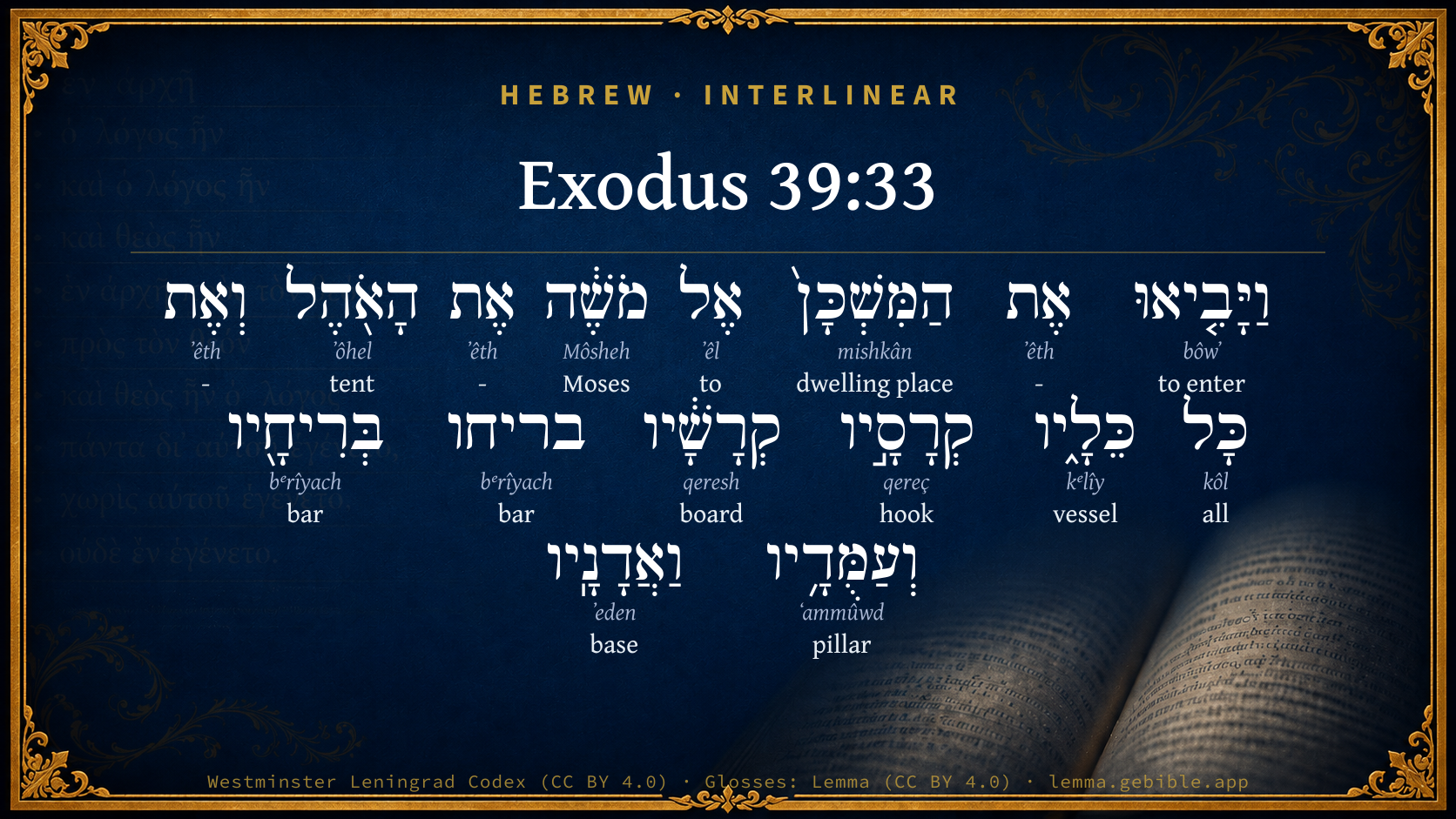
  1. וַיָּבִ֤יאוּ bôwʼ H935 “and · to enter” Conjunction + Verb, Hiphil, Sequential Imperfect, 3rd Person, Masculine, Plural
  2. אֶת ʼêth H853 “-” Particle, Direct Object
  3. הַמִּשְׁכָּן֙ mishkân H4908 “the · dwelling place” Particle, Definite Article + Noun, Common, Masculine, Singular, Absolute
  4. אֶל ʼêl H413 “to” Preposition
  5. מֹשֶׁ֔ה Môsheh H4872 “Moses” Noun, Proper
  6. אֶת ʼêth H853 “-” Particle, Direct Object
  7. הָאֹ֖הֶל ʼôhel H168 “the · tent” Particle, Definite Article + Noun, Common, Masculine, Singular, Absolute
  8. וְאֶת ʼêth H853 “and · -” Conjunction + Particle, Direct Object
  9. כָּל kôl H3605 “all of” Noun, Common, Masculine, Singular, Construct
  10. כֵּלָ֑יו kᵉlîy H3627 “vessels · his” Noun, Common, Masculine, Plural, Construct + Suffix, Personal, 3rd Person, Masculine, Singular
  11. קְרָשָׁ֔יו qeresh H7175 “boards · his” Noun, Common, Masculine, Plural, Construct + Suffix, Personal, 3rd Person, Masculine, Singular
  12. בריחו bᵉrîyach H1280 “bars · his” Noun, Common, Masculine, Plural, Construct + Suffix, Personal, 3rd Person, Masculine, Singular
  13. בְּרִיחָ֖יו bᵉrîyach H1280 “bars · his” Noun, Common, Masculine, Plural, Construct + Suffix, Personal, 3rd Person, Masculine, Singular
  14. וְעַמֻּדָ֥יו ʻammûwd H5982 “and · pillars · his” Conjunction + Noun, Common, Masculine, Plural, Construct + Suffix, Personal, 3rd Person, Masculine, Singular
  15. וַאֲדָנָֽיו ʼeden H134 “and · bases · his” Conjunction + Noun, Common, Masculine, Plural, Construct + Suffix, Personal, 3rd Person, Masculine, Singular

About this verse

These counts appear in no published source. They are computed here, from the morphology-tagged text and Lemma’s own curated glosses. What Lemma adds →

16
words
13
distinct lemmas
Pentateuch
section

Notable vocabulary

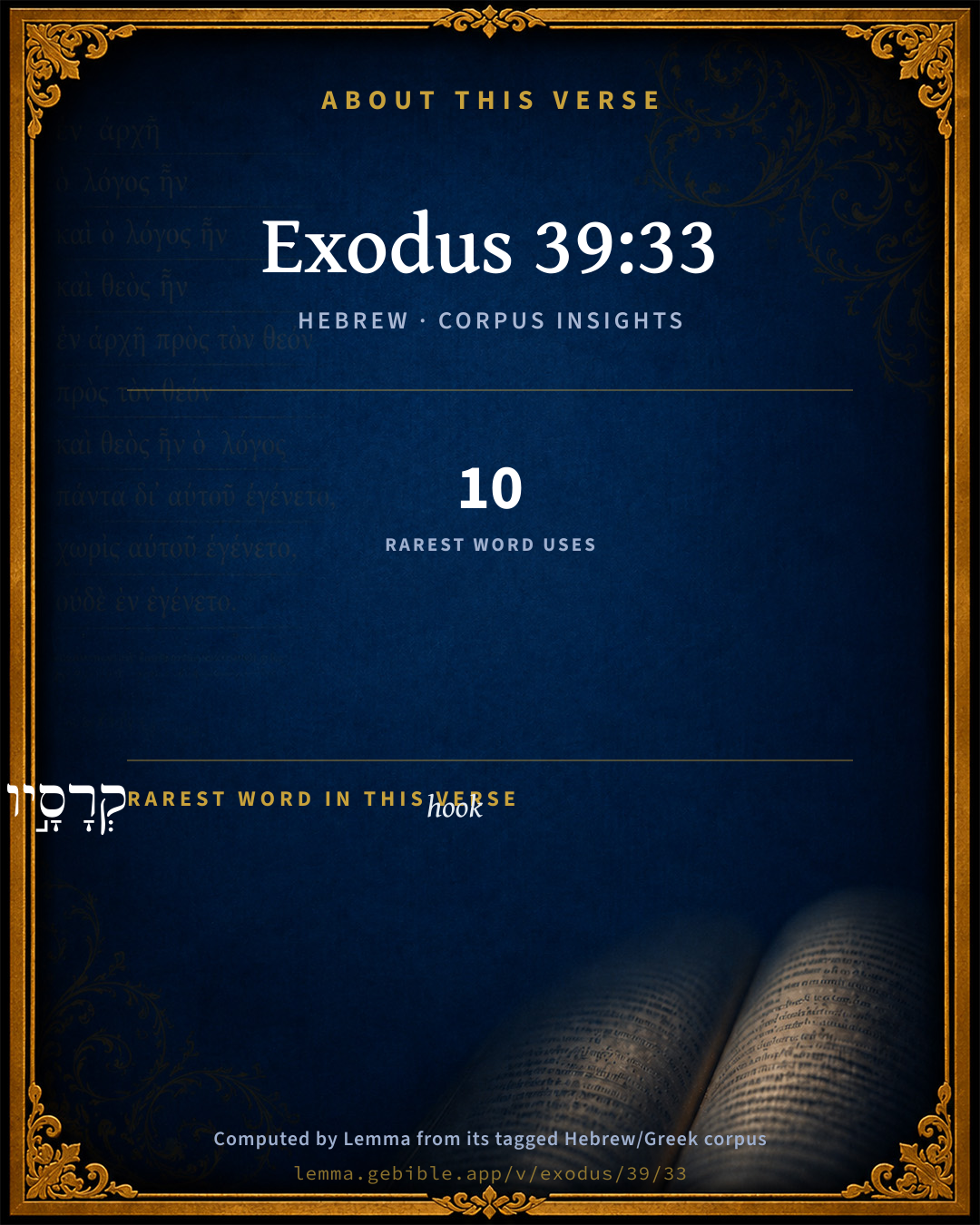
The rarest word here is קְרָסָ֣יו hook H7165 — appearing just 10 times in the whole Hebrew Bible.

Shared distinctive vocabulary

קְרָסָ֣יו hook H7165 occurs in 7 verses of the Hebrew Bible. Also found in:

Grammatical profile

  • 1 verb
  • 11 nouns
  • 1 preposition
  • 3 particles

Verb forms

  • וַיָּבִ֤יאוּ Hiphil · Sequential Imperfect

Repetition

A word recurs within this verse — often emphatic in Hebrew:

  • בריחו bar H1280 ×2

Cross-references

4

Topical passages linked to Exodus 39:33 in the Treasury of Scripture Knowledge — connected by theme and wording, ordered by reader-vote popularity; previews shown in the World English Bible.

  • Exodus 25:1–30 Yahweh spoke to Moses, saying,
  • Exodus 31:7–11 the tent of meeting, the ark of the testimony, the mercy seat that is on it, all the furniture of the Tent,
  • Exodus 35:11–19 the tent, its outer covering, its roof, its clasps, its boards, its bars, its pillars, and its sockets;
  • Exodus 36:1–38 "Bezalel and Oholiab shall work with every wise-hearted man, in whom Yahweh has put wisdom and understanding to know how to work all the work for the service of the sanctuary, according to all that Yahweh has commanded."

Cross-references courtesy of OpenBible.info (CC BY 4.0).

Hebrew and Greek witnesses Masoretic Hebrew ↔ Greek Septuagint

The same verse in the two great witnesses to the Old Testament, shown verse-for-verse.

These are two independent witnesses, not word-aligned to each other, and the Septuagint is shown in lemma (dictionary) form.

Hebrew Exodus 39:33 Masoretic · Westminster Leningrad Codex

וַיָּבִ֤יאוּ אֶת הַמִּשְׁכָּן֙ אֶל מֹשֶׁ֔ה אֶת הָאֹ֖הֶל וְאֶת כָּל כֵּלָ֑יו קְרָסָ֣יו קְרָשָׁ֔יו בריחו בְּרִיחָ֖יו וְעַמֻּדָ֥יו וַאֲדָנָֽיו

They brought the tent to Moses, the tent, with all its furniture, its clasps, its boards, it bars, its pillars, its sockets,

World English Bible · Public Domain

Hebrew: Westminster Leningrad Codex (CC BY 4.0). Greek: Septuagint (public domain); English from a public-domain English Septuagint. How the Septuagint differs from the Hebrew →

Targum (Aramaic paraphrase)

2

The Targum is the ancient Jewish Aramaic paraphrase of the Hebrew Scriptures — an interpretive translation, not the Hebrew text itself. Onkelos (literal) and Pseudo-Jonathan (expansive) render the Torah, and Jonathan the Prophets. Coverage is partial: where no permissively-licensed English translation exists for a verse, only the Aramaic is shown. This is verse-level text, not a word-by-word alignment to the Hebrew.

  1. Targum Onkelos Torah (Genesis–Deuteronomy)
    וְאַיְתִיוּ יָת מַשְׁכְּנָא לְמשֶׁה יָת מַשְׁכְּנָא וְיָת כָּל מָנוֹהִי פוּרְפוֹהִי דַפּוֹהִי עַבְּרוֹהִי וְעַמוּדוֹהִי וְסַמְכוֹהִי:

    (no public-domain English translation for this verse)

    Targum Onkelos — Aramaic: “Onkelos Genesis” (public domain); “Onkelos Exodus” (public domain); “Onkelos Leviticus” (public domain); “Onkelos Numbers” (public domain); “Onkelos Deuteronomy” (public domain). English: “Sefaria Community Translation” (CC0 1.0 (public-domain dedication)); “J.W. Etheridge. The Targums of Onkelos and Jonathan Ben Uzziel on the Pentateuch. London: Longmans, Green, 1862” (public domain). Text via Sefaria.

  2. Targum Pseudo-Jonathan Torah (Genesis–Deuteronomy)
    וְאַיְיתִיוּ יַת מַשְׁכְּנָא לְוַת משֶׁה לְבֵית מִדְרָשֵׁיהּ דְּהֲווּ תַּמָּן יַתְבִין משֶׁה וְאַהֲרן וּבְנוֹי וַהֲוָה מִתְרַץ לְהוֹן סֵדֶר כְּהוּנְתָּא וְתַמָּן יַתְבִין סָבֵי יִשְרָאֵל וְאַחְוִיאוּ לֵיהּ יַת מַשְׁכְּנָא וְיַת כָּל מָנוֹי פּוּרְפּוֹי לוּחוֹי נַגְרוֹי עֲמוּדוֹי וְחוֹמְרוֹי

    And they brought the tabernacle to Mosheh at his house of instruction, (beth Midrash,) where sat Mosheh, and Aharon, and his sons, where he gave direction to them concerning the order of the priesthood; and there, and Aharon, (also) sat the elders of Israel. And they brought to him the tabernacle and all its vessels: its taches, its boards, its bars, its pillars, and its bases;

    Targum Pseudo-Jonathan — Aramaic: “Targum Jonathan on Genesis” (public domain); “Targum Jonathan on Exodus” (public domain); “Targum Jonathan on Leviticus” (public domain); “Targum Jonathan on Numbers” (public domain); “Targum Jonathan on Deuteronomy” (public domain). English: “The Targum of Jonathan ben Uzziel, trans. J. W. Etheridge, London, 1862” (public domain). Text via Sefaria.

Commentary

Notes on Exodus 39:33 from classic Christian and Jewish commentators (each source and its license shown beneath its notes). The classic Christian expositions comment on the surrounding passage and are grouped to its opening verse, so a note may address several verses; the Jewish commentaries on the Tanakh (Rashi and others) are per-verse, so they appear only where the commentator wrote on this verse.

Lemma curates 59 commentaries, every one of them public domain or Creative Commons licensed, each selected and text-cleaned for this edition rather than reprinted as found. About our sources →

Ellicott's Commentary for English Readers

THE PRESENTATION OF THE WORK TO MOSES, AND HIS APPROVAL OF IT.

(33-43) It is probable that the various parts of the work were presented to Moses for inspection as they were completed; that if they did not satisfy him, they might be altered and amended at once. Moses alone had seen “the pattern in the mount,” and Moses alone could say if the work came up to the required standard. We are not told that anything was rejected; and it is quite possible that all the portions of the work were satisfactorily rendered at their first essay by the several workmen; for the workmen, it must be remembered, besides receiving instructions from Moses, were divinely assisted in the production of their several works (Exo. 36:42).

A Bible Commentary for English Readers, edited by Charles John Ellicott (1878–1897) — public domain. Text from a community e-Sword module.

The Cambridge Bible for Schools and Colleges

gen. ed. J. J. S. Perowne

33. the tabernacle] the Dwelling, i.e., in the proper sense of the term (see on Exo_26:1), the curtains constituting the ‘Dwelling’ (Exo_26:1-6).

the Tent] the tent of goats’ hair, outside the ‘curtains’ (Exo_26:7-13).

33–40. The things made are all brought to Moses, and (v. 43) approved by him. A complete enumeration is given, substantially in the same order as in Exo_35:11-19.

The Cambridge Bible for Schools and Colleges (gen. ed. J. J. S. Perowne; Cambridge University Press, 1878–1918) — public domain. Text from a community e-Sword module.

John Gill's Exposition

And they brought the tabernacle unto Moses,.... That is, the several parts of it before it was put together, with all its furniture, and everything appertaining to it; which are examined in the order in which they were directed to be made, from hence to the end of Exo 39:42 and this was done, that Moses might inspect the whole, and see whether it was done according to the pattern shown him, and the instructions he had given to the workmen.

Exodus 39:43

John Gill's Exposition of the Whole Bible (1746–1763) — public domain (CC PDM 1.0). Text via the HelloAO Bible API.

Rashi

Rabbi Shlomo Yitzchaki (Rashi)

ויביאו את המשכן וגו׳ AND THEY BROUGHT THE TABERNACLE [UNTO MOSES etc.], for they themselves were unable to erect it. Since Moses had done no work in the Mishkan, the Holy One, blessed is He, left for him the task of erecting it, for nobody was able to set it up because of the weight of the boards which no human strength was capable of setting up. Moses, however, succeeded in placing it in position. Moses said to the Holy One, blessed be He, “How is its erection possible by human beings?” God answered him: “You be busy with your hand!” He appeared to be erecting it, but in fact it set itself up and rose of its own accord. That is why Scripture says, (Exodus 40:17) “The Tabernacle was erected (הוקם)” — was erected by itself. This is a Midrash of Rabbi Tanchuma 2:11:11.

Rashi on the Tanakh — English translations: “The Judaica Press complete Tanach with Rashi, translated by A. J. Rosenberg” (CC BY 4.0); “Pentateuch with Rashi's commentary by M. Rosenbaum and A.M. Silbermann, 1929-1934” (public domain); “The Metsudah Tanach series, Lakewood, N.J” (CC BY 4.0); and “The Book of Joshua, Metsudah Publications, 1997” (CC BY 4.0). Text via Sefaria.

Ramban (Nachmanides)

Rabbi Moshe ben Nachman (Ramban / Nachmanides)

AND THEY BROUGHT THE TABERNACLE UNTO MOSES, THE TENT, AND ALL ITS VESSELS. The translation of this verse is as if it were written with the connective vav [which indicates “and”], thus making the sense of the verse: “and they brought the Tabernacle unto Moses, ‘and’ the tent and all its vessels,” for it was the curtains of fine-twined linen that are called “Tabernacle,” as it is said, And thou shalt make the Tabernacle with ten curtains of fine-twined linen, and then it continues, and thou shalt couple the curtains… that the Tabernacle may be one whole., Verse 6. The “tent,” however, means the curtains of goats’ hair, as Scripture says with reference to them, And thou shalt make curtains of goats’ hair for a tent over the Tabernacle;, Verse 7. and thou shalt couple the tent together, that it may be one., Verse 11. Similarly, the Tabernacle, its tent, and its covering, 35:11. means “and its tent.” So also here the meaning of the verse is, “and they brought the Tabernacle unto Moses, and the tent, and all its vessels,” as Scripture mentions here [in this section] the names of all its parts. At times the whole house is called “the Tent of Meeting,” as He said, and they shall make all that I have commanded thee: the Tent of Meeting, and the ark of the Testimony, 31:6-7. for “the Tent of Meeting” is the house in its totality, where He would meet with Moses., 30:6. Similarly, all the vessels of the service of the Tabernacle of the Tent of Meeting [refers to the building as a whole].

Ramban (Nachmanides) on the Tanakh — English translation: “Commentary on the Torah by Ramban (Nachmanides). Translated and annotated by Charles B. Chavel. New York, Shilo Pub. House, 1971-1976” (CC BY 4.0). Text via Sefaria.

Lesson kit

Teaching starters — assembled from the data on this page, not authored interpretation. Every prompt links to the verse data it draws on. Edit before teaching.

Exodus, in the Pentateuch, opens this verse with 16 words (13 distinct Hebrew lemmas). Its most distinctive word is qereç (“hook”). A historical commentator’s framing appears above. Read the whole chapter for the surrounding context.

Discussion questions

  1. How does “hook” (qereç) shape what this verse is saying?
  2. Exodus 26:6 shares the word «hook» with this verse. How do the two illuminate each other?
  3. “bar” occurs 2× in this one verse. What is the effect of the repetition?
  4. These translations render this verse differently; the difference is in the English rendering, not the original. What questions does that raise?
  5. The verb «וַיָּבִ֤יאוּ» is Hiphil Sequential Imperfect. How does its form color the action?
  6. Reading how Ellicott's Commentary for English Readers and The Cambridge Bible for Schools and Colleges read this verse, where do the two commentators agree and where do they part?

Things to notice

Reading settings

Reading text

Shown beneath each verse's original-language words.

Old Testament
Old Testament edition

Read the OT as the Masoretic Hebrew (MT) or the Greek Septuagint (LXX).

English shown for the Greek Septuagint (in the Hebrew ↔ Greek comparison).

Comparing translations? Open the Compare panel on any verse page to stack up to four side by side.