
Exodus 33:8

Hebrew (Westminster Leningrad Codex) Exodus 33:8 appears in the Hebrew Old Testament. The text above is from the Westminster Leningrad Codex. Each word links to its Strong’s number, a concise gloss, and parsing drawn from the Open Scriptures Hebrew Bible morphology. Click any word for its full Brown-Driver-Briggs (BDB) entry.
Download image
Cite this verse

Exodus 33:8 (World English Bible). Public Domain. Lemma interlinear Bible study tool, https://lemma.gebible.app/v/exodus/33/8.

Show BibTeX & RIS
BibTeX
RIS
English Translation
It happened that when Moses went out to the Tent, that all the people rose up, and stood, everyone at their tent door, and watched Moses, until he had gone into the Tent.
World English Bible · Public Domain
Download a study sheet

One document with this verse’s original text, its word-by-word gloss line, the meaning frame, cross-references with their text, attributed commentary, and full source and license credits — printable, and it pastes into notes with its structure intact.

This verse Autodidact and up

Study sheet (.html) Plain text (.txt)

A passage Seminary Student

Up to 50 verses in one chapter. A passage sheet keeps up to 6 commentary sources and 12 cross-references per verse, in the order this page ranks them, and says so on the sheet whenever that leaves anything out. Ask for a single verse and you get the Autodidact verse sheet above.

Everything on this page stays free to read, with no account — the sheet is a download of what is already on screen, not access to it.

Want to remove ads? Support Godless Engineer
Compare translations 3

The same verse in 3 English versions, stacked beneath the original-language interlinear above. Click any original word for its lexicon entry.

Each is an independent rendering of the whole verse — the interlinear is not word-aligned to these translations.

Highlighted words mark where these versions differ — a whole-verse word diff, not a word-by-word alignment.

  • World English Bible Public Domain
    It happened that when Moses went out to the Tent, that all the people rose up, and stood, everyone at their tent door, and watched Moses, until he had gone into the Tent.
  • King James Version Public Domain
    And it came to pass, when Moses went out unto the tabernacle, that all the people rose up, and stood every man at his tent door, and looked after Moses, until he was gone into the tabernacle.
  • unfoldingWord Literal Text CC BY-SA 4.0
    And it happened as Moses went out to the tent, all the people would stand up and each would be stationed the entrance of his tent, and they stared behind Moses until he went into the tent.

unfoldingWord Literal Text — © unfoldingWord, licensed CC BY-SA 4.0. Word-aligned USFM3 via Door43 (git.door43.org/unfoldingWord/en_ult).

Versions to compare (up to 4)

3 of 4 selected

Show all 18 translations

Every available English version of this verse, each an independent rendering of the whole verse.

  • World English Bible Public Domain
    It happened that when Moses went out to the Tent, that all the people rose up, and stood, everyone at their tent door, and watched Moses, until he had gone into the Tent.
  • Berean Standard Bible Public Domain
    Then, whenever Moses went out to the tent, all the people would stand at the entrances to their own tents and watch Moses until he entered the tent.
  • Majority Standard Bible Public Domain
    Then, whenever Moses went out to the tent, all the people would stand at the entrances to their own tents and watch Moses until he entered the tent.
  • King James Version Public Domain
    And it came to pass, when Moses went out unto the tabernacle, that all the people rose up, and stood every man at his tent door, and looked after Moses, until he was gone into the tabernacle.
  • American Standard Version (1901) Public Domain
    And it came to pass, when Moses went out unto the Tent, that all the people rose up, and stood, every man at his tent door, and looked after Moses, until he was gone into the Tent.
  • Revised Version (1885) Public Domain
    And it came to pass, when Moses went out unto the Tent, that all the people rose up, and stood, every man at his tent door, and looked after Moses, until he was gone into the Tent.
  • Geneva Bible (1599) Public Domain
    And when Moses went out vnto the Tabernacle, all the people rose vp, and stood euery man at his tent doore, and looked after Moses, vntil he was gone into the Tabernacle.
  • Douay-Rheims (1899) Public Domain
    And when Moses went forth to the tabernacle, all the people rose up, and every one stood in the door of his pavilion, and they beheld the back of Moses, till he went into the tabernacle.
  • Young's Literal Translation Public Domain
    And it hath come to pass, at the going out of Moses unto the tent, all the people rise, and have stood, each at the opening of his tent, and have looked expectingly after Moses, until his going into the tent.
  • Literal Standard Version CC BY-SA 4.0
    And it has come to pass, at the going out of Moses to the tent, all the people rise, and have stood, each at the opening of his tent, and have looked expectingly after Moses, until his going into the tent.
  • Unlocked Literal Bible CC BY-SA 4.0
    When Moses would go out to the tent, all the people would stand up at their tent entrances and look at Moses until he had gone inside.
  • unfoldingWord Literal Text CC BY-SA 4.0
    And it happened as Moses went out to the tent, all the people would stand up and each would be stationed the entrance of his tent, and they stared behind Moses until he went into the tent.
  • Darby Bible Public Domain
    And it came to pass, when Moses went out to the tent, all the people rose up, and stood every man at the entrance of his tent, and they looked after Moses until he entered into the tent.
  • World Messianic Bible Public Domain
    When Moses went out to the Tent, all the people rose up, and stood, everyone at their tent door, and watched Moses, until he had gone into the Tent.
  • Webster's Bible Public Domain
    And it came to pass when Moses went out to the tabernacle, that all the people rose, and stood every man at his tent-door, and looked after Moses, until he had gone into the tabernacle.
  • Free Bible Version CC BY-SA 4.0
    Whenever Moses went out to the Tent, all the people would go and stand at the entrance of their tents. They would watch him until he had gone inside.
  • Bible in Basic English Public Domain
    And whenever Moses went out to the Tent of meeting, all the people got up and everyone went to the door of his tent, looking after Moses till he went inside the Tent.
  • JPS Tanakh (1917) Public Domain
    And it came to pass, when Moses went out unto the Tent, that all the people rose up, and stood, every man at his tent door, and looked after Moses, until he was gone into the Tent.

Literal Standard Version (2020), Covenant Press — licensed CC BY-SA 4.0. Text via the HelloAO Bible API (eBible.org). Unlocked Literal Bible (unfoldingWord) — licensed CC BY-SA 4.0. Text via the HelloAO Bible API (eBible.org). unfoldingWord Literal Text — © unfoldingWord, licensed CC BY-SA 4.0. Word-aligned USFM3 via Door43 (git.door43.org/unfoldingWord/en_ult). Free Bible Version, Dr. Jonathan Gallagher — licensed CC BY-SA 4.0. Text via the HelloAO Bible API (eBible.org).

Word by word

More ways to search: Search by grammar → Find every occurrence → Compare this word →

Practice this passage: Drill this verse → Learn its vocabulary →

וְהִבִּ֨יטוּ֙
nâbaṭ
H5027
“and · to look”
Conjunction + Verb, Hiphil, Sequential Perfect, 3rd Person, Common, Plural
Part of Speech
Conjunction + Verb
Stem
Hiphil
Form
Sequential Perfect
Person
3rd Person
Gender
Common
Number
Plural
Full BDB Definition

TWOT: None

to look, regard - (Piel) to look - (Hiphil) - to look - to regard, show regard to, pay attention to, consider - to look upon, regard, show regard to
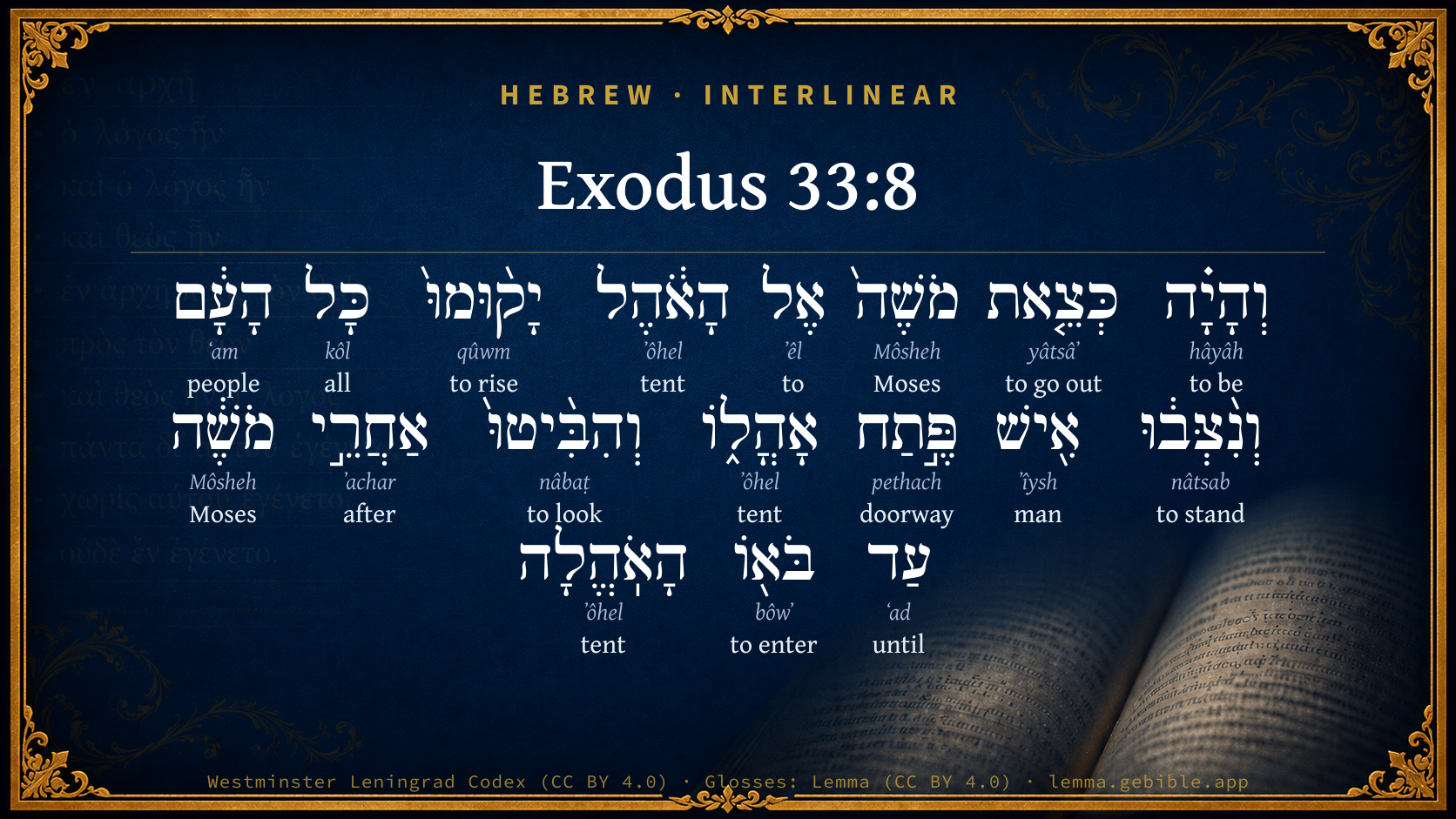
  1. וְהָיָ֗ה hâyâh H1961 “and · to be” Conjunction + Verb, Qal, Sequential Perfect, 3rd Person, Masculine, Singular
  2. כְּצֵ֤את yâtsâʼ H3318 “like/as · to go out” Preposition + Verb, Qal, Infinitive Construct
  3. מֹשֶׁה֙ Môsheh H4872 “Moses” Noun, Proper
  4. אֶל ʼêl H413 “to” Preposition
  5. הָאֹ֔הֶל ʼôhel H168 “the · tent” Particle, Definite Article + Noun, Common, Masculine, Singular, Absolute
  6. יָק֨וּמוּ֙ qûwm H6965 “to rise” Verb, Qal, Imperfect, 3rd Person, Masculine, Plural
  7. כָּל kôl H3605 “all of” Noun, Common, Masculine, Singular, Construct
  8. הָעָ֔ם ʻam H5971 “the · people” Particle, Definite Article + Noun, Common, Masculine, Singular, Absolute
  9. וְנִ֨צְּב֔וּ nâtsab H5324 “and · to stand” Conjunction + Verb, Niphal, Sequential Perfect, 3rd Person, Common, Plural
  10. אִ֖ישׁ ʼîysh H376 “man” Noun, Common, Masculine, Singular, Absolute
  11. פֶּ֣תַח pethach H6607 “doorway of” Noun, Common, Masculine, Singular, Construct
  12. אָהֳל֑וֹ ʼôhel H168 “tent · his” Noun, Common, Masculine, Singular, Construct + Suffix, Personal, 3rd Person, Masculine, Singular
  13. אַחֲרֵ֣י ʼachar H310 “after” Preposition
  14. מֹשֶׁ֔ה Môsheh H4872 “Moses” Noun, Proper
  15. עַד ʻad H5704 “until” Preposition
  16. בֹּא֖וֹ bôwʼ H935 “to enter · him” Verb, Qal, Infinitive Construct + Suffix, Personal, 3rd Person, Masculine, Singular
  17. הָאֹֽהֱלָה ʼôhel H168 “the · tent · toward” Particle, Definite Article + Noun, Common, Masculine, Singular, Absolute + Suffix, Demonstrative

About this verse

These counts appear in no published source. They are computed here, from the morphology-tagged text and Lemma’s own curated glosses. What Lemma adds →

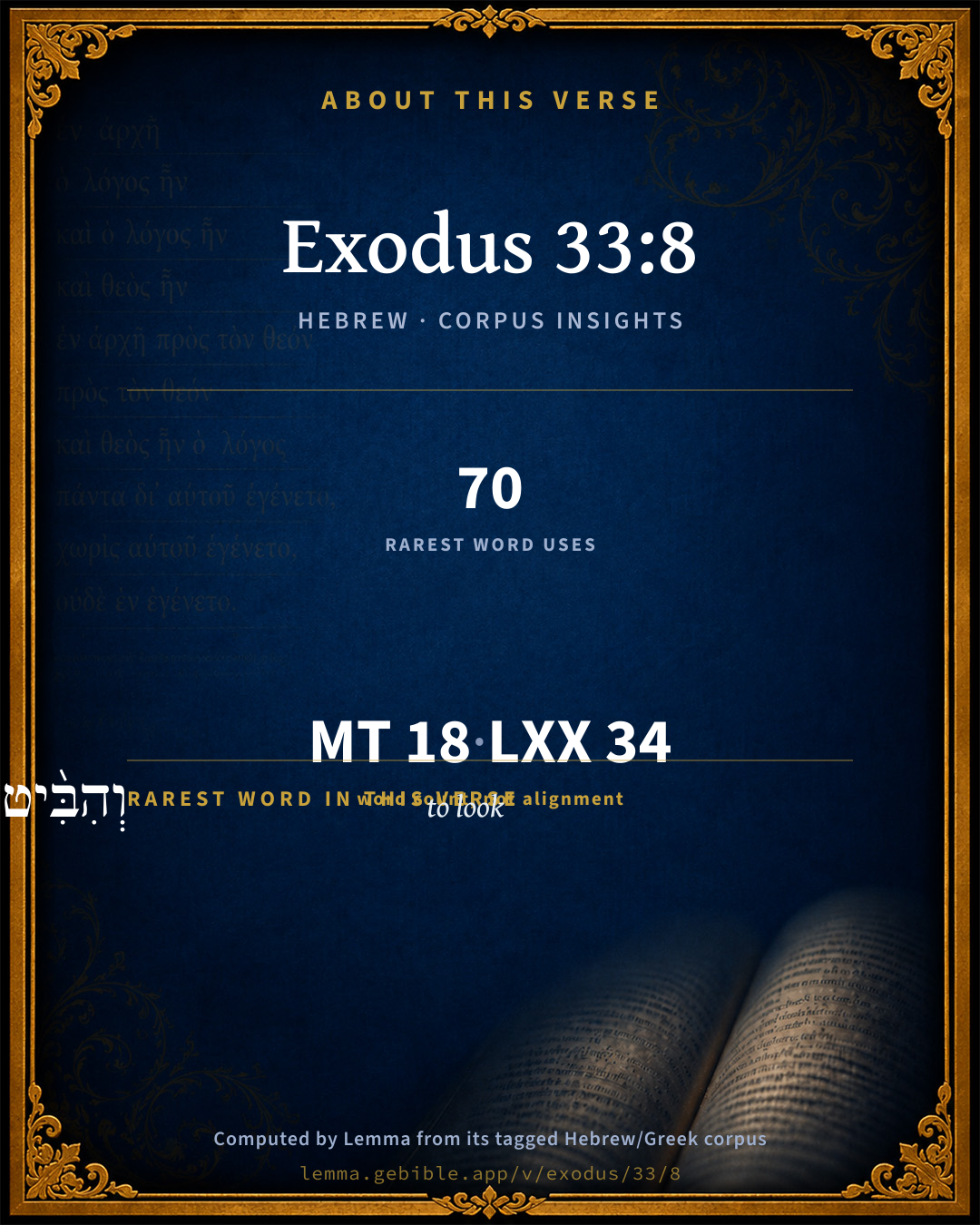
18
words
15
distinct lemmas
Pentateuch
section

Grammatical profile

  • 6 verbs
  • 9 nouns
  • 3 prepositions

Verb forms

  • וְהָיָ֗ה Qal · Sequential Perfect
  • כְּצֵ֤את Qal · Infinitive Construct
  • יָק֨וּמוּ֙ Qal · Imperfect
  • וְנִ֨צְּב֔וּ Niphal · Sequential Perfect
  • וְהִבִּ֨יטוּ֙ Hiphil · Sequential Perfect
  • בֹּא֖וֹ Qal · Infinitive Construct

Repetition

Words recur within this verse — often emphatic in Hebrew:

  • הָאֹ֔הֶל tent H168 ×3
  • מֹשֶׁה֙ Moses H4872 ×2

Hebrew & Septuagint length

In English translation the verse runs 33 words from the Hebrew and 36 from the Septuagint (LXX English) — closely comparable.

A rough comparison of the two English renderings, which tokenize alike — not a word-level alignment.

Word counts can differ between the Hebrew and the Greek without any difference in meaning — e.g. the Hebrew direct-object marker אֵת has no separate Greek word, and Greek often adds the article ὁ.

In the original languages it is 18 Hebrew tokens and 34 Greek tokens — but the two are counted differently (Hebrew bundles its prefixes and suffixes into one token; the Greek is in lemma form), so that isn’t a like-for-like length.

Cross-references

1

Topical passages linked to Exodus 33:8 in the Treasury of Scripture Knowledge — connected by theme and wording, ordered by reader-vote popularity; previews shown in the World English Bible.

  • Numbers 16:27 So they got them up from the tent of Korah, Dathan, and Abiram, on every side: and Dathan and Abiram came out, and stood at the door of their tents, and their wives, and their sons, and their little ones.

Cross-references courtesy of OpenBible.info (CC BY 4.0).

Hebrew and Greek witnesses Masoretic Hebrew ↔ Greek Septuagint

The same verse in the two great witnesses to the Old Testament, shown verse-for-verse.

These are two independent witnesses, not word-aligned to each other, and the Septuagint is shown in lemma (dictionary) form.

Hebrew Exodus 33:8 Masoretic · Westminster Leningrad Codex

וְהָיָ֗ה כְּצֵ֤את מֹשֶׁה֙ אֶל הָאֹ֔הֶל יָק֨וּמוּ֙ כָּל הָעָ֔ם וְנִ֨צְּב֔וּ אִ֖ישׁ פֶּ֣תַח אָהֳל֑וֹ וְהִבִּ֨יטוּ֙ אַחֲרֵ֣י מֹשֶׁ֔ה עַד בֹּא֖וֹ הָאֹֽהֱלָה

It happened that when Moses went out to the Tent, that all the people rose up, and stood, everyone at their tent door, and watched Moses, until he had gone into the Tent.

World English Bible · Public Domain

Greek LXX Exodus 33:8 Septuagint · lemma form

ἡνίκα δέ ἄν εἰςπορεύομαι μωυσῆς εἰς ὁ σκηνή ἔξω ὁ παρεμβολή ἵστημι πᾶς ὁ λαός σκοπεύω ἕκαστος παρά ὁ θύρα ὁ σκηνή αὐτός καί κατανοέω ἀποεἶμι μωυσῆς ἕως ὁ εἰςἔρχομαι αὐτός εἰς ὁ σκηνή

And whenever Moses went into the tabernacle without the camp, all the people stood every one watching by the doors of his tent; and when Moses departed, they took notice until he entered into the tabernacle.

LXX2012 (modern English Septuagint) · Public Domain

Hebrew: Westminster Leningrad Codex (CC BY 4.0). Greek: Septuagint (public domain); English from LXX2012 (modern English Septuagint) (Public Domain). How the Septuagint differs from the Hebrew →

Targum (Aramaic paraphrase)

2

The Targum is the ancient Jewish Aramaic paraphrase of the Hebrew Scriptures — an interpretive translation, not the Hebrew text itself. Onkelos (literal) and Pseudo-Jonathan (expansive) render the Torah, and Jonathan the Prophets. Coverage is partial: where no permissively-licensed English translation exists for a verse, only the Aramaic is shown. This is verse-level text, not a word-by-word alignment to the Hebrew.

  1. Targum Onkelos Torah (Genesis–Deuteronomy)
    וַהֲוָה כַּד נְפַק משֶׁה לְמַשְׁכְּנָא קַיְמִין כָּל עַמָא וּמִתְעַתְּדִין גְבַר בִּתְרַע מַשְׁכְּנֵהּ וּמִסְתַּכְּלִין אֲחוֹרֵי משֶׁה עַד דְעָלֵל לְמַשְׁכְּנָא:

    (no public-domain English translation for this verse)

    Targum Onkelos — Aramaic: “Onkelos Genesis” (public domain); “Onkelos Exodus” (public domain); “Onkelos Leviticus” (public domain); “Onkelos Numbers” (public domain); “Onkelos Deuteronomy” (public domain). English: “Sefaria Community Translation” (CC0 1.0 (public-domain dedication)); “J.W. Etheridge. The Targums of Onkelos and Jonathan Ben Uzziel on the Pentateuch. London: Longmans, Green, 1862” (public domain). Text via Sefaria.

  2. Targum Pseudo-Jonathan Torah (Genesis–Deuteronomy)
    וַהֲוָה כַּד הֲוָה נָפִיק משֶׁה מִן מַשְׁרִיתָא וְאָזֵיל לְמַשְׁכְּנָא קַיְימִין כָּל רַשִׁיעֵי עַמָּא וּמִתְעַתְּדִין גְּבַר בִּתְרַע מַשְׁכְּנֵיהּ וּמִסְתַּכְּלִין בְּעֵינָא בִּישָׁא אֲחוּרֵי משֶׁה עַד זְמַן מֵיעֲלֵיהּ לְמַשְׁכְּנָא

    And it was when Mosheh passed forth from the camp to go to the tabernacle that all the wicked people arose, and stood, every man at the door of his tent, and looked with the evil eye after Mosheh, when he entered the tabernacle.

    Targum Pseudo-Jonathan — Aramaic: “Targum Jonathan on Genesis” (public domain); “Targum Jonathan on Exodus” (public domain); “Targum Jonathan on Leviticus” (public domain); “Targum Jonathan on Numbers” (public domain); “Targum Jonathan on Deuteronomy” (public domain). English: “The Targum of Jonathan ben Uzziel, trans. J. W. Etheridge, London, 1862” (public domain). Text via Sefaria.

Commentary

Notes on Exodus 33:8 from classic Christian and Jewish commentators (each source and its license shown beneath its notes). The classic Christian expositions comment on the surrounding passage and are grouped to its opening verse, so a note may address several verses; the Jewish commentaries on the Tanakh (Rashi and others) are per-verse, so they appear only where the commentator wrote on this verse.

Lemma curates 59 commentaries, every one of them public domain or Creative Commons licensed, each selected and text-cleaned for this edition rather than reprinted as found. About our sources →

Trapp's Complete Commentary

John Trapp

Exo 33:8 And it came to pass, when Moses went out unto the tabernacle, [that] all the people rose up, and stood every man [at] his tent door, and looked after Moses, until he was gone into the tabernacle.

Ver. 8. And looked after Moses.] To see what success, what acceptance: as David looked up after his prayer to see how it sped. {Psa 5:3}

John Trapp, A Commentary or Exposition upon All the Books of the Old and New Testament (1647–1656) — public domain. Text from a community e-Sword module.

Joseph Benson's Commentary

Exo 33:8. When Moses went out unto the tabernacle — Namely, to intercede with God for the people, all the people stood every man at his tent door — Acknowledging themselves unworthy to approach nearer; and looked after Moses — To observe what signs of favour he should receive from God in answer to his prayers. Hereby, also, they showed their grief for God’s departure, their respect to Moses, whom they had lately slighted, their dependance on his mediation, and concern about the issue of it.

Joseph Benson's Commentary on the Old and New Testaments (1811–1818) — public domain. Text from a community e-Sword module.

Tyndale Open Study Notes

Tyndale Open Resources

33:8-11 get up and stand . . . stand and bow down: The people were awed by the thought that Moses was talking directly to God, face to face (33:11).

Tyndale Open Study Notes — © Tyndale Open Resources, licensed CC BY-SA 4.0. Text via the HelloAO Bible API.

Jamieson, Fausset & Brown

Robert Jamieson, A. R. Fausset & David Brown

all the people rose up, and stood every man at his tent door--Its removal produced deep and universal consternation; and it is easy to conceive how anxiously all eyes would be directed towards it; how rapidly the happy intelligence would spread, when a phenomenon was witnessed from which an encouraging hope could be founded.

Jamieson, Fausset & Brown — Commentary Critical and Explanatory on the Whole Bible (1871) — public domain (CC PDM 1.0). Text via the HelloAO Bible API.

Ellicott's Commentary for English Readers

(8) When Moses went out . . . all the people rose up.—As a mark of respect and reverence. (Comp. Est_5:9.)

The cloudy pillar descended.—During the stay of the Israelites in the plain at the foot of Sinai, the ordinary place occupied by the pillar of the cloud was the summit of the mount (Exo_19:16; Exo_19:20; Exo_20:21; Exo_24:15-18; Exo_34:5). At this time, whenever Moses entered the temporary tabernacle, the cloud came down from Sinai, ascending again when he quitted it.

And the Lord talked with Moses.—Heb., and talked with Moses. The “cloudy pillar” is the subject of the verb “talked.” It is here identified with God, who manifested Himself through it.

A Bible Commentary for English Readers, edited by Charles John Ellicott (1878–1897) — public domain. Text from a community e-Sword module.

The Cambridge Bible for Schools and Colleges

gen. ed. J. J. S. Perowne

8. Whenever Moses went out to the Tent, all the people would rise up, and follow him reverently with their eyes. The camp seems to be pictured on a much smaller scale by E than by P.

door] lit. opening: so vv. 9, 10, and regularly with ‘tent.’

The Cambridge Bible for Schools and Colleges (gen. ed. J. J. S. Perowne; Cambridge University Press, 1878–1918) — public domain. Text from a community e-Sword module.

John Gill's Exposition

And it came to pass, when Moses went out of the tabernacle,.... For when he had pitched it he did not continue there; which shows it was not the tent or tabernacle he dwelt in, but whither he went to and fro, both to meet the Lord in it, and transact the affairs of the people, and especially the great affair now depending between God and them:

that all the people rose up: in reverence of him as their ruler, and the minister of God, and as their Mediator between God and them, though they had but lately thought and spoke very meanly and contemptibly of him, Exo 32:1 see Job 29:8.

and stood every man at his tent door; none offering to go in, nor to sit down until he was gone into the tabernacle, which was an instance of their respect to him:

and looked after Moses until he was gone into the tabernacle; kept their eye on him as long as they could see him, thereby expressing their esteem of him, signifying their desire that he would intercede for them, and wishing him success therein: the Targum of Jonathan interprets all this of the ungodly among them that looked after Moses with an evil eye.

John Gill's Exposition of the Whole Bible (1746–1763) — public domain (CC PDM 1.0). Text via the HelloAO Bible API.

Haydock's Catholic Bible Commentary

Rose up, out of respect to their prince, who was not their mediator also. (Haydock)

George Leo Haydock (1774–1849), Haydock's Catholic Family Bible and Commentary, 1859 edition — public domain. Excludes Psalms (Douay-Rheims chapter numbering differs from Protestant) and Deuterocanonical books (Catholic canon only).

Matthew Poole's English Annotations

Testifying their grief for God’s departure, their respect to Moses, whom they had lately despised, their earnest desire of his intercession for them, their longing for God’s favour, and their humble expectation of a gracious return from God by the hands of Moses.

Matthew Poole's English Annotations on the Holy Bible (1683–1685) — public domain. Text from a community e-Sword/MySword module.

Whedon's Commentary on the Bible

Daniel D. Whedon

8-11. These verses show that this tent served a special purpose in the Sinaitic revelation of Jehovah. Into it Moses entered to plead and to receive divine communications, and there Jehovah spake unto Moses face to face, as a man speaketh unto his friend. The cloudy pillar was a medium of communication, for according to the most correct translation of Exo_33:9 it was the pillar that descended and stood at the door of the tabernacle, and… talked with Moses. Jehovah spoke through, or out of, the cloud. The speaking with Moses face to face did not involve a sight of God’s face, for he explains in Exo_33:20 that no man could see his face and live. So he communed with him from the cloud which veiled his glory. All the people were permitted to behold the cloudy pillar in the distance, but only Moses and Joshua entered the tent, and it is said that when Moses returned to camp Joshua tarried behind and departed not out of the tabernacle. The tent was not to be left altogether alone, and so it would seem that Moses’s servant stayed as on guard.

Daniel D. Whedon (gen. ed.), Commentary on the Old and New Testaments (1874–1909) — public domain. Text from a community e-Sword module.

The Pulpit Commentary

When Moses went out .... all the people rose up. Probably Moses "went out" at a set time, or at set times, each day; and the people watched for his going, and "rose up," as a mark of respect and reverence. They felt that he went to the tent mainly to pray for them.

The Pulpit Commentary (1880–1919), ed. H.D.M. Spence-Jones & Joseph S. Exell — public domain. Text from a community e-Sword module.

John Wesley's Explanatory Notes

And when Moses went out to the tabernacle, the people looked after him - In token of their respect to him whom before they had slighted, and their dependence upon his mediation. By this it appeared, that they were full of concern what would be the issue.

John Wesley, Explanatory Notes Upon the Whole Bible (1754–1765) — public domain. Text via the GEBible commentary corpus.

Rashi

Rabbi Shlomo Yitzchaki (Rashi)

והיה — This expresses an action continually going on (“and it used to be”),

כצאת משה WHEN MOSES WENT OUT from the camp in order to go אל האהל INTO THE TENT, יקומו כל העם ALL THE PEOPLE ROSE UP — they used to stand up before him and did not sit down until he vanished from their sight (Hebrew: was hidden from them).

והביטו אחרי משה AND THEY LOOKED AFTER MOSES — Not sneeringly but out of admiration; they exclaimed: Happy is the human being (Hebrew: one born of woman) who is so sure that the Shechina will enter the door of his tent after him (cf. Kiddushin 33b; Midrash Tanchuma, Ki Tisa 27, Exodus Rabbah 51:6).

Rashi on the Tanakh — English translations: “The Judaica Press complete Tanach with Rashi, translated by A. J. Rosenberg” (CC BY 4.0); “Pentateuch with Rashi's commentary by M. Rosenbaum and A.M. Silbermann, 1929-1934” (public domain); “The Metsudah Tanach series, Lakewood, N.J” (CC BY 4.0); and “The Book of Joshua, Metsudah Publications, 1997” (CC BY 4.0). Text via Sefaria.

Lesson kit

Teaching starters — assembled from the data on this page, not authored interpretation. Every prompt links to the verse data it draws on. Edit before teaching.

Exodus, in the Pentateuch, opens this verse with 18 words (15 distinct Hebrew lemmas). Its most distinctive word is nâbaṭ (“to look”). A historical commentator’s framing appears above. Read the whole chapter for the surrounding context.

Discussion questions

  1. The word nâbaṭ carries the sense “to look.” How does it shape the verse?
  2. Numbers 16:27 shares this passage’s theme. How do the two illuminate each other?
  3. “tent” occurs 3× in this one verse. What is the effect of the repetition?
  4. The translations on this page render this verse differently — a whole-verse word diff, not a word-by-word alignment. What might account for the different wordings?
  5. The verb «וְהָיָ֗ה» is Qal Sequential Perfect. How does its form color the action?
  6. Reading how Trapp's Complete Commentary and Joseph Benson's Commentary read this verse, where do the two commentators agree and where do they part?

Things to notice

Reading settings

Reading text

Shown beneath each verse's original-language words.

Old Testament
Old Testament edition

Read the OT as the Masoretic Hebrew (MT) or the Greek Septuagint (LXX).

English shown for the Greek Septuagint (in the Hebrew ↔ Greek comparison).

Comparing translations? Open the Compare panel on any verse page to stack up to four side by side.