
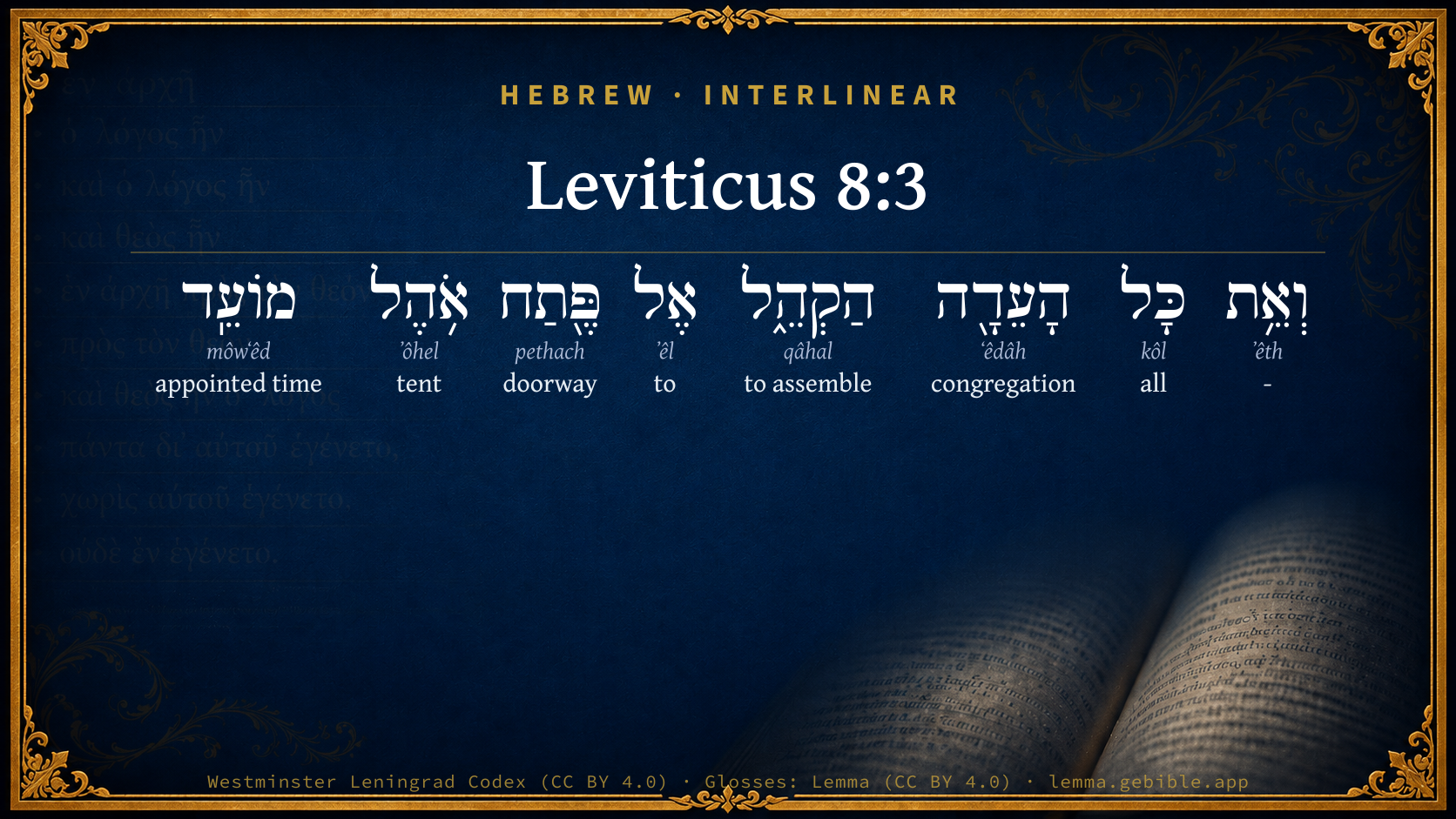
Leviticus 8:3

Hebrew (Westminster Leningrad Codex) Leviticus 8:3 appears in the Hebrew Old Testament. The text above is from the Westminster Leningrad Codex. Each word links to its Strong’s number, a concise gloss, and parsing drawn from the Open Scriptures Hebrew Bible morphology. Click any word for its full Brown-Driver-Briggs (BDB) entry.
Download image
Cite this verse

Leviticus 8:3 (World English Bible). Public Domain. Lemma interlinear Bible study tool, https://lemma.gebible.app/v/leviticus/8/3.

Show BibTeX & RIS
BibTeX
RIS
English Translation
and assemble all the congregation at the door of the Tent of Meeting."
World English Bible · Public Domain
Download a study sheet

One document with this verse’s original text, its word-by-word gloss line, the meaning frame, cross-references with their text, attributed commentary, and full source and license credits — printable, and it pastes into notes with its structure intact.

This verse Autodidact and up

Study sheet (.html) Plain text (.txt)

A passage Seminary Student

Up to 50 verses in one chapter. A passage sheet keeps up to 6 commentary sources and 12 cross-references per verse, in the order this page ranks them, and says so on the sheet whenever that leaves anything out. Ask for a single verse and you get the Autodidact verse sheet above.

Everything on this page stays free to read, with no account — the sheet is a download of what is already on screen, not access to it.

Want to remove ads? Support Godless Engineer
Compare translations 3

The same verse in 3 English versions, stacked beneath the original-language interlinear above. Click any original word for its lexicon entry.

Each is an independent rendering of the whole verse — the interlinear is not word-aligned to these translations.

Highlighted words mark where these versions differ — a whole-verse word diff, not a word-by-word alignment.

  • World English Bible Public Domain
    and assemble all the congregation at the door of the Tent of Meeting."
  • King James Version Public Domain
    And gather thou all the congregation together unto the door of the tabernacle of the congregation.
  • unfoldingWord Literal Text CC BY-SA 4.0
    And assemble the whole congregation at the entrance of the tent of meeting.”

unfoldingWord Literal Text — © unfoldingWord, licensed CC BY-SA 4.0. Word-aligned USFM3 via Door43 (git.door43.org/unfoldingWord/en_ult).

Versions to compare (up to 4)

3 of 4 selected

Show all 18 translations

Every available English version of this verse, each an independent rendering of the whole verse.

  • World English Bible Public Domain
    and assemble all the congregation at the door of the Tent of Meeting."
  • Berean Standard Bible Public Domain
    and assemble the whole congregation at the entrance to the Tent of Meeting.”
  • Majority Standard Bible Public Domain
    and assemble the whole congregation at the entrance to the Tent of Meeting.”
  • King James Version Public Domain
    And gather thou all the congregation together unto the door of the tabernacle of the congregation.
  • American Standard Version (1901) Public Domain
    and assemble thou all the congregation at the door of the tent of meeting.
  • Revised Version (1885) Public Domain
    and assemble thou all the congregation at the door of the tent of meeting.
  • Geneva Bible (1599) Public Domain
    And assemble all the company at the doore of the Tabernacle of the Congregation.
  • Douay-Rheims (1899) Public Domain
    And thou shalt gather together all the congregation to the door of the tabernacle.
  • Young's Literal Translation Public Domain
    and all the company assemble thou unto the opening of the tent of meeting.'
  • Literal Standard Version CC BY-SA 4.0
    and assemble all the congregation to the opening of the Tent of Meeting.”
  • Unlocked Literal Bible CC BY-SA 4.0
    Assemble all the assembly at the entrance to the tent of meeting.”
  • unfoldingWord Literal Text CC BY-SA 4.0
    And assemble the whole congregation at the entrance of the tent of meeting.”
  • Darby Bible Public Domain
    and gather all the assembly together at the entrance of the tent of meeting.
  • World Messianic Bible Public Domain
    and assemble all the congregation at the door of the Tent of Meeting.”
  • Webster's Bible Public Domain
    And assemble thou all the congregation to the door of the tabernacle of the congregation.
  • Free Bible Version CC BY-SA 4.0
    and have everyone assemble at the entrance to the Tent of Meeting.”
  • Bible in Basic English Public Domain
    And let all the people come together at the door of the Tent of meeting.
  • JPS Tanakh (1917) Public Domain
    and assemble thou all the congregation at the door of the tent of meeting.'

Literal Standard Version (2020), Covenant Press — licensed CC BY-SA 4.0. Text via the HelloAO Bible API (eBible.org). Unlocked Literal Bible (unfoldingWord) — licensed CC BY-SA 4.0. Text via the HelloAO Bible API (eBible.org). unfoldingWord Literal Text — © unfoldingWord, licensed CC BY-SA 4.0. Word-aligned USFM3 via Door43 (git.door43.org/unfoldingWord/en_ult). Free Bible Version, Dr. Jonathan Gallagher — licensed CC BY-SA 4.0. Text via the HelloAO Bible API (eBible.org).

Word by word

More ways to search: Search by grammar → Find every occurrence → Compare this word →

Practice this passage: Drill this verse → Learn its vocabulary →

About this verse

These counts appear in no published source. They are computed here, from the morphology-tagged text and Lemma’s own curated glosses. What Lemma adds →

8
words
8
distinct lemmas
Pentateuch
section

Shared distinctive vocabulary

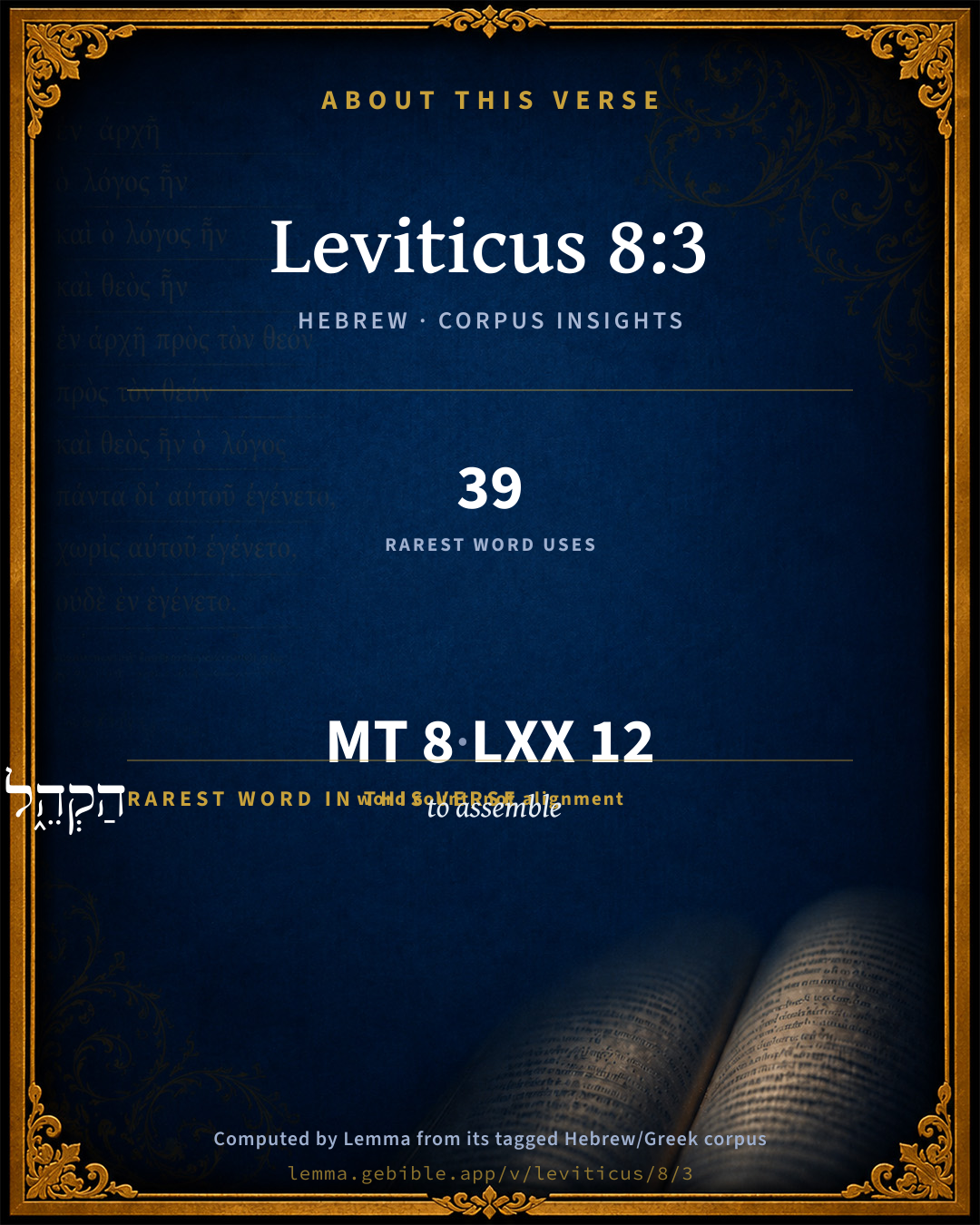
הַקְהֵ֑ל to assemble H6950 occurs in 39 verses of the Hebrew Bible. Also found in:

Grammatical profile

  • 1 verb
  • 5 nouns
  • 1 preposition
  • 1 particle

Verb forms

  • הַקְהֵ֑ל Hiphil · Imperative

Hebrew & Septuagint length

In English translation the verse runs 13 words from the Hebrew and 13 from the Septuagint (LXX English) — the same length.

A rough comparison of the two English renderings, which tokenize alike — not a word-level alignment.

Word counts can differ between the Hebrew and the Greek without any difference in meaning — e.g. the Hebrew direct-object marker אֵת has no separate Greek word, and Greek often adds the article ὁ.

In the original languages it is 8 Hebrew tokens and 12 Greek tokens — but the two are counted differently (Hebrew bundles its prefixes and suffixes into one token; the Greek is in lemma form), so that isn’t a like-for-like length.

Cross-references

12

Topical passages linked to Leviticus 8:3 in the Treasury of Scripture Knowledge — connected by theme and wording, ordered by reader-vote popularity; previews shown in the World English Bible.

  • 2 Chronicles 30:13 There assembled at Jerusalem much people to keep the feast of unleavened bread in the second month, a very great assembly.
  • Acts 2:1 Now when the day of Pentecost had come, they were all with one accord in one place.
  • Numbers 20:8 Take the rod, and assemble the congregation, you, and Aaron your brother, and speak you to the rock before their eyes, that it give forth its water; and you shall bring forth to them water out of the rock; so you shall give the congregation and their cattle drink.
  • Numbers 21:16 From there they traveled to Beer: that is the well of which Yahweh said to Moses, Gather the people together, and I will give them water.
  • 1 Chronicles 13:5 So David assembled all Israel together, from the Shihor [the brook] of Egypt even to the entrance of Hamath, to bring the ark of God from Kiriath Jearim.
  • 1 Chronicles 15:3 David assembled all Israel at Jerusalem, to bring up the ark of Yahweh to its place, which he had prepared for it.
  • 2 Chronicles 5:2 Then Solomon assembled the elders of Israel, and all the heads of the tribes, the princes of the fathers' [houses] of the children of Israel, to Jerusalem, to bring up the ark of the covenant of Yahweh out of the city of David, which is Zion.
  • 2 Chronicles 5:6 King Solomon and all the congregation of Israel, that were assembled to him, were before the ark, sacrificing sheep and oxen, that could not be counted nor numbered for multitude.
  • 2 Chronicles 30:2 For the king had taken counsel, and his princes, and all the assembly in Jerusalem, to keep the Passover in the second month.
  • 2 Chronicles 30:25 All the assembly of Judah, with the priests and the Levites, and all the assembly who came out of Israel, and the foreigners who came out of the land of Israel, and who lived in Judah, rejoiced.
  • Nehemiah 8:1 All the people gathered themselves together as one man into the broad place that was before the water gate; and they spoke to Ezra the scribe to bring the book of the law of Moses, which Yahweh had commanded to Israel.
  • Psalms 22:25 Of you comes my praise in the great assembly. I will pay my vows before those who fear him.

Cross-references courtesy of OpenBible.info (CC BY 4.0).

Hebrew and Greek witnesses Masoretic Hebrew ↔ Greek Septuagint

The same verse in the two great witnesses to the Old Testament, shown verse-for-verse.

These are two independent witnesses, not word-aligned to each other, and the Septuagint is shown in lemma (dictionary) form.

Hebrew Leviticus 8:3 Masoretic · Westminster Leningrad Codex

וְאֵ֥ת כָּל הָעֵדָ֖ה הַקְהֵ֑ל אֶל פֶּ֖תַח אֹ֥הֶל מוֹעֵֽד

and assemble all the congregation at the door of the Tent of Meeting."

World English Bible · Public Domain

Greek LXX Leviticus 8:3 Septuagint · lemma form

καί πᾶς ὁ συναγωγή ἐκκλησιάζω ἐπί ὁ θύρα ὁ σκηνή ὁ μαρτύριον

and assemble the whole congregation at the door of the tabernacle of witness.

LXX2012 (modern English Septuagint) · Public Domain

Hebrew: Westminster Leningrad Codex (CC BY 4.0). Greek: Septuagint (public domain); English from LXX2012 (modern English Septuagint) (Public Domain). How the Septuagint differs from the Hebrew →

Targum (Aramaic paraphrase)

2

The Targum is the ancient Jewish Aramaic paraphrase of the Hebrew Scriptures — an interpretive translation, not the Hebrew text itself. Onkelos (literal) and Pseudo-Jonathan (expansive) render the Torah, and Jonathan the Prophets. Coverage is partial: where no permissively-licensed English translation exists for a verse, only the Aramaic is shown. This is verse-level text, not a word-by-word alignment to the Hebrew.

  1. Targum Onkelos Torah (Genesis–Deuteronomy)
    וְיָת כָּל כְּנִשְׁתָּא כְּנֵשׁ לִתְרַע מַשְׁכַּן זִמְנָא

    (no public-domain English translation for this verse)

    Targum Onkelos — Aramaic: “Onkelos Genesis” (public domain); “Onkelos Exodus” (public domain); “Onkelos Leviticus” (public domain); “Onkelos Numbers” (public domain); “Onkelos Deuteronomy” (public domain). English: “Sefaria Community Translation” (CC0 1.0 (public-domain dedication)); “J.W. Etheridge. The Targums of Onkelos and Jonathan Ben Uzziel on the Pentateuch. London: Longmans, Green, 1862” (public domain). Text via Sefaria.

  2. Targum Pseudo-Jonathan Torah (Genesis–Deuteronomy)
    וְיַת כָּל כְּנִישְׁתָּא כְּנוֹשׁ לִתְרַע מַשְׁכַּן זִימְנָא

    And let all the congregation gather together at the gate of the tabernacle of ordinance.

    Targum Pseudo-Jonathan — Aramaic: “Targum Jonathan on Genesis” (public domain); “Targum Jonathan on Exodus” (public domain); “Targum Jonathan on Leviticus” (public domain); “Targum Jonathan on Numbers” (public domain); “Targum Jonathan on Deuteronomy” (public domain). English: “The Targum of Jonathan ben Uzziel, trans. J. W. Etheridge, London, 1862” (public domain). Text via Sefaria.

Commentary

Notes on Leviticus 8:3 from classic Christian and Jewish commentators (each source and its license shown beneath its notes). The classic Christian expositions comment on the surrounding passage and are grouped to its opening verse, so a note may address several verses; the Jewish commentaries on the Tanakh (Rashi and others) are per-verse, so they appear only where the commentator wrote on this verse.

Lemma curates 59 commentaries, every one of them public domain or Creative Commons licensed, each selected and text-cleaned for this edition rather than reprinted as found. About our sources →

Trapp's Complete Commentary

John Trapp

Lev 8:3 And gather thou all the congregation together unto the door of the tabernacle of the congregation.

Ver. 3. And gather thou all the congregation.] Ministers are to be ordained in the public assembly, {Act 14:22} that the people may show their approbation, profess their purpose of obedience, and pray for God’s Spirit to be poured upon them.

John Trapp, A Commentary or Exposition upon All the Books of the Old and New Testament (1647–1656) — public domain. Text from a community e-Sword module.

Joseph Benson's Commentary

Lev 8:3. All the congregation — The elders, who represented all, and as many of the people as would and could get thither, that all might be witnesses both of Aaron’s commission from God, and of his work and business.

Joseph Benson's Commentary on the Old and New Testaments (1811–1818) — public domain. Text from a community e-Sword module.

Jamieson, Fausset & Brown

Robert Jamieson, A. R. Fausset & David Brown

gather thou all the congregation together, &c.--It was manifestly expedient for the Israelitish people to be satisfied that Aaron's appointment to the high dignity of the priesthood was not a personal intrusion, nor a family arrangement between him and Moses; and nothing, therefore, could be a more prudent or necessary measure, for impressing a profound conviction of the divine origin and authority of the priestly institution, than to summon a general assembly of the people, and in their presence perform the solemn ceremonies of inauguration, which had been prescribed by divine authority.

Jamieson, Fausset & Brown — Commentary Critical and Explanatory on the Whole Bible (1871) — public domain (CC PDM 1.0). Text via the HelloAO Bible API.

Ellicott's Commentary for English Readers

(3) And gather thou all the congregation together—Better, and gather all the assembly together. The same word is rightly rendered assembly in the Authorised Version in Lev_8:4. (See Lev_4:13.) That is, call together the assembly of the elders, the heads of the tribes, and the principal men who represented the people. This is confirmed by Lev_9:1, where it is distinctly said that “Moses called Aaron and his sous, and the elders of Israel,” and where these elders are called in the following verse “the children of Israel,” by virtue of their representing the children of Israel.

Unto the door of the tabernacle of the congregation.—Better, to the entrance of the tent of meeting, that is, the courtyard of the same.

A Bible Commentary for English Readers, edited by Charles John Ellicott (1878–1897) — public domain. Text from a community e-Sword module.

John Gill's Exposition

And gather thou all the congregation together,.... That is, the heads of the tribes and the elders of the people, as Aben Ezra interprets it; for the whole body of the people, and every individual of them, could not be got together:

unto the door of the tabernacle of the congregation; taking this for the whole court itself, as it sometimes is; though no doubt on this occasion as great a number was convened as well could be admitted into the court, or about it, to be spectators and witnesses of the solemn investiture of Aaron and his sons with the priestly office.

John Gill's Exposition of the Whole Bible (1746–1763) — public domain (CC PDM 1.0). Text via the HelloAO Bible API.

Albert Barnes' Notes on the Bible

Gather ... - Rather, gather all the assembly together toward the entrance of the tent of meeting. See Lev 4:13. The whole body of the people were summoned on this occasion, and the elders probably occupied the first places. The elders are especially called together in an unequivocal manner to receive directions to provide the first sacrifices for the nation to be offered by the newly consecrated priests Lev 9:1, and the body of the people afterward assemble as they do here Lev 9:5. The spot designated was the portion of the court in front of the tabernacle (see Lev 1:3 note). Toward this space the people were commanded to assemble to witness the great national ceremony of the consecration of the priesthood, the solemn setting apart of one of their families, the members of which were henceforth to stand as mediators between them and Yahweh in carrying out the precepts of the ceremonial law. Those who could do so, may have come into the court, and a great number of others may have occupied the heights which overlooked the enclosure of the court. As the series of ceremonies was repeated every day during a week Lev 8:33, it is natural to suppose that some of the people attended on one day and some on another.

Albert Barnes' Notes on the Bible (1834–1885) — public domain. Text from a community e-Sword/MySword module.

Matthew Poole's English Annotations

The elders which represented all, and as many of the people as would and could get thither, that all might be witnesses both of Aaron’s commission from God, and of his work and business.

Matthew Poole's English Annotations on the Holy Bible (1683–1685) — public domain. Text from a community e-Sword/MySword module.

Whedon's Commentary on the Bible

Daniel D. Whedon

3. Gather… all the congregation — The elders representing the people gathered in front of the tabernacle; behind them stood the congregation occupying all the heights around. No ordination of a minister should be in the presence of ministers only, but before the laity, who are deeply interested in the character and qualifications of those who stand before them as God’s representatives.

Daniel D. Whedon (gen. ed.), Commentary on the Old and New Testaments (1874–1909) — public domain. Text from a community e-Sword module.

The Pulpit Commentary

HOMILIES BY W. CLARKSON Vers. 3-5. A time for publicity.

The solemn inauguration of Aaron and his sons into their sacred office was to have the utmost possible publicity. This was

I A DIVINE INSTRUCTION. The Lord said, "Take Aaron... and gather thou all the congregation together," etc. (verses 1-3). "This is the thing which the Lord commanded to be done" (verse 5).

II A PROVISION AGAINST POPULAR JEALOUSY. The scene described in Numbers 16 shows only too well how necessary it was to convey to "all the congregation" the truth that Aaron and his sons were divinely appointed to their office. This the more because of the near relationship between Moses and Aaron.

III A PROVISION FOR POPULAR ESTEEM. It was in the last degree desirable that the people should have an exalted idea of the priesthood, and, more especially, of the high priesthood. Everything which would contribute to this would be of real religious service. It was, therefore, fitting that "all the congregation" should be spectators of the impressive solemnities of the inaugural scene.

IV A HELPFUL INFLUENCE ON THEIR OWN MINDS. It was of equal importance to the Hebrew commonwealth that the priests themselves should cherish a profound sense of the sacred and elevated character of their work. For any irreverence or neglect of theirs was calculated to involve the community in sin and in disaster. (see 1Sa_1:17 Mal_2:8) So solemn and impressive a ceremony as this, in the sight of all the people, would exert a salutary influence on the mind both of father and sons.

In ordinary life, piety and publicity are strangers. Devotion shuts itself in the inner chamber, (Mat_6:6) or climbs up into the fold of the mountain. (Mat_14:23) We nourish our holiest thoughts, and form our best resolves, not in the glare of the public gathering, but in the secret place, when alone with God. Nevertheless, there are occasions when we should not shun publicity; when it is not modesty but weakness to do so. When we avow our attachment to our Saviour, and thus "confess him before men"; (Mat_10:32) still more, when we enter upon any responsible office in connection with his Church (e.g. , the Christian ministry); and yet more, if we are summoned, as Aaron was, to any post of unusual eminence and responsibility, we do well to take the vows of God upon us before "all the congregation." If not "a thing which the Lord commanded to be done," it is

(1) a Divine suggestion; (Act_6:7 Act_13:3 1Ti_6:12)

(2) instructive to the people;

(3) helpful to ourselves.

We need all the influences we can gain from every source to incite us to zealous labour, and to strengthen us against temptation. It is right and wise to avail ourselves of all the help we gain from the remembrance that we have confessed Christ our Lord, and pledged ourselves to do his work before "all the congregation," "before many witnesses. C.

The Pulpit Commentary (1880–1919), ed. H.D.M. Spence-Jones & Joseph S. Exell — public domain. Text from a community e-Sword module.

John Wesley's Explanatory Notes

All the congregation - The elders who represented all, and as many of the people as would, and could get thither, that all might be witnesses both of Aaron's commission from God, and of his work and business.

John Wesley, Explanatory Notes Upon the Whole Bible (1754–1765) — public domain. Text via the GEBible commentary corpus.

Rashi

Rabbi Shlomo Yitzchaki (Rashi)

הקהל אל פתח אהל מועד AND ASSEMBLE THOU [THE WHOLE CONGREGATION), UNTO THE ENTRANCE OF THE TENT OF MEETING — This is one of the instances where the lesser comprised the greater (the small area accommodated the whole congregation) (Leviticus Rabbah 10 9).

Rashi on the Tanakh — English translations: “The Judaica Press complete Tanach with Rashi, translated by A. J. Rosenberg” (CC BY 4.0); “Pentateuch with Rashi's commentary by M. Rosenbaum and A.M. Silbermann, 1929-1934” (public domain); “The Metsudah Tanach series, Lakewood, N.J” (CC BY 4.0); and “The Book of Joshua, Metsudah Publications, 1997” (CC BY 4.0). Text via Sefaria.

Lesson kit

Teaching starters — assembled from the data on this page, not authored interpretation. Every prompt links to the verse data it draws on. Edit before teaching.

Leviticus, in the Pentateuch, opens this verse with 8 words (8 distinct Hebrew lemmas). Its most distinctive word is qâhal (“to assemble”). A historical commentator’s framing appears above. Read the whole chapter for the surrounding context.

Discussion questions

  1. How does “to assemble” (qâhal) shape what this verse is saying?
  2. How does Exodus 32:1, which shares the word «to assemble», read alongside this verse?
  3. The translations on this page render this verse differently — a whole-verse word diff, not a word-by-word alignment. What might account for the different wordings?
  4. «הַקְהֵ֑ל» is a Hiphil Imperative verb. How does that grammatical form shape the action described?
  5. Compare how Trapp's Complete Commentary and Joseph Benson's Commentary read this verse. Where do they agree or differ?

Things to notice

Reading settings

Reading text

Shown beneath each verse's original-language words.

Old Testament
Old Testament edition

Read the OT as the Masoretic Hebrew (MT) or the Greek Septuagint (LXX).

English shown for the Greek Septuagint (in the Hebrew ↔ Greek comparison).

Comparing translations? Open the Compare panel on any verse page to stack up to four side by side.