
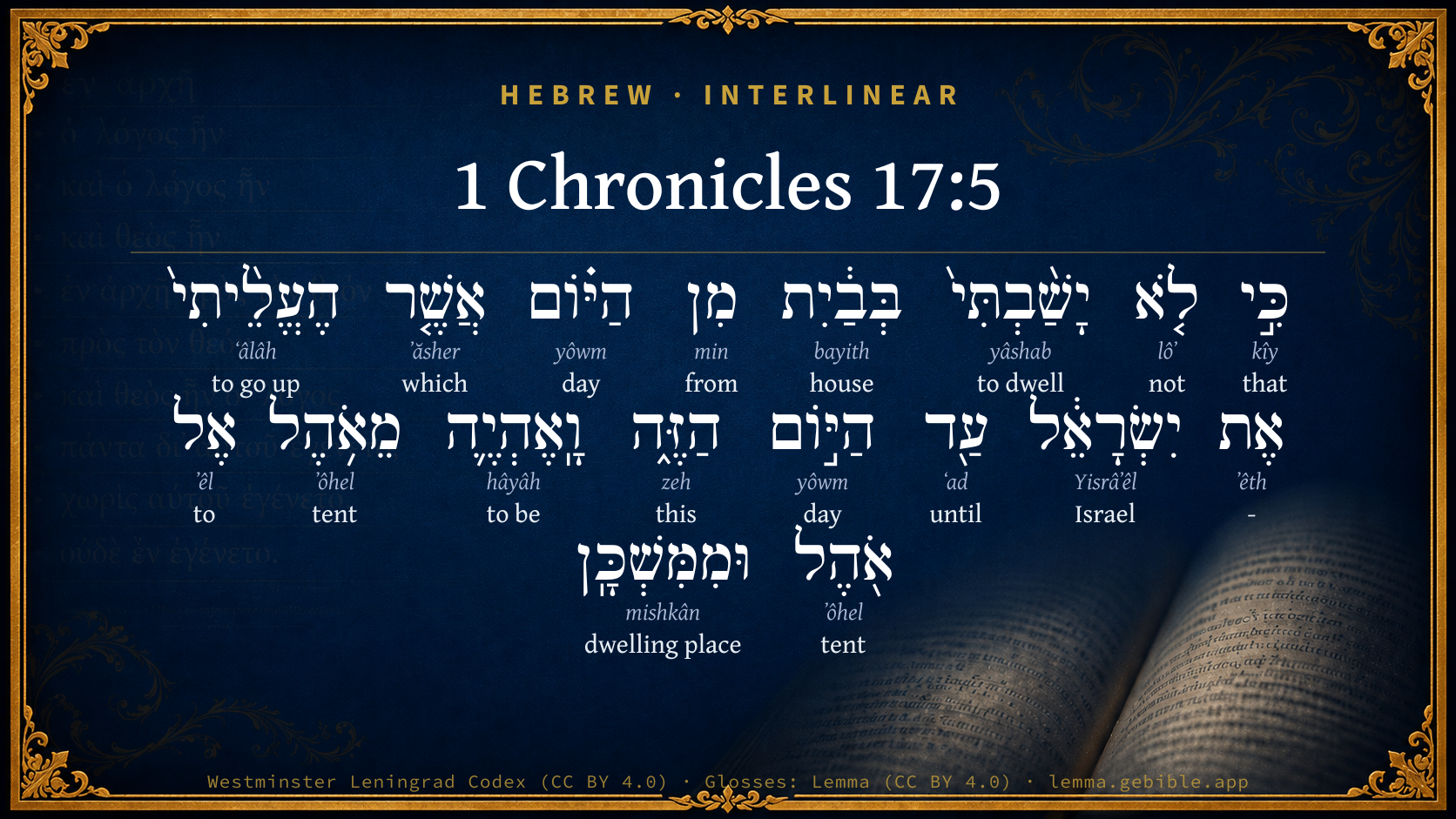
1 Chronicles 17:5

Hebrew (Westminster Leningrad Codex) 1 Chronicles 17:5 appears in the Hebrew Old Testament. The text above is from the Westminster Leningrad Codex. Each word links to its Strong’s number, a concise gloss, and parsing drawn from the Open Scriptures Hebrew Bible morphology. Click any word for its full Brown-Driver-Briggs (BDB) entry.
Download image
Cite this verse

1 Chronicles 17:5 (World English Bible). Public Domain. Lemma interlinear Bible study tool, https://lemma.gebible.app/v/1-chronicles/17/5.

Show BibTeX & RIS
BibTeX
RIS
English Translation
for I have not lived in a house since the day that I brought up Israel, to this day, but have gone from tent to tent, and from [one] tent [to another].
World English Bible · Public Domain
Download a study sheet

One document with this verse’s original text, its word-by-word gloss line, the meaning frame, cross-references with their text, attributed commentary, and full source and license credits — printable, and it pastes into notes with its structure intact.

This verse Autodidact and up

Study sheet (.html) Plain text (.txt)

A passage Seminary Student

Up to 50 verses in one chapter. A passage sheet keeps up to 6 commentary sources and 12 cross-references per verse, in the order this page ranks them, and says so on the sheet whenever that leaves anything out. Ask for a single verse and you get the Autodidact verse sheet above.

Everything on this page stays free to read, with no account — the sheet is a download of what is already on screen, not access to it.

Want to remove ads? Support Godless Engineer
Compare translations 3

The same verse in 3 English versions, stacked beneath the original-language interlinear above. Click any original word for its lexicon entry.

Each is an independent rendering of the whole verse — the interlinear is not word-aligned to these translations.

Highlighted words mark where these versions differ — a whole-verse word diff, not a word-by-word alignment.

  • World English Bible Public Domain
    for I have not lived in a house since the day that I brought up Israel, to this day, but have gone from tent to tent, and from [one] tent [to another].
  • King James Version Public Domain
    For I have not dwelt in an house since the day that I brought up Israel unto this day; but have gone from tent to tent, and from one tabernacle to another.
  • unfoldingWord Literal Text CC BY-SA 4.0
    for I have not dwelled in a house from the day that I brought up Israel until this day, but I have been from tent to tent, and from a tabernacle.

unfoldingWord Literal Text — © unfoldingWord, licensed CC BY-SA 4.0. Word-aligned USFM3 via Door43 (git.door43.org/unfoldingWord/en_ult).

Versions to compare (up to 4)

3 of 4 selected

Show all 18 translations

Every available English version of this verse, each an independent rendering of the whole verse.

  • World English Bible Public Domain
    for I have not lived in a house since the day that I brought up Israel, to this day, but have gone from tent to tent, and from [one] tent [to another].
  • Berean Standard Bible Public Domain
    For I have not dwelt in a house from the day I brought Israel up out of Egypt until this day, but I have moved from tent to tent and dwelling to dwelling.
  • Majority Standard Bible Public Domain
    For I have not dwelt in a house from the day I brought Israel up out of Egypt until this day, but I have moved from tent to tent and dwelling to dwelling.
  • King James Version Public Domain
    For I have not dwelt in an house since the day that I brought up Israel unto this day; but have gone from tent to tent, and from one tabernacle to another.
  • American Standard Version (1901) Public Domain
    for I have not dwelt in a house since the day that I brought up Israel, unto this day, but have gone from tent to tent, and from `one' tabernacle `to another'.
  • Revised Version (1885) Public Domain
    for I have not dwelt in an house since the day that I brought up Israel, unto this day; but have gone from tent to tent, and from one tabernacle to another.
  • Geneva Bible (1599) Public Domain
    For I haue dwelt in no house, since the day that I brought out the childre of Israel vnto this daye, but I haue bene from tent to tent, and from habitation to habitation.
  • Douay-Rheims (1899) Public Domain
    For I have not remained in a house from the time that I brought up Israel, to this day: but I have been always changing places in a tabernacle, and in a tent,
  • Young's Literal Translation Public Domain
    for I have not dwelt in a house from the day that I brought up Israel till this day, and I am from tent unto tent: and from the tabernacle,
  • Literal Standard Version CC BY-SA 4.0
    For I have not dwelt in a house from the day that I brought up Israel until this day, and I am [going] from tent to tent, and from the Dwelling Place.
  • Unlocked Literal Bible CC BY-SA 4.0
    For I have not lived in a house from the day that I brought up Israel to this present day. Instead, I have been living in a tent, a tabernacle, in various places.
  • unfoldingWord Literal Text CC BY-SA 4.0
    for I have not dwelled in a house from the day that I brought up Israel until this day, but I have been from tent to tent, and from a tabernacle.
  • Darby Bible Public Domain
    for I have not dwelt in a house since the day that I brought up Israel to this day; but I have been from tent to tent, and from [one] tabernacle [to another].
  • World Messianic Bible Public Domain
    for I have not lived in a house since the day that I brought up Israel to this day, but have gone from tent to tent, and from one tent to another.
  • Webster's Bible Public Domain
    For I have not dwelt in a house since the day that I brought up Israel to this day; but have gone from tent to tent, and from one tabernacle to another.
  • Free Bible Version CC BY-SA 4.0
    I have not lived in a house from the time I led Israel out of Egypt until now. I have lived in tents, moving from place to place.
  • Bible in Basic English Public Domain
    For from the day when I took Israel up, till this day, I have had no house, but have gone from tent to tent, and from living-place to living-place.
  • JPS Tanakh (1917) Public Domain
    for I have not dwelt in a house since the day that I brought up Israel, unto this day; but have gone from tent to tent, and from one tabernacle to another.

Literal Standard Version (2020), Covenant Press — licensed CC BY-SA 4.0. Text via the HelloAO Bible API (eBible.org). Unlocked Literal Bible (unfoldingWord) — licensed CC BY-SA 4.0. Text via the HelloAO Bible API (eBible.org). unfoldingWord Literal Text — © unfoldingWord, licensed CC BY-SA 4.0. Word-aligned USFM3 via Door43 (git.door43.org/unfoldingWord/en_ult). Free Bible Version, Dr. Jonathan Gallagher — licensed CC BY-SA 4.0. Text via the HelloAO Bible API (eBible.org).

Word by word

More ways to search: Search by grammar → Find every occurrence → Compare this word →

Practice this passage: Drill this verse → Learn its vocabulary →

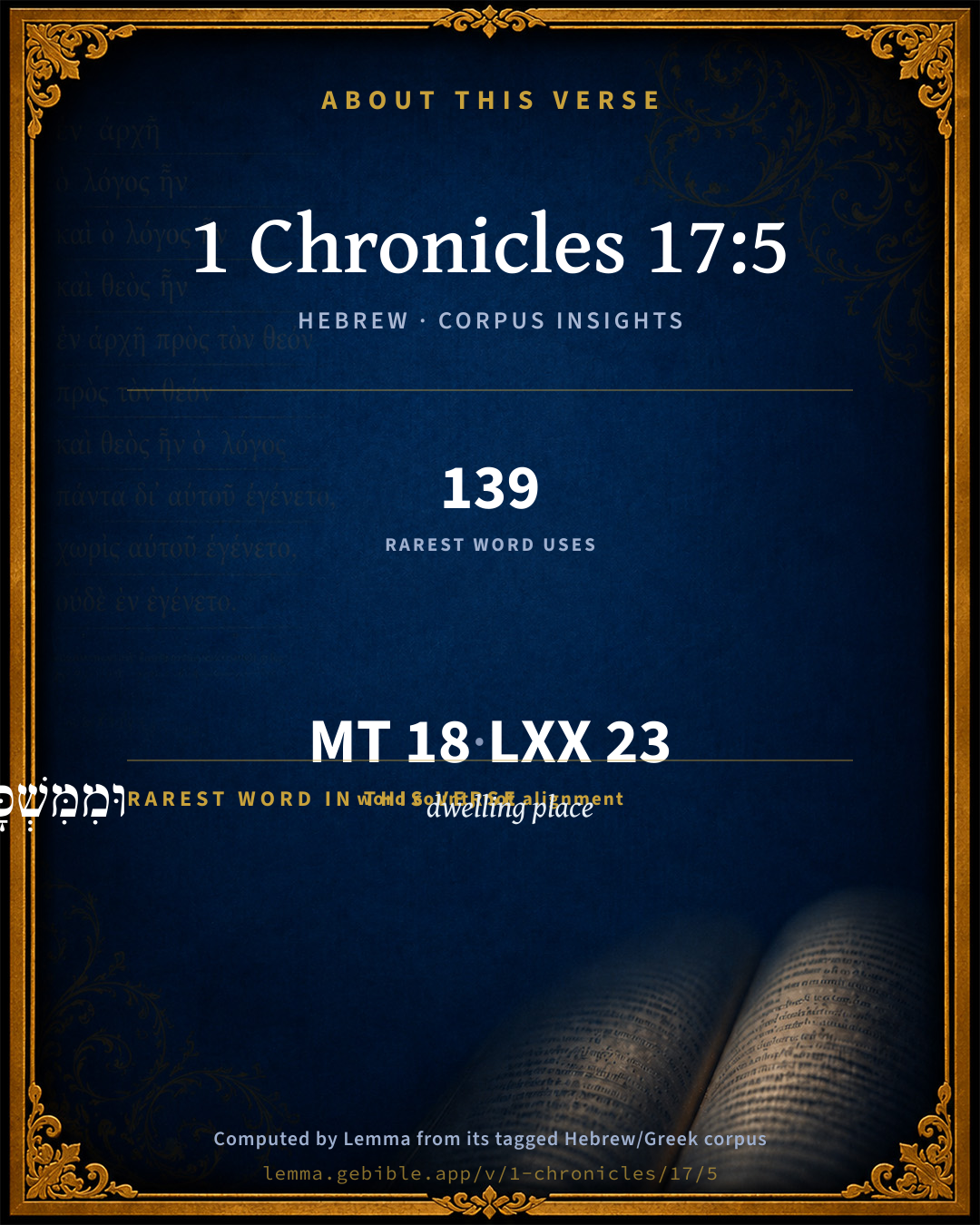
וּמִמִּשְׁכָּֽן
mishkân
H4908
“and · from · dwelling place”
Conjunction + Preposition + Noun, Common, Masculine, Singular, Absolute
Part of Speech
Conjunction + Preposition + Noun
Type
Common
Gender
Masculine
Number
Singular
State
Absolute
Full BDB Definition

Origin: from H7931

TWOT: 2387c

dwelling place, tabernacle - dwelling-place - dwellings
  1. כִּ֣י kîy H3588 “that” Conjunction
  2. לֹ֤א lôʼ H3808 “not” Particle, Negative
  3. יָשַׁ֨בְתִּי֙ yâshab H3427 “to dwell” Verb, Qal, Perfect, 1st Person, Common, Singular
  4. בְּבַ֔יִת bayith H1004 “in/at · house” Preposition + Noun, Common, Masculine, Singular, Absolute
  5. מִן min H4480 “from” Preposition
  6. הַיּ֗וֹם yôwm H3117 “the · day” Particle, Definite Article + Noun, Common, Masculine, Singular, Absolute
  7. אֲשֶׁ֤ר ʼăsher H834 “which” Particle, Relative
  8. הֶעֱלֵ֨יתִי֙ ʻâlâh H5927 “to go up” Verb, Hiphil, Perfect, 1st Person, Common, Singular
  9. אֶת ʼêth H853 “-” Particle, Direct Object
  10. יִשְׂרָאֵ֔ל Yisrâʼêl H3478 “Israel” Noun, Proper
  11. עַ֖ד ʻad H5704 “until” Preposition
  12. הַיּ֣וֹם yôwm H3117 “the · day” Particle, Definite Article + Noun, Common, Masculine, Singular, Absolute
  13. הַזֶּ֑ה zeh H2088 “the · this” Particle, Definite Article + Pronoun, Demonstrative, Masculine, Singular
  14. וָֽאֶהְיֶ֛ה hâyâh H1961 “and · to be” Conjunction + Verb, Qal, Sequential Imperfect, 1st Person, Common, Singular
  15. מֵאֹ֥הֶל ʼôhel H168 “from · tent” Preposition + Noun, Common, Masculine, Singular, Absolute
  16. אֶל ʼêl H413 “to” Preposition
  17. אֹ֖הֶל ʼôhel H168 “tent” Noun, Common, Masculine, Singular, Absolute

About this verse

These counts appear in no published source. They are computed here, from the morphology-tagged text and Lemma’s own curated glosses. What Lemma adds →

18
words
16
distinct lemmas
Historical
section

Grammatical profile

  • 3 verbs
  • 7 nouns
  • 1 pronoun
  • 3 prepositions
  • 1 conjunction
  • 3 particles

Verb forms

  • יָשַׁ֨בְתִּי֙ Qal · Perfect
  • הֶעֱלֵ֨יתִי֙ Hiphil · Perfect
  • וָֽאֶהְיֶ֛ה Qal · Sequential Imperfect

Repetition

Words recur within this verse — often emphatic in Hebrew:

  • הַיּ֗וֹם day H3117 ×2
  • מֵאֹ֥הֶל tent H168 ×2

Hebrew & Septuagint length

In English translation the verse runs 32 words from the Hebrew and 29 from the Septuagint (LXX English) — closely comparable.

A rough comparison of the two English renderings, which tokenize alike — not a word-level alignment.

Word counts can differ between the Hebrew and the Greek without any difference in meaning — e.g. the Hebrew direct-object marker אֵת has no separate Greek word, and Greek often adds the article ὁ.

In the original languages it is 18 Hebrew tokens and 23 Greek tokens — but the two are counted differently (Hebrew bundles its prefixes and suffixes into one token; the Greek is in lemma form), so that isn’t a like-for-like length.

Cross-references

10

Topical passages linked to 1 Chronicles 17:5 in the Treasury of Scripture Knowledge — connected by theme and wording, ordered by reader-vote popularity; previews shown in the World English Bible.

  • 2 Samuel 7:6 for I have not lived in a house since the day that I brought up the children of Israel out of Egypt, even to this day, but have walked in a tent and in a tent.
  • 1 Kings 8:16 Since the day that I brought forth my people Israel out of Egypt, I chose no city out of all the tribes of Israel to build a house, that my name might be there; but I chose David to be over my people Israel.
  • Isaiah 66:1–2 Thus says Yahweh, heaven is my throne, and the earth is my footstool: what manner of house will you build to me? and what place shall be my rest?
  • Exodus 40:2–3 "On the first day of the first month you shall raise up the tent of the Tent of Meeting.
  • 2 Chronicles 2:6 But who is able to build him a house, seeing heaven and the heaven of heavens can't contain him? who am I then, that I should build him a house, save only to burn incense before him?
  • 2 Samuel 6:17 They brought in the ark of Yahweh, and set it in its place, in the midst of the tent that David had pitched for it; and David offered burnt offerings and peace-offerings before Yahweh.
  • 1 Kings 8:4 They brought up the ark of Yahweh, and the tent of meeting, and all the holy vessels that were in the Tent; even these did the priests and the Levites bring up.
  • 1 Kings 8:27 But will God in very deed dwell on the earth? behold, heaven and the heaven of heavens can't contain you; how much less this house that I have built!
  • 2 Chronicles 6:18 But will God in very deed dwell with men on the earth? behold, heaven and the heaven of heavens can't contain you; how much less this house which I have built!
  • Acts 7:44–50 "Our fathers had the tent of the testimony in the wilderness, even as he who spoke to Moses commanded him to make it according to the pattern that he had seen;

Cross-references courtesy of OpenBible.info (CC BY 4.0).

Hebrew and Greek witnesses Masoretic Hebrew ↔ Greek Septuagint

The same verse in the two great witnesses to the Old Testament, shown verse-for-verse.

These are two independent witnesses, not word-aligned to each other, and the Septuagint is shown in lemma (dictionary) form.

Hebrew 1 Chronicles 17:5 Masoretic · Westminster Leningrad Codex

כִּ֣י לֹ֤א יָשַׁ֨בְתִּי֙ בְּבַ֔יִת מִן הַיּ֗וֹם אֲשֶׁ֤ר הֶעֱלֵ֨יתִי֙ אֶת יִשְׂרָאֵ֔ל עַ֖ד הַיּ֣וֹם הַזֶּ֑ה וָֽאֶהְיֶ֛ה מֵאֹ֥הֶל אֶל אֹ֖הֶל וּמִמִּשְׁכָּֽן

for I have not lived in a house since the day that I brought up Israel, to this day, but have gone from tent to tent, and from [one] tent [to another].

World English Bible · Public Domain

Greek LXX 1 Chronicles 17:5 Septuagint · lemma form

ὅτι οὐ καταοἰκέω ἐν οἶκος ἀπό ὁ ἡμέρα ὅς ἀναἄγω ὁ ἰσραήλ ἕως ὁ ἡμέρα οὗτος καί εἰμί ἐν σκηνή καί ἐν κατάλυμα

For I have not lived in a house from the day that I brought up Israel until this day, but I have been in a tabernacle and a tent,

LXX2012 (modern English Septuagint) · Public Domain

Hebrew: Westminster Leningrad Codex (CC BY 4.0). Greek: Septuagint (public domain); English from LXX2012 (modern English Septuagint) (Public Domain). How the Septuagint differs from the Hebrew →

Commentary

Notes on 1 Chronicles 17:5 from classic Christian and Jewish commentators (each source and its license shown beneath its notes). The classic Christian expositions comment on the surrounding passage and are grouped to its opening verse, so a note may address several verses; the Jewish commentaries on the Tanakh (Rashi and others) are per-verse, so they appear only where the commentator wrote on this verse.

Lemma curates 59 commentaries, every one of them public domain or Creative Commons licensed, each selected and text-cleaned for this edition rather than reprinted as found. About our sources →

Geneva Bible (1599)

Geneva Bible translators

That is, in a tent which removed to and fro.

Geneva Bible (1599) marginal notes — public domain. Text via Bolls.life.

Jamieson, Fausset & Brown

Robert Jamieson, A. R. Fausset & David Brown

I . . . have gone from tent to tent, and from one tabernacle to another--The literal rendering is, "I was walking in a tent and in a dwelling." The evident intention (as we may see from Ch1 17:6) was to lay stress upon the fact that God was a Mithhatlek (a travelling God) and went from one place to another with His tent and His entire dwelling (the dwelling included not merely the tent, but the fore-courts with the altar of burnt offerings, &c.) [BERTHEAU].

Jamieson, Fausset & Brown — Commentary Critical and Explanatory on the Whole Bible (1871) — public domain (CC PDM 1.0). Text via the HelloAO Bible API.

Adam Clarke's Commentary

Verse 5. But have gone from tent to tent] "I have transferred my tabernacle from Gilgal to Nob, from Nob to Shiloh, and from Shiloh to Gibeon."-Targum and Jarchi.

Adam Clarke's Commentary on the Bible (1810–1826) — public domain. Text from a community e-Sword/MySword module.

Ellicott's Commentary for English Readers

(5) Since the day that I brought up Israel (“out of Egypt,” Samuel) unto this day.—The construction, as compared with Samuel, is simplified, and the sentence abbreviated.

But have gone . . .—Literally, and I became from tent to tent, and from dwelling. This is clearly too brief for sense; some words must have fallen out, or the reading of Samuel may be original here. The phrase “and I became” almost demands a participle, and the one actually read in Samuel may be here disguised under the expression translated “from tent.” A slight further change (in the prepositions) will give the sense: “And I continued walking in a tent and in a dwelling.” Perhaps, however, the original text was, “and I walked from tent to tent, and from dwelling to dwelling;” alluding to the various sanctuaries anciently recognised, such as Bethel (Jdg_20:18; Jdg_20:26), Mizpeh (Jdg_11:11; 1Sa_10:17), and Shiloh. The word “dwelling” (mishkân) is a more general term than tent. It includes the sacred tent and its surrounding court.

A Bible Commentary for English Readers, edited by Charles John Ellicott (1878–1897) — public domain. Text from a community e-Sword module.

The Cambridge Bible for Schools and Colleges

gen. ed. J. J. S. Perowne

5. I brought up Israel] i.e. out of Egypt (so Sam.).

but have gone from tent to tent and from one tabernacle to another] Sam. but have walked in a tent and in a tabernacle. The Heb. text of Chron. defies translation; that of Sam. is better.

The Cambridge Bible for Schools and Colleges (gen. ed. J. J. S. Perowne; Cambridge University Press, 1878–1918) — public domain. Text from a community e-Sword module.

The Pulpit Commentary

This verse contains the three termshouse, tent, tabernacle. (see notes on 1Ch_16:1) Gesenius observes that when the Hebrew of the last two words is used distinctively, the tent describes the outer coverings of the twelve curtains; and the tabernacle, the ten inner curtains and framework as well, in other words, the whole equipment of the well-known tabernacle. As compared with the version we have here, the parallel place speaks an almost pathetic condescension, "I was a shifting traveller in tent and tabernacle." God meant to remind David how surely and faithfully he had shared the pilgrim lot and unsettledness of his people. What most holy the tabernacle contained was herein a type of the bodily tabernacle of Jesus Christ in later times.

Vers. 5, 6.

God"s earthly dwelling-place a tabernacle, not a house.

In the Divine reply sent to David it is made an important point that God had hitherto dwelt in a tent, and had expressed no desire for a more permanent form of habitation. As the message is given in 2Sa_7:6, God had "walked in a tent and in a tabernacle; "the term "tent" properly indicating an erection of curtains and ropes, and the term "tabernacle" a somewhat more stable structure of boards. In either case the point of comparison is the movableness of the building God had hitherto used, and the fixity of the one which David now proposed to raise. The verses indicate that permanency in the symbol of the Divine presence is not offered by God, but sought by man. It would seem that there is some peril in the settledness of things even in the thought of the Divine presence for sinful man. His conditions and his associations had better bechanging and transitory. Permanence can only belong to that which is "perfect" and "holy." Again and again this reproach has rested on men: "Because they have no changes, therefore they forget God." It may also be shown that elaboration of the external, artistic form and beauty in the house itself has always for man this peril, that it may satisfy him, and take away his thought from that spiritual reality of which it is the expression. Religious symbols assume a certain amount of religious culture and sensitiveness to the spiritual; if they become of value to us for their own sakes, they are mischievous as was the old brazen serpent, and spiritual reformers may well call them "Nehushtan," worthless brass. None seem to have valued the old tabernacle for its own sake, but in after days men thought the temple sacred, and assumed the peculiar acceptableness of prayer offered within its courts, when the Shechinah glory had passed away from its holy place.

I A TABERNACLE BETTER REPRESENTED MAN"S BODY THAN A HOUSE COULD DO. See St. Paul"s figure in 2Co_5:1-3. Illustrate such analogies as these: A tent is frail; easily taken down, and removed; seriously affected by storms, and manifestly decaying swiftly.

II A TABERNACLE BETTER REPRESENTED MAN"S LIFE. Especially in its lasting but a little while

Brief life is here our portion; Brief sorrow, short-lived care;

and in its changeableness. The shepherd"s tent is set up but for the shelter of a night; journeying on to find fresh pastures, he knows not where he may be on the morrow. So in our life on earth we can seldom gain the security that we may rest. Again and again, so unexpectedly, the moving pillar-cloud bids us be up and away.

III A TABERNACLE WAS MORE SUGGESTIVE OF DEVINE ADAPTATIONS TO MAN"S CIRCUMSTANCES. As an easily movable thing, it could be where it was most wanted: sometimes in the centre of the camp, while the people tarried in one spot; at other times in the front of the camp, when the people journeyed; and at another time in the midst of the divided Jordan, holding back, as it were, the waters until the people passed over. Yet in this there was a peril of misuse, for, in their wilfulness, the people sort for the ark to their camp, seeking to make it a mere charm to ensure their victory, and in consequence the symbol of God"s presence fell into the hands of the enemy. No one would have thought of taking the ark away from the fixed and permanent temple.

IV A TABERNACLE WAS LESS LIKELY TO TAKE ATTENTION OFF FROM GOD HIMSELF THAN A HOUSE WAS. For this, which may be the lesson to impress in conclusion, see passage in the introduction to this homily, and also the previous sketch on ver. 1. R.T.

The Pulpit Commentary (1880–1919), ed. H.D.M. Spence-Jones & Joseph S. Exell — public domain. Text from a community e-Sword module.

Rashi

Rabbi Shlomo Yitzchaki (Rashi)

but I have [gone] from tent to tent and from tabernacle i.e., and I have walked from tent to tent and from tabernacle to tabernacle: from Gilgal to Shiloh, and from Shiloh to Nob, and from Nob to Gibeon, and although I was wandering from tent to tent and from tabernacle to tabernacle...

Rashi on the Tanakh — English translations: “The Judaica Press complete Tanach with Rashi, translated by A. J. Rosenberg” (CC BY 4.0); “Pentateuch with Rashi's commentary by M. Rosenbaum and A.M. Silbermann, 1929-1934” (public domain); “The Metsudah Tanach series, Lakewood, N.J” (CC BY 4.0); and “The Book of Joshua, Metsudah Publications, 1997” (CC BY 4.0). Text via Sefaria.

Lesson kit

Teaching starters — assembled from the data on this page, not authored interpretation. Every prompt links to the verse data it draws on. Edit before teaching.

1 Chronicles, in the Historical, opens this verse with 18 words (16 distinct Hebrew lemmas). Its most distinctive word is mishkân (“dwelling place”). A historical commentator’s framing appears above. Read the whole chapter for the surrounding context.

Discussion questions

  1. The word mishkân carries the sense “dwelling place.” How does it shape the verse?
  2. 2 Samuel 7:6 shares this passage’s theme. How do the two illuminate each other?
  3. “day” occurs 2× in this one verse. What is the effect of the repetition?
  4. These translations render this verse differently. What is at stake in choosing one wording over another?
  5. The verb «יָשַׁ֨בְתִּי֙» is Qal Perfect. How does its form color the action?
  6. Reading how Geneva Bible (1599) and Jamieson, Fausset & Brown read this verse, where do the two commentators agree and where do they part?

Things to notice

Reading settings

Reading text

Shown beneath each verse's original-language words.

Old Testament
Old Testament edition

Read the OT as the Masoretic Hebrew (MT) or the Greek Septuagint (LXX).

English shown for the Greek Septuagint (in the Hebrew ↔ Greek comparison).

Comparing translations? Open the Compare panel on any verse page to stack up to four side by side.