
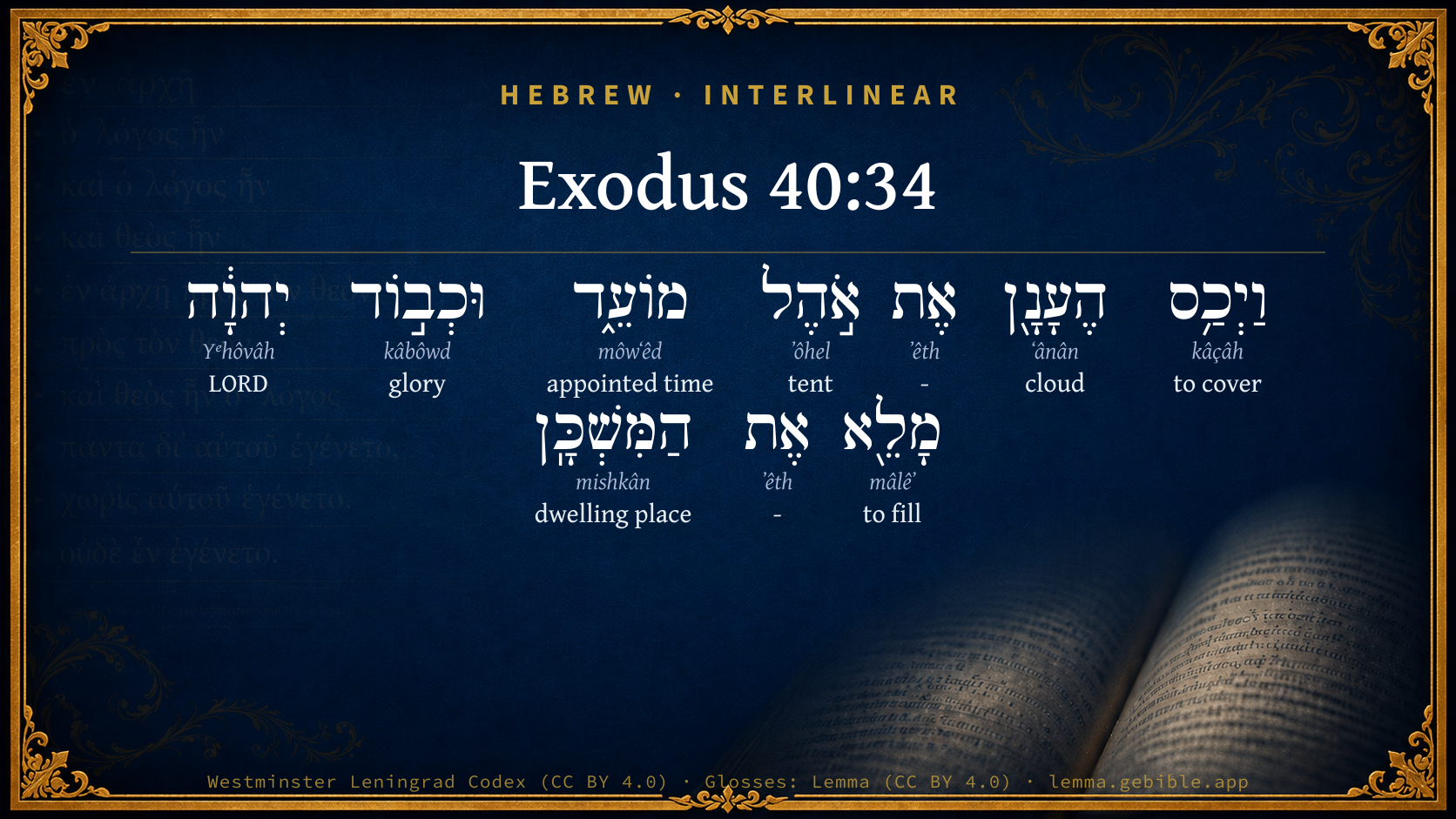
Exodus 40:34

Hebrew (Westminster Leningrad Codex) Exodus 40:34 appears in the Hebrew Old Testament. The text above is from the Westminster Leningrad Codex. Each word links to its Strong’s number, a concise gloss, and parsing drawn from the Open Scriptures Hebrew Bible morphology. Click any word for its full Brown-Driver-Briggs (BDB) entry.
Download image
Cite this verse

Exodus 40:34 (World English Bible). Public Domain. Lemma interlinear Bible study tool, https://lemma.gebible.app/v/exodus/40/34.

Show BibTeX & RIS
BibTeX
RIS
English Translation
Then the cloud covered the tent of meeting, and the glory of Yahweh filled the tent.
World English Bible · Public Domain
Download a study sheet

One document with this verse’s original text, its word-by-word gloss line, the meaning frame, cross-references with their text, attributed commentary, and full source and license credits — printable, and it pastes into notes with its structure intact.

This verse Autodidact and up

Study sheet (.html) Plain text (.txt)

A passage Seminary Student

Up to 50 verses in one chapter. A passage sheet keeps up to 6 commentary sources and 12 cross-references per verse, in the order this page ranks them, and says so on the sheet whenever that leaves anything out. Ask for a single verse and you get the Autodidact verse sheet above.

Everything on this page stays free to read, with no account — the sheet is a download of what is already on screen, not access to it.

Want to remove ads? Support Godless Engineer
Compare translations 3

The same verse in 3 English versions, stacked beneath the original-language interlinear above. Click any original word for its lexicon entry.

Each is an independent rendering of the whole verse — the interlinear is not word-aligned to these translations.

Highlighted words mark where these versions differ — a whole-verse word diff, not a word-by-word alignment.

  • World English Bible Public Domain
    Then the cloud covered the tent of meeting, and the glory of Yahweh filled the tent.
  • King James Version Public Domain
    Then a cloud covered the tent of the congregation, and the glory of the LORD filled the tabernacle.
  • unfoldingWord Literal Text CC BY-SA 4.0
    And the cloud covered the tent of meeting, and the glory of Yahweh filled the Dwelling.

unfoldingWord Literal Text — © unfoldingWord, licensed CC BY-SA 4.0. Word-aligned USFM3 via Door43 (git.door43.org/unfoldingWord/en_ult).

Versions to compare (up to 4)

3 of 4 selected

Show all 18 translations

Every available English version of this verse, each an independent rendering of the whole verse.

  • World English Bible Public Domain
    Then the cloud covered the tent of meeting, and the glory of Yahweh filled the tent.
  • Berean Standard Bible Public Domain
    Then the cloud covered the Tent of Meeting, and the glory of the LORD filled the tabernacle.
  • Majority Standard Bible Public Domain
    Then the cloud covered the Tent of Meeting, and the glory of the LORD filled the tabernacle.
  • King James Version Public Domain
    Then a cloud covered the tent of the congregation, and the glory of the LORD filled the tabernacle.
  • American Standard Version (1901) Public Domain
    Then the cloud covered the tent of meeting, and the glory of Jehovah filled the tabernacle.
  • Revised Version (1885) Public Domain
    Then the cloud covered the tent of meeting, and the glory of the LORD filled the tabernacle.
  • Geneva Bible (1599) Public Domain
    Then the cloud couered the Tabernacle of the Congregation, and the glorie of the Lord filled the Tabernacle.
  • Douay-Rheims (1899) Public Domain
    If at any time the cloud removed from the tabernacle, the children of Israel went forward by their troops:
  • Young's Literal Translation Public Domain
    And the cloud covereth the tent of meeting, and the honour of Jehovah hath filled the tabernacle;
  • Literal Standard Version CC BY-SA 4.0
    And the cloud covers the Tent of Meeting, and the glory of YHWH has filled the Dwelling Place;
  • Unlocked Literal Bible CC BY-SA 4.0
    Then the cloud covered the tent of meeting, and Yahweh's glory filled the tabernacle.
  • unfoldingWord Literal Text CC BY-SA 4.0
    And the cloud covered the tent of meeting, and the glory of Yahweh filled the Dwelling.
  • Darby Bible Public Domain
    And the cloud covered the tent of meeting, and the glory of Jehovah filled the tabernacle.
  • World Messianic Bible Public Domain
    Then the cloud covered the Tent of Meeting, and the LORD’s glory filled the tabernacle.
  • Webster's Bible Public Domain
    Then a cloud covered the tent of the congregation, and the glory of the LORD filled the tabernacle.
  • Free Bible Version CC BY-SA 4.0
    Then the cloud covered the Tent of Meeting, and the glory of the Lord filled the Tabernacle.
  • Bible in Basic English Public Domain
    Then the cloud came down covering the Tent of meeting, and the House was full of the glory of the Lord;
  • JPS Tanakh (1917) Public Domain
    Then the cloud covered the tent of meeting, and the glory of the LORD filled the tabernacle.

Literal Standard Version (2020), Covenant Press — licensed CC BY-SA 4.0. Text via the HelloAO Bible API (eBible.org). Unlocked Literal Bible (unfoldingWord) — licensed CC BY-SA 4.0. Text via the HelloAO Bible API (eBible.org). unfoldingWord Literal Text — © unfoldingWord, licensed CC BY-SA 4.0. Word-aligned USFM3 via Door43 (git.door43.org/unfoldingWord/en_ult). Free Bible Version, Dr. Jonathan Gallagher — licensed CC BY-SA 4.0. Text via the HelloAO Bible API (eBible.org).

Word by word

More ways to search: Search by grammar → Find every occurrence → Compare this word →

Practice this passage: Drill this verse → Learn its vocabulary →

הֶעָנָ֖ן
ʻânân
H6051
“the · cloud”
Particle, Definite Article + Noun, Common, Masculine, Singular, Absolute
Part of Speech
Particle + Noun
Type
Common
Gender
Masculine
Number
Singular
State
Absolute
Full BDB Definition

Origin: from H6049

TWOT: 1655a

cloud, cloudy, cloud-mass - cloud-mass (of theophanic cloud) - cloud
  1. וַיְכַ֥ס kâçâh H3680 “and · to cover” Conjunction + Verb, Piel, Sequential Imperfect, 3rd Person, Masculine, Singular
  2. אֶת ʼêth H853 “-” Particle, Direct Object
  3. אֹ֣הֶל ʼôhel H168 “tent of” Noun, Common, Masculine, Singular, Construct
  4. מוֹעֵ֑ד môwʻêd H4150 “appointed time” Noun, Common, Masculine, Singular, Absolute
  5. וּכְב֣וֹד kâbôwd H3519 “and · glory of” Conjunction + Noun, Common, Both, Singular, Construct
  6. יְהוָ֔ה Yᵉhôvâh H3068 “LORD” Noun, Proper
  7. מָלֵ֖א mâlêʼ H4390 “to fill” Verb, Qal, Perfect, 3rd Person, Masculine, Singular
  8. אֶת ʼêth H853 “-” Particle, Direct Object
  9. הַמִּשְׁכָּֽן mishkân H4908 “the · dwelling place” Particle, Definite Article + Noun, Common, Masculine, Singular, Absolute

About this verse

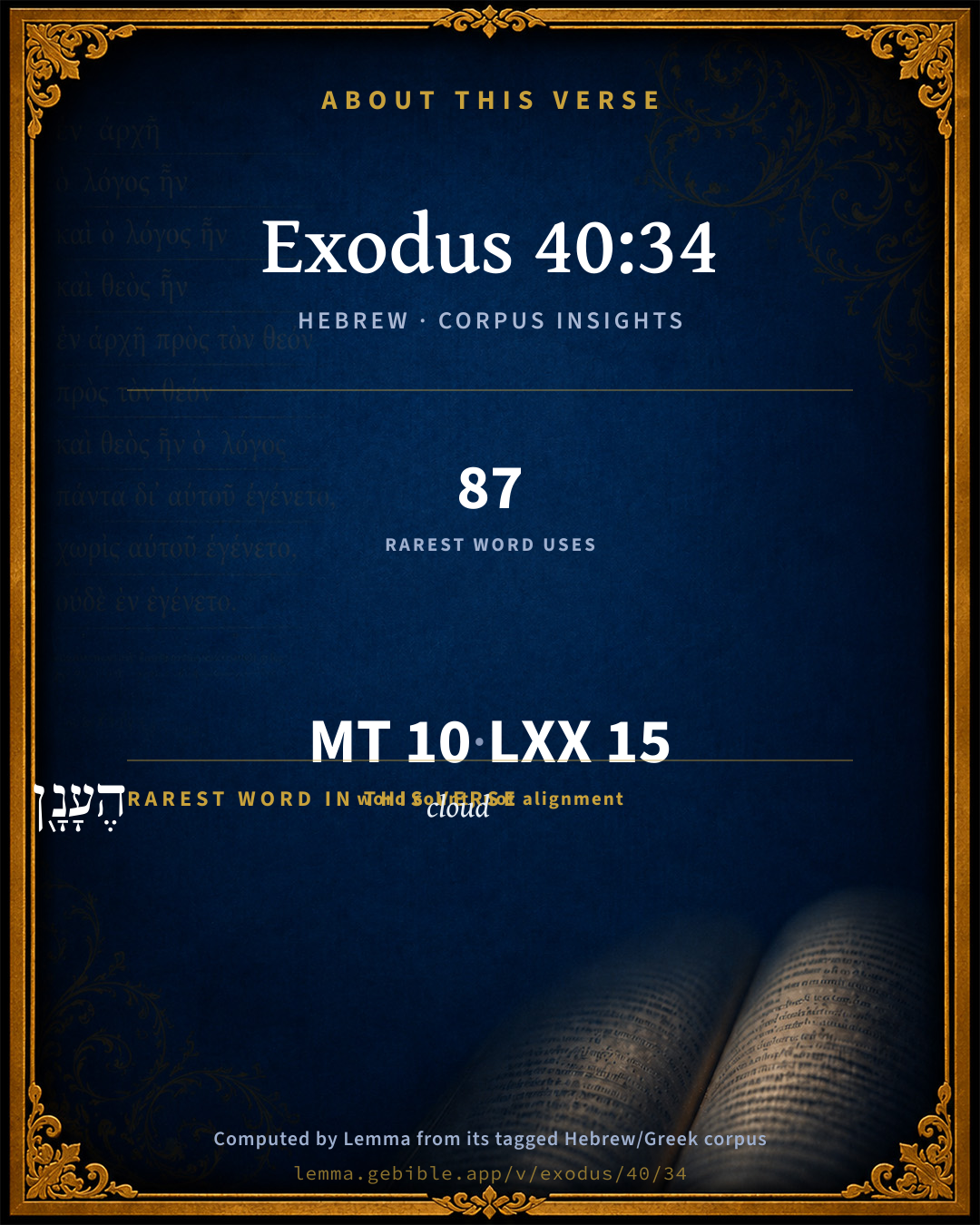
These counts appear in no published source. They are computed here, from the morphology-tagged text and Lemma’s own curated glosses. What Lemma adds →

10
words
9
distinct lemmas
Pentateuch
section

Grammatical profile

  • 2 verbs
  • 6 nouns
  • 2 particles

Verb forms

  • וַיְכַ֥ס Piel · Sequential Imperfect
  • מָלֵ֖א Qal · Perfect

Hebrew & Septuagint length

In English translation the verse runs 16 words from the Hebrew and 19 from the Septuagint (LXX English) — closely comparable.

A rough comparison of the two English renderings, which tokenize alike — not a word-level alignment.

Word counts can differ between the Hebrew and the Greek without any difference in meaning — e.g. the Hebrew direct-object marker אֵת has no separate Greek word, and Greek often adds the article ὁ.

In the original languages it is 10 Hebrew tokens and 15 Greek tokens — but the two are counted differently (Hebrew bundles its prefixes and suffixes into one token; the Greek is in lemma form), so that isn’t a like-for-like length.

Cross-references

21

Topical passages linked to Exodus 40:34 in the Treasury of Scripture Knowledge — connected by theme and wording, ordered by reader-vote popularity; previews shown in the World English Bible.

  • Revelation 15:8 The temple was filled with smoke from the glory of God, and from his power. No one was able to enter into the temple, until the seven plagues of the seven angels would be finished.
  • Numbers 9:15–23 On the day that the tabernacle was raised up, the cloud covered the tabernacle, even the Tent of the Testimony: and at evening it was over the tabernacle as it were the appearance of fire, until morning.
  • 2 Chronicles 7:2 The priests could not enter into the house of Yahweh, because the glory of Yahweh filled Yahweh's house.
  • Exodus 14:19–20 The angel of God, who went before the camp of Israel, moved and went behind them; and the pillar of cloud moved from before them, and stood behind them.
  • Exodus 14:24 It happened in the morning watch, that Yahweh looked out on the host of the Egyptians through the pillar of fire and of cloud, and confused the Egyptian army.
  • Exodus 29:43 There I will meet with the children of Israel; and the place shall be sanctified by my glory.
  • Revelation 21:23–24 The city has no need for the sun, neither of the moon, to shine, for the very glory of God illuminated it, and its lamp is the Lamb.
  • Exodus 13:21–22 Yahweh went before them by day in a pillar of cloud, to lead them on their way, and by night in a pillar of fire, to give them light, that they might go by day and by night:
  • Exodus 33:9 It happened, when Moses entered into the Tent, that the pillar of cloud descended, stood at the door of the Tent, and spoke with Moses.
  • Leviticus 16:2 and Yahweh said to Moses, "Tell Aaron your brother, not to come at all times into the Most Holy Place within the veil, before the mercy seat which is on the ark; lest he die: for I will appear in the cloud on the mercy seat.
  • Ezekiel 43:4–7 The glory of Yahweh came into the house by the way of the gate whose prospect is toward the east.
  • Haggai 2:7 and I will shake all nations. The precious things of all nations will come, and I will fill this house with glory, says Yahweh of Hosts.
  • Haggai 2:9 'The latter glory of this house will be greater than the former,' says Yahweh of Hosts; 'and in this place will I give peace,' says Yahweh of Hosts."
  • Revelation 21:3 I heard a loud voice out of heaven saying, "Behold, God's dwelling is with people, and he will dwell with them, and they will be his people, and God himself will be with them as their God.
  • 1 Kings 8:10–11 It came to pass, when the priests were come out of the holy place, that the cloud filled the house of Yahweh,
  • 2 Chronicles 5:13 it happened, when the trumpeters and singers were as one, to make one sound to be heard in praising and thanking Yahweh; and when they lifted up their voice with the trumpets and cymbals and instruments of music, and praised Yahweh, [saying], For he is good; for his loving kindness endures forever; that then the house was filled with a cloud, even the house of Yahweh,
  • Psalms 18:10–12 He rode on a cherub, and flew. Yes, he soared on the wings of the wind.
  • Isaiah 4:5–6 Yahweh will create over the whole habitation of Mount Zion, and over her assemblies, a cloud and smoke by day, and the shining of a flaming fire by night; for over all the glory will be a canopy.
  • Isaiah 6:4 The foundations of the thresholds shook at the voice of him who called, and the house was filled with smoke.
  • Exodus 25:8 Let them make me a sanctuary, that I may dwell among them.
  • Exodus 25:21–22 You shall put the mercy seat on top of the ark, and in the ark you shall put the testimony that I will give you.

Cross-references courtesy of OpenBible.info (CC BY 4.0).

Hebrew and Greek witnesses Masoretic Hebrew ↔ Greek Septuagint

The same verse in the two great witnesses to the Old Testament, shown verse-for-verse.

These are two independent witnesses, not word-aligned to each other, and the Septuagint is shown in lemma (dictionary) form.

Hebrew Exodus 40:34 Masoretic · Westminster Leningrad Codex

וַיְכַ֥ס הֶעָנָ֖ן אֶת אֹ֣הֶל מוֹעֵ֑ד וּכְב֣וֹד יְהוָ֔ה מָלֵ֖א אֶת הַמִּשְׁכָּֽן

Then the cloud covered the tent of meeting, and the glory of Yahweh filled the tent.

World English Bible · Public Domain

Greek LXX Exodus 40:34 Septuagint · lemma form

εἰ δέ μή ἀναβαίνω ὁ νεφέλη οὐ ἀναζευγνύω ἕως ὁ ἡμέρα ὅς ἀναβαίνω ὁ νεφέλη

And the cloud covered the tabernacle of witness, and the tabernacle was filled with the glory of the Lord.

LXX2012 (modern English Septuagint) · Public Domain

Hebrew: Westminster Leningrad Codex (CC BY 4.0). Greek: Septuagint (public domain); English from LXX2012 (modern English Septuagint) (Public Domain). How the Septuagint differs from the Hebrew →

Targum (Aramaic paraphrase)

2

The Targum is the ancient Jewish Aramaic paraphrase of the Hebrew Scriptures — an interpretive translation, not the Hebrew text itself. Onkelos (literal) and Pseudo-Jonathan (expansive) render the Torah, and Jonathan the Prophets. Coverage is partial: where no permissively-licensed English translation exists for a verse, only the Aramaic is shown. This is verse-level text, not a word-by-word alignment to the Hebrew.

  1. Targum Onkelos Torah (Genesis–Deuteronomy)
    וַחֲפָא עֲנָנָא יָת מַשְׁכַּן זִמְנָא וִיקָרָא דַיְיָ אִתְמְלֵי יָת מַשְׁכְּנָא:

    (no public-domain English translation for this verse)

    Targum Onkelos — Aramaic: “Onkelos Genesis” (public domain); “Onkelos Exodus” (public domain); “Onkelos Leviticus” (public domain); “Onkelos Numbers” (public domain); “Onkelos Deuteronomy” (public domain). English: “Sefaria Community Translation” (CC0 1.0 (public-domain dedication)); “J.W. Etheridge. The Targums of Onkelos and Jonathan Ben Uzziel on the Pentateuch. London: Longmans, Green, 1862” (public domain). Text via Sefaria.

  2. Targum Pseudo-Jonathan Torah (Genesis–Deuteronomy)
    וַחֲפָא עֲנַן יְקָרָא יַת מַשְׁכַּן זִמְנָא וְאִיקַר שְׁכִינְתָּא דַיְיָ אִתְמְלֵי יַת מַשְׁכְּנָא

    Then the Cloud of Glory overspread the tabernacle of ordinance, and the glory of the Shekinah of the Lord filled the tabernacle.

    Targum Pseudo-Jonathan — Aramaic: “Targum Jonathan on Genesis” (public domain); “Targum Jonathan on Exodus” (public domain); “Targum Jonathan on Leviticus” (public domain); “Targum Jonathan on Numbers” (public domain); “Targum Jonathan on Deuteronomy” (public domain). English: “The Targum of Jonathan ben Uzziel, trans. J. W. Etheridge, London, 1862” (public domain). Text via Sefaria.

Commentary

Notes on Exodus 40:34 from classic Christian and Jewish commentators (each source and its license shown beneath its notes). The classic Christian expositions comment on the surrounding passage and are grouped to its opening verse, so a note may address several verses; the Jewish commentaries on the Tanakh (Rashi and others) are per-verse, so they appear only where the commentator wrote on this verse.

Lemma curates 59 commentaries, every one of them public domain or Creative Commons licensed, each selected and text-cleaned for this edition rather than reprinted as found. About our sources →

Matthew Henry's Commentary

As when, in the creation, God had finished this earth, which he designed for man's habitation, he made man, and put him in possession of it, so when Moses had finished the tabernacle, which was designed for God's dwelling-place among men, God came and took possession of it. The shechinah, the divine eternal Word, though not yet made flesh, yet, as a prelude to that event, came and dwelt among them, Joh 1:14. This was henceforward the place of his throne, and the place of the soles of his feet (Eze 43:7); here he resided, here he ruled. By the visible tokens of God's coming among them to take possession of the tabernacle he testified both the return of his favour to them, which they had forfeited by the golden calf (Exo 33:7), and his gracious acceptance of all the expense they had been at, and all the care and pains they had taken about the tabernacle. Thus God owned them, showed himself well pleased with what they had done, and abundantly rewarded them. Note, God will dwell with those that prepare him a habitation. The broken and contrite heart, the clean and holy heart, that is furnished for his service, and devoted to his honour, shall be his rest for ever; here will Christ dwell by faith, Eph 3:17. Where God has a throne and an altar in the soul, there is a living temple. And God will be sure to own and crown the operations of his own grace and the observance of his own appointments.

As God had manifested himself upon mount Sinai, so he did now in this newly-erected tabernacle. We read (Exo 24:16) that the glory of the Lord abode upon mount Sinai, which is said to be like devouring fire (Exo 40:17), and that the cloud covered it on the outside, and the glory of the Lord filled it within, to which, probably there is an allusion in Zac 2:5, where God promises to be a wall of fire round about Jerusalem (and the pillar of cloud was by night a pillar of fire) and the glory in the midst of her.

I. The cloud covered the tent. That same cloud which, as the chariot or pavilion of the shechinah, had come up before them out of Egypt and led them hither, now settled upon the tabernacle and hovered over it, even in the hottest and clearest day; for it was none of those clouds which the sun scatters. This cloud was intended to be, 1. A token of God's presence constantly visible day and night (Exo 40:38) to all Israel, even to those that lay in the remotest corners of the camp, that they might never again make a question of it, Is the Lord among us, or is he not? That very cloud which had already been so pregnant with wonders in the Red Sea, and on mount Sinai, sufficient to prove God in it of a truth, was continually in sight of all the house of Israel throughout all their journeys; so that they were inexcusable if they believed not their own eyes. 2. A concealment of the tabernacle, and the glory of God in it. God did indeed dwell among them, but he dwelt in a cloud: Verily thou art a God that hidest, thyself. Blessed be God for the gospel of Christ, in which we all with open face behold as in a glass, not in a cloud, the glory of the Lord. 3. A protection of the tabernacle. They had sheltered it with one covering upon another, but, after all, the cloud that covered it was its best guard. Those that dwell in the house of the Lord are hidden there, and are safe under the divine protection, Psa 27:4, Psa 27:5. Yet this, which was then a peculiar favour to the tabernacle, is promised to every dwelling-place of mount Zion (Isa 4:5); for upon all the glory shall be a defence. 4. A guide to the camp of Israel in their march through the wilderness, Exo 40:36, Exo 40:37. While the cloud continued on the tabernacle, they rested; when it removed, they removed and followed it, as being purely under divine direction. This is spoken of more fully, Num 9:19; Psa 78:14; Psa 105:39. As before the tabernacle was set up the Israelites had the cloud for their guide, which appeared sometimes in one place and sometimes in another, but henceforward rested on the tabernacle and was to be found there only, so the church had divine revelation for its guide from the first, before the scriptures were written, but since the making up of that canon it rests in that as its tabernacle, and there only it is to be found, as in the creation the light which was made the first day, centered in the sun the fourth day. Blessed be God for the law and the testimony!

II. The glory of the Lord filled the tabernacle, Exo 40:34, Exo 40:35. The shechinah now made an awful and pompous entry into the tabernacle, through the outer part of which it passed into the most holy place, as the presence-chamber, and there seated itself between the cherubim. It was in light and fire, and (for aught we know) no otherwise, that the shechinah made itself visible; for God is light; our God is a consuming fire. With these the tabernacle was now filled, yet, as before the bush was not consumed, so now the curtains were not so much as singed by this fire; for to those that have received the anointing the terrible majesty of God is not destroying. Yet so dazzling was the light, and so dreadful was the fire, that Moses was not able to enter into the tent of the congregation, at the door of which he attended, till the splendour had a little abated, and the glory of the Lord retired within the veil, Exo 40:35. This shows how terrible the glory and majesty of God are, and how unable the greatest and best of men are to stand before him. The divine light and fire, let forth in their full strength, will overpower the strongest heads and the purest hearts. But what Moses could not do, in that he was weak through the flesh, has been done by our Lord Jesus, whom God caused to draw near and approach, and who, as the forerunner, has for us entered, and has invited us to come boldly even to the mercy-seat. He was able to enter into the holy place not made with hands (Heb 9:24); nay, he is himself the true tabernacle, filled with the glory of God (Joh 1:14), even with the divine grace and truth prefigured by this fire and light. In him the shechinah took up its rest for ever, for in him dwells all the fulness of the godhead bodily. Blessed be God for Jesus Christ!

Matthew Henry's Commentary on the Whole Bible (1708–1710) — public domain (CC PDM 1.0). Text via the HelloAO Bible API.

Whedon's Commentary on the Bible

Daniel D. Whedon

JEHOVAH’S GLORY FILLING THE TABERNACLE, Exo_40:34-38.

It only remains that Jehovah manifest his approval of the tabernacle by some visible proof of his presence and abode there. Accordingly, when Moses had approved the work done, and completed what it was intended for human hands to do, the cloud which had accompanied them in their journey from Egypt (see note on Exo_13:21) covered the tent of the congregation, and the glory of the Lord filled the tabernacle. The tent is here distinguished from the tabernacle, and is to be understood as the outer covering of curtains, while the tabernacle proper was the more immediate dwelling within, the mishcan, consisting of the board structure, and the ornamented curtains which were placed upon it. See note at the beginning of chap. 26. So gloriously did the cloud appear above the tent, and so wonderfully did the divine glory fill the interior of the sacred dwelling, that Moses was not able to enter. He had previously approached the thick darkness of Sinai, out of which Jehovah spoke, (Exo_20:21;) he had witnessed an unparalleled display of the divine glory in the mount, (Exo_33:19-23; Exo_34:5-8;) but this theophany was too intense in its splendour to permit even Moses to enter within the holy places where, for the time, the Holy One abode in special presence.

36-38. When the cloud was taken up — This description of the guidance of Israel by the cloud is more fully detailed in Num_9:15-23. It appropriately concludes the Book of Exodus, which records the bondage, the redemption, and the consecration of Israel. The great facts written in this book served to make the history of Israel typical of the redemption of mankind; and especially does the image of the cloud and fire, accompanying, by day and by night, all the house of Israel, throughout all their journeys, portray in most impressive form the doctrine of the imminent providence of our Heavenly Father. He is with his people always; and they may read the lessons of the exodus and the tabernacle, and in every generation sing: “The Lord God is a sun and shield: the Lord will give grace and glory: no good thing will he withhold from them that walk uprightly. O Lord of hosts, blessed is the man that trusteth in thee.” Psa_84:11-12.

SYMBOLISM OF THE TABERNACLE.

The symbolism and typology of the Mosaic tabernacle are recognized in the ninth chapter of the Epistle to the Hebrews, and we may well suppose that a structure designed to serve so important a purpose in the religious training of the chosen nation must have been planned to suggest some grand and precious spiritual truths. (Comp. note on the Symbolism of the Temple at the close of notes on 1 Kings 7.) That it was a symbol of inner and spiritual relationship, made possible between God and man by the blood of atonement, we have already indicated in our introductory note at the beginning of chapter 25, and we take no space to detail the various conjectures by which it is made to represent things which are physical and visible. As shown in the passage above referred to, and especially by the teaching of Exo_29:42-46, the great idea which centers in the complex symbol is that of JEHOVAH DWELLING WITH HIS PEOPLE. Man is by sin estranged from God, and there can be no reunion and fellowship without remission of sins and a purifying of the spiritual nature of man. This was graciously provided for in the expiatory sacrifices required of every Israelite. The life or soul was conceived as living and subsisting in the blood, (Lev_17:11,) and when the blood of a victim was poured out at the altar it symbolized the surrender of a life which had been forfeited by sin, and the worshipper who made the sacrifice thereby acknowledged before Jehovah his death-deserving guilt. There could, accordingly, be no approach to God on the part of sinful men — no possible meeting and dwelling with him — except by the offerings made at the great altar in front of the sacred tent. No priest might pass into the tabernacle until sprinkled with blood from that altar, (Exo_29:21,) and the live coals, used for burning the incense before Jehovah, were taken from the same place. Lev_16:12. Nor might the priest, on penalty of death, minister at the altar or enter the tabernacle without first washing at the laver, (Exo_30:20-21.) So the great altar in the court continually proclaimed that without the shedding of blood there is no remission, and the priestly ablutions denoted that without the washing of regeneration no man might enter the kingdom of God. Compare Psa_24:3-4; Joh_3:5; Heb_10:19-22. The blessed and holy dwelling with God, symbolized in the holy places of the tabernacle, were possible only because of the reconciliation effected at the altar of sacrifice without.

The two apartments of the tabernacle, known as the holy and the most holy places, were adapted to represent the relationship between the human and the divine, made possible by the gracious covenant of God with his people. Into the first the priests entered, as the representatives of the people, and their service there was not for themselves alone, but for all Israel, whose relation to God, so long as they kept his covenant, was that of a kingdom of priests and a holy nation. Exo_19:5-6; comp. 1Pe_2:5; 1Pe_2:9; Rev_1:6; Rev_5:10. As the officiating priest stood in the holy place, facing the holy of holies, he had at his right hand the table of showbread, on his left the candlestick, and immediately before him the altar of incense. Exo_40:22-27. The twelve cakes of bread (bread of presence) kept continually on the table as before God, most obviously symbolized the twelve tribes of Israel continually offering themselves as an acceptable sacrifice in the presence of Jehovah. The golden candlestick with its seven lamps, opposite the table, was another symbol of Israel considered as the Church of the living God and the light of the world. Then, further, the constant devotion of Israel to God was represented at the golden altar of incense immediately before the vail, and in front of the mercy-seat, (Exo_30:6.) The offering of incense was an expressive symbol of the prayers of saints, (Psa_141:2; Rev_5:8; Rev_8:3-4,) and the whole multitude of the people were wont to pray without at the hour of the incense offering. Luk_1:10. Jehovah was pleased to “inhabit the praises of Israel,” (Psa_22:3,) for all that his people may be and do in their consecrated relation to him expresses itself in their prayers before his altar and mercy seat.

The holy place, therefore, with its table and candlestick and golden altar of incense, symbolized the relation of the true Israel to God, made available by the blood of atonement. The holy of holies, on the other hand, symbolized Jehovah’s relations to his people, and profoundly suggested the terms or considerations by which it was compatible for him to meet and dwell with man. It contained the ark, within which were deposited the two tables of testimony — Jehovah’s declaration out of the thick darkness — a monumental witness of his wrath against sin. Over this ark, and covering the tables of testimony, was placed the capporeth, or mercy seat, to be sprinkled with blood on the great day of atonement. Lev_16:11-17. Here was a most significant symbol of mercy covering wrath. Made of fine gold, and having its dimensions the same as the length and breadth of the ark, (Lev_25:17,) it fittingly represented that glorious provision of infinite wisdom and love by which, in virtue of the precious blood of Christ, and in complete harmony with the righteousness of God, atonement is made for the guilty but penitent transgressor.

The cherubim, spreading out their wings over the mercy seat, and gazing as in wondering adoration upon it, were appropriate symbols of the redeemed and glorified Israel, who shall ultimately behold the glory of God, and dwell in his heavenly light forever. This subject we have treated in the note on Gen_3:24, page 100 of this Commentary.

The ministration of the high priest on the great day of atonement, as described in Leviticus 16, is declared in the Epistle to the Hebrews to have prefigured the redeeming work of Christ, who, “being come a high priest of good things to come, by a greater and more perfect tabernacle, not made with hands,… neither by the blood of goats and calves, but by his own blood, entered in once into the holy place, having obtained eternal redemption for us.… For Christ is not entered into the holy places made with hands, which are the figures of the true; but into heaven itself, now to appear in the presence of God for us.” Heb_9:11-12; Heb_9:24. The believer is, accordingly, exhorted “to enter into the holiest by the blood of Jesus.” The way has been opened in the fulness of time, and the glory of heaven itself consists mainly in this, that God and his people dwell together in unspeakable felicity. The many mansions (μοναι, dwellings, abiding places, Joh_14:2,) of the Father’s house in the heavens are but the fuller realization and perfection of the believer’s fellowship with God on earth. He who by the grace of redemption dwells in God and God in him (1Jn_4:16) has already entered by faith into these holy relationships. He lingers, as it were, a little while in the holy place, until all fleshly vails are rent, and the perfected spirit enters into the holy of holies, and beholds the Prince of Life upon his throne.

Daniel D. Whedon (gen. ed.), Commentary on the Old and New Testaments (1874–1909) — public domain. Text from a community e-Sword module.

Jamieson, Fausset & Brown

Robert Jamieson, A. R. Fausset & David Brown

a cloud--literally, "The cloud," the mystic cloud which was the well-known symbol of the Divine Presence. After remaining at a great distance from them on the summit of the mount, it appeared to be in motion; and if many among them had a secret misgiving about the issue, how the fainting heart would revive, the interest of the moment intensely increase, and the tide of joy swell in every bosom, when that symbolic cloud was seen slowly and majestically descending towards the plain below and covering the tabernacle. The entire and universal concealment of the tabernacle within the folds of an impervious cloud was not without a deep and instructive meaning; it was a protection to the sacred edifice from the burning heats of the Arabian climate; it was a token of the Divine Presence; and it was also an emblem of the Mosaic dispensation, which, though it was a revelation from heaven, yet left many things hid in obscurity; for it was a dark cloud compared with the bright cloud, which betokened the clearer and fuller discoveries of the divine character and glory in the gospel (Mat 17:5).

the glory of the Lord filled the tabernacle--that is, light and fire, a created splendor, which was the peculiar symbol of God (Jo1 1:5). Whether this light was inherent in the cloud or not, it emanated from it on this occasion, and making its entry, not with the speed of a lightning flash as if it were merely an electric spark, but in majestic splendor, it passed through the outer porch into the interior of the most holy place (Kg1 8:10; Joh 1:14). Its miraculous character is shown by the fact, that, though "it filled the tabernacle," not a curtain or any article of furniture was so much as singed.

Jamieson, Fausset & Brown — Commentary Critical and Explanatory on the Whole Bible (1871) — public domain (CC PDM 1.0). Text via the HelloAO Bible API.

Adam Clarke's Commentary

Verse 34. Then a cloud covered the tent] Thus God gave his approbation of the work; and as this was visible, so it was a sign to all the people that Jehovah was among them.

And the glory of the Lord filled the tabernacle.] How this was manifested we cannot tell; it was probably by some light or brightness which was insufferable to the sight, for Moses himself could not enter in because of the cloud and the glory, Ex 40:35. Precisely the same happened when Solomon had dedicated his temple; for it is said that the cloud filled the house of the Lord, so that the priests could not stand to minister because of the cloud; for the glory of the Lord had filled the house of the Lord; 1Kg 8:10-11. Previously to this the cloud of the Divine glory had rested upon that tent or tabernacle which Moses had pitched without the camp, after the transgression in the matter of the molten calf; but now the cloud removed from that tabernacle and rested upon this one, which was made by the command and under the direction of God himself. And there is reason to believe that this tabernacle was pitched in the centre of the camp, all the twelve tribes pitching their different tents in a certain order around it.

Adam Clarke's Commentary on the Bible (1810–1826) — public domain. Text from a community e-Sword/MySword module.

Ellicott's Commentary for English Readers

THE DESCENT OF THE GLOEY OF GOD UPON THE TABERNACLE.

(34) Then a cloud.—Heb., the cloud, i.e., the same cloud that had accompanied the host and directed their journeys from Succoth (Exo_13:20-22).

Covered the tent.—The cloud rested on the tent outside; the “glory of God,”—some ineffably brilliant appearance—entered inside, and “filled” the entire dwelling. It pleased God thus to manifest His intention of making good His promise to go with the people in person (Exo_33:17).

A Bible Commentary for English Readers, edited by Charles John Ellicott (1878–1897) — public domain. Text from a community e-Sword module.

The Cambridge Bible for Schools and Colleges

gen. ed. J. J. S. Perowne

34–38. The cloud (see on Exo_13:21-22) now takes up its abode on the Tent of Meeting (cf. Num_9:15 P), and the glory (see on Exo_16:10) of Jehovah fills the Dwelling (vv. 34 f.). Ever afterwards, through the period of the Israelites’ journeyings, the cloud, while they were stationary, remains upon the Tent of Meeting, with fire shining in it by night, its being lifted up from it being a signal that they are to break up camp, and move on (vv. 36–38).

the glory of Jehovah filled the Dwelling] cf. Exo_29:43.

The Cambridge Bible for Schools and Colleges (gen. ed. J. J. S. Perowne; Cambridge University Press, 1878–1918) — public domain. Text from a community e-Sword module.

John Gill's Exposition

For the cloud of the Lord was upon the tabernacle by day,.... Or over it (g), it covered it, when it abode upon it, and rested; and stood on high over it when it moved and the people journeyed:

and fire was on it by night; the same phenomenon which had the appearance of a cloud in the day time shone like fire in the night time: or "fire was in it" (h); that is, in the cloud; so it appeared in the night, and was, as the Targum of Jonathan here calls it, a pillar of fire; the same with the pillar of cloud and fire, which departed not from the people all the while they were in the wilderness, Exo 13:21 and this was

in the sight of all the house of Israel, throughout all their journeys; whether by night or by day; for in hot countries they travel much by night; and as the cloud was both a shelter from the heat of the sun in the daytime, and a direction of their way; so the fire by night was of the same use for direction, and might be also terrifying to wild beasts in the wilderness, who are afraid of fire, and so be a security to the Israelites from them; all which is an emblem of the guidance and protection, light, joy, and comfort, the church of God has from his gracious presence, while in the wilderness of this world; see Isa 4:5.

(g) "supra tabernaculum", Drusius. (h) "in ea"; Fagius, Junius & Tremellius; Drusius.

Next: Leviticus Introduction

John Gill's Exposition of the Whole Bible (1746–1763) — public domain (CC PDM 1.0). Text via the HelloAO Bible API.

Albert Barnes' Notes on the Bible

On the distinction between the tent as the outer shelter and the tabernacle as the dwelling-place of Yahweh, which is very clear in these verses, see Exo 26:1 note. The glory appeared as a light within and as a cloud on the outside.

Exo 40:35

Compare the entrance of the high priest into the holy of holies on the day of atonement, Lev 16:2, Lev 16:13. For special appearances of this glory in the tabernacle, see Num 14:10; Num 16:19, Num 16:42.

The tabernacle, after it had accompanied the Israelites in their wanderings in the wilderness, was most probably first set up in the holy land at Gilgal Jos 4:19; Jos 5:10; Jos 9:6; Jos 10:6, Jos 10:43. But before the death of Joshua, it was erected at Shiloh Jos 18:1; Jos 19:51. Here it remained as the national sanctuary throughout the time of the Judges Jos 18:8; Jos 21:2; Jos 22:19; Jdg 18:31; Jdg 21:19; 1Sa 1:3; 1Sa 4:3. But its external construction was at this time somewhat changed, and doors, strictly so called, had taken the place of the entrance curtain 1Sa 3:15 : hence, it seems to have been sometimes called the temple 1Sa 1:9; 1Sa 3:3, the name by which the structure of Solomon was afterward commonly known. After the time of Eli it was removed to Nob in the canton of Benjamin, not far from Jerusalem 1Sa 21:1-9. From thence, in the time of David, it was removed to Gibeon 1Ch 16:39; 1Ch 21:29; 2Ch 1:3; 1Ki 3:4; 1Ki 9:2. It was brought from Gibeon to Jerusalem by Solomon 1Ki 8:4. After this, it disappears from the narrative of Scripture. When the temple of Solomon was built, “the tabernacle of the tent” had entirely performed its work; it had protected the ark of the covenant during the migrations of the people until they were settled in the land, and the promise was fulfilled, that the Lord would choose out a place for Himself in which His name should be preserved and His service should be maintained Deu 12:14, Deu 12:21; Deu 14:24.

In accordance with its dignity as the most sacred object in the sanctuary, the original ark of the covenant constructed by Moses was preserved and transferred from the tabernacle to the temple. The golden altar, the candlestick and the showbread table were renewed by Solomon. They were subsequently renewed by Zerubbabel, and lastly by the Maccabees (see Exo 25:23.) But the ark was preserved in the temple until Jerusalem was taken by the forces of Nebuchadnezzar 2Ch 35:3; Jer 3:16. It was never replaced in the second temple. According to a rabbinical tradition, its site was marked by a block of stone.

Albert Barnes' Notes on the Bible (1834–1885) — public domain. Text from a community e-Sword/MySword module.

Matthew Poole's English Annotations

i.e. The glorious presence of God, which having been forfeited and lost was now returned to them, and took its habitation among them.

Matthew Poole's English Annotations on the Holy Bible (1683–1685) — public domain. Text from a community e-Sword/MySword module.

The Pulpit Commentary

Vers. 34-38. THE DESCENT OF THE GLORY OF GOD ON THE COMPLETED WORK. The work was finished the fist incense burnt (ver. 27) the first sacrifice offered (ver. 29). Those who had watched the proceedings, and those who had been engaged in them, were probably about to retire to rest. Even Moses had withdrawn, and left the tabernacle to itself when suddenly, there was a manifestation of Divine Power. The cloud, which had gone before the Israelites from Succoth onward, (Exo_13:20-22) and which had recently settled upon the extemporised "Tent of Meeting", (Exo_33:9) left its place, and "covered" the newly-erected structure externally (ver. 34), while an intensely brilliant light here called "the glory of God filled the whole interior of the tabernacle (ib,). Moses, it appears, would fain have reentered the tabernacle to see the great sight"; (Exo_3:3) but he could not the "glory" was too dazzling (ver. 35). Thus a distinct approval was given to all that had been done. God accepted his house, and entered it. The people saw that he had foregone his wrath, and would be content henceforth to dwell among them and journey with them. Henceforth, throughout the wanderings, the cloud and tabernacle were inseparable. If the cloud was lifted a little off it and moved in front, the tabernacle had to follow (ver. 36) if it settled down on the roof, the people stopped and remained until it moved again (ver. 37). The appearance was as of a cloud by day, and as of fire by night, so that all could always see where the tabernacle was, and whether it was stationary or in motion (ver. 38). After the first descent, it would seem that "the glory" withdrew into the Holy of Holies, so that both Moses and the priests could enter the holy place, and minister there. (Lev_8:10 Lev_10:13, etc.) Then a cloud. In the original "the cloud," i.e. the cloud so often spoken of. (Exo_13:21, 22 14:19, 20, 24 19:9 24:15-18 33:9, 10) Covered the tent. Descended on the outer covering and rested there. Filled the tabernacle . Entered inside, and filled both holy place and Holy of Holies.

HOMILETICS.

Vers. 34-35. The symbols of God"s presence.

I GOD IS SEEN BY THOSE WHO UNFEIGNEDLY LOVE HIM AS PURE LIGHT. "I am the light of the world". (Joh_8:12 Joh 9:5) "In him was life, and the life was the light of men". (Joh_1:4) "In him is no darkness at all". (1Jn_2:5) With clear unclouded radiance he shines on those who tread his heavenly courts, which need no other light besides him. "The city hath no need of the sun, neither of the moon, to shine in it; for the glory of God doth lighten it, and the Lamb is the light thereof". (Rev_21:23) With a radiance not much less bright, he looks upon his saints on earth, cheering them, illumining their paths, making them glad with the light of his countenance. He may veil himself in condescension to their infirmity; but the veil is translucent; it covers without concealing; it tempers the brightness, but only as a thin haze tempers the splendours of the lord of day.

II GOD SHOWS HIMSELF TO THE GENERALITY OF MEN AS MINGLED LIGHT AND CLOUD. To Abraham he appeared as "a smoking furnace and a burning lamp"; (Gen_15:17) to the Israelites at Sinai as combined smoke and fire; (Exo_19:18) to Solomon, dazzled by his glory, he was still one who "dwelt in the thick darkness". (1Ki_8:12) When Isaiah beheld him sitting in his temple "the house was filled with smoke"; (Isa_6:1-4) when Ezekiel "saw visions of God," he "looked and behold, a great cloud, and a fire infolding itself." Wherever the glory of the Lord is seen, wherever he looks upon men with. mercy and compassion, there his proper symbolism is light, though it may be a light partially obscured and mingled with darkness. For darkness symbolises his anger; and in the case of his wayward children, he cannot but be at once compassionate and angry; displeased, yet anxious to forgive. Or the darkness may be the dense cloud of human ignorance which the Divine light can only partially pierce through. Any way, the bulk of men see God as a light amid smoke. "Clouds and darkness are round about (Psa_97:2) makes darkness his secret place, his pavilion round about him with dark waters, and thick clouds to cover him". (Psa_18:11) Fire flashes out of the clouds occasionally; gleams of light stream forth; "at the brightness of his presence, his clouds remove" (Psalm 12), and he is seen to be man"s "true light.

III GOD IS TO SOME MERE DARKNESS, A DENSE OPAQUE CLOUD. This he is:

1. To agnostics to them who know him not, and refuse to believe thathe can be known;

2. To them who have never heard of him, but have a dim unconsciousfeeling that some infinite unknown being exists;

3. To them that have been taught to view him as a remorseless, revengefulbeing, without pity or mercy;

4. To them that, having known him aright, have cast his words behind theirback, thrown off his authority, and placed themselves in determined antagonism to his will and commandments. All is dark in the future to such persons; and in the thought of God is "the blackness of darkness for ever." Because they have not chosen to retain God in their knowledge, God has given them over to a reprobate mind. (Rom_1:28) They "put bitter for sweet, and sweet for bitter." He, in whom is no darkness at all, is to them mere darkness. The God of this world has "blinded their eyes" that they cannot see; and, like a blind man, looking at the sun, the darkness which is in their own vision they ascribe to the object which" their dim sight, fails to distinguish., God is "the, true light, which lighteth every man that cometh into the world. (Joh_1:9) But if the light that is within thee be darkness, how great is that darkness!" (Mat_6:23)

HOMILIES BY J. URQUHART Vers. 34-38. Indwelling and guidance.

I GOD OWNS THE DWELLING-PLACE SET UP ACCORDING TO HIS COMMANDMENTS. "Then the cloud," etc. "And Moses was not able to enter in," etc.; it was claimed as his own and taken possession of by the Lord.

1. The soul which comes by God"s way will be filled with God"s glory.

2. The Church which honours God he will glorify.

3. The full glory of the perfected Church, the bride of Christ.

II WHERE THE LORD DWELLS HE GUIDES. When the cloud was taken up they went onward; when it rested they rested.

1. He is our guide in our onward journey.

(1) In providence. We must make sure that we follow him. It will not avail to choose our own way and then ask God to be with us. We are to follow his leading, not he ours.

(2) In grace. We may be mourning departed joy. There may be no longer the freshness and power we once felt in the ministration of the word, or in prayer. We have been slumbering and loitering. We have not striven to press through our sins and into fuller light. The cloud has lifted and gone onward, and we must follow after. "This one thing I do.

2. He is our guide into patience.

(1) He teaches us to bear and so to overcome.

(2) By the resting of faith to possess and to grow. U.

HOMILIES BY J. ORR Vers. 34-38. The house filled with glory.

The close of the book of Exodus is worthy of the greatness of its subject. It ends where the history of the world will end, with the descent of Jehovah"s glory to dwell with men. (Rev_21:3) We have seen Israel in bondage; have beheld its redemption; have followed it through the wilderness; have heard the thunders of the law at Sinai; have been witnesses of the nation"s covenant with God; have seen its shameful apostasy; have traced the steps of its reconciliation; have heard the instructions given for the building of this tabernacle; have viewed the tabernacle itself. We see now the symbol of Jehovah"s glorious presence in the midst of the people whom he has thus in so many ways made his own. What a wondrous succession of subjects we have thus had before us in the course of our review. The intolerable anguish of oppressed Israel; the birth of the deliverer; the singular providence of his early life; his great choice; the call in Midian; the revelation of the name; the return to Egypt; first failures; the long and tragic contest with Pharaoh; the hardening of Pharaoh"s heart; the exodus; the Red Sea; the miracles of the desert; the law; the covenant; the "patterns" shown to Moses in the mount; the sin of the calf; the great intercession; the name of mercy; the preparation of the sanctuary. There remains to complete the series only this final scene of the entrance of Jehovah"s glory into the house prepared for his habitation. This was the true consecration of the sanctuary, and the true consecration of the nation. "A cloud covered the tent of the congregation, and the glory of the Lord filled the tabernacle" (ver. 14). In what is related in these verses we have:

I A THREEFOLD PRIVILEGE.

1. Indwelling. The filling of the tabernacle with the glory was the symbol of Jehovah"s taking up his abode in it, and so in Israel. (cf. Exo_25:8) It testified

(1) to the completeness of his reconciliation with the people. Cf. Isa_12:1 Lord, 1 will praise thee, though thou wast angry with me, thineanger is turned away, and thou comfortedst me.

(2) To his complacency in the beautiful house they had reared for him. Cf. Psa_132:14 is my rest for ever, here will I dwell; for I have desired it.

(3) To his desire to dwell among them. Note

1. The true glory of the Church is God"s residence in her midst. This wasIsrael"s highest distinction. (Exo_33:16)

2. We should pray that the time may come when the Church shall be, notonly dwelt in by her Lord, but "filled" with the "glory" of his presence. (Isa 60)

1. Protection. The glory filled the tabernacle within, while the cloud spread itself above the tent as a protective covering without. So is Jehovah the protection of his Church. (Isa_4:5, Isa_4:6; Zec_2:5)

2. Guidance (vers. 36-38). See Homily on Exo_13:21, Exo_13:22.

II A HINT OF IMPERFECTION. "Moses was not able to enter into the tent of the congregation," etc. (ver. 35). Thus are we reminded that, amidst all these glorious circumstances, that which is perfect is not yet come.

1. Law, not gospel.

2. A material building, not a spiritual house.

3. Earth, not heaven. It was a glory

(1) too great for man to see. Even Moses, who had seen so much of the Divine glory, was not able to look upon it.

(2) Too great for such a building a mere material structure to contain. Man longs for nearer communion. So great a glory needs a better house to contain it a spiritual. (1Pe_2:5)

III A FORECAST OF WHAT SHALL BE. That which is perfect is not yet come, but it will come by-and-by.

1. The tabernacle of God will be with men, and he will dwell among them. (Rev_21:3, Rev_21:4) His glory will fill it. "The glory of God did lighten it, and the Lamb is the light thereof". (Rev_21:23)

2. This glory will be no longer unapproachable. We shall be able to endurethe sight. "His servants shall serve him, and they shall see his face". (Rev_22:3, Rev_22:4) We shall receive the Vision.

3. This, however, will only be when earthly conditions have beenexchanged for heavenly. "This corruptible must put on incorruption, and this mortal must put on immortality". (1Co_15:53) Till that hour arrives, we must be content to "walk by faith, not by sight", (2Co_5:7) seeing only "as through a glass darkly". J.O. (1Co_13:12)

The Pulpit Commentary (1880–1919), ed. H.D.M. Spence-Jones & Joseph S. Exell — public domain. Text from a community e-Sword module.

John Wesley's Explanatory Notes

As when God had finished this earth, which he designed for man's habitation, he made man, and put him in possession of it; so when Moses had finished the tabernacle, which was designed for God's dwelling-place among men, God came and took possession of it. By these visible tokens of his coming among them, he testified both the return of his favour, which they had forfeited by the golden calf, and his gracious acceptance of their care and pains about the tabernacle. Thus God shewed himself well- pleased with what they had done, and abundantly rewarded them. A cloud covered the tent - The same cloud which, as the chariot or pavilion of the Shechinah, had come up before them out of Egypt, now settled upon the tabernacle, and hovered over it, even in the hottest and clearest day; for it was none of those clouds which the sun scatters. This cloud was intended to be a token of God's presence, constantly visible day and night to all Israel. A protection of the tabernacle: they had sheltered it with one covering upon another, but after all, the cloud that covered it was its best guard: And a guide to the camp of Israel in their march through the wilderness. While the cloud continued on the tabernacle, they rested; when it removed, they removed and followed it, as being purely under a divine conduct. And the glory of the Lord filled the tabernacle - The Shechinah now made an awful entry into the tabernacle, passing through the outer part of it into the most holy place, and there seating itself between the cherubim. It was in light and fire, and, for ought we know, no other-wise, that the Shechinah made itself visible. With these the tabernacle was now filled; yet as before the bush, so now the curtains were not consumed, for, to those that have received the anointing, the majesty of God is not destroying. Yet now so dazzling was the light, and so dreadful was the fire, that Moses was not able to enter into the tent of the congregation, at the door of which he attended, till the splendour was a little abated, and the glory of the Lord retired within the veil. But what Moses could not do, our Lord Jesus has done, whom God caused to draw near and approach, and as the fore-runner he is for us entered, and has invited us to come boldly even to the mercy-seat. He was able to enter into the holy place not made with hands; he is himself the true tabernacle, filled with the glory of God, even with that divine grace and truth which were figured by this fire and light. In him the Shechinah took up its rest forever, for in him dwells all the fulness of the Godhead bodily.

John Wesley, Explanatory Notes Upon the Whole Bible (1754–1765) — public domain. Text via the GEBible commentary corpus.

Scofield Reference Notes

C. I. Scofield

glory

Cf. Eph 2:22. What the shekinah glory was to tabernacle and temple, that the Spirit is to the "holy temple," the Church, and to the temple which is the believer’s body. 1Co 6:19.

The Scofield Reference Bible (1917 edition), notes by C. I. Scofield — public domain. Text from a community e-Sword module.

Kretzmann's Popular Commentary

Paul E. Kretzmann

The Cloud of God’s Glory

v. 34. Then a cloud covered the Tent of the Congregation, and the glory of the Lord filled the Tabernacle, shut off from the gaze of sinful men by the screen of cloud. So Jehovah Himself consecrated the Sanctuary by this manifestation of His glory in the sacred cloud, even before it was consecrated by the priesthood.

v. 35. And Moses was not able to enter into the Tent of the Congregation, not even he, the friend of Jehovah, because the cloud abode thereon, and the glory of the Lord filled the Tabernacle. This shows that the people had now again received the full pardon of the Lord, since He once more dwelt in their midst with His gracious presence.

v. 36. And when the cloud was taken up from over the Tabernacle, the children of Israel went onward in all their journeys;

v. 37. but if the cloud were not taken up, then they journeyed not till the day that it was taken up. The people broke camp and moved onward only with the moving of the cloud.

v. 38. For the cloud of the Lord was upon the Tabernacle by day, and fire was on it by night, in the sight, before the eyes, of all the house of Israel, throughout all their journeys. Thus did the presence of the covenant God accompany them in all their journeyings, and the Tabernacle served to hold before the congregation the object of its calling and the certain fulfillment of the promises to the patriarchs.

Paul E. Kretzmann, Popular Commentary of the Bible (1921–1924) — public domain. Text from a community e-Sword module.

unfoldingWord translationNotes

Door43 World Missions Community

Yahweh's glory filled

"Yahweh's awesome presence filled"

translationWords

tent of meeting

Yahweh

glory

tabernacle

Moses

unfoldingWord translationNotes — © Distant Shores Media and the Door43 World Missions Community, licensed CC BY-SA 4.0. Source: git.door43.org/Door43/en_tn.

Ramban (Nachmanides)

Rabbi Moshe ben Nachman (Ramban / Nachmanides)

AND THE CLOUD COVERED THE TENT OF MEETING etc. Scripture is stating that the cloud covered the Tabernacle from all sides, with the result that the building was covered and hidden in it.

AND THE GLORY OF THE ETERNAL FILLED THE TABERNACLE, this means that it was filled completely with the Glory, for the Glory rested within the cloud inside the Tabernacle, just as it is said with reference to Mount Sinai, unto the thick darkness where G-d was. It states further on that Moses was not able to come into the Tent of Meeting — even to the door, because the cloud covered it, and he was not permitted to come into the cloud. Moreover, the Glory of the Eternal filled the Tabernacle, so how could he enter it? The reason for this was so that Moses should not go in without permission, but instead G-d would call him and then he was to come into the midst of the cloud, just as He had done at Mount Sinai, as it is said, and He called unto Moses on the seventh day out of the midst of the cloud, and then it says, And Moses entered into the midst of the cloud., Verse 18.In line with the plain meaning of Scripture, it is because it is said, and the Eternal spoke unto him out of the Tent of Meeting that Moses did not enter the Tabernacle, but G-d called him from the Tent of Meeting and he stood at its door and He spoke to him. But our Rabbis have said: “One verse states, And Moses was not able to enter into the Tent of Meeting, and another verse states, and when Moses went into the Tent of Meeting [thus the two verses appear to be contradictory]! The matter is decided by the passage, because the cloud abode thereon.” ). For in the opinion of the Rabbis, the phrase and when Moses went into the Tent of Meeting, means that he went inside of his own accord without being called. Or it may be that because Scripture states there, and he heard the Voice speaking unto him from above the ark-cover, therefore it appeared to the Rabbis that Moses stood within the Tent before the ark-cover. Now as long as the Glory of G-d filled the Tabernacle, Moses did not enter it. Therefore they say that he only would enter after the cloud withdrew, meaning after it withdrew from covering the whole Tent, and the Glory no longer filled the Tabernacle. That was only on the eighth day of the installation when the Glory descended there, and as for the call that came to Moses, of which it is said, And he called unto Moses, that happened, in the opinion of the Rabbis, before [the eighth day, namely, on the first day of the installation], as I have explained above. It is possible that the verse before us which repeats, and the Glory of the Eternal filled the Tabernacle [when it had already stated, and the cloud covered the Tent of Meeting], alludes to the Glory that dwells within it.

Thus is completed the Book of Redemption,In which the Eternal, the G-d of Israel, hath entered.

Even for the children of Israel, a people near unto Him.

He saved him from the hand of him that hated him,And redeemed him from the hand of his enemy., 106:10.

And blessed be G-dWho delighted in the peace of His servant, 35:27.

Who has helped him to come thus far,

Who renews his youth in his old age,

Who satisfies his hunger with His Torah,

And He made him to suck honey and the fat thereof.

For he set his whole heart [to seek G-d],

And to His Name he offers blessings morning and evening.

Blessed be He of Whose bounty we have partaken,And through Whose goodness we live.

Ramban (Nachmanides) on the Tanakh — English translation: “Commentary on the Torah by Ramban (Nachmanides). Translated and annotated by Charles B. Chavel. New York, Shilo Pub. House, 1971-1976” (CC BY 4.0). Text via Sefaria.

Lesson kit

Teaching starters — assembled from the data on this page, not authored interpretation. Every prompt links to the verse data it draws on. Edit before teaching.

Exodus, in the Pentateuch, opens this verse with 10 words (9 distinct Hebrew lemmas). Its most distinctive word is ʻânân (“cloud”). A historical commentator’s framing appears above. Read the whole chapter for the surrounding context.

Discussion questions

  1. How does “cloud” (ʻânân) shape what this verse is saying?
  2. How does Revelation 15:8, which shares this passage’s theme, read alongside this verse?
  3. These translations render this verse differently. What is at stake in choosing one wording over another?
  4. «וַיְכַ֥ס» is a Piel Sequential Imperfect verb. How does that grammatical form shape the action described?
  5. Compare how Matthew Henry's Commentary and Whedon's Commentary on the Bible read this verse. Where do they agree or differ?

Things to notice

Reading settings

Reading text

Shown beneath each verse's original-language words.

Old Testament
Old Testament edition

Read the OT as the Masoretic Hebrew (MT) or the Greek Septuagint (LXX).

English shown for the Greek Septuagint (in the Hebrew ↔ Greek comparison).

Comparing translations? Open the Compare panel on any verse page to stack up to four side by side.