
Psalms 91:10

Hebrew (Westminster Leningrad Codex) Psalms 91:10 appears in the Hebrew Old Testament. The text above is from the Westminster Leningrad Codex. Each word links to its Strong’s number, a concise gloss, and parsing drawn from the Open Scriptures Hebrew Bible morphology. Click any word for its full Brown-Driver-Briggs (BDB) entry.
Download image
Cite this verse

Psalms 91:10 (World English Bible). Public Domain. Lemma interlinear Bible study tool, https://lemma.gebible.app/v/psalms/91/10.

Show BibTeX & RIS
BibTeX
RIS
English Translation
No evil shall happen to you, Neither shall any plague come near your dwelling.
World English Bible · Public Domain
Download a study sheet

One document with this verse’s original text, its word-by-word gloss line, the meaning frame, cross-references with their text, attributed commentary, and full source and license credits — printable, and it pastes into notes with its structure intact.

This verse Autodidact and up

Study sheet (.html) Plain text (.txt)

A passage Seminary Student

Up to 50 verses in one chapter. A passage sheet keeps up to 6 commentary sources and 12 cross-references per verse, in the order this page ranks them, and says so on the sheet whenever that leaves anything out. Ask for a single verse and you get the Autodidact verse sheet above.

Everything on this page stays free to read, with no account — the sheet is a download of what is already on screen, not access to it.

Want to remove ads? Support Godless Engineer
Compare translations 3

The same verse in 3 English versions, stacked beneath the original-language interlinear above. Click any original word for its lexicon entry.

Each is an independent rendering of the whole verse — the interlinear is not word-aligned to these translations.

Highlighted words mark where these versions differ — a whole-verse word diff, not a word-by-word alignment.

  • World English Bible Public Domain
    No evil shall happen to you, Neither shall any plague come near your dwelling.
  • King James Version Public Domain
    There shall no evil befall thee, neither shall any plague come nigh thy dwelling.
  • unfoldingWord Literal Text CC BY-SA 4.0
    evil will not happen to you, and a plague will not approach your tent.

unfoldingWord Literal Text — © unfoldingWord, licensed CC BY-SA 4.0. Word-aligned USFM3 via Door43 (git.door43.org/unfoldingWord/en_ult).

Versions to compare (up to 4)

3 of 4 selected

Show all 18 translations

Every available English version of this verse, each an independent rendering of the whole verse.

  • World English Bible Public Domain
    No evil shall happen to you, Neither shall any plague come near your dwelling.
  • Berean Standard Bible Public Domain
    no evil will befall you, no plague will approach your tent.
  • Majority Standard Bible Public Domain
    no evil will befall you, no plague will approach your tent.
  • King James Version Public Domain
    There shall no evil befall thee, neither shall any plague come nigh thy dwelling.
  • American Standard Version (1901) Public Domain
    There shall no evil befall thee, Neither shall any plague come nigh thy tent.
  • Revised Version (1885) Public Domain
    There shall no evil befall thee, neither shall any plague come nigh thy tent.
  • Geneva Bible (1599) Public Domain
    There shall none euill come vnto thee, neither shall any plague come neere thy tabernacle.
  • Douay-Rheims (1899) Public Domain
    There shall no evil come to thee: nor shall the scourge come near thy dwelling.
  • Young's Literal Translation Public Domain
    Evil happeneth not unto thee, And a plague cometh not near thy tent,
  • Literal Standard Version CC BY-SA 4.0
    Evil does not happen to you, || And a plague does not come near your tent,
  • Unlocked Literal Bible CC BY-SA 4.0
    No evil will overtake you; no affliction will come near your home.
  • unfoldingWord Literal Text CC BY-SA 4.0
    evil will not happen to you, and a plague will not approach your tent.
  • Darby Bible Public Domain
    There shall no evil befall thee, neither shall any plague come nigh thy tent.
  • World Messianic Bible Public Domain
    no evil shall happen to you, neither shall any plague come near your dwelling.
  • Webster's Bible Public Domain
    There shall no evil befall thee, neither shall any plague come nigh thy dwelling.
  • Free Bible Version CC BY-SA 4.0
    nothing evil will happen to you; no plague will come near where you live.
  • Bible in Basic English Public Domain
    No evil will come on you, and no disease will come near your tent.
  • JPS Tanakh (1917) Public Domain
    There shall no evil befall thee, neither shall any plague come nigh thy tent.

Literal Standard Version (2020), Covenant Press — licensed CC BY-SA 4.0. Text via the HelloAO Bible API (eBible.org). Unlocked Literal Bible (unfoldingWord) — licensed CC BY-SA 4.0. Text via the HelloAO Bible API (eBible.org). unfoldingWord Literal Text — © unfoldingWord, licensed CC BY-SA 4.0. Word-aligned USFM3 via Door43 (git.door43.org/unfoldingWord/en_ult). Free Bible Version, Dr. Jonathan Gallagher — licensed CC BY-SA 4.0. Text via the HelloAO Bible API (eBible.org).

Word by word

More ways to search: Search by grammar → Find every occurrence → Compare this word →

Practice this passage: Drill this verse → Learn its vocabulary →

תְאֻנֶּ֣ה
ʼânâh
H579
“to meet”
Verb, Pual, Imperfect, 3rd Person, Feminine, Singular
Part of Speech
Verb
Stem
Pual
Form
Imperfect
Person
3rd Person
Gender
Feminine
Number
Singular
Full BDB Definition

Origin: a primitive root [perhaps rather identical with H578 through the idea of contraction in anguish]

TWOT: 126

to meet, encounter, approach, be opportune - (Piel) to allow to meet, cause to meet - (Pual) to be sent, be allowed to meet - (Hithpael) to seek occasion (quarrel), cause oneself to meet
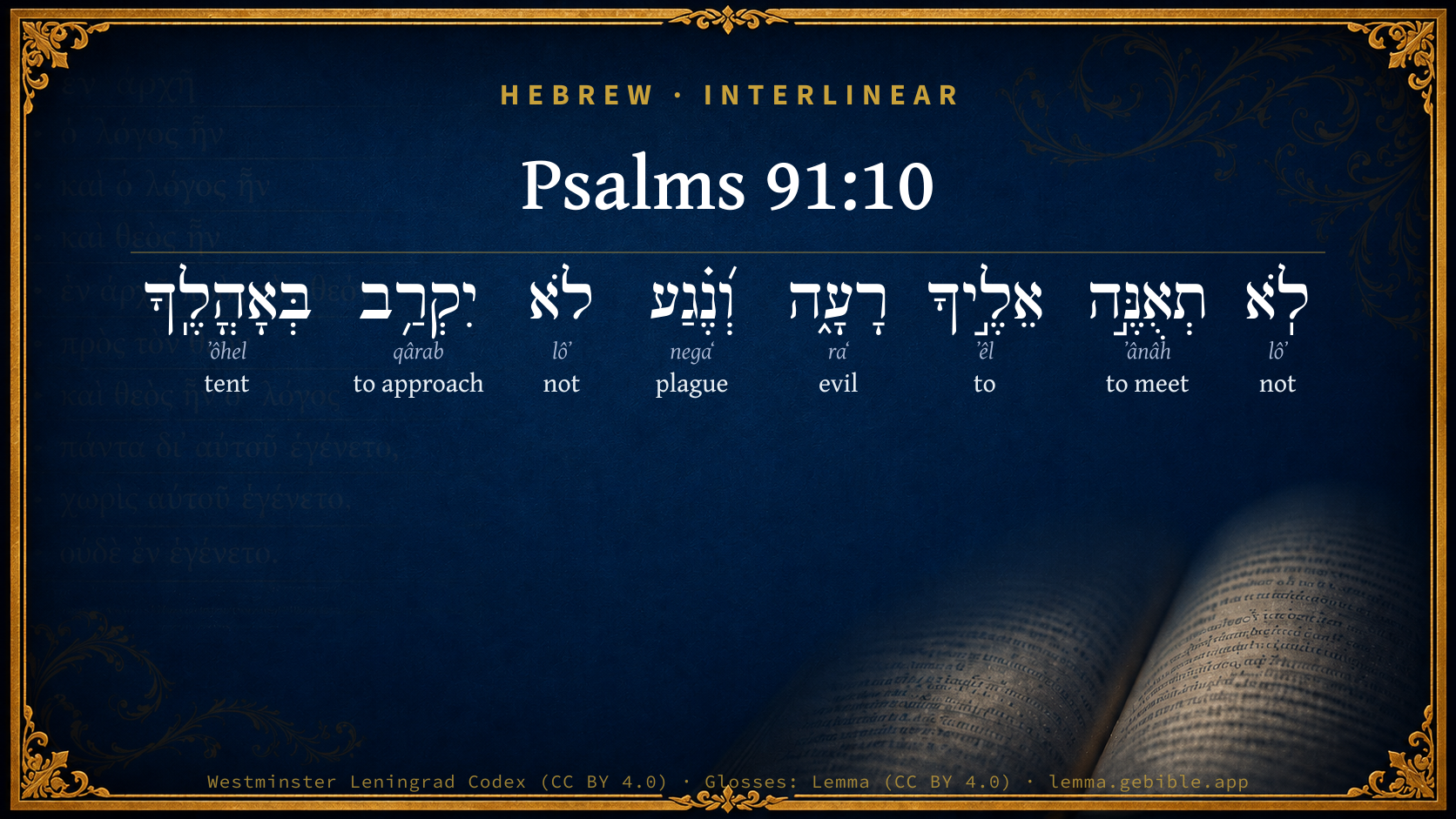
  1. לֹֽא lôʼ H3808 “not” Particle, Negative
  2. אֵלֶ֣יךָ ʼêl H413 “to · you” Preposition + Suffix, Personal, 2nd Person, Masculine, Singular
  3. רָעָ֑ה raʻ H7451 “evil” Noun, Common, Feminine, Singular, Absolute
  4. וְ֝נֶ֗גַע negaʻ H5061 “and · plague” Conjunction + Noun, Common, Masculine, Singular, Absolute
  5. לֹא lôʼ H3808 “not” Particle, Negative
  6. יִקְרַ֥ב qârab H7126 “to approach” Verb, Qal, Imperfect, 3rd Person, Masculine, Singular
  7. בְּאָהֳלֶֽךָ ʼôhel H168 “in/at · tent · your” Preposition + Noun, Common, Masculine, Singular, Construct + Suffix, Personal, 2nd Person, Masculine, Singular

About this verse

These counts appear in no published source. They are computed here, from the morphology-tagged text and Lemma’s own curated glosses. What Lemma adds →

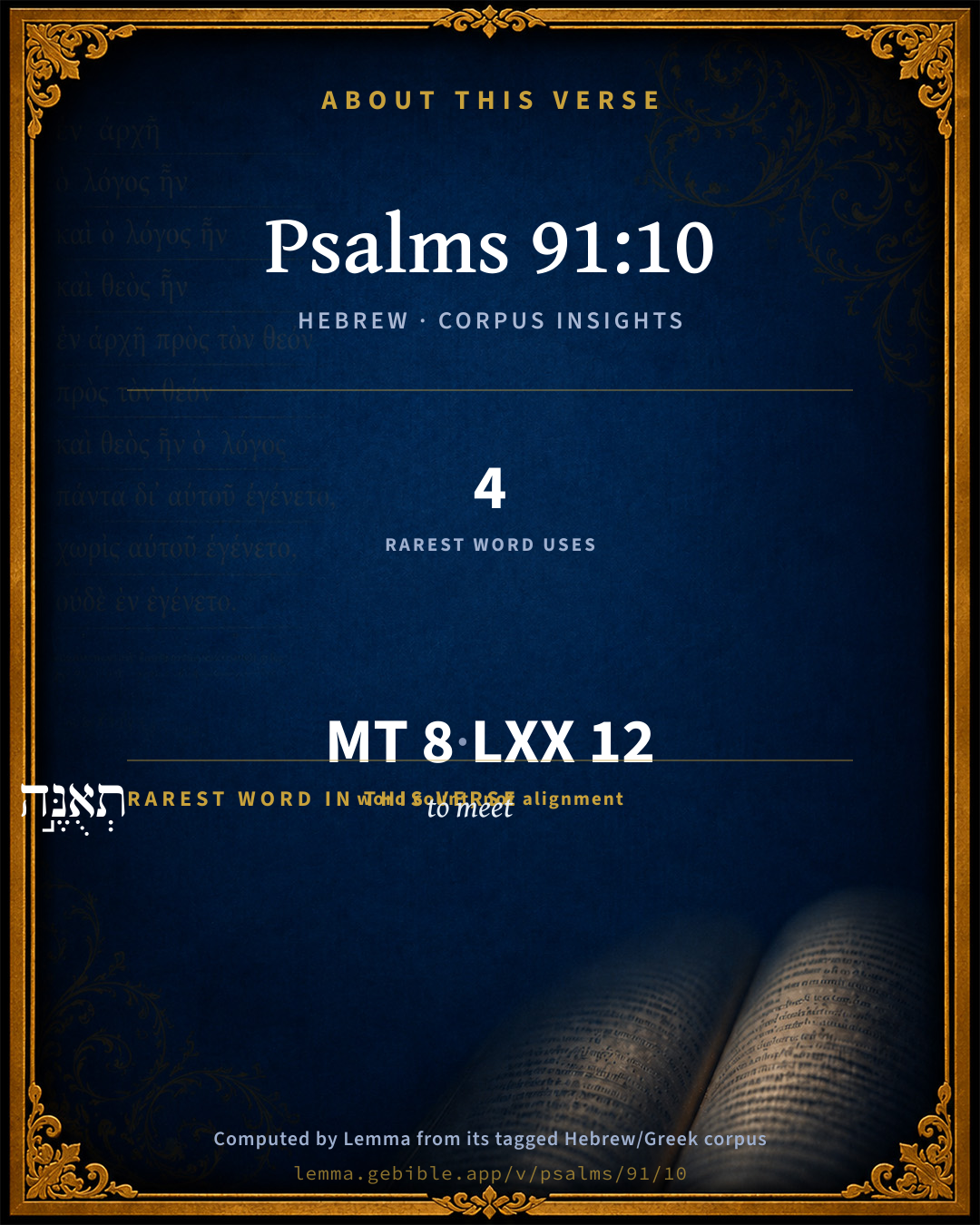
8
words
7
distinct lemmas
Wisdom
section

Notable vocabulary

The rarest word here is תְאֻנֶּ֣ה to meet H579 — appearing just 4 times in the whole Hebrew Bible.

Shared distinctive vocabulary

תְאֻנֶּ֣ה to meet H579 occurs in 4 verses of the Hebrew Bible. Also found in:

Grammatical profile

  • 2 verbs
  • 3 nouns
  • 1 preposition
  • 2 particles

Verb forms

  • תְאֻנֶּ֣ה Pual · Imperfect
  • יִקְרַ֥ב Qal · Imperfect

Repetition

A word recurs within this verse — often emphatic in Hebrew:

Hebrew & Septuagint length

In English translation the verse runs 14 words from the Hebrew and 15 from the Septuagint (LXX English) — closely comparable.

A rough comparison of the two English renderings, which tokenize alike — not a word-level alignment.

Word counts can differ between the Hebrew and the Greek without any difference in meaning — e.g. the Hebrew direct-object marker אֵת has no separate Greek word, and Greek often adds the article ὁ.

In the original languages it is 8 Hebrew tokens and 12 Greek tokens — but the two are counted differently (Hebrew bundles its prefixes and suffixes into one token; the Greek is in lemma form), so that isn’t a like-for-like length.

Cross-references

5

Topical passages linked to Psalms 91:10 in the Treasury of Scripture Knowledge — connected by theme and wording, ordered by reader-vote popularity; previews shown in the World English Bible.

  • Proverbs 12:21 No mischief shall happen to the righteous, But the wicked shall be filled with evil.
  • Psalms 121:7 Yahweh will keep you from all evil. He will keep your soul.
  • Deuteronomy 7:15 Yahweh will take away from you all sickness; and none of the evil diseases of Egypt, which you know, will he put on you, but will lay them on all those who hate you.
  • Romans 8:25 But if we hope for that which we don't see, we wait for it with patience.
  • Job 5:24 You shall know that your tent is in peace. You shall visit your fold, and shall miss nothing.

Cross-references courtesy of OpenBible.info (CC BY 4.0).

Hebrew and Greek witnesses Masoretic Hebrew ↔ Greek Septuagint

The same verse in the two great witnesses to the Old Testament, shown verse-for-verse.

You’re reading Greek Psalm 90 (Hebrew Psalm 91). The Septuagint counts the superscription, so verse numbers can differ from the Hebrew — chapter-level alignment, not verse-by-verse. Numbering follows Rahlfs.

These are two independent witnesses, not word-aligned to each other, and the Septuagint is shown in lemma (dictionary) form.

Hebrew Psalms 91:10 Masoretic · Westminster Leningrad Codex

לֹֽא תְאֻנֶּ֣ה אֵלֶ֣יךָ רָעָ֑ה וְ֝נֶ֗גַע לֹא יִקְרַ֥ב בְּאָהֳלֶֽךָ

No evil shall happen to you, Neither shall any plague come near your dwelling.

World English Bible · Public Domain

Greek LXX Greek Psalm 90:10 Septuagint · lemma form

οὐ προςἔρχομαι πρός σύ κακός καί μάστιξ οὐ ἐγγίζω ὁ σκήνωμα σύ

No evils shall come upon you, and no scourge shall draw near to your dwelling.

LXX2012 (modern English Septuagint) · Public Domain

Hebrew: Westminster Leningrad Codex (CC BY 4.0). Greek: Septuagint (public domain); English from LXX2012 (modern English Septuagint) (Public Domain). How the Septuagint differs from the Hebrew →

Commentary

Notes on Psalms 91:10 from classic Christian and Jewish commentators (each source and its license shown beneath its notes). The classic Christian expositions comment on the surrounding passage and are grouped to its opening verse, so a note may address several verses; the Jewish commentaries on the Tanakh (Rashi and others) are per-verse, so they appear only where the commentator wrote on this verse.

Lemma curates 59 commentaries, every one of them public domain or Creative Commons licensed, each selected and text-cleaned for this edition rather than reprinted as found. About our sources →

Trapp's Complete Commentary

John Trapp

Psa 91:10 There shall no evil befall thee, neither shall any plague come nigh thy dwelling.

Ver. 10. There shall no evil befall the] No devoratory evil, as Tertullian expresseth it; nothing that tendeth ad exitium, but only ad exercitium, and such as shall end in thy good.

Neither shall any plague] What a wonderful separation made the Lord between the houses of the Israelites and the Egyptians, Exo 11:7. See Job 5:1-27, and take these places, as Psa 91:6. For it may befall a saint to share in a common calamity; as the good corn and weeds are cut down together, but for a different end and purpose,

- Non te tua plurima, Pantheu,

Labentem texit pietas -

John Trapp, A Commentary or Exposition upon All the Books of the Old and New Testament (1647–1656) — public domain. Text from a community e-Sword module.

The Biblical Illustrator

Joseph S. Exell

Psa_91:10

Neither shall any plague come nigh thy dwelling.

Immunity from disease

That wealthy promise has not become exhausted by the lapse of time. Rather has the promise acquired a new and deeper significance, and it now embraces in its generous charge the interests of the soul. We move amid moral pestilences. Plague-stricken people are all about us--men and women afflicted with moral and spiritual diseases which carry the germs of perilous contagion. How are we to escape them? The Maser went into the very precincts of the plague, and yet was immune in the foul contagion. Disease demands prepared conditions. If the conditions are absent the contagion is impotent. What, then, was our Lords condition when he entered into fellowship with men and women who were smitten by the plague of sin? The prince of this world cometh, and hath nothing in me. How different it all was in the life of Judas Iscariot! The devil put it into the heart of Judas! The germs fell in the prepared conditions; they found a congenial lodgment, and they bore their issues in an evil life.

1. One of the primary pre-disposing conditions of disease is physical exhaustion. The natural forces are reduced. The energy is spent. The army is driven away from the walls, the gates are left undefended, and the enemy has an open way. Our physical defences are found in the natural resistances of the body. Let these be impoverished, and our security is gone. Let me change the analogy. In the life of the body we are only safe when our income exceeds our expenditure. How is it with the soul? The strength of the soul depends upon the quality of its resistances. If the soul is strong and powerful, the Pharisaic germ of hypocrisy or the microbe of actual vice will gain no foothold. But the soul can become faint. Its defences can be straitened, and the stronghold may then be easily taken at the first besiegement of sin. Now, how does a soul become exhausted? We can use our previous figure: the expenditure has exceeded the income. We have broken correspondencies with our resources. We have ignored the land of rest. Men easily capitulate to the evil one when, by neglect of prayer, they have reduced themselves to spiritual exhaustion.

2. Another of the predisposing conditions to disease is bad food. Diet is not altogether a matter of indifference when we are considering the advance of disease. Some foods are the friends of hostile microbes; they are the forerunners of disease; they prepare the way, arranging congenial conditions. How is it with the soul? Is diet of any moment? With what kind of food are we feeding the mind? Is it a food which predisposes the mind to offer hospitality to the foe? How about our reading? Let us subject ourselves to a rigorous self-investigation. Can we honestly expect our minds to be healthy with the kind of food we give them? Thoughts are foodstuff. Where, then, shall we gather them? He gave them bread from heaven to eat! The Lords bread will make us immune against disease. This is the bread, of which, if a man eat, he shall not die.

3. Another predisposing condition to disease is undisciplined emotion. The bacteriologist has told us that excessive grief and fretfulness open the doors to the invading army of disease. It is not so much some commanding emotional passion which exhausts the body; little frets can do it. We can lose a pound quite as effectually by dropping two hundred and forty pennies as by losing a sovereign. The great point to remember is, that all these dispositions lower the strength and quality of our physical defences. How is it with the soul? Undisciplined emotion is a condition against which we must be on our guard. How easily some people can be stirred into violent emotion! Now, all unharnessed emotion impoverishes the spiritual defences. The devil likes nothing better than to get our emotions well stirred, to make us satisfied with these pleasurable feelings, and then behind our satisfaction to carry on his nefarious work. Emotionalism is the forerunner of evil contagion, and provides conditions for the microbe which will end at last in the bondage of an eradical disease. Let me mention one other predisposing condition of moral and spiritual disease.

4. Our bacteriologists tell us that one of the greatest discoveries of the last generation has been the absolute necessity of scrupulous cleanliness in all surgical work. Our doctors are now vigilant to the last degree in closing every door against the entrance of dirt. Operations are performed with sterilized instruments under the most exacting conditions of cleanliness. The smallest remnant of uncleanliness affords a foothold for disease. How is it with the soul? Is there any need of the same scrupulousness? Are we as vigilant in maintaining the purity of our spirits as the surgeon is in maintaining the cleanliness of His work? Do we not rather treat small scruples lightly, and do we not laugh at the morally painstaking, and label them faddy or puritanical? We retain a dirty little prejudice, or some spirit of undue severity, or some little policy which we persuade ourselves cannot be called wrong, but only expedient; and these retained uncleannesses afford the occasion an opportunity to the enemy of our souls; and through the entrance thus obtained he leads all the forces of darkness and the strong black battalions of hell. If we are to defeat him we shall have to attend to the scruple. One grain of dirt can afford sustenance to a host of microbes. Now, let me recall the glorious promise with which I began. Neither shall any plague come nigh thy dwelling. It is possible for us to be in the world and yet not of it, to mix with sinners and yet be separate from them, to be perfectly pure and yet to go and be their minister and guest. Our only security is in God. In Him we have all-sufficient defences. (J. H. Jowett, M.A.)

Safety from disease

In 1854, when Mr. Spurgeon had scarcely been twelve months in London, there was raging there a fearful epidemic of Asiatic cholera. With all his youthful ardour he plunged at once into the work of relieving the sick and the suffering and the dying, and of burying the dead. Weary and worn with much work, he one day came back from a funeral service feeling as though he himself were a prey to the awful judgment and scourge of God. He was passing along a certain street, and he observed in the window of a shoemakers shop a paper wafered to a pane of glass, and on which were inscribed in large characters the 9th and 10th verses of the 91st psalm--Because thou hast made the Lord, which is my refuge, even the Most High, thy habitation; there shall no evil befall thee, neither shall any plague come nigh thy dwelling. Mr. Spurgeon said, That was Gods message to me. I at once took heart, and from that moment I neither felt any fear of the cholera myself nor did I suffer any harm from repeated ministries upon the sick and the dying.

The Biblical Illustrator, edited by Joseph S. Exell (c. 1880s–1900s) — public domain. Text from a community e-Sword module.

The Treasury of David

Charles H. Spurgeon

Ver. 10. There shall no evil befall thee, etc. It is a security in the very midst of evils. Not like the security of angelssafety in a world of safety, quiet in a calm; but it is quiet in a storm; safety amid desolation and the elements of destruction, deliverance where everything else is going to wreck. Cicaties Bradley, 1840.

Ver. 10. God doth not say no afflictions shall befall us, but no evil. Thomas Watson.

Ver. 10. Sin which has kindled a fire in hell, is kindling fires on earth continually. And when they break out, every one is asking how they happened. Amos replies, "Shall there be evil in a city, and the Lord hath not done it?" And when desolation is made by fire, Isaiah declares, The Lord hath "consumed us, because of our iniquities." Many years ago my house was oft threatened to be destroyed, but the Lord insured it, by giving me Ps 91:10; and the Lord's providence is the best insurance. John Bridge.

Ver. 10.

1. The Personal Blessing.

2. The Domestic Blessing.

3. The connection between the two.

Psalms 91:11*

Charles H. Spurgeon's The Treasury of David (1869–1885) — public domain. Psalms only. Text from a community e-Sword/MySword module.

J. A. Alexander on Psalms

Joseph Addison Alexander

10. (Psa 91:10) There shall not happen to thee (any) evil, and a stroke shall not approach into thy tent. The first verb is a causative passive, and strictly means, shall not be suffered or allowed to happen. Evil, i.e. natural evil, suffering or distress. The word translated stroke is very commonly applied to God's strokes or afflictive judgments. See above, on Psa 38:11; Psa 39:10. Into thy tent is an expression apparently intended to qualify the promise, which might otherwise have seemed too absolute and inconsistent with the context, from which we learn that danger was to draw nigh, even to the righteous, but not so as actually to enter his tent, and take up its abode with him.

Joseph Addison Alexander, The Psalms Translated and Explained (1850) — public domain. Text from a community e-Sword module.

Ellicott's Commentary for English Readers

(10) Dwelling.—Literally, tent: an instance in which the patriarchal life became stereotyped, so to speak, in the language. (See Note, Psa_104:3.) Even we speak of “pitching our tent.”

A Bible Commentary for English Readers, edited by Charles John Ellicott (1878–1897) — public domain. Text from a community e-Sword module.

The Cambridge Bible for Schools and Colleges

gen. ed. J. J. S. Perowne

10. befall thee] Lit., be let befall thee. Cp. Pro_12:21.

thy dwelling] Lit., thy tent, a survival of the language of nomad life.

The Cambridge Bible for Schools and Colleges (gen. ed. J. J. S. Perowne; Cambridge University Press, 1878–1918) — public domain. Text from a community e-Sword module.

John Gill's Exposition

There shall no evil befall thee,.... The evil of sin cleaves to the best of saints, the evil of temptations besets them, and the evil of afflictions comes upon them, as chastisements from the Lord; for they must expect to receive evil, in this sense, as well as good, from his hands; but the evil of punishment never touches them; and therefore, when any public calamity befalls them in common with others, yet not as an evil of punishment; it is not an evil to them, it is for their good:

neither shall any plague come nigh thy dwelling; how should it, when they dwell in God, and have made him, the most High, their habitation (u); Psa 91:1 otherwise it may come nigh their temporal dwellings; See Gill on Psa 91:7 though it may not enter into them; and, should it, yet not as an evil, or by way of punishment; see Pro 3:33.

(u) "excelsum posuisti habitaculum tuum", Pagninus, Montanus, De Dieu, Gejerus.

John Gill's Exposition of the Whole Bible (1746–1763) — public domain (CC PDM 1.0). Text via the HelloAO Bible API.

Albert Barnes' Notes on the Bible

There shall no evil befall thee - The Chaldee Paraphrase has, “The Lord of the world answered and said, ‘There shall no evil befall thee,’” etc. The sentiment, however, is that the psalmist could assure such an one, from his own personal experience, that he would be safe. He had himself made Yahweh his refuge, and he could speak with confidence of the safety of doing so. This, of course, is to be understood as a general truth, in accordance with what has been said above.

Neither shall any plague come nigh thy dwelling - On the word rendered “plague” here נגע nega‛ - see Psa 38:12, note; Psa 39:11, note. It is not the same word which is used in Psa 91:6, and translated “pestilence;” and it does not refer to what is technically called the “plague.” It may denote anything that would be expressive of the divine displeasure, or that would be sent as a punishment. The word rendered “dwelling” here means a tent; and the idea is, that no such mark of displeasure would abide with him, or enter his tent as its home. Of course, this also must be understood as a general promise, or as meaning that religion would constitute a general ground of security.

Albert Barnes' Notes on the Bible (1834–1885) — public domain. Text from a community e-Sword/MySword module.

Matthew Poole's English Annotations

To wit, so as to destroy thee, as the next verse limits and expounds it. For surely this promise is not made to all that dwell nigh to his children and servants, who may possibly be wicked men, and so strangers from God’s covenant and promises. How far this secures his own person, See Poole "Psa 91:7".

Matthew Poole's English Annotations on the Holy Bible (1683–1685) — public domain. Text from a community e-Sword/MySword module.

Whedon's Commentary on the Bible

Daniel D. Whedon

10. Come nigh thy dwelling—The allusion is to Exo_12:23. Compare Isa_54:14

Daniel D. Whedon (gen. ed.), Commentary on the Old and New Testaments (1874–1909) — public domain. Text from a community e-Sword module.

The Pulpit Commentary

There shall no evil befall thee, neither shall any plague come nigh thy dwelling. The faithful man is to be preserved from evil of every kind. His very "dwelling" is to be protected so that his family may suffer no hurt.

The Pulpit Commentary (1880–1919), ed. H.D.M. Spence-Jones & Joseph S. Exell — public domain. Text from a community e-Sword module.

unfoldingWord translationNotes

Door43 World Missions Community

No evil will overtake you

The writer speaks of a person experiencing bad or evil things as if evil were a person who overtakes another person. AT: "Nothing evil will happen to you" (See: Metaphor and Personification)

no affliction will come near your home

The psalmist speaks of people who afflict others as though they were the harm they cause. AT: "no one will be able to harm your family" (See: Personification and Metonymy)

For he will direct

"Yahweh will command"

in all your ways

The psalmist speaks of the way a person lives his life as if it were a path down which the person walked. AT: "in everything you do" or "at all times" (See: Metaphor)

translationWords

evil

afflicted

angel

unfoldingWord translationNotes — © Distant Shores Media and the Door43 World Missions Community, licensed CC BY-SA 4.0. Source: git.door43.org/Door43/en_tn.

Rashi

Rabbi Shlomo Yitzchaki (Rashi)

No...will befall Heb. לא תאנה, will not happen. Similarly, (Exod. 21:13): “and God allowed it to happen (אנה) to his hand.”

Rashi on the Tanakh — English translations: “The Judaica Press complete Tanach with Rashi, translated by A. J. Rosenberg” (CC BY 4.0); “Pentateuch with Rashi's commentary by M. Rosenbaum and A.M. Silbermann, 1929-1934” (public domain); “The Metsudah Tanach series, Lakewood, N.J” (CC BY 4.0); and “The Book of Joshua, Metsudah Publications, 1997” (CC BY 4.0). Text via Sefaria.

Lesson kit

Teaching starters — assembled from the data on this page, not authored interpretation. Every prompt links to the verse data it draws on. Edit before teaching.

Psalms, in the Wisdom, opens this verse with 8 words (7 distinct Hebrew lemmas). Its most distinctive word is ʼânâh (“to meet”). A historical commentator’s framing appears above. Read the whole chapter for the surrounding context.

Discussion questions

  1. What does “to meet” (ʼânâh) contribute to the verse as a whole?
  2. How does Exodus 21:13, which shares the word «to meet», read alongside this verse?
  3. What does the repetition of “not” (2× in this one verse) do in this verse?
  4. These translations render this verse differently. What is at stake in choosing one wording over another?
  5. «תְאֻנֶּ֣ה» is a Pual Imperfect verb. How does that grammatical form shape the action described?
  6. Compare how Trapp's Complete Commentary and The Biblical Illustrator read this verse. Where do they agree or differ?

Things to notice

Reading settings

Reading text

Shown beneath each verse's original-language words.

Old Testament
Old Testament edition

Read the OT as the Masoretic Hebrew (MT) or the Greek Septuagint (LXX).

English shown for the Greek Septuagint (in the Hebrew ↔ Greek comparison).

Comparing translations? Open the Compare panel on any verse page to stack up to four side by side.