
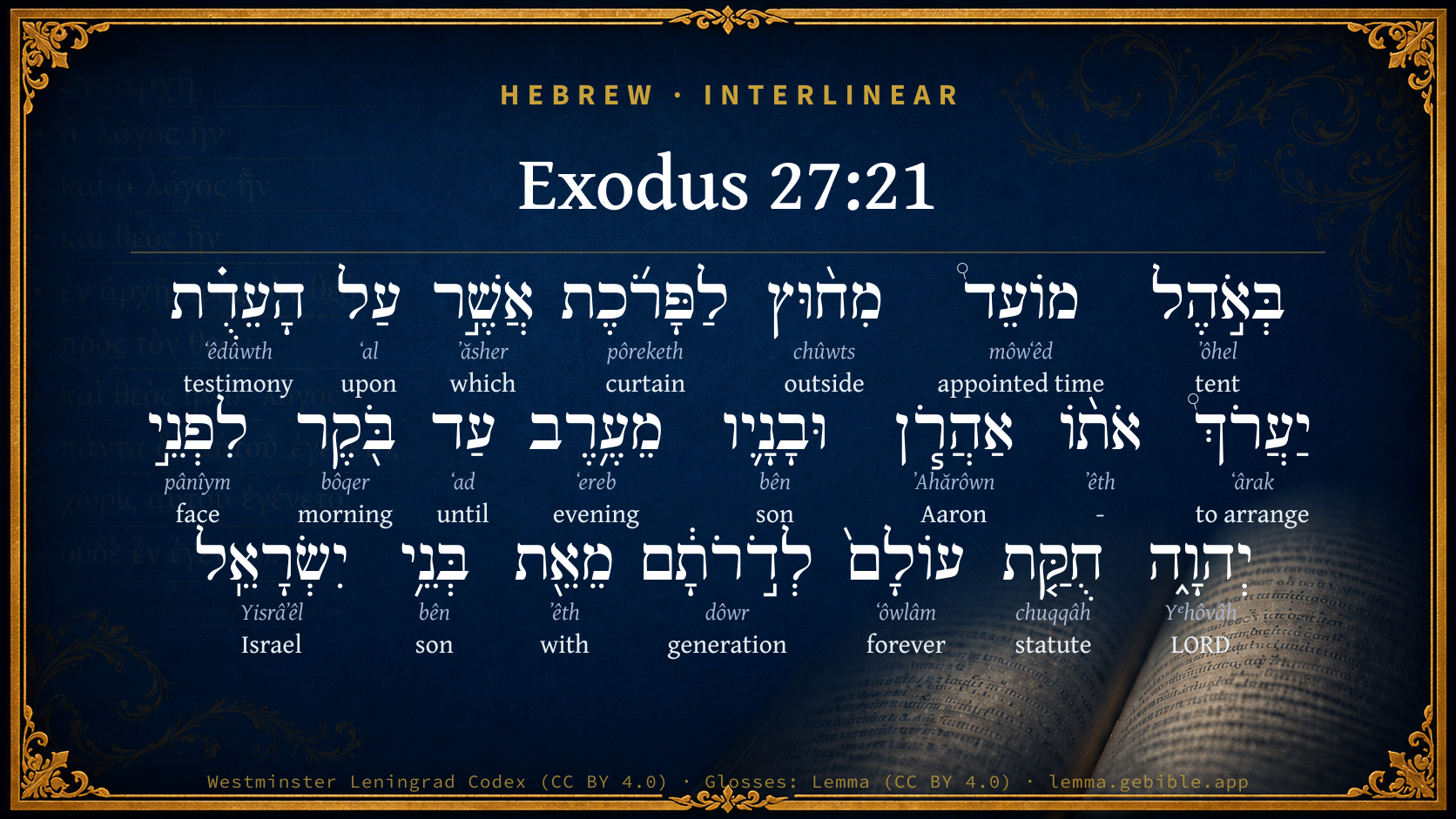
Exodus 27:21

Hebrew (Westminster Leningrad Codex) Exodus 27:21 appears in the Hebrew Old Testament. The text above is from the Westminster Leningrad Codex. Each word links to its Strong’s number, a concise gloss, and parsing drawn from the Open Scriptures Hebrew Bible morphology. Click any word for its full Brown-Driver-Briggs (BDB) entry.
Download image
Cite this verse

Exodus 27:21 (World English Bible). Public Domain. Lemma interlinear Bible study tool, https://lemma.gebible.app/v/exodus/27/21.

Show BibTeX & RIS
BibTeX
RIS
English Translation
In the tent of meeting, outside the veil which is before the testimony, Aaron and his sons shall keep it in order from evening to morning before Yahweh: it shall be a statute forever throughout their generations on the behalf of the children of Israel.
World English Bible · Public Domain
Download a study sheet

One document with this verse’s original text, its word-by-word gloss line, the meaning frame, cross-references with their text, attributed commentary, and full source and license credits — printable, and it pastes into notes with its structure intact.

This verse Autodidact and up

Study sheet (.html) Plain text (.txt)

A passage Seminary Student

Up to 50 verses in one chapter. A passage sheet keeps up to 6 commentary sources and 12 cross-references per verse, in the order this page ranks them, and says so on the sheet whenever that leaves anything out. Ask for a single verse and you get the Autodidact verse sheet above.

Everything on this page stays free to read, with no account — the sheet is a download of what is already on screen, not access to it.

Want to remove ads? Support Godless Engineer
Compare translations 3

The same verse in 3 English versions, stacked beneath the original-language interlinear above. Click any original word for its lexicon entry.

Each is an independent rendering of the whole verse — the interlinear is not word-aligned to these translations.

Highlighted words mark where these versions differ — a whole-verse word diff, not a word-by-word alignment.

  • World English Bible Public Domain
    In the tent of meeting, outside the veil which is before the testimony, Aaron and his sons shall keep it in order from evening to morning before Yahweh: it shall be a statute forever throughout their generations on the behalf of the children of Israel.
  • King James Version Public Domain
    In the tabernacle of the congregation without the vail, which is before the testimony, Aaron and his sons shall order it from evening to morning before the LORD: it shall be a statute for ever unto their generations on the behalf of the children of Israel.
  • unfoldingWord Literal Text CC BY-SA 4.0
    In the tent of meeting, outside the curtain inside of which is the testimony, Aaron and his sons shall arrange it before the face of Yahweh, from evening to morning. This is an eternal statute throughout the generations of the sons of Israel.

unfoldingWord Literal Text — © unfoldingWord, licensed CC BY-SA 4.0. Word-aligned USFM3 via Door43 (git.door43.org/unfoldingWord/en_ult).

Versions to compare (up to 4)

3 of 4 selected

Show all 18 translations

Every available English version of this verse, each an independent rendering of the whole verse.

  • World English Bible Public Domain
    In the tent of meeting, outside the veil which is before the testimony, Aaron and his sons shall keep it in order from evening to morning before Yahweh: it shall be a statute forever throughout their generations on the behalf of the children of Israel.
  • Berean Standard Bible Public Domain
    In the Tent of Meeting, outside the veil that is in front of the Testimony, Aaron and his sons are to tend the lamps before the LORD from evening until morning. This is to be a permanent statute for the Israelites for the generations to come.
  • Majority Standard Bible Public Domain
    In the Tent of Meeting, outside the veil that is in front of the Testimony, Aaron and his sons are to tend the lamps before the LORD from evening until morning. This is to be a permanent statute for the Israelites for the generations to come.
  • King James Version Public Domain
    In the tabernacle of the congregation without the vail, which is before the testimony, Aaron and his sons shall order it from evening to morning before the LORD: it shall be a statute for ever unto their generations on the behalf of the children of Israel.
  • American Standard Version (1901) Public Domain
    In the tent of meeting, without the veil which is before the testimony, Aaron and his sons shall keep it in order from evening to morning before Jehovah: it shall be a statue for ever throughout their generations on the behalf of the children of Israel.
  • Revised Version (1885) Public Domain
    In the tent of meeting, without the veil which is before the testimony, Aaron and his sons shall order it from evening to morning before the LORD: it shall be a statute for ever throughout their generations on the behalf of the children of Israel.
  • Geneva Bible (1599) Public Domain
    In the Tabernacle of the Congregation without the vaile, which is before the Testimony, shall Aaron and his sonnes dresse them from euening to morning before the Lord, for a statute for euer vnto their generations, to be obserued by the children of Israel.
  • Douay-Rheims (1899) Public Domain
    In the tabernacle of the testimony without the veil that hangs before the testimony. And Aaron and his sons shall order it, that it may give light before the Lord until the morning. It shall be a perpetual observance throughout their successions among the children of Israel.
  • Young's Literal Translation Public Domain
    in the tent of meeting, at the outside of the vail, which `is' over the testimony, doth Aaron -- his sons also -- arrange it from evening till morning before Jehovah -- a statute age-during to their generations, from the sons of Israel.
  • Literal Standard Version CC BY-SA 4.0
    In the Tent of Meeting, at the outside of the veil, which [is] over the Testimony, Aaron—his sons also—arrange it from evening until morning before YHWH. [It is] a continuous statute for their generations, from the sons of Israel.”
  • Unlocked Literal Bible CC BY-SA 4.0
    In the tent of meeting, outside the curtain that is in front of the tabernacle that contains the ark of testimony, Aaron and his sons must keep the lamps burning before Yahweh, from evening to morning. This requirement will be a lasting ordinance throughout the generations of the people of Israel.
  • unfoldingWord Literal Text CC BY-SA 4.0
    In the tent of meeting, outside the curtain inside of which is the testimony, Aaron and his sons shall arrange it before the face of Yahweh, from evening to morning. This is an eternal statute throughout the generations of the sons of Israel.
  • Darby Bible Public Domain
    In the tent of meeting outside the veil, which is before the testimony, Aaron and his sons shall dress them from evening to morning before Jehovah: [it is] an everlasting statute, for their generations, on the part of the children of Israel.
  • World Messianic Bible Public Domain
    In the Tent of Meeting, outside the veil which is before the covenant, Aaron and his sons shall keep it in order from evening to morning before the LORD: it shall be a statute forever throughout their generations on the behalf of the children of Israel.
  • Webster's Bible Public Domain
    In the tabernacle of the congregation without the vail, which is before the testimony, Aaron and his sons shall order it from evening to morning before the LORD: It shall be a statute for ever to their generations on the behalf of the children of Israel.
  • Free Bible Version CC BY-SA 4.0
    In the Tent of Meeting, outside the veil in front of the Testimony, Aaron and his sons are to keep the lamps burning in the Lord's presence from evening until morning. This requirement is to be observed by the Israelites for all generations.
  • Bible in Basic English Public Domain
    Let Aaron and his sons put this in order, evening and morning, before the Lord, inside the Tent of meeting, outside the veil which is before the ark; this is to be an order for ever, from generation to generation, to be kept by the children of Israel.
  • JPS Tanakh (1917) Public Domain
    In the tent of meeting, without the veil which is before the testimony, Aaron and his sons shall set it in order, to burn from evening to morning before the LORD; it shall be a statute for ever throughout their generations on the behalf of the children of Israel.

Literal Standard Version (2020), Covenant Press — licensed CC BY-SA 4.0. Text via the HelloAO Bible API (eBible.org). Unlocked Literal Bible (unfoldingWord) — licensed CC BY-SA 4.0. Text via the HelloAO Bible API (eBible.org). unfoldingWord Literal Text — © unfoldingWord, licensed CC BY-SA 4.0. Word-aligned USFM3 via Door43 (git.door43.org/unfoldingWord/en_ult). Free Bible Version, Dr. Jonathan Gallagher — licensed CC BY-SA 4.0. Text via the HelloAO Bible API (eBible.org).

Word by word

More ways to search: Search by grammar → Find every occurrence → Compare this word →

Practice this passage: Drill this verse → Learn its vocabulary →

לַפָּרֹ֜כֶת
pôreketh
H6532
“to/for the · curtain”
Preposition, Determined + Noun, Common, Feminine, Singular, Absolute
Part of Speech
Preposition + Noun
Type
Common
Gender
Feminine
Number
Singular
State
Absolute
Full BDB Definition

Origin: act part of the same as H6531

TWOT: 1818a

curtain, veil
  1. בְּאֹ֣הֶל ʼôhel H168 “in/at · tent of” Preposition + Noun, Common, Masculine, Singular, Construct
  2. מוֹעֵד֩ môwʻêd H4150 “appointed time” Noun, Common, Masculine, Singular, Absolute
  3. מִח֨וּץ chûwts H2351 “from · outside” Preposition + Noun, Common, Masculine, Singular, Absolute
  4. אֲשֶׁ֣ר ʼăsher H834 “which” Particle, Relative
  5. עַל ʻal H5921 “upon” Preposition
  6. הָעֵדֻ֗ת ʻêdûwth H5715 “the · testimony” Particle, Definite Article + Noun, Common, Feminine, Singular, Absolute
  7. יַעֲרֹךְ֩ ʻârak H6186 “to arrange” Verb, Qal, Imperfect, 3rd Person, Masculine, Singular
  8. אֹת֨וֹ ʼêth H853 “- · him” Particle, Direct Object + Suffix, Personal, 3rd Person, Masculine, Singular
  9. אַהֲרֹ֧ן ʼAhărôwn H175 “Aaron” Noun, Proper
  10. וּבָנָ֛יו bên H1121 “and · sons · his” Conjunction + Noun, Common, Masculine, Plural, Construct + Suffix, Personal, 3rd Person, Masculine, Singular
  11. מֵעֶ֥רֶב ʻereb H6153 “from · evening” Preposition + Noun, Common, Masculine, Singular, Absolute
  12. עַד ʻad H5704 “until” Preposition
  13. בֹּ֖קֶר bôqer H1242 “morning” Noun, Common, Masculine, Singular, Absolute
  14. לִפְנֵ֣י pânîym H6440 “to/for · face(s) of” Preposition + Noun, Common, Both, Plural, Construct
  15. יְהוָ֑ה Yᵉhôvâh H3068 “LORD” Noun, Proper
  16. חֻקַּ֤ת chuqqâh H2708 “statute of” Noun, Common, Both, Singular, Construct
  17. עוֹלָם֙ ʻôwlâm H5769 “forever” Noun, Common, Masculine, Singular, Absolute
  18. לְדֹ֣רֹתָ֔ם dôwr H1755 “to/for · generations · their” Preposition + Noun, Common, Masculine, Plural, Construct + Suffix, Personal, 3rd Person, Masculine, Plural
  19. מֵאֵ֖ת ʼêth H854 “from · with” Preposition + Preposition
  20. בְּנֵ֥י bên H1121 “sons of” Noun, Common, Masculine, Plural, Construct
  21. יִשְׂרָאֵֽל Yisrâʼêl H3478 “Israel” Noun, Proper

About this verse

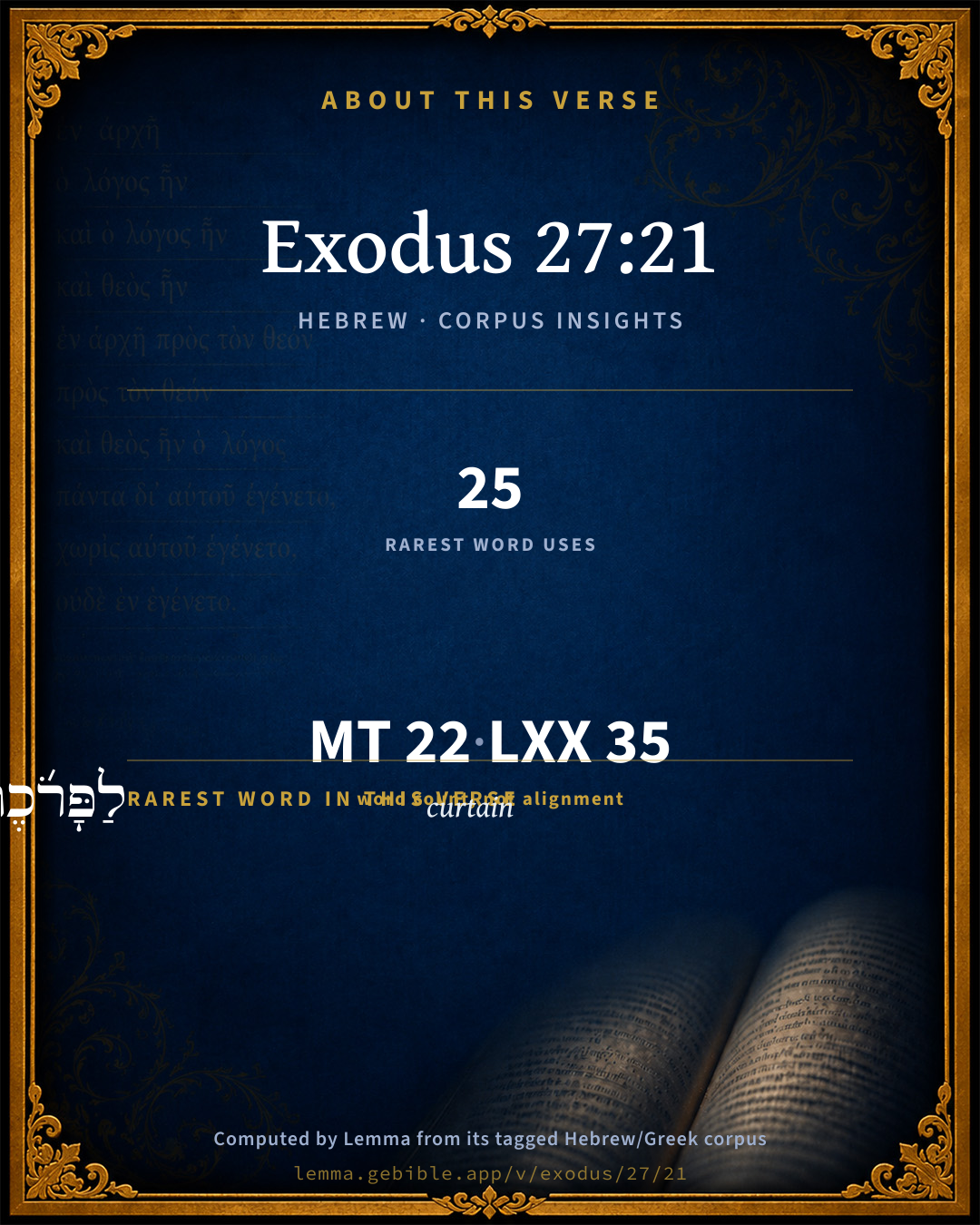
These counts appear in no published source. They are computed here, from the morphology-tagged text and Lemma’s own curated glosses. What Lemma adds →

22
words
21
distinct lemmas
Pentateuch
section

Notable vocabulary

The rarest word here is לַפָּרֹ֜כֶת curtain H6532 — appearing just 25 times in the whole Hebrew Bible.

Shared distinctive vocabulary

לַפָּרֹ֜כֶת curtain H6532 occurs in 23 verses of the Hebrew Bible. Also found in:

Grammatical profile

  • 1 verb
  • 16 nouns
  • 3 prepositions
  • 2 particles

Verb forms

  • יַעֲרֹךְ֩ Qal · Imperfect

Repetition

A word recurs within this verse — often emphatic in Hebrew:

  • וּבָנָ֛יו son H1121 ×2

Hebrew & Septuagint length

In English translation the verse runs 45 words from the Hebrew and 44 from the Septuagint (LXX English) — closely comparable.

A rough comparison of the two English renderings, which tokenize alike — not a word-level alignment.

Word counts can differ between the Hebrew and the Greek without any difference in meaning — e.g. the Hebrew direct-object marker אֵת has no separate Greek word, and Greek often adds the article ὁ.

In the original languages it is 22 Hebrew tokens and 35 Greek tokens — but the two are counted differently (Hebrew bundles its prefixes and suffixes into one token; the Greek is in lemma form), so that isn’t a like-for-like length.

Cross-references

33

Topical passages linked to Exodus 27:21 in the Treasury of Scripture Knowledge — connected by theme and wording, ordered by reader-vote popularity; previews shown in the World English Bible.

  • Numbers 18:23 But the Levites shall do the service of the tent of meeting, and they shall bear their iniquity: it shall be a statute forever throughout your generations; and among the children of Israel they shall have no inheritance.
  • Numbers 19:21 It shall be a perpetual statute to them: and he who sprinkles the water for impurity shall wash his clothes, and he who touches the water for impurity shall be unclean until even.
  • Exodus 30:8 When Aaron lights the lamps at evening, he shall burn it, a perpetual incense before Yahweh throughout your generations.
  • Leviticus 3:17 "'It shall be a perpetual statute throughout your generations in all your dwellings, that you shall eat neither fat nor blood.'"
  • Leviticus 16:34 "This shall be an everlasting statute for you, to make atonement for the children of Israel once in the year because of all their sins." It was done as Yahweh commanded Moses.
  • 1 Samuel 3:3 and the lamp of God hadn't yet gone out, and Samuel had laid down [to sleep], in the temple of Yahweh, where the ark of God was;
  • 2 Chronicles 13:11 and they burn to Yahweh every morning and every evening burnt offerings and sweet incense: the show bread also [set they] in order on the pure table; and the lampstand of gold with the lamps of it, to burn every evening: for we keep the charge of Yahweh our God; but you have forsaken him.
  • Exodus 28:43 They shall be on Aaron, and on his sons, when they go in to the tent of meeting, or when they come near to the altar to minister in the holy place; that they don't bear iniquity, and die: it shall be a statute forever to him and to his descendants after him.
  • 1 Samuel 30:25 It was so from that day forward, that he made it a statute and an ordinance for Israel to this day.
  • John 5:35 He was the burning and shining lamp, and you were willing to rejoice for a while in his light.
  • 2 Peter 1:19 We have the more sure word of prophecy; whereunto you do well that you take heed, as to a lamp shining in a dark place, until the day dawns, and the day star arises in your hearts:
  • Matthew 4:16 The people who sat in darkness saw a great light, To those who sat in the region and shadow of death, To them light has dawned."
  • Luke 12:35 "Let your loins be girded and your lamps burning.
  • 2 Corinthians 4:6 seeing it is God who said, "Light will shine out of darkness," who has shone in our hearts, to give the light of the knowledge of the glory of God in the face of Jesus Christ.
  • Revelation 2:1 To the angel of the assembly in Ephesus write: "He who holds the seven stars in his right hand, he who walks among the seven golden lampstands says these things:
  • Genesis 1:5 God called the light Day, and the darkness he called Night. There was evening and there was morning, one day.
  • Genesis 1:8 God called the expanse sky. There was evening and there was morning, a second day.
  • Exodus 16:34 As Yahweh commanded Moses, so Aaron laid it up before the Testimony, to be kept.
  • Exodus 25:16 You shall put the testimony which I shall give you into the ark.
  • Exodus 25:21–22 You shall put the mercy seat on top of the ark, and in the ark you shall put the testimony that I will give you.
  • Exodus 26:31–33 "You shall make a veil of blue, and purple, and scarlet, and fine twined linen, with cherubim. The work of the skillful workman shall it be made.
  • Exodus 29:9–10 You shall dress them with belts, Aaron and his sons, and bind headbands on them: and they shall have the priesthood by a perpetual statute: and you shall consecrate Aaron and his sons.
  • Exodus 29:28 and it shall be for Aaron and his sons as their portion forever from the children of Israel; for it is a heave-offering: and it shall be a heave-offering from the children of Israel of the sacrifices of their peace-offerings, even their heave-offering to Yahweh.
  • Exodus 29:42 It shall be a continual burnt offering throughout your generations at the door of the tent of meeting before Yahweh, where I will meet with you, to speak there to you.
  • Exodus 29:44 I will sanctify the tent of meeting and the altar: Aaron also and his sons I will sanctify, to minister to me in the priest's office.
  • Exodus 30:36 and you shall beat some of it very small, and put some of it before the testimony in the tent of meeting, where I will meet with you. It shall be to you most holy.
  • Exodus 40:3 You shall put the ark of the testimony in it, and you shall screen the ark with the veil.
  • Leviticus 3:8 and he shall lay his hand on the head of his offering, and kill it before the tent of meeting: and Aaron's sons shall sprinkle its blood on the altar round about.
  • Leviticus 24:3 Outside of the veil of the Testimony, in the Tent of Meeting, shall Aaron keep it in order from evening to morning before Yahweh continually: it shall be a statute forever throughout your generations.
  • Leviticus 24:9 It shall be for Aaron and his sons; and they shall eat it in a holy place: for it is most holy to him of the offerings of Yahweh made by fire by a perpetual statute."
  • Numbers 8:9 You shall present the Levites before the Tent of Meeting. You shall assemble the whole congregation of the children of Israel.
  • Psalms 134:1 Look! Praise Yahweh, all you servants of Yahweh, Who stand by night in Yahweh's house!
  • Malachi 2:7 For the priest's lips should keep knowledge, and they should seek the law at his mouth; for he is the messenger of Yahweh of Hosts.

Cross-references courtesy of OpenBible.info (CC BY 4.0).

Hebrew and Greek witnesses Masoretic Hebrew ↔ Greek Septuagint

The same verse in the two great witnesses to the Old Testament, shown verse-for-verse.

These are two independent witnesses, not word-aligned to each other, and the Septuagint is shown in lemma (dictionary) form.

Hebrew Exodus 27:21 Masoretic · Westminster Leningrad Codex

בְּאֹ֣הֶל מוֹעֵד֩ מִח֨וּץ לַפָּרֹ֜כֶת אֲשֶׁ֣ר עַל הָעֵדֻ֗ת יַעֲרֹךְ֩ אֹת֨וֹ אַהֲרֹ֧ן וּבָנָ֛יו מֵעֶ֥רֶב עַד בֹּ֖קֶר לִפְנֵ֣י יְהוָ֑ה חֻקַּ֤ת עוֹלָם֙ לְדֹ֣רֹתָ֔ם מֵאֵ֖ת בְּנֵ֥י יִשְׂרָאֵֽל

In the tent of meeting, outside the veil which is before the testimony, Aaron and his sons shall keep it in order from evening to morning before Yahweh: it shall be a statute forever throughout their generations on the behalf of the children of Israel.

World English Bible · Public Domain

Greek LXX Exodus 27:21 Septuagint · lemma form

ἐν ὁ σκηνή ὁ μαρτύριον ἔξωθεν ὁ καταπέτασμα ὁ ἐπί ὁ διαθήκη καίω αὐτός ααρων καί ὁ υἱός αὐτός ἀπό ἑσπέρα ἕως πρωΐ ἐναντίον κύριος νόμιμος αἰώνιος εἰς ὁ γενεά σύ παρά ὁ υἱός ἰσραήλ

in the tabernacle of the testimony, without the veil that is before the ark of the covenant, shall Aaron and his sons burn it from evening until morning, before the Lord: it is a perpetual ordinance throughout your generations of the children of Israel.

LXX2012 (modern English Septuagint) · Public Domain

On this verse, Adam Clarke's Commentary discusses the Septuagint’s reading. Read the note in Commentary ↓

Hebrew: Westminster Leningrad Codex (CC BY 4.0). Greek: Septuagint (public domain); English from LXX2012 (modern English Septuagint) (Public Domain). How the Septuagint differs from the Hebrew →

Targum (Aramaic paraphrase)

2

The Targum is the ancient Jewish Aramaic paraphrase of the Hebrew Scriptures — an interpretive translation, not the Hebrew text itself. Onkelos (literal) and Pseudo-Jonathan (expansive) render the Torah, and Jonathan the Prophets. Coverage is partial: where no permissively-licensed English translation exists for a verse, only the Aramaic is shown. This is verse-level text, not a word-by-word alignment to the Hebrew.

  1. Targum Onkelos Torah (Genesis–Deuteronomy)
    בְּמַשְׁכַּן זִמְנָא מִבָּרָא לְפָרֻכְתָּא דְעַל סַהֲדוּתָא יְסַדַר יָתֵהּ אַהֲרֹן וּבְנוֹהִי מֵרַמְשָׁא עַד צַפְרָא קָדָם יְיָ קְיָם עֲלָם לְדָרֵיהוֹן מִן בְּנֵי יִשְׂרָאֵל:

    (no public-domain English translation for this verse)

    Targum Onkelos — Aramaic: “Onkelos Genesis” (public domain); “Onkelos Exodus” (public domain); “Onkelos Leviticus” (public domain); “Onkelos Numbers” (public domain); “Onkelos Deuteronomy” (public domain). English: “Sefaria Community Translation” (CC0 1.0 (public-domain dedication)); “J.W. Etheridge. The Targums of Onkelos and Jonathan Ben Uzziel on the Pentateuch. London: Longmans, Green, 1862” (public domain). Text via Sefaria.

  2. Targum Pseudo-Jonathan Torah (Genesis–Deuteronomy)
    בְּמַשְׁכַּן זִימְנָא מִבָּרָא לְפַרְגוֹדָא דְעַל סַהֲדוּתָא יְסַדֵּר יָתֵיהּ אַהֲרן וּבְנוֹי מִן רַמְשָׁא עַד צַפְרָא קֳדָם יְיָ קְיַים עֲלָם לְדָרֵיהוֹן מִן בְּנֵי יִשְרָאֵל

    In the tabernacle of the covenant, without the veil that is before the testimony, Aharon and his sons shall set it in order from evening until morning before the Lord, an everlasting statute to your generations of the house of Israel.

    Targum Pseudo-Jonathan — Aramaic: “Targum Jonathan on Genesis” (public domain); “Targum Jonathan on Exodus” (public domain); “Targum Jonathan on Leviticus” (public domain); “Targum Jonathan on Numbers” (public domain); “Targum Jonathan on Deuteronomy” (public domain). English: “The Targum of Jonathan ben Uzziel, trans. J. W. Etheridge, London, 1862” (public domain). Text via Sefaria.

Commentary

Notes on Exodus 27:21 from classic Christian and Jewish commentators (each source and its license shown beneath its notes). The classic Christian expositions comment on the surrounding passage and are grouped to its opening verse, so a note may address several verses; the Jewish commentaries on the Tanakh (Rashi and others) are per-verse, so they appear only where the commentator wrote on this verse.

Lemma curates 59 commentaries, every one of them public domain or Creative Commons licensed, each selected and text-cleaned for this edition rather than reprinted as found. About our sources →

Tyndale Open Study Notes

Tyndale Open Resources

27:21 the Tabernacle (literally the Tent of Meeting): The expression Tent of Meeting sometimes refers to the Tabernacle tent; in these cases the expression is essentially synonymous with Tabernacle, and the NLT consistently renders it Tabernacle. In addition, a temporary tent also called the “Tent of Meeting” is mentioned in 33:7-11. See study note on 40:2.

Tyndale Open Study Notes — © Tyndale Open Resources, licensed CC BY-SA 4.0. Text via the HelloAO Bible API.

Jamieson, Fausset & Brown

Robert Jamieson, A. R. Fausset & David Brown

shall order it from evening to morning--The tabernacle having no windows, the lamps required to be lighted during the day. JOSEPHUS says that in his time only three were lighted; but his were degenerate times, and there is no Scripture authority for this limitation. But although the priests were obliged from necessity to light them by day, they might have let them go out at night had it not been for this express ordinance.

Next: Exodus Chapter 28

Jamieson, Fausset & Brown — Commentary Critical and Explanatory on the Whole Bible (1871) — public domain (CC PDM 1.0). Text via the HelloAO Bible API.

Adam Clarke's Commentary

Verse 21. The tabernacle of the congregation] The place where all the assembly of the people were to worship, where the God of that assembly was pleased to reside, and to which, as the habitation of their king and protector, they were ever to turn their faces in all their adorations.

Before the testimony] That is, the ark where the tables of the covenant were deposited. See Ex 25:16.

Aaron and his sons] These and their descendants being the only legitimate priests, God having established the priesthood in this family.

Shall order it from evening to morning] Josephus says the whole of the seven lamps burned all the night; in the morning four were extinguished, and three kept burning through the whole day. Others assert that the whole seven were kept lighted both day and night continually; but it appears sufficiently evident, from 1Sa 3:3, that these lamps were extinguished in the morning: And ere the lamp of God went out in the temple of the Lord, where the ark of God was, and Samuel was laid down to sleep, c. See also Ex 30:8: And when Aaron LIGHTETH THE LAMPS AT EVEN. It appears therefore that the business of the priests was to light the lamps in the evening and either to extinguish them in the morning, or permit them to burn out, having put in the night before as much oil as was necessary to last till daylight.

A statute for ever] This ordering of the lamps night and morning, and attendance on the service of the tabernacle, was a statute that was to be in full force while the tabernacle and temple stood, and should have its spiritual accomplishment in the Christian Church to the end of time. Reader, the tabernacle and temple are both destroyed; the Church of Christ is established in their place. The seven golden candlesticks were typical of this Church and the glorious light it possesses, Re 1:12-20; and Jesus Christ, the Fountain and Dispenser of this true light, walks in the midst of them. Reader, hast thou that celestial flame to enlighten and animate thy heart in all those acts of devotion which thou professest to pay to him as thy Maker, Redeemer, and Preserver? What is thy profession, and what thy religious acts and services, without this? A sounding brass, a tinkling cymbal.

TERTULLIAN asserts that all the ancient heathens borrowed their best notions from the sacred writings: "Which," says he, "of your poets, which of your sophists, have not drunk from the fountain of the prophets? It is from those sacred springs that your philosophers have refreshed their thirsty spirits; and if they found any thing in the Holy Scriptures which hit their fancy, or which served their hypothesis, they took and turned it to a compliance with their own curiosity, not considering those writings to be sacred and unalterable, nor understanding their true sense, every one altering them according to his own fancy." - Apologet.

The reader's attention has already been called to this point several times in the preceding parts of this work, and the subject will frequently recur. At the conclusion of Ex 25:31 (See Clarke on Ex 25:31) we had occasion to observe that the heathens had imitated many things in that Divine worship prescribed by Moses; but in application to their own corrupt system every thing was in a certain measure falsified and distorted, yet not so far as to prevent the grand outlines of primitive truth from being discerned. One of the most complete imitations of the tabernacle and its whole service is found in the very ancient temple of Hercules, founded probably by the Phoenicians, at Gades, now Cadiz, in Spain, so minutely described by Silius Italicus from actual observation. He observes that though the temple was at that time very ancient, yet the beams were the same that had been placed there by the founders, and that they were generally supposed to be incorruptible; a quality ascribed to the shittim wood, termed ξυλον ασηπτον, incorruptible wood, by the Septuagint. That women were not permitted to enter this temple, and that no swine were ever suffered to come near it. That the priests did not wear party-coloured vestments, but were always clothed in fine linen, and their bonnets made of the same. That they offered incense to their god, their clothes being ungirded; for the same reason doubtless given Ex 20:26, that in going up to the altar nothing unseemly might appear, and therefore they permitted their long robes to fall down to their feet. He adds, that by the laws of their forefathers they bore on their sacerdotal vestments the latus clavus, which was a round knob or stud of purple with which the robes of the Roman knights and senators were adorned, which these priests seem to have copied from the breastplate of judgment made of cunning work, embroidered with purple, blue, c. See Ex 28:15. They also ministered barefooted, their hair was trimmed or cut off, and they observed the strictest continency, and kept a perpetual fire burning on their altars. And he farther adds that there was no image or similitude of the gods to be seen in that sacred place. This is the substance of his description but as some of my readers may wish to see the original, I shall here subjoin it.

Vulgatum (nec cassa fides) ab origine fani

Impositas durare trabes, solasque per aevum

Condentum novisse manus: hic credere gaudent

Consedisse Deum, seniumque repellere templis.

Tum, queis fas et honos adyti penetralia nosse,

Foemineos prohibent gressus, ac limine curant

Setigeros arcere sues: nec discolor ulli

Ante aras cultus: velantur corpora lino,

Et Pelusiaco praefulget stamine vertex.

Discinctis mos thura dare, atque, e lege parenturn

Sacrificam LATO vestem distinguere CLAVO.

Pes nudus, tousaeque comae, castumque cubile,

Irrestincta focis servant altaria flammae.

Sed nulla effigies, simulacrave nota Deorum

Majestate locum, et sacro implevere timore.

Punicor., lib. iii., ver. 17-31.

This is such a remarkable case that I think myself justified in quoting it at length, as an extraordinary monument, though corrupted, of the tabernacle and its service. It is probable that the original founders had consecrated this temple to the true God, under the name of אל EL, the strong God, or אל גבור EL GIBBOR, the strong, prevailing, and victorious God, Isa 9:6, out of whom the Greeks and Romans made their Hercules, or god of strength; and, to make it agree with this appropriation, the labours of Hercules were sculptured on the doors of this temple at Gades.

In foribus labor Alcidae Lernaea recisis

Anguibus Hydra jacet, &c., &c.

Adam Clarke's Commentary on the Bible (1810–1826) — public domain. Text from a community e-Sword/MySword module.

Ellicott's Commentary for English Readers

(21) In the tabernacle of the congregation.—Heb., in the tent of meeting—i.e., the place where God met the earthly ruler of His people. (See Exo_25:22.)

Before the testimony—i.e., in front of the Ark which contained “the Testimony,” or “Two Tables.” (See Note on Exo_16:34.)

Aaron and his sons.—The priestly character of Aaron and his descendants, laid down in the next chapter, is here anticipated.

From evening to morning.—See the second Note on Exo_27:20.

A Bible Commentary for English Readers, edited by Charles John Ellicott (1878–1897) — public domain. Text from a community e-Sword module.

The Cambridge Bible for Schools and Colleges

gen. ed. J. J. S. Perowne

21. the tent of meeting] Heb. ’ôhel mô‘çd, i.e. the tent of appointed meeting (cf. Job_30:23 ‘the house of appointed meeting for all living,’ of Sheol), the tent appointed by Jehovah as the place where He will ‘meet’ Moses (see in P Exo_25:22, Exo_30:6; Exo_30:36) and Israel (Exo_29:42-43, Num_17:4), and communicate His will to them, or (OTJC.2[205] 246) the ‘tent of tryst’ (i.e. of appointment to meet). It is the oldest name of what we now commonly know as the ‘Tabernacle’ (see on Exo_25:9), being first found in E (Exo_33:7 : see the note), where it denotes the tent which Moses used to pitch outside the camp, to which everyone resorted who sought Jehovah, and whither Moses also used to repair in order that Jehovah might speak with him. It is mentioned besides in JE in Num_11:16; Num_12:4, Deu_31:14. The Tent of meeting, as described by P, is a much more elaborate structure than that can have been (see p. 257 f.). He mentions it some 130 times.

[205] W. R. Smith, Old Testament in the Jewish Church, ed. 2, 1892.

The rendering of AV. ‘tabernacle (i.e. tent: see on Exo_25:9) of the congregation’ is based on a mistaken interpretation of mô‘çd, as though this word were a synonym of ‘çdâh, ‘congregation’ (Exo_12:3 &c.). The LXX. render the expression by ἡ σκηνὴ τοῦ μαρτυρίου, ‘the tent of the testimony’ (whence Vulg. tabernaculum testimonii), treating ’ôhel mô‘çd incorrectly as a synonym of ’ôhel hâ‘çdûth (Num_9:15; Num_17:7-8, 2Ch_24:6†), which does mean ‘the tent of the testimony’ (see on Exo_25:16): cf. Act_7:44, Rev_15:5.

outside the veil, &c.] cf. Exo_26:35; and on Exo_25:21.

order] an archaism for set in order, arrange; so often in EVV., as Lev_24:4, Jdg_6:26, 1Ki_20:14, Jer_46:3 : cf. in the Communion Service, ‘when the priest hath so ordered the bread and wine,’ &c.; and in PBV. of Psa_37:23; Psa_40:2; Psa_40:6 (cf. Job_13:18), Psa_50:23. The meaning is, arrange the lamps on the stand.

from evening to morning] the lamps were to be removed every morning to be trimmed (Exo_30:7), and to be lighted and replaced every evening to burn during the night (Exo_30:8, 2Ch_13:11). (The later usage was, however, different; see DB. iv. 664a, and Schürer, as cited.)

a due for ever from] ḥuḳḳâh may mean either a prescribed rule (i.e. a statute), or a prescribed portion (i.e. a due): so ḥôḳ, Exo_29:28, Lev_7:34 b, Lev_7:36, Exo_24:8 (AVm.); cf. Pro_30:8; Pro_31:15 (RVm.).

The Cambridge Bible for Schools and Colleges (gen. ed. J. J. S. Perowne; Cambridge University Press, 1878–1918) — public domain. Text from a community e-Sword module.

John Gill's Exposition

In the tabernacle of the congregation,.... The reasons usually given for this name of the tabernacle are, either because the children of Israel gathered and met together here at certain times, or because here the Lord met with Moses, and his successors, as he had promised, Exo 25:22, but neither of them will hold good; not the first, because the place where the candlestick was, and which Aaron and his sons are here said to order, was in the holy place, into which only the priests entered, and therefore could not be called the tabernacle of the congregation, from the people of Israel being gathered and assembling there; not the latter, because it was in the most holy place, where the Lord promised to meet with Moses, and commune with him, even from between the cherubim over the mercy seat there: indeed, at the door of the tabernacle of the congregation the children of Israel assembled, and there the Lord met them, and so the whole might be called from thence, and there seems to be no other reason for it, Exo 29:42 and this place was

without the vail, which is before the testimony; that is, without the vail which divided between the holy and the most holy place, and which vail was before the ark, where the law or the testimony was put; for the candlestick was in that part of the tabernacle which was without the vail, or in the holy place: and here

Aaron and his sons shall order it from evening to morning before the Lord; that is, they were to take care that the lamps which went out might be lighted; and that they be kept clear and burning, they were to trim and snuff them, for which they had proper instruments provided for them, Exo 25:37. This points at the word of God, which shines as a light in a dark place, and is a lamp to the feet, and a light to the path, and to the constant application of Gospel ministers in preaching it, in order to enlighten men in all ages unto the end of the world:

it shall be a statute for ever unto their generations, on the behalf of the children of Israel; on whom it was incumbent to provide oil for the lamps, as long as the tabernacle and temple service lasted; and figured out either the maintenance of Gospel ministers by the churches, or the grace and gifts of the Spirit, with which they are furnished by the head of the church, often signified by oil in Scripture.

Next: Exodus Chapter 28

John Gill's Exposition of the Whole Bible (1746–1763) — public domain (CC PDM 1.0). Text via the HelloAO Bible API.

Albert Barnes' Notes on the Bible

The tabernacle of the congregation - More literally, the tent of meeting. This is the first occurrence of this designation of the tabernacle, and the idea connected with it is that of Yahweh meeting with either Moses, or the priests, or (in a few cases) with the people gathered into a congregation at the entrance of the tent.

Without the rail, which is before the testimony - i. e. the holy place (see Exo 25:16).

Albert Barnes' Notes on the Bible (1834–1885) — public domain. Text from a community e-Sword/MySword module.

Haydock's Catholic Bible Commentary

Aaron. Here God declares that the sons of Aaron are chosen by him to perform this office. They were not anointed priests till chap. xxix. (Haydock) --- Light. Thus God admonishes us to let our good works always shine before men. (Ven. Bede, Taber. iii. 1.)

George Leo Haydock (1774–1849), Haydock's Catholic Family Bible and Commentary, 1859 edition — public domain. Excludes Psalms (Douay-Rheims chapter numbering differs from Protestant) and Deuterocanonical books (Catholic canon only).

Matthew Poole's English Annotations

The tabernacle of the congregation was so called, because there the people used to meet not only one with another, but with God also. See Exo 25:22; Num 17:4. Others render it, in the tabernacle of witness, because there God declared his mind and will, and man’s duty. Without the veil, to wit, the second veil, in the holy place.

Before the testimony; a short speech for before the ark of the testimony, as it is elsewhere more largely called: compare Exo 25:16.

Shall order it, to wit, the lamp, or the lights, taking care that there be a constant supply of them, and that they burn well.

Matthew Poole's English Annotations on the Holy Bible (1683–1685) — public domain. Text from a community e-Sword/MySword module.

Whedon's Commentary on the Bible

Daniel D. Whedon

21. Without the vail — Outside and in front of the vail described Exo_26:31-33.

Before the testimony — In front of the most holy place, in which the ark of the testimony was set. The mention of Aaron and his sons, in connexion with this service, leads naturally to an account of the institution of the Aaronic priesthood, which follows in the next chapter.

Daniel D. Whedon (gen. ed.), Commentary on the Old and New Testaments (1874–1909) — public domain. Text from a community e-Sword module.

The Pulpit Commentary

The tabernacle of the congregation. Rather, "the tent of meeting the tent where God would meet the earthly ruler of the people (Exo_25:22) and give him commands and directions not the place of meeting for the people themselves, who might in no case go beyond the entrance to the structure. The testimony i,e., the ark which contained the "testimony," or two tables of stone written with the finger of God. Aaron and his sons. Compare Exo_24:1. The intention to confer the priesthood on the descendants of Aaron, first openly revealed in the next chapter (vers. 1-43), is tacitly assumed from time to time in the earlier narrative. Shall order it from evening to morning. See the comment on ver. 20. It is difficult to assign these words any distinct meaning unless we accept the view, that the lamp burnt during the night only. It shall be a statute for ever. This expression is not at all common. In Exodus it occurs only here and in four other places. In Leviticus it is met with some six or seven times. The portions of the law thus characterised must be regarded as of special importance. (See the homiletics on this verse.)

The Pulpit Commentary (1880–1919), ed. H.D.M. Spence-Jones & Joseph S. Exell — public domain. Text from a community e-Sword module.

Rashi

Rabbi Shlomo Yitzchaki (Rashi)

מערב עד בקר FROM EVENING TO MORNING — Give it its due measure of oil so that it may burn from evening to morning. Our Rabbis estimated half a log of oil as sufficient for the nights of Tebeth which are long, and they ordained a similar quantity for every night of the year, and if any were left over on the shorter nights it did not matter (Menachot 89a).

Rashi on the Tanakh — English translations: “The Judaica Press complete Tanach with Rashi, translated by A. J. Rosenberg” (CC BY 4.0); “Pentateuch with Rashi's commentary by M. Rosenbaum and A.M. Silbermann, 1929-1934” (public domain); “The Metsudah Tanach series, Lakewood, N.J” (CC BY 4.0); and “The Book of Joshua, Metsudah Publications, 1997” (CC BY 4.0). Text via Sefaria.

Lesson kit

Teaching starters — assembled from the data on this page, not authored interpretation. Every prompt links to the verse data it draws on. Edit before teaching.

Exodus, in the Pentateuch, opens this verse with 22 words (21 distinct Hebrew lemmas). Its most distinctive word is pôreketh (“curtain”). A historical commentator’s framing appears above. Read the whole chapter for the surrounding context.

Discussion questions

  1. How does “curtain” (pôreketh) shape what this verse is saying?
  2. Exodus 26:31 shares the word «curtain» with this verse. How do the two illuminate each other?
  3. “son” occurs 2× in this one verse. What is the effect of the repetition?
  4. These translations render this verse differently; the difference is in the English rendering, not the original. What questions does that raise?
  5. The verb «יַעֲרֹךְ֩» is Qal Imperfect. How does its form color the action?
  6. Reading how Tyndale Open Study Notes and Jamieson, Fausset & Brown read this verse, where do the two commentators agree and where do they part?

Things to notice

Reading settings

Reading text

Shown beneath each verse's original-language words.

Old Testament
Old Testament edition

Read the OT as the Masoretic Hebrew (MT) or the Greek Septuagint (LXX).

English shown for the Greek Septuagint (in the Hebrew ↔ Greek comparison).

Comparing translations? Open the Compare panel on any verse page to stack up to four side by side.