Exodus 26:12

Hebrew (Westminster Leningrad Codex) Exodus 26:12 appears in the Hebrew Old Testament. The text above is from the Westminster Leningrad Codex. Each word links to its Strong’s number, a concise gloss, and parsing drawn from the Open Scriptures Hebrew Bible morphology. Click any word for its full Brown-Driver-Briggs (BDB) entry.
Download image
Cite this verse

Exodus 26:12 (World English Bible). Public Domain. Lemma interlinear Bible study tool, https://lemma.gebible.app/v/exodus/26/12.

Show BibTeX & RIS
BibTeX
RIS
English Translation
The overhanging part that remains of the curtains of the tent, the half curtain that remains, shall hang over the back of the tent.
World English Bible · Public Domain
Highlights Full analysis ↓
Download a study sheet

One document with this verse’s original text, its word-by-word gloss line, the meaning frame, cross-references with their text, attributed commentary, and full source and license credits — printable, and it pastes into notes with its structure intact.

This verse Autodidact and up

Study sheet (.html) Plain text (.txt)

A passage Seminary Student

Up to 50 verses in one chapter. A passage sheet keeps up to 6 commentary sources and 12 cross-references per verse, in the order this page ranks them, and says so on the sheet whenever that leaves anything out. Ask for a single verse and you get the Autodidact verse sheet above.

Everything on this page stays free to read, with no account — the sheet is a download of what is already on screen, not access to it.

Want to remove ads? Support Godless Engineer
Compare translations 3

The same verse in 3 English versions, stacked beneath the original-language interlinear above. Click any original word for its lexicon entry.

Each is an independent rendering of the whole verse — the interlinear is not word-aligned to these translations.

Highlighted words mark where these versions differ — a whole-verse word diff, not a word-by-word alignment.

  • World English Bible Public Domain
    The overhanging part that remains of the curtains of the tent, the half curtain that remains, shall hang over the back of the tent.
  • King James Version Public Domain
    And the remnant that remaineth of the curtains of the tent, the half curtain that remaineth, shall hang over the backside of the tabernacle.
  • unfoldingWord Literal Text CC BY-SA 4.0
    And the remaining excess curtain of the tent, the half curtain remaining, shall hang over the back of the Dwelling.

unfoldingWord Literal Text — © unfoldingWord, licensed CC BY-SA 4.0. Word-aligned USFM3 via Door43 (git.door43.org/unfoldingWord/en_ult).

Versions to compare (up to 4)

3 of 4 selected

Show all 18 translations

Every available English version of this verse, each an independent rendering of the whole verse.

  • World English Bible Public Domain
    The overhanging part that remains of the curtains of the tent, the half curtain that remains, shall hang over the back of the tent.
  • Berean Standard Bible Public Domain
    As for the overlap that remains of the tent curtains, the half curtain that is left over shall hang down over the back of the tabernacle.
  • Majority Standard Bible Public Domain
    As for the overlap that remains of the tent curtains, the half curtain that is left over shall hang down over the back of the tabernacle.
  • King James Version Public Domain
    And the remnant that remaineth of the curtains of the tent, the half curtain that remaineth, shall hang over the backside of the tabernacle.
  • American Standard Version (1901) Public Domain
    And the overhanging part that remaineth of the curtains of the tent, the half curtain that remaineth, shall hang over the back of the tabernacle.
  • Revised Version (1885) Public Domain
    And the overhanging part that remaineth of the curtains of the tent, the half curtain that remaineth, shall hang over the back of the tabernacle.
  • Geneva Bible (1599) Public Domain
    And the remnant that resteth in ye curtaines of the couering, euen the halfe curtaine that resteth, shalbe left at the backeside of the Tabernacle,
  • Douay-Rheims (1899) Public Domain
    And that which shall remain of the curtains, that are prepared for the roof, to wit, one curtain that is over and above, with the half thereof thou shalt cover the back parts of the tabernacle.
  • Young's Literal Translation Public Domain
    `And the superfluity in the curtains of the tent -- the half of the curtain which is superfluous -- hath spread over the hinder part of the tabernacle;
  • Literal Standard Version CC BY-SA 4.0
    And the excess remaining in the curtains of the tent—the half of the curtain which is remaining—has spread over the back part of the Dwelling Place;
  • Unlocked Literal Bible CC BY-SA 4.0
    The leftover half curtain, that is, the overhanging part remaining from the tent's curtains, must hang at the back of the tabernacle.
  • unfoldingWord Literal Text CC BY-SA 4.0
    And the remaining excess curtain of the tent, the half curtain remaining, shall hang over the back of the Dwelling.
  • Darby Bible Public Domain
    And that which remaineth hanging over of the curtains of the tent, the half curtain that remaineth, shall hang over the rear of the tabernacle.
  • World Messianic Bible Public Domain
    The overhanging part that remains of the curtains of the tent—the half curtain that remains—shall hang over the back of the tabernacle.
  • Webster's Bible Public Domain
    And the remnant that remaineth of the curtains of the tent, the half curtain that remaineth, shall hang over the backside of the tabernacle.
  • Free Bible Version CC BY-SA 4.0
    The extra half-curtain of this tent covering will be left to hang over the back of the Tabernacle.
  • Bible in Basic English Public Domain
    And the folded part which is over of the curtains of the tent, the half-curtain which is folded back, will be hanging down over the back of the House.
  • JPS Tanakh (1917) Public Domain
    And as for the overhanging part that remaineth of the curtains of the tent, the half curtain that remaineth over shall hang over the back of the tabernacle.

Literal Standard Version (2020), Covenant Press — licensed CC BY-SA 4.0. Text via the HelloAO Bible API (eBible.org). Unlocked Literal Bible (unfoldingWord) — licensed CC BY-SA 4.0. Text via the HelloAO Bible API (eBible.org). unfoldingWord Literal Text — © unfoldingWord, licensed CC BY-SA 4.0. Word-aligned USFM3 via Door43 (git.door43.org/unfoldingWord/en_ult). Free Bible Version, Dr. Jonathan Gallagher — licensed CC BY-SA 4.0. Text via the HelloAO Bible API (eBible.org).

Word by word

More ways to search: Search by grammar → Find every occurrence → Compare this word →

Practice this passage: Drill this verse → Learn its vocabulary →

וְסֶ֨רַח֙
çerach
H5629
“and · excess”
Conjunction + Noun, Common, Masculine, Singular, Absolute
Part of Speech
Conjunction + Noun
Type
Common
Gender
Masculine
Number
Singular
State
Absolute
Full BDB Definition

Origin: from H5628

TWOT: 1543a

excess, overhanging
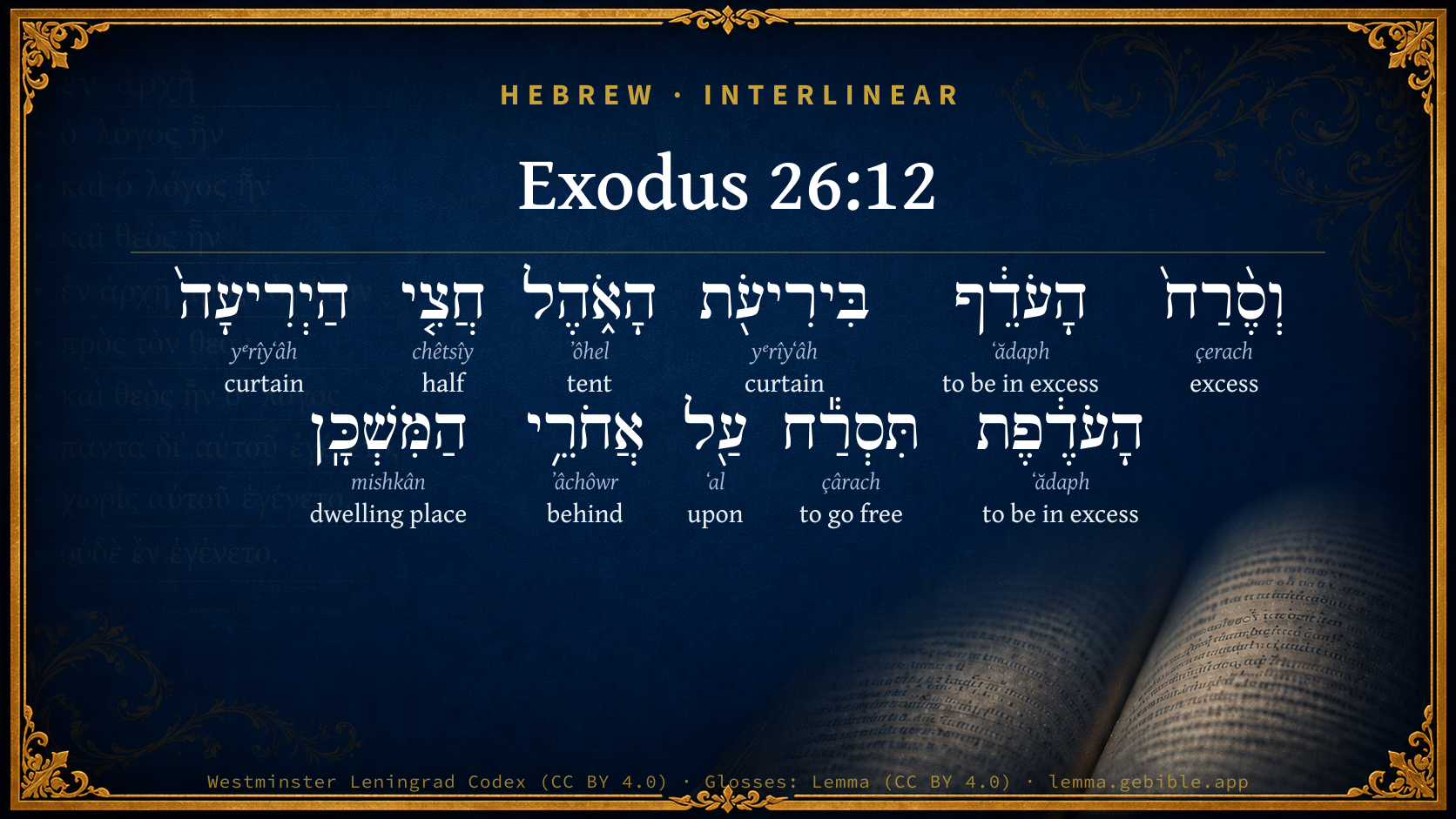
  1. הָעֹדֵ֔ף ʻădaph H5736 “the · being in excess” Particle, Definite Article + Verb, Qal, Participle Active, Masculine, Singular, Absolute
  2. בִּירִיעֹ֖ת yᵉrîyʻâh H3407 “in/at · curtains of” Preposition + Noun, Common, Feminine, Plural, Construct
  3. הָאֹ֑הֶל ʼôhel H168 “the · tent” Particle, Definite Article + Noun, Common, Masculine, Singular, Absolute
  4. חֲצִ֤י chêtsîy H2677 “half of” Noun, Common, Masculine, Singular, Construct
  5. הַיְרִיעָה֙ yᵉrîyʻâh H3407 “the · curtain” Particle, Definite Article + Noun, Common, Feminine, Singular, Absolute
  6. הָעֹדֶ֔פֶת ʻădaph H5736 “the · being in excess” Particle, Definite Article + Verb, Qal, Participle Active, Feminine, Singular, Absolute
  7. תִּסְרַ֕ח çârach H5628 “to go free” Verb, Qal, Imperfect, 3rd Person, Feminine, Singular
  8. עַ֖ל ʻal H5921 “upon” Preposition
  9. אֲחֹרֵ֥י ʼâchôwr H268 “behind” Preposition
  10. הַמִּשְׁכָּֽן mishkân H4908 “the · dwelling place” Particle, Definite Article + Noun, Common, Masculine, Singular, Absolute

About this verse

These counts appear in no published source. They are computed here, from the morphology-tagged text and Lemma’s own curated glosses. What Lemma adds →

11
words
9
distinct lemmas
Pentateuch
section

Notable vocabulary

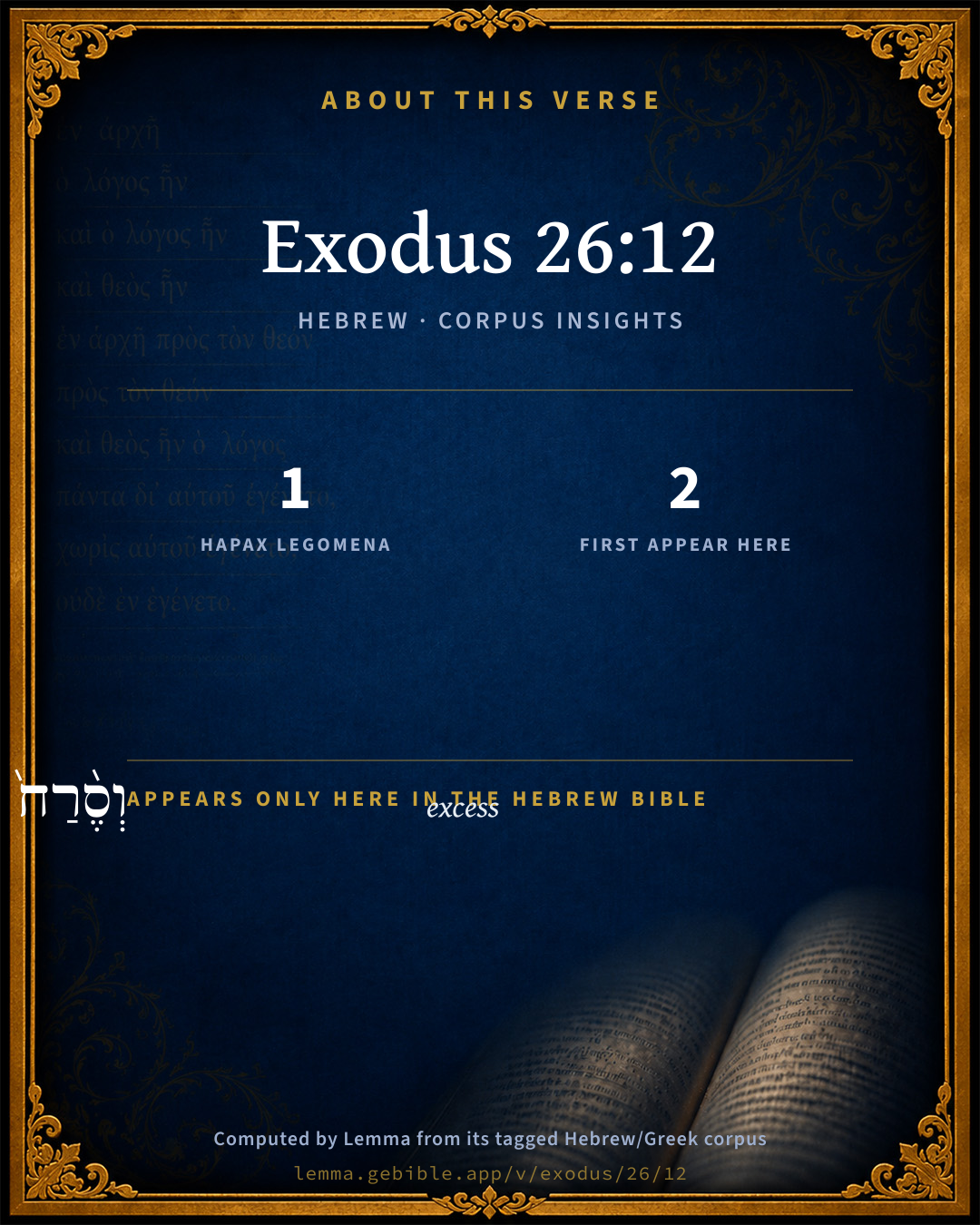
1 hapax legomenon — a word that appears only here in the entire Hebrew Bible:

  • וְסֶ֨רַח֙ excess H5629

First appearance in Scripture

These words make their first canonical appearance in the Hebrew Bible here:

  • וְסֶ֨רַח֙ excess H5629
  • תִּסְרַ֕ח to go free H5628

Shared distinctive vocabulary

תִּסְרַ֕ח to go free H5628 occurs in 7 verses of the Hebrew Bible. Also found in:

Grammatical profile

  • 3 verbs
  • 6 nouns
  • 2 prepositions

Verb forms

  • הָעֹדֵ֔ף Qal · Participle Active
  • הָעֹדֶ֔פֶת Qal · Participle Active
  • תִּסְרַ֕ח Qal · Imperfect

Repetition

Words recur within this verse — often emphatic in Hebrew:

  • הָעֹדֵ֔ף to be in excess H5736 ×2
  • בִּירִיעֹ֖ת curtain H3407 ×2

Hebrew & Septuagint length

In English translation the verse runs 24 words from the Hebrew and 47 from the Septuagint (LXX English) — the Septuagint runs noticeably longer here. See the side-by-side →

A rough comparison of the two English renderings, which tokenize alike — not a word-level alignment.

Word counts can differ between the Hebrew and the Greek without any difference in meaning — e.g. the Hebrew direct-object marker אֵת has no separate Greek word, and Greek often adds the article ὁ.

Hebrew and Greek witnesses Masoretic Hebrew ↔ Greek Septuagint

The same verse in the two great witnesses to the Old Testament, shown verse-for-verse.

Here the Septuagint runs noticeably longer than the Hebrew — LXX2012 (modern English Septuagint) 47 words vs World English Bible 24. A rough length comparison of the two English translations, not a word-level alignment — read both below.

These are two independent witnesses, not word-aligned to each other, and the Septuagint is shown in lemma (dictionary) form.

Hebrew Exodus 26:12 Masoretic · Westminster Leningrad Codex

וְסֶ֨רַח֙ הָעֹדֵ֔ף בִּירִיעֹ֖ת הָאֹ֑הֶל חֲצִ֤י הַיְרִיעָה֙ הָעֹדֶ֔פֶת תִּסְרַ֕ח עַ֖ל אֲחֹרֵ֥י הַמִּשְׁכָּֽן

The overhanging part that remains of the curtains of the tent, the half curtain that remains, shall hang over the back of the tent.

World English Bible · Public Domain

Greek LXX Exodus 26:12 Septuagint · lemma form

καί ὑποτίθημι ὁ πλεονάζω ἐν ὁ δέρρις ὁ σκηνή ὁ ἥμισυς ὁ δέρρις ὁ ὑπολείπω ὑποκαλύπτω ὁ πλεονάζω ὁ δέρρις ὁ σκηνή ὑποκαλύπτω ὀπίσω ὁ σκηνή

And you shall fix at the end that which is over in the skins of the tabernacle; the half of the skin that is left shall you fold over, according to the overplus of the skins of the tabernacle; you shall fold it over behind the tabernacle.

LXX2012 (modern English Septuagint) · Public Domain

Hebrew: Westminster Leningrad Codex (CC BY 4.0). Greek: Septuagint (public domain); English from LXX2012 (modern English Septuagint) (Public Domain). How the Septuagint differs from the Hebrew →

Targum (Aramaic paraphrase)

2

The Targum is the ancient Jewish Aramaic paraphrase of the Hebrew Scriptures — an interpretive translation, not the Hebrew text itself. Onkelos (literal) and Pseudo-Jonathan (expansive) render the Torah, and Jonathan the Prophets. Coverage is partial: where no permissively-licensed English translation exists for a verse, only the Aramaic is shown. This is verse-level text, not a word-by-word alignment to the Hebrew.

  1. Targum Onkelos Torah (Genesis–Deuteronomy)
    וְסִרְחָא דְיַתִּירָא בִּירִיעַת מַשְׁכְּנָא פַּלְגוּת יְרִיעֲתָא דְיַתִּירָא תִּסְרַח עַל אֲחוֹרֵי מַשְׁכְּנָא:

    (no public-domain English translation for this verse)

    Targum Onkelos — Aramaic: “Onkelos Genesis” (public domain); “Onkelos Exodus” (public domain); “Onkelos Leviticus” (public domain); “Onkelos Numbers” (public domain); “Onkelos Deuteronomy” (public domain). English: “Sefaria Community Translation” (CC0 1.0 (public-domain dedication)); “J.W. Etheridge. The Targums of Onkelos and Jonathan Ben Uzziel on the Pentateuch. London: Longmans, Green, 1862” (public domain). Text via Sefaria.

  2. Targum Pseudo-Jonathan Torah (Genesis–Deuteronomy)
    וְשִׁיפּוּעַ מוֹתָרָא בִּירִיעוֹת מַשְׁכְּנָא פַּלְגוּת יְרִיעָתָא דִיתֵירָא תִּשְׁפַּע עַל אֲחוֹרֵי מַשְׁכְּנָא

    And the surplus which remaineth of the curtains of the Tabernacle, the half curtain which remaineth, thou shalt spread over the hinder part of the Tabernacle.

    Targum Pseudo-Jonathan — Aramaic: “Targum Jonathan on Genesis” (public domain); “Targum Jonathan on Exodus” (public domain); “Targum Jonathan on Leviticus” (public domain); “Targum Jonathan on Numbers” (public domain); “Targum Jonathan on Deuteronomy” (public domain). English: “The Targum of Jonathan ben Uzziel, trans. J. W. Etheridge, London, 1862” (public domain). Text via Sefaria.

Commentary

Notes on Exodus 26:12 from classic Christian and Jewish commentators (each source and its license shown beneath its notes). The classic Christian expositions comment on the surrounding passage and are grouped to its opening verse, so a note may address several verses; the Jewish commentaries on the Tanakh (Rashi and others) are per-verse, so they appear only where the commentator wrote on this verse.

Lemma curates 59 commentaries, every one of them public domain or Creative Commons licensed, each selected and text-cleaned for this edition rather than reprinted as found. About our sources →

Keil & Delitzsch

C. F. Keil & F. Delitzsch

This tent-cloth was two cubits longer than the inner one, as each piece was 30 cubits long instead of 28; it was also two cubits broader, as it was composed of 11 pieces, the eleventh only reckoning as two cubits, as it was to be laid double. Consequently there was an excess (העדף that which is over) of two cubits each way; and according to Exo 26:12 and Exo 26:13 this was to be disposed of in the following manner: "As for the spreading out of the excess in the tent-cloths, the half of the cloth in excess shall spread out over the back of the dwelling; and the cubit from here and from there in the excess in the length of the tent-cloths (i.e., the cubit over in the length in each of the cloths) shall be spread out on the sides of the dwelling from here and from there to cover it." Now since, according to this, one half of the two cubits of the sixth piece which was laid double was to hang down the back of the tabernacle, there only remained one cubit for the gable of the front. It follows, therefore, that the joining of the two halves with loops and clasps would come a cubit farther back, than the place where the curtain of the holy of holies divided the dwelling. But in consequence of the cloth being a cubit longer in every direction, it nearly reached the ground on all three sides, the thickness of the wooden framework alone preventing it from reaching it altogether.

Keil & Delitzsch — Biblical Commentary on the Old Testament (1861–1891) — public domain (CC PDM 1.0). Text via the HelloAO Bible API. (Old Testament only.)

Geneva Bible (1599)

Geneva Bible translators

For these curtains were two cubits longer than the curtains of the Tabernacle so that they were wider by a cubit on both sides.

Geneva Bible (1599) marginal notes — public domain. Text via Bolls.life.

Ellicott's Commentary for English Readers

(12) The remnant that remaineth.—Even after the doubling back, the goats’-hair covering would be half a breadth wider than the linen one. This half-breadth was to be allowed to hang down at the back of the tent.

A Bible Commentary for English Readers, edited by Charles John Ellicott (1878–1897) — public domain. Text from a community e-Sword module.

The Cambridge Bible for Schools and Colleges

gen. ed. J. J. S. Perowne

12. overhanging] The Heb. means loose or free, not necessarily ‘overhanging.’

the half curtain that remaineth] The breadth in front is laid double (v. 9): it is consequently halved in width; and the entire length of the curtain is thus 42 cubits. As the Dwelling Isaiah 30 cubits long and 10 cubits high, it follows that, according to the usual view of v. 9b, 12 cubits will hang down behind, according to Kennedy’s view, 10 cubits will hang down behind. The ‘half-curtain’ (= 2 cubits) overhanging a the back can thus, upon the usual view, be only the 2 cubits in excess of the 10 (so Di.), the whole 12, we may suppose, being stretched out, and pegged to the ground in the manner of a tent: it is not, however, very natural to speak of only the 2 cubits as hanging down loosely behind: we should rather expect the whole 12 to be so spoken of. The difficulty would be removed, if we might suppose the words, ‘the half-curtain that remaineth,’ in v. 12 to be a mistaken gloss, arising out of a hasty reading of v. 9b: if these words are omitted, the length of the part hanging down behind is not specified, and it might, of course, be either the 12 cubits required by the ordinary view of v. 9b, or the 10 cubits required by Kennedy’s view. The latter view does better justice to v. 9b, and also has the advantage of making the goats’ hair curtain hang down symmetrically on the two sides and the back, viz. so a exactly to touch the ground in each case.

The Cambridge Bible for Schools and Colleges (gen. ed. J. J. S. Perowne; Cambridge University Press, 1878–1918) — public domain. Text from a community e-Sword module.

John Gill's Exposition

And a cubit on the one side, and a cubit on the other side o that which remaineth in the length of the curtains of the tent,.... The curtains of the tent, or the goat hair curtains, were two cubits longer than the other, and these are the two cubits, one on one side and the other on the other, which remained, and by which they were longer than the linen curtains:

it shall hang over the sides of the tabernacle; the north and south sides: on this side:

and on that side, to cover it; and as the above learned doctor observes (o), their length of fifteen yards reached half a yard lower on either side than the other curtains did, and yet they came not to the ground by a quarter of a yard; so that the silver foundations (of which afterwards) were always plain to be seen everywhere but at the west end.

(o) Works, vol. 1. p. 719.

John Gill's Exposition of the Whole Bible (1746–1763) — public domain (CC PDM 1.0). Text via the HelloAO Bible API.

Whedon's Commentary on the Bible

Daniel D. Whedon

12. The half curtain that remaineth — One half of the sixth curtain was to be doubled or folded in the front, and this would allow another half curtain to hang over the back side of the tabernacle (mishcan) but the exact manner of its adjustment is not described.

Daniel D. Whedon (gen. ed.), Commentary on the Old and New Testaments (1874–1909) — public domain. Text from a community e-Sword module.

The Pulpit Commentary

The remnant which remaineth, etc. Both this and the next verse presume a very close connection between the fine linen covering of the mishkan and the goats hair tent-cloth which protected it. "The remnant that remaineth" is the half-breadth by which the tent-cloth would overlap the linen covering at the back of the tent, when at the front half of the eleventh breadth had been turned back upon the other half (see comment on ver. 9). This "remnant" was to be "allowed to hang down over the back part of the tabernacle.

The Pulpit Commentary (1880–1919), ed. H.D.M. Spence-Jones & Joseph S. Exell — public domain. Text from a community e-Sword module.

unfoldingWord translationNotes

Door43 World Missions Community

General Information:

Yahweh continues telling Moses what the people must do.

cubit

A cubit is 46 centimeters. (See: Biblical Distance)

dyed red

"colored red"

translationWords

tent

tabernacle

ewe

unfoldingWord translationNotes — © Distant Shores Media and the Door43 World Missions Community, licensed CC BY-SA 4.0. Source: git.door43.org/Door43/en_tn.

Rashi

Rabbi Shlomo Yitzchaki (Rashi)

וסרח העדף ביריעת האהל AND THE SURPLUS OF THE CURTAINS OF THE TENT over and above the lower curtains of the Tabernacle [SHALL HANG OVER etc.]. “The curtains of the אהל” were the upper ones made of goats’ hair which Scripture calls אהל, as it states about them, (v. 7) “they shall be an אהל over the dwelling.” The word אהל used in connection with them means only a covering (the word has not its usual meaning of “tent“) because they formed a cover and a screen over the lower ones. They exceeded the lower ones by one half curtain on the west side. For the other half of the eleventh curtain which was in excess of the number of the lower ones was folded over to hang in front of the tent (the Tabernacle) (cf. v. 9). There therefore remained two cubits, — the breadth of the half of it — in excess of the width of the lower curtains (it is this which is here described as חצי היריעה העדפת “the half curtain that exceeded”).

תסרח על אחרי המשכן SHALL HANG OVER THE BACK OF THE TABERNACLE — to cover the two cubits of the boards that were left bare.

אחרי המשכן THE BACK OF THE TABERNACLE — i. e. the west side. This is called “the back” because the entrance was on the east side which was therefore its front. The north and the south are accordingly called the “sides” in the right and the left directions.

Rashi on the Tanakh — English translations: “The Judaica Press complete Tanach with Rashi, translated by A. J. Rosenberg” (CC BY 4.0); “Pentateuch with Rashi's commentary by M. Rosenbaum and A.M. Silbermann, 1929-1934” (public domain); “The Metsudah Tanach series, Lakewood, N.J” (CC BY 4.0); and “The Book of Joshua, Metsudah Publications, 1997” (CC BY 4.0). Text via Sefaria.

Lesson kit

Teaching starters — assembled from the data on this page, not authored interpretation. Every prompt links to the verse data it draws on. Edit before teaching.

Exodus, in the Pentateuch, opens this verse with 11 words (9 distinct Hebrew lemmas). Its most distinctive word is çerach (“excess”). The Greek Septuagint runs longer here. A historical commentator’s framing appears above. Read the whole chapter for the surrounding context.

Discussion questions

  1. The word çerach carries the sense “excess.” How does it shape the verse?
  2. 1 word here appears nowhere else in the Hebrew Bible. Why might the author reach for such rare wording?
  3. 2 words make their first appearance in Scripture here. What does this debut establish?
  4. How does Exodus 26:13, which shares the word «to go free», read alongside this verse?
  5. What does the repetition of “to be in excess” (2× in this one verse) do in this verse?
  6. The Septuagint runs longer here than the Hebrew. What might account for the difference?
  7. The translations on this page render this verse differently — a whole-verse word diff, not a word-by-word alignment. What might account for the different wordings?
  8. «הָעֹדֵ֔ף» is a Qal Participle Active verb. How does that grammatical form shape the action described?

Things to notice

  • 1 word in this verse appears nowhere else in the Hebrew Bible.
  • 2 words make their first canonical appearance in Scripture here.
  • These translations choose different wording for 12 words in this verse.
  • “to be in excess” occurs 2× in this single verse.
  • 9 distinct Hebrew lemmas span 11 words in this verse.

Reading settings

Reading text

Shown beneath each verse's original-language words.

Old Testament
Old Testament edition

Read the OT as the Masoretic Hebrew (MT) or the Greek Septuagint (LXX).

English shown for the Greek Septuagint (in the Hebrew ↔ Greek comparison).

Comparing translations? Open the Compare panel on any verse page to stack up to four side by side.