Genesis 18:6

Hebrew (Westminster Leningrad Codex) Genesis 18:6 appears in the Hebrew Old Testament. The text above is from the Westminster Leningrad Codex. Each word links to its Strong’s number, a concise gloss, and parsing drawn from the Open Scriptures Hebrew Bible morphology. Click any word for its full Brown-Driver-Briggs (BDB) entry.
Download image
Cite this verse

Genesis 18:6 (World English Bible). Public Domain. Lemma interlinear Bible study tool, https://lemma.gebible.app/v/genesis/18/6.

Show BibTeX & RIS
BibTeX
RIS
English Translation
Abraham hurried into the tent to Sarah, and said, "Quickly make ready three measures of fine meal, knead it, and make cakes."
World English Bible · Public Domain
Highlights
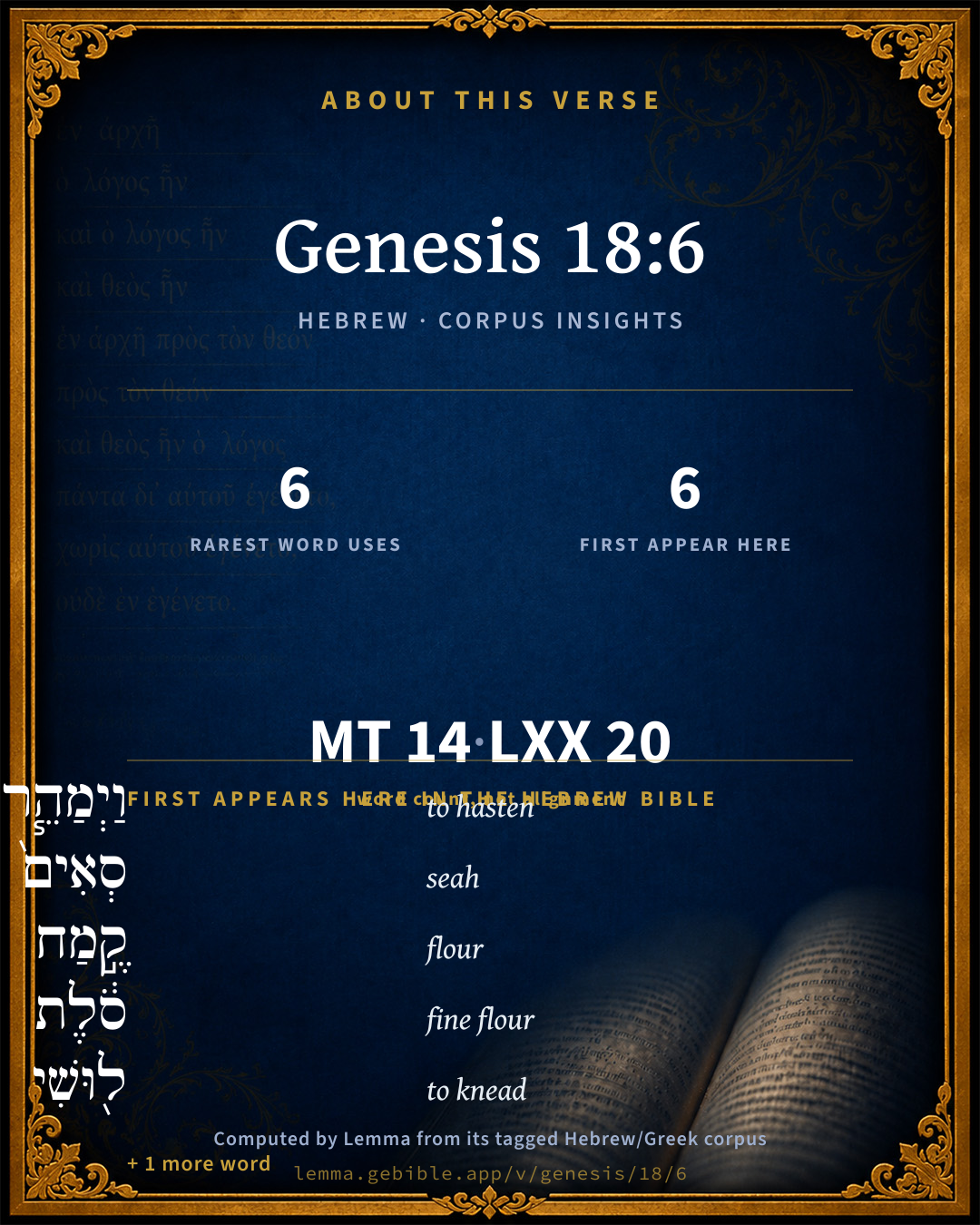
  • 6 first appearances in the Hebrew Bible
Full analysis ↓
Download a study sheet

One document with this verse’s original text, its word-by-word gloss line, the meaning frame, cross-references with their text, attributed commentary, and full source and license credits — printable, and it pastes into notes with its structure intact.

This verse Autodidact and up

Study sheet (.html) Plain text (.txt)

A passage Seminary Student

Up to 50 verses in one chapter. A passage sheet keeps up to 6 commentary sources and 12 cross-references per verse, in the order this page ranks them, and says so on the sheet whenever that leaves anything out. Ask for a single verse and you get the Autodidact verse sheet above.

Everything on this page stays free to read, with no account — the sheet is a download of what is already on screen, not access to it.

Want to remove ads? Support Godless Engineer
Compare translations 3

The same verse in 3 English versions, stacked beneath the original-language interlinear above. Click any original word for its lexicon entry.

Each is an independent rendering of the whole verse — the interlinear is not word-aligned to these translations.

Highlighted words mark where these versions differ — a whole-verse word diff, not a word-by-word alignment.

  • World English Bible Public Domain
    Abraham hurried into the tent to Sarah, and said, "Quickly make ready three measures of fine meal, knead it, and make cakes."
  • King James Version Public Domain
    And Abraham hastened into the tent unto Sarah, and said, Make ready quickly three measures of fine meal, knead it, and make cakes upon the hearth.
  • unfoldingWord Literal Text CC BY-SA 4.0
    Then Abraham hurried into the tent to Sarah and said, “Hurry! three seahs of fine flour. Knead and make loaves.”

unfoldingWord Literal Text — © unfoldingWord, licensed CC BY-SA 4.0. Word-aligned USFM3 via Door43 (git.door43.org/unfoldingWord/en_ult).

Versions to compare (up to 4)

3 of 4 selected

Show all 18 translations

Every available English version of this verse, each an independent rendering of the whole verse.

  • World English Bible Public Domain
    Abraham hurried into the tent to Sarah, and said, "Quickly make ready three measures of fine meal, knead it, and make cakes."
  • Berean Standard Bible Public Domain
    So Abraham hurried into the tent and said to Sarah, “Quick! Prepare three seahs of fine flour, knead it, and bake some bread.”
  • Majority Standard Bible Public Domain
    So Abraham hurried into the tent and said to Sarah, “Quick! Prepare three seahs of fine flour, knead it, and bake some bread.”
  • King James Version Public Domain
    And Abraham hastened into the tent unto Sarah, and said, Make ready quickly three measures of fine meal, knead it, and make cakes upon the hearth.
  • American Standard Version (1901) Public Domain
    And Abraham hastened into the tent unto Sarah, and said, Make ready quickly three measures of fine meal, knead it, and make cakes.
  • Revised Version (1885) Public Domain
    And Abraham hastened into the tent unto Sarah, and said, Make ready quickly three measures of fine meal, knead it, and make cakes.
  • Geneva Bible (1599) Public Domain
    Then Abraham made haste into the tent vnto Sarah, and saide, Make ready at once three measures of fine meale: kneade it, and make cakes vpon the hearth.
  • Douay-Rheims (1899) Public Domain
    And I will set a morsel of bread, and strengthen ye your heart, afterwards you shall pass on: for therefore are you come aside to your servant. And they said: Do as thou hast spoken.
  • Young's Literal Translation Public Domain
    And Abraham hasteth towards the tent, unto Sarah, and saith, `Hasten three measures of flour-meal, knead, and make cakes;'
  • Literal Standard Version CC BY-SA 4.0
    And Abraham hurries toward the tent, to Sarah, and says, “Hurry three measures of flour-meal, knead, and make cakes”;
  • Unlocked Literal Bible CC BY-SA 4.0
    Then Abraham quickly went into the tent to Sarah, and said, “Hurry, get three seahs of fine flour, knead it, and make bread.”
  • unfoldingWord Literal Text CC BY-SA 4.0
    Then Abraham hurried into the tent to Sarah and said, “Hurry! three seahs of fine flour. Knead and make loaves.”
  • Darby Bible Public Domain
    And Abraham hastened into the tent to Sarah, and said, Knead quickly three seahs of wheaten flour, and make cakes.
  • World Messianic Bible Public Domain
    Abraham hurried into the tent to Sarah, and said, “Quickly prepare three seahs of fine meal, knead it, and make cakes.”
  • Webster's Bible Public Domain
    And Abraham hastened into the tent to Sarah, and said, Make ready quickly three measures of fine meal, knead it, and make cakes upon the hearth.
  • Free Bible Version CC BY-SA 4.0
    Abraham hurried back to the tent and told Sarah, “Quick! Make some bread using three large measures of the best flour. Knead the dough and bake the bread.”
  • Bible in Basic English Public Domain
    Then Abraham went quickly into the tent, and said to Sarah, Get three measures of meal straight away and make cakes.
  • JPS Tanakh (1917) Public Domain
    And Abraham hastened into the tent unto Sarah, and said: 'Make ready quickly three measures of fine meal, knead it, and make cakes.'

Literal Standard Version (2020), Covenant Press — licensed CC BY-SA 4.0. Text via the HelloAO Bible API (eBible.org). Unlocked Literal Bible (unfoldingWord) — licensed CC BY-SA 4.0. Text via the HelloAO Bible API (eBible.org). unfoldingWord Literal Text — © unfoldingWord, licensed CC BY-SA 4.0. Word-aligned USFM3 via Door43 (git.door43.org/unfoldingWord/en_ult). Free Bible Version, Dr. Jonathan Gallagher — licensed CC BY-SA 4.0. Text via the HelloAO Bible API (eBible.org).

Word by word

More ways to search: Search by grammar → Find every occurrence → Compare this word →

Practice this passage: Drill this verse → Learn its vocabulary →

ל֖וּשִׁי
lûwsh
H3888
“knead”
Verb, Qal, Imperative, 2nd Person, Feminine, Singular
Part of Speech
Verb
Stem
Qal
Form
Imperative
Person
2nd Person
Gender
Feminine
Number
Singular
Full BDB Definition

Origin: a primitive root

TWOT: 1100

(Qal) to knead (dough)
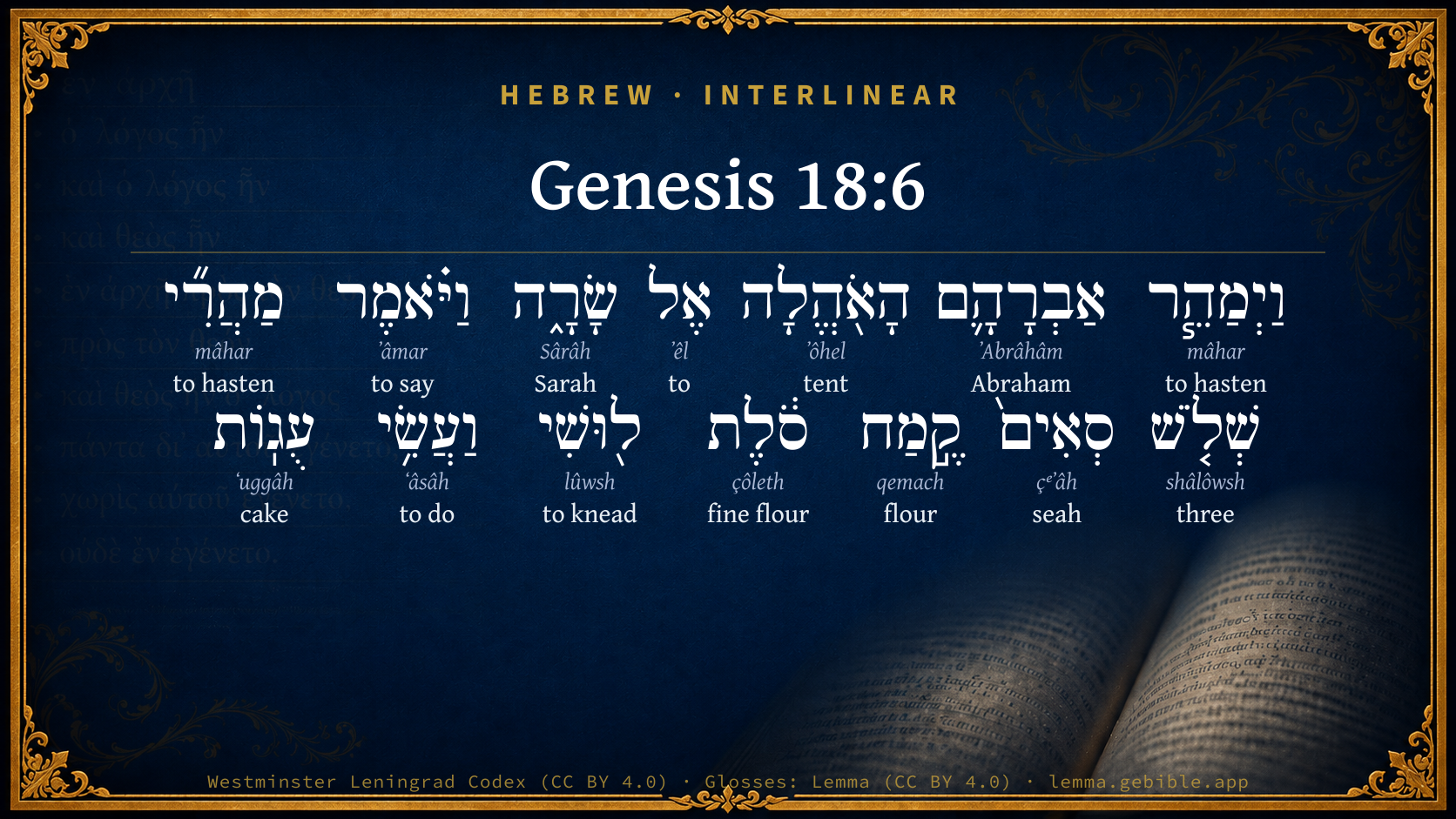
  1. וַיְמַהֵ֧ר mâhar H4116 “and · to hasten” Conjunction + Verb, Piel, Sequential Imperfect, 3rd Person, Masculine, Singular
  2. אַבְרָהָ֛ם ʼAbrâhâm H85 “Abraham” Noun, Proper
  3. הָאֹ֖הֱלָה ʼôhel H168 “the · tent · toward” Particle, Definite Article + Noun, Common, Masculine, Singular, Absolute + Suffix, Demonstrative
  4. אֶל ʼêl H413 “to” Preposition
  5. שָׂרָ֑ה Sârâh H8283 “Sarah” Noun, Proper
  6. וַיֹּ֗אמֶר ʼâmar H559 “and · to say” Conjunction + Verb, Qal, Sequential Imperfect, 3rd Person, Masculine, Singular
  7. מַהֲרִ֞י mâhar H4116 “hasten” Verb, Piel, Imperative, 2nd Person, Feminine, Singular
  8. שְׁלֹ֤שׁ shâlôwsh H7969 “three” Adjective, Cardinal number, Feminine, Singular, Absolute
  9. סְאִים֙ çᵉʼâh H5429 “seahs” Noun, Common, Feminine, Plural, Absolute
  10. קֶ֣מַח qemach H7058 “flour” Noun, Common, Masculine, Singular, Absolute
  11. סֹ֔לֶת çôleth H5560 “fine flour” Noun, Common, Feminine, Singular, Absolute
  12. וַעֲשִׂ֥י ʻâsâh H6213 “and · do” Conjunction + Verb, Qal, Imperative, 2nd Person, Feminine, Singular
  13. עֻגֽוֹת ʻuggâh H5692 “cakes” Noun, Common, Feminine, Plural, Absolute

About this verse

These counts appear in no published source. They are computed here, from the morphology-tagged text and Lemma’s own curated glosses. What Lemma adds →

14
words
13
distinct lemmas
Pentateuch
section

Notable vocabulary

The rarest word here is ל֖וּשִׁי to knead H3888 — appearing just 6 times in the whole Hebrew Bible.

First appearance in Scripture

These words make their first canonical appearance in the Hebrew Bible here:

  • וַיְמַהֵ֧ר to hasten H4116
  • סְאִים֙ seah H5429
  • קֶ֣מַח flour H7058
  • סֹ֔לֶת fine flour H5560
  • ל֖וּשִׁי to knead H3888
  • עֻגֽוֹת cake H5692

Shared distinctive vocabulary

ל֖וּשִׁי to knead H3888 occurs in 5 verses of the Hebrew Bible. Also found in:

Grammatical profile

  • 5 verbs
  • 7 nouns
  • 1 adjective
  • 1 preposition

Verb forms

  • וַיְמַהֵ֧ר Piel · Sequential Imperfect
  • וַיֹּ֗אמֶר Qal · Sequential Imperfect
  • מַהֲרִ֞י Piel · Imperative
  • ל֖וּשִׁי Qal · Imperative
  • וַעֲשִׂ֥י Qal · Imperative

Repetition

A word recurs within this verse — often emphatic in Hebrew:

  • וַיְמַהֵ֧ר to hasten H4116 ×2

Hebrew & Septuagint length

In English translation the verse runs 22 words from the Hebrew and 23 from the Septuagint (LXX English) — closely comparable.

A rough comparison of the two English renderings, which tokenize alike — not a word-level alignment.

Word counts can differ between the Hebrew and the Greek without any difference in meaning — e.g. the Hebrew direct-object marker אֵת has no separate Greek word, and Greek often adds the article ὁ.

In the original languages it is 14 Hebrew tokens and 20 Greek tokens — but the two are counted differently (Hebrew bundles its prefixes and suffixes into one token; the Greek is in lemma form), so that isn’t a like-for-like length.

Cross-references

8

Topical passages linked to Genesis 18:6 in the Treasury of Scripture Knowledge — connected by theme and wording, ordered by reader-vote popularity; previews shown in the World English Bible.

  • Matthew 13:33 He spoke another parable to them. "The Kingdom of Heaven is like yeast, which a woman took, and hid in three measures of meal, until it was all leavened."
  • Romans 12:13 contributing to the needs of the saints; given to hospitality.
  • Galatians 5:13 For you, brothers, were called for freedom. Only don't use your freedom for gain to the flesh, but through love be servants to one another.
  • Isaiah 32:8 But the noble devises noble things; and in noble things shall he continue.
  • Luke 10:38–40 It happened as they went on their way, he entered into a certain village, and a certain woman named Martha received him into her house.
  • Acts 16:15 When she and her household were baptized, she begged us, saying, "If you have judged me to be faithful to the Lord, come into my house, and stay." So she persuaded us.
  • Hebrews 13:2 Don't forget to show hospitality to strangers, for in doing so, some have entertained angels without knowing it.
  • 1 Peter 4:9 Be hospitable one to another without grumbling.

Cross-references courtesy of OpenBible.info (CC BY 4.0).

Hebrew and Greek witnesses Masoretic Hebrew ↔ Greek Septuagint

The same verse in the two great witnesses to the Old Testament, shown verse-for-verse.

These are two independent witnesses, not word-aligned to each other, and the Septuagint is shown in lemma (dictionary) form.

Hebrew Genesis 18:6 Masoretic · Westminster Leningrad Codex

וַיְמַהֵ֧ר אַבְרָהָ֛ם הָאֹ֖הֱלָה אֶל שָׂרָ֑ה וַיֹּ֗אמֶר מַהֲרִ֞י שְׁלֹ֤שׁ סְאִים֙ קֶ֣מַח סֹ֔לֶת ל֖וּשִׁי וַעֲשִׂ֥י עֻגֽוֹת

Abraham hurried into the tent to Sarah, and said, "Quickly make ready three measures of fine meal, knead it, and make cakes."

World English Bible · Public Domain

Greek LXX Genesis 18:6 Septuagint · lemma form

καί σπεύδω αβρααμ ἐπί ὁ σκηνή πρός σαρρα καί εἶπον αὐτός σπεύδω καί φυράω τρεῖς μέτρον σεμίδαλις καί ποιέω ἐγκρυφίας

And Abraam hasted to the tent to Sarrha, and said to her, Hasten, and knead three measures of fine flour, and make cakes.

LXX2012 (modern English Septuagint) · Public Domain

On this verse, The Cambridge Bible for Schools and Colleges discusses the Septuagint’s reading. Read the note in Commentary ↓

Hebrew: Westminster Leningrad Codex (CC BY 4.0). Greek: Septuagint (public domain); English from LXX2012 (modern English Septuagint) (Public Domain). How the Septuagint differs from the Hebrew →

Targum (Aramaic paraphrase)

2

The Targum is the ancient Jewish Aramaic paraphrase of the Hebrew Scriptures — an interpretive translation, not the Hebrew text itself. Onkelos (literal) and Pseudo-Jonathan (expansive) render the Torah, and Jonathan the Prophets. Coverage is partial: where no permissively-licensed English translation exists for a verse, only the Aramaic is shown. This is verse-level text, not a word-by-word alignment to the Hebrew.

  1. Targum Onkelos Torah (Genesis–Deuteronomy)
    וְאוֹחִי אַבְרָהָם לְמַשְׁכְּנָא לְוַת שָׂרָה וַאֲמַר אוֹחָא תְּלָת סְאִין קִמְחָא דְּסָלְתָּא לוּשִׁי וְעִבִידִי גְּרִיצָן

    (no public-domain English translation for this verse)

    Targum Onkelos — Aramaic: “Onkelos Genesis” (public domain); “Onkelos Exodus” (public domain); “Onkelos Leviticus” (public domain); “Onkelos Numbers” (public domain); “Onkelos Deuteronomy” (public domain). English: “Sefaria Community Translation” (CC0 1.0 (public-domain dedication)); “J.W. Etheridge. The Targums of Onkelos and Jonathan Ben Uzziel on the Pentateuch. London: Longmans, Green, 1862” (public domain). Text via Sefaria.

  2. Targum Pseudo-Jonathan Torah (Genesis–Deuteronomy)
    וְאוֹחִי אַבְרָהָם לְמַשְׁכְּנָא לְוַת שָרָה וַאֲמַר אוֹחָא תְּלַת סְאִין סְמִידָא דְסוּלְתָּא פִּתּוּכֵי וַעֲבִידִי גְרִיצָן

    And Abraham hastened into the tent unto Sarah, and said to her, Hasten three measures of flour-meal, mix and make cakes.

    Targum Pseudo-Jonathan — Aramaic: “Targum Jonathan on Genesis” (public domain); “Targum Jonathan on Exodus” (public domain); “Targum Jonathan on Leviticus” (public domain); “Targum Jonathan on Numbers” (public domain); “Targum Jonathan on Deuteronomy” (public domain). English: “The Targum of Jonathan ben Uzziel, trans. J. W. Etheridge, London, 1862” (public domain). Text via Sefaria.

Commentary

Notes on Genesis 18:6 from classic Christian and Jewish commentators (each source and its license shown beneath its notes). The classic Christian expositions comment on the surrounding passage and are grouped to its opening verse, so a note may address several verses; the Jewish commentaries on the Tanakh (Rashi and others) are per-verse, so they appear only where the commentator wrote on this verse.

Lemma curates 59 commentaries, every one of them public domain or Creative Commons licensed, each selected and text-cleaned for this edition rather than reprinted as found. About our sources →

Trapp's Complete Commentary

John Trapp

Gen 18:6 And Abraham hastened into the tent unto Sarah, and said, Make ready quickly three measures of fine meal, knead [it], and make cakes upon the hearth.

Ver. 6. Make ready quickly.] Habent aulae suum cito, cito , saith one. So had Abraham’s house here. He, she, the boy, and all hasted, and had their various offices. The very expression itself here used, is concise and quick; much like that of the prophet in the case of returning to God, "If ye will inquire, inquire; return, come". {Isa 21:12}

“ Praecipita tempus; mors atra impendet agenti .” - Silius.

Three measures of fine meal.] Three pecks for three man’s dinners; and the best of the best too; fine meal, the fat calf, butter and milk, God’s plenty of all, and hearty welcome; the goodman himself standing by, and bidding them "Come": which shows his humanity, and his humility also.

“ Dat bene, dat multum, qui dat cum munere vultum .”

John Trapp, A Commentary or Exposition upon All the Books of the Old and New Testament (1647–1656) — public domain. Text from a community e-Sword module.

Geneva Bible (1599)

Geneva Bible translators

Hebrew, Seim.

Geneva Bible (1599) marginal notes — public domain. Text via Bolls.life.

Jamieson, Fausset & Brown

Robert Jamieson, A. R. Fausset & David Brown

Abraham hastened . . . unto Sarah . . . make cakes upon the hearth--Bread is baked daily, no more than is required for family use, and always by the women, commonly the wife. It is a short process. Flour mixed with water is made into dough, and being rolled out into cakes, it is placed on the earthen floor, previously heated by a fire. The fire being removed, the cakes are laid on the ground, and being covered over with hot embers, are soon baked, and eaten the moment they are taken off.

Jamieson, Fausset & Brown — Commentary Critical and Explanatory on the Whole Bible (1871) — public domain (CC PDM 1.0). Text via the HelloAO Bible API.

Adam Clarke's Commentary

Verse 6. Three measures of fine meal] The סאה seah, which is here translated measure, contained, according to Bishop Cumberland, about two gallons and a half; and Mr. Ainsworth translates the word peck. On this circumstance the following observations of the judicious and pious Abbe Fleury cannot fail to be acceptable to the reader. Speaking of the frugality of the patriarchs he says: "We have an instance of a splendid entertainment in that which Abraham made for the three angels. He set a whole calf before them, new bread, but baked on the hearth, together with butter and milk. Three measures of meal were baked into bread on this occasion, which come to more than two of our bushels, and nearly to fifty-six pounds of our weight; hence we may conclude that men were great eaters in those days, used much exercise, were probably of a much larger stature as well as longer lives than we. Homer (Odyss. lib. xiv., ver. 74, c.) makes his heroes great eaters. When Eumaeus entertained Ulysses, he dressed two pigs for himself and his guest.

'So saying, he girded quick his tunic close,

And issuing sought the styes thence bringing two,

Of the imprisoned herd, he slaughtered both,

Singed them and slash'd and spitted them, and placed

The whole well roasted, banquets spits, and all,

Reeking before Ulysses.'

COWPER.

On another occasion a hog of five years old was slaughtered and served up for five persons: -

' - His wood for fuel he prepared,

And dragging thither a well-fatted brawn

Of the fifth year:

Next piercing him, and scorching close his hair,

The joints they parted,' c.

Ibid. ver. 419. COWPER.

Homer's heroes wait upon themselves and guests in the common occasions of life the patriarchs do the same. Abraham, who had so many servants, and was nearly a hundred years old, brought the water himself to wash the feet of his guests, ordered his wife to make the bread quickly, went himself to choose the calf from the herd, and came again to serve them standing. I will allow that he was animated on this occasion with a desire of showing hospitality, but the lives of all the rest of the patriarchs were similar to this."

Make cakes upon the hearth.] Or under the ashes. This mode is used in the east to the present day. When the hearth is strongly heated with the fire that has been kindled on it, they remove the coals, sweep off the ashes, lay on the bread, and then cover it with the hot cinders.

Adam Clarke's Commentary on the Bible (1810–1826) — public domain. Text from a community e-Sword/MySword module.

John Calvin's Commentaries

6. And Abraham hastened into the tent Abraham’s care in entertaining his guests is here recorded; and Moses, at the same time, shows what a well-ordered house he had. In short, he presents us, in a few words, with a beautiful picture of domestic government. Abraham runs, partly, to command what he would have done; and partly, to execute his own duty, as the master of the house. Sarah keeps within the tent; not to indulge in sloth, but rather to take her own part also, in the labor. The servants are all prompt to obey. Here is the sweet concord of a well-conducted family; which could not have thus suddenly arisen, unless each had, by long practice, been accustomed to right discipline. A question, however; arises out of the assertion of Moses, that the angels did eat. Some expound it, that they only appeared as persons eating; which fancy enters their minds through the medium of another error; since they imagine them to have been mere spectres, and not endued with real bodies. But, in my judgment, the thing is far otherwise. In the first place, this was no prophetical vision, in which the images of absent things are brought before the eyes; but the angels really came into the house of Abraham. Wherefore, I do not doubt that God, — who created the whole world out of nothing, and who daily proves himself to be a wonderful Artificer in forming creatures, — gave them bodies, for a time, in which they might fulfill the office enjoined them. And as they truly walked, spoke, and discharged other functions; so I conclude, they did truly eat; not because they were hungry, but in order to conceal themselves, until the proper time for making themselves known. Yet as God speedily annihilated those bodies, which had been created for a temporary use; so there will be no absurdity in saying, that the food itself was destroyed, together with their bodies. But, as it is profitable briefly to touch upon such questions; and, as religion in no way forbids us to do so; there is on the other hand, nothing better than that we should content ourselves with a sober solution of them.

John Calvin's Commentaries (1540-1563) — public domain. Text from the Calvin Translation Society English edition (1840s-50s) via the Christian Classics Ethereal Library (ccel.org). Calvin's coverage is partial (roughly two-thirds of the Bible); uncommented books and verses are honest gaps, never fabricated. The 19th-century editor's footnotes and remarks are omitted so the notes are faithfully Calvin's own voice.

Ellicott's Commentary for English Readers

(6) Three measures.—Heb. three seahs, the seah being a little more than a peck. It is still usual on the arrival of a stranger to make this hasty preparation for his entertainment, the ordinary meal even of a wealthy sheik consisting of flour and some camels’ milk boiled together. Cakes such as those here described, baked amid the embers on the hot hearth-stone, are considered a delicacy (1Ki_19:6). Flesh is seldom eaten; but if a traveller arrives, sweet milk and rice are added to the meal, and if he be a person of distinction a lamb or kid is killed. Abraham’s calf, “tender and good,” shows that he regarded his visitors as persons of more than ordinary high rank; and the quantity of food cooked seems to show that the three travellers had numerous attendants. The calf would be cut into small portions, and a meal like this is, we are told, got ready in a very short time.

A Bible Commentary for English Readers, edited by Charles John Ellicott (1878–1897) — public domain. Text from a community e-Sword module.

The Cambridge Bible for Schools and Colleges

gen. ed. J. J. S. Perowne

6. into the tent unto Sarah] Sarah does not appear before the strangers. She is occupied with the baking. Abraham and his servant are responsible for the selection and killing of a calf, the cooking of the meat, and the procuring of butter and milk from the herd. A meal in which meat is provided is a rarity in a Bedouin’s life, and is the sign of the offering of hospitality.

three measures of fine meal] A “measure” is a seah, or one-third of an ephah. The amount, therefore, represented by three seahs was one ephah. It is the same quantity mentioned by our Lord in Mat_13:33, “the kingdom of heaven is like unto leaven, which a woman took, and hid in three measures of meal.” The seah contained nearly a peck and a half.

fine meal] Two words are here used, ḳemaḥ and sôleth, meaning “meal,” “fine flour.”

cakes] These would be baked on flat hot stones placed in the clay oven, or in the hot ashes which were sometimes heaped up over them; hence LXX ἐγκρυφίαι, Lat. panes subcinericii. Cf. 1Ki_19:6.

The Cambridge Bible for Schools and Colleges (gen. ed. J. J. S. Perowne; Cambridge University Press, 1878–1918) — public domain. Text from a community e-Sword module.

John Gill's Exposition

And Abraham hastened into the tent unto Sarah,.... In order to acquaint her with his guests, and to give proper instructions for providing food for them; and this he hasted to do, being hearty in the entertainment of them, and that he might not keep them too long from their journey:

and said, to Sarah his wife:

make ready quickly three measures of fine meal; which was ready sifted from the bran, and was the finest flour that was in the house, and only wanted to be mixed and kneaded and made up into cakes; and he ordered three measures or seahs of them, each of which held more than our peck, and all three made an ephah or bushel, being willing to have enough, and to make a generous entertainment for them; this he enjoined Sarah to do, but not of herself, but by her maids, and no doubt, for quicker dispatch, she might assist herself, wherefore it follows:

knead it, and make cakes upon the hearth; after the fine flour was made dough and kneaded, it was made into round cakes, and these were put upon an hearth made hot, and then covered with hot embers, by which means they were soon baked and fit to eat; this was done "upon hot stones" (n); and a traveller (o) into those parts some years ago reports, that, passing through the deserts of Arabia, when they chose to eat new bread, instead of, or for want of biscuits, they made a paste of flour and water, and wrought it into broad cakes about the thickness of a finger, and put them in a hot place on the ground, heated on purpose by fire, and covered them with ashes and coals, and turned them several times until they were enough, and that these cakes were savoury and good to eat: some of the Arabians, he says: have in their tents stones or copper plates, made on purpose to bake them, and gives (p) an instance of a woman they met with in a country lying between Mesopotamia and Media, making such cakes for them in the same manner.

(n) Bochart. Hierozoic. par. 1. l. 2. c. 34. col. 328. (o) Rauwolff's Travels, par. 2. ch. 4. p. 120. (p) Ib. c. 9. p. 163.

John Gill's Exposition of the Whole Bible (1746–1763) — public domain (CC PDM 1.0). Text via the HelloAO Bible API.

Haydock's Catholic Bible Commentary

Measures, or one epha; that is, three pecks and three pints, English corn measure. --- Flour, of the finest quality, similæ. --- Hearth, as being soonest ready.

George Leo Haydock (1774–1849), Haydock's Catholic Family Bible and Commentary, 1859 edition — public domain. Excludes Psalms (Douay-Rheims chapter numbering differs from Protestant) and Deuterocanonical books (Catholic canon only).

Matthew Poole's English Annotations

Three measures, containing each the third part of an ephah. See Exo 16:36.

Upon the hearth; upon the coals, or in the warm cinders, or in an oven. He had doubtless other bread ready, but he would have new bread for them, which he thought most grateful.

Matthew Poole's English Annotations on the Holy Bible (1683–1685) — public domain. Text from a community e-Sword/MySword module.

Whedon's Commentary on the Bible

Daniel D. Whedon

6. Abraham hastened — The haste or rapidity with which a hospitable feast is prepared by an Oriental for his guest is notable. See on 1Sa_28:24. The words make ready quickly are, in the Hebrew, but the same word מהר, hasten.

Three measures of fine meal — The measure, or seah, is supposed to have been about one peck, and accordingly the large quantity of flour taken shows the bounty of Abraham’s hospitality. He would prepare a royal feast.

Cakes upon the hearth — Such were usually baked among the coals.

Daniel D. Whedon (gen. ed.), Commentary on the Old and New Testaments (1874–1909) — public domain. Text from a community e-Sword module.

The Pulpit Commentary

And Abraham hastened into the tent unto Sarah, and said, Make ready quickly three measures. Hebrew, three seahs, a seah being a third of an ephah, and containing 374 cubic inches each (Keil); a third of a bushel (Kalisch)of fine meal, literally, of flour, fine flour; semidaliv (LXX); the first term when alone denoting flour of ordinary quality (cf. Lev_2:1 Lev_5:11; Num_7:13) knead it, and make cakes upon the hearth i.e. "round unleavened cakes baked upon hot stones" (Keil).

The Pulpit Commentary (1880–1919), ed. H.D.M. Spence-Jones & Joseph S. Exell — public domain. Text from a community e-Sword module.

Keil & Delitzsch

C. F. Keil & F. Delitzsch

When the three men had accepted the hospitable invitation, Abraham, just like a Bedouin sheikh of the present day, directed his wife to take three seahs (374 cubic inches each) of fine meal, and back cakes of it as quickly as possible (עגּות round unleavened cakes baked upon hot stones); he also had a tender calf killed, and sent for milk and butter, or curdled milk, and thus prepared a bountiful and savoury meal, of which the guests partook. The eating of material food on the part of these heavenly beings was not in appearance only, but was really eating; an act which may be attributed to the corporeality assumed, and is to be regarded as analogous to the eating on the part of the risen and glorified Christ (Luk 24:41.), although the miracle still remains physiologically incomprehensible.

Keil & Delitzsch — Biblical Commentary on the Old Testament (1861–1891) — public domain (CC PDM 1.0). Text via the HelloAO Bible API. (Old Testament only.)

unfoldingWord translationNotes

Door43 World Missions Community

three seahs

about 22 liters (See: Biblical Volume)

bread

This bread was probably cooked quickly on a hot stone. It may have been flat or round like small loaves or rolls.

he hurried

"the servant hurried"

to prepare it

"to cut it up and roast it"

curds

This refers to the solid part of fermented milk. It may have been yogurt or cheese.

the calf that had been prepared

"the roasted calf"

before them

"before the three visitors"

translationWords

Abraham

Sarah

unfoldingWord translationNotes — © Distant Shores Media and the Door43 World Missions Community, licensed CC BY-SA 4.0. Source: git.door43.org/Door43/en_tn.

Rashi

Rabbi Shlomo Yitzchaki (Rashi)

קמח סלת MEAL, FINE FLOUR — The fine flour (סלת) for the cakes, the meal (קמח) for the dough used by cooks to place over the pot to absorb the scum (Bava Metzia 86b).

Rashi on the Tanakh — English translations: “The Judaica Press complete Tanach with Rashi, translated by A. J. Rosenberg” (CC BY 4.0); “Pentateuch with Rashi's commentary by M. Rosenbaum and A.M. Silbermann, 1929-1934” (public domain); “The Metsudah Tanach series, Lakewood, N.J” (CC BY 4.0); and “The Book of Joshua, Metsudah Publications, 1997” (CC BY 4.0). Text via Sefaria.

Ramban (Nachmanides)

Rabbi Moshe ben Nachman (Ramban / Nachmanides)

MEAL, FINE FLOUR. The fine flour for the cakes; the meal for the dough used by cooks to place over the pot to absorb the scum. Thus the words of Rashi. And so it is found in Bereshith Rabbah. Now there the Sages explained that there were three measures of meal and three measures of fine flour for each one of the guests. But we do not know why he served so much bread for three men. Perhaps he was aware of how the food disappeared successively, and it was as if he was offering more Burnt-offerings upon the altar, or perhaps because in their honor chiefs of his house dined with them.By way of the simple meaning [of Scripture, the verse is to be interpreted as follows: Make ready quickly three measures of meal to make of them fine flour. Thus from the entire three measures of meal, they extracted a bit of fine flour.

Ramban (Nachmanides) on the Tanakh — English translation: “Commentary on the Torah by Ramban (Nachmanides). Translated and annotated by Charles B. Chavel. New York, Shilo Pub. House, 1971-1976” (CC BY 4.0). Text via Sefaria.

Radak

Rabbi David Kimhi (Radak)

ויאמר...שלש סאים, in order to make a challah, loaf, of bread comprising one sa-ah (measure) of flour for each of his guests.

קמח סולת, flour, suitable to make into cake. Cake is made of flour which can be baked more quickly than ordinary bread.

Radak on the Tanakh — English translations: “Sefaria Community Translation” (CC0 1.0 (public-domain dedication)); “Eliyahu Munk, HaChut Hameshulash” (CC BY 4.0); “Rabbi Mike Feuer, Jerusalem Anthology” (CC BY 4.0); and “R. David Kimhi on the first book of Psalms, Translated by R.G. Finch, London, 1919” (public domain). Text via Sefaria.

Lesson kit

Teaching starters — assembled from the data on this page, not authored interpretation. Every prompt links to the verse data it draws on. Edit before teaching.

Genesis, in the Pentateuch, opens this verse with 14 words (13 distinct Hebrew lemmas). Its most distinctive word is lûwsh (“to knead”). A historical commentator’s framing appears above. Read the whole chapter for the surrounding context.

Discussion questions

  1. What does “to knead” (lûwsh) contribute to the verse as a whole?
  2. 6 words make their first appearance in Scripture here. What does this debut establish?
  3. How does 1 Samuel 28:24, which shares the word «to knead», read alongside this verse?
  4. What does the repetition of “to hasten” (2× in this one verse) do in this verse?
  5. These translations render this verse differently; the difference is in the English rendering, not the original. What questions does that raise?
  6. «וַיְמַהֵ֧ר» is a Piel Sequential Imperfect verb. How does that grammatical form shape the action described?
  7. Compare how Trapp's Complete Commentary and Geneva Bible (1599) read this verse. Where do they agree or differ?

Things to notice

Reading settings

Reading text

Shown beneath each verse's original-language words.

Old Testament
Old Testament edition

Read the OT as the Masoretic Hebrew (MT) or the Greek Septuagint (LXX).

English shown for the Greek Septuagint (in the Hebrew ↔ Greek comparison).

Comparing translations? Open the Compare panel on any verse page to stack up to four side by side.