
Exodus 26:9

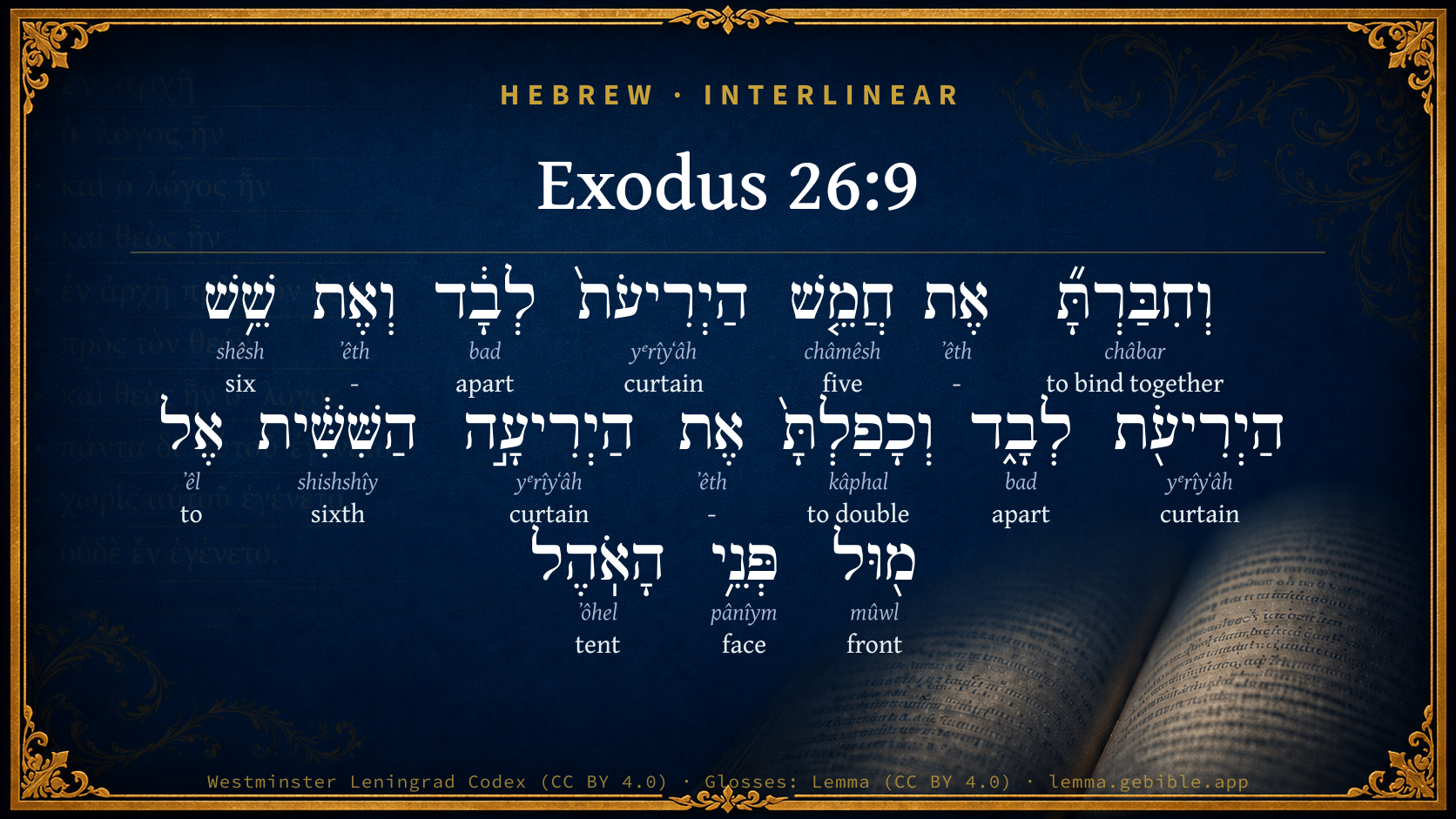
Hebrew (Westminster Leningrad Codex) Exodus 26:9 appears in the Hebrew Old Testament. The text above is from the Westminster Leningrad Codex. Each word links to its Strong’s number, a concise gloss, and parsing drawn from the Open Scriptures Hebrew Bible morphology. Click any word for its full Brown-Driver-Briggs (BDB) entry.
Download image
Cite this verse

Exodus 26:9 (World English Bible). Public Domain. Lemma interlinear Bible study tool, https://lemma.gebible.app/v/exodus/26/9.

Show BibTeX & RIS
BibTeX
RIS
English Translation
You shall couple five curtains by themselves, and six curtains by themselves, and shall double over the sixth curtain in the forefront of the tent.
World English Bible · Public Domain
Highlights
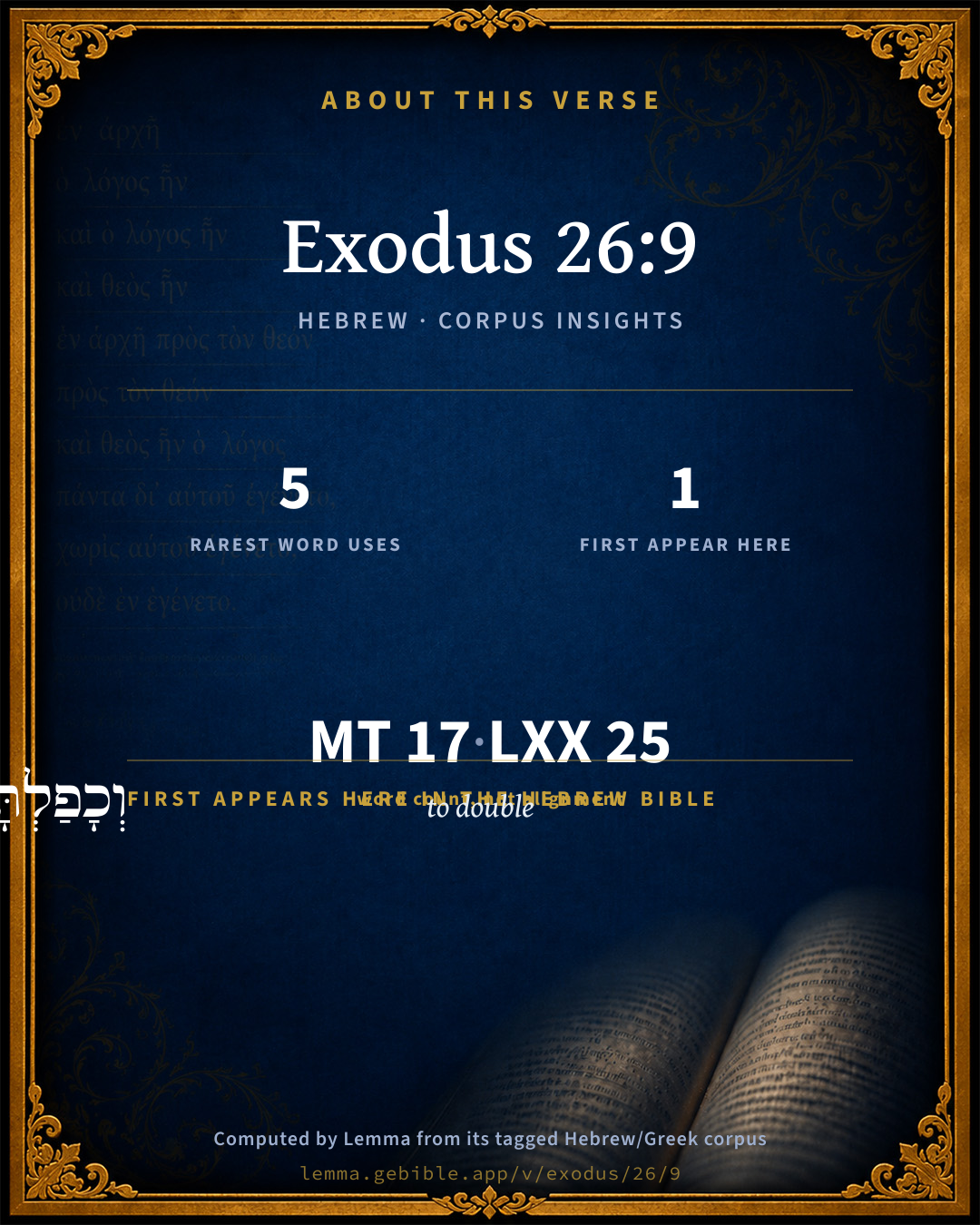
  • 1 first appearance in the Hebrew Bible
Full analysis ↓
Download a study sheet

One document with this verse’s original text, its word-by-word gloss line, the meaning frame, cross-references with their text, attributed commentary, and full source and license credits — printable, and it pastes into notes with its structure intact.

This verse Autodidact and up

Study sheet (.html) Plain text (.txt)

A passage Seminary Student

Up to 50 verses in one chapter. A passage sheet keeps up to 6 commentary sources and 12 cross-references per verse, in the order this page ranks them, and says so on the sheet whenever that leaves anything out. Ask for a single verse and you get the Autodidact verse sheet above.

Everything on this page stays free to read, with no account — the sheet is a download of what is already on screen, not access to it.

Want to remove ads? Support Godless Engineer
Compare translations 3

The same verse in 3 English versions, stacked beneath the original-language interlinear above. Click any original word for its lexicon entry.

Each is an independent rendering of the whole verse — the interlinear is not word-aligned to these translations.

Highlighted words mark where these versions differ — a whole-verse word diff, not a word-by-word alignment.

  • World English Bible Public Domain
    You shall couple five curtains by themselves, and six curtains by themselves, and shall double over the sixth curtain in the forefront of the tent.
  • King James Version Public Domain
    And thou shalt couple five curtains by themselves, and six curtains by themselves, and shalt double the sixth curtain in the forefront of the tabernacle.
  • unfoldingWord Literal Text CC BY-SA 4.0
    And you shall join five curtains to each other and six curtains to each other. And you shall double over the sixth curtain at the front of the face of the tent.

unfoldingWord Literal Text — © unfoldingWord, licensed CC BY-SA 4.0. Word-aligned USFM3 via Door43 (git.door43.org/unfoldingWord/en_ult).

Versions to compare (up to 4)

3 of 4 selected

Show all 18 translations

Every available English version of this verse, each an independent rendering of the whole verse.

  • World English Bible Public Domain
    You shall couple five curtains by themselves, and six curtains by themselves, and shall double over the sixth curtain in the forefront of the tent.
  • Berean Standard Bible Public Domain
    Join five of the curtains into one set and the other six into another. Then fold the sixth curtain over double at the front of the tent.
  • Majority Standard Bible Public Domain
    Join five of the curtains into one set and the other six into another. Then fold the sixth curtain over double at the front of the tent.
  • King James Version Public Domain
    And thou shalt couple five curtains by themselves, and six curtains by themselves, and shalt double the sixth curtain in the forefront of the tabernacle.
  • American Standard Version (1901) Public Domain
    And thou shalt couple five curtains by themselves, and six curtains by themselves, and shalt double over the sixth curtain in the forefront of the tent.
  • Revised Version (1885) Public Domain
    And thou shalt couple five curtains by themselves, and six curtains by themselves, and shalt double over the sixth curtain in the forefront of the tent.
  • Geneva Bible (1599) Public Domain
    And thou shalt couple fiue curtaynes by themselues, and the sixe curtaines by themselues: but thou shalt double the sixt curtaine vpon the forefront of the couering.
  • Douay-Rheims (1899) Public Domain
    Five of which thou shalt couple by themselves, and the six others thou shalt couple one to another, so as to double the sixth curtain in the front of the roof.
  • Young's Literal Translation Public Domain
    and thou hast joined the five curtains apart, and the six curtains apart, and hast doubled the six curtains over-against the front of the tent.
  • Literal Standard Version CC BY-SA 4.0
    and you have joined the five curtains apart, and the six curtains apart, and have doubled the six curtains at the front of the tent.
  • Unlocked Literal Bible CC BY-SA 4.0
    You must join five curtains to each other and the other six curtains to each other. You must double over the sixth curtain in the front of the tent.
  • unfoldingWord Literal Text CC BY-SA 4.0
    And you shall join five curtains to each other and six curtains to each other. And you shall double over the sixth curtain at the front of the face of the tent.
  • Darby Bible Public Domain
    And thou shalt couple five of the curtains by themselves, and six of the curtains by themselves, and shalt double the sixth curtain in the front of the tent.
  • World Messianic Bible Public Domain
    You shall couple five curtains by themselves, and six curtains by themselves, and shall double over the sixth curtain in the forefront of the tent.
  • Webster's Bible Public Domain
    And thou shalt couple five curtains by themselves, and six curtains by themselves, and shalt double the sixth curtain in the front of the tabernacle.
  • Free Bible Version CC BY-SA 4.0
    Join five of the curtains together as one set and the other six as another set. Then fold the sixth curtain in two at the front of the tent.
  • Bible in Basic English Public Domain
    Five of these curtains are to be joined together, and the other six are to be joined together, the sixth being folded over to make a hanging in front of the tent.
  • JPS Tanakh (1917) Public Domain
    And thou shalt couple five curtains by themselves, and six curtains by themselves, and shalt double over the sixth curtain in the forefront of the tent.

Literal Standard Version (2020), Covenant Press — licensed CC BY-SA 4.0. Text via the HelloAO Bible API (eBible.org). Unlocked Literal Bible (unfoldingWord) — licensed CC BY-SA 4.0. Text via the HelloAO Bible API (eBible.org). unfoldingWord Literal Text — © unfoldingWord, licensed CC BY-SA 4.0. Word-aligned USFM3 via Door43 (git.door43.org/unfoldingWord/en_ult). Free Bible Version, Dr. Jonathan Gallagher — licensed CC BY-SA 4.0. Text via the HelloAO Bible API (eBible.org).

Word by word

More ways to search: Search by grammar → Find every occurrence → Compare this word →

Practice this passage: Drill this verse → Learn its vocabulary →

וְכָפַלְתָּ֙
kâphal
H3717
“and · to double”
Conjunction + Verb, Qal, Sequential Perfect, 2nd Person, Masculine, Singular
Part of Speech
Conjunction + Verb
Stem
Qal
Form
Sequential Perfect
Person
2nd Person
Gender
Masculine
Number
Singular
Full BDB Definition

Origin: a primitive root

TWOT: 1019

to double, fold double, double over - (Qal) to double over - (Niphal) to be doubled
  1. וְחִבַּרְתָּ֞ châbar H2266 “and · to bind together” Conjunction + Verb, Piel, Sequential Perfect, 2nd Person, Masculine, Singular
  2. אֶת ʼêth H853 “-” Particle, Direct Object
  3. חֲמֵ֤שׁ châmêsh H2568 “five” Adjective, Cardinal number, Feminine, Singular, Absolute
  4. הַיְרִיעֹת֙ yᵉrîyʻâh H3407 “the · curtains” Particle, Definite Article + Noun, Common, Feminine, Plural, Absolute
  5. לְבָ֔ד bad H905 “to/for · apart” Preposition + Noun, Common, Masculine, Singular, Absolute
  6. וְאֶת ʼêth H853 “and · -” Conjunction + Particle, Direct Object
  7. שֵׁ֥שׁ shêsh H8337 “six” Adjective, Cardinal number, Feminine, Singular, Absolute
  8. הַיְרִיעֹ֖ת yᵉrîyʻâh H3407 “the · curtains” Particle, Definite Article + Noun, Common, Feminine, Plural, Absolute
  9. לְבָ֑ד bad H905 “to/for · apart” Preposition + Noun, Common, Masculine, Singular, Absolute
  10. אֶת ʼêth H853 “-” Particle, Direct Object
  11. הַיְרִיעָ֣ה yᵉrîyʻâh H3407 “the · curtain” Particle, Definite Article + Noun, Common, Feminine, Singular, Absolute
  12. הַשִּׁשִּׁ֔ית shishshîy H8345 “the · sixth” Particle, Definite Article + Adjective, Ordinal number, Feminine, Singular, Absolute
  13. אֶל ʼêl H413 “to” Preposition
  14. מ֖וּל mûwl H4136 “front” Preposition
  15. פְּנֵ֥י pânîym H6440 “face(s) of” Noun, Common, Both, Plural, Construct
  16. הָאֹֽהֶל ʼôhel H168 “the · tent” Particle, Definite Article + Noun, Common, Masculine, Singular, Absolute

About this verse

These counts appear in no published source. They are computed here, from the morphology-tagged text and Lemma’s own curated glosses. What Lemma adds →

17
words
12
distinct lemmas
Pentateuch
section

Notable vocabulary

The rarest word here is וְכָפַלְתָּ֙ to double H3717 — appearing just 5 times in the whole Hebrew Bible.

First appearance in Scripture

This word makes its first canonical appearance in the Hebrew Bible here:

  • וְכָפַלְתָּ֙ to double H3717

Shared distinctive vocabulary

וְכָפַלְתָּ֙ to double H3717 occurs in 4 verses of the Hebrew Bible. Also found in:

Grammatical profile

  • 2 verbs
  • 7 nouns
  • 3 adjectives
  • 2 prepositions
  • 3 particles

Verb forms

  • וְחִבַּרְתָּ֞ Piel · Sequential Perfect
  • וְכָפַלְתָּ֙ Qal · Sequential Perfect

Repetition

Words recur within this verse — often emphatic in Hebrew:

  • הַיְרִיעֹת֙ curtain H3407 ×3
  • לְבָ֔ד apart H905 ×2

Hebrew & Septuagint length

In English translation the verse runs 25 words from the Hebrew and 25 from the Septuagint (LXX English) — the same length.

A rough comparison of the two English renderings, which tokenize alike — not a word-level alignment.

Word counts can differ between the Hebrew and the Greek without any difference in meaning — e.g. the Hebrew direct-object marker אֵת has no separate Greek word, and Greek often adds the article ὁ.

In the original languages it is 17 Hebrew tokens and 25 Greek tokens — but the two are counted differently (Hebrew bundles its prefixes and suffixes into one token; the Greek is in lemma form), so that isn’t a like-for-like length.

Hebrew and Greek witnesses Masoretic Hebrew ↔ Greek Septuagint

The same verse in the two great witnesses to the Old Testament, shown verse-for-verse.

These are two independent witnesses, not word-aligned to each other, and the Septuagint is shown in lemma (dictionary) form.

Hebrew Exodus 26:9 Masoretic · Westminster Leningrad Codex

וְחִבַּרְתָּ֞ אֶת חֲמֵ֤שׁ הַיְרִיעֹת֙ לְבָ֔ד וְאֶת שֵׁ֥שׁ הַיְרִיעֹ֖ת לְבָ֑ד וְכָפַלְתָּ֙ אֶת הַיְרִיעָ֣ה הַשִּׁשִּׁ֔ית אֶל מ֖וּל פְּנֵ֥י הָאֹֽהֶל

You shall couple five curtains by themselves, and six curtains by themselves, and shall double over the sixth curtain in the forefront of the tent.

World English Bible · Public Domain

Greek LXX Exodus 26:9 Septuagint · lemma form

καί συνἅπτω ὁ πέντε δέρρις ἐπί ὁ αὐτός καί ὁ ἕξ δέρρις ἐπί ὁ αὐτός καί ἐπιδιπλόω ὁ δέρρις ὁ ἕκτος κατά πρόσωπον ὁ σκηνή

And you shall join the five skins together, and the six skins together; and you shall double the sixth skin in front of the tabernacle.

LXX2012 (modern English Septuagint) · Public Domain

Hebrew: Westminster Leningrad Codex (CC BY 4.0). Greek: Septuagint (public domain); English from LXX2012 (modern English Septuagint) (Public Domain). How the Septuagint differs from the Hebrew →

Targum (Aramaic paraphrase)

2

The Targum is the ancient Jewish Aramaic paraphrase of the Hebrew Scriptures — an interpretive translation, not the Hebrew text itself. Onkelos (literal) and Pseudo-Jonathan (expansive) render the Torah, and Jonathan the Prophets. Coverage is partial: where no permissively-licensed English translation exists for a verse, only the Aramaic is shown. This is verse-level text, not a word-by-word alignment to the Hebrew.

  1. Targum Onkelos Torah (Genesis–Deuteronomy)
    וּתְלָפֵף יָת חֲמֵשׁ יְרִיעָן לְחוֹד וְיָת שִׁית יְרִיעָן לְחוֹד וְתֵיעוּף יָת יְרִיעֲתָא שְׁתִיתֵיתָא לָקֳבֵל אַפֵּי מַשְׁכְּנָא:

    (no public-domain English translation for this verse)

    Targum Onkelos — Aramaic: “Onkelos Genesis” (public domain); “Onkelos Exodus” (public domain); “Onkelos Leviticus” (public domain); “Onkelos Numbers” (public domain); “Onkelos Deuteronomy” (public domain). English: “Sefaria Community Translation” (CC0 1.0 (public-domain dedication)); “J.W. Etheridge. The Targums of Onkelos and Jonathan Ben Uzziel on the Pentateuch. London: Longmans, Green, 1862” (public domain). Text via Sefaria.

  2. Targum Pseudo-Jonathan Torah (Genesis–Deuteronomy)
    וּתְלָפִיף יַת חֲמֵשׁ יְרִיעַן לְחוֹד כָּל קְבֵיל חַמְשָׁא סִפְרֵי אוֹרַיְיתָא וְיַת שִׁית יְרִיעַן לְחוֹד כָּל קְבֵיל שִׁית סִדְרֵי מַתְנִיתָּא וְתֵיעוֹף יַת יְרִיעֲתָא שָׁתִיתֵיתָא כָּל קְבֵיל אַפֵּי מַשְׁכְּנָא

    And thou shalt conjoin five curtains together, corresponding with the five books of the Law; and six curtains together, corresponding with the six orders of the Mishna; and shalt fold the sixth curtain over the front of the tabernacle.

    Targum Pseudo-Jonathan — Aramaic: “Targum Jonathan on Genesis” (public domain); “Targum Jonathan on Exodus” (public domain); “Targum Jonathan on Leviticus” (public domain); “Targum Jonathan on Numbers” (public domain); “Targum Jonathan on Deuteronomy” (public domain). English: “The Targum of Jonathan ben Uzziel, trans. J. W. Etheridge, London, 1862” (public domain). Text via Sefaria.

Commentary

Notes on Exodus 26:9 from classic Christian and Jewish commentators (each source and its license shown beneath its notes). The classic Christian expositions comment on the surrounding passage and are grouped to its opening verse, so a note may address several verses; the Jewish commentaries on the Tanakh (Rashi and others) are per-verse, so they appear only where the commentator wrote on this verse.

Lemma curates 59 commentaries, every one of them public domain or Creative Commons licensed, each selected and text-cleaned for this edition rather than reprinted as found. About our sources →

Tyndale Open Study Notes

Tyndale Open Resources

26:9 The two goat-hair curtains (26:7) totaled 45 feet by 66 feet. The extra 6 feet were equally distributed to hang down over the front and back of the framework.

Tyndale Open Study Notes — © Tyndale Open Resources, licensed CC BY-SA 4.0. Text via the HelloAO Bible API.

Geneva Bible (1599)

Geneva Bible translators

That is, five on the one side, and five on the other, and the sixth should hang over the door of the Tabernacle.

Geneva Bible (1599) marginal notes — public domain. Text via Bolls.life.

Ellicott's Commentary for English Readers

(9) Thou . . . shalt double the sixth curtain in the forefront of the tabernacle.—The additional “breadth” was to be doubled back upon itself, so giving a sort of finish to the roof in the front of the structure.

A Bible Commentary for English Readers, edited by Charles John Ellicott (1878–1897) — public domain. Text from a community e-Sword module.

John Gill's Exposition

And thou shall couple five curtains by themselves,.... And make one large curtain of them, as was ordered with respect to the linen curtains:

and six curtains by themselves; as there were eleven of them, such a division was made of five into one large curtain, and six into another; and as that which had six in it would reach further than the other, provision is made for the disposal and use of that as follows:

and shall double the sixth curtain in the forefront of the tabernacle; at the entrance of it, in the east end of it; the sixth curtain reaching to that, and hanging down, was turned up, and so doubled, opposite the door or entrance; and was, as Jarchi says, like a modest bride that covers her face with a vail, which before this had no covering; for thus it was, as Dr. Lightfoot (m) describes it, the holy place was ten yards long, and the five curtains sewed together were just so broad, and so they covered only the top and the sides, but hung not down at the end, which was eastward--but the six (goat hair curtains) that lay east reached to the end, covered the pillars whereon that vail hung, and they hung half a curtain's breadth or a yard over the entrance.

(m) Works, vol. 1. p. 718.

John Gill's Exposition of the Whole Bible (1746–1763) — public domain (CC PDM 1.0). Text via the HelloAO Bible API.

Matthew Poole's English Annotations

For the better security of the inward covering.

Matthew Poole's English Annotations on the Holy Bible (1683–1685) — public domain. Text from a community e-Sword/MySword module.

Whedon's Commentary on the Bible

Daniel D. Whedon

9. Five curtains by themselves — The expression by themselves seems evidently to mean the same as “together one to another” in Exo_26:3. These eleven breadths were to be coupled together like those ten in two great pieces, and the putting five in one and six in the other would provide that their places of union by loops and taches (Exo_26:10-11) would not, when spread over the roof, coincide with those of the tabernacle cloth of ten curtains.

Double the sixth — So that half of it would hang over in the forefront of the tent. Comp. on Exo_26:12.

Daniel D. Whedon (gen. ed.), Commentary on the Old and New Testaments (1874–1909) — public domain. Text from a community e-Sword module.

The Pulpit Commentary

Thou shalt couple, etc. As with the inner awning of linen, so with the goats" hair tent-cloth. The whole when made up was to be in two pieces, for convenience of transport. (See the comment on ver. 3.) The number of breadths in the tent-cloth being uneven, the two pieces were to be of different sizes, one containing five, and the other six, "breadths." Thou shalt double the sixth curtain in the forefront of the tabernacle. "Tabernacle" here is a mistranslation; since the Hebrew word is "ohel, "tent." The meaning may be, either that the sixth breadth was to be doubled back upon the fifth, or that half of it was to be doubled back upon the other half. The latter view is to be preferred, since otherwise the extra breadth would have been superfluous.

The Pulpit Commentary (1880–1919), ed. H.D.M. Spence-Jones & Joseph S. Exell — public domain. Text from a community e-Sword module.

Keil & Delitzsch

C. F. Keil & F. Delitzsch

Five of these were to be connected (sewed together) by themselves (לבד), and the other six in the same manner; and the sixth piece was to be made double, i.e., folded together, towards the front of the tent, so as to form a kind of gable, as Josephus has also explained the passage (Ant. iii. 6, 4).

Keil & Delitzsch — Biblical Commentary on the Old Testament (1861–1891) — public domain (CC PDM 1.0). Text via the HelloAO Bible API. (Old Testament only.)

Rashi

Rabbi Shlomo Yitzchaki (Rashi)

וכפלת את היריעה הששית AND THOU SHALT DOUBLE THE SIXTH CURTAIN which was additional in these upper curtains over and above the lower curtains,

אל מול פני האהל OPPOSITE THE FRONT OF THE TENT; half of its breadth (two cubits) hung down, being doubled, over the screen which was on the east side before the entrance, whereby the Tabernacle gained the appearance of a modest bride who has her face covered by a veil.

Rashi on the Tanakh — English translations: “The Judaica Press complete Tanach with Rashi, translated by A. J. Rosenberg” (CC BY 4.0); “Pentateuch with Rashi's commentary by M. Rosenbaum and A.M. Silbermann, 1929-1934” (public domain); “The Metsudah Tanach series, Lakewood, N.J” (CC BY 4.0); and “The Book of Joshua, Metsudah Publications, 1997” (CC BY 4.0). Text via Sefaria.

Lesson kit

Teaching starters — assembled from the data on this page, not authored interpretation. Every prompt links to the verse data it draws on. Edit before teaching.

Exodus, in the Pentateuch, opens this verse with 17 words (12 distinct Hebrew lemmas). Its most distinctive word is kâphal (“to double”). A historical commentator’s framing appears above. Read the whole chapter for the surrounding context.

Discussion questions

  1. What does “to double” (kâphal) contribute to the verse as a whole?
  2. This is the first place “to double” appears in Scripture (first appears here). What does its debut here establish?
  3. How does Exodus 28:16, which shares the word «to double», read alongside this verse?
  4. What does the repetition of “curtain” (3× in this one verse) do in this verse?
  5. These translations render this verse differently. What is at stake in choosing one wording over another?
  6. «וְחִבַּרְתָּ֞» is a Piel Sequential Perfect verb. How does that grammatical form shape the action described?
  7. Compare how Tyndale Open Study Notes and Geneva Bible (1599) read this verse. Where do they agree or differ?

Things to notice

Reading settings

Reading text

Shown beneath each verse's original-language words.

Old Testament
Old Testament edition

Read the OT as the Masoretic Hebrew (MT) or the Greek Septuagint (LXX).

English shown for the Greek Septuagint (in the Hebrew ↔ Greek comparison).

Comparing translations? Open the Compare panel on any verse page to stack up to four side by side.