Exodus 26:7

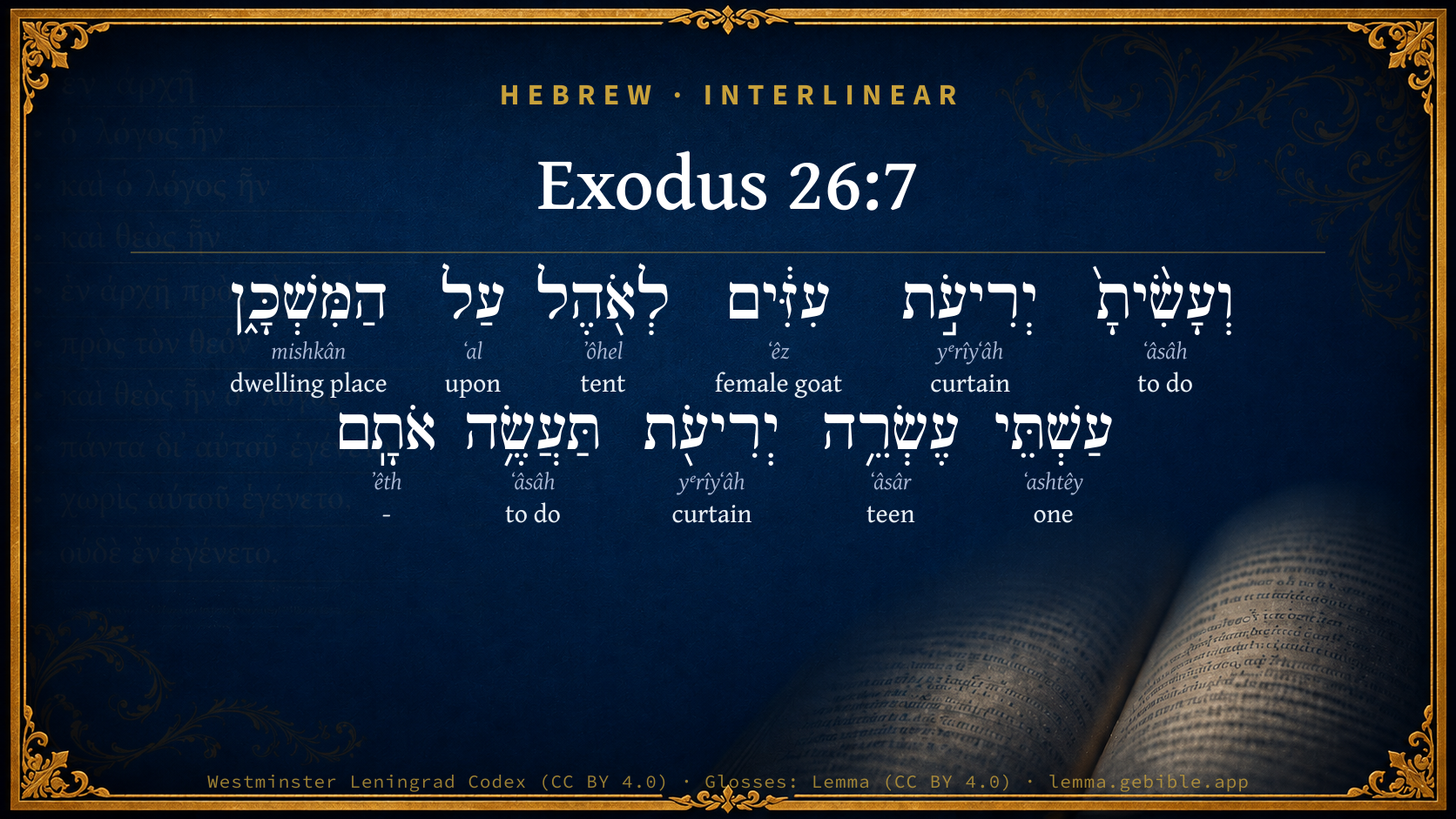
Hebrew (Westminster Leningrad Codex) Exodus 26:7 appears in the Hebrew Old Testament. The text above is from the Westminster Leningrad Codex. Each word links to its Strong’s number, a concise gloss, and parsing drawn from the Open Scriptures Hebrew Bible morphology. Click any word for its full Brown-Driver-Briggs (BDB) entry.
Download image
Cite this verse

Exodus 26:7 (World English Bible). Public Domain. Lemma interlinear Bible study tool, https://lemma.gebible.app/v/exodus/26/7.

Show BibTeX & RIS
BibTeX
RIS
English Translation
"You shall make curtains of goats' hair for a covering over the tent: eleven curtains shall you make them.
World English Bible · Public Domain
Highlights
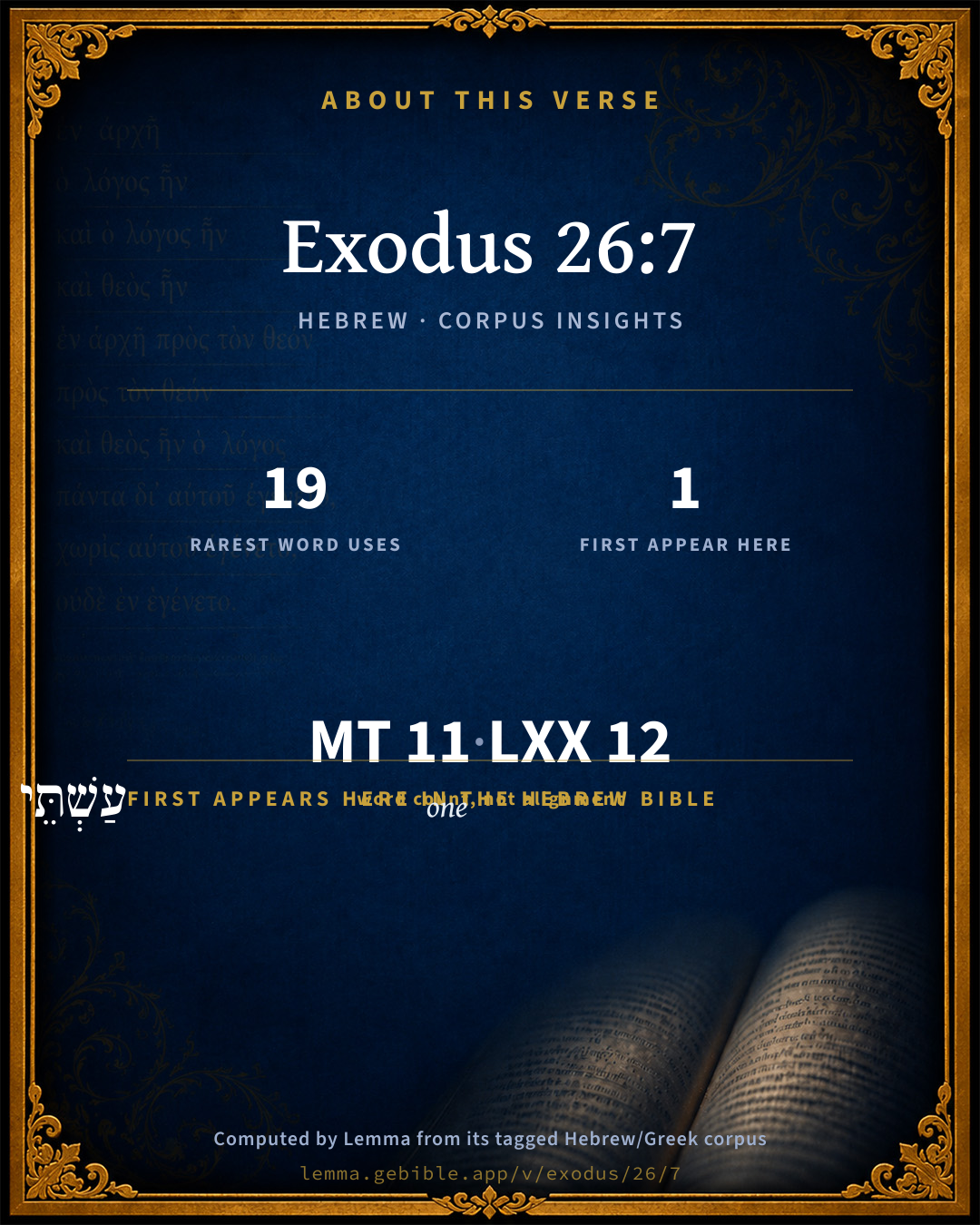
  • 1 first appearance in the Hebrew Bible
Full analysis ↓
Download a study sheet

One document with this verse’s original text, its word-by-word gloss line, the meaning frame, cross-references with their text, attributed commentary, and full source and license credits — printable, and it pastes into notes with its structure intact.

This verse Autodidact and up

Study sheet (.html) Plain text (.txt)

A passage Seminary Student

Up to 50 verses in one chapter. A passage sheet keeps up to 6 commentary sources and 12 cross-references per verse, in the order this page ranks them, and says so on the sheet whenever that leaves anything out. Ask for a single verse and you get the Autodidact verse sheet above.

Everything on this page stays free to read, with no account — the sheet is a download of what is already on screen, not access to it.

Want to remove ads? Support Godless Engineer
Compare translations 3

The same verse in 3 English versions, stacked beneath the original-language interlinear above. Click any original word for its lexicon entry.

Each is an independent rendering of the whole verse — the interlinear is not word-aligned to these translations.

Highlighted words mark where these versions differ — a whole-verse word diff, not a word-by-word alignment.

  • World English Bible Public Domain
    "You shall make curtains of goats' hair for a covering over the tent: eleven curtains shall you make them.
  • King James Version Public Domain
    And thou shalt make curtains of goats' hair to be a covering upon the tabernacle: eleven curtains shalt thou make.
  • unfoldingWord Literal Text CC BY-SA 4.0
    And you shall make curtains of goats’ hair for a tent over the Dwelling. You shall make 11 of these curtains.

unfoldingWord Literal Text — © unfoldingWord, licensed CC BY-SA 4.0. Word-aligned USFM3 via Door43 (git.door43.org/unfoldingWord/en_ult).

Versions to compare (up to 4)

3 of 4 selected

Show all 18 translations

Every available English version of this verse, each an independent rendering of the whole verse.

  • World English Bible Public Domain
    "You shall make curtains of goats' hair for a covering over the tent: eleven curtains shall you make them.
  • Berean Standard Bible Public Domain
    You are to make curtains of goat hair for the tent over the tabernacle—eleven curtains in all.
  • Majority Standard Bible Public Domain
    You are to make curtains of goat hair for the tent over the tabernacle—eleven curtains in all.
  • King James Version Public Domain
    And thou shalt make curtains of goats' hair to be a covering upon the tabernacle: eleven curtains shalt thou make.
  • American Standard Version (1901) Public Domain
    And thou shalt make curtains of goats' `hair' for a tent over the tabernacle: eleven curtains shalt thou make them.
  • Revised Version (1885) Public Domain
    And thou shalt make curtains of goats’ hair for a tent over the tabernacle: eleven curtains shalt thou make them.
  • Geneva Bible (1599) Public Domain
    Also thou shalt make curtaines of goates heare, to be a couering vpon the Tabernacle: thou shalt make them to the number of eleuen curtaines.
  • Douay-Rheims (1899) Public Domain
    Thou shalt make also eleven curtains of goats' hair, to cover the top of the tabernacle.
  • Young's Literal Translation Public Domain
    `And thou hast made curtains of goats' `hair', for a tent over the tabernacle; thou dost make eleven curtains:
  • Literal Standard Version CC BY-SA 4.0
    And you have made curtains of goats’ [hair] for a tent over the Dwelling Place; you make eleven curtains:
  • Unlocked Literal Bible CC BY-SA 4.0
    You must make curtains of goats' hair for a tent over the tabernacle. You must make eleven of these curtains.
  • unfoldingWord Literal Text CC BY-SA 4.0
    And you shall make curtains of goats’ hair for a tent over the Dwelling. You shall make 11 of these curtains.
  • Darby Bible Public Domain
    And thou shalt make curtains of goats' [hair] for a tent over the tabernacle: eleven curtains shalt thou make them.
  • World Messianic Bible Public Domain
    “You shall make curtains of goats’ hair for a covering over the tabernacle. You shall make eleven curtains.
  • Webster's Bible Public Domain
    And thou shalt make curtains of goats' hair to be a covering upon the tabernacle: eleven curtains shalt thou make.
  • Free Bible Version CC BY-SA 4.0
    Make eleven curtains of goat hair as a tent to cover the Tabernacle.
  • Bible in Basic English Public Domain
    And you are to make curtains of goats' hair for a tent over the House, eleven curtains.
  • JPS Tanakh (1917) Public Domain
    And thou shalt make curtains of goats' hair for a tent over the tabernacle; eleven curtains shalt thou make them.

Literal Standard Version (2020), Covenant Press — licensed CC BY-SA 4.0. Text via the HelloAO Bible API (eBible.org). Unlocked Literal Bible (unfoldingWord) — licensed CC BY-SA 4.0. Text via the HelloAO Bible API (eBible.org). unfoldingWord Literal Text — © unfoldingWord, licensed CC BY-SA 4.0. Word-aligned USFM3 via Door43 (git.door43.org/unfoldingWord/en_ult). Free Bible Version, Dr. Jonathan Gallagher — licensed CC BY-SA 4.0. Text via the HelloAO Bible API (eBible.org).

Word by word

More ways to search: Search by grammar → Find every occurrence → Compare this word →

Practice this passage: Drill this verse → Learn its vocabulary →

עַשְׁתֵּי
ʻashtêy
H6249
“one”
Adjective, Cardinal number, Both, Plural, Construct
Part of Speech
Adjective
Type
Cardinal number
Gender
Both
Number
Plural
State
Construct
Full BDB Definition

Origin: apparently masc. pl. construction of H6247 in the sense of an afterthought (used only in connection with H6240 in lieu of H259 ) eleven or (ordinal) eleventh

TWOT: 1717c

one, eleven, eleventh
  1. וְעָשִׂ֨יתָ֙ ʻâsâh H6213 “and · to do” Conjunction + Verb, Qal, Sequential Perfect, 2nd Person, Masculine, Singular
  2. יְרִיעֹ֣ת yᵉrîyʻâh H3407 “curtains of” Noun, Common, Feminine, Plural, Construct
  3. עִזִּ֔ים ʻêz H5795 “female goats” Noun, Common, Feminine, Plural, Absolute
  4. לְאֹ֖הֶל ʼôhel H168 “to/for · tent” Preposition + Noun, Common, Masculine, Singular, Absolute
  5. עַל ʻal H5921 “upon” Preposition
  6. הַמִּשְׁכָּ֑ן mishkân H4908 “the · dwelling place” Particle, Definite Article + Noun, Common, Masculine, Singular, Absolute
  7. עֶשְׂרֵ֥ה ʻâsâr H6240 “teen” Adjective, Cardinal number, Feminine, Singular, Absolute
  8. יְרִיעֹ֖ת yᵉrîyʻâh H3407 “curtains” Noun, Common, Feminine, Plural, Absolute
  9. תַּעֲשֶׂ֥ה ʻâsâh H6213 “to do” Verb, Qal, Imperfect, 2nd Person, Masculine, Singular
  10. אֹתָֽם ʼêth H853 “- · them” Particle, Direct Object + Suffix, Personal, 3rd Person, Masculine, Plural

About this verse

These counts appear in no published source. They are computed here, from the morphology-tagged text and Lemma’s own curated glosses. What Lemma adds →

11
words
9
distinct lemmas
Pentateuch
section

Notable vocabulary

The rarest word here is עַשְׁתֵּי one H6249 — appearing just 19 times in the whole Hebrew Bible.

First appearance in Scripture

This word makes its first canonical appearance in the Hebrew Bible here:

  • עַשְׁתֵּי one H6249

Shared distinctive vocabulary

עַשְׁתֵּי one H6249 occurs in 18 verses of the Hebrew Bible. Also found in:

Grammatical profile

  • 2 verbs
  • 5 nouns
  • 2 adjectives
  • 1 preposition
  • 1 particle

Verb forms

  • וְעָשִׂ֨יתָ֙ Qal · Sequential Perfect
  • תַּעֲשֶׂ֥ה Qal · Imperfect

Repetition

Words recur within this verse — often emphatic in Hebrew:

  • וְעָשִׂ֨יתָ֙ to do H6213 ×2
  • יְרִיעֹ֣ת curtain H3407 ×2

Hebrew & Septuagint length

In English translation the verse runs 19 words from the Hebrew and 21 from the Septuagint (LXX English) — closely comparable.

A rough comparison of the two English renderings, which tokenize alike — not a word-level alignment.

Word counts can differ between the Hebrew and the Greek without any difference in meaning — e.g. the Hebrew direct-object marker אֵת has no separate Greek word, and Greek often adds the article ὁ.

In the original languages it is 11 Hebrew tokens and 12 Greek tokens — but the two are counted differently (Hebrew bundles its prefixes and suffixes into one token; the Greek is in lemma form), so that isn’t a like-for-like length.

Cross-references

15

Topical passages linked to Exodus 26:7 in the Treasury of Scripture Knowledge — connected by theme and wording, ordered by reader-vote popularity; previews shown in the World English Bible.

  • Exodus 26:14 You shall make a covering for the tent of rams' skins dyed red, and a covering of sea cow hides above.
  • Exodus 25:4 blue, purple, scarlet, fine linen, goats' hair,
  • Exodus 26:1 "Moreover you shall make the tent with ten curtains; of fine twined linen, and blue, and purple, and scarlet, with cherubim. The work of the skillful workman you shall make them.
  • Exodus 26:9 You shall couple five curtains by themselves, and six curtains by themselves, and shall double over the sixth curtain in the forefront of the tent.
  • Exodus 26:12 The overhanging part that remains of the curtains of the tent, the half curtain that remains, shall hang over the back of the tent.
  • Exodus 35:6 blue, purple, scarlet, fine linen, goats' hair,
  • Exodus 35:23 Everyone, with whom was found blue, purple, scarlet, fine linen, goats' hair, rams' skins dyed red, and sea cow hides, brought them.
  • Exodus 35:26 All the women whose heart stirred them up in wisdom spun the goats' hair.
  • Exodus 36:14–18 He made curtains of goats' hair for a covering over the tent. He made them eleven curtains.
  • Numbers 4:25 they shall carry the curtains of the tabernacle, and the Tent of Meeting, its covering, and the covering of sealskin that is above on it, and the screen for the door of the Tent of Meeting,
  • Numbers 31:20 As to every garment, and all that is made of skin, and all work of goats' [hair], and all things made of wood, you shall purify yourselves.
  • Psalms 45:13 The princess inside is all glorious. Her clothing is interwoven with gold.
  • Isaiah 4:5 Yahweh will create over the whole habitation of Mount Zion, and over her assemblies, a cloud and smoke by day, and the shining of a flaming fire by night; for over all the glory will be a canopy.
  • 1 Peter 3:4 but in the hidden person of the heart, in the incorruptible adornment of a gentle and quiet spirit, which is in the sight of God very precious.
  • 1 Peter 5:5 Likewise, you younger ones, be subject to the elder. Yes, all of you gird yourselves with humility, to subject yourselves to one another; for "God resists the proud, but gives grace to the humble."

Cross-references courtesy of OpenBible.info (CC BY 4.0).

Hebrew and Greek witnesses Masoretic Hebrew ↔ Greek Septuagint

The same verse in the two great witnesses to the Old Testament, shown verse-for-verse.

These are two independent witnesses, not word-aligned to each other, and the Septuagint is shown in lemma (dictionary) form.

Hebrew Exodus 26:7 Masoretic · Westminster Leningrad Codex

וְעָשִׂ֨יתָ֙ יְרִיעֹ֣ת עִזִּ֔ים לְאֹ֖הֶל עַל הַמִּשְׁכָּ֑ן עַשְׁתֵּי עֶשְׂרֵ֥ה יְרִיעֹ֖ת תַּעֲשֶׂ֥ה אֹתָֽם

"You shall make curtains of goats' hair for a covering over the tent: eleven curtains shall you make them.

World English Bible · Public Domain

Greek LXX Exodus 26:7 Septuagint · lemma form

καί ποιέω δέρρις τριχίνας σκέπη ἐπί ὁ σκηνή ἕνδεκα δέρρις ποιέω αὐτός

And you shall make for a covering of the tabernacle skins with the hair on, you shall make them eleven skins.

LXX2012 (modern English Septuagint) · Public Domain

Hebrew: Westminster Leningrad Codex (CC BY 4.0). Greek: Septuagint (public domain); English from LXX2012 (modern English Septuagint) (Public Domain). How the Septuagint differs from the Hebrew →

Targum (Aramaic paraphrase)

2

The Targum is the ancient Jewish Aramaic paraphrase of the Hebrew Scriptures — an interpretive translation, not the Hebrew text itself. Onkelos (literal) and Pseudo-Jonathan (expansive) render the Torah, and Jonathan the Prophets. Coverage is partial: where no permissively-licensed English translation exists for a verse, only the Aramaic is shown. This is verse-level text, not a word-by-word alignment to the Hebrew.

  1. Targum Onkelos Torah (Genesis–Deuteronomy)
    וְתַעְבֵּד יְרִיעָן מְעַזֵי לִפְרָסָא עַל מַשְׁכְּנָא חֲדָא עֶסְרֵי יְרִיעָן תַּעְבֵּד יָתְהוֹן:

    (no public-domain English translation for this verse)

    Targum Onkelos — Aramaic: “Onkelos Genesis” (public domain); “Onkelos Exodus” (public domain); “Onkelos Leviticus” (public domain); “Onkelos Numbers” (public domain); “Onkelos Deuteronomy” (public domain). English: “Sefaria Community Translation” (CC0 1.0 (public-domain dedication)); “J.W. Etheridge. The Targums of Onkelos and Jonathan Ben Uzziel on the Pentateuch. London: Longmans, Green, 1862” (public domain). Text via Sefaria.

  2. Targum Pseudo-Jonathan Torah (Genesis–Deuteronomy)
    וְתַעֲבֵיד יְרִיעַן דְּמֵעִיזֵי לְמִפְרַס עַל מַשְׁכְּנָא חַדְסְרִי יְרִיעַן תַּעֲבֵיד יַתְהֵין

    And thou shalt make curtains of goats' hair to extend over the tabernacle: eleven curtains thou shalt make them.

    Targum Pseudo-Jonathan — Aramaic: “Targum Jonathan on Genesis” (public domain); “Targum Jonathan on Exodus” (public domain); “Targum Jonathan on Leviticus” (public domain); “Targum Jonathan on Numbers” (public domain); “Targum Jonathan on Deuteronomy” (public domain). English: “The Targum of Jonathan ben Uzziel, trans. J. W. Etheridge, London, 1862” (public domain). Text via Sefaria.

Commentary

Notes on Exodus 26:7 from classic Christian and Jewish commentators (each source and its license shown beneath its notes). The classic Christian expositions comment on the surrounding passage and are grouped to its opening verse, so a note may address several verses; the Jewish commentaries on the Tanakh (Rashi and others) are per-verse, so they appear only where the commentator wrote on this verse.

Lemma curates 59 commentaries, every one of them public domain or Creative Commons licensed, each selected and text-cleaned for this edition rather than reprinted as found. About our sources →

Matthew Henry's Commentary

Moses is here ordered to make a double covering for the tabernacle, that it might not rain in, and that the beauty of those fine curtains might not be damaged. 1. There was to be a covering of hair camlet curtains, which were somewhat larger every way than the inner curtains, because they were to enclose them, and probably were stretched out at some little distance from them, Exo 26:7, etc. These were coupled together with brass clasps. The stuff being less valuable, the tacks were so; but the brass tacks would answer the intention as effectually as the golden ones. The bonds of unity may be as strong between curtains of goats' hair as between those of purple and scarlet. 2. Over this there was to be another covering, and that a double one (Exo 26:14), one of rams' skins dyed red, probably dressed with the wool on; another of badgers' skins, so we translate it, but it should rather seem to have been some strong sort of leather (but very fine), for we read of the best sort of shoes being made of it, Eze 16:10. Now observe here, (1.) That the outside of the tabernacle was coarse and rough, the beauty of it was in the inner curtains. Those in whom God dwells must labour to be better than they seem to be. Hypocrites put the best side outwards, like whited sepulchres; but the king's daughter is all glorious within (Psa 45:13); in the eye of the world black as the tents of Kedar, but, in the eye of God, comely as the curtains of Solomon, Sol 1:5. Let our adorning be that of the hidden man of the heart, which God values, Pe1 3:4. (2.) That where God places his glory he will create a defence upon it; even upon the habitations of the righteous there shall be a covert, Isa 6:5, Isa 6:6. The protection of Providence shall always be upon the beauty of holiness. God's tent will be a pavilion, Psa 27:5.

Matthew Henry's Commentary on the Whole Bible (1708–1710) — public domain (CC PDM 1.0). Text via the HelloAO Bible API.

Trapp's Complete Commentary

John Trapp

Exo 26:7 And thou shalt make curtains [of] goats’ [hair] to be a covering upon the tabernacle: eleven curtains shalt thou make.

Ver. 7. Of goats’ hair.] The tabernacle was goats’ hair without, and gold within. God hid his Son under the carpenter’s son. "The king’s daughter is all glorious within." {Psa 45:13} And all her sons are princes in all lands. {Psa 45:16} Howbeit, they must be content to pass to heaven as Christ their Head did, as concealed men. "Therefore the world knoweth us not, because it knew not him." {Joh 1:10} "Our life is hid with Christ," {Col 3:4} as the life of flowers in winter is hid in the root.

John Trapp, A Commentary or Exposition upon All the Books of the Old and New Testament (1647–1656) — public domain. Text from a community e-Sword module.

Geneva Bible (1599)

Geneva Bible translators

Lest rain and weather should mar it.

Geneva Bible (1599) marginal notes — public domain. Text via Bolls.life.

Jamieson, Fausset & Brown

Robert Jamieson, A. R. Fausset & David Brown

curtains of goats' hair--These coarse curtains were to be one more in number than the others, and to extend a yard lower on each side, the use of them being to protect and conceal the richer curtains.

Jamieson, Fausset & Brown — Commentary Critical and Explanatory on the Whole Bible (1871) — public domain (CC PDM 1.0). Text via the HelloAO Bible API.

Adam Clarke's Commentary

Verse 7. Curtains of goats' hair] Stuff made of goats' hair. See Clarke on Ex 25:4. This was the second covering.

Adam Clarke's Commentary on the Bible (1810–1826) — public domain. Text from a community e-Sword/MySword module.

Ellicott's Commentary for English Readers

(7) To be a covering.—Literally, to be a tent. (See the first Note on the chapter.)

Eleven curtains—i.e., eleven breadths. (See Note 2 on Exo_26:1.)

2. THE GOATS’-HAIR TENT-CLOTH.

(7-13) An awning such as that described in Exo_26:1-6 would have neither kept out sun nor rain. For this purpose an ordinary cloth of goats’-hair was requisite, and accordingly Moses was instructed to make a second covering, which was to be of this material, and to extend over the whole of the first, thus externally concealing it. This second covering was, like the first, to be in two portions (Exo_26:9-11), each of them made up of several “breadths,” but the two portions were not to be of the same size. Both were to be thirty cubits in length, but the hinder portion was to contain five “breadths,” while the portion in front was to contain six. Thus the outer covering was six feet broader than the inner one. The object was the protection of the inner covering, which was overlapped at both ends by the outer one (Exo_26:9; Exo_26:12).

A Bible Commentary for English Readers, edited by Charles John Ellicott (1878–1897) — public domain. Text from a community e-Sword module.

The Cambridge Bible for Schools and Colleges

gen. ed. J. J. S. Perowne

Exodus 7-13 (cf. Exo_36:14-18). The Tent over the Dwelling, consisting of eleven curtains of cloth made of goats’ hair, each 30 cubits long, and 4 cubits wide, fastened together so as to form a single large curtain, 30 cubits broad, and 44 cubits long. The Bedawin still make their tents of goats’ hair in the same way: breadths of goats’ hair cloth, it may be ¾ yd. broad, and as long as the breadth of the tent, are stitched together, and form a covering capable of keeping out the heaviest rain (Burckh. Bedouins, i. 37; cf. DB. iv. 717): comp. Son_1:5, where their dark colour is alluded to.

The Cambridge Bible for Schools and Colleges (gen. ed. J. J. S. Perowne; Cambridge University Press, 1878–1918) — public domain. Text from a community e-Sword module.

John Gill's Exposition

And thou shalt make curtains of goats' hair,.... Jarchi calls it the flower or down of goats, the softer and finer part of their hair, which was spun by women, as appears from Exo 35:26, and was made up into a stuff somewhat like our camelot; these curtains were coarser than the former, and were made to be put over them, to preserve them from the weather, as it follows:

to be a covering upon the tabernacle: which, by the curtains of linen coupled together, became one tabernacle, as in the preceding verse: and these curtains were to be a tent or covering over them: they were somewhat like, being made of the same matter, with the coverings with which the ancient Arabs covered their tents, which were made of goats' hair, as were the tents of Kedar alluded to in Sol 1:5, these curtains of goats' hair denote the outward appearance of Christ in human nature, who, attended with all human infirmities, excepting sin, was in the form of a servant, in great meanness and poverty, covered with reproach, and had in the greatest contempt, and especially at the time of his sufferings and death; though all rich and glorious within, full of grace, and of all the blessings of grace, of righteousness and life, of light, joy, peace, and comfort for his people; and may also denote the mean appearance of the church and people of God outwardly; being, generally speaking, a poor and an afflicted people, subject to the scorn, reproach, and persecutions of men, but all glorious within, enriched with the grace of God and righteousness of Christ; and so, in one respect, like these curtains of goats' hair, and, in another respect, like the curtains of fine linen:

eleven curtains shalt thou make; one more than the other; the reason of which was, that there might be one at the entrance of the tabernacle, there being no linen curtain there, see Exo 26:9.

John Gill's Exposition of the Whole Bible (1746–1763) — public domain (CC PDM 1.0). Text via the HelloAO Bible API.

Matthew Poole's English Annotations

Of goats’ hair, spun, Exo 35:26, and woven into a stuff, like our camlet.

To be a covering; to be put next above the curtains.

Matthew Poole's English Annotations on the Holy Bible (1683–1685) — public domain. Text from a community e-Sword/MySword module.

Whedon's Commentary on the Bible

Daniel D. Whedon

7. Curtains of goats’ hair — For the use of this material for tents see Exo_25:4, note.

Covering upon the tabernacle — Literally, for a tent (אהל) over the tabernacle, (משׁכן.) This then was to form a regular tent cover, while the one just previously described was to serve more for interior ornamentation.

Daniel D. Whedon (gen. ed.), Commentary on the Old and New Testaments (1874–1909) — public domain. Text from a community e-Sword module.

The Pulpit Commentary

The goat"s skin tent-cloth (vers. 7-13).

From the inner covering of the tabernacle the directions proceed to the external covering, or rather coverings, which constituted the real strength of the structure, and its protection from wet or stormy weather. Curtains of goats" hair, such as the Arabs still use, as the ordinary covering of their tents (Layard, Nin. and Bab., p. 171), were to form a true "tent" ("ohel) above the tabernacle, being supported by tent-poles, and kept taut by means of cords and pegs. (Exo_27:19 Exo_35:18) See the representation in Dr. W. Smith"s Dictionary of the Bible, vol. 3. p. 1454, which is reproduced in the Speaker"s Commentary, vol. 1. p. 376. To be a covering. In Exo_36:14, we have made curtains of goats" hair for the tent over the tabernacle," which is far better. The word used in both places is the same ("ohel) Eleven curtainsi.e. , "eleven breadths." Compare ver. 1.

The Pulpit Commentary (1880–1919), ed. H.D.M. Spence-Jones & Joseph S. Exell — public domain. Text from a community e-Sword module.

Keil & Delitzsch

C. F. Keil & F. Delitzsch

The outer tent-cloth, "for the tent over the dwelling," was to consist of eleven lengths of goats' hair, i.e., of cloth made of goats' hair;

(Note: The coverings of the tents of the Bedouin Arabs are still made of cloth woven from black goats' hair, which the women spin and weave (see Lynch's Expedition of the United States to the Jordan and Dead Sea).)

each piece being thirty cubits long and four broad.

Keil & Delitzsch — Biblical Commentary on the Old Testament (1861–1891) — public domain (CC PDM 1.0). Text via the HelloAO Bible API. (Old Testament only.)

Scofield Reference Notes

C. I. Scofield

goats’ hair CF. Lev 16:5; Lev 16:7-10. The reference seems to be to the result of the ordinance of the two goats as "covering" (See Scofield "Lev 16:5") thus speaking of Christ in atonement See Scofield "Gen 3:21". This thought is intensified in the colour of the rams’ skins, Exo 26:14.

The Scofield Reference Bible (1917 edition), notes by C. I. Scofield — public domain. Text from a community e-Sword module.

unfoldingWord translationNotes

Door43 World Missions Community

General Information:

Yahweh continues telling Moses what the people must do.

eleven ... thirty ... four

"11 ... 30 ... 4" (See: Numbers)

cubits

A cubit is 46 centimeters. (See: Biblical Distance)

translationWords

goat

tent

tabernacle

unfoldingWord translationNotes — © Distant Shores Media and the Door43 World Missions Community, licensed CC BY-SA 4.0. Source: git.door43.org/Door43/en_tn.

Rashi

Rabbi Shlomo Yitzchaki (Rashi)

יריעת עזים CURTAINS OF עזים — i. e. GOATS HAIR (cf. Rashi on Exodus 25:4).

לאהל על המשכן TO BE A COVERING UPON THE DWELLING — i. e. to spread them over the lower curtains (over those which had been already placed over the Tabernacle).

Rashi on the Tanakh — English translations: “The Judaica Press complete Tanach with Rashi, translated by A. J. Rosenberg” (CC BY 4.0); “Pentateuch with Rashi's commentary by M. Rosenbaum and A.M. Silbermann, 1929-1934” (public domain); “The Metsudah Tanach series, Lakewood, N.J” (CC BY 4.0); and “The Book of Joshua, Metsudah Publications, 1997” (CC BY 4.0). Text via Sefaria.

Lesson kit

Teaching starters — assembled from the data on this page, not authored interpretation. Every prompt links to the verse data it draws on. Edit before teaching.

Exodus, in the Pentateuch, opens this verse with 11 words (9 distinct Hebrew lemmas). Its most distinctive word is ʻashtêy (“one”). A historical commentator’s framing appears above. Read the whole chapter for the surrounding context.

Discussion questions

  1. What does “one” (ʻashtêy) contribute to the verse as a whole?
  2. This is the first place “one” appears in Scripture (first appears here). What does its debut here establish?
  3. How does Exodus 26:8, which shares the word «one», read alongside this verse?
  4. What does the repetition of “to do” (2× in this one verse) do in this verse?
  5. These translations render this verse differently. What is at stake in choosing one wording over another?
  6. «וְעָשִׂ֨יתָ֙» is a Qal Sequential Perfect verb. How does that grammatical form shape the action described?
  7. Compare how Matthew Henry's Commentary and Trapp's Complete Commentary read this verse. Where do they agree or differ?

Things to notice

Reading settings

Reading text

Shown beneath each verse's original-language words.

Old Testament
Old Testament edition

Read the OT as the Masoretic Hebrew (MT) or the Greek Septuagint (LXX).

English shown for the Greek Septuagint (in the Hebrew ↔ Greek comparison).

Comparing translations? Open the Compare panel on any verse page to stack up to four side by side.