
Joshua 19:51

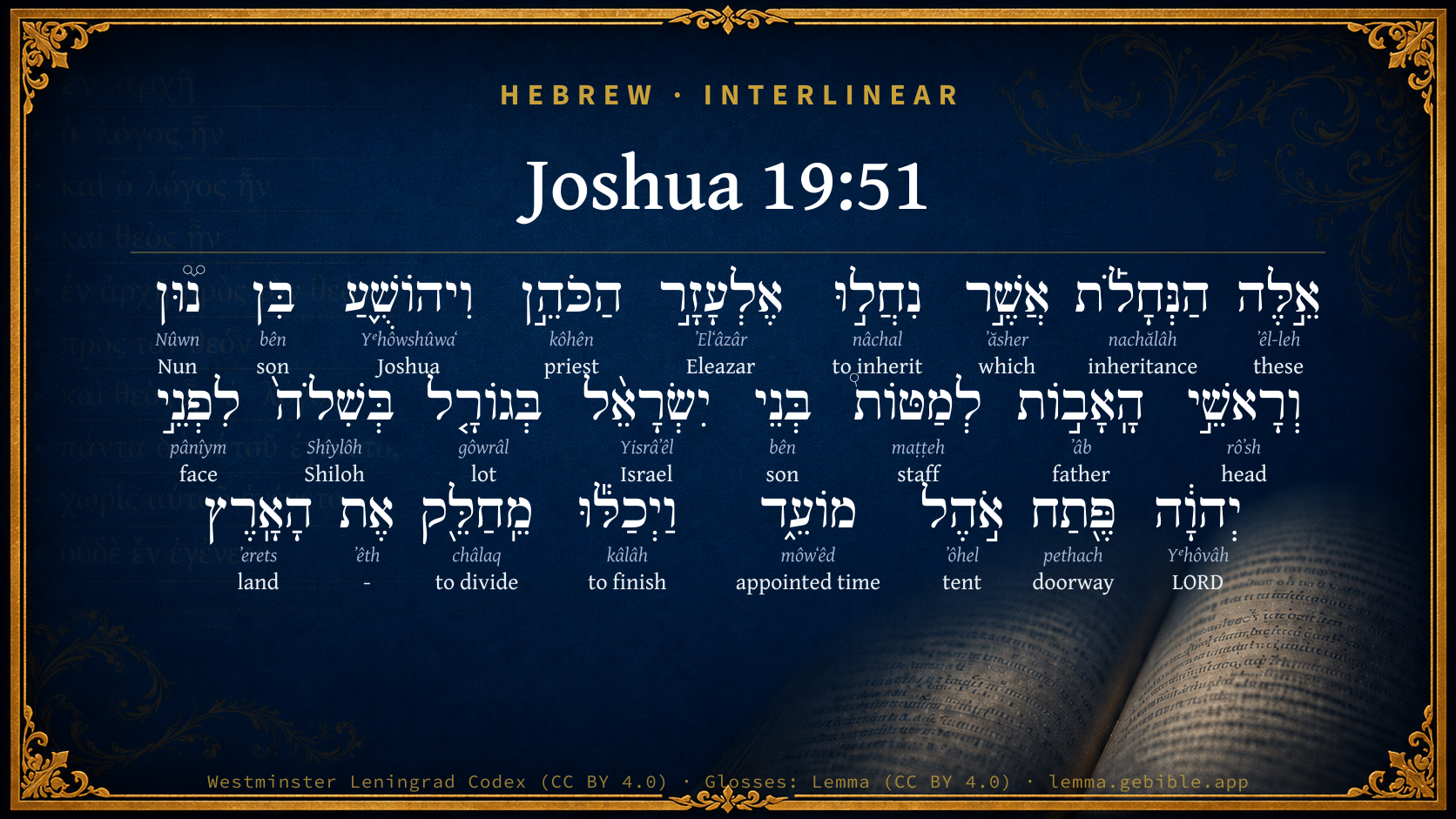
Hebrew (Westminster Leningrad Codex) Joshua 19:51 appears in the Hebrew Old Testament. The text above is from the Westminster Leningrad Codex. Each word links to its Strong’s number, a concise gloss, and parsing drawn from the Open Scriptures Hebrew Bible morphology. Click any word for its full Brown-Driver-Briggs (BDB) entry.
Download image
Cite this verse

Joshua 19:51 (World English Bible). Public Domain. Lemma interlinear Bible study tool, https://lemma.gebible.app/v/joshua/19/51.

Show BibTeX & RIS
BibTeX
RIS
English Translation
These are the inheritances, which Eleazar the priest, and Joshua the son of Nun, and the heads of the fathers' [houses] of the tribes of the children of Israel, distributed for inheritance by lot in Shiloh before Yahweh, at the door of the tent of meeting. So they made an end of dividing the land.
World English Bible · Public Domain
Download a study sheet

One document with this verse’s original text, its word-by-word gloss line, the meaning frame, cross-references with their text, attributed commentary, and full source and license credits — printable, and it pastes into notes with its structure intact.

This verse Autodidact and up

Study sheet (.html) Plain text (.txt)

A passage Seminary Student

Up to 50 verses in one chapter. A passage sheet keeps up to 6 commentary sources and 12 cross-references per verse, in the order this page ranks them, and says so on the sheet whenever that leaves anything out. Ask for a single verse and you get the Autodidact verse sheet above.

Everything on this page stays free to read, with no account — the sheet is a download of what is already on screen, not access to it.

Want to remove ads? Support Godless Engineer
Compare translations 3

The same verse in 3 English versions, stacked beneath the original-language interlinear above. Click any original word for its lexicon entry.

Each is an independent rendering of the whole verse — the interlinear is not word-aligned to these translations.

Highlighted words mark where these versions differ — a whole-verse word diff, not a word-by-word alignment.

  • World English Bible Public Domain
    These are the inheritances, which Eleazar the priest, and Joshua the son of Nun, and the heads of the fathers' [houses] of the tribes of the children of Israel, distributed for inheritance by lot in Shiloh before Yahweh, at the door of the tent of meeting. So they made an end of dividing the land.
  • King James Version Public Domain
    These are the inheritances, which Eleazar the priest, and Joshua the son of Nun, and the heads of the fathers of the tribes of the children of Israel, divided for an inheritance by lot in Shiloh before the LORD, at the door of the tabernacle of the congregation. So they made an end of dividing the country.
  • unfoldingWord Literal Text CC BY-SA 4.0
    These the inheritances that Eleazar the priest and Joshua, the son of Nun, and the heads of the fathers of the tribes of the sons of Israel gave as an inheritance by lot in Shiloh to the face of Yahweh at the entrance of the Tent of Meeting. And they finished from dividing the land.

unfoldingWord Literal Text — © unfoldingWord, licensed CC BY-SA 4.0. Word-aligned USFM3 via Door43 (git.door43.org/unfoldingWord/en_ult).

Versions to compare (up to 4)

3 of 4 selected

Show all 18 translations

Every available English version of this verse, each an independent rendering of the whole verse.

  • World English Bible Public Domain
    These are the inheritances, which Eleazar the priest, and Joshua the son of Nun, and the heads of the fathers' [houses] of the tribes of the children of Israel, distributed for inheritance by lot in Shiloh before Yahweh, at the door of the tent of meeting. So they made an end of dividing the land.
  • Berean Standard Bible Public Domain
    These are the inheritances that Eleazar the priest, Joshua son of Nun, and the heads of the families distributed by lot to the tribes of Israel at Shiloh before the LORD at the entrance to the Tent of Meeting. So they finished dividing up the land.
  • Majority Standard Bible Public Domain
    These are the inheritances that Eleazar the priest, Joshua son of Nun, and the heads of the families distributed by lot to the tribes of Israel at Shiloh before the LORD at the entrance to the Tent of Meeting. So they finished dividing up the land.
  • King James Version Public Domain
    These are the inheritances, which Eleazar the priest, and Joshua the son of Nun, and the heads of the fathers of the tribes of the children of Israel, divided for an inheritance by lot in Shiloh before the LORD, at the door of the tabernacle of the congregation. So they made an end of dividing the country.
  • American Standard Version (1901) Public Domain
    These are the inheritances, which Eleazar the priest, and Joshua the son of Nun, and the heads of the fathers' `houses' of the tribes of the children of Israel, distributed for inheritance by lot in Shiloh before Jehovah, at the door of the tent of meeting. So they made an end of dividing the land.
  • Revised Version (1885) Public Domain
    These are the inheritances, which Eleazar the priest, and Joshua the son of Nun, and the heads of the fathers’ houses of the tribes of the children of Israel, distributed for inheritance by lot in Shiloh before the LORD, at the door of the tent of meeting. So they made an end of dividing the land.
  • Geneva Bible (1599) Public Domain
    These are ye heritages which Eleazar the Priest, and Ioshua the sonne of Nun, and the chiefe fathers of the tribes of the children of Israel deuided by lot in Shiloh before the Lord at the doore of the Tabernacle of the Congregation: so they made an ende of deuiding the countrey.
  • Douay-Rheims (1899) Public Domain
    These are the possessions which Eleazar the priest, and Josue the son of Nun, and the princes of the families, and of the tribes of the children of Israel, distributed by lot in Silo, before the Lord at the door of the tabernacle of the testimony, and they divided the land.
  • Young's Literal Translation Public Domain
    These `are' the inheritances which Eleazar the priest, and Joshua son of Nun, and the heads of the fathers of the tribes of the sons of Israel, have caused to inherit by lot, in Shiloh, before Jehovah, at the opening of the tent of meeting; and they finish to apportion the land.
  • Literal Standard Version CC BY-SA 4.0
    These [are] the inheritances which Eleazar the priest, and Joshua son of Nun, and the heads of the fathers of the tribes of the sons of Israel, have caused to inherit by lot, in Shiloh, before YHWH, at the opening of the Tent of Meeting; and they finish to apportion the land.
  • Unlocked Literal Bible CC BY-SA 4.0
    These are the inheritances that Eleazar the priest, Joshua son of Nun, and the leaders of the tribes of the people of Israel assigned by lot at Shiloh, before Yahweh, at the entrance of the tent of meeting. So they finished assigning the land.
  • unfoldingWord Literal Text CC BY-SA 4.0
    These the inheritances that Eleazar the priest and Joshua, the son of Nun, and the heads of the fathers of the tribes of the sons of Israel gave as an inheritance by lot in Shiloh to the face of Yahweh at the entrance of the Tent of Meeting. And they finished from dividing the land.
  • Darby Bible Public Domain
    These were the inheritances, which Eleazar the priest, and Joshua the son of Nun, and the chief fathers of the tribes of the children of Israel, distributed by lot in Shiloh before Jehovah, at the entrance of the tent of meeting. And they ended dividing the land.
  • World Messianic Bible Public Domain
    These are the inheritances, which Eleazar the priest, Joshua the son of Nun, and the heads of the fathers’ houses of the tribes of the children of Israel, distributed for inheritance by lot in Shiloh before the LORD, at the door of the Tent of Meeting. So they finished dividing the land.
  • Webster's Bible Public Domain
    These are the inheritances which Eleazar the priest, and Joshua the son of Nun, and the heads of the fathers of the tribes of the children of Israel, divided for an inheritance by lot in Shiloh before the LORD, at the door of the tabernacle of the congregation. So they made an end of dividing the country.
  • Free Bible Version CC BY-SA 4.0
    These were the allocations distributed by Eleazar the priest, Joshua, son of Nun, and the leaders of the Israelite tribes. They were made by casting lots at Shiloh in the presence of the Lord at the entrance of the Tent of Meeting. So they finished dividing up the land.
  • Bible in Basic English Public Domain
    These are the heritages which Eleazar the priest and Joshua, the son of Nun, and the heads of families of the tribes of the children of Israel gave out at Shiloh, by the decision of the Lord, at the door of the Tent of meeting. So the distribution of the land was complete.
  • JPS Tanakh (1917) Public Domain
    These are the inheritances, which Eleazar the priest, and Joshua the son of Nun, and the heads of the fathers' houses of the tribes of the children of Israel, distributed for inheritance by lot in Shiloh before the LORD, at the door of the tent of meeting. So they made an end of dividing the land.

Literal Standard Version (2020), Covenant Press — licensed CC BY-SA 4.0. Text via the HelloAO Bible API (eBible.org). Unlocked Literal Bible (unfoldingWord) — licensed CC BY-SA 4.0. Text via the HelloAO Bible API (eBible.org). unfoldingWord Literal Text — © unfoldingWord, licensed CC BY-SA 4.0. Word-aligned USFM3 via Door43 (git.door43.org/unfoldingWord/en_ult). Free Bible Version, Dr. Jonathan Gallagher — licensed CC BY-SA 4.0. Text via the HelloAO Bible API (eBible.org).

Word by word

More ways to search: Search by grammar → Find every occurrence → Compare this word →

Practice this passage: Drill this verse → Learn its vocabulary →

נ֟וּן
Nûwn
H5126
“Nun”
Noun, Proper
Part of Speech
Noun
Type
Proper
Full BDB Definition

Origin: from H5125

TWOT: None

Nun = "fish" or " posterity" - father of Joshua the successor of Moses
  1. אֵ֣לֶּה ʼêl-leh H428 “these” Pronoun, Demonstrative, Common, Plural
  2. הַנְּחָלֹ֡ת nachălâh H5159 “the · inheritances” Particle, Definite Article + Noun, Common, Feminine, Plural, Absolute
  3. אֲשֶׁ֣ר ʼăsher H834 “which” Particle, Relative
  4. נִחֲל֣וּ nâchal H5157 “to inherit” Verb, Piel, Perfect, 3rd Person, Common, Plural
  5. אֶלְעָזָ֣ר ʼElʻâzâr H499 “Eleazar” Noun, Proper
  6. הַכֹּהֵ֣ן kôhên H3548 “the · priest” Particle, Definite Article + Noun, Common, Masculine, Singular, Absolute
  7. וִיהוֹשֻׁ֪עַ Yᵉhôwshûwaʻ H3091 “and · Joshua” Conjunction + Noun, Proper
  8. בִּן bên H1121 “son of” Noun, Common, Masculine, Singular, Construct
  9. וְרָאשֵׁ֣י rôʼsh H7218 “and · heads of” Conjunction + Noun, Common, Masculine, Plural, Construct
  10. הָֽאָב֣וֹת ʼâb H1 “the · fathers” Particle, Definite Article + Noun, Common, Masculine, Plural, Absolute
  11. לְמַטּוֹת֩ maṭṭeh H4294 “to/for · staffs of” Preposition + Noun, Common, Masculine, Plural, Construct
  12. בְּנֵי bên H1121 “sons of” Noun, Common, Masculine, Plural, Construct
  13. יִשְׂרָאֵ֨ל Yisrâʼêl H3478 “Israel” Noun, Proper
  14. בְּגוֹרָ֤ל gôwrâl H1486 “in/at · lot” Preposition + Noun, Common, Masculine, Singular, Absolute
  15. בְּשִׁלֹה֙ Shîylôh H7887 “in/at · Shiloh” Preposition + Noun, Proper
  16. לִפְנֵ֣י pânîym H6440 “to/for · face(s) of” Preposition + Noun, Common, Both, Plural, Construct
  17. יְהוָ֔ה Yᵉhôvâh H3068 “LORD” Noun, Proper
  18. פֶּ֖תַח pethach H6607 “doorway of” Noun, Common, Masculine, Singular, Construct
  19. אֹ֣הֶל ʼôhel H168 “tent of” Noun, Common, Masculine, Singular, Construct
  20. מוֹעֵ֑ד môwʻêd H4150 “appointed time” Noun, Common, Masculine, Singular, Absolute
  21. וַיְכַלּ֕וּ kâlâh H3615 “and · to finish” Conjunction + Verb, Piel, Sequential Imperfect, 3rd Person, Masculine, Plural
  22. מֵֽחַלֵּ֖ק châlaq H2505 “from · to divide” Preposition + Verb, Piel, Infinitive Construct
  23. אֶת ʼêth H853 “-” Particle, Direct Object
  24. הָאָֽרֶץ ʼerets H776 “the · land” Particle, Definite Article + Noun, Common, Both, Singular, Absolute

About this verse

These counts appear in no published source. They are computed here, from the morphology-tagged text and Lemma’s own curated glosses. What Lemma adds →

25
words
24
distinct lemmas
Historical
section

Shared distinctive vocabulary

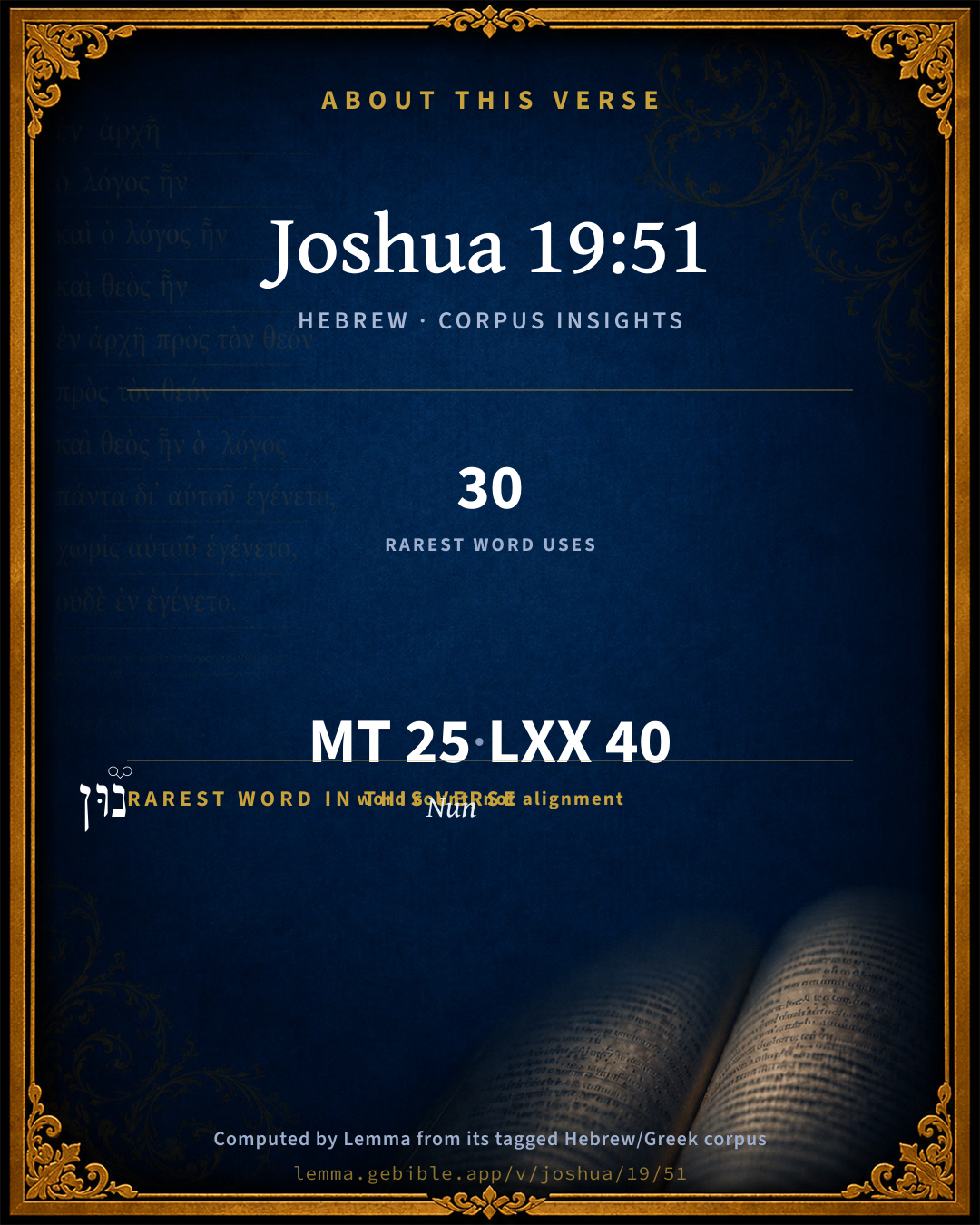
נ֟וּן Nun H5126 occurs in 30 verses of the Hebrew Bible. Also found in:

Grammatical profile

  • 3 verbs
  • 19 nouns
  • 1 pronoun
  • 2 particles

Verb forms

  • נִחֲל֣וּ Piel · Perfect
  • וַיְכַלּ֕וּ Piel · Sequential Imperfect
  • מֵֽחַלֵּ֖ק Piel · Infinitive Construct

Repetition

A word recurs within this verse — often emphatic in Hebrew:

Hebrew & Septuagint length

In English translation the verse runs 55 words from the Hebrew and 53 from the Septuagint (LXX English) — closely comparable.

A rough comparison of the two English renderings, which tokenize alike — not a word-level alignment.

Word counts can differ between the Hebrew and the Greek without any difference in meaning — e.g. the Hebrew direct-object marker אֵת has no separate Greek word, and Greek often adds the article ὁ.

In the original languages it is 25 Hebrew tokens and 40 Greek tokens — but the two are counted differently (Hebrew bundles its prefixes and suffixes into one token; the Greek is in lemma form), so that isn’t a like-for-like length.

Cross-references

16

Topical passages linked to Joshua 19:51 in the Treasury of Scripture Knowledge — connected by theme and wording, ordered by reader-vote popularity; previews shown in the World English Bible.

  • Joshua 14:1 These are the inheritances which the children of Israel took in the land of Canaan, which Eleazar the priest, and Joshua the son of Nun, and the heads of the fathers' [houses] of the tribes of the children of Israel, distributed to them,
  • Joshua 18:10 Joshua cast lots for them in Shiloh before Yahweh: and there Joshua divided the land to the children of Israel according to their divisions.
  • Joshua 18:1 The whole congregation of the children of Israel assembled themselves together at Shiloh, and set up the tent of meeting there: and the land was subdued before them.
  • Hebrews 4:8–9 For if Joshua had given them rest, he would not have spoken afterward of another day.
  • Genesis 49:10 The scepter will not depart from Judah, Nor the ruler's staff from between his feet, Until he comes to whom it belongs. To him will the obedience of the peoples be.
  • Judges 21:19 They said, Behold, there is a feast of Yahweh from year to year in Shiloh, which is on the north of Bethel, on the east side of the highway that goes up from Bethel to Shechem, and on the south of Lebonah.
  • Judges 21:21 and see, and, behold, if the daughters of Shiloh come out to dance in the dances, then come you out of the vineyards, and catch you every man his wife of the daughters of Shiloh, and go to the land of Benjamin.
  • 1 Samuel 1:3 This man went up out of his city from year to year to worship and to sacrifice to Yahweh of Hosts in Shiloh. The two sons of Eli, Hophni and Phinehas, priests to Yahweh, were there.
  • Psalms 47:3–4 He subdues nations under us, And peoples under our feet.
  • Psalms 78:60 So that he forsook the tent of Shiloh, The tent which he placed among men;
  • Jeremiah 7:12–14 But go you now to my place which was in Shiloh, where I caused my name to dwell at the first, and see what I did to it for the wickedness of my people Israel.
  • Matthew 20:23 He said to them, "You will indeed drink my cup, and be baptized with the baptism that I am baptized with, but to sit on my right hand and on my left hand is not mine to give; but it is for whom it has been prepared by my Father."
  • Matthew 25:34 Then the King will tell those on his right hand, 'Come, blessed of my Father, inherit the Kingdom prepared for you from the foundation of the world;
  • John 14:2–3 In my Father's house are many mansions. If it weren't so, I would have told you. I am going to prepare a place for you.
  • John 17:2 even as you gave him authority over all flesh, he will give eternal life to all whom you have given him.
  • Numbers 34:17–29 These are the names of the men who shall divide the land to you for inheritance: Eleazar the priest, and Joshua the son of Nun.

Cross-references courtesy of OpenBible.info (CC BY 4.0).

Hebrew and Greek witnesses Masoretic Hebrew ↔ Greek Septuagint

The same verse in the two great witnesses to the Old Testament, shown verse-for-verse.

These are two independent witnesses, not word-aligned to each other, and the Septuagint is shown in lemma (dictionary) form.

Hebrew Joshua 19:51 Masoretic · Westminster Leningrad Codex

אֵ֣לֶּה הַנְּחָלֹ֡ת אֲשֶׁ֣ר נִחֲל֣וּ אֶלְעָזָ֣ר הַכֹּהֵ֣ן וִיהוֹשֻׁ֪עַ בִּן נ֟וּן וְרָאשֵׁ֣י הָֽאָב֣וֹת לְמַטּוֹת֩ בְּנֵי יִשְׂרָאֵ֨ל בְּגוֹרָ֤ל בְּשִׁלֹה֙ לִפְנֵ֣י יְהוָ֔ה פֶּ֖תַח אֹ֣הֶל מוֹעֵ֑ד וַיְכַלּ֕וּ מֵֽחַלֵּ֖ק אֶת הָאָֽרֶץ

These are the inheritances, which Eleazar the priest, and Joshua the son of Nun, and the heads of the fathers' [houses] of the tribes of the children of Israel, distributed for inheritance by lot in Shiloh before Yahweh, at the door of the tent of meeting. So they made an end of dividing the land.

World English Bible · Public Domain

Greek LXX Joshua 19:51 Septuagint · lemma form

οὗτος ὁ διαίρεσις ὅς κατακληρονομέω ελεαζαρ ὁ ἱερεύς καί ἰησοῦς ὁ ὁ ναυη καί ὁ ἄρχων ὁ πατριά ἐν ὁ φυλή ἰσραήλ κατά κλῆρος ἐν σηλω ἐναντίον κύριος παρά ὁ θύρα ὁ σκηνή ὁ μαρτύριον καί πορεύομαι ἐνβατεύω ὁ γῆ

These are the divisions which Eleazar the priest divided by lot, and Joshua the son of Naue, and the heads of families among the tribes of Israel, according to the lots, in Selo before the Lord by the doors of the tabernacle of testimony, and they went to take possession of the land.

LXX2012 (modern English Septuagint) · Public Domain

Hebrew: Westminster Leningrad Codex (CC BY 4.0). Greek: Septuagint (public domain); English from LXX2012 (modern English Septuagint) (Public Domain). How the Septuagint differs from the Hebrew →

Targum (Aramaic paraphrase)

1

The Targum is the ancient Jewish Aramaic paraphrase of the Hebrew Scriptures — an interpretive translation, not the Hebrew text itself. Onkelos (literal) and Pseudo-Jonathan (expansive) render the Torah, and Jonathan the Prophets. Coverage is partial: where no permissively-licensed English translation exists for a verse, only the Aramaic is shown. This is verse-level text, not a word-by-word alignment to the Hebrew.

  1. Targum Jonathan Prophets (Joshua–Malachi)
    אִילֵן אַחֲסַנְתַּיָא דִי אַחֲסִין אֶלְעָזָר כַּהֲנָא וִיהוֹשֻׁעַ בַּר נוּן וְרֵישֵׁי אַבְהָתָא לְשִׁבְטַיָא דִבְנֵי יִשְׂרָאֵל בְּעַדְבָא בְּשִׁלֹה קֳדָם יְיָ בִּתְרַע מַשְׁכַּן זִמְנָא וְשֵׁיצִיאוּ מִלְפַלָגָא יַת אַרְעָא:

    (no public-domain English translation for this verse)

    Targum Jonathan — Aramaic: “Mikraot Gedolot” (public domain). English: “Sefaria Community Translation” (CC0 1.0 (public-domain dedication)); “London "Chaldee Paraphrase," 1871” (public domain). Text via Sefaria.

Commentary

Notes on Joshua 19:51 from classic Christian and Jewish commentators (each source and its license shown beneath its notes). The classic Christian expositions comment on the surrounding passage and are grouped to its opening verse, so a note may address several verses; the Jewish commentaries on the Tanakh (Rashi and others) are per-verse, so they appear only where the commentator wrote on this verse.

Lemma curates 59 commentaries, every one of them public domain or Creative Commons licensed, each selected and text-cleaned for this edition rather than reprinted as found. About our sources →

Joseph Benson's Commentary

Jos 19:51. These are the inheritances, &c. — Upon the whole of this division of the land, it deserves our remarking, that the lot fell to the several tribes just as Jacob and Moses had foretold. And this division served to keep up the distinction of tribes, which was to continue till the coming of the Messiah. And we may observe further, that God had expressly named, some years before, as we find by Num 34:17-29, the very persons who should divide the land unto the children of Israel, and expressly described the bounds how far every way the land reached which was to be divided by them.

Joseph Benson's Commentary on the Old and New Testaments (1811–1818) — public domain. Text from a community e-Sword module.

Tyndale Open Study Notes

Tyndale Open Resources

19:51 After Joshua received his inheritance, the division of the land was completed. Joshua served God and led Israel faithfully for many years, and God was gracious to Joshua.

Tyndale Open Study Notes — © Tyndale Open Resources, licensed CC BY-SA 4.0. Text via the HelloAO Bible API.

Jamieson, Fausset & Brown

Robert Jamieson, A. R. Fausset & David Brown

These are the inheritances--This verse is the formal close of the section which narrates the history of the land distribution; and to stamp it with due importance, the names of the commissioners are repeated, as well as the spot where so memorable a transaction took place.

Next: Joshua Chapter 20

Jamieson, Fausset & Brown — Commentary Critical and Explanatory on the Whole Bible (1871) — public domain (CC PDM 1.0). Text via the HelloAO Bible API.

Adam Clarke's Commentary

Verse 51. At the door of the tabernacle] All the inheritances were determined by lot, and this was cast before the Lord - every thing was done in his immediate presence, as under his eye; hence there was no murmuring, each having received his inheritance as from the hand of God himself, though some of them thought they must have additional territory, because of the great increase of their families.

Adam Clarke's Commentary on the Bible (1810–1826) — public domain. Text from a community e-Sword/MySword module.

Whedon's Commentary on the Bible

Daniel D. Whedon

51. They made an end of dividing the country — But after the division and allotment it remained to designate the cities of refuge and the Levitical cities. An account of this is given in the next two chapters.]

Daniel D. Whedon (gen. ed.), Commentary on the Old and New Testaments (1874–1909) — public domain. Text from a community e-Sword module.

The Pulpit Commentary

At the door of the tabernacle of the congregation. The lots were drawn under Divine sanction. The ruler of the State and the ruler of the Church combined in this sacred act, hallowed by all the rites of religion, and confirmed by the presence and approbation of the heads or representatives of all the tribes. Accordingly, as has been said above, we hear of no murmurings or disputings afterwards. However much the Israelites may have quarrelled among themselves, there is not a hint of dissatisfaction with the final distribution of territory. Three points may be noticed here

1. The authenticity of the narrative is confirmed by these evidences of the internal agreement of its parts.

2. We learn the value of mutual consultation, of open and fair dealing, from this narrative. The parcelling out of the inheritance of Israel under God"s command was carried out in such a manner as to preclude the slightest suspicion of partiality.

3. The duty of hallowing all important actions with the sanctions of religion, of uniting prayer and a public recognition of God"s authority with every event of moment, whether in the life of the individual or of the body politic, finds an illustration here. An age which, like the present, is disposed to relegate to the closet all recognition of God"s authority, which rushes into wars without God"s blessing, celebrates national or local ceremonials without acknowledging Him, contracts matrimony without publicly seeking His blessing, receives children from Him without caring to dedicate them formally to His service, can hardly plead that it is acting in the spirit of the Divine Scriptures. A well known writer in our age declares that we have "forgotten God." Though the external and formal recognition of Him may be consistent with much forgetfulness in the heart, yet the absence of such recognition is not likely to make us remember Him, nor can it be pleaded as proof that we do so.

The Pulpit Commentary (1880–1919), ed. H.D.M. Spence-Jones & Joseph S. Exell — public domain. Text from a community e-Sword module.

Keil & Delitzsch

C. F. Keil & F. Delitzsch

Closing formula to the account of the distribution of the land, which refers primarily to Jos 18:1., as the expression "in Shiloh" shows, but which also includes Josh 14-17.

Keil & Delitzsch — Biblical Commentary on the Old Testament (1861–1891) — public domain (CC PDM 1.0). Text via the HelloAO Bible API. (Old Testament only.)

unfoldingWord translationNotes

Door43 World Missions Community

These are the inheritances ... assigned

The land and cities that the various tribes received are spoken of as if they were an inheritance that they received as a permanent possession. AT: "These are the portions of land and the cities ... assigned as inheritances" (See: Metaphor)

translationWords

priest

Shiloh

tent of meeting

unfoldingWord translationNotes — © Distant Shores Media and the Door43 World Missions Community, licensed CC BY-SA 4.0. Source: git.door43.org/Door43/en_tn.

Rashi

Rabbi Shlomo Yitzchaki (Rashi)

That were divided for inheritance. They caused them to inherit.

Rashi on the Tanakh — English translations: “The Judaica Press complete Tanach with Rashi, translated by A. J. Rosenberg” (CC BY 4.0); “Pentateuch with Rashi's commentary by M. Rosenbaum and A.M. Silbermann, 1929-1934” (public domain); “The Metsudah Tanach series, Lakewood, N.J” (CC BY 4.0); and “The Book of Joshua, Metsudah Publications, 1997” (CC BY 4.0). Text via Sefaria.

Lesson kit

Teaching starters — assembled from the data on this page, not authored interpretation. Every prompt links to the verse data it draws on. Edit before teaching.

Joshua, in the Historical, opens this verse with 25 words (24 distinct Hebrew lemmas). Its most distinctive word is Nûwn (“Nun”). A historical commentator’s framing appears above. Read the whole chapter for the surrounding context.

Discussion questions

  1. How does “Nun” (Nûwn) shape what this verse is saying?
  2. Exodus 33:11 shares the word «Nun» with this verse. How do the two illuminate each other?
  3. “son” occurs 2× in this one verse. What is the effect of the repetition?
  4. These translations render this verse differently. What is at stake in choosing one wording over another?
  5. The verb «נִחֲל֣וּ» is Piel Perfect. How does its form color the action?
  6. Reading how Joseph Benson's Commentary and Tyndale Open Study Notes read this verse, where do the two commentators agree and where do they part?

Things to notice

Reading settings

Reading text

Shown beneath each verse's original-language words.

Old Testament
Old Testament edition

Read the OT as the Masoretic Hebrew (MT) or the Greek Septuagint (LXX).

English shown for the Greek Septuagint (in the Hebrew ↔ Greek comparison).

Comparing translations? Open the Compare panel on any verse page to stack up to four side by side.