Exodus 26:14

Hebrew (Westminster Leningrad Codex) Exodus 26:14 appears in the Hebrew Old Testament. The text above is from the Westminster Leningrad Codex. Each word links to its Strong’s number, a concise gloss, and parsing drawn from the Open Scriptures Hebrew Bible morphology. Click any word for its full Brown-Driver-Briggs (BDB) entry.
Download image
Cite this verse

Exodus 26:14 (World English Bible). Public Domain. Lemma interlinear Bible study tool, https://lemma.gebible.app/v/exodus/26/14.

Show BibTeX & RIS
BibTeX
RIS
English Translation
You shall make a covering for the tent of rams' skins dyed red, and a covering of sea cow hides above.
World English Bible · Public Domain
Download a study sheet

One document with this verse’s original text, its word-by-word gloss line, the meaning frame, cross-references with their text, attributed commentary, and full source and license credits — printable, and it pastes into notes with its structure intact.

This verse Autodidact and up

Study sheet (.html) Plain text (.txt)

A passage Seminary Student

Up to 50 verses in one chapter. A passage sheet keeps up to 6 commentary sources and 12 cross-references per verse, in the order this page ranks them, and says so on the sheet whenever that leaves anything out. Ask for a single verse and you get the Autodidact verse sheet above.

Everything on this page stays free to read, with no account — the sheet is a download of what is already on screen, not access to it.

Want to remove ads? Support Godless Engineer
Compare translations 3

The same verse in 3 English versions, stacked beneath the original-language interlinear above. Click any original word for its lexicon entry.

Each is an independent rendering of the whole verse — the interlinear is not word-aligned to these translations.

Highlighted words mark where these versions differ — a whole-verse word diff, not a word-by-word alignment.

  • World English Bible Public Domain
    You shall make a covering for the tent of rams' skins dyed red, and a covering of sea cow hides above.
  • King James Version Public Domain
    And thou shalt make a covering for the tent of rams' skins dyed red, and a covering above of badgers' skins.
  • unfoldingWord Literal Text CC BY-SA 4.0
    And you shall make a covering for the tent of reddened hides of rams, and a covering of hides of sea-cows above that.

unfoldingWord Literal Text — © unfoldingWord, licensed CC BY-SA 4.0. Word-aligned USFM3 via Door43 (git.door43.org/unfoldingWord/en_ult).

Versions to compare (up to 4)

3 of 4 selected

Show all 18 translations

Every available English version of this verse, each an independent rendering of the whole verse.

  • World English Bible Public Domain
    You shall make a covering for the tent of rams' skins dyed red, and a covering of sea cow hides above.
  • Berean Standard Bible Public Domain
    Also make a covering for the tent out of ram skins dyed red, and over that a covering of fine leather.
  • Majority Standard Bible Public Domain
    Also make a covering for the tent out of ram skins dyed red, and over that a covering of fine leather.
  • King James Version Public Domain
    And thou shalt make a covering for the tent of rams' skins dyed red, and a covering above of badgers' skins.
  • American Standard Version (1901) Public Domain
    And thou shalt make a covering for the tent of rams' skins dyed red, and a covering of sealskins above.
  • Revised Version (1885) Public Domain
    And thou shalt make a covering for the tent of rams’ skins dyed red, and a covering of sealskins above.
  • Geneva Bible (1599) Public Domain
    Moreouer, for that couering thou shalt make a couering of rammes skinnes died red, and a couering of badgers skinnes aboue.
  • Douay-Rheims (1899) Public Domain
    Thou shalt make also another cover to the roof, of rams' skins dyed red; and over that again another cover of violet coloured skins.
  • Young's Literal Translation Public Domain
    and thou hast made a covering for the tent, of rams' skins made red, and a covering of badgers' skins above.
  • Literal Standard Version CC BY-SA 4.0
    and you have made a covering for the tent of rams’ skins made red, and a covering of tachashim skins above.
  • Unlocked Literal Bible CC BY-SA 4.0
    You must make for the tabernacle a covering of ram skins dyed red, and another covering of fine leather to go above that.
  • unfoldingWord Literal Text CC BY-SA 4.0
    And you shall make a covering for the tent of reddened hides of rams, and a covering of hides of sea-cows above that.
  • Darby Bible Public Domain
    And thou shalt make a covering for the tent of rams' skins dyed red, and a covering of badgers' skins over [that].
  • World Messianic Bible Public Domain
    You shall make a covering for the tent of rams’ skins dyed red, and a covering of sea cow hides above.
  • Webster's Bible Public Domain
    And thou shalt make a covering for the tent, of rams' skins dyed red, and a covering above of badgers' skins.
  • Free Bible Version CC BY-SA 4.0
    Make a covering for the goat hair tent from tanned ram skins, and place an extra covering of fine leather over that.
  • Bible in Basic English Public Domain
    And then you are to make a cover for the tent, of sheepskins coloured red, and a cover of leather over that.
  • JPS Tanakh (1917) Public Domain
    And thou shalt make a covering for the tent of rams' skins dyed red and a covering of sealskins above.

Literal Standard Version (2020), Covenant Press — licensed CC BY-SA 4.0. Text via the HelloAO Bible API (eBible.org). Unlocked Literal Bible (unfoldingWord) — licensed CC BY-SA 4.0. Text via the HelloAO Bible API (eBible.org). unfoldingWord Literal Text — © unfoldingWord, licensed CC BY-SA 4.0. Word-aligned USFM3 via Door43 (git.door43.org/unfoldingWord/en_ult). Free Bible Version, Dr. Jonathan Gallagher — licensed CC BY-SA 4.0. Text via the HelloAO Bible API (eBible.org).

Word by word

More ways to search: Search by grammar → Find every occurrence → Compare this word →

Practice this passage: Drill this verse → Learn its vocabulary →

מְאָדָּמִ֑ים
ʼâdam
H119
“red”
Verb, Pual, Participle Passive, Masculine, Plural, Absolute
Part of Speech
Verb
Stem
Pual
Form
Participle Passive
Gender
Masculine
Number
Plural
State
Absolute
Full BDB Definition

Origin: of unknown derivation

TWOT: 26b

to be red, red - (Qal) ruddy (of Nazarites) - (Pual) - to be rubbed red - dyed red - reddened - (Hiphil) - to cause to show red - to glare - to emit (show) redness - (Hithpael) - to redden - to grow red - to look red
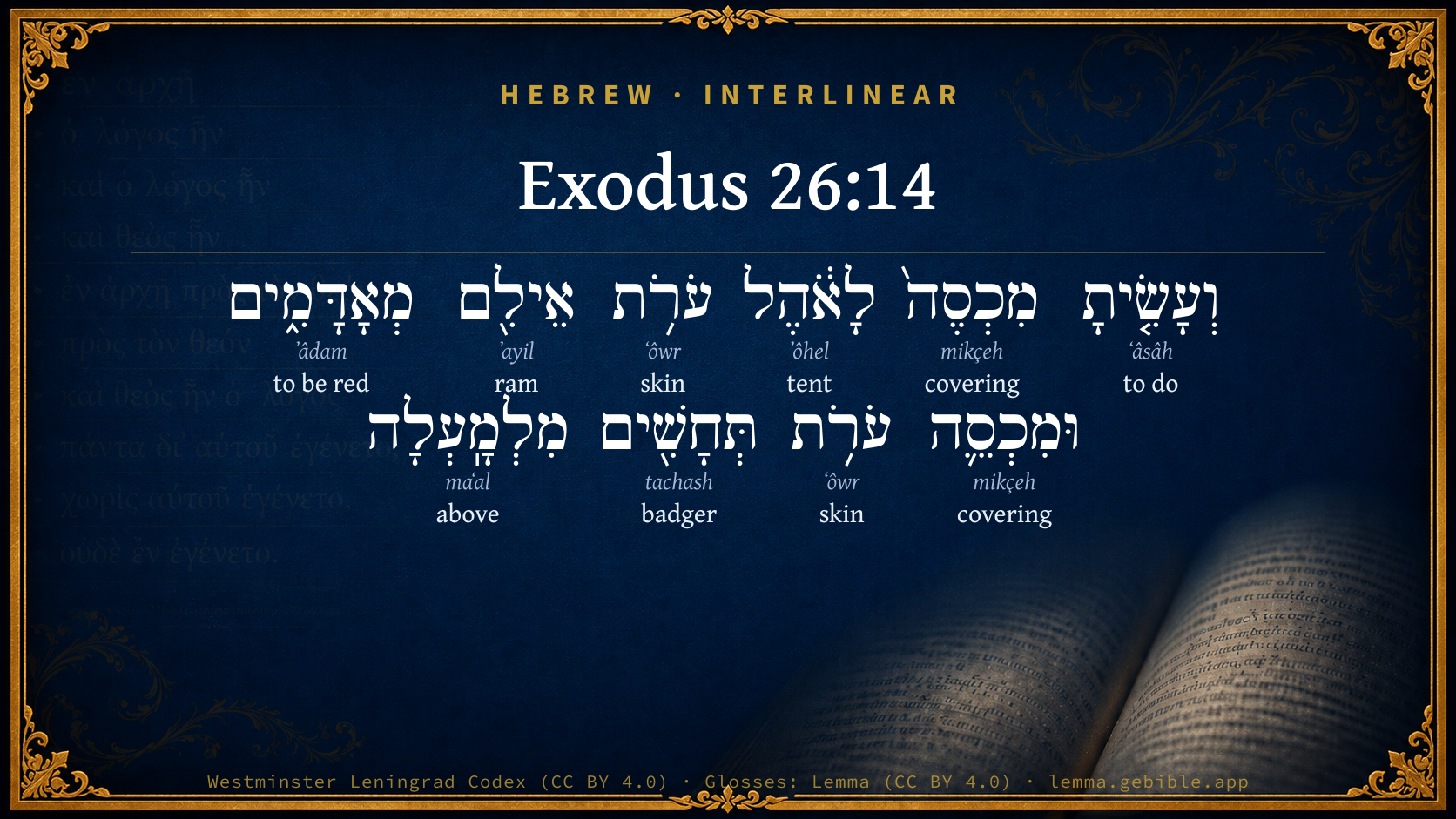
  1. וְעָשִׂ֤יתָ ʻâsâh H6213 “and · to do” Conjunction + Verb, Qal, Sequential Perfect, 2nd Person, Masculine, Singular
  2. מִכְסֶה֙ mikçeh H4372 “covering” Noun, Common, Masculine, Singular, Absolute
  3. לָאֹ֔הֶל ʼôhel H168 “to/for the · tent” Preposition, Determined + Noun, Common, Masculine, Singular, Absolute
  4. עֹרֹ֥ת ʻôwr H5785 “skins of” Noun, Common, Masculine, Plural, Construct
  5. אֵילִ֖ם ʼayil H352 “rams” Noun, Common, Masculine, Plural, Absolute
  6. וּמִכְסֵ֛ה mikçeh H4372 “and · covering of” Conjunction + Noun, Common, Masculine, Singular, Construct
  7. עֹרֹ֥ת ʻôwr H5785 “skins of” Noun, Common, Masculine, Plural, Construct
  8. תְּחָשִׁ֖ים tachash H8476 “badgers” Noun, Common, Masculine, Plural, Absolute
  9. מִלְמָֽעְלָה maʻal H4605 “from · to/for · above · toward” Preposition + Preposition + Adverb + Suffix, Demonstrative

About this verse

These counts appear in no published source. They are computed here, from the morphology-tagged text and Lemma’s own curated glosses. What Lemma adds →

10
words
8
distinct lemmas
Pentateuch
section

Notable vocabulary

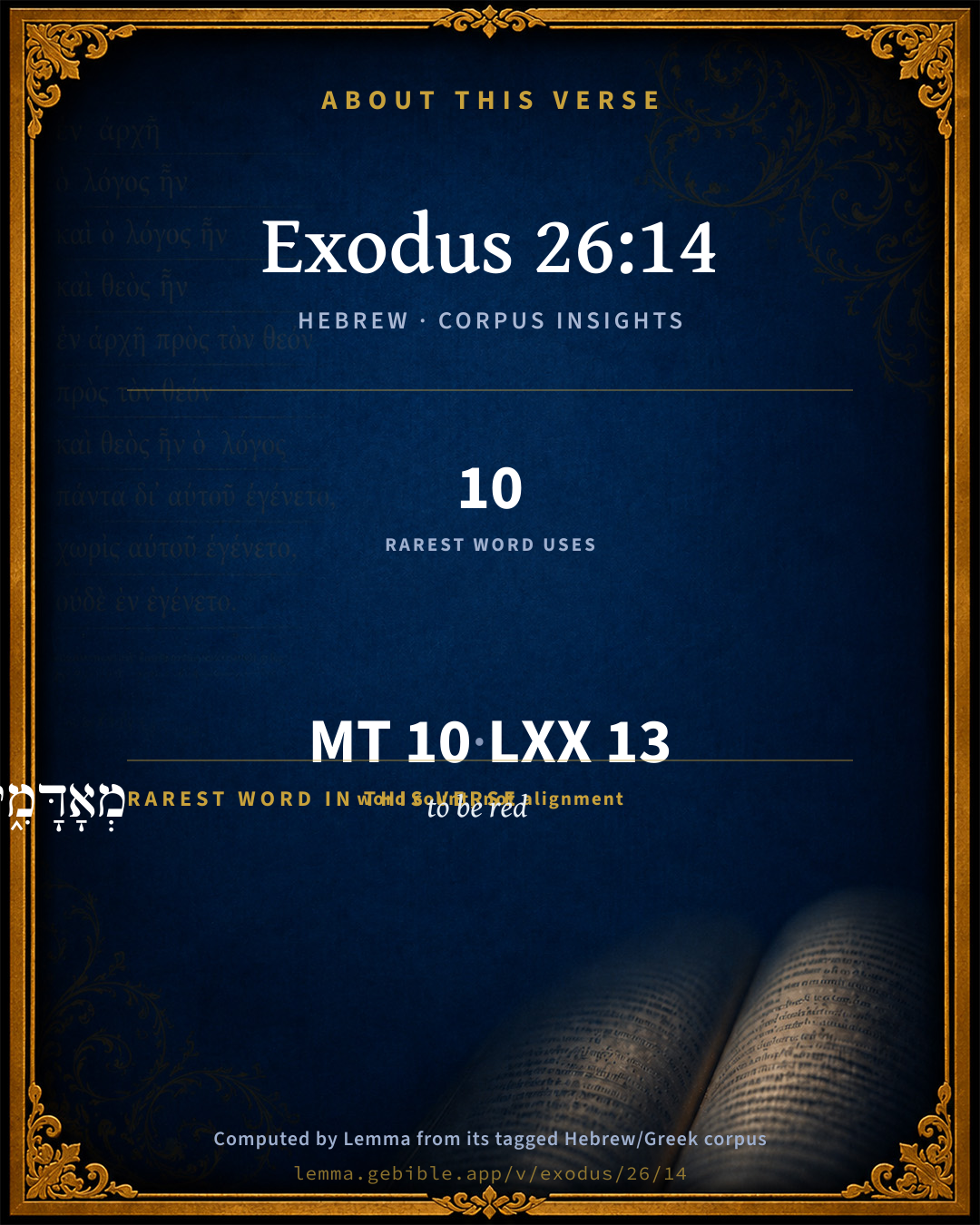
The rarest word here is מְאָדָּמִ֑ים to be red H119 — appearing just 10 times in the whole Hebrew Bible.

Shared distinctive vocabulary

מְאָדָּמִ֑ים to be red H119 occurs in 10 verses of the Hebrew Bible. Also found in:

Grammatical profile

  • 2 verbs
  • 7 nouns
  • 1 adverb

Verb forms

  • וְעָשִׂ֤יתָ Qal · Sequential Perfect
  • מְאָדָּמִ֑ים Pual · Participle Passive

Repetition

Words recur within this verse — often emphatic in Hebrew:

  • מִכְסֶה֙ covering H4372 ×2
  • עֹרֹ֥ת skin H5785 ×2

Hebrew & Septuagint length

In English translation the verse runs 21 words from the Hebrew and 20 from the Septuagint (LXX English) — closely comparable.

A rough comparison of the two English renderings, which tokenize alike — not a word-level alignment.

Word counts can differ between the Hebrew and the Greek without any difference in meaning — e.g. the Hebrew direct-object marker אֵת has no separate Greek word, and Greek often adds the article ὁ.

In the original languages it is 10 Hebrew tokens and 13 Greek tokens — but the two are counted differently (Hebrew bundles its prefixes and suffixes into one token; the Greek is in lemma form), so that isn’t a like-for-like length.

Cross-references

12

Topical passages linked to Exodus 26:14 in the Treasury of Scripture Knowledge — connected by theme and wording, ordered by reader-vote popularity; previews shown in the World English Bible.

  • Exodus 36:19 He made a covering for the tent of rams' skins dyed red, and a covering of sea cow hides above.
  • Exodus 25:5 rams' skins dyed red, sea cow hides, acacia wood,
  • Exodus 35:7 rams' skins dyed red, sea cow hides, acacia wood,
  • Exodus 35:23 Everyone, with whom was found blue, purple, scarlet, fine linen, goats' hair, rams' skins dyed red, and sea cow hides, brought them.
  • Exodus 39:34 the covering of rams' skins dyed red, the covering of sea cow hides, the veil of the screen,
  • Numbers 4:5 When the camp moves forward, Aaron shall go in, and his sons, and they shall take down the veil of the screen, and cover the ark of the Testimony with it,
  • Numbers 4:10 They shall put it and all its vessels within a covering of sealskin, and shall put it on the frame.
  • Psalms 27:5 For in the day of trouble he will keep me secretly in his pavilion. In the covert of his tent he will hide me. He will lift me up on a rock.
  • Psalms 121:4–5 Behold, he who keeps Israel Will neither slumber nor sleep.
  • Isaiah 4:6 There will be a pavilion for a shade in the daytime from the heat, and for a refuge and for a shelter from storm and from rain.
  • Isaiah 25:4 For you have been a stronghold to the poor, a stronghold to the needy in his distress, a refuge from the storm, a shade from the heat, when the blast of the awesome ones is as a storm against the wall.
  • Ezekiel 16:10 I clothed you also with embroidered work, and shod you with sealskin, and I girded you about with fine linen, and covered you with silk.

Cross-references courtesy of OpenBible.info (CC BY 4.0).

Hebrew and Greek witnesses Masoretic Hebrew ↔ Greek Septuagint

The same verse in the two great witnesses to the Old Testament, shown verse-for-verse.

These are two independent witnesses, not word-aligned to each other, and the Septuagint is shown in lemma (dictionary) form.

Hebrew Exodus 26:14 Masoretic · Westminster Leningrad Codex

וְעָשִׂ֤יתָ מִכְסֶה֙ לָאֹ֔הֶל עֹרֹ֥ת אֵילִ֖ם מְאָדָּמִ֑ים וּמִכְסֵ֛ה עֹרֹ֥ת תְּחָשִׁ֖ים מִלְמָֽעְלָה

You shall make a covering for the tent of rams' skins dyed red, and a covering of sea cow hides above.

World English Bible · Public Domain

Greek LXX Exodus 26:14 Septuagint · lemma form

καί ποιέω κατακάλυμμα ὁ σκηνή δέρμα κριός ἐρυθροδανόω καί ἐπικάλυμμα δέρμα ὑακίνθινος ἐπάνωθεν

And you shall make for a covering of the tabernacle rams' skins dyed red, and blue skins as coverings above.

LXX2012 (modern English Septuagint) · Public Domain

On this verse, The Cambridge Bible for Schools and Colleges discusses the Septuagint’s reading. Read the note in Commentary ↓

Hebrew: Westminster Leningrad Codex (CC BY 4.0). Greek: Septuagint (public domain); English from LXX2012 (modern English Septuagint) (Public Domain). How the Septuagint differs from the Hebrew →

Targum (Aramaic paraphrase)

2

The Targum is the ancient Jewish Aramaic paraphrase of the Hebrew Scriptures — an interpretive translation, not the Hebrew text itself. Onkelos (literal) and Pseudo-Jonathan (expansive) render the Torah, and Jonathan the Prophets. Coverage is partial: where no permissively-licensed English translation exists for a verse, only the Aramaic is shown. This is verse-level text, not a word-by-word alignment to the Hebrew.

  1. Targum Onkelos Torah (Genesis–Deuteronomy)
    וְתַעְבֵּד חוֹפָאָה לִפְרָסָא מַשְׁכֵי דְדִכְרֵי מְסַמְקֵי וְחוֹפָאָה מַשְׁכֵי דְסַסְגוֹנָא מִלְעֵלָא:

    (no public-domain English translation for this verse)

    Targum Onkelos — Aramaic: “Onkelos Genesis” (public domain); “Onkelos Exodus” (public domain); “Onkelos Leviticus” (public domain); “Onkelos Numbers” (public domain); “Onkelos Deuteronomy” (public domain). English: “Sefaria Community Translation” (CC0 1.0 (public-domain dedication)); “J.W. Etheridge. The Targums of Onkelos and Jonathan Ben Uzziel on the Pentateuch. London: Longmans, Green, 1862” (public domain). Text via Sefaria.

  2. Targum Pseudo-Jonathan Torah (Genesis–Deuteronomy)
    וְתַעֲבֵיד חוֹפָאָה לְמַשְׁכְּנָא מוֹשְׁכֵי דְדִכְרֵי מִסַמְקֵי וְחוֹפָאָה דְמַשְׁכֵי סַסְגְּוָונָא מִלְעֵילָא

    And thou shalt make a covering for the tabernacle of rams' skins dyed red, and a covering of purple skins above.

    Targum Pseudo-Jonathan — Aramaic: “Targum Jonathan on Genesis” (public domain); “Targum Jonathan on Exodus” (public domain); “Targum Jonathan on Leviticus” (public domain); “Targum Jonathan on Numbers” (public domain); “Targum Jonathan on Deuteronomy” (public domain). English: “The Targum of Jonathan ben Uzziel, trans. J. W. Etheridge, London, 1862” (public domain). Text via Sefaria.

Commentary

Notes on Exodus 26:14 from classic Christian and Jewish commentators (each source and its license shown beneath its notes). The classic Christian expositions comment on the surrounding passage and are grouped to its opening verse, so a note may address several verses; the Jewish commentaries on the Tanakh (Rashi and others) are per-verse, so they appear only where the commentator wrote on this verse.

Lemma curates 59 commentaries, every one of them public domain or Creative Commons licensed, each selected and text-cleaned for this edition rather than reprinted as found. About our sources →

Trapp's Complete Commentary

John Trapp

Exo 26:14 And thou shalt make a covering for the tent [of] rams’ skins dyed red, and a covering above [of] badgers’ skins.

Ver. 14. A covering for the tent.] Shadowing out God’s protecting his people, {Isa 4:6; Isa 25:4 Psa 27:5} as these rams’ skins covered the ark from the violence of wind and weather.

John Trapp, A Commentary or Exposition upon All the Books of the Old and New Testament (1647–1656) — public domain. Text from a community e-Sword module.

Joseph Benson's Commentary

Exo 26:14. Badgers’ skins — So we translate it: but it seems rather to have been some strong sort of leather, but very fine, for we read of the best sort of shoes made of it, Eze 16:10. This was the fourth covering of the tabernacle. The first was of linen, the second of goats’ hair, and the third of rams’ skins.

Joseph Benson's Commentary on the Old and New Testaments (1811–1818) — public domain. Text from a community e-Sword module.

Geneva Bible (1599)

Geneva Bible translators

To be put upon the covering that was made of goats’ hair.

This was the third covering of the Tabernacle.

Geneva Bible (1599) marginal notes — public domain. Text via Bolls.life.

Jamieson, Fausset & Brown

Robert Jamieson, A. R. Fausset & David Brown

a covering . . . of rams' skins dyed red--that is, of Turkey red leather. [See on Exo 39:34.]

Jamieson, Fausset & Brown — Commentary Critical and Explanatory on the Whole Bible (1871) — public domain (CC PDM 1.0). Text via the HelloAO Bible API.

Adam Clarke's Commentary

Verse 14. Rams' skins dyed red] See Clarke on Ex 25:5. This was the third covering; and what is called the badgers' skins was the fourth. See Clarke on Ex 25:5. Why there should have been four coverings does not appear. They might have been designed partly for respect; and partly to keep off dust and dirt, and the extremely fine sand which in that desert rises as it were on every breeze; and partly to keep off the intense heat of the sun, which would otherwise have destroyed the poles, bars, boards, and the whole of the wood work. As to the conjecture of some that "the four coverings were intended the better to keep off the rain," it must appear unfounded to those who know that in that desert rain was rarely ever seen.

Adam Clarke's Commentary on the Bible (1810–1826) — public domain. Text from a community e-Sword/MySword module.

Ellicott's Commentary for English Readers

3. THE TWO OUTER COVERINGS.

(14) As the object of the two outer coverings must have been to keep out rain, we must suppose them to have protected not only the ridge of the roof, but, at any rate, the whole of the mishkân. Their length must, therefore, have been at least thirty cubits, and their breadth fourteen.

A Bible Commentary for English Readers, edited by Charles John Ellicott (1878–1897) — public domain. Text from a community e-Sword module.

The Cambridge Bible for Schools and Colleges

gen. ed. J. J. S. Perowne

14. (cf. Exo_36:19). Two outer coverings of stronger and stouter materials, to be laid over the Tent, for protection against rain. Kn. reminds us that on military expeditions the Romans used in winter to cover their tents with skins (sub pellibus hiemare).

rams’ skins dyed red] i.e. leather, dyed, not with the costly Phoenician ‘scarlet’ (Exo_25:4), but probably (Kennedy), as LXX. ἠρυθροδανωμένα suggests, with madder (ἐρυθρόδανον).

sealskins] dugong skins (Exo_25:5). The Dwelling, with the coverings above it, was kept in its place by cords connecting it with pins driven into the ground, in the manner of a tent: see Exo_27:19, Exo_35:18, Exo_38:20; Exo_38:31.

15–30 (cf. Exo_36:20-34). The ‘boards,’ or, perhaps, frames, for the Dwelling. There is great difficulty in some of the details: but the general sense is clear. The ‘boards’ were to be of acacia wood, overlaid with gold, each 10 cubits (15 ft.) long, and 1½ cubits (2 ft. 3 in.) broad: they were to be placed upright, so as to form the sides and back of the Dwelling, each resting in two sockets of silver: there were to be twenty forming each side, six to form the back, and two, of special construction, at the corners, where the back and sides met: five bars, attached to the boards by rings, were to run horizontally along the two sides and the back, respectively, to hold them firmly in their place.

The Cambridge Bible for Schools and Colleges (gen. ed. J. J. S. Perowne; Cambridge University Press, 1878–1918) — public domain. Text from a community e-Sword module.

John Gill's Exposition

And thou shalt make the boards for the tabernacle,.... Which were the pillars and supports, and properly the walls of it, which gave it its firmness and security, or otherwise the curtains would have been blown about by every wind: they were to be made

of shittim wood standing up; just as they grew, as a Jewish writer observes (p); these planks or boards were not to be laid along the lengthways of them, but to be set upright; and may denote such who are pillars in the house of God, and are to be upright both in heart and conversation, both ministers and private members; and indeed the church itself is the pillar and ground of truth, Gal 2:9.

(p) Bartenora in Misn. Succa, c. 3. sect. 14.

John Gill's Exposition of the Whole Bible (1746–1763) — public domain (CC PDM 1.0). Text via the HelloAO Bible API.

Haydock's Catholic Bible Commentary

Skins. These two were probably as large as the last, to keep out rain; (Menochius) though the text only specifies the roof.

George Leo Haydock (1774–1849), Haydock's Catholic Family Bible and Commentary, 1859 edition — public domain. Excludes Psalms (Douay-Rheims chapter numbering differs from Protestant) and Deuterocanonical books (Catholic canon only).

Matthew Poole's English Annotations

To preserve the rest from the injury of the weather.

Matthew Poole's English Annotations on the Holy Bible (1683–1685) — public domain. Text from a community e-Sword/MySword module.

Whedon's Commentary on the Bible

Daniel D. Whedon

14. A covering — To be placed still above the goats’ hair tent-cloth, as an additional protection.

Rams’ skins… badgers’ skins — See note on Exo_25:5. Whether these extra coverings of skins were coextensive with the entire roof, we are nowhere told, but in the absence of specific information we are hardly justified in the conclusion that one or both of them served only for a coping. No doubt the common customs of adjusting tent cloths among a nomadic people were presupposed, and definite information on some matters of detail was considered unnecessary.

Daniel D. Whedon (gen. ed.), Commentary on the Old and New Testaments (1874–1909) — public domain. Text from a community e-Sword module.

The Pulpit Commentary

The outer protection (ver. 14).

And thou shalt make a covering for the tent. Nothing is said of the size of this covering; but, as its object was clearly to protect the roof of the tent from penetration by wet, it seems reasonable to suppose that it extended at least as far as the boards of the tabernacle. To do this, it must have been thirty cubits long, and fourteen broad.

The Pulpit Commentary (1880–1919), ed. H.D.M. Spence-Jones & Joseph S. Exell — public domain. Text from a community e-Sword module.

John Wesley's Explanatory Notes

Badger skins - So we translate it, but it should rather seem to have been some strong sort of leather, (but very fine) for we read of the best sort of shoes made of it. Ezek. xvi, 10.

John Wesley, Explanatory Notes Upon the Whole Bible (1754–1765) — public domain. Text via the GEBible commentary corpus.

Keil & Delitzsch

C. F. Keil & F. Delitzsch

"The other coverings were placed on the top of this tent: one made of rams' skins dyed red, "as a covering for the tent," and another upon the top of this, made of the skins of the sea-cow (תּחשׁים, see at Exo 25:5).

Keil & Delitzsch — Biblical Commentary on the Old Testament (1861–1891) — public domain (CC PDM 1.0). Text via the HelloAO Bible API. (Old Testament only.)

Rashi

Rabbi Shlomo Yitzchaki (Rashi)

מכסה לאהל [AND THOU SHALT MAKE] A COVERING FOR THE אהל — For that roofing of goats’ hair (which is termed אהל in this section) make still another covering of rams’ skins dyed red, and above this also a covering of Tachash skins. These uppermost covers however covered the roof only (were not hanging over the sides), their length being 30 cubits and their width 10. This is the opinion of R. Nehemia (that the goats’ skins and the layer of rams’ and Tachash skins formed two different covers one above the other); according to R. Jehudah, however, there was only one cover, half of it being of rams’ skins dyed red and half of it of Tachash skins (cf. Shabbat 28a).

Rashi on the Tanakh — English translations: “The Judaica Press complete Tanach with Rashi, translated by A. J. Rosenberg” (CC BY 4.0); “Pentateuch with Rashi's commentary by M. Rosenbaum and A.M. Silbermann, 1929-1934” (public domain); “The Metsudah Tanach series, Lakewood, N.J” (CC BY 4.0); and “The Book of Joshua, Metsudah Publications, 1997” (CC BY 4.0). Text via Sefaria.

Lesson kit

Teaching starters — assembled from the data on this page, not authored interpretation. Every prompt links to the verse data it draws on. Edit before teaching.

Exodus, in the Pentateuch, opens this verse with 10 words (8 distinct Hebrew lemmas). Its most distinctive word is ʼâdam (“to be red”). A historical commentator’s framing appears above. Read the whole chapter for the surrounding context.

Discussion questions

  1. What does “to be red” (ʼâdam) contribute to the verse as a whole?
  2. How does Exodus 25:5, which shares the word «to be red», read alongside this verse?
  3. What does the repetition of “covering” (2× in this one verse) do in this verse?
  4. These translations render this verse differently. What is at stake in choosing one wording over another?
  5. «וְעָשִׂ֤יתָ» is a Qal Sequential Perfect verb. How does that grammatical form shape the action described?
  6. Compare how Trapp's Complete Commentary and Joseph Benson's Commentary read this verse. Where do they agree or differ?

Things to notice

Reading settings

Reading text

Shown beneath each verse's original-language words.

Old Testament
Old Testament edition

Read the OT as the Masoretic Hebrew (MT) or the Greek Septuagint (LXX).

English shown for the Greek Septuagint (in the Hebrew ↔ Greek comparison).

Comparing translations? Open the Compare panel on any verse page to stack up to four side by side.