Exodus 40:35

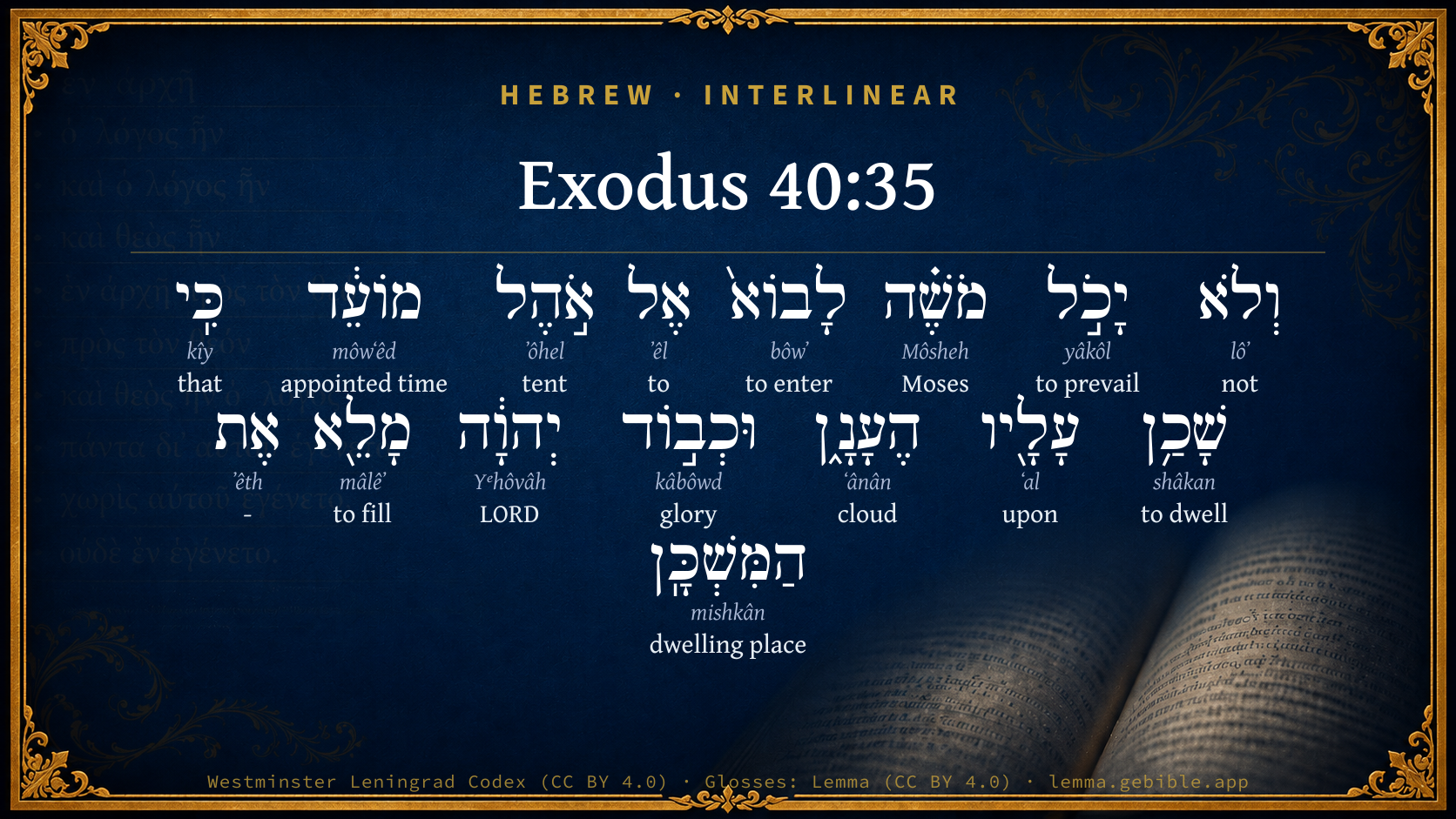
Hebrew (Westminster Leningrad Codex) Exodus 40:35 appears in the Hebrew Old Testament. The text above is from the Westminster Leningrad Codex. Each word links to its Strong’s number, a concise gloss, and parsing drawn from the Open Scriptures Hebrew Bible morphology. Click any word for its full Brown-Driver-Briggs (BDB) entry.
Download image
Cite this verse

Exodus 40:35 (World English Bible). Public Domain. Lemma interlinear Bible study tool, https://lemma.gebible.app/v/exodus/40/35.

Show BibTeX & RIS
BibTeX
RIS
English Translation
Moses wasn't able to enter into the tent of meeting, because the cloud stayed on it, and Yahweh's glory filled the tent.
World English Bible · Public Domain
Download a study sheet

One document with this verse’s original text, its word-by-word gloss line, the meaning frame, cross-references with their text, attributed commentary, and full source and license credits — printable, and it pastes into notes with its structure intact.

This verse Autodidact and up

Study sheet (.html) Plain text (.txt)

A passage Seminary Student

Up to 50 verses in one chapter. A passage sheet keeps up to 6 commentary sources and 12 cross-references per verse, in the order this page ranks them, and says so on the sheet whenever that leaves anything out. Ask for a single verse and you get the Autodidact verse sheet above.

Everything on this page stays free to read, with no account — the sheet is a download of what is already on screen, not access to it.

Want to remove ads? Support Godless Engineer
Compare translations 3

The same verse in 3 English versions, stacked beneath the original-language interlinear above. Click any original word for its lexicon entry.

Each is an independent rendering of the whole verse — the interlinear is not word-aligned to these translations.

Highlighted words mark where these versions differ — a whole-verse word diff, not a word-by-word alignment.

  • World English Bible Public Domain
    Moses wasn't able to enter into the tent of meeting, because the cloud stayed on it, and Yahweh's glory filled the tent.
  • King James Version Public Domain
    And Moses was not able to enter into the tent of the congregation, because the cloud abode thereon, and the glory of the LORD filled the tabernacle.
  • unfoldingWord Literal Text CC BY-SA 4.0
    And Moses was not able to go into the tent of meeting, because the cloud had settled on it and the glory of Yahweh had filled the Dwelling.

unfoldingWord Literal Text — © unfoldingWord, licensed CC BY-SA 4.0. Word-aligned USFM3 via Door43 (git.door43.org/unfoldingWord/en_ult).

Versions to compare (up to 4)

3 of 4 selected

Show all 18 translations

Every available English version of this verse, each an independent rendering of the whole verse.

  • World English Bible Public Domain
    Moses wasn't able to enter into the tent of meeting, because the cloud stayed on it, and Yahweh's glory filled the tent.
  • Berean Standard Bible Public Domain
    Moses was unable to enter the Tent of Meeting because the cloud had settled on it, and the glory of the LORD filled the tabernacle.
  • Majority Standard Bible Public Domain
    Moses was unable to enter the Tent of Meeting because the cloud had settled on it, and the glory of the LORD filled the tabernacle.
  • King James Version Public Domain
    And Moses was not able to enter into the tent of the congregation, because the cloud abode thereon, and the glory of the LORD filled the tabernacle.
  • American Standard Version (1901) Public Domain
    And Moses was not able to enter into the tent of meeting, because the cloud abode thereon, and the glory of Jehovah filled the tabernacle.
  • Revised Version (1885) Public Domain
    And Moses was not able to enter into the tent of meeting, because the cloud abode thereon, and the glory of the LORD filled the tabernacle.
  • Geneva Bible (1599) Public Domain
    So Moses could not enter into the Tabernacle of the Congregation, because the cloude abode thereon, and the glorie of the Lord filled the Tabernacle.
  • Douay-Rheims (1899) Public Domain
    If it hung over, they remained in the same place.
  • Young's Literal Translation Public Domain
    and Moses hath not been able to go in unto the tent of meeting, for the cloud hath tabernacled on it, and the honour of Jehovah hath filled the tabernacle.
  • Literal Standard Version CC BY-SA 4.0
    and Moses has not been able to go into the Tent of Meeting, for the cloud has dwelt on it, and the glory of YHWH has filled the Dwelling Place.
  • Unlocked Literal Bible CC BY-SA 4.0
    Moses was not able to enter the tent of meeting because the cloud had settled on it, and because Yahweh's glory filled the tabernacle.
  • unfoldingWord Literal Text CC BY-SA 4.0
    And Moses was not able to go into the tent of meeting, because the cloud had settled on it and the glory of Yahweh had filled the Dwelling.
  • Darby Bible Public Domain
    And Moses could not enter into the tent of meeting, for the cloud abode on it, and the glory of Jehovah filled the tabernacle.
  • World Messianic Bible Public Domain
    Moses wasn’t able to enter into the Tent of Meeting, because the cloud stayed on it, and the LORD’s glory filled the tabernacle.
  • Webster's Bible Public Domain
    And Moses was not able to enter into the tent of the congregation, because the cloud abode upon it, and the glory of the LORD filled the tabernacle.
  • Free Bible Version CC BY-SA 4.0
    Moses could not enter the Tent of Meeting because the cloud remained on it, and the glory of the Lord filled the Tabernacle.
  • Bible in Basic English Public Domain
    So that Moses was not able to go into the Tent of meeting, because the cloud was resting on it, and the House was full of the glory of the Lord.
  • JPS Tanakh (1917) Public Domain
    And Moses was not able to enter into the tent of meeting, because the cloud abode thereon, and the glory of the LORD filled the tabernacle. —

Literal Standard Version (2020), Covenant Press — licensed CC BY-SA 4.0. Text via the HelloAO Bible API (eBible.org). Unlocked Literal Bible (unfoldingWord) — licensed CC BY-SA 4.0. Text via the HelloAO Bible API (eBible.org). unfoldingWord Literal Text — © unfoldingWord, licensed CC BY-SA 4.0. Word-aligned USFM3 via Door43 (git.door43.org/unfoldingWord/en_ult). Free Bible Version, Dr. Jonathan Gallagher — licensed CC BY-SA 4.0. Text via the HelloAO Bible API (eBible.org).

Word by word

More ways to search: Search by grammar → Find every occurrence → Compare this word →

Practice this passage: Drill this verse → Learn its vocabulary →

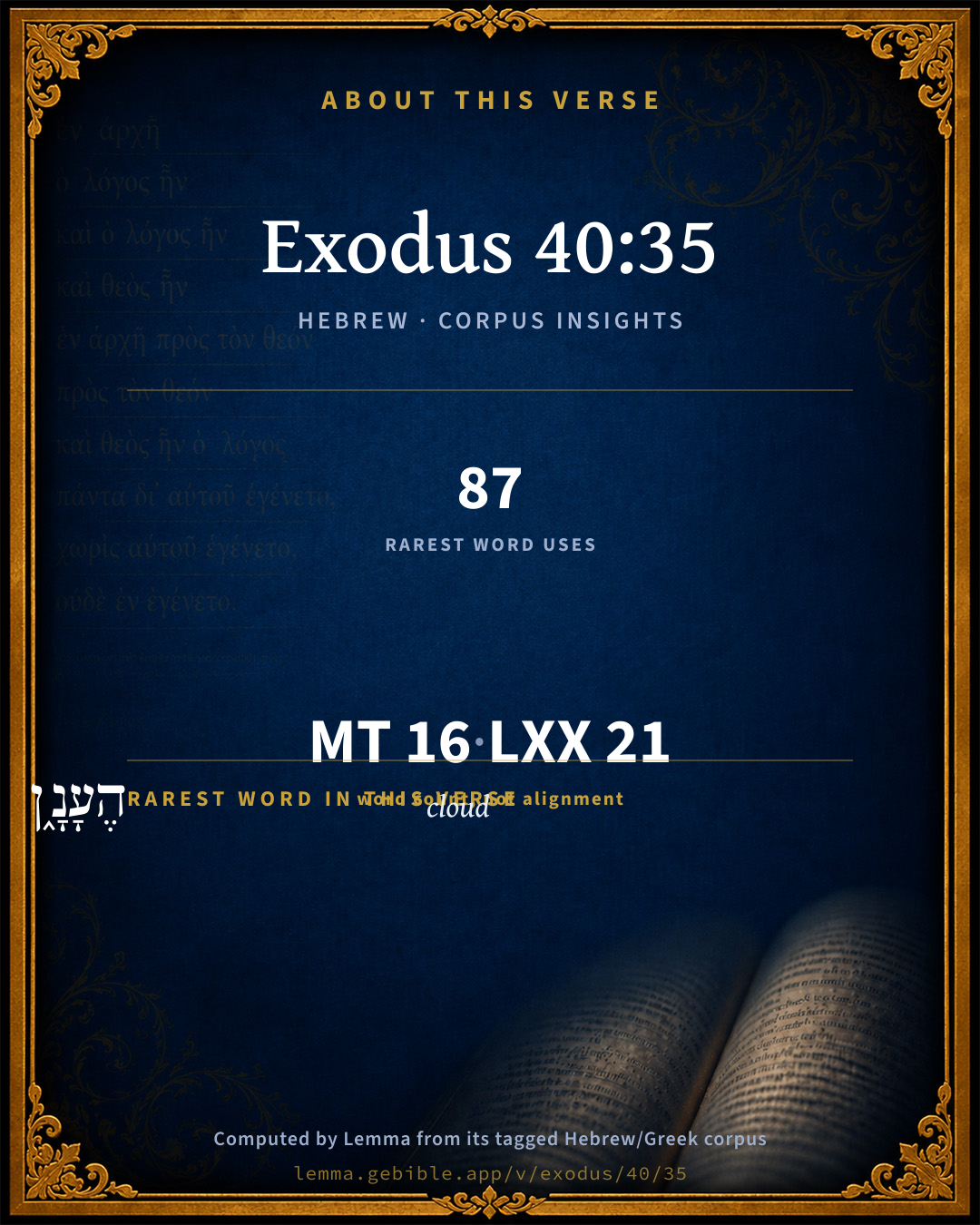
הֶעָנָ֑ן
ʻânân
H6051
“the · cloud”
Particle, Definite Article + Noun, Common, Masculine, Singular, Absolute
Part of Speech
Particle + Noun
Type
Common
Gender
Masculine
Number
Singular
State
Absolute
Full BDB Definition

Origin: from H6049

TWOT: 1655a

cloud, cloudy, cloud-mass - cloud-mass (of theophanic cloud) - cloud
  1. וְלֹא lôʼ H3808 “and · not” Conjunction + Particle, Negative
  2. יָכֹ֣ל yâkôl H3201 “to prevail” Verb, Qal, Perfect, 3rd Person, Masculine, Singular
  3. מֹשֶׁ֗ה Môsheh H4872 “Moses” Noun, Proper
  4. לָבוֹא֙ bôwʼ H935 “to enter” Preposition + Verb, Qal, Infinitive Construct
  5. אֶל ʼêl H413 “to” Preposition
  6. אֹ֣הֶל ʼôhel H168 “tent of” Noun, Common, Masculine, Singular, Construct
  7. מוֹעֵ֔ד môwʻêd H4150 “appointed time” Noun, Common, Masculine, Singular, Absolute
  8. כִּֽי kîy H3588 “that” Conjunction
  9. שָׁכַ֥ן shâkan H7931 “to dwell” Verb, Qal, Perfect, 3rd Person, Masculine, Singular
  10. עָלָ֖יו ʻal H5921 “upon · him” Preposition + Suffix, Personal, 3rd Person, Masculine, Singular
  11. וּכְב֣וֹד kâbôwd H3519 “and · glory of” Conjunction + Noun, Common, Both, Singular, Construct
  12. יְהוָ֔ה Yᵉhôvâh H3068 “LORD” Noun, Proper
  13. מָלֵ֖א mâlêʼ H4390 “to fill” Verb, Qal, Perfect, 3rd Person, Masculine, Singular
  14. אֶת ʼêth H853 “-” Particle, Direct Object
  15. הַמִּשְׁכָּֽן mishkân H4908 “the · dwelling place” Particle, Definite Article + Noun, Common, Masculine, Singular, Absolute

About this verse

These counts appear in no published source. They are computed here, from the morphology-tagged text and Lemma’s own curated glosses. What Lemma adds →

16
words
16
distinct lemmas
Pentateuch
section

Grammatical profile

  • 4 verbs
  • 7 nouns
  • 2 prepositions
  • 1 conjunction
  • 2 particles

Verb forms

  • יָכֹ֣ל Qal · Perfect
  • לָבוֹא֙ Qal · Infinitive Construct
  • שָׁכַ֥ן Qal · Perfect
  • מָלֵ֖א Qal · Perfect

Hebrew & Septuagint length

In English translation the verse runs 22 words from the Hebrew and 28 from the Septuagint (LXX English) — closely comparable.

A rough comparison of the two English renderings, which tokenize alike — not a word-level alignment.

Word counts can differ between the Hebrew and the Greek without any difference in meaning — e.g. the Hebrew direct-object marker אֵת has no separate Greek word, and Greek often adds the article ὁ.

In the original languages it is 16 Hebrew tokens and 21 Greek tokens — but the two are counted differently (Hebrew bundles its prefixes and suffixes into one token; the Greek is in lemma form), so that isn’t a like-for-like length.

Cross-references

6

Topical passages linked to Exodus 40:35 in the Treasury of Scripture Knowledge — connected by theme and wording, ordered by reader-vote popularity; previews shown in the World English Bible.

  • 1 Kings 8:11 so that the priests could not stand to minister by reason of the cloud; for the glory of Yahweh filled the house of Yahweh.
  • Leviticus 16:2 and Yahweh said to Moses, "Tell Aaron your brother, not to come at all times into the Most Holy Place within the veil, before the mercy seat which is on the ark; lest he die: for I will appear in the cloud on the mercy seat.
  • 2 Chronicles 7:2 The priests could not enter into the house of Yahweh, because the glory of Yahweh filled Yahweh's house.
  • Isaiah 6:4 The foundations of the thresholds shook at the voice of him who called, and the house was filled with smoke.
  • 2 Chronicles 5:13–14 it happened, when the trumpeters and singers were as one, to make one sound to be heard in praising and thanking Yahweh; and when they lifted up their voice with the trumpets and cymbals and instruments of music, and praised Yahweh, [saying], For he is good; for his loving kindness endures forever; that then the house was filled with a cloud, even the house of Yahweh,
  • Revelation 15:8 The temple was filled with smoke from the glory of God, and from his power. No one was able to enter into the temple, until the seven plagues of the seven angels would be finished.

Cross-references courtesy of OpenBible.info (CC BY 4.0).

Hebrew and Greek witnesses Masoretic Hebrew ↔ Greek Septuagint

The same verse in the two great witnesses to the Old Testament, shown verse-for-verse.

These are two independent witnesses, not word-aligned to each other, and the Septuagint is shown in lemma (dictionary) form.

Hebrew Exodus 40:35 Masoretic · Westminster Leningrad Codex

וְלֹא יָכֹ֣ל מֹשֶׁ֗ה לָבוֹא֙ אֶל אֹ֣הֶל מוֹעֵ֔ד כִּֽי שָׁכַ֥ן עָלָ֖יו הֶעָנָ֑ן וּכְב֣וֹד יְהוָ֔ה מָלֵ֖א אֶת הַמִּשְׁכָּֽן

Moses wasn't able to enter into the tent of meeting, because the cloud stayed on it, and Yahweh's glory filled the tent.

World English Bible · Public Domain

Greek LXX Exodus 40:35 Septuagint · lemma form

νεφέλη γάρ εἰμί ἐπί ὁ σκηνή ἡμέρα καί πῦρ εἰμί ἐπί αὐτός νύξ ἐναντίον πᾶς ἰσραήλ ἐν πᾶς ὁ ἀναζυγή αὐτός

And Moses was not able to enter into the tabernacle of testimony, because the cloud overshadowed it, and the tabernacle was filled with the glory of the Lord.

LXX2012 (modern English Septuagint) · Public Domain

Hebrew: Westminster Leningrad Codex (CC BY 4.0). Greek: Septuagint (public domain); English from LXX2012 (modern English Septuagint) (Public Domain). How the Septuagint differs from the Hebrew →

Targum (Aramaic paraphrase)

2

The Targum is the ancient Jewish Aramaic paraphrase of the Hebrew Scriptures — an interpretive translation, not the Hebrew text itself. Onkelos (literal) and Pseudo-Jonathan (expansive) render the Torah, and Jonathan the Prophets. Coverage is partial: where no permissively-licensed English translation exists for a verse, only the Aramaic is shown. This is verse-level text, not a word-by-word alignment to the Hebrew.

  1. Targum Onkelos Torah (Genesis–Deuteronomy)
    וְלָא יָכִיל משֶׁה לְמֵיעַל לְמַשְׁכַּן זִמְנָא אֲרֵי שְׁרָא עֲלוֹהִי עֲנָנָא וִיקָרָא דַיְיָ אִתְמְלִי יָת מַשְׁכְּנָא:

    (no public-domain English translation for this verse)

    Targum Onkelos — Aramaic: “Onkelos Genesis” (public domain); “Onkelos Exodus” (public domain); “Onkelos Leviticus” (public domain); “Onkelos Numbers” (public domain); “Onkelos Deuteronomy” (public domain). English: “Sefaria Community Translation” (CC0 1.0 (public-domain dedication)); “J.W. Etheridge. The Targums of Onkelos and Jonathan Ben Uzziel on the Pentateuch. London: Longmans, Green, 1862” (public domain). Text via Sefaria.

  2. Targum Pseudo-Jonathan Torah (Genesis–Deuteronomy)
    וְלָא הֲוָה אֶפְשַׁר לְמשֶׁה לְמֵיעַל לְמַשְׁכַּן זִמְנָא אֲרוּם שְׁרָא עֲלוֹי עֲנַן יְקָרָא וְאִיקַר שְׁכִינְתָּא דַיְיָ אִתְמְלֵי יַת מַשְׁכְּנָא

    And Mosheh was not able to enter the tabernacle of ordinance, because the Cloud of Glory rested upon it, and the glory of the Lord's Shekinah filled the tabernacle.

    Targum Pseudo-Jonathan — Aramaic: “Targum Jonathan on Genesis” (public domain); “Targum Jonathan on Exodus” (public domain); “Targum Jonathan on Leviticus” (public domain); “Targum Jonathan on Numbers” (public domain); “Targum Jonathan on Deuteronomy” (public domain). English: “The Targum of Jonathan ben Uzziel, trans. J. W. Etheridge, London, 1862” (public domain). Text via Sefaria.

Commentary

Notes on Exodus 40:35 from classic Christian and Jewish commentators (each source and its license shown beneath its notes). The classic Christian expositions comment on the surrounding passage and are grouped to its opening verse, so a note may address several verses; the Jewish commentaries on the Tanakh (Rashi and others) are per-verse, so they appear only where the commentator wrote on this verse.

Lemma curates 59 commentaries, every one of them public domain or Creative Commons licensed, each selected and text-cleaned for this edition rather than reprinted as found. About our sources →

Jamieson, Fausset & Brown

Robert Jamieson, A. R. Fausset & David Brown

Moses was not able to enter into the tent of the congregation--How does this circumstance show the incapacity of man, in his present state, to look upon the unveiled perfections of the Godhead! Moses could not endure the unclouded effulgence, nor the sublimest of the prophets (Isa 6:5). But what neither Moses nor the most eminent of God's messengers to the ancient church through the weakness of nature could endure, we can all now do by an exercise of faith; looking unto Jesus, who reflected with chastened radiance the brightness of the Father's glory; and who, having as the Forerunner for us, entered within the veil, has invited us to come boldly to the mercy seat. While Moses was compelled, through the influence of overwhelming awe, to stand aloof and could not enter the tabernacle, Christ entered into the holy place not made with hands; nay, He is Himself the true tabernacle, filled with the glory of God, ever with the grace and truth which the Shekinah typified. What great reason we have to thank God for Jesus Christ, who, while He Himself was the brightness of the Father's glory, yet exhibited that glory in so mild and attractive a manner, as to allure us to draw near with confidence and love into the Divine Presence!

Jamieson, Fausset & Brown — Commentary Critical and Explanatory on the Whole Bible (1871) — public domain (CC PDM 1.0). Text via the HelloAO Bible API.

Ellicott's Commentary for English Readers

(35) Moses was not able to enter into the tent.—Apparently, Moses, seeing the cloud descend, as it had been wont to do upon the temporary “tent of meeting” (Exo_33:9), endeavoured to re-enter the Tabernacle which he had quitted, but was unable; the “glory” forbade approach. (Comp. the effect of the “glory” when it descended on Solomon’s Temple, 1Ki_8:11; 2Ch_5:14; 2Ch_7:2.)

A Bible Commentary for English Readers, edited by Charles John Ellicott (1878–1897) — public domain. Text from a community e-Sword module.

The Cambridge Bible for Schools and Colleges

gen. ed. J. J. S. Perowne

35. was not able, &c.] cf. 1Ki_8:10 f. (at the dedication of Solomon’s Temple), Eze_43:4 f.

The Cambridge Bible for Schools and Colleges (gen. ed. J. J. S. Perowne; Cambridge University Press, 1878–1918) — public domain. Text from a community e-Sword module.

Matthew Poole's English Annotations

Moses was not able to enter in, partly because of the extraordinary thickness and brightness of the cloud, which both dazzled his eyes and struck him with horror, as 1Ki 8:11; and partly, because of his great reverence and dread of that eminent and glorious appearance of God; and partly, because he was not called to it, as he was not able to go up into the mount till he was called, Exo 24:16.

Matthew Poole's English Annotations on the Holy Bible (1683–1685) — public domain. Text from a community e-Sword/MySword module.

The Pulpit Commentary

Moses was not able to enter. It is implied that he wished nay, tried to enter but the "glory" prevented him. (Compare 1Ki_8:11; 2Ch_5:14 2Ch_7:2) Because the cloud abode thereon. It was not the external "cloud" which prevented Moses from entering, but the internal "glory." But the two are regarded as inseparable.

The Pulpit Commentary (1880–1919), ed. H.D.M. Spence-Jones & Joseph S. Exell — public domain. Text from a community e-Sword module.

Rashi

Rabbi Shlomo Yitzchaki (Rashi)

ולא יכל משה לבא אל אהל מועד AND MOSES WAS NOT ABLE TO COME INTO THE APPOINTED TENT — But another verse says, (Numbers 7:89) “And when Moses came into the appointed tent [to speak with Him then he heard the voice]”! There comes, however, a third verse and reconciles these apparently contradictory verses, for it says here כי שכן עליו הענן “For (or when) the cloud abode thereon (on the appointed tent)”. Hence you may say: so long as the cloud was upon it “he was not able to come into the appointed tent”, but as soon as the cloud disappeared he entered it and spoke with Him (Sifra, Braita d'Rabbi Yishmael 18).

Rashi on the Tanakh — English translations: “The Judaica Press complete Tanach with Rashi, translated by A. J. Rosenberg” (CC BY 4.0); “Pentateuch with Rashi's commentary by M. Rosenbaum and A.M. Silbermann, 1929-1934” (public domain); “The Metsudah Tanach series, Lakewood, N.J” (CC BY 4.0); and “The Book of Joshua, Metsudah Publications, 1997” (CC BY 4.0). Text via Sefaria.

Ibn Ezra

Rabbi Abraham ibn Ezra

Moshe was unable to enter. Moshe was the one who placed the cover with the cherubim upon the ark in the first place. It seems likely that he was also the one who covered it with the paroches whenever they broke camp, for no one else could have gazed upon the seat of Hashem’s glory (see I Shemuel 4:4). Apparently, then, it is not that he was unable to enter the Tabernacle at all while the cloud was upon it, but only that he had to wait to be summoned, as can be seen from the first verse in Vayikra, “And He called to Moshe”.

Ibn Ezra on the Tanakh — English translations: “Sefaria Community Translation” (CC0 1.0 (public-domain dedication)); “Yalkut, Sifsei Chachomim Chumash, Metsudah Publications, 2009” (CC BY 4.0); and “Commentary of Ibn Ezra on Isaiah - trans. by M. Friedlander, 1873” (public domain). Text via Sefaria.

Lesson kit

Teaching starters — assembled from the data on this page, not authored interpretation. Every prompt links to the verse data it draws on. Edit before teaching.

Exodus, in the Pentateuch, opens this verse with 16 words (16 distinct Hebrew lemmas). Its most distinctive word is ʻânân (“cloud”). A historical commentator’s framing appears above. Read the whole chapter for the surrounding context.

Discussion questions

  1. How does “cloud” (ʻânân) shape what this verse is saying?
  2. 1 Kings 8:11 shares this passage’s theme. How do the two illuminate each other?
  3. The translations on this page render this verse differently — a whole-verse word diff, not a word-by-word alignment. What might account for the different wordings?
  4. The verb «יָכֹ֣ל» is Qal Perfect. How does its form color the action?
  5. Reading how Jamieson, Fausset & Brown and Ellicott's Commentary for English Readers read this verse, where do the two commentators agree and where do they part?

Things to notice

Reading settings

Reading text

Shown beneath each verse's original-language words.

Old Testament
Old Testament edition

Read the OT as the Masoretic Hebrew (MT) or the Greek Septuagint (LXX).

English shown for the Greek Septuagint (in the Hebrew ↔ Greek comparison).

Comparing translations? Open the Compare panel on any verse page to stack up to four side by side.