
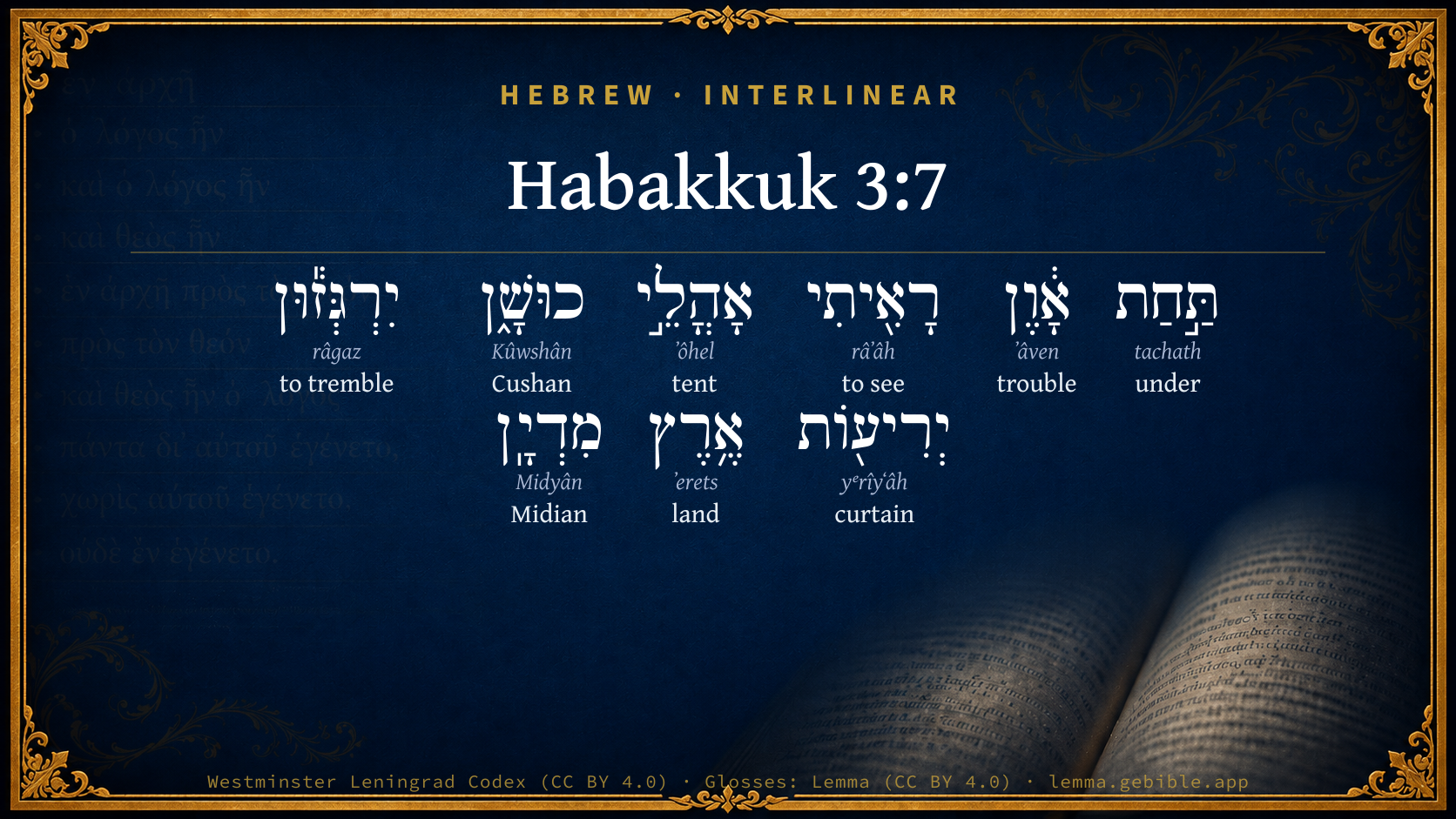
Habakkuk 3:7

Hebrew (Westminster Leningrad Codex) Habakkuk 3:7 appears in the Hebrew Old Testament. The text above is from the Westminster Leningrad Codex. Each word links to its Strong’s number, a concise gloss, and parsing drawn from the Open Scriptures Hebrew Bible morphology. Click any word for its full Brown-Driver-Briggs (BDB) entry.
Download image
Cite this verse

Habakkuk 3:7 (World English Bible). Public Domain. Lemma interlinear Bible study tool, https://lemma.gebible.app/v/habakkuk/3/7.

Show BibTeX & RIS
BibTeX
RIS
English Translation
I saw the tents of Cushan in affliction. The dwellings of the land of Midian trembled.
World English Bible · Public Domain
Highlights
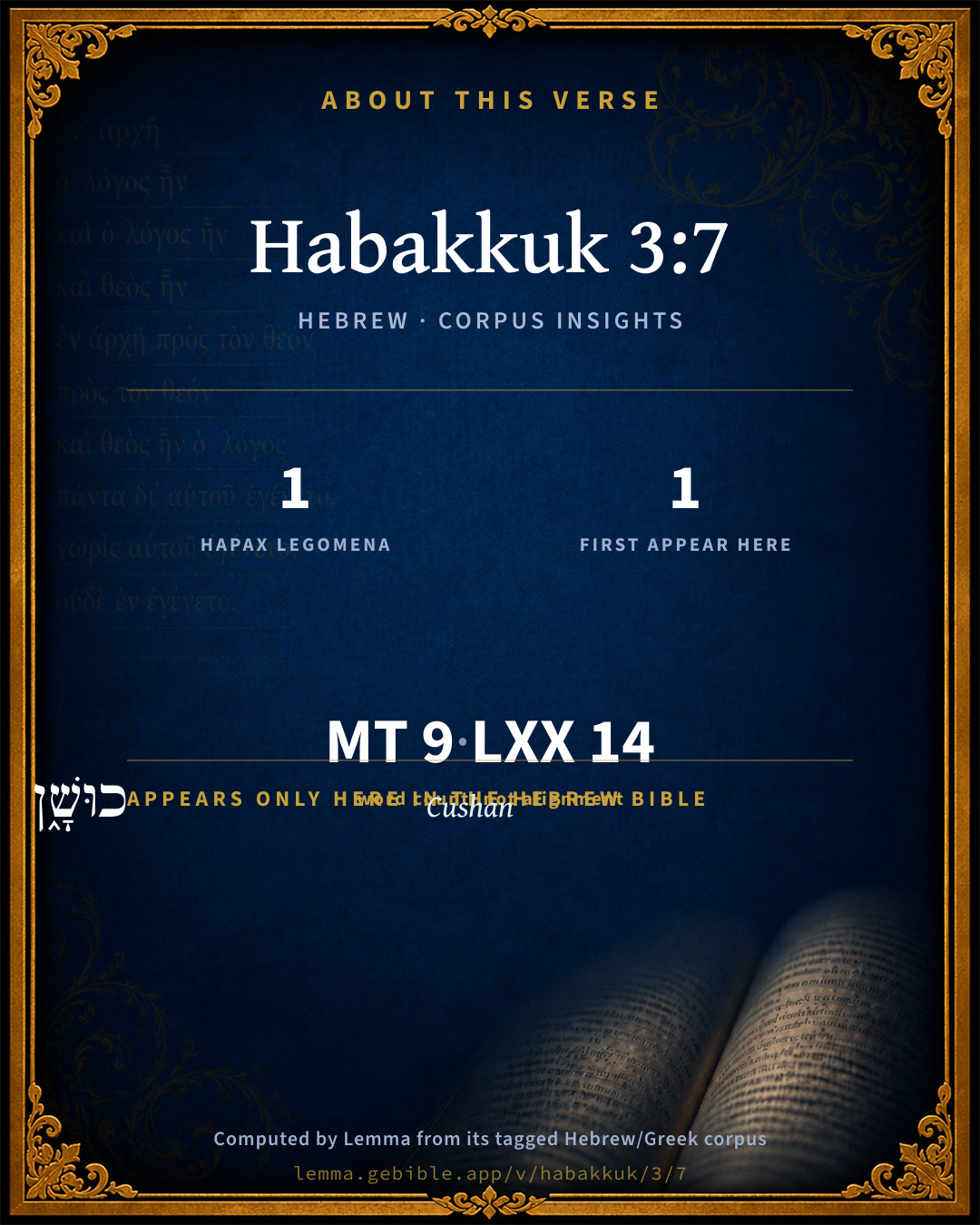
  • 1 hapax legomenon — only here in the Hebrew Bible
  • 1 first appearance in the Hebrew Bible
Full analysis ↓
Download a study sheet

One document with this verse’s original text, its word-by-word gloss line, the meaning frame, cross-references with their text, attributed commentary, and full source and license credits — printable, and it pastes into notes with its structure intact.

This verse Autodidact and up

Study sheet (.html) Plain text (.txt)

A passage Seminary Student

Up to 50 verses in one chapter. A passage sheet keeps up to 6 commentary sources and 12 cross-references per verse, in the order this page ranks them, and says so on the sheet whenever that leaves anything out. Ask for a single verse and you get the Autodidact verse sheet above.

Everything on this page stays free to read, with no account — the sheet is a download of what is already on screen, not access to it.

Want to remove ads? Support Godless Engineer
Compare translations 3

The same verse in 3 English versions, stacked beneath the original-language interlinear above. Click any original word for its lexicon entry.

Each is an independent rendering of the whole verse — the interlinear is not word-aligned to these translations.

Highlighted words mark where these versions differ — a whole-verse word diff, not a word-by-word alignment.

  • World English Bible Public Domain
    I saw the tents of Cushan in affliction. The dwellings of the land of Midian trembled.
  • King James Version Public Domain
    I saw the tents of Cushan in affliction: and the curtains of the land of Midian did tremble.
  • unfoldingWord Literal Text CC BY-SA 4.0
    Under trouble I saw the tents of Cushan; the curtains of the land of Midian trembled. q1

unfoldingWord Literal Text — © unfoldingWord, licensed CC BY-SA 4.0. Word-aligned USFM3 via Door43 (git.door43.org/unfoldingWord/en_ult).

Versions to compare (up to 4)

3 of 4 selected

Show all 18 translations

Every available English version of this verse, each an independent rendering of the whole verse.

  • World English Bible Public Domain
    I saw the tents of Cushan in affliction. The dwellings of the land of Midian trembled.
  • Berean Standard Bible Public Domain
    I saw the tents of Cushan in distress; the curtains of Midian were trembling.
  • Majority Standard Bible Public Domain
    I saw the tents of Cushan in distress; the curtains of Midian were trembling.
  • King James Version Public Domain
    I saw the tents of Cushan in affliction: and the curtains of the land of Midian did tremble.
  • American Standard Version (1901) Public Domain
    I saw the tents of Cushan in affliction; The curtains of the land of Midian did tremble.
  • Revised Version (1885) Public Domain
    I saw the tents of Cushan in affliction: the curtains of the land of Midian did tremble.
  • Geneva Bible (1599) Public Domain
    For his iniquitie I sawe the tentes of Cushan, and the curtaines of the land of Midian did tremble.
  • Douay-Rheims (1899) Public Domain
    I saw the tents of Ethiopia for their iniquity, the curtains of the land of Madian shall be troubled.
  • Young's Literal Translation Public Domain
    Under sorrow I have seen tents of Cushan, Tremble do curtains of the land of Midian.
  • Literal Standard Version CC BY-SA 4.0
    Under sorrow I have seen tents of Cushan, || Curtains of the land of Midian tremble.
  • Unlocked Literal Bible CC BY-SA 4.0
    I saw the tents of Cushan in affliction, and the fabric of the tents in the land of Midian trembling.
  • unfoldingWord Literal Text CC BY-SA 4.0
    Under trouble I saw the tents of Cushan; the curtains of the land of Midian trembled. q1
  • Darby Bible Public Domain
    I saw the tents of Cushan in affliction; The curtains of the land of Midian did tremble.
  • World Messianic Bible Public Domain
    I saw the tents of Cushan in affliction. The dwellings of the land of Midian trembled.
  • Webster's Bible Public Domain
    I saw the tents of Cushan in affliction: and the curtains of the land of Midian trembled.
  • Free Bible Version CC BY-SA 4.0
    I saw the tents of Cushan suffering, the tent curtains of the land of Midian tremble.
  • Bible in Basic English Public Domain
    The curtains of Cushan were troubled, and the tents of Midian were shaking.
  • JPS Tanakh (1917) Public Domain
    I see the tents of Cushan in affliction; the curtains of the land of Midian do tremble.

Literal Standard Version (2020), Covenant Press — licensed CC BY-SA 4.0. Text via the HelloAO Bible API (eBible.org). Unlocked Literal Bible (unfoldingWord) — licensed CC BY-SA 4.0. Text via the HelloAO Bible API (eBible.org). unfoldingWord Literal Text — © unfoldingWord, licensed CC BY-SA 4.0. Word-aligned USFM3 via Door43 (git.door43.org/unfoldingWord/en_ult). Free Bible Version, Dr. Jonathan Gallagher — licensed CC BY-SA 4.0. Text via the HelloAO Bible API (eBible.org).

Word by word

More ways to search: Search by grammar → Find every occurrence → Compare this word →

Practice this passage: Drill this verse → Learn its vocabulary →

About this verse

These counts appear in no published source. They are computed here, from the morphology-tagged text and Lemma’s own curated glosses. What Lemma adds →

9
words
9
distinct lemmas
Prophets
section

Notable vocabulary

1 hapax legomenon — a word that appears only here in the entire Hebrew Bible:

  • כוּשָׁ֑ן Cushan H3572

First appearance in Scripture

This word makes its first canonical appearance in the Hebrew Bible here:

  • כוּשָׁ֑ן Cushan H3572

Shared distinctive vocabulary

יִרְגְּז֕וּן to tremble H7264 occurs in 40 verses of the Hebrew Bible. Also found in:

Grammatical profile

  • 2 verbs
  • 6 nouns
  • 1 preposition

Verb forms

  • רָאִ֖יתִי Qal · Perfect
  • יִרְגְּז֕וּן Qal · Imperfect

Hebrew & Septuagint length

In English translation the verse runs 16 words from the Hebrew and 22 from the Septuagint (LXX English) — closely comparable.

A rough comparison of the two English renderings, which tokenize alike — not a word-level alignment.

Word counts can differ between the Hebrew and the Greek without any difference in meaning — e.g. the Hebrew direct-object marker אֵת has no separate Greek word, and Greek often adds the article ὁ.

In the original languages it is 9 Hebrew tokens and 14 Greek tokens — but the two are counted differently (Hebrew bundles its prefixes and suffixes into one token; the Greek is in lemma form), so that isn’t a like-for-like length.

Cross-references

9

Topical passages linked to Habakkuk 3:7 in the Treasury of Scripture Knowledge — connected by theme and wording, ordered by reader-vote popularity; previews shown in the World English Bible.

  • Exodus 15:14–16 The peoples have heard. They tremble. Pangs have taken hold on the inhabitants of Philistia.
  • Genesis 10:6–7 The sons of Ham: Cush, Mizraim, Put, and Canaan.
  • Genesis 25:1–4 Abraham took another wife, and her name was Keturah.
  • Numbers 22:3–4 Moab was sore afraid of the people, because they were many: and Moab was distressed because of the children of Israel.
  • Numbers 31:2–12 Avenge the children of Israel of the Midianites: afterward you shall be gathered to your people.
  • Joshua 2:10 For we have heard how Yahweh dried up the water of the Red Sea before you, when you came out of Egypt; and what you did to the two kings of the Amorites, who were beyond the Jordan, to Sihon and to Og, whom you utterly destroyed.
  • Joshua 9:24 They answered Joshua, and said, Because it was certainly told your servants, how that Yahweh your God commanded his servant Moses to give you all the land, and to destroy all the inhabitants of the land from before you; therefore we were sore afraid for our lives because of you, and have done this thing.
  • Judges 7:24–25 Gideon sent messengers throughout all the hill-country of Ephraim, saying, Come down against Midian, and take before them the waters, as far as Beth Barah, even the Jordan. So all the men of Ephraim were gathered together, and took the waters as far as Beth Barah, even the Jordan.
  • Psalms 83:5–10 For they have conspired together with one mind. They form an alliance against you.

Cross-references courtesy of OpenBible.info (CC BY 4.0).

Hebrew and Greek witnesses Masoretic Hebrew ↔ Greek Septuagint

The same verse in the two great witnesses to the Old Testament, shown verse-for-verse.

These are two independent witnesses, not word-aligned to each other, and the Septuagint is shown in lemma (dictionary) form.

Hebrew Habakkuk 3:7 Masoretic · Westminster Leningrad Codex

תַּ֣חַת אָ֔וֶן רָאִ֖יתִי אָהֳלֵ֣י כוּשָׁ֑ן יִרְגְּז֕וּן יְרִיע֖וֹת אֶ֥רֶץ מִדְיָֽן

I saw the tents of Cushan in affliction. The dwellings of the land of Midian trembled.

World English Bible · Public Domain

Greek LXX Habakkuk 3:7 Septuagint · lemma form

πορεία αἰώνιος αὐτός ἀντί κόπος ὁράω σκήνωμα αἰθίοψ πτοέω καί ὁ σκηνή γῆ μαδιαμ

Because of troubles I looked upon the tents of the Ethiopians: the tabernacles also of the land of Madiam shall be dismayed.

LXX2012 (modern English Septuagint) · Public Domain

On this verse, John Gill's Exposition discusses the Septuagint’s reading. Read the note in Commentary ↓

Hebrew: Westminster Leningrad Codex (CC BY 4.0). Greek: Septuagint (public domain); English from LXX2012 (modern English Septuagint) (Public Domain). How the Septuagint differs from the Hebrew →

Targum (Aramaic paraphrase)

1

The Targum is the ancient Jewish Aramaic paraphrase of the Hebrew Scriptures — an interpretive translation, not the Hebrew text itself. Onkelos (literal) and Pseudo-Jonathan (expansive) render the Torah, and Jonathan the Prophets. Coverage is partial: where no permissively-licensed English translation exists for a verse, only the Aramaic is shown. This is verse-level text, not a word-by-word alignment to the Hebrew.

  1. Targum Jonathan Prophets (Joshua–Malachi)
    כַּד פְּלָחוּ בֵּית יִשְׂרָאֵל לְטַעֲוָתָא מְסַרְתִּינוּן בְּיַד כּוּשָׁן חַיָבָא וְכַד תָּבוּ לְמֶעְבַּד אוֹרַיְתָא עֲבָדֵית לְהוֹן נִסִין וּגְבוּרָן וּפְרַקְתִּינוּן מִיַד מִדְיָנָאֵי עַל יַד גִדְעוֹן בַר יוֹאָשׁ:

    (no public-domain English translation for this verse)

    Targum Jonathan — Aramaic: “Mikraot Gedolot” (public domain). English: “Sefaria Community Translation” (CC0 1.0 (public-domain dedication)); “London "Chaldee Paraphrase," 1871” (public domain). Text via Sefaria.

Commentary

Notes on Habakkuk 3:7 from classic Christian and Jewish commentators (each source and its license shown beneath its notes). The classic Christian expositions comment on the surrounding passage and are grouped to its opening verse, so a note may address several verses; the Jewish commentaries on the Tanakh (Rashi and others) are per-verse, so they appear only where the commentator wrote on this verse.

Lemma curates 59 commentaries, every one of them public domain or Creative Commons licensed, each selected and text-cleaned for this edition rather than reprinted as found. About our sources →

John Gill's Exposition

I saw the tents of Cushan in affliction,.... The same with Cush or Ethiopia; hence the Septuagint and Vulgate Latin versions render it, "the tents of the Ethiopians"; and these are the same with "the curtains of Midian" in the next clause, tents being made of curtains, and the Ethiopians and Midianites the same people; so the daughter of the priest of Midian, whom Moses married, is called an Ethiopian woman, Exo 2:21. This seems to have respect to that panic which seized the neighbouring nations by whom the Israelites passed, as well as the Canaanites, into whose land they were marching, when they heard what wonderful things were done for them in Egypt, at the Red sea, and in the wilderness, which was predicted by Moses in Exo 15:14 and not only fulfilled in the Canaanites, as appears from what Rahab says, Jos 2:9 but particularly in the Moabites and Midianites, who sent to each other, and consulted together against Israel; and, by the advice of Balaam, found ways and means to draw them into fornication, and so to idolatry; for which the Israelites having suffered, were stirred up to avenge themselves on them, and slew five of their kings, and a great multitude of their people; and so the words may be rendered, "for iniquity" (l); and the word is often used for idolatry; that is, for the sin they drew the Israelites into, they were brought into trembling and great distress, which the prophet saw, perceived, and understood by reading the history of those times; see Num 22:3 though the Jewish commentators, and others, generally refer this to the case of Chushanrishathaim king of Mesopotamia, who carried Israel into captivity, from whence they were delivered by Othniel, who prevailed against Cushan, and into whose hands he fell; and so then he and his people were seen in affliction, Jdg 3:7 but Cushan here is not the name of a man, but of a country: and whereas it follows,

the curtains of the land of Midian did tremble; this is thought to refer to the times of Gideon, when the Midianites were overcome by him with three hundred men, and in their fright fell upon and destroyed each other; signified by a barley cake tumbling into the host of Midian, and overturning a tent, as represented in a dream to one of Gideon's men, Jdg 7:13 but the former reference seems best; and it should be observed, that Cush or Ethiopia, and Midian, were parts of Arabia; for not only the Arabians are said to be near the Ethiopians, or at the hand of the Cushites, Ch2 21:16 but Sinai, a part of Horeb, where Moses fed the flock of his father-in-law, the priest of Midian, is expressly said to be in Arabia; compare Exo 3:1 and with those Arabians called Scenitae, from their dwelling in tents, agree the characters in the text: now the people inhabiting those places, the prophet foresaw by a spirit of prophecy "under vanity" (m), as it may be rendered; that is, "subject" to it, as the whole Gentile world was, Rom 8:20 or under the power of idolatry; but it was foretold that these should be converted in Gospel times, Psa 68:31 which was brought about, partly by the Apostles Matthew and Matthias, said to be sent into Ethiopia; and partly by the Ethiopian eunuch, converted and baptized by Philip, who doubtless was the means of spreading the Gospel in his own country, when returned to it, Act 8:27 and chiefly by the Apostle Paul, who went into Arabia, and preached there, quickly after his conversion; and here were churches in the first times of Christianity; See Gill on Gal 1:17 and at this time Cushan or Ethiopia was in affliction; and the Midianites trembled, such of them to whom the word came in power, and they were made sensible of their danger and misery, as the apostle did, the instrument of their conversion, Act 9:6 once more, as an Ethiopian is an emblem of a man in a state of nature, and describes very aptly wicked and profligate persons, apostates from religion, and such as are persecutors of good men, Jer 13:23 it may design such here; and be expressive of their distress and trouble, the fear and dread they would be seized with on seeing Christianity prevail, and Paganism falling in the Roman empire; which distress and trembling are in a very lively manner set forth in Rev 6:15.

(l) "propter iniquitatem", V. L. Calvin, Tigurine version. (m) "Subjecta vanitati", Heb.; "sub vanitate", Piscator, Cocceius, Van Till.

John Gill's Exposition of the Whole Bible (1746–1763) — public domain (CC PDM 1.0). Text via the HelloAO Bible API.

Trapp's Complete Commentary

John Trapp

Hab 3:7 I saw the tents of Cushan in affliction: [and] the curtains of the land of Midian did tremble.

Ver. 7. I saw the tents of Cushan] King of Mesopotamia, who tyrannized over Israel eight years after Joshua’s death; God selling his people to him for nought, and not increasing his wealth by their price, Psa 44:12 Jdg 3:8. But delivering them in the end by that valiant Othniel, who brought the tents of Cushan under affliction or vanity. Some render it propter iniquitatem, because of iniquity, and set this sense upon it; It was for sin that God sold his people into the hands of Cushanrishathaim, and yet afterwards sent them a Saviour; why then should they now despair of a seasonable return out of captivity, though by their sins they have provoked the Lord to wrath; since if they return unto him and seek his favour, there is yet mercy with the Lord, that he may be feared? Lo, this is the right use of histories: and this is our duty, to make observations to ourselves, as did the prophet here: I saw the tents of Cushan; I considered the thing that hath been, it is the same which shall be, and that which is done is that which shall be done, &c., Ecc 1:9. Historiae fidae monitrices dicuntur παρα το ισταναι τον ρουν.

And the curtains of the land of Midian did tremble] Cortinae vel pelles, &c. When by the sword of the Lord and of Gideon they were cut off and discomfited, Jdg 7:7.

John Trapp, A Commentary or Exposition upon All the Books of the Old and New Testament (1647–1656) — public domain. Text from a community e-Sword module.

Joseph Benson's Commentary

Hab 3:7. I saw the tents of Cushan in affliction — Since Moses’s wife, who was a Midianite, is called (Num 12:1) a Cushite, Cushan may be here another name for Midian, and then the two members of this period will be equivalent; but if they be different, then the Cushites must have been an Arabian nation who dwelt in tents near the Midianites, and were seized with the same consternation, at the approach of Jehovah and his people Israel, as the latter were. The total overthrow which the Israelites gave the Midianites and their allies, as recorded Num 31:7-12, is probably here referred to. We can never sufficiently admire the strength and spirit, as well as justness and propriety, of this whole description. “The glory with which Jehovah is arrayed, is such as fills the heaven and the earth; a glory arising not from the pomp of external grandeur, and the parade of honourable followers, but from himself. His power is the terror of all the world around him; the insignia of it being, not the sword or the fasces, but the pestilence and devouring fire; and so great is the dread of him, that the Canaanites flee at his approach, the land trembles at his presence, and the nations around are not able to hide their dismay. Such is Habakkuk’s description of Jehovah, simple and plain, but yet grand and sublime; as much excelling every pagan description of Jupiter, as light surpasses darkness.” — Green and Houbigant.

Joseph Benson's Commentary on the Old and New Testaments (1811–1818) — public domain. Text from a community e-Sword module.

Tyndale Open Study Notes

Tyndale Open Resources

3:7 Midian occupied the southern part of the region just east of the Jordan (see Gen 36:35); the nation was trembling in terror at the earth-shaking power of God’s presence (Hab 3:6).

Tyndale Open Study Notes — © Tyndale Open Resources, licensed CC BY-SA 4.0. Text via the HelloAO Bible API.

Geneva Bible (1599)

Geneva Bible translators

The iniquity of the king of Syria in vexing thy people was made manifest by thy judgment, to the comfort of thy Church, Judg. 5:10, and also of the Midianites, which destroyed themselves, Judg. 7:22.

Geneva Bible (1599) marginal notes — public domain. Text via Bolls.life.

Jamieson, Fausset & Brown

Robert Jamieson, A. R. Fausset & David Brown

the tents--that is, the dwellers.

Cushan--the same as Cush; made "Cush-an" to harmonize with "Midi-an" in the parallel clause. So Lotan is found in the Hebrew of Genesis for Lot. BOCHART therefore considers it equivalent to Midian, or a part of Arabia. So in Num 12:1, Moses' Midianite wife is called an Ethiopian (Hebrew, Cushite). MAURER thinks the dwellers on both sides of the Arabian Gulf, or Red Sea, are meant; for in Hab 3:6 God's everlasting or ancient ways of delivering His people are mentioned; and in Hab 3:8, the dividing of the Red Sea for them. Compare Miriam's song as to the fear of Israel's foes far and near caused thereby (Exo 15:14-16). Hebrew expositors refer it to Chushan-rishathaim, king of Mesopotamia, or Syria, the first oppressor of Israel (Jdg 3:8, Jdg 3:10), from whom Othniel delivered them. Thus the second hemistich of the verse will refer to the deliverance of Israel from Midian by Gideon (Jdg. 6:1-7:25) to which Hab 3:11 plainly refers. Whichever of these views be correct, the general reference is to God's interpositions against Israel's foes of old.

in affliction--rather, "under affliction" (regarded) as a heavy burden. Literally, "vanity" or "iniquity," hence the punishment of it (compare Num 25:17-18).

curtains--the coverings of their tents; the shifting habitations of the nomad tribes, which resembled the modern Bedouins.

tremble--namely, at Jehovah's terrible interposition for Israel against them.

Jamieson, Fausset & Brown — Commentary Critical and Explanatory on the Whole Bible (1871) — public domain (CC PDM 1.0). Text via the HelloAO Bible API.

Adam Clarke's Commentary

Verse 7. I saw the tents of Cushan in affliction] Cush is Arabia. The Arabians dwelt in tents, hence they were called Scenitae. When the Lord appeared on Mount Sinai, the Arabs of the Red Sea abandoned their tents, being terror-struck; and the Midianites also were seized with fear. See the desolation wrought among this people by Phinehas, Nu 31:1, c., on account of their having enticed the Israelites to idolatry, Nu 25:1, &c. Either Cush and Midian lay contiguous to each other or, these names are poetically used to express the same place.

Adam Clarke's Commentary on the Bible (1810–1826) — public domain. Text from a community e-Sword/MySword module.

John Calvin's Commentaries

The Prophet relates here, no doubt, whatever might bring comfort to the miserable Jews, as they thought themselves rejected and in a manner alienated from God. Hence the Prophet mentions here other deliverances, which were clear evidences of God’s constant favor towards his chosen people. He had hitherto spoken of their redemption, and he will presently return to the same subject: but he introduces here other histories; as though he had said, that it was not only at one time that God had testified how much he loved the race of Abraham, and how inviolable was the covenant he had made; but that he had given the same testimonies at various times: for as he had also defended his people against other enemies, the conclusion was obvious, that God’s hand was thus made manifest, that the children of Abraham might know that they were not deceived, when they were adopted by him.

Hence Habakkuk mentions the tents of Cushan as another evidence of God’s power in preserving his people, and the curtains of Midian; for we know how wonderful was the work, when the Jews were delivered by the hand of Gideon; and the same was the case with respect to the king of Chosen.

We now, then, understand the design of the Prophet: for as he knew that the time was near when the Jews might succumb to despair in their great adversities, he reminds them of the evidences of God’s favor and power, which had been given to their fathers, that they might entertain firm hope in time to come, and be fully persuaded that God would be their deliverer, as he had been formerly to their fathers.

John Calvin's Commentaries (1540-1563) — public domain. Text from the Calvin Translation Society English edition (1840s-50s) via the Christian Classics Ethereal Library (ccel.org). Calvin's coverage is partial (roughly two-thirds of the Bible); uncommented books and verses are honest gaps, never fabricated. The 19th-century editor's footnotes and remarks are omitted so the notes are faithfully Calvin's own voice.

Ellicott's Commentary for English Readers

(7) “I saw.”—Better, I see. Did tremble.—Better, are trembling. Probably the imagery is still borrowed from the Exodus story, the nations instanced being the borderers on the Red Sea—viz., Cushan (Cush, or Ethiopia) on the west, and Midian on the east side. A plausible theory, however, as old as the Targum, connects this verse with later episodes in Israel’s history. “Cushan” is identified with that Mesopotamian oppressor, “Cushan-rishathaim,” whom the judge Othniel overcame. (Jdg_3:8-10). And “Midian” is interpreted by Judges 6, which records how Gideon delivered Israel from Midianite oppression. Both names thus become typical instances of tyranny subdued by Jehovah’s intervention. We prefer the other interpretation, because the prophet’s eye is still fixed apparently on the earlier history (see Hab_3:8, et seq.), and a reference here to the time of the Judges would mar the elimactic symmetry of the composition. “Cushan,” however, is never used elsewhere for “Cush,” though the LXX. understood it in this meaning. “Curtains” in the second hemistich is merely a variation on “tents” in the first. (Comp. Son_1:5.)

A Bible Commentary for English Readers, edited by Charles John Ellicott (1878–1897) — public domain. Text from a community e-Sword module.

The Cambridge Bible for Schools and Colleges

gen. ed. J. J. S. Perowne

7. tents of Cushan] Cushan here cannot be Cush or Ethiopia in Africa. In Num_12:1 it is said that Moses had married a Cushite wife, though she was a Midianite; and in the next clause here Midian is parallel to Cushan (cf. the name Lotan for Lot, Gen_36:29). Cushan and Midian consequently are either names for the same people or for branches of it. This people dwelt in the neighbourhood of Sinai. Mention of the ancient Cushan and Midian suggests that it is the Theo phany of the Exodus that the poet is describing, though perhaps the inference is not conclusive, as he might suppose the ancient conditions still existing in his day, or even of purpose use archaic names. Present tenses are preferable:

Under affliction I see the tents of Cushan,

The curtains of the land of Midian do tremble.

“Curtains,” parallel to tents, are the tent hangings.

The Cambridge Bible for Schools and Colleges (gen. ed. J. J. S. Perowne; Cambridge University Press, 1878–1918) — public domain. Text from a community e-Sword module.

Albert Barnes' Notes on the Bible

I saw - in prophetic vision 1Ki 22:17.

The tents of Cushan in (under) affliction - Upon the coming of the Lord there follows the visitation of those alien from Him. . Cushan-Rishathaim was the first, whose ambition God overruled to chasten His people Jdg 3:8-10.. It has been remarked that as “king of Aram-Naharaim” or North Mesopotamia, he was probably sovereign of the Aram, from which Balak king of Moab, allied with Midian, sent for Balaam to curse Israel. Midian was the last enemy who, at the very entrance of the promised land, seduced God’s people into idolatry and foul sin and lusts. Midian became then the object of the wrath of God Num 25:17. They were also among the early oppressors of Israel, leaving Jdg 6:4, Jdg 6:11. “no sustenance for Israel, neither sheep nor ox nor ass,” driving them for refuge to dwell in the “dens and the mountains, caves and fastnesses,” consuming the produce of their land like locusts, so that he whom God raised up as their subduer, was threshing even in a wine-press to hide it from them.

Both the kingdom of Aram-Naharaim and Midian disappear from history after those great defeats. Midian, beside its princes Jdg 8:10. “lost,” by mutual slaughter, “one hundred and twenty thousand men who drew sword.” It left its name as a proverb for the utter destruction of these who sought to exterminate the people of God. Psa 83:9, Psa 83:11-12. “Do unto them as unto the Midianites; make them and their princes like Oreb and Zeeb; all their princes us Zebah and as Zalmunnah, who said, let us take to ourselves the houses of God in possession.” It was an exterminating warfare, which rolled back on those who waged it. So Isaiah sums up an utter breaking-off of the yoke and the rod of the oppressor, as being Isa 9:4 “as in the day of Midian.” The same word, aven, is nothingness, iniquity, and the fruit of iniquity, trouble (Job 5:6; Job 26:14; Jer 4:15; Hos 9:4; not in Psa 55:4; nor (as Gesenius) in Job 4:8; Psa 22:8; Isa 59:4.) (since iniquity is emptiness and opposed to that which is, God and His Goodness, and ends in sorrow); so then Cushan is seen as lying as all sinners do, weighed down by and under what is very “emptiness.”

Tents and curtains are emblems of what shall pass away, under which the wicked shelter themselves from the troubles of this present life, as from heat and rain, “but which in themselves decay, and are consumed by fire.” “The curtains of Midian tremble.” The prophet uses the present to shew that he was not speaking of any mere past terror, but of that terror, which should still seize those opposed to God. The word “wrath” (רגז rôgez) echoes through the hymns; Hab 3:2. here the wicked tremble, רגז râgaz, under it, to perish; afterward the prophet Hab 3:16. to live.

Albert Barnes' Notes on the Bible (1834–1885) — public domain. Text from a community e-Sword/MySword module.

Haydock's Catholic Bible Commentary

Ethiopia, the land of the Blacks, and Madian, are here taken for the enemies of God and his people, who shall perish for their iniquity. (Challoner) --- Chus peopled that part of Arabia. (Haydock) --- Hebrew has Chusan, perhaps to rhyme with Madian; though some think that Chusan (defeated by Othoniel) and Madian (over whom Gedeon gained a complete victory) are designated, Judges ii and vi. When the Hebrews had crossed the Red Sea, the Arabs and Madianites removed their tents in great trepidation. (Calmet) --- These nations dwelt chiefly under tents, or skins, which would be removed in time of war. (Worthington)

George Leo Haydock (1774–1849), Haydock's Catholic Family Bible and Commentary, 1859 edition — public domain. Excludes Psalms (Douay-Rheims chapter numbering differs from Protestant) and Deuterocanonical books (Catholic canon only).

Matthew Poole's English Annotations

I saw; not with the eye, but with his mind and understanding, in reading the history of Israel’s travels.

The tents, for the people that dwelt in them. Of Cushan; some say of Cushen-rishathaim, in Othniel’s time, and under his victories over them; but I rather think it is meant of the Ethiopians, on the confines of Arabia, that land of Cush, near whose borders Israel’s march through and encampings in the wilderness had very often lain.

In affliction; in fear and pain, lest that mighty people, under the conduct of their general, (famed for miracles,) should, as a violent storm, fall on them and despoil them.

The curtains, for those that dwell within them; these people dwelt in tents, and these made up on the sides with curtains.

The land; people of the land. Midian; a people sprung from one of Abraham’s sons by Keturah, who gave his name Midian to the land, as well as to the people.

Did tremble; were sore afraid of the arms of Israel, which at last, by God’s express direction, were employed against Midian, and cut off five kings, and destroyed the country. These terrible things our God, whose ways are everlasting, hath done to carry our fathers from Egypt to Canaan: let him, who is our God, still revive his work, &c.

Matthew Poole's English Annotations on the Holy Bible (1683–1685) — public domain. Text from a community e-Sword/MySword module.

The Pulpit Commentary

As God moves in his majesty the various nations are struck with fear, as of old were the peoples that heard of the Exodus. (see Exo_15:14-16) I saw. In prophetic vision. (1Ki_22:17) The tents of Cushan; LXX skhnwmata Aijqiotwn "the tents of the Ethiopians;" Vulgate, tentoria Aethiopiae. "Cushan" is not Chushan-Rishathaim, the Mesopotamian king mentioned in Jud_1:3, but is a lengthened form of Cush (as Lotan for Lot,, (Gen_36:20) the biblical name for Ethiopia. Here the African country is meant, lying along the west coast of the Red Sea. In affliction. Panic-stricken. The prophet particularizes what he had said above generally of the nations hostile to the people of God. The curtains; the tent curtains; Vulgate, pelles. Both "tents" and "curtains" are used by metonymy for their inhabitants. Midian. The country on the Gulf of Akaba, the eastern arm of the Red Sea. Ethiopia and Midian are named, as God is supposed to advance from the south.

The Pulpit Commentary (1880–1919), ed. H.D.M. Spence-Jones & Joseph S. Exell — public domain. Text from a community e-Sword module.

John Wesley's Explanatory Notes

The tents - The people that dwelt in them. Arabia - Near whose borders Israel marched. In affliction - In fear and pain, lest that mighty people should fall on them. The curtains - Those that dwelt within them; these people dwelt in tents, which were made up on the sides with curtains.

John Wesley, Explanatory Notes Upon the Whole Bible (1754–1765) — public domain. Text via the GEBible commentary corpus.

Scofield Reference Notes

C. I. Scofield

Cushan

Or, Ethiopia.

The Scofield Reference Bible (1917 edition), notes by C. I. Scofield — public domain. Text from a community e-Sword module.

unfoldingWord translationNotes

Door43 World Missions Community

General Information:

Habakkuk continues to describe his vision of Yahweh.

I saw the tents of Cushan in affliction, and the fabric of the tents in the land of Midian trembling

Possible meanings are 1) the words "the tents" and "the fabric of the tents" are metonyms for the people who live in those tents. AT: "I saw the people who live in tents in the land of Cushan in affliction, and the people who live in tents in the land of Midian trembling" or 2) this is a metaphor in which Habakkuk speaks of the tents in Cushan and Midian being blown about by a storm as if the tents were people who were trembling in affliction. AT: "I saw the tents of Cushan blown about like people in affliction, and the fabric of the tents in the land of Midian trembling as if they were people" (See: Metonymy and Metaphor)

Cushan

This can be 1) the name of a people group otherwise unknown or 2) the same as Cush. (See: How to Translate Names and Translate Unknowns)

you rode upon your horses and your victorious chariots

The phrases "your horses" and "your victorious chariots" both refer to the same thing. This speaks of Yahweh as if he were a warrior riding a horse-drawn chariot into battle. AT: "you rode your horse-drawn chariots to victory" (See: Doublet)

translationWords

tent

afflicted

Midian

Yahweh

wrath

chariot

unfoldingWord translationNotes — © Distant Shores Media and the Door43 World Missions Community, licensed CC BY-SA 4.0. Source: git.door43.org/Door43/en_tn.

Rashi

Rabbi Shlomo Yitzchaki (Rashi)

Because of iniquity that was found in Israel.

I saw the tents of Cushan standing in the open and inflicting injury upon Israel, and when they humbled themselves before you... the curtains... quaked All is to be understood according to the Targum.

Rashi on the Tanakh — English translations: “The Judaica Press complete Tanach with Rashi, translated by A. J. Rosenberg” (CC BY 4.0); “Pentateuch with Rashi's commentary by M. Rosenbaum and A.M. Silbermann, 1929-1934” (public domain); “The Metsudah Tanach series, Lakewood, N.J” (CC BY 4.0); and “The Book of Joshua, Metsudah Publications, 1997” (CC BY 4.0). Text via Sefaria.

Lesson kit

Teaching starters — assembled from the data on this page, not authored interpretation. Every prompt links to the verse data it draws on. Edit before teaching.

Habakkuk, in the Prophets, opens this verse with 9 words (9 distinct Hebrew lemmas). Its most distinctive word is Kûwshân (“Cushan”). A historical commentator’s framing appears above. Read the whole chapter for the surrounding context.

Discussion questions

  1. What does “Cushan” (Kûwshân) contribute to the verse as a whole?
  2. This verse holds 1 word here found nowhere else in the Hebrew Bible. What might the rare word draw attention to?
  3. The word “Cushan” first appears here in Scripture. What is being introduced at this debut?
  4. Genesis 45:24 shares the word «to tremble» with this verse. How do the two illuminate each other?
  5. These translations render this verse differently. What is at stake in choosing one wording over another?
  6. The verb «רָאִ֖יתִי» is Qal Perfect. How does its form color the action?
  7. Reading how John Gill's Exposition and Trapp's Complete Commentary read this verse, where do the two commentators agree and where do they part?

Things to notice

Reading settings

Reading text

Shown beneath each verse's original-language words.

Old Testament
Old Testament edition

Read the OT as the Masoretic Hebrew (MT) or the Greek Septuagint (LXX).

English shown for the Greek Septuagint (in the Hebrew ↔ Greek comparison).

Comparing translations? Open the Compare panel on any verse page to stack up to four side by side.