
Deuteronomy 11:6

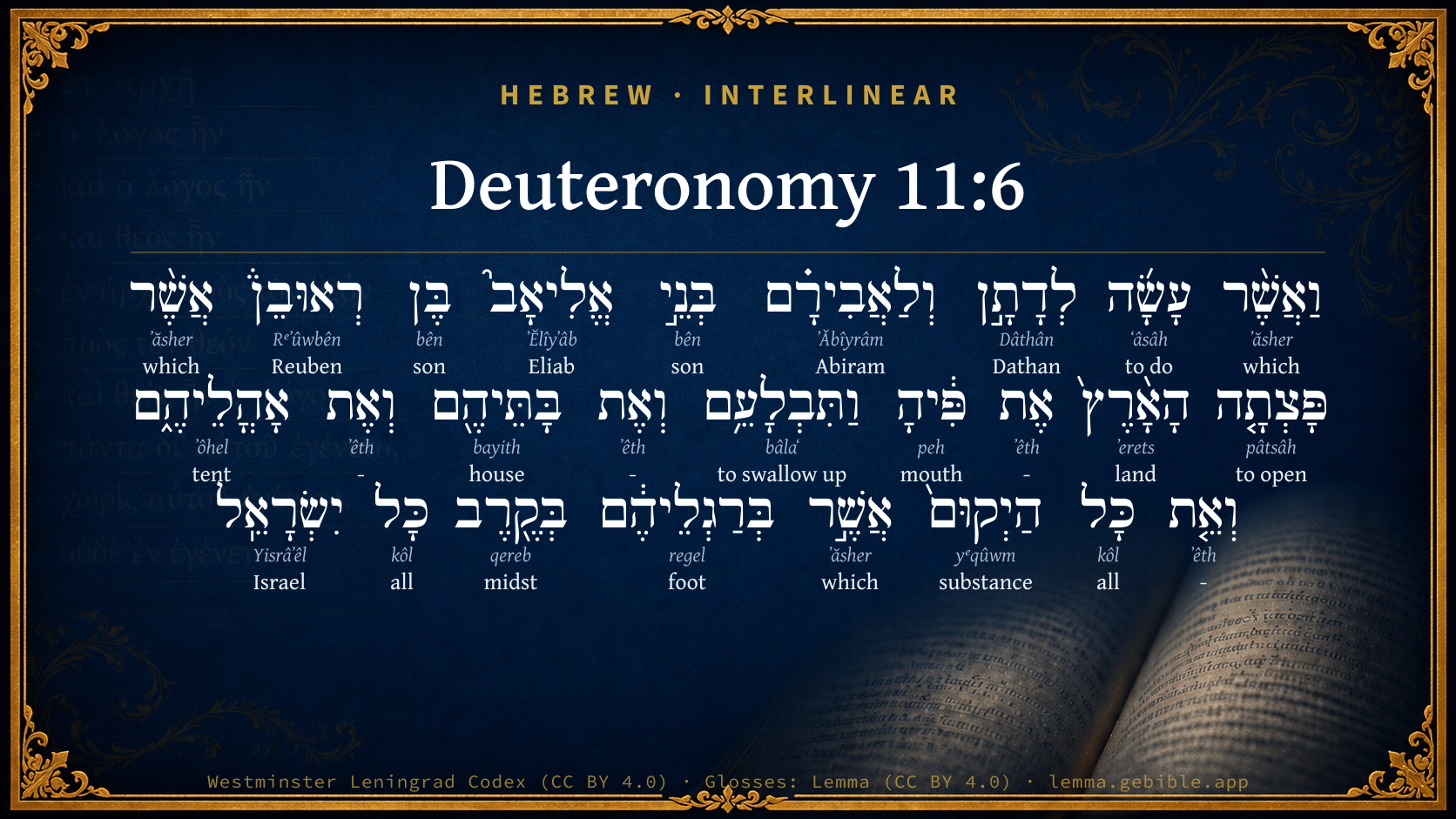
Hebrew (Westminster Leningrad Codex) Deuteronomy 11:6 appears in the Hebrew Old Testament. The text above is from the Westminster Leningrad Codex. Each word links to its Strong’s number, a concise gloss, and parsing drawn from the Open Scriptures Hebrew Bible morphology. Click any word for its full Brown-Driver-Briggs (BDB) entry.
Download image
Cite this verse

Deuteronomy 11:6 (World English Bible). Public Domain. Lemma interlinear Bible study tool, https://lemma.gebible.app/v/deuteronomy/11/6.

Show BibTeX & RIS
BibTeX
RIS
English Translation
and what he did to Dathan and Abiram, the sons of Eliab, the son of Reuben; how the earth opened its mouth, and swallowed them up, and their households, and their tents, and every living thing that followed them, in the midst of all Israel:
World English Bible · Public Domain
Download a study sheet

One document with this verse’s original text, its word-by-word gloss line, the meaning frame, cross-references with their text, attributed commentary, and full source and license credits — printable, and it pastes into notes with its structure intact.

This verse Autodidact and up

Study sheet (.html) Plain text (.txt)

A passage Seminary Student

Up to 50 verses in one chapter. A passage sheet keeps up to 6 commentary sources and 12 cross-references per verse, in the order this page ranks them, and says so on the sheet whenever that leaves anything out. Ask for a single verse and you get the Autodidact verse sheet above.

Everything on this page stays free to read, with no account — the sheet is a download of what is already on screen, not access to it.

Want to remove ads? Support Godless Engineer
Compare translations 3

The same verse in 3 English versions, stacked beneath the original-language interlinear above. Click any original word for its lexicon entry.

Each is an independent rendering of the whole verse — the interlinear is not word-aligned to these translations.

Highlighted words mark where these versions differ — a whole-verse word diff, not a word-by-word alignment.

  • World English Bible Public Domain
    and what he did to Dathan and Abiram, the sons of Eliab, the son of Reuben; how the earth opened its mouth, and swallowed them up, and their households, and their tents, and every living thing that followed them, in the midst of all Israel:
  • King James Version Public Domain
    And what he did unto Dathan and Abiram, the sons of Eliab, the son of Reuben: how the earth opened her mouth, and swallowed them up, and their households, and their tents, and all the substance that was in their possession, in the midst of all Israel:
  • unfoldingWord Literal Text CC BY-SA 4.0
    and what he had done to Dathan and to Abiram, the sons of Eliab, son of Reuben, how the earth opened its mouth and swallowed them up and their houses and their tents and every living thing that in their steps, in the midst of all Israel—

unfoldingWord Literal Text — © unfoldingWord, licensed CC BY-SA 4.0. Word-aligned USFM3 via Door43 (git.door43.org/unfoldingWord/en_ult).

Versions to compare (up to 4)

3 of 4 selected

Show all 18 translations

Every available English version of this verse, each an independent rendering of the whole verse.

  • World English Bible Public Domain
    and what he did to Dathan and Abiram, the sons of Eliab, the son of Reuben; how the earth opened its mouth, and swallowed them up, and their households, and their tents, and every living thing that followed them, in the midst of all Israel:
  • Berean Standard Bible Public Domain
    and what He did in the midst of all the Israelites to Dathan and Abiram, the sons of Eliab the Reubenite, when the earth opened its mouth and swallowed them, their households, their tents, and every living thing that belonged to them.
  • Majority Standard Bible Public Domain
    and what He did in the midst of all the Israelites to Dathan and Abiram, the sons of Eliab the Reubenite, when the earth opened its mouth and swallowed them, their households, their tents, and every living thing that belonged to them.
  • King James Version Public Domain
    And what he did unto Dathan and Abiram, the sons of Eliab, the son of Reuben: how the earth opened her mouth, and swallowed them up, and their households, and their tents, and all the substance that was in their possession, in the midst of all Israel:
  • American Standard Version (1901) Public Domain
    and what he did unto Dathan and Abiram, the sons of Eliab, the son of Reuben; how the earth opened its mouth, and swallowed them up, and their households, and their tents, and every living thing that followed them, in the midst of all Israel:
  • Revised Version (1885) Public Domain
    and what he did unto Dathan and Abiram, the sons of Eliab, the son of Reuben; how the earth opened her mouth, and swallowed them up, and their households, and their tents, and every living thing that followed them, in the midst of all Israel:
  • Geneva Bible (1599) Public Domain
    And what he did vnto Dathan and Abiram the sonnes of Eliab ye sonne of Reuben, when the earth opened her mouth, and swallowed them with their housholds and their tents, and all their substance that they had in the middes of al Israel.
  • Douay-Rheims (1899) Public Domain
    And to Dathan and Abiron the sons of Eliab, who was the son of Ruben: whom the earth, opening her mouth swallowed up with their households and tents, and all their substance, which they had in the midst of Israel.
  • Young's Literal Translation Public Domain
    and that which He hath done to Dathan, and to Abiram, sons of Eliab, sons of Reuben, when the earth hath opened her mouth and swalloweth them, and their houses, and their tents, and all that liveth, which is at their feet, in the midst of all Israel:
  • Literal Standard Version CC BY-SA 4.0
    and that which He has done to Dathan and to Abiram, sons of Eliab, sons of Reuben, when the earth has opened her mouth and swallows them, and their houses, and their tents, and all that lives which is at their feet, in the midst of all Israel—
  • Unlocked Literal Bible CC BY-SA 4.0
    They had not seen what Yahweh had done to Dathan and Abiram, the sons of Eliab son of Reuben, how the earth opened its mouth and swallowed them up, their households, their tents, and every living thing that followed them, in the middle of all Israel.
  • unfoldingWord Literal Text CC BY-SA 4.0
    and what he had done to Dathan and to Abiram, the sons of Eliab, son of Reuben, how the earth opened its mouth and swallowed them up and their houses and their tents and every living thing that in their steps, in the midst of all Israel—
  • Darby Bible Public Domain
    and what he did unto Dathan and Abiram, the sons of Eliab, the son of Reuben, -- how the earth opened its mouth, and swallowed them up, with their households, and their tents, and all the living substance that belonged to them, in the midst of all Israel.
  • World Messianic Bible Public Domain
    and what he did to Dathan and Abiram, the sons of Eliab, the son of Reuben—how the earth opened its mouth and swallowed them up, with their households, their tents, and every living thing that followed them, in the middle of all Israel;
  • Webster's Bible Public Domain
    And what he did to Dathan and Abiram, the sons of Eliab, the son of Reuben: how the earth opened her mouth, and swallowed them up, and their households, and their tents, and all the substance that was in their possession, in the midst of all Israel:
  • Free Bible Version CC BY-SA 4.0
    You saw what he did, right there among you, to Dothan and Abiram, the sons of Eliab of the tribe of Reuben, when the earth split open and swallowed them down—their families, their tents, and all their animals.
  • Bible in Basic English Public Domain
    And what he did to Dathan and Abiram, the sons of Eliab, the son of Reuben; when they went down into the open mouth of the earth, with their families and their tents and every living thing which was theirs, before the eyes of all Israel:
  • JPS Tanakh (1917) Public Domain
    and what He did unto Dathan and Abiram, the sons of Eliab, the son of Reuben; how the earth opened her mouth, and swallowed them up, and their households, and their tents, and every living substance that followed them, in the midst of all Israel;

Literal Standard Version (2020), Covenant Press — licensed CC BY-SA 4.0. Text via the HelloAO Bible API (eBible.org). Unlocked Literal Bible (unfoldingWord) — licensed CC BY-SA 4.0. Text via the HelloAO Bible API (eBible.org). unfoldingWord Literal Text — © unfoldingWord, licensed CC BY-SA 4.0. Word-aligned USFM3 via Door43 (git.door43.org/unfoldingWord/en_ult). Free Bible Version, Dr. Jonathan Gallagher — licensed CC BY-SA 4.0. Text via the HelloAO Bible API (eBible.org).

Word by word

More ways to search: Search by grammar → Find every occurrence → Compare this word →

Practice this passage: Drill this verse → Learn its vocabulary →

הַיְקוּם֙
yᵉqûwm
H3351
“the · substance”
Particle, Definite Article + Noun, Common, Masculine, Singular, Absolute
Part of Speech
Particle + Noun
Type
Common
Gender
Masculine
Number
Singular
State
Absolute
Full BDB Definition

Origin: from H6965

TWOT: 1999f

living substance, that which stands or exists, existence, substance
  1. וַאֲשֶׁ֨ר ʼăsher H834 “and · which” Conjunction + Particle, Relative
  2. עָשָׂ֜ה ʻâsâh H6213 “to do” Verb, Qal, Perfect, 3rd Person, Masculine, Singular
  3. לְדָתָ֣ן Dâthân H1885 “to/for · Dathan” Preposition + Noun, Proper
  4. וְלַאֲבִירָ֗ם ʼĂbîyrâm H48 “and · to/for · Abiram” Conjunction + Preposition + Noun, Proper
  5. בְּנֵ֣י bên H1121 “sons of” Noun, Common, Masculine, Plural, Construct
  6. אֱלִיאָב֮ ʼĔlîyʼâb H446 “Eliab” Noun, Proper
  7. בֶּן bên H1121 “son of” Noun, Common, Masculine, Singular, Construct
  8. רְאוּבֵן֒ Rᵉʼûwbên H7205 “Reuben” Noun, Proper
  9. אֲשֶׁ֨ר ʼăsher H834 “which” Particle, Relative
  10. פָּצְתָ֤ה pâtsâh H6475 “to open” Verb, Qal, Perfect, 3rd Person, Feminine, Singular
  11. הָאָ֨רֶץ֙ ʼerets H776 “the · land” Particle, Definite Article + Noun, Common, Both, Singular, Absolute
  12. אֶת ʼêth H853 “-” Particle, Direct Object
  13. פִּ֔יהָ peh H6310 “mouth · her” Noun, Common, Masculine, Singular, Construct + Suffix, Personal, 3rd Person, Feminine, Singular
  14. וַתִּבְלָעֵ֥ם bâlaʻ H1104 “and · to swallow up · them” Conjunction + Verb, Qal, Sequential Imperfect, 3rd Person, Feminine, Singular + Suffix, Personal, 3rd Person, Masculine, Plural
  15. וְאֶת ʼêth H853 “and · -” Conjunction + Particle, Direct Object
  16. בָּתֵּיהֶ֖ם bayith H1004 “houses · their” Noun, Common, Masculine, Plural, Construct + Suffix, Personal, 3rd Person, Masculine, Plural
  17. וְאֶת ʼêth H853 “and · -” Conjunction + Particle, Direct Object
  18. אָהֳלֵיהֶ֑ם ʼôhel H168 “tents · their” Noun, Common, Masculine, Plural, Construct + Suffix, Personal, 3rd Person, Masculine, Plural
  19. וְאֵ֤ת ʼêth H853 “and · -” Conjunction + Particle, Direct Object
  20. כָּל kôl H3605 “all of” Noun, Common, Masculine, Singular, Construct
  21. אֲשֶׁ֣ר ʼăsher H834 “which” Particle, Relative
  22. בְּרַגְלֵיהֶ֔ם regel H7272 “in/at · feet · their” Preposition + Noun, Common, Feminine, Dual, Construct + Suffix, Personal, 3rd Person, Masculine, Plural
  23. בְּקֶ֖רֶב qereb H7130 “in/at · midst of” Preposition + Noun, Common, Masculine, Singular, Construct
  24. כָּל kôl H3605 “all of” Noun, Common, Masculine, Singular, Construct
  25. יִשְׂרָאֵֽל Yisrâʼêl H3478 “Israel” Noun, Proper

About this verse

These counts appear in no published source. They are computed here, from the morphology-tagged text and Lemma’s own curated glosses. What Lemma adds →

26
words
19
distinct lemmas
Pentateuch
section

Notable vocabulary

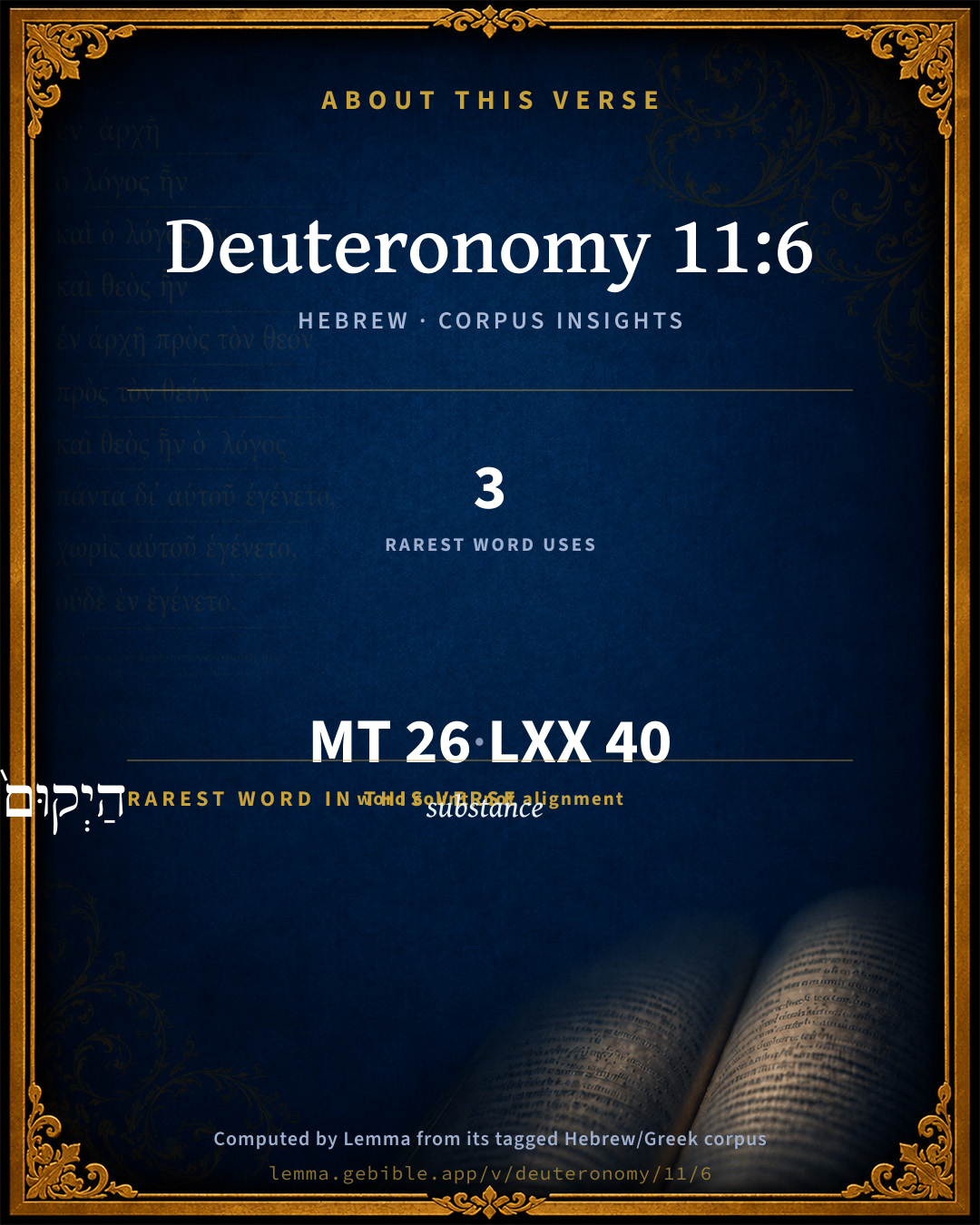
The rarest word here is הַיְקוּם֙ substance H3351 — appearing just 3 times in the whole Hebrew Bible.

Shared distinctive vocabulary

הַיְקוּם֙ substance H3351 occurs in 3 verses of the Hebrew Bible. Also found in:

Grammatical profile

  • 3 verbs
  • 16 nouns
  • 7 particles

Verb forms

  • עָשָׂ֜ה Qal · Perfect
  • פָּצְתָ֤ה Qal · Perfect
  • וַתִּבְלָעֵ֥ם Qal · Sequential Imperfect

Repetition

Words recur within this verse — often emphatic in Hebrew:

  • בְּנֵ֣י son H1121 ×2
  • כָּל all H3605 ×2
  • וַאֲשֶׁ֨ר which H834 ×3

Hebrew & Septuagint length

In English translation the verse runs 45 words from the Hebrew and 47 from the Septuagint (LXX English) — closely comparable.

A rough comparison of the two English renderings, which tokenize alike — not a word-level alignment.

Word counts can differ between the Hebrew and the Greek without any difference in meaning — e.g. the Hebrew direct-object marker אֵת has no separate Greek word, and Greek often adds the article ὁ.

In the original languages it is 26 Hebrew tokens and 40 Greek tokens — but the two are counted differently (Hebrew bundles its prefixes and suffixes into one token; the Greek is in lemma form), so that isn’t a like-for-like length.

Cross-references

4

Topical passages linked to Deuteronomy 11:6 in the Treasury of Scripture Knowledge — connected by theme and wording, ordered by reader-vote popularity; previews shown in the World English Bible.

  • Numbers 26:9–10 The sons of Eliab: Nemuel, and Dathan, and Abiram. These are that Dathan and Abiram, who were called of the congregation, who strove against Moses and against Aaron in the company of Korah, when they strove against Yahweh,
  • Psalms 106:17 The earth opened and swallowed up Dathan, And covered the company of Abiram.
  • Numbers 16:1–35 Now Korah, the son of Izhar, the son of Kohath, the son of Levi, with Dathan and Abiram, the sons of Eliab, and On, the son of Peleth, sons of Reuben, took [men]:
  • Numbers 27:3 Our father died in the wilderness, and he was not among the company of those who gathered themselves together against Yahweh in the company of Korah: but he died in his own sin; and he had no sons.

Cross-references courtesy of OpenBible.info (CC BY 4.0).

Hebrew and Greek witnesses Masoretic Hebrew ↔ Greek Septuagint

The same verse in the two great witnesses to the Old Testament, shown verse-for-verse.

These are two independent witnesses, not word-aligned to each other, and the Septuagint is shown in lemma (dictionary) form.

Hebrew Deuteronomy 11:6 Masoretic · Westminster Leningrad Codex

וַאֲשֶׁ֨ר עָשָׂ֜ה לְדָתָ֣ן וְלַאֲבִירָ֗ם בְּנֵ֣י אֱלִיאָב֮ בֶּן רְאוּבֵן֒ אֲשֶׁ֨ר פָּצְתָ֤ה הָאָ֨רֶץ֙ אֶת פִּ֔יהָ וַתִּבְלָעֵ֥ם וְאֶת בָּתֵּיהֶ֖ם וְאֶת אָהֳלֵיהֶ֑ם וְאֵ֤ת כָּל הַיְקוּם֙ אֲשֶׁ֣ר בְּרַגְלֵיהֶ֔ם בְּקֶ֖רֶב כָּל יִשְׂרָאֵֽל

and what he did to Dathan and Abiram, the sons of Eliab, the son of Reuben; how the earth opened its mouth, and swallowed them up, and their households, and their tents, and every living thing that followed them, in the midst of all Israel:

World English Bible · Public Domain

Greek LXX Deuteronomy 11:6 Septuagint · lemma form

καί ὅσος ποιέω ὁ δαθαν καί αβιρων υἱός ελιαβ υἱός ρουβην ὅς ἀναοἴγω ὁ γῆ ὁ στόμα αὐτός καταπίνω αὐτός καί ὁ οἶκος αὐτός καί ὁ σκηνή αὐτός καί πᾶς αὐτός ὁ ὑπόστασις ὁ μετά αὐτός ἐν μέσος πᾶς ἰσραήλ

and all the things that he did to Dathan and Abiron the sons of Eliab the son of Ruben, whom the earth opening her mouth swallowed up, and their houses, and their tents, and all their substance that was with them, in the midst of all Israel:

LXX2012 (modern English Septuagint) · Public Domain

Hebrew: Westminster Leningrad Codex (CC BY 4.0). Greek: Septuagint (public domain); English from LXX2012 (modern English Septuagint) (Public Domain). How the Septuagint differs from the Hebrew →

Targum (Aramaic paraphrase)

2

The Targum is the ancient Jewish Aramaic paraphrase of the Hebrew Scriptures — an interpretive translation, not the Hebrew text itself. Onkelos (literal) and Pseudo-Jonathan (expansive) render the Torah, and Jonathan the Prophets. Coverage is partial: where no permissively-licensed English translation exists for a verse, only the Aramaic is shown. This is verse-level text, not a word-by-word alignment to the Hebrew.

  1. Targum Onkelos Torah (Genesis–Deuteronomy)
    וְדִי עֲבַד לְדָתָן וְלַאֲבִירָם בְּנֵי אֱלִיאָב בַּר רְאוּבֵן דִי פְתָחַת אַרְעָא יָת פּוּמַהּ וּבְלָעָתְנוּן וְיָת אֱנַשׁ בָּתֵּיהוֹן וְיָת מַשְׁכְּנֵיהוֹן וְיָת כָּל יְקוּמָא דִי עִמְהוֹן בְּגוֹ כָּל יִשְׂרָאֵל

    (no public-domain English translation for this verse)

    Targum Onkelos — Aramaic: “Onkelos Genesis” (public domain); “Onkelos Exodus” (public domain); “Onkelos Leviticus” (public domain); “Onkelos Numbers” (public domain); “Onkelos Deuteronomy” (public domain). English: “Sefaria Community Translation” (CC0 1.0 (public-domain dedication)); “J.W. Etheridge. The Targums of Onkelos and Jonathan Ben Uzziel on the Pentateuch. London: Longmans, Green, 1862” (public domain). Text via Sefaria.

  2. Targum Pseudo-Jonathan Torah (Genesis–Deuteronomy)
    וּדְעָבַד לְדָתָן וְלַאֲבִירָם בְּנֵי אֱלִיאָב בַּר רְאוּבֵן דִּפְתָחַת אַרְעָא יַת פּוּמָהּ וּבְלָעַתְנוּן וְיַת אֵינַשׁ בָּתֵּיהוֹן וְיַת כָּל טַרְיָיתָא דַּהֲווֹ עִמְהוֹן בְּגוֹ כָּל יִשְרָאֵל

    and what He did unto Dathan and Abiram the sons of Eliab bar Reuben, when the earth opened her mouth and swallowed them up with the men of their house, and all their substance, in the midst of all Israel:

    Targum Pseudo-Jonathan — Aramaic: “Targum Jonathan on Genesis” (public domain); “Targum Jonathan on Exodus” (public domain); “Targum Jonathan on Leviticus” (public domain); “Targum Jonathan on Numbers” (public domain); “Targum Jonathan on Deuteronomy” (public domain). English: “The Targum of Jonathan ben Uzziel, trans. J. W. Etheridge, London, 1862” (public domain). Text via Sefaria.

Commentary

Notes on Deuteronomy 11:6 from classic Christian and Jewish commentators (each source and its license shown beneath its notes). The classic Christian expositions comment on the surrounding passage and are grouped to its opening verse, so a note may address several verses; the Jewish commentaries on the Tanakh (Rashi and others) are per-verse, so they appear only where the commentator wrote on this verse.

Lemma curates 59 commentaries, every one of them public domain or Creative Commons licensed, each selected and text-cleaned for this edition rather than reprinted as found. About our sources →

Trapp's Complete Commentary

John Trapp

Deu 11:6 And what he did unto Dathan and Abiram, the sons of Eliab, the son of Reuben: how the earth opened her mouth, and swallowed them up, and their households, and their tents, and all the substance that [was] in their possession, in the midst of all Israel:

Ver. 6. Dathan and Abiram.] Who were Reubenites; and therefore discontented, say the Jewish doctors, because the birthright was taken from Reuben, for his incest, and given to Judah and Joseph. Korah is here, though not mentioned yet, neither excluded nor excused.

John Trapp, A Commentary or Exposition upon All the Books of the Old and New Testament (1647–1656) — public domain. Text from a community e-Sword module.

The Biblical Illustrator

Joseph S. Exell

Deu_11:6

And what He did unto Dathan and Abiram.

The spirit of revolution

Moses recalls the revolt against his authority in the wilderness. It took place in conjunction with the revolt of Korah (Num_17:1-13). The point which Moses emphasises is the revolt against Divinely constituted authority, and the result thereof. At the head of the civil rebellion were the sons of Reuben, Dathan and Abiram. As descendants of the first-born of Israel they grudged Moses his lofty position. They allied themselves with the Levitical revolt, and under the cloak of asserting the universal priesthood of the people (Num_16:3) led many to follow them into the vortex of revolution. This insurrection against the Divinely ordered religious and political order threatened the very existence of Israel. God therefore visited the rebels with special Divine judgment, and the nation was saved. This episode in Israels history gives us a glimpse of the motives which underlie most revolutionary movements. In these--

I. Vice decks herself in the appearance of virtue.

1. The revolutionaries profess ardent desires for the commonweal, for freedom--to save the enslaved community, etc. Liberty, equality, etc., is their cry, war against tyranny and oppression. They seek to play the role of unselfish friends of the people.

2. But in their depths such movements are mostly dominated by selfishness. In the revolt here referred to Korah was simply an ambitious Levite, hypocritical and selfish. The Reubenites were moved by tribal ambition. Selfishness, ambition, special interests were the moving springs of this as of other revolutions.

3. The revolution of Dathan and Abiram took its rise first on an ecclesiastical ground; but the political movement was not far behind the ecclesiastical. Men with widely differing opinions joined in opposing constituted authority. The cry for illumination is speedily followed by that for so-called freedom.

4. Revolution is not accompanied by penitence. It never seeks the ground of its complaints in the faults of the people themselves.

5. Most revolutions are dominated by some phrase or party cry. Here it was: All the people are holy. The power of the partial truth in it lay in Gods Word: Ye shall be to Me . . . an holy nation. But God had appointed leaders in Church and State, therefore it was against His authority Dathan and Abiram rebelled.

II. The prophetic significance of this typical event.

1. The deepest fulfilment lies in the future--in the days of antichrist. Then the political and ecclesiastical order will be overturned--when antichrist comes offering promise of deliverance from all ecclesiastical and political ills.

2. But the punishment meted out to Dathan and Abiram with their fellow rebels shall fall more fiercely on antichrist (Rev_19:20).

3. A veil, however, overhangs this future. Still there are experiences in history which prepare us to understand what shall be. The French Revolution is a striking example. It was not merely a revolt of ruled against rulers. It was first a spiritual revolution. Scepticism had loosened religious authority, and the political crisis speedily followed, as in the rebellion of Korah. So in France ambitious leaders shrieked of liberty, etc. The whole foundations of order were overturned. Then from the Revolution rose one who had no law but his own will. He trod men under his feet; for twenty-five years the storm raged. Here was a faint experience of what will be in the times of antichrist. A respite has been given; but he who has eyes may conceive somewhat of the trend of that great future revolt.

III. What shall we do in view of what is coming?

1. Let us ask, guided by Gods Word, what revolts in Church and State will lead to. What is the meaning of much of so-called progress and freedom? If the Son shall make you free, etc. (Joh_8:36). What is culture if not found in Christs Gospel?--this is the only culture of eternal worth. Modern progress does not always mean progress in righteousness.

2. Do not let the hollow phrases of the modern age influence us. In Gods Word the madness of rebellion, its falseness and hypocrisy are seen, and its terrible end. The way of righteousness is conformity to the Divine order. The sin of participation in rebellion must be shunned. Those who stand on the side of revolution, of the antichristian age, or (in the future) of antichrist, lay themselves open to the punishment of the rebellious Reubenites. (W. Grashoff.)

The Biblical Illustrator, edited by Joseph S. Exell (c. 1880s–1900s) — public domain. Text from a community e-Sword module.

Tyndale Open Study Notes

Tyndale Open Resources

11:6 Dathan and Abiram: See Num 16:1-40. In the Lord’s administration of his kingdom, he established levels of authority and command that were not to be transgressed. Because the Lord had appointed Moses and Aaron as leaders, the rebellion of Dathan and Abiram against Moses was the same as rebellion against God’s sovereign rule.

Tyndale Open Study Notes — © Tyndale Open Resources, licensed CC BY-SA 4.0. Text via the HelloAO Bible API.

Geneva Bible (1599)

Geneva Bible translators

Hebrew, was at their feet.

Geneva Bible (1599) marginal notes — public domain. Text via Bolls.life.

Adam Clarke's Commentary

Verse 6. What he did unto Dathan, &c.] See the notes on Nu 16:24-33.

Adam Clarke's Commentary on the Bible (1810–1826) — public domain. Text from a community e-Sword/MySword module.

Ellicott's Commentary for English Readers

(6) What he did unto Dathan and Abiram. . . .—See Numbers 16. It is impossible to separate the rebellion of Korah from that of Dathan and Abiram, and seeing that the whole point of Korah’s rebellion was the priesthood, it is difficult to see how the writer of Deuteronomy could be ignorant of any priesthood save that of the whole tribe of Levi. The object of Koran’s rebellion was to abolish the distinction between a Kohathite and a priest,

A Bible Commentary for English Readers, edited by Charles John Ellicott (1878–1897) — public domain. Text from a community e-Sword module.

The Cambridge Bible for Schools and Colleges

gen. ed. J. J. S. Perowne

6. what he did unto Dathan and Abiram] The severity of God’s discipline was not only shown to Israel’s enemies, but in the midst of all Israel to rebellious Israelites. Without such a recollection, the description of that discipline, especially in view of the alarm it was fitted to inspire, would not be complete. This answers Steuern.’s argument that the verse is secondary, on the grounds that there was no reason to mention specially this one out of all the divine punishments inflicted on Israel, and that with the phrase in the midst of all Israel the people are not directly addressed, and that the form of the discourse is thus broken. On the contrary, as shown above, the phrase suits the speaker’s purpose, cp. Deu_17:4; Deu_17:7, Deu_23:16 (17). The event is described in Numbers 16, a passage compounded of JE and P (see Numbers in this series). This verse partly repeats the phraseology of JE, with some variations (e.g. a different verb for opened), cp. Num_16:1 b, Num_16:26-27 b (tents), Num_16:30 (all that appertained unto them), Num_16:32 a. And, like JE, D mentions Dathan and Abiram alone as the victims of the judgement. Instead of them P mentions Korah. This is another illustration of the consistency with which D follows JE, and was either ignorant of, or deliberately ignored P. It is interesting that Sam. adds to D’s statement ‘and all the men belonging to Korah.’

The Cambridge Bible for Schools and Colleges (gen. ed. J. J. S. Perowne; Cambridge University Press, 1878–1918) — public domain. Text from a community e-Sword module.

John Gill's Exposition

But your eyes have seen all the great acts of the Lord which he did; Even all before related, with many others; and therefore the instruction they should learn from thence should be as follows.

But your eyes have seen all the great acts of the Lord which he did; Even all before related, with many others; and therefore the instruction they should learn from thence should be as follows.

Deuteronomy 11:8

deu 11:8

deu 11:8

deu 11:8Therefore shall you keep all the commandments which I command you this day,.... For the reasons before suggested, as well as for what follow:

that ye may be strong; healthful in body, and courageous in mind, for sin tends to weaken both; whereas observance of the commands of God contributes to the health and strength of the body, and the rigour of the mind; both which were necessary to the present expedition they were going upon:

and go in and possess the land whither ye go to possess it; the land of Canaan, they were marching towards in order to possess it; and nothing would more inspire them with courage, and cause them to enter it manfully without fear of their enemies, than obedience to the commands of God; whose presence being promised them on that account, they might expect it, and so had nothing to fear from the inhabitants of the land.

John Gill's Exposition of the Whole Bible (1746–1763) — public domain (CC PDM 1.0). Text via the HelloAO Bible API.

Albert Barnes' Notes on the Bible

See the margin. literally, “every living thing at their feet.” The expression does not mean their goods, which would be included in their “households and tents,” but their followers Num 16:32.

Albert Barnes' Notes on the Bible (1834–1885) — public domain. Text from a community e-Sword/MySword module.

Matthew Poole's English Annotations

In their possession, Heb. at their feet, i.e. under their power, Psa 8:6, which followed them, or belonged to them.

Matthew Poole's English Annotations on the Holy Bible (1683–1685) — public domain. Text from a community e-Sword/MySword module.

Whedon's Commentary on the Bible

Daniel D. Whedon

6. What he did unto Dathan and Abiram — Korah is not here mentioned, though in Numbers xvi the destruction of Korah and his company is recorded as well as that of Dathan and Abiram. Keil suggests that Korah is omitted out of regard to the feelings of his kindred who were then living. Another suggestion to account for the omission is that the rebellion was sufficiently characterized by the two names Dathan and Abiram. There is the same omission of Korah in Psa_106:17 : “The earth opened and swallowed up Dathan, and covered the company of Abiram.” Moses is not giving a full history of the misdeeds of the people. Nor does he mention all the rebellions. He is not writing as an annalist, he is talking as a prophet, and he introduces the historical incidents to add force to his admonitions.

The substance… in their possession — Literally, the living thing which was at their feet. Undoubtedly it means all their servants. In Num_16:32, all the men that belonged to Korah is the correct rendering of the Hebrew expression, and is analogous to this.

Daniel D. Whedon (gen. ed.), Commentary on the Old and New Testaments (1874–1909) — public domain. Text from a community e-Sword module.

The Pulpit Commentary

All the substance that was in their possession; literally, every living thing (Gen_7:4, Gen_7:23) that was at their feet, i.e. all their followers. (cf. "all the people that follow, thee," Exo_11:8; "all the men that appertained unto Korah,". Num_16:32)

The Pulpit Commentary (1880–1919), ed. H.D.M. Spence-Jones & Joseph S. Exell — public domain. Text from a community e-Sword module.

unfoldingWord translationNotes

Door43 World Missions Community

General Information:

Moses continues to remind the adults to teach their children God's mighty deeds.

Dathan and Abiram, the sons of Eliab

Moses is referring to an event in the past when Dathan and Abiram rebelled against Moses and Aaron. The full meaning of this statement can be made explicit. (See: Assumed Knowledge and Implicit Information)

Dathan ... Abiram ... Eliab

These are names of men. (See: How to Translate Names)

son of Reuben

"descendant of Reuben"

earth opened its mouth and swallowed them up

Yahweh causing the land to split open so that the people fell in is spoken of as if the land had a mouth and the ability to swallow people. (See: Personification)

every living thing that followed them

This refers to their servants and animals.

in the middle of all Israel

This means all the people of Israel witnessed what happened to Dathan, Abiram, their families, and their possessions.

But your eyes have seen

Here "eyes" represents the whole person. AT: "But you have seen" (See: Synecdoche)

translationWords

Yahweh

Reuben

earth

household

tent

life

Israel

unfoldingWord translationNotes — © Distant Shores Media and the Door43 World Missions Community, licensed CC BY-SA 4.0. Source: git.door43.org/Door43/en_tn.

Rashi

Rabbi Shlomo Yitzchaki (Rashi)

בקרב כל ישראל [AND THE EARTH SWALLOWED THEM UP] IN THE MIDST OF ALL ISRAEL — Wherever one of them fled the earth was riven beneath him and swallowed him up. This is the view of R. Judah. Rabbi Nehemiah said to him: But is it not already stated, (Numbers 16:32) “And the earth opened its mouth”, and it does not state “its mouths”? Whereupon he (R. Judah) asked him: “But how, then, can I explain the words: “in the midst of all Israel” (if there was but one spot at which they were swallowed up, as you suggest Scripture states by the word פיה, “its mouth”)? He replied to him: you can reconcile the two texts by assuming that the earth became a declivity, — something like a funnel, — and wherever it was that one of them happened to be, he rolled down until he reached the place where the fissure was (cf. Yalkut Shimoni on Torah 752).

ואת כל היקום אשר ברגליהם AND ALL THE SUBSTANCE THAT WAS AT THEIR FEET — This means a man’s money, that places him on his feet (Sanhedrin 110a).

Rashi on the Tanakh — English translations: “The Judaica Press complete Tanach with Rashi, translated by A. J. Rosenberg” (CC BY 4.0); “Pentateuch with Rashi's commentary by M. Rosenbaum and A.M. Silbermann, 1929-1934” (public domain); “The Metsudah Tanach series, Lakewood, N.J” (CC BY 4.0); and “The Book of Joshua, Metsudah Publications, 1997” (CC BY 4.0). Text via Sefaria.

Ramban (Nachmanides)

Rabbi Moshe ben Nachman (Ramban / Nachmanides)

He mentions and what He did unto Dathan and A biram, but did not mention of Korach and his company that a fire came forth from before the Eternal and consumed them, because it is a prohibition of the Torah for a stranger [non-priest] to approach [the Sanctuary] to burn incense, such a transgressor being punished in all future generations, as happened also to King Uzziah; therefore he did not enumerate it among the signs in the wilderness.

Ramban (Nachmanides) on the Tanakh — English translation: “Commentary on the Torah by Ramban (Nachmanides). Translated and annotated by Charles B. Chavel. New York, Shilo Pub. House, 1971-1976” (CC BY 4.0). Text via Sefaria.

Lesson kit

Teaching starters — assembled from the data on this page, not authored interpretation. Every prompt links to the verse data it draws on. Edit before teaching.

Deuteronomy, in the Pentateuch, opens this verse with 26 words (19 distinct Hebrew lemmas). Its most distinctive word is yᵉqûwm (“substance”). A historical commentator’s framing appears above. Read the whole chapter for the surrounding context.

Discussion questions

  1. The word yᵉqûwm carries the sense “substance.” How does it shape the verse?
  2. How does Genesis 7:4, which shares the word «substance», read alongside this verse?
  3. What does the repetition of “son” (2× in this one verse) do in this verse?
  4. These translations render this verse differently. What is at stake in choosing one wording over another?
  5. «עָשָׂ֜ה» is a Qal Perfect verb. How does that grammatical form shape the action described?
  6. Compare how Trapp's Complete Commentary and The Biblical Illustrator read this verse. Where do they agree or differ?

Things to notice

Reading settings

Reading text

Shown beneath each verse's original-language words.

Old Testament
Old Testament edition

Read the OT as the Masoretic Hebrew (MT) or the Greek Septuagint (LXX).

English shown for the Greek Septuagint (in the Hebrew ↔ Greek comparison).

Comparing translations? Open the Compare panel on any verse page to stack up to four side by side.