
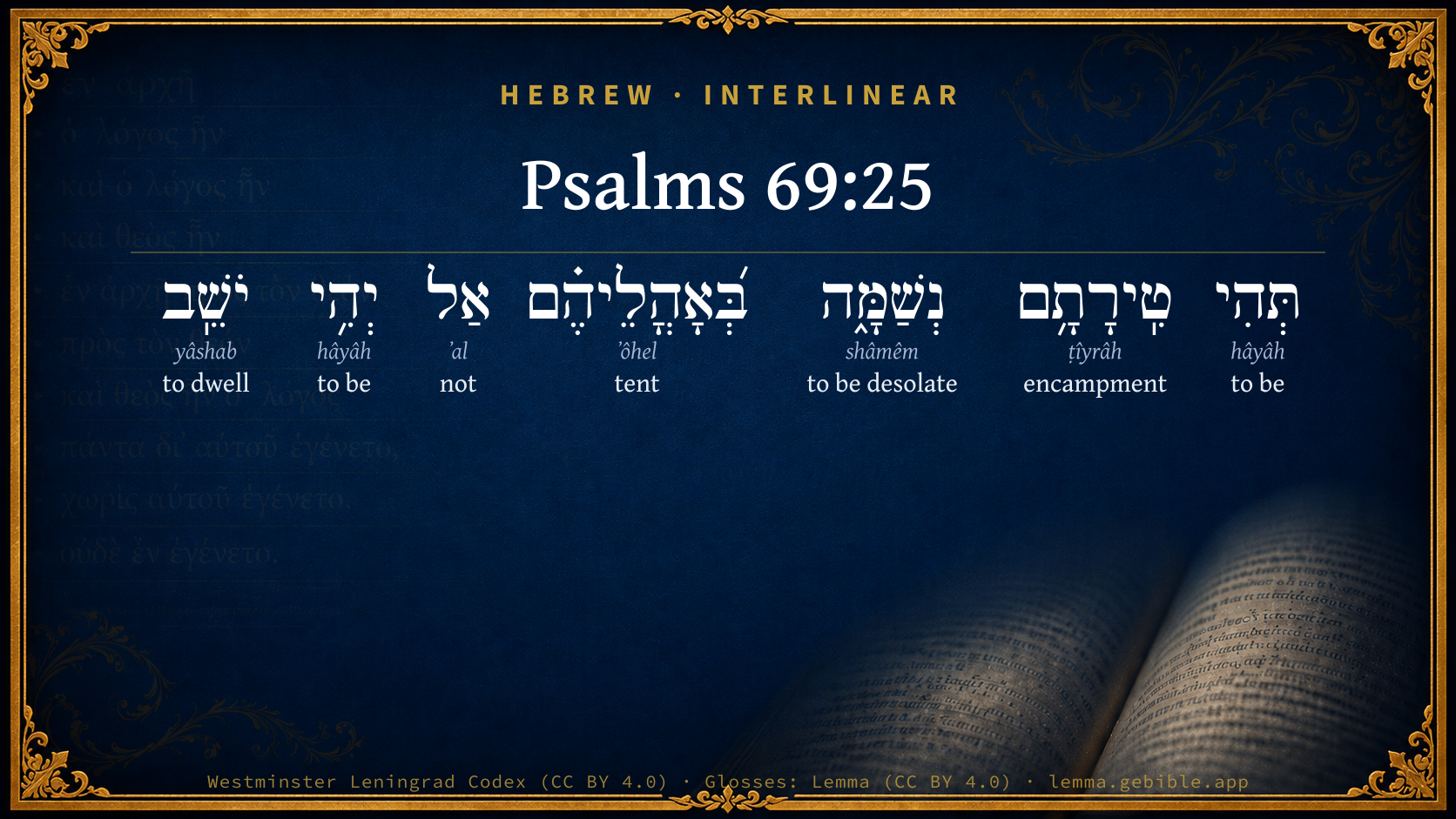
Psalms 69:25

Hebrew (Westminster Leningrad Codex) Psalms 69:25 appears in the Hebrew Old Testament. The text above is from the Westminster Leningrad Codex. Each word links to its Strong’s number, a concise gloss, and parsing drawn from the Open Scriptures Hebrew Bible morphology. Click any word for its full Brown-Driver-Briggs (BDB) entry.
Download image
Cite this verse

Psalms 69:25 (World English Bible). Public Domain. Lemma interlinear Bible study tool, https://lemma.gebible.app/v/psalms/69/25.

Show BibTeX & RIS
BibTeX
RIS
English Translation
Let their habitation be desolate. Let no one dwell in their tents.
World English Bible · Public Domain
Download a study sheet

One document with this verse’s original text, its word-by-word gloss line, the meaning frame, cross-references with their text, attributed commentary, and full source and license credits — printable, and it pastes into notes with its structure intact.

This verse Autodidact and up

Study sheet (.html) Plain text (.txt)

A passage Seminary Student

Up to 50 verses in one chapter. A passage sheet keeps up to 6 commentary sources and 12 cross-references per verse, in the order this page ranks them, and says so on the sheet whenever that leaves anything out. Ask for a single verse and you get the Autodidact verse sheet above.

Everything on this page stays free to read, with no account — the sheet is a download of what is already on screen, not access to it.

Want to remove ads? Support Godless Engineer
Compare translations 3

The same verse in 3 English versions, stacked beneath the original-language interlinear above. Click any original word for its lexicon entry.

Each is an independent rendering of the whole verse — the interlinear is not word-aligned to these translations.

Highlighted words mark where these versions differ — a whole-verse word diff, not a word-by-word alignment.

  • World English Bible Public Domain
    Let their habitation be desolate. Let no one dwell in their tents.
  • King James Version Public Domain
    Let their habitation be desolate; and let none dwell in their tents.
  • unfoldingWord Literal Text CC BY-SA 4.0
    Let their encampment be deserted; let there not be a dweller in their tents.

unfoldingWord Literal Text — © unfoldingWord, licensed CC BY-SA 4.0. Word-aligned USFM3 via Door43 (git.door43.org/unfoldingWord/en_ult).

Versions to compare (up to 4)

3 of 4 selected

Show all 18 translations

Every available English version of this verse, each an independent rendering of the whole verse.

  • World English Bible Public Domain
    Let their habitation be desolate. Let no one dwell in their tents.
  • Berean Standard Bible Public Domain
    May their place be deserted; let there be no one to dwell in their tents.
  • Majority Standard Bible Public Domain
    May their place be deserted; let there be no one to dwell in their tents.
  • King James Version Public Domain
    Let their habitation be desolate; and let none dwell in their tents.
  • American Standard Version (1901) Public Domain
    Let their habitation be desolate; Let none dwell in their tents.
  • Revised Version (1885) Public Domain
    Let their habitation be desolate; let none dwell in their tents.
  • Geneva Bible (1599) Public Domain
    Let their habitation be voide, and let none dwell in their tents.
  • Douay-Rheims (1899) Public Domain
    Pour out thy indignation upon them: and let thy wrathful anger take hold of them.
  • Young's Literal Translation Public Domain
    Their tower is desolated, In their tents there is no dweller.
  • Literal Standard Version CC BY-SA 4.0
    Their tower is desolated, || There is no dweller in their tents.
  • Unlocked Literal Bible CC BY-SA 4.0
    Let their place be a desolation; let no one live in their tents.
  • unfoldingWord Literal Text CC BY-SA 4.0
    Let their encampment be deserted; let there not be a dweller in their tents.
  • Darby Bible Public Domain
    Let their habitation be desolate; let there be no dweller in their tents.
  • World Messianic Bible Public Domain
    Let their habitation be desolate. Let no one dwell in their tents.
  • Webster's Bible Public Domain
    \\69:24\\Pour out thy indignation upon them, and let thy wrathful anger take hold of them.
  • Free Bible Version CC BY-SA 4.0
    Let the places where they live be deserted. Let their homes be abandoned.
  • Bible in Basic English Public Domain
    Give their houses to destruction, and let there be no one in their tents.
  • JPS Tanakh (1917) Public Domain
    (69-26) Let their encampment be desolate; let none dwell in their tents.

Literal Standard Version (2020), Covenant Press — licensed CC BY-SA 4.0. Text via the HelloAO Bible API (eBible.org). Unlocked Literal Bible (unfoldingWord) — licensed CC BY-SA 4.0. Text via the HelloAO Bible API (eBible.org). unfoldingWord Literal Text — © unfoldingWord, licensed CC BY-SA 4.0. Word-aligned USFM3 via Door43 (git.door43.org/unfoldingWord/en_ult). Free Bible Version, Dr. Jonathan Gallagher — licensed CC BY-SA 4.0. Text via the HelloAO Bible API (eBible.org).

Word by word

More ways to search: Search by grammar → Find every occurrence → Compare this word →

Practice this passage: Drill this verse → Learn its vocabulary →

About this verse

These counts appear in no published source. They are computed here, from the morphology-tagged text and Lemma’s own curated glosses. What Lemma adds →

7
words
6
distinct lemmas
Wisdom
section

Notable vocabulary

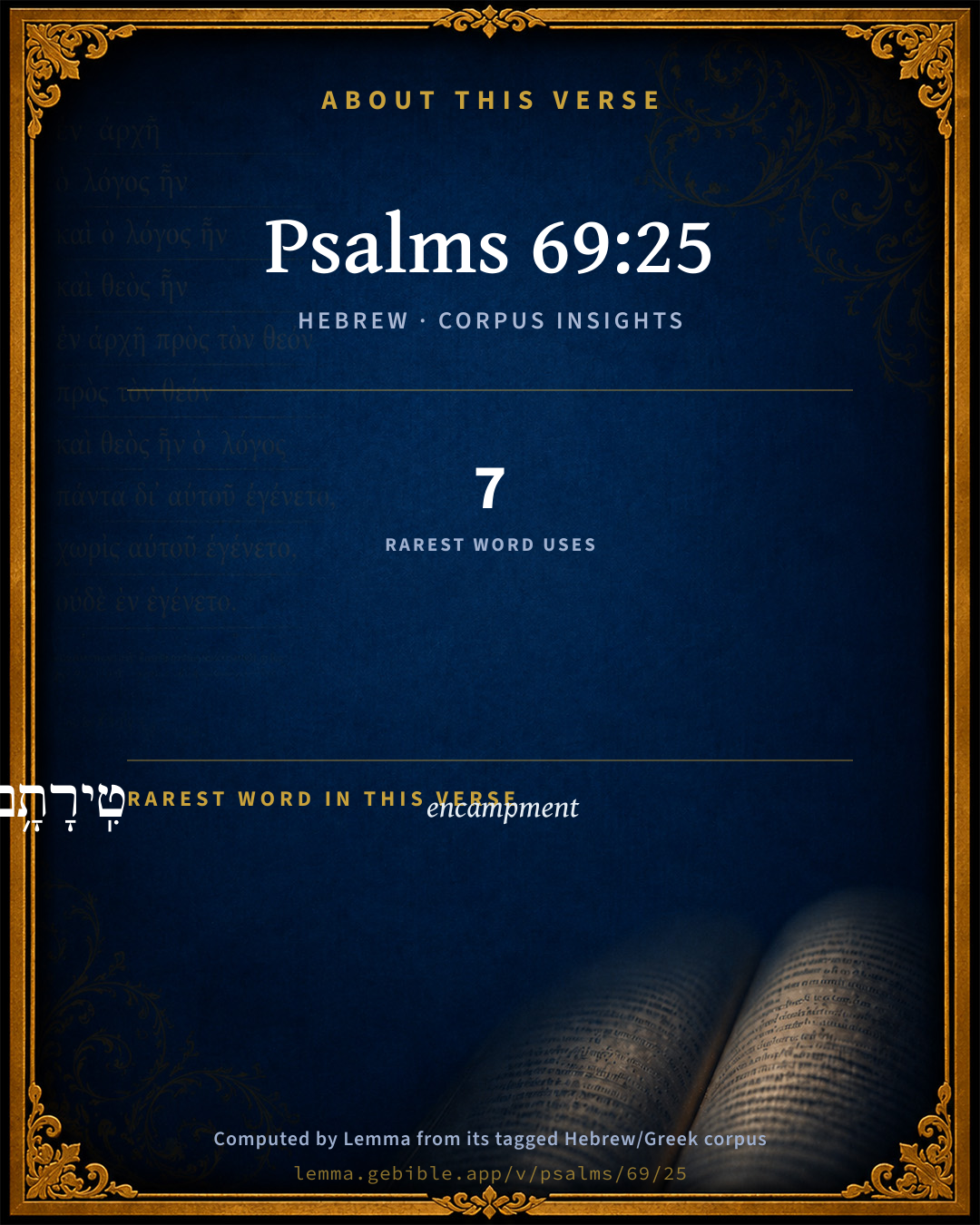
The rarest word here is טִֽירָתָ֥ם encampment H2918 — appearing just 7 times in the whole Hebrew Bible.

Shared distinctive vocabulary

טִֽירָתָ֥ם encampment H2918 occurs in 7 verses of the Hebrew Bible. Also found in:

Grammatical profile

  • 4 verbs
  • 2 nouns
  • 1 particle

Verb forms

  • תְּהִי Qal · Imperfect
  • נְשַׁמָּ֑ה Niphal · Participle Active
  • יְהִ֥י Qal · Jussive
  • יֹשֵֽׁב Qal · Participle Active

Repetition

A word recurs within this verse — often emphatic in Hebrew:

  • תְּהִי to be H1961 ×2

Hebrew & Septuagint length

In English translation the verse runs 12 words from the Hebrew and 15 from the Septuagint (LXX English) — closely comparable.

A rough comparison of the two English renderings, which tokenize alike — not a word-level alignment.

Word counts can differ between the Hebrew and the Greek without any difference in meaning — e.g. the Hebrew direct-object marker אֵת has no separate Greek word, and Greek often adds the article ὁ.

Cross-references

8

Topical passages linked to Psalms 69:25 in the Treasury of Scripture Knowledge — connected by theme and wording, ordered by reader-vote popularity; previews shown in the World English Bible.

  • Acts 1:20 For it is written in the book of Psalms, 'Let his habitation be made desolate, Let no one dwell therein,' and, 'Let another take his office.'
  • Matthew 23:38 Behold, your house is left to you desolate.
  • Jeremiah 7:12–14 But go you now to my place which was in Shiloh, where I caused my name to dwell at the first, and see what I did to it for the wickedness of my people Israel.
  • Isaiah 6:11 Then I said, "Lord, how long?" He answered, "Until cities are waste without inhabitant, And houses without man, And the land becomes utterly waste,
  • Luke 13:35 Behold, your house is left to you desolate. I tell you, you will not see me, until you say, 'Blessed is he who comes in the name of the Lord!'"
  • 1 Kings 9:8 Though this house is so high, yet shall everyone who passes by it be astonished, and shall hiss; and they shall say, Why has Yahweh done thus to this land, and to this house?
  • Matthew 24:1–2 Jesus went out from the temple, and was going on his way. His disciples came to him to show him the buildings of the temple.
  • Isaiah 5:1 Let me sing for my well beloved a song of my beloved about his vineyard. My beloved had a vineyard on a very fruitful hill.

Cross-references courtesy of OpenBible.info (CC BY 4.0).

Hebrew and Greek witnesses Masoretic Hebrew ↔ Greek Septuagint

The same verse in the two great witnesses to the Old Testament, shown verse-for-verse.

You’re reading Greek Psalm 68 (Hebrew Psalm 69). The Septuagint counts the superscription, so verse numbers can differ from the Hebrew — chapter-level alignment, not verse-by-verse. Numbering follows Rahlfs.

These are two independent witnesses, not word-aligned to each other, and the Septuagint is shown in lemma (dictionary) form.

Hebrew Psalms 69:25 Masoretic · Westminster Leningrad Codex

תְּהִי טִֽירָתָ֥ם נְשַׁמָּ֑ה בְּ֝אָהֳלֵיהֶ֗ם אַל יְהִ֥י יֹשֵֽׁב

Let their habitation be desolate. Let no one dwell in their tents.

World English Bible · Public Domain

Greek LXX Greek Psalm 68:25 Septuagint · lemma form

ἐκχέω ἐπί αὐτός ὁ ὀργή σύ καί ὁ θυμός ὁ ὀργή σύ καταλαμβάνω αὐτός

Let their habitation be made desolate; and let there be no inhabitant in their tents:

LXX2012 (modern English Septuagint) · Public Domain

On this verse, J. A. Alexander on Psalms discusses the Septuagint’s reading. Read the note in Commentary ↓

Hebrew: Westminster Leningrad Codex (CC BY 4.0). Greek: Septuagint (public domain); English from LXX2012 (modern English Septuagint) (Public Domain). How the Septuagint differs from the Hebrew →

Commentary

Notes on Psalms 69:25 from classic Christian and Jewish commentators (each source and its license shown beneath its notes). The classic Christian expositions comment on the surrounding passage and are grouped to its opening verse, so a note may address several verses; the Jewish commentaries on the Tanakh (Rashi and others) are per-verse, so they appear only where the commentator wrote on this verse.

Lemma curates 59 commentaries, every one of them public domain or Creative Commons licensed, each selected and text-cleaned for this edition rather than reprinted as found. About our sources →

Trapp's Complete Commentary

John Trapp

Psa 69:25 Let their habitation be desolate; [and] let none dwell in their tents.

Ver. 25. Let their habitation be desolate] Heb. their palaces, or castles, so named of being fair and high built, in row and order. It is here put not only for their habitation, but for their function. See Act 1:20.

And let none dwell in their tents] Lege et luge, Read and lament, saith one, speaking of the ruin of Jerusalem by the Romans, under Vespasian, and again under Hadrian, by whom all Judaea was left almost uninhabited, the Jews utterly banished, and forbidden upon pain of death to look toward their own country (Dio in Hadrian). At this day there be not to be found in Jerusalem itself a hundred households of Jews. Behold the severity of God for the contempt of Christ and his people (Breerwood’s Enquirer).

John Trapp, A Commentary or Exposition upon All the Books of the Old and New Testament (1647–1656) — public domain. Text from a community e-Sword module.

Joseph Benson's Commentary

Psa 69:25. Let their habitation — Hebrew, שׂירתם, tiratham, their palace, as the same word is rendered Son 8:9, or castle, as Gen 25:16, and Num 31:10. It is meant either of their temple, in which they placed their glory and their confidence for safety, or more generally of their strong and magnificent buildings and houses in which they dwelt, as it follows in the next clause. And let none dwell in their tents — None of their posterity, or none at all. Let the places be accounted execrable and dreadful. Bishop Patrick’s paraphrase is, “Let their most magnificent structures be laid waste; and root them out so entirely, that there may not be a man left to dwell in their poorest cottages.” This verse had a most eminent completion in the final destruction of Jerusalem, and of the Jewish state and nation, according to the predictions of the Lord Jesus, Mat 23:36-38; Luk 21:6, &c. Jerusalem has indeed been again partly rebuilt, and inhabited by Gentiles, by Christians, and by Saracens, but no more by the Jewish people.

Joseph Benson's Commentary on the Old and New Testaments (1811–1818) — public domain. Text from a community e-Sword module.

J. A. Alexander on Psalms

Joseph Addison Alexander

26. (Psa 69:25). Let their home be desolated, in their tents may there be no one dwelling, or let no one dwell. The word translated home seems properly to mean an enclosure, with special reference, perhaps, to an encampment or collection of tents (Gen 25:16, Num 21:10). The translation castle in the English version of the places just referred to, and that of palace in the margin of the one before us, seem entirely conjectural. The Septuagint here has a Greek word, meaning a place to pass the night in, especially for flocks and herds, and thence transferred to farm or country houses. This expression is retained in Act 1:20, where the verse before us is quoted, in connection with Psa 109:8, and applied to Judas Iscariot, not as an individual merely, but as a type and representative of the Jewish people, in their malignant and perfidious enmity to Christ. This does not prove our Lord to be the exclusive subject of the whole psalm, a conclusion forbidden by the confession of sin in Psa 69:5 above; but it does shew that He is not only one, but the chief member, nay the great type and representative, of the whole class of innocent sufferers at the hands of wicked enemies. See also Mat 23:38.

Joseph Addison Alexander, The Psalms Translated and Explained (1850) — public domain. Text from a community e-Sword module.

Tyndale Open Study Notes

Tyndale Open Resources

69:25 Peter quoted this verse after the death of Judas Iscariot (Acts 1:20).

Tyndale Open Study Notes — © Tyndale Open Resources, licensed CC BY-SA 4.0. Text via the HelloAO Bible API.

Geneva Bible (1599)

Geneva Bible translators

Punish not only them, but their posterity, which shall be like unto them.

Geneva Bible (1599) marginal notes — public domain. Text via Bolls.life.

John Calvin's Commentaries

25 Let their habitation be desolate. Here he proceeds farther than in the preceding verse, praying that God would cause his wrath to descend to their posterity; and it is no new thing for the sins of the fathers to be cast into the bosom of the children. As David uttered these imprecations by the inspiration and influence of the Holy Spirit, so he took them out of the law itself, in which God threatens that he will

“visit the iniquity of the fathers upon the children unto the third and fourth generation of them that hate him,” (Exodus 20:5)

In this way he desires that the memorial of them may be cursed, and that thus God would not spare them even after their death.

John Calvin's Commentaries (1540-1563) — public domain. Text from the Calvin Translation Society English edition (1840s-50s) via the Christian Classics Ethereal Library (ccel.org). Calvin's coverage is partial (roughly two-thirds of the Bible); uncommented books and verses are honest gaps, never fabricated. The 19th-century editor's footnotes and remarks are omitted so the notes are faithfully Calvin's own voice.

Ellicott's Commentary for English Readers

(25) Habitation.—The derivation is from a word meaning circle, and a better rendering is therefore encampment or village. Nomadic tribes pitch their tents in an enclosed ring. The derivation of the English town is precisely similar. The desolation of his homestead was, to the Arab, the most frightful of calamities. (Comp. Job_18:15. For St. Peter’s use of this verse, combined with Psa_109:8, see Act_1:20, and Note, New Testament Commentary.)

A Bible Commentary for English Readers, edited by Charles John Ellicott (1878–1897) — public domain. Text from a community e-Sword module.

The Cambridge Bible for Schools and Colleges

gen. ed. J. J. S. Perowne

25. their habitation] Rather, as R.V. marg., their encampment; cp. Gen_25:16; Num_31:10; Eze_25:4 (R.V.). The language is a survival from the habits of nomad life, with which however the Israelites must always have been familiar. Cp. Jer_4:20; Jer_10:20. To the Oriental no prospect was more terrible than that of the complete extermination of his family. Cp. Job_18:19; Pro_14:11.

The quotation in Act_1:20 is a free adaptation of the LXX.

The Cambridge Bible for Schools and Colleges (gen. ed. J. J. S. Perowne; Cambridge University Press, 1878–1918) — public domain. Text from a community e-Sword module.

John Gill's Exposition

Let their habitation be desolate,.... Which is applied to Judas, Act 1:20; but not to the exclusion of others; for it must be understood of the habitations of others; even of their princes and nobles, their chief magistrates, high priest and other priests, scribes, and doctors of the law: for the word may be rendered, "their palace" or "castle" (k), as it is by some; and so may denote the houses of their principal men, the members of their sanhedrim; their houses great and fair, of which there were many in Jerusalem when it was destroyed; see Isa 5:9; as well as the habitations of the meaner sort of people, which all became desolate at that time; and particularly their house, the temple, which was like a palace or castle, built upon a mountain. This was left desolate, as our Lord foretold it would, Mat 23:38;

and let none dwell in their tents; the city of Jerusalem was wholly destroyed and not a house left standing in it, nor an inhabitant of it; it was laid even with the ground, ploughed up, and not one stone left upon another, Luk 19:44.

(k) "palatium eorum", Pagninus, Montanus, Tigurine version, Cocceius, Michaelis; "castella eorum", Junius & Tremellius, Piscator; "palatium vel casteilum eorum", Gejerus; so Ainsworth.

John Gill's Exposition of the Whole Bible (1746–1763) — public domain (CC PDM 1.0). Text via the HelloAO Bible API.

Albert Barnes' Notes on the Bible

Let their habitation be desolate - Margin, “their palace.” The Hebrew word means properly a wall; then, a fortress or castle; and then it means also a nomadic encampment, a rustic village, a farm-hamlet. The word conveys the idea of an “enclosure,” with special reference to an encampment, or a collection of tents. The Septuagint renders it here ἔπαυλις epaulis, meaning a place to pass the night in, especially for flocks and herds. The Hebrew word - טירה ṭı̂yrâh - is rendered “castles” in Gen 25:16; Num 31:10; 1Ch 6:54; “palaces” in Son 8:9; Eze 25:4; “rows” in Eze 46:23; and “habitation” in this place. It does not occur elsewhere. Here it means their “home,” - their place of abode, - but with no particular reference to the “kind” of home, whether a palace, a castle, or an encampment. The idea is, that the place which they had occupied, or where they had dwelt, would be made vacant. They would be removed, and the place would be solitary and forsaken. It is equivalent to a prayer that they might be destroyed.

And let none dwell in their tents - Margin, as in Hebrew, “let there not be a dweller.” That is, Let their tents where they had dwelt be wholly forsaken. This passage is quoted in Act 1:20, as applicable to Judas. See the notes at that passage.

Albert Barnes' Notes on the Bible (1834–1885) — public domain. Text from a community e-Sword/MySword module.

Matthew Poole's English Annotations

Their habitation, Heb. their palace, as this word signifies, Gen 25:16; Num 31:10; Son 8:9. Either,

1. Their temple, in which they place their glory and safety. Or rather,

2. and more generally, Their strongest and most magnificent buildings and houses, in which they dwelt, as it follows in the next clause, which explains this.

None; either,

1. None of their posterity. Destroy them both root and branch. Or,

2. None at all. Let the places be accounted execrable and dreadful.

Matthew Poole's English Annotations on the Holy Bible (1683–1685) — public domain. Text from a community e-Sword/MySword module.

The Treasury of David

Charles H. Spurgeon

Ver. 25. Let their habitation be desolate; and let none dwell in their tents. This may signify that their posterity shall be cut off, and the abode which they occupy shall be left a ruin; or, as our Lord quoted it, it refers to the temple, which was left by its divine occupant and became a desolation. What occurs on a large scale to families and nations is often fulfilled in individuals, as was conspicuously the case with Judas, to whom Peter referred this prophecy, Ac 1:20, "For it is written in the book of Psalms, let this habitation be desolate, and let no man dwell therein." The fierce proclamation of Nebuchadnezzar, "that every people, nation, and language, that speak anything amiss against the God of Shadrach, Meshach, and Abednego, shall be cut in pieces, and their houses shall be made a dunghill, "is but an anticipation of that dread hour when the enemies of the Lord shall be broken in pieces, and perish out of the land.

Ver. 25. Let their habitation; that is, not only the place where they dwell, but even their very offices and functions, be void, viz., by thy just taking them away from amongst men; and let none, viz., of their seed and posterity, dwell in their tents, viz., that they have dwelt in: he meaneth, that he would have them die without heir or issue. Thomas Wilcocks.

Ver. 25. Let none dwell in their tents. After the temple itself was taken, or rather turned to ashes, the miserable remnant of the Jewish people begged of Titus that he would permit them to pass through the breeches of the wall with their wives and children, and go into the wilderness--a request which he indignantly refused. (Josephus). So that, literally, "there was no inhabitant for their tents." John Mason Good.

None.

Psalms 69:26*

Charles H. Spurgeon's The Treasury of David (1869–1885) — public domain. Psalms only. Text from a community e-Sword/MySword module.

Whedon's Commentary on the Bible

Daniel D. Whedon

25. Let their habitation be desolate—Again the verb should take the declarative, not the optative, sense: Their habitation shall be laid waste.

The imagery is nomadic, after the true Arab life, and the word “habitation” may take the sense of encampment, or village life in the desert, with the radical idea of fortified, or strong, “habitation,” where the greater safety was enjoyed. To lay these waste by plunder and rapine, or by divine judgments, was a most terrible calamity to a Shemite. In Psa_69:23 their “loins” are represented as shaking through fear and alarm; here their safest dwellingplaces are laid waste, and they hence rooted out.

Let none dwell in their tents—The Apostle Peter says of this entire verse, that “the Holy Ghost by the mouth of David spake [it] before concerning Judas.” Act_1:16-20. It is, therefore, in harmony with eternal justice, and with the spirit of the New Testament, no less than with that of the Old.

Daniel D. Whedon (gen. ed.), Commentary on the Old and New Testaments (1874–1909) — public domain. Text from a community e-Sword module.

The Pulpit Commentary

Let their habitation be desolate; literally, their encampment Tirah (hryfi) is the circular enclosure of a nomadic tribe, within which it kept its cattle or took refuge itself. (Gen_26:16 Num_31:10) Nomadic expressions remained in use after nomadic habits had ceased. (see 1Ki_12:16) And let none dwell in their tents. A duplication of the preceding clause.

The Pulpit Commentary (1880–1919), ed. H.D.M. Spence-Jones & Joseph S. Exell — public domain. Text from a community e-Sword module.

Lesson kit

Teaching starters — assembled from the data on this page, not authored interpretation. Every prompt links to the verse data it draws on. Edit before teaching.

Psalms, in the Wisdom, opens this verse with 7 words (6 distinct Hebrew lemmas). Its most distinctive word is ṭîyrâh (“encampment”). A historical commentator’s framing appears above. Read the whole chapter for the surrounding context.

Discussion questions

  1. What does “encampment” (ṭîyrâh) contribute to the verse as a whole?
  2. Genesis 25:16 shares the word «encampment» with this verse. How do the two illuminate each other?
  3. “to be” occurs 2× in this one verse. What is the effect of the repetition?
  4. These translations render this verse differently; the difference is in the English rendering, not the original. What questions does that raise?
  5. The verb «תְּהִי» is Qal Imperfect. How does its form color the action?
  6. Reading how Trapp's Complete Commentary and Joseph Benson's Commentary read this verse, where do the two commentators agree and where do they part?

Things to notice

  • These translations choose different wording for 9 words in this verse.
  • “to be” occurs 2× in this single verse.
  • 6 distinct Hebrew lemmas span 7 words in this verse.

Reading settings

Reading text

Shown beneath each verse's original-language words.

Old Testament
Old Testament edition

Read the OT as the Masoretic Hebrew (MT) or the Greek Septuagint (LXX).

English shown for the Greek Septuagint (in the Hebrew ↔ Greek comparison).

Comparing translations? Open the Compare panel on any verse page to stack up to four side by side.