
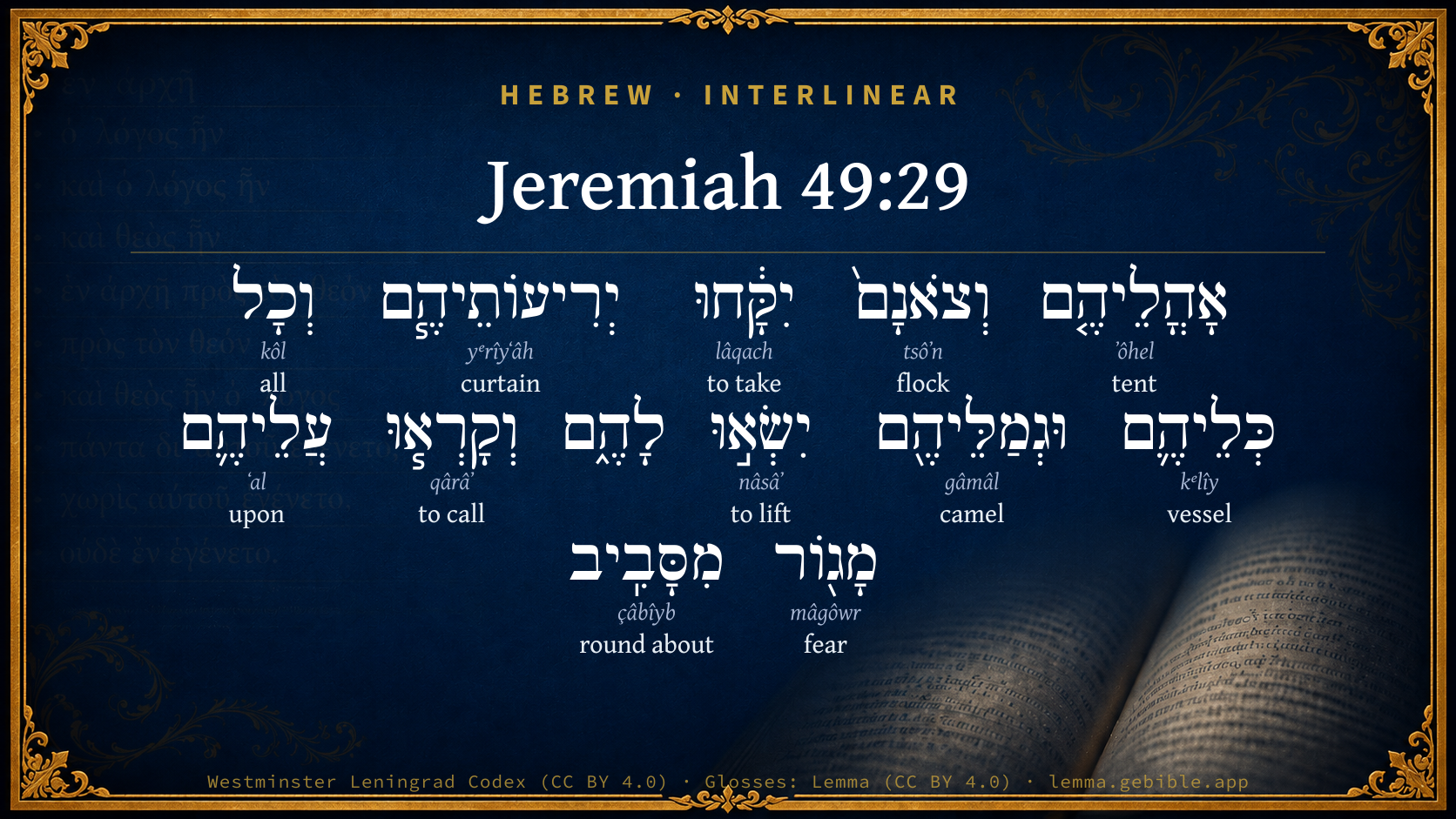
Jeremiah 49:29

Hebrew (Westminster Leningrad Codex) Jeremiah 49:29 appears in the Hebrew Old Testament. The text above is from the Westminster Leningrad Codex. Each word links to its Strong’s number, a concise gloss, and parsing drawn from the Open Scriptures Hebrew Bible morphology. Click any word for its full Brown-Driver-Briggs (BDB) entry.
Download image
Cite this verse

Jeremiah 49:29 (World English Bible). Public Domain. Lemma interlinear Bible study tool, https://lemma.gebible.app/v/jeremiah/49/29.

Show BibTeX & RIS
BibTeX
RIS
English Translation
Their tents and their flocks shall they take; they shall carry away for themselves their curtains, and all their vessels, and their camels; and they shall cry to them, Terror on every side!
World English Bible · Public Domain
Download a study sheet

One document with this verse’s original text, its word-by-word gloss line, the meaning frame, cross-references with their text, attributed commentary, and full source and license credits — printable, and it pastes into notes with its structure intact.

This verse Autodidact and up

Study sheet (.html) Plain text (.txt)

A passage Seminary Student

Up to 50 verses in one chapter. A passage sheet keeps up to 6 commentary sources and 12 cross-references per verse, in the order this page ranks them, and says so on the sheet whenever that leaves anything out. Ask for a single verse and you get the Autodidact verse sheet above.

Everything on this page stays free to read, with no account — the sheet is a download of what is already on screen, not access to it.

Want to remove ads? Support Godless Engineer
Compare translations 3

The same verse in 3 English versions, stacked beneath the original-language interlinear above. Click any original word for its lexicon entry.

Each is an independent rendering of the whole verse — the interlinear is not word-aligned to these translations.

Highlighted words mark where these versions differ — a whole-verse word diff, not a word-by-word alignment.

  • World English Bible Public Domain
    Their tents and their flocks shall they take; they shall carry away for themselves their curtains, and all their vessels, and their camels; and they shall cry to them, Terror on every side!
  • King James Version Public Domain
    Their tents and their flocks shall they take away: they shall take to themselves their curtains, and all their vessels, and their camels; and they shall cry unto them, Fear is on every side.
  • unfoldingWord Literal Text CC BY-SA 4.0
    Their tents and their flocks will be taken, along with their tent curtains and all of their equipment; their camels will be led away from them, and men will shout to them, ‘Terror is on every side!’

unfoldingWord Literal Text — © unfoldingWord, licensed CC BY-SA 4.0. Word-aligned USFM3 via Door43 (git.door43.org/unfoldingWord/en_ult).

Versions to compare (up to 4)

3 of 4 selected

Show all 18 translations

Every available English version of this verse, each an independent rendering of the whole verse.

  • World English Bible Public Domain
    Their tents and their flocks shall they take; they shall carry away for themselves their curtains, and all their vessels, and their camels; and they shall cry to them, Terror on every side!
  • Berean Standard Bible Public Domain
    They will take their tents and flocks, their tent curtains and all their goods. They will take their camels for themselves. They will shout to them: ‘Terror is on every side!’
  • Majority Standard Bible Public Domain
    They will take their tents and flocks, their tent curtains and all their goods. They will take their camels for themselves. They will shout to them: ‘Terror is on every side!’
  • King James Version Public Domain
    Their tents and their flocks shall they take away: they shall take to themselves their curtains, and all their vessels, and their camels; and they shall cry unto them, Fear is on every side.
  • American Standard Version (1901) Public Domain
    Their tents and their flocks shall they take; they shall carry away for themselves their curtains, and all their vessels, and their camels; and they shall cry unto them, Terror on every side!
  • Revised Version (1885) Public Domain
    Their tents and their flocks shall they take; they shall carry away for themselves their curtains, and all their vessels, and their camels: and they shall cry unto them, Terror on every side.
  • Geneva Bible (1599) Public Domain
    Their tents and their flocks shall they take away: yea, they shall take to themselues their curtaines and all their vessels, and their camels, and they shall crie vnto them, Feare is on euery side.
  • Douay-Rheims (1899) Public Domain
    They shall take their tents, and their flocks: and shall carry off for themselves their curtains, and all their vessels, and their camels: and they shall call fear upon them round about.
  • Young's Literal Translation Public Domain
    Their tents and their flock they do take, Their curtains, and all their vessels, And their camels, they bear away for themselves, And they called concerning them, Fear `is' round about.
  • Literal Standard Version CC BY-SA 4.0
    They take their tents and their flock, || Their curtains, and all their vessels, || And they carry away their camels for themselves, || And they called concerning them, || Fear [is] all around.
  • Unlocked Literal Bible CC BY-SA 4.0
    Their tents and their flocks will be taken, along with their tent curtains and all of their equipment; their camels will be led away from them, and men will shout to them, “Terror is on every side!”
  • unfoldingWord Literal Text CC BY-SA 4.0
    Their tents and their flocks will be taken, along with their tent curtains and all of their equipment; their camels will be led away from them, and men will shout to them, ‘Terror is on every side!’
  • Darby Bible Public Domain
    Their tents and their flocks shall they take; their curtains and all their vessels, and their camels, shall they carry away for themselves; and they shall cry unto them, Terror on every side!
  • World Messianic Bible Public Domain
    They will take their tents and their flocks. they will carry away for themselves their curtains, all their vessels, and their camels; and they will cry to them, ‘Terror on every side!’
  • Webster's Bible Public Domain
    Their tents and their flocks shall they take away: they shall take to themselves their curtains, and all their vessels, and their camels; and they shall cry to them, Fear is on every side.
  • Free Bible Version CC BY-SA 4.0
    Take their tents and their flocks! Carry off their tent curtains and all their possessions! Take their camels for yourselves. Shout out to them: “Terror is everywhere!”
  • Bible in Basic English Public Domain
    Their tents and their flocks they will take; they will take away for themselves their curtains and all their vessels and their camels: they will give a cry to them, Fear on every side.
  • JPS Tanakh (1917) Public Domain
    Their tents and their flocks shall they take, they shall carry away for themselves their curtains, and all their vessels, and their camels; and they shall proclaim against them a terror on every side.

Literal Standard Version (2020), Covenant Press — licensed CC BY-SA 4.0. Text via the HelloAO Bible API (eBible.org). Unlocked Literal Bible (unfoldingWord) — licensed CC BY-SA 4.0. Text via the HelloAO Bible API (eBible.org). unfoldingWord Literal Text — © unfoldingWord, licensed CC BY-SA 4.0. Word-aligned USFM3 via Door43 (git.door43.org/unfoldingWord/en_ult). Free Bible Version, Dr. Jonathan Gallagher — licensed CC BY-SA 4.0. Text via the HelloAO Bible API (eBible.org).

Word by word

More ways to search: Search by grammar → Find every occurrence → Compare this word →

Practice this passage: Drill this verse → Learn its vocabulary →

מָג֖וֹר
mâgôwr
H4032
“fear”
Noun, Common, Masculine, Singular, Absolute
Part of Speech
Noun
Type
Common
Gender
Masculine
Number
Singular
State
Absolute
Full BDB Definition

Origin: from H1481 in the sense of fearing

TWOT: 332a

fear, terror
  1. אָהֳלֵיהֶ֤ם ʼôhel H168 “tents · their” Noun, Common, Masculine, Plural, Construct + Suffix, Personal, 3rd Person, Masculine, Plural
  2. וְצֹאנָם֙ tsôʼn H6629 “and · flock · their” Conjunction + Noun, Common, Both, Singular, Construct + Suffix, Personal, 3rd Person, Masculine, Plural
  3. יִקָּ֔חוּ lâqach H3947 “to take” Verb, Qal, Imperfect, 3rd Person, Masculine, Plural
  4. יְרִיעוֹתֵיהֶ֧ם yᵉrîyʻâh H3407 “curtains · their” Noun, Common, Feminine, Plural, Construct + Suffix, Personal, 3rd Person, Masculine, Plural
  5. וְכָל kôl H3605 “and · all of” Conjunction + Noun, Common, Masculine, Singular, Construct
  6. כְּלֵיהֶ֛ם kᵉlîy H3627 “vessels · their” Noun, Common, Masculine, Plural, Construct + Suffix, Personal, 3rd Person, Masculine, Plural
  7. וּגְמַלֵּיהֶ֖ם gâmâl H1581 “and · camels · their” Conjunction + Noun, Common, Masculine, Plural, Construct + Suffix, Personal, 3rd Person, Masculine, Plural
  8. יִשְׂא֣וּ nâsâʼ H5375 “to lift” Verb, Qal, Imperfect, 3rd Person, Masculine, Plural
  9. וְקָרְא֧וּ qârâʼ H7121 “and · to call” Conjunction + Verb, Qal, Sequential Perfect, 3rd Person, Common, Plural
  10. עֲלֵיהֶ֛ם ʻal H5921 “upon · them” Preposition + Suffix, Personal, 3rd Person, Masculine, Plural
  11. מִסָּבִֽיב çâbîyb H5439 “from · round about” Preposition + Noun, Common, Both, Singular, Absolute

About this verse

These counts appear in no published source. They are computed here, from the morphology-tagged text and Lemma’s own curated glosses. What Lemma adds →

13
words
12
distinct lemmas
Prophets
section

Notable vocabulary

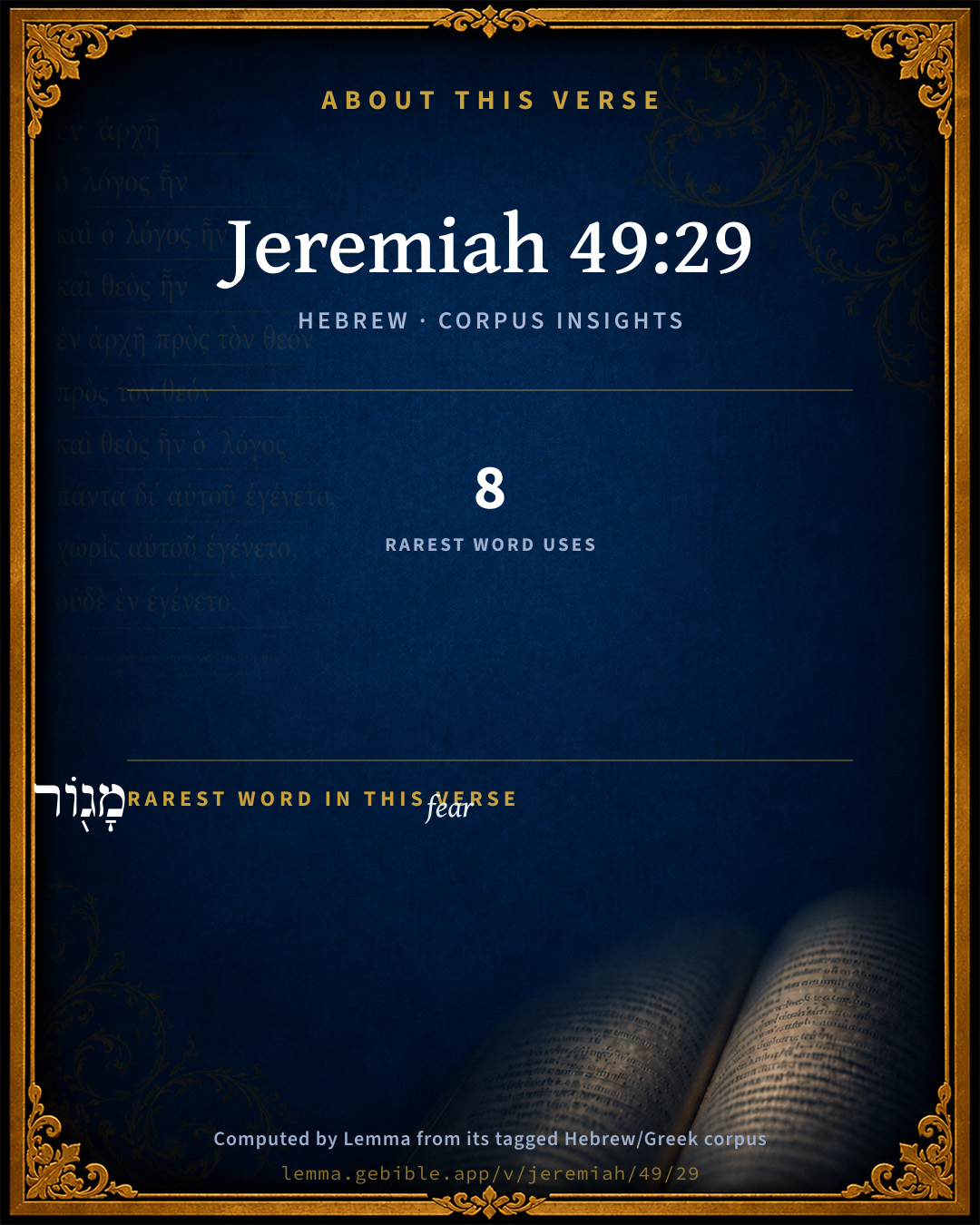
The rarest word here is מָג֖וֹר fear H4032 — appearing just 8 times in the whole Hebrew Bible.

Shared distinctive vocabulary

מָג֖וֹר fear H4032 occurs in 8 verses of the Hebrew Bible. Also found in:

Grammatical profile

  • 3 verbs
  • 8 nouns
  • 2 prepositions

Verb forms

  • יִקָּ֔חוּ Qal · Imperfect
  • יִשְׂא֣וּ Qal · Imperfect
  • וְקָרְא֧וּ Qal · Sequential Perfect

Cross-references

20

Topical passages linked to Jeremiah 49:29 in the Treasury of Scripture Knowledge — connected by theme and wording, ordered by reader-vote popularity; previews shown in the World English Bible.

  • Jeremiah 6:25 Don't go forth into the field, nor walk by the way; for the sword of the enemy, [and] terror, are on every side.
  • Jeremiah 46:5 Why have I seen it? they are dismayed and are turned backward; and their mighty ones are beaten down, and have fled apace, and don't look back: terror is on every side, says Yahweh.
  • Psalms 120:5 Woe is me, that I live in Meshech, That I dwell among the tents of Kedar!
  • Habakkuk 3:7 I saw the tents of Cushan in affliction. The dwellings of the land of Midian trembled.
  • Genesis 37:25 They sat down to eat bread, and they lifted up their eyes and looked, and saw a caravan of Ishmaelites was coming from Gilead, with their camels bearing spices and balm and myrrh, going to carry it down to Egypt.
  • Judges 6:5 For they came up with their cattle and their tents; they came in as locusts for multitude; both they and their camels were without number: and they came into the land to destroy it.
  • Judges 7:12 The Midianites and the Amalekites and all the children of the east lay along in the valley like locusts for multitude; and their camels were without number, as the sand which is on the sea-shore for multitude.
  • Judges 8:21 Then Zebah and Zalmunna said, Rise you, and fall on us; for as the man is, so is his strength. Gideon arose, and killed Zebah and Zalmunna, and took the crescents that were on their camels' necks.
  • Judges 8:26 The weight of the golden ear-rings that he requested was one thousand and seven hundred [shekels] of gold, besides the crescents, and the pendants, and the purple clothing that was on the kings of Midian, and besides the chains that were about their camels' necks.
  • 1 Chronicles 5:20–21 They were helped against them, and the Hagrites were delivered into their hand, and all who were with them; for they cried to God in the battle, and he was entreated of them, because they put their trust in him.
  • Job 1:3 His possessions also were seven thousand sheep, three thousand camels, five hundred yoke of oxen, five hundred she-donkeys, and a very great household; so that this man was the greatest of all the children of the east.
  • Psalms 31:13 For I have heard the slander of many, terror on every side, While they conspire together against me, They plot to take away my life.
  • Isaiah 13:20 It shall never be inhabited, neither shall it be lived in from generation to generation: neither shall the Arabian pitch tent there; neither shall shepherds make their flocks to lie down there.
  • Isaiah 60:7 All the flocks of Kedar shall be gathered together to you, the rams of Nebaioth shall minister to you; they shall come up with acceptance on my altar; and I will glorify the house of my glory.
  • Jeremiah 4:20 Destruction on destruction is cried; for the whole land is laid waste: suddenly are my tents destroyed, [and] my curtains in a moment.
  • Jeremiah 10:20 My tent is destroyed, and all my cords are broken: my children are gone forth from me, and they are no more: there is none to spread my tent any more, and to set up my curtains.
  • Jeremiah 20:3–4 It happened on the next day, that Pashhur brought forth Jeremiah out of the stocks. Then said Jeremiah to him, Yahweh has not called your name Pashhur, but Magormissabib.
  • Jeremiah 49:24 Damascus has grown feeble, she turns herself to flee, and trembling has seized on her: anguish and sorrows have taken hold of her, as of a woman in travail.
  • 2 Corinthians 4:8 We are pressed on every side, yet not crushed; perplexed, yet not to despair;
  • 2 Corinthians 7:5 For even when we had come into Macedonia, our flesh had no relief, but we were afflicted on every side. Fightings were outside. Fear was inside.

Cross-references courtesy of OpenBible.info (CC BY 4.0).

Hebrew and Greek witnesses Masoretic Hebrew ↔ Greek Septuagint

The same verse in the two great witnesses to the Old Testament, shown verse-for-verse.

These are two independent witnesses, not word-aligned to each other, and the Septuagint is shown in lemma (dictionary) form.

Hebrew Jeremiah 49:29 Masoretic · Westminster Leningrad Codex

אָהֳלֵיהֶ֤ם וְצֹאנָם֙ יִקָּ֔חוּ יְרִיעוֹתֵיהֶ֧ם וְכָל כְּלֵיהֶ֛ם וּגְמַלֵּיהֶ֖ם יִשְׂא֣וּ לָהֶ֑ם וְקָרְא֧וּ עֲלֵיהֶ֛ם מָג֖וֹר מִסָּבִֽיב

Their tents and their flocks shall they take; they shall carry away for themselves their curtains, and all their vessels, and their camels; and they shall cry to them, Terror on every side!

World English Bible · Public Domain

Greek LXX Structure differs

In the Septuagint, Jeremiah is about an eighth shorter than the Hebrew and arranges its material differently — the Oracles Against the Nations (Hebrew chapters 46–51) appear in the middle of the Greek book, after 25:13. Because the chapter and verse boundaries do not line up, a verse-for-verse comparison with the Hebrew is not shown.

A verse-for-verse comparison isn’t shown here because the chapters and verses don’t line up. Switch to the LXX edition with the MT / LXX toggle above to read the Greek directly.

Hebrew: Westminster Leningrad Codex (CC BY 4.0). Greek: Septuagint (public domain); English from a public-domain English Septuagint. How the Septuagint differs from the Hebrew →

Targum (Aramaic paraphrase)

1

The Targum is the ancient Jewish Aramaic paraphrase of the Hebrew Scriptures — an interpretive translation, not the Hebrew text itself. Onkelos (literal) and Pseudo-Jonathan (expansive) render the Torah, and Jonathan the Prophets. Coverage is partial: where no permissively-licensed English translation exists for a verse, only the Aramaic is shown. This is verse-level text, not a word-by-word alignment to the Hebrew.

  1. Targum Jonathan Prophets (Joshua–Malachi)
    מַשְׁכְּנֵיהוֹן וְעָנְהוֹן יִשְׁבּוּן יְרִיעָתְהוֹן וְכָל מָנֵיהוֹן וְגַמְלֵהוֹן יִסְבוּן לְהוֹן וְיִתְכַּנְשׁוּן עֲלֵיהוֹן דְקַטְלִין בְּחַרְבָּא מִסְחוֹר סְחוֹר:

    (no public-domain English translation for this verse)

    Targum Jonathan — Aramaic: “Mikraot Gedolot” (public domain). English: “Sefaria Community Translation” (CC0 1.0 (public-domain dedication)); “London "Chaldee Paraphrase," 1871” (public domain). Text via Sefaria.

Commentary

Notes on Jeremiah 49:29 from classic Christian and Jewish commentators (each source and its license shown beneath its notes). The classic Christian expositions comment on the surrounding passage and are grouped to its opening verse, so a note may address several verses; the Jewish commentaries on the Tanakh (Rashi and others) are per-verse, so they appear only where the commentator wrote on this verse.

Lemma curates 59 commentaries, every one of them public domain or Creative Commons licensed, each selected and text-cleaned for this edition rather than reprinted as found. About our sources →

Trapp's Complete Commentary

John Trapp

Jer 49:29 Their tents and their flocks shall they take away: they shall take to themselves their curtains, and all their vessels, and their camels; and they shall cry unto them, Fear [is] on every side.

Ver. 29. Their tents and their flocks.] For which they were termed scenitae and nomades, as living a pastoral life in tents.

And they shall cry unto them, Fear is on every side.] Magormissabib might be their word, wherewith, loudly uttered, they might frighten and overcome these enemies; like as the Britons, our ancestors, once overcame a mighty army of Saxons and Picts in this land, by ringing out the word Hallelujah with a courage among the mountains near where the enemy had camped. {a}

{a} Ussier., De Brit. Eccles. Primord.

John Trapp, A Commentary or Exposition upon All the Books of the Old and New Testament (1647–1656) — public domain. Text from a community e-Sword module.

Geneva Bible (1599)

Geneva Bible translators

Because they used to dwell in tents, he nameth the things that pertain thereunto.

Geneva Bible (1599) marginal notes — public domain. Text via Bolls.life.

Jamieson, Fausset & Brown

Robert Jamieson, A. R. Fausset & David Brown

tents--in which they dwelt, from which they are called Scenites, that is, tent dwellers.

curtains--namely, with which the tents were covered (Jer 4:20; Jer 10:20; Psa 104:2).

they shall cry unto them, Fear, &c.--The foe, on crying, Fear . . ., shall discomfit them (the Kedarenes) by their mere cry.

Jamieson, Fausset & Brown — Commentary Critical and Explanatory on the Whole Bible (1871) — public domain (CC PDM 1.0). Text via the HelloAO Bible API.

Adam Clarke's Commentary

Verse 29. Their tents and their flocks] This description of property shows that they were Scenite or Nomad Arabs; persons who dwell in tents, and whose principal property was cattle, especially camels, of the whole of which they were plundered by the Chaldeans.

Adam Clarke's Commentary on the Bible (1810–1826) — public domain. Text from a community e-Sword/MySword module.

John Calvin's Commentaries

The Prophet, in speaking of tents and curtains, had regard to the way of living adopted by that nation; for the Arabs, we know, dwelt in cabins and tents, as they do at this day, and they were also shepherds. They had no cultivated fields, but led their flocks through the deserts; and they had a great number of camels. This is the reason why the Prophet mentions tents, curtains, camels, and flocks, while speaking of the Kedareans; for they dwelt not in a fertile country, they possessed no arable lands, nor had they much other wealth, neither cities nor palaces. The sum of what is said is, that the Kedareans were doomed to destruction, and were therefore exposed as a prey to their enemies.

But as this was difficult to be believed, he adds, They shall cry to them, Terror on every side By these words the Prophet means, that there would be so much dread, that all would suffer their possessions to be plundered, not daring to make any resistance, because terror on every side would lay hold on them. They who read, “They shall call them terror on every side,” think that this is said metaphorically of the soldiers, as they were terrible. Some also say, “The king of Babylon shall call” or summon “terror on every side against them.” But the former explanation is the most probable, that when enemies called or cried out, Terror, terror, as conquerors, they would overcome them by their voice alone. This is, as I think, the real meaning of the Prophet. It now follows, —

John Calvin's Commentaries (1540-1563) — public domain. Text from the Calvin Translation Society English edition (1840s-50s) via the Christian Classics Ethereal Library (ccel.org). Calvin's coverage is partial (roughly two-thirds of the Bible); uncommented books and verses are honest gaps, never fabricated. The 19th-century editor's footnotes and remarks are omitted so the notes are faithfully Calvin's own voice.

Ellicott's Commentary for English Readers

(29) Fear is on every side.—There is a striking individuality in this reproduction of the Magor-missabib cry which had been so prominent in the prophet’s own life and preaching (Jer_6:25; Jer_20:3; Jer_20:10; Jer_46:5).

A Bible Commentary for English Readers, edited by Charles John Ellicott (1878–1897) — public domain. Text from a community e-Sword module.

The Cambridge Bible for Schools and Colleges

gen. ed. J. J. S. Perowne

29. curtains] i.e. tent-hangings. See on ch. Jer_4:20.

Terror on every side] See on ch. Jer_6:25.

The Cambridge Bible for Schools and Colleges (gen. ed. J. J. S. Perowne; Cambridge University Press, 1878–1918) — public domain. Text from a community e-Sword module.

John Gill's Exposition

Their tents and their flocks shall they take away,.... The Kedarenes were a people whose business chiefly lay in feeding flocks, and of which their substance consisted; and they mostly dwelt in tents, which they removed from place to place, for the sake of pasturage for their flocks; hence they were sometimes called Scenites, and sometimes Nomades; see Psa 120:5; but now both their habitations, such as they were, and their flocks too, wherein lay their riches, would be taken away from them:

they shall take to themselves their curtains, and all their vessels,

and their camels; their curtains made of skins of beasts, of which their tents were made; or with which they were covered to protect them from the inclemencies of the weather; and all the furniture of them, their household goods; their vessels for domestic use; and utensils for their calling and employment; and their camels, which were much used in those countries for travelling from place to place; on which they put their tents, curtains, and vessels, when they removed from one pasturage to another; these they, not the Kedarenes, should take to themselves, and flee with them; but the Chaldeans should seize on them for themselves, as their booty and prey:

and they shall cry unto them, fear is on every side; or, "magormissabib", "a fear all round", Jer 20:3; this is the word the Chaldeans shall use, and with it frighten the Kedarenes out of their tents; or by the sound of their trumpets, the alarm of war, and by their shouts and cries, and the clashing of their arms, they shall put them in fear all around: or else the Kedarenes and Hazorites, when they shall see the Chaldean army approaching, shall say one to another, fear is on all sides of us; nothing but ruin and destruction attend us from every quarter.

John Gill's Exposition of the Whole Bible (1746–1763) — public domain (CC PDM 1.0). Text via the HelloAO Bible API.

Albert Barnes' Notes on the Bible

Curtains - The hangings of the tents.

Fear is on every side - Magor-missabib (see Jer 6:25 note); a cry, indicating the panic which followed the unexpected onset of the enemy.

Albert Barnes' Notes on the Bible (1834–1885) — public domain. Text from a community e-Sword/MySword module.

Haydock's Catholic Bible Commentary

About. The enemy shall terrify them, and plunder all their riches.

George Leo Haydock (1774–1849), Haydock's Catholic Family Bible and Commentary, 1859 edition — public domain. Excludes Psalms (Douay-Rheims chapter numbering differs from Protestant) and Deuterocanonical books (Catholic canon only).

Matthew Poole's English Annotations

That is, the Chaldeans shall take away the Kedarens’ tents; for they being a people whose cattle were their livelihood, had no fixed houses, but tents, which were movable habitations, covered with skins of beasts; and the curtains which they used to draw before those tents, and served them as sides, as gable ends of houses serve us; and all the furniture of their tents or tabernacles, and their cattle; and either their enemies should fright them with terrible noises and outcries, or they should themselves cry out that they were surrounded with objects of fear.

Matthew Poole's English Annotations on the Holy Bible (1683–1685) — public domain. Text from a community e-Sword/MySword module.

Whedon's Commentary on the Bible

Daniel D. Whedon

29. Tents and flocks, curtains and vessels and camels make up the wealth of nomads. By “curtains” are meant the hangings of the tent; and by “vessels,” the simple cooking utensils of these wanderers.

Daniel D. Whedon (gen. ed.), Commentary on the Old and New Testaments (1874–1909) — public domain. Text from a community e-Sword module.

The Pulpit Commentary

All the possessions of the nomad are here mentioned first his tents and his flocks; then the hangings of which the tent is composed, (Jer_4:20 Jer_10:20) and the vessels which it contains; and finally the camels which the Arab rides, not to mention their other uses. All this shall be ruthlessly appropriated by the Chaldean invaders. Fear is on every side. Again Jeremiah"s motto recurs. (see on Jer_6:25) It expresses here, not the war cry itself, but the result produced by it.

"Fear on every side.

This is a sadly familiar phrase of Jeremiah"s. It is frequently applicable. The causes of alarm are numerous; so are the sufferers.

I FEAR IS AN EVIL. It is not only the shadow of future calamity; it is evil itself evil even if it is not justified by the event.

1. It is distressing.

2. It is degrading debasing the mind, crushing out all that is noble and unselfish.

3. It is paralyzing. Under the influence of fear we are confused and helpless; all energy is gone.

II THERE ARE MANY OCCASIONS OF FEAR. Jeremiah frequently exclaims, "Fear on every side!" We know not how many dangers surround us political, social, domestic, personal; dangers to property, family, health, and life. The wonder is that they who have no refuge above themselves are so complacent. Such unwarrantable calmness must be traced to moral dullness rather than to true courage. For how truly terrible is the condition of the sinner! The laws of the universe are against him. If he flees from this life new horrors await him in the dread unknown land.

III THE DEEPEST SOURCE OF FEAR IS OUR OWN SIN.

1. This brings the greatest danger upon us the penalty of outraged justice and broken law.

2. This awakens the feeling of terror. Conscience makes cowards of us all.

IV IN GOD IS THE REFUGE FROM FEAR. Men fear God in their guilt. Yet it is he who alone can deliver them from fear,

(1) by removing the evil feared;

(2) or by strengthening them to endure it; and also

(3) by calming the troubled sold as one whom his mother comforteth.

It is well that we should feel fear on every side if it leads us to cry, "What must we do to be saved?" and then to hear and follow the gospel answer, "Trust to the Lord Jesus Christ, and thou shalt be saved."

The Pulpit Commentary (1880–1919), ed. H.D.M. Spence-Jones & Joseph S. Exell — public domain. Text from a community e-Sword module.

John Wesley's Explanatory Notes

They - The Chaldeans.

John Wesley, Explanatory Notes Upon the Whole Bible (1754–1765) — public domain. Text via the GEBible commentary corpus.

Rashi

Rabbi Shlomo Yitzchaki (Rashi)

terror Heb. מגור (amassment in French). Another explanation: an expression of fear.

Rashi on the Tanakh — English translations: “The Judaica Press complete Tanach with Rashi, translated by A. J. Rosenberg” (CC BY 4.0); “Pentateuch with Rashi's commentary by M. Rosenbaum and A.M. Silbermann, 1929-1934” (public domain); “The Metsudah Tanach series, Lakewood, N.J” (CC BY 4.0); and “The Book of Joshua, Metsudah Publications, 1997” (CC BY 4.0). Text via Sefaria.

Lesson kit

Teaching starters — assembled from the data on this page, not authored interpretation. Every prompt links to the verse data it draws on. Edit before teaching.

Jeremiah, in the Prophets, opens this verse with 13 words (12 distinct Hebrew lemmas). Its most distinctive word is mâgôwr (“fear”). A historical commentator’s framing appears above. Read the whole chapter for the surrounding context.

Discussion questions

  1. How does “fear” (mâgôwr) shape what this verse is saying?
  2. How does Psalms 31:13, which shares the word «fear», read alongside this verse?
  3. The translations on this page render this verse differently — a whole-verse word diff, not a word-by-word alignment. What might account for the different wordings?
  4. «יִקָּ֔חוּ» is a Qal Imperfect verb. How does that grammatical form shape the action described?
  5. Compare how Trapp's Complete Commentary and Geneva Bible (1599) read this verse. Where do they agree or differ?

Things to notice

Reading settings

Reading text

Shown beneath each verse's original-language words.

Old Testament
Old Testament edition

Read the OT as the Masoretic Hebrew (MT) or the Greek Septuagint (LXX).

English shown for the Greek Septuagint (in the Hebrew ↔ Greek comparison).

Comparing translations? Open the Compare panel on any verse page to stack up to four side by side.