
Exodus 30:26

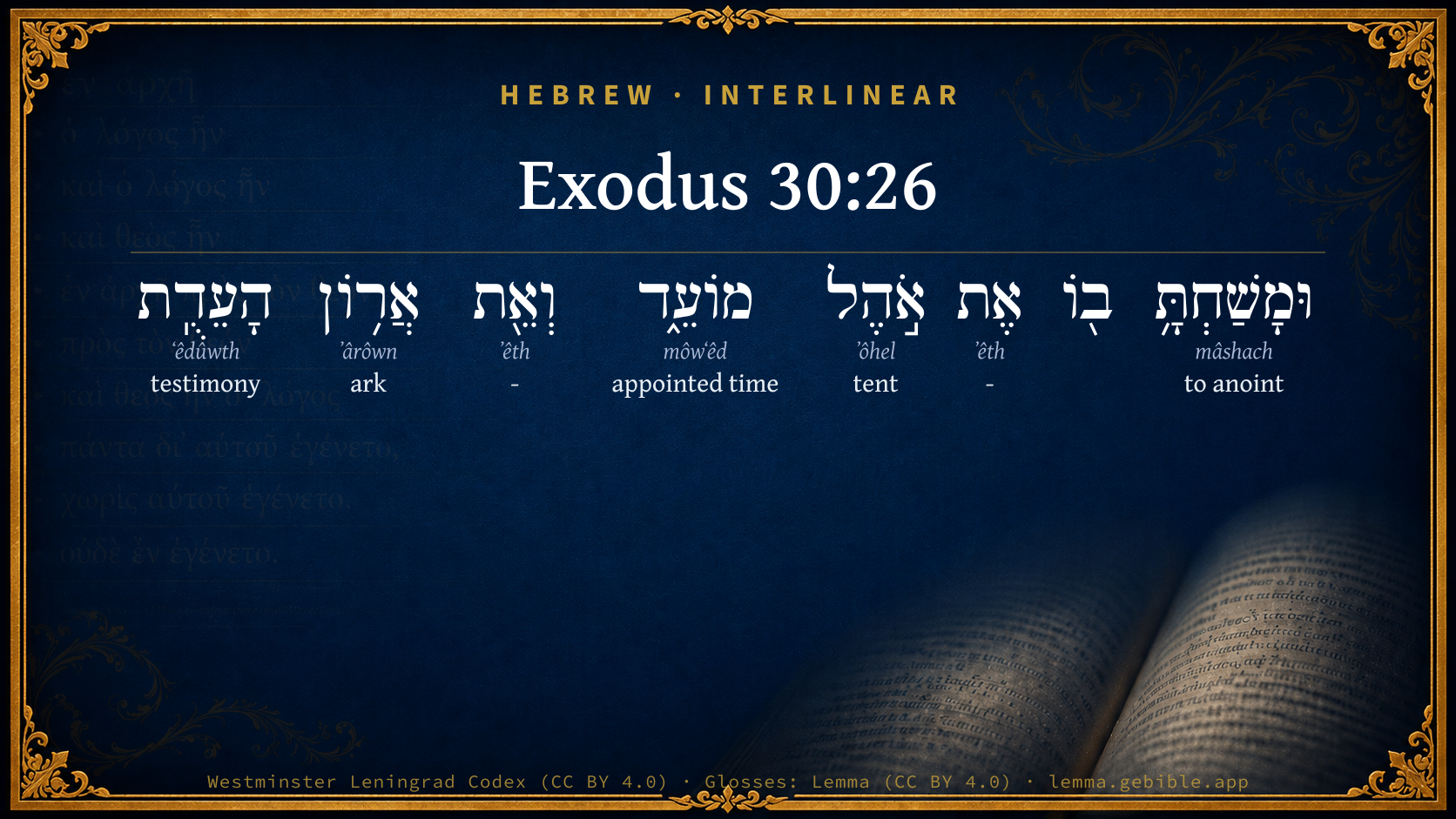
Hebrew (Westminster Leningrad Codex) Exodus 30:26 appears in the Hebrew Old Testament. The text above is from the Westminster Leningrad Codex. Each word links to its Strong’s number, a concise gloss, and parsing drawn from the Open Scriptures Hebrew Bible morphology. Click any word for its full Brown-Driver-Briggs (BDB) entry.
Download image
Cite this verse

Exodus 30:26 (World English Bible). Public Domain. Lemma interlinear Bible study tool, https://lemma.gebible.app/v/exodus/30/26.

Show BibTeX & RIS
BibTeX
RIS
English Translation
You shall use it to anoint the tent of meeting, the ark of the testimony,
World English Bible · Public Domain
Download a study sheet

One document with this verse’s original text, its word-by-word gloss line, the meaning frame, cross-references with their text, attributed commentary, and full source and license credits — printable, and it pastes into notes with its structure intact.

This verse Autodidact and up

Study sheet (.html) Plain text (.txt)

A passage Seminary Student

Up to 50 verses in one chapter. A passage sheet keeps up to 6 commentary sources and 12 cross-references per verse, in the order this page ranks them, and says so on the sheet whenever that leaves anything out. Ask for a single verse and you get the Autodidact verse sheet above.

Everything on this page stays free to read, with no account — the sheet is a download of what is already on screen, not access to it.

Want to remove ads? Support Godless Engineer
Compare translations 3

The same verse in 3 English versions, stacked beneath the original-language interlinear above. Click any original word for its lexicon entry.

Each is an independent rendering of the whole verse — the interlinear is not word-aligned to these translations.

Highlighted words mark where these versions differ — a whole-verse word diff, not a word-by-word alignment.

  • World English Bible Public Domain
    You shall use it to anoint the tent of meeting, the ark of the testimony,
  • King James Version Public Domain
    And thou shalt anoint the tabernacle of the congregation therewith, and the ark of the testimony,
  • unfoldingWord Literal Text CC BY-SA 4.0
    And you shall anoint with it the tent of meeting and the Box of the Testimony

unfoldingWord Literal Text — © unfoldingWord, licensed CC BY-SA 4.0. Word-aligned USFM3 via Door43 (git.door43.org/unfoldingWord/en_ult).

Versions to compare (up to 4)

3 of 4 selected

Show all 18 translations

Every available English version of this verse, each an independent rendering of the whole verse.

  • World English Bible Public Domain
    You shall use it to anoint the tent of meeting, the ark of the testimony,
  • Berean Standard Bible Public Domain
    Use this oil to anoint the Tent of Meeting, the ark of the Testimony,
  • Majority Standard Bible Public Domain
    Use this oil to anoint the Tent of Meeting, the ark of the Testimony,
  • King James Version Public Domain
    And thou shalt anoint the tabernacle of the congregation therewith, and the ark of the testimony,
  • American Standard Version (1901) Public Domain
    And thou shalt anoint therewith the tent of meeting, and the ark of the testimony,
  • Revised Version (1885) Public Domain
    And thou shalt anoint therewith the tent of meeting, and the ark of the testimony,
  • Geneva Bible (1599) Public Domain
    And thou shalt anoynt the Tabernacle of the Congregation therewith, and the Arke of the Testimonie:
  • Douay-Rheims (1899) Public Domain
    And therewith thou shalt anoint the tabernacle of the testimony, and the ark of the testament,
  • Young's Literal Translation Public Domain
    `And thou hast anointed with it the tent of meeting, and the ark of the testimony,
  • Literal Standard Version CC BY-SA 4.0
    And with it you have anointed the Tent of Meeting, and the Ark of the Testimony,
  • Unlocked Literal Bible CC BY-SA 4.0
    You must anoint the tent of meeting with this oil, as well as the ark of the testimony,
  • unfoldingWord Literal Text CC BY-SA 4.0
    And you shall anoint with it the tent of meeting and the Box of the Testimony
  • Darby Bible Public Domain
    And thou shalt anoint the tent of meeting with it, and the ark of the testimony,
  • World Messianic Bible Public Domain
    You shall use it to anoint the Tent of Meeting, the ark of the covenant,
  • Webster's Bible Public Domain
    And thou shalt anoint the tabernacle of the congregation with it, and the ark of the testimony,
  • Free Bible Version CC BY-SA 4.0
    Use it to anoint the Tent of Meeting, the Ark of the Testimony,
  • Bible in Basic English Public Domain
    This oil is to be put on the Tent of meeting, and on the ark of the law,
  • JPS Tanakh (1917) Public Domain
    And thou shalt anoint therewith the tent of meeting, and the ark of the testimony,

Literal Standard Version (2020), Covenant Press — licensed CC BY-SA 4.0. Text via the HelloAO Bible API (eBible.org). Unlocked Literal Bible (unfoldingWord) — licensed CC BY-SA 4.0. Text via the HelloAO Bible API (eBible.org). unfoldingWord Literal Text — © unfoldingWord, licensed CC BY-SA 4.0. Word-aligned USFM3 via Door43 (git.door43.org/unfoldingWord/en_ult). Free Bible Version, Dr. Jonathan Gallagher — licensed CC BY-SA 4.0. Text via the HelloAO Bible API (eBible.org).

Word by word

More ways to search: Search by grammar → Find every occurrence → Compare this word →

Practice this passage: Drill this verse → Learn its vocabulary →

About this verse

These counts appear in no published source. They are computed here, from the morphology-tagged text and Lemma’s own curated glosses. What Lemma adds →

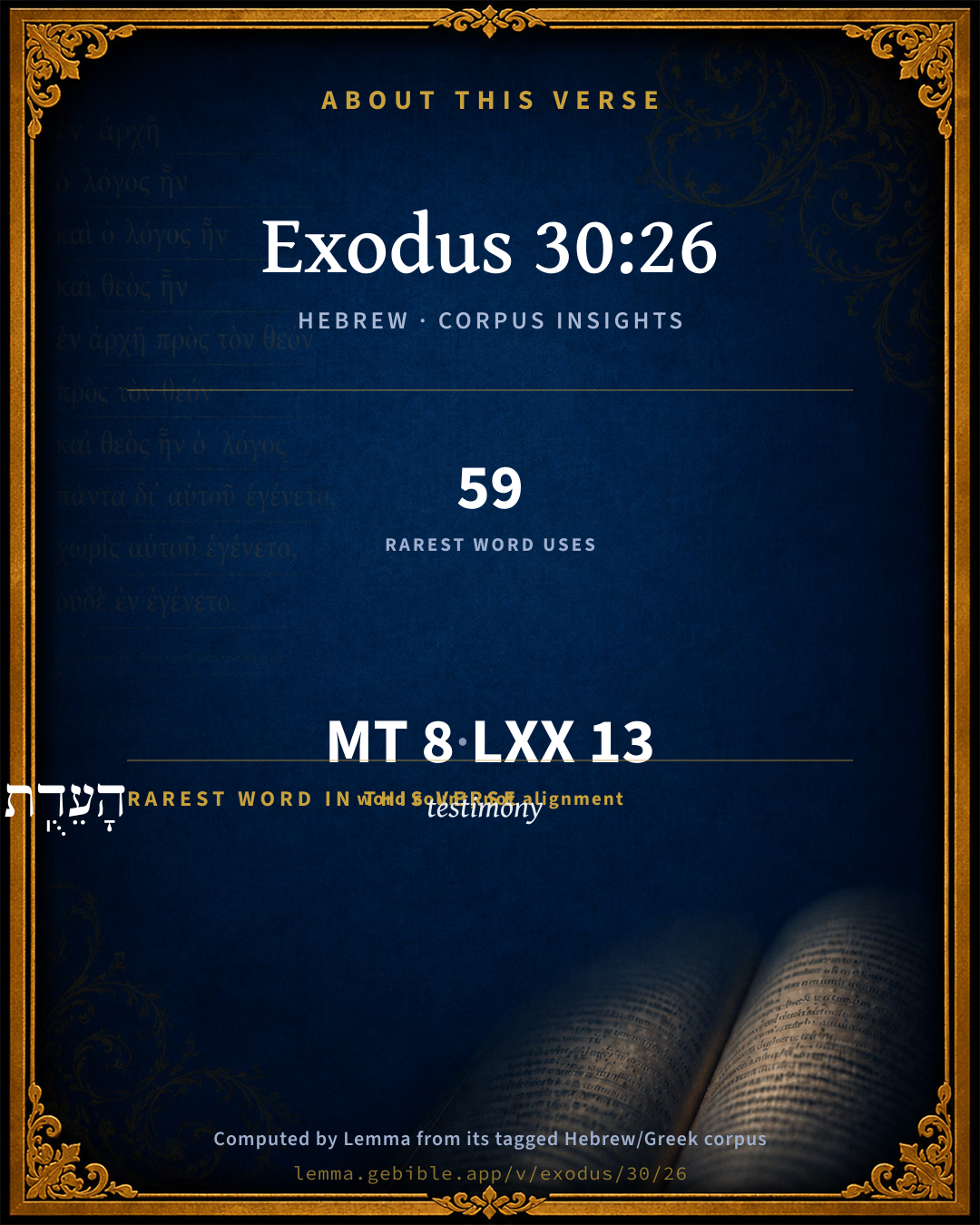
8
words
6
distinct lemmas
Pentateuch
section

Shared distinctive vocabulary

הָעֵדֻֽת testimony H5715 occurs in 57 verses of the Hebrew Bible. Also found in:

Grammatical profile

  • 1 verb
  • 4 nouns
  • 1 preposition
  • 2 particles

Verb forms

  • וּמָשַׁחְתָּ֥ Qal · Sequential Perfect

Hebrew & Septuagint length

In English translation the verse runs 15 words from the Hebrew and 18 from the Septuagint (LXX English) — closely comparable.

A rough comparison of the two English renderings, which tokenize alike — not a word-level alignment.

Word counts can differ between the Hebrew and the Greek without any difference in meaning — e.g. the Hebrew direct-object marker אֵת has no separate Greek word, and Greek often adds the article ὁ.

In the original languages it is 8 Hebrew tokens and 13 Greek tokens — but the two are counted differently (Hebrew bundles its prefixes and suffixes into one token; the Greek is in lemma form), so that isn’t a like-for-like length.

Cross-references

9

Topical passages linked to Exodus 30:26 in the Treasury of Scripture Knowledge — connected by theme and wording, ordered by reader-vote popularity; previews shown in the World English Bible.

  • Numbers 7:1 It happened on the day that Moses had finished setting up the tabernacle, and had anointed it and sanctified it, with all its furniture, and the altar with all its vessels, and had anointed and sanctified them;
  • Exodus 40:9–15 You shall take the anointing oil, and anoint the tent, and all that is in it, and shall make it holy, and all its furniture: and it will be holy.
  • Leviticus 8:10–12 Moses took the anointing oil, and anointed the tabernacle and all that was in it, and sanctified them.
  • Numbers 7:10 The princes gave offerings for the dedication of the altar in the day that it was anointed, even the princes gave their offerings before the altar.
  • Isaiah 61:1 The Spirit of the Lord Yahweh is on me; because Yahweh has anointed me to preach good news to the humble; he has sent me to bind up the broken-hearted, to proclaim liberty to the captives, and the opening [of the prison] to those who are bound;
  • Acts 10:38 even Jesus of Nazareth, how God anointed him with the Holy Spirit and with power, who went about doing good and healing all who were oppressed by the devil, for God was with him.
  • 2 Corinthians 1:21–22 Now he who establishes us with you in Christ, and anointed us, is God;
  • 1 John 2:20 You have an anointing from the Holy One, and you know the truth.
  • 1 John 2:27 As for you, the anointing which you received from him remains in you, and you don't need for anyone to teach you. But as his anointing teaches you concerning all things, and is true, and is no lie, and even as it taught you, you will remain in him.

Cross-references courtesy of OpenBible.info (CC BY 4.0).

Hebrew and Greek witnesses Masoretic Hebrew ↔ Greek Septuagint

The same verse in the two great witnesses to the Old Testament, shown verse-for-verse.

These are two independent witnesses, not word-aligned to each other, and the Septuagint is shown in lemma (dictionary) form.

Hebrew Exodus 30:26 Masoretic · Westminster Leningrad Codex

וּמָשַׁחְתָּ֥ ב֖וֹ אֶת אֹ֣הֶל מוֹעֵ֑ד וְאֵ֖ת אֲר֥וֹן הָעֵדֻֽת

You shall use it to anoint the tent of meeting, the ark of the testimony,

World English Bible · Public Domain

Greek LXX Exodus 30:26 Septuagint · lemma form

καί χρίω ἐκ αὐτός ὁ σκηνή ὁ μαρτύριον καί ὁ κιβωτός ὁ μαρτύριον

And you shall anoint with it the tabernacle of witness, and the ark of the tabernacle of witness,

LXX2012 (modern English Septuagint) · Public Domain

Hebrew: Westminster Leningrad Codex (CC BY 4.0). Greek: Septuagint (public domain); English from LXX2012 (modern English Septuagint) (Public Domain). How the Septuagint differs from the Hebrew →

Targum (Aramaic paraphrase)

2

The Targum is the ancient Jewish Aramaic paraphrase of the Hebrew Scriptures — an interpretive translation, not the Hebrew text itself. Onkelos (literal) and Pseudo-Jonathan (expansive) render the Torah, and Jonathan the Prophets. Coverage is partial: where no permissively-licensed English translation exists for a verse, only the Aramaic is shown. This is verse-level text, not a word-by-word alignment to the Hebrew.

  1. Targum Onkelos Torah (Genesis–Deuteronomy)
    וּתְרַבִּי בֵהּ יָת מַשְׁכַּן זִמְנָא וְיָת אֲרוֹנָא דְסַהֲדוּתָא:

    (no public-domain English translation for this verse)

    Targum Onkelos — Aramaic: “Onkelos Genesis” (public domain); “Onkelos Exodus” (public domain); “Onkelos Leviticus” (public domain); “Onkelos Numbers” (public domain); “Onkelos Deuteronomy” (public domain). English: “Sefaria Community Translation” (CC0 1.0 (public-domain dedication)); “J.W. Etheridge. The Targums of Onkelos and Jonathan Ben Uzziel on the Pentateuch. London: Longmans, Green, 1862” (public domain). Text via Sefaria.

  2. Targum Pseudo-Jonathan Torah (Genesis–Deuteronomy)
    וּתְרַבֵּי בֵיהּ יַת מַשְׁכַּן זִימְנָא וְיַת אֲרוֹנָא דְסַהֲדוּתָא

    And with it anoint thou the tabernacle of ordinance, and the ark of the testimony,

    Targum Pseudo-Jonathan — Aramaic: “Targum Jonathan on Genesis” (public domain); “Targum Jonathan on Exodus” (public domain); “Targum Jonathan on Leviticus” (public domain); “Targum Jonathan on Numbers” (public domain); “Targum Jonathan on Deuteronomy” (public domain). English: “The Targum of Jonathan ben Uzziel, trans. J. W. Etheridge, London, 1862” (public domain). Text via Sefaria.

Commentary

Notes on Exodus 30:26 from classic Christian and Jewish commentators (each source and its license shown beneath its notes). The classic Christian expositions comment on the surrounding passage and are grouped to its opening verse, so a note may address several verses; the Jewish commentaries on the Tanakh (Rashi and others) are per-verse, so they appear only where the commentator wrote on this verse.

Lemma curates 59 commentaries, every one of them public domain or Creative Commons licensed, each selected and text-cleaned for this edition rather than reprinted as found. About our sources →

Ellicott's Commentary for English Readers

(26) Thou shalt anoint the tabernacle.—The tabernacle and its contents were to be first consecrated, then the priests. In the tabernacle itself, the consecration was to begin with the ark of the testimony in the Holy of Holies, then to proceed to the Holy place, where the table of shewbread with its “vessels,” the golden candlestick, and the altar of incense were to be anointed; and finally to pass the vail to the outer court, where the holy oil was to be sprinkled upon the brazen altar, and upon the laver, to sanctify them. (See Exo_30:26-29; and comp. Lev_8:10-11.)

A Bible Commentary for English Readers, edited by Charles John Ellicott (1878–1897) — public domain. Text from a community e-Sword module.

Trapp's Complete Commentary

John Trapp

Exo 30:26 And thou shalt anoint the tabernacle of the congregation therewith, and the ark of the testimony,

Ver. 26. And thou shalt anoint the tabernacle.] So to consecrate the same to God’s service, and to set forth how joyfully and gladly men should serve the Lord.

John Trapp, A Commentary or Exposition upon All the Books of the Old and New Testament (1647–1656) — public domain. Text from a community e-Sword module.

The Preacher's Complete Homiletical Commentary

Joseph S. Exell (gen. ed.)

ILLUSTRATIONS

BY

REV. WILLIAM ADAMSON

Anointing-Oil Symbolism! Exo_30:26-30.

(1.) All parts of the Mosaic worship were symbolic; and all those parts were symbolic of Christ. They all silently spoke of One beyond and behind, above and around them. Moreover, the most explicit directions were given for their anointing. The altars and the sacred furniture, as well as the priests and the high priest, were to be most carefully anointed. But the unction seems to have been most special in the case of the high priest. As, then, the various portions of the Tabernacle and its appurtenances were emblematic of Christ, this anointing must also have been figurative of something done to Christ.

(2.) One of the sweetest names of the Lord Jesus is “Christ”—the Anointed One. “With my holy oil, have I anointed Him.” The unction of the Holy One, our great High Priest received in (a) Intention, long before the head of Aaron had received the material unction; (b) Intimation, when the wise men of the East laid their gifts at His feet; (c) Interpretation, when the Holy Spirit descended from heaven upon Him, as He knelt in prayer on Jordan’s strand. He received not the Spirit by measure; for in Him dwelleth all the fulness of the Godhead bodily.

“Nor prayer is made by man alone;

The Holy Spirit pleads,

And Jesus, on the eternal throne,

For sinners intercedes.”

—Montgomery.

ILLUSTRATIONS

BY

REV. WILLIAM ADAMSON

Sacrificial Speech! Exo_30:1-38.

(1.) No student of the Bible needs to be reminded that by the complicated and long protracted series of events which preceded, accompanied, and followed the Exodus from Egypt, the essential doctrine of Gospel truth and grace are distinctly made known. By a stupendous array of symbolic acts and facts they are most emphatically confirmed and illustrated.

(2.) Thomson remarks that what is more pertinent, if possible, is that the record of them is so guided as to suggest and evolve the very best words, figures, and phrases by which these fundamental doctrines can be set forth. This is equally true of the words and ideas in this chapter of Exodus, as of the paschal lamb in Egypt, or the smiting of the rock in Horeb.

(3.) The symbolic acts and facts, it has been wisely asserted, in connection with the typical institutions, rites, and ceremonies of the Mosaic economy, were designed to permeate, and did permeate, the entire religious consciousness of the Hebrews. They thus gave birth to spiritual ideas and emotions wholly peculiar, and to corresponding formulas by which to give expression to them.

“I saw a Moslem work upon his shroud alone,

With earnest care, even as the silkworms weave their own,

When with that sacred Script it was filled from side to side,

He wrapt it round his body, and in calmness died.”

—Oriental.

Incense-Ingredients! Exo_30:34-38.

(1.) Composition! Exo_30:34-35. The ingredients are described with great precision; and were principally obtained in traffic from the Phœnicians. A few of them were products of native plants; but most of them came from Arabia, India, and spice islands of the Indian Archipelago. Great skill was required in the mixing of these ingredients. The art was a recognised profession among the Jews; and the rokechim, translated “apothecary” in our version, was simply a maker of perfumes.

(2.) Consecration! Exo_30:36-37. This mixture was to be pounded in very small particles, and deposited as a very holy thing in the Tabernacle, before the ark of the testimony. It has been said that this was to ensure a store of it being always in readiness. But this excludes the Divine idea of “holy consecration.” Hence, according to the Rabbins, one of the fifteen prefects was retained in Solomon’s temple for the special purpose of preparing it; and a part of the temple was reserved for his use as a laboratory, to indicate the purity of incense.

(3.) Conservation! Exo_30:38. So precious and holy was this incense considered, that it was forbidden to make a similar perfume for private use on pain of death.

“Nor will He to those lips attend

Whose prayers are not sincere.”

—Burton.

Incense and Unction! Exo_30:1-38. The Canticle of Solomon lies in the casket of Revelation—an exquisite gem—engraved with emblematic characters. It is a retrospective poem upon Christ in the Pentateuch; and it is a prospective poem upon Christ in the New Testament.

(1.) Son_3:6 : “Who is this that cometh up from the wilderness” is Jesus Christ coming up from the wilderness of Judea—from the wilderness, whence the sweetest odours are gathered; for not amid rich and cultured fields, but amongst the rocks and sands of the desert, are the incense and unction herbs obtained.

(2.) He comes up “like pillars of smoke,” which cannot derive its significance from the Shekinah pillar-cloud, but from those fragrant clouds of incense wafted upwards on the eastern air—in type of the prayers of Jesus on His Baptism. As perfumes of fragrant oil anoint our High Priest; so pillars of perfumed vapours ascend from His heart.

(3.) He comes up “perfumed with myrrh and frankincense,” anointed with the Holy Spirit; for on Jesus our great High Priest the Spirit is shed immeasurably. In this “Vessel of Honour” the Spirit is poured, abiding in Himself in all fulness, and as an exhaustless fountain ever overflowing for His people.

“The Spirit, through the Saviour shed,

His sacred fire imparts,

Refines our dross, and love divine

Enkindles in our hearts.”

The Preacher's Complete Homiletical Commentary (gen. ed. Joseph S. Exell; Funk & Wagnalls, c. 1892) — public domain (pre-1929). A full-Bible homiletical/sermon-outline anthology covering 65 of 66 books (2 John is absent from the source module). Text from a community e-Sword module.

Geneva Bible (1599)

Geneva Bible translators

All things which appertain to the Tabernacle.

Geneva Bible (1599) marginal notes — public domain. Text via Bolls.life.

John Gill's Exposition

And thou shall anoint the tabernacle of the congregation therewith,.... It cannot be thought the whole of it should be anointed all over, but only a part of it for the whole; and this was either typical of the human nature of Christ, the true tabernacle God pitched, and not man, and which was anointed with the Holy Ghost; or of the church and people of God, who are an holy tabernacle or temple of the Lord, and who receive the unction from the Holy One:

and the ark of the testimony; the chest where the law was, and stood in the most holy place of the tabernacle; and was a type of the Messiah, the anointed One, in whose heart the law was, and who is the fulfilling end of it for righteousness.

John Gill's Exposition of the Whole Bible (1746–1763) — public domain (CC PDM 1.0). Text via the HelloAO Bible API.

Matthew Poole's English Annotations

This was only an outward ceremony, signifying the separation and sanctification of these things for the service of God; as the anointing of kings and priests noted their designation to their offices.

Matthew Poole's English Annotations on the Holy Bible (1683–1685) — public domain. Text from a community e-Sword/MySword module.

The Pulpit Commentary

Vers. 26-29. Thou shalt anoint the tabernacle. The first application of the holy oil was to be to the inanimate objects constituting the paraphernalia of worship viz.,

1. The tabernacle itself as a whole;

2. The furniture of the holy of holies the ark and mercy seat;

3. The furniture of the holy place the show-bread table, the candlestick,and the altar of incense; and

4. The furniture of the court the altar of burnt-offering, and the laver. After applying the oil to these, Moses was to proceed to the anointing of the priests. (Compare Lev_8:10-12)

The Pulpit Commentary (1880–1919), ed. H.D.M. Spence-Jones & Joseph S. Exell — public domain. Text from a community e-Sword module.

Keil & Delitzsch

C. F. Keil & F. Delitzsch

(see at Lev 8:10.). This anointing oil was holy, either because it was made from the four fragrant substances according to the proportions commanded by Jehovah, or because God declared this kind of mixture and preparation holy (cf. Exo 30:32), and forbade for all time, on pain of death (Exo 30:31), not only the use of ointment so prepared for any ordinary anointings, but even an imitation of it. "Upon man's flesh shall it not be poured," i.e., it is not to be used for the ordinary practice of anointing the human body (Exo 30:32). "Man," i.e., the ordinary man in distinction from the priests. בּמתכּנתּו according to its measure, i.e., according to the proportions prescribed for its manufacture. זר (Exo 30:33) a stranger, is not only the non-Israelite, but laymen or non-priests in general. On the expression, "cut off from his people," see at Gen 17:14.

Keil & Delitzsch — Biblical Commentary on the Old Testament (1861–1891) — public domain (CC PDM 1.0). Text via the HelloAO Bible API. (Old Testament only.)

unfoldingWord translationNotes

Door43 World Missions Community

General Information:

Yahweh continues speaking to Moses.

You must anoint

Here "you" refers to Moses. (See: Forms of You)

ark of the testimony

The ark is the chest that contains the commandments. This can be stated clearly in the translation. See how you translated this in Exodus 26:33. AT: "the chest containing the commandments" (See: Assumed Knowledge and Implicit Information)

the altar for burnt offerings

"the altar on which offering were burnt"

translationWords

anoint

tent of meeting

oil

ark

lampstand

altar of incense

altar

burnt offering

unfoldingWord translationNotes — © Distant Shores Media and the Door43 World Missions Community, licensed CC BY-SA 4.0. Source: git.door43.org/Door43/en_tn.

Rashi

Rabbi Shlomo Yitzchaki (Rashi)

ומשחת בו AND THOU SHALT ANOINT WITH IT — All anointings mentioned in Scriptures were made in the form of a Greek X except the anointing of kings which were made round the head like a crown (wreath) (Keritot 5b).

Rashi on the Tanakh — English translations: “The Judaica Press complete Tanach with Rashi, translated by A. J. Rosenberg” (CC BY 4.0); “Pentateuch with Rashi's commentary by M. Rosenbaum and A.M. Silbermann, 1929-1934” (public domain); “The Metsudah Tanach series, Lakewood, N.J” (CC BY 4.0); and “The Book of Joshua, Metsudah Publications, 1997” (CC BY 4.0). Text via Sefaria.

Lesson kit

Teaching starters — assembled from the data on this page, not authored interpretation. Every prompt links to the verse data it draws on. Edit before teaching.

Exodus, in the Pentateuch, opens this verse with 8 words (6 distinct Hebrew lemmas). Its most distinctive word is ʻêdûwth (“testimony”). A historical commentator’s framing appears above. Read the whole chapter for the surrounding context.

Discussion questions

  1. How does “testimony” (ʻêdûwth) shape what this verse is saying?
  2. How does Exodus 16:34, which shares the word «testimony», read alongside this verse?
  3. The translations on this page render this verse differently — a whole-verse word diff, not a word-by-word alignment. What might account for the different wordings?
  4. «וּמָשַׁחְתָּ֥» is a Qal Sequential Perfect verb. How does that grammatical form shape the action described?
  5. Compare how Ellicott's Commentary for English Readers and Trapp's Complete Commentary read this verse. Where do they agree or differ?

Things to notice

Reading settings

Reading text

Shown beneath each verse's original-language words.

Old Testament
Old Testament edition

Read the OT as the Masoretic Hebrew (MT) or the Greek Septuagint (LXX).

English shown for the Greek Septuagint (in the Hebrew ↔ Greek comparison).

Comparing translations? Open the Compare panel on any verse page to stack up to four side by side.