Exodus 29:10

Hebrew (Westminster Leningrad Codex) Exodus 29:10 appears in the Hebrew Old Testament. The text above is from the Westminster Leningrad Codex. Each word links to its Strong’s number, a concise gloss, and parsing drawn from the Open Scriptures Hebrew Bible morphology. Click any word for its full Brown-Driver-Briggs (BDB) entry.
Download image
Cite this verse

Exodus 29:10 (World English Bible). Public Domain. Lemma interlinear Bible study tool, https://lemma.gebible.app/v/exodus/29/10.

Show BibTeX & RIS
BibTeX
RIS
English Translation
"You shall bring the bull before the tent of meeting: and Aaron and his sons shall lay their hands on the head of the bull.
World English Bible · Public Domain
Download a study sheet

One document with this verse’s original text, its word-by-word gloss line, the meaning frame, cross-references with their text, attributed commentary, and full source and license credits — printable, and it pastes into notes with its structure intact.

This verse Autodidact and up

Study sheet (.html) Plain text (.txt)

A passage Seminary Student

Up to 50 verses in one chapter. A passage sheet keeps up to 6 commentary sources and 12 cross-references per verse, in the order this page ranks them, and says so on the sheet whenever that leaves anything out. Ask for a single verse and you get the Autodidact verse sheet above.

Everything on this page stays free to read, with no account — the sheet is a download of what is already on screen, not access to it.

Want to remove ads? Support Godless Engineer
Compare translations 3

The same verse in 3 English versions, stacked beneath the original-language interlinear above. Click any original word for its lexicon entry.

Each is an independent rendering of the whole verse — the interlinear is not word-aligned to these translations.

Highlighted words mark where these versions differ — a whole-verse word diff, not a word-by-word alignment.

  • World English Bible Public Domain
    "You shall bring the bull before the tent of meeting: and Aaron and his sons shall lay their hands on the head of the bull.
  • King James Version Public Domain
    And thou shalt cause a bullock to be brought before the tabernacle of the congregation: and Aaron and his sons shall put their hands upon the head of the bullock.
  • unfoldingWord Literal Text CC BY-SA 4.0
    And you shall bring the bull to the face of the tent of meeting, and Aaron and his sons shall lay their hands on the head of the bull.

unfoldingWord Literal Text — © unfoldingWord, licensed CC BY-SA 4.0. Word-aligned USFM3 via Door43 (git.door43.org/unfoldingWord/en_ult).

Versions to compare (up to 4)

3 of 4 selected

Show all 18 translations

Every available English version of this verse, each an independent rendering of the whole verse.

  • World English Bible Public Domain
    "You shall bring the bull before the tent of meeting: and Aaron and his sons shall lay their hands on the head of the bull.
  • Berean Standard Bible Public Domain
    You are to present the bull at the front of the Tent of Meeting, and Aaron and his sons are to lay their hands on its head.
  • Majority Standard Bible Public Domain
    You are to present the bull at the front of the Tent of Meeting, and Aaron and his sons are to lay their hands on its head.
  • King James Version Public Domain
    And thou shalt cause a bullock to be brought before the tabernacle of the congregation: and Aaron and his sons shall put their hands upon the head of the bullock.
  • American Standard Version (1901) Public Domain
    And thou shalt bring the bullock before the tent of meeting: and Aaron and his sons shall lay their hands upon the head of the bullock.
  • Revised Version (1885) Public Domain
    And thou shalt bring the bullock before the tent of meeting: and Aaron and his sons shall lay their hands upon the head of the bullock.
  • Geneva Bible (1599) Public Domain
    After, thou shalt present the calfe before the Tabernacle of the Congregation, and Aaron and his sonnes shall put their handes vpon the head of the calfe.
  • Douay-Rheims (1899) Public Domain
    Thou shalt present also the calf before the tabernacle of the testimony. And Aaron and his sons shall lay their hands upon his head,
  • Young's Literal Translation Public Domain
    and hast brought near the bullock before the tent of meeting, and Aaron hath laid -- his sons also -- their hands on the head of the bullock.
  • Literal Standard Version CC BY-SA 4.0
    and have brought the bullock near before the Tent of Meeting, and Aaron has laid—his sons also—their hands on the head of the bullock.
  • Unlocked Literal Bible CC BY-SA 4.0
    You must all bring the bull before the tent of meeting, and Aaron and his sons must lay their hands on its head.
  • unfoldingWord Literal Text CC BY-SA 4.0
    And you shall bring the bull to the face of the tent of meeting, and Aaron and his sons shall lay their hands on the head of the bull.
  • Darby Bible Public Domain
    And thou shalt present the bullock before the tent of meeting; and Aaron and his sons shall lay their hands upon the head of the bullock;
  • World Messianic Bible Public Domain
    “You shall bring the bull before the Tent of Meeting; and Aaron and his sons shall lay their hands on the head of the bull.
  • Webster's Bible Public Domain
    And thou shalt cause a bullock to be brought before the tabernacle of the congregation; and Aaron and his sons shall put their hands upon the head of the bullock.
  • Free Bible Version CC BY-SA 4.0
    Take the bull to the front of the Tent of Meeting, and Aaron and his sons are to place their hands on its head.
  • Bible in Basic English Public Domain
    Then let the ox be taken in front of the Tent of meeting: and let Aaron and his sons put their hands on its head.
  • JPS Tanakh (1917) Public Domain
    And thou shalt bring the bullock before the tent of meeting; and Aaron and his sons shall lay their hands upon the head of the bullock.

Literal Standard Version (2020), Covenant Press — licensed CC BY-SA 4.0. Text via the HelloAO Bible API (eBible.org). Unlocked Literal Bible (unfoldingWord) — licensed CC BY-SA 4.0. Text via the HelloAO Bible API (eBible.org). unfoldingWord Literal Text — © unfoldingWord, licensed CC BY-SA 4.0. Word-aligned USFM3 via Door43 (git.door43.org/unfoldingWord/en_ult). Free Bible Version, Dr. Jonathan Gallagher — licensed CC BY-SA 4.0. Text via the HelloAO Bible API (eBible.org).

Word by word

More ways to search: Search by grammar → Find every occurrence → Compare this word →

Practice this passage: Drill this verse → Learn its vocabulary →

וְסָמַ֨ךְ
çâmak
H5564
“and · to lean”
Conjunction + Verb, Qal, Sequential Perfect, 3rd Person, Masculine, Singular
Part of Speech
Conjunction + Verb
Stem
Qal
Form
Sequential Perfect
Person
3rd Person
Gender
Masculine
Number
Singular
Full BDB Definition

Origin: a primitive root

TWOT: 1514

to lean, lay, rest, support, put, uphold, lean upon - (Qal) - to lean or lay upon, rest upon, lean against - to support, uphold, sustain - (Niphal) to support or brace oneself - (Piel) to sustain, refresh, revive
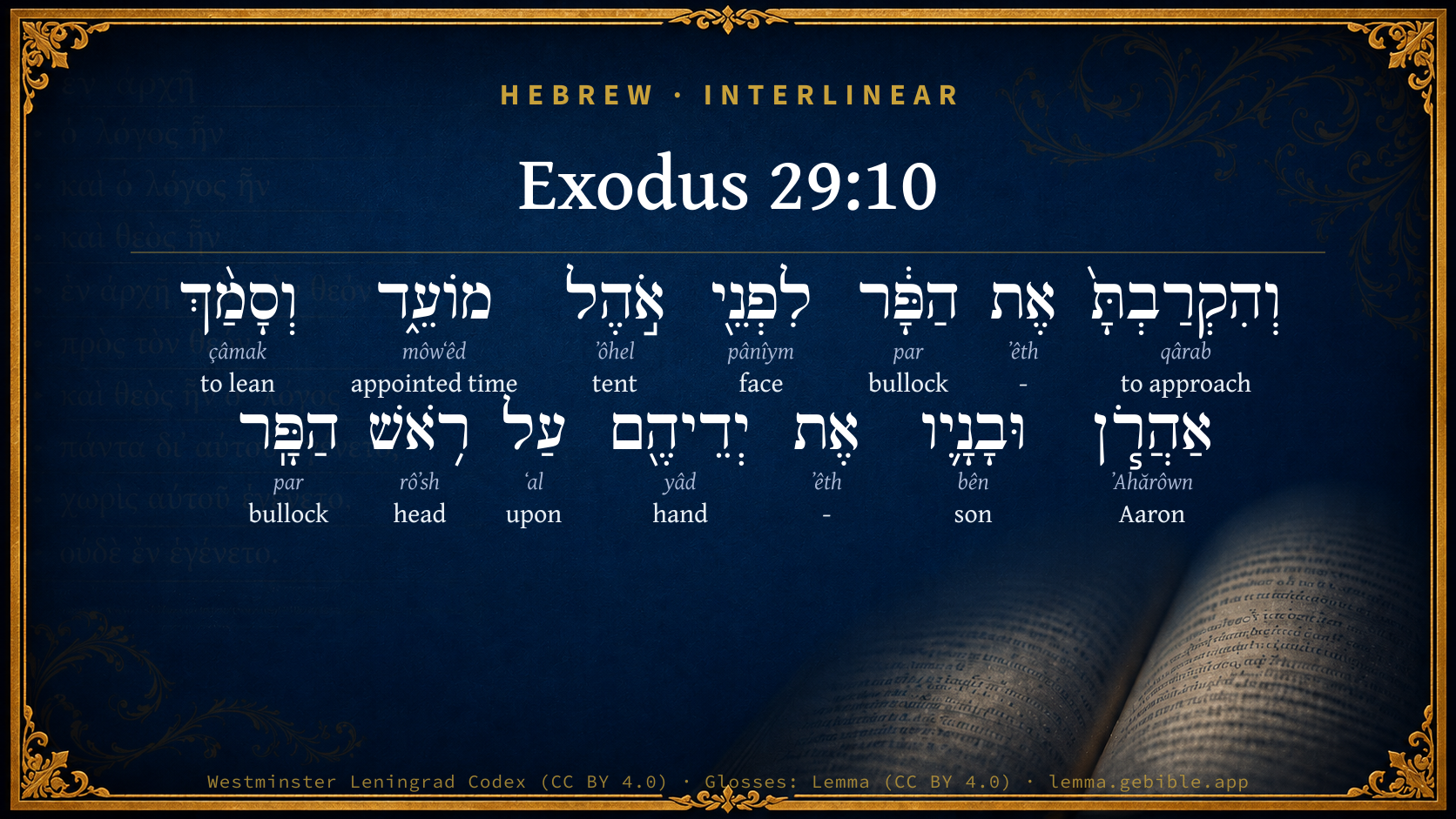
  1. וְהִקְרַבְתָּ֙ qârab H7126 “and · to approach” Conjunction + Verb, Hiphil, Sequential Perfect, 2nd Person, Masculine, Singular
  2. אֶת ʼêth H853 “-” Particle, Direct Object
  3. הַפָּ֔ר par H6499 “the · bullock” Particle, Definite Article + Noun, Common, Masculine, Singular, Absolute
  4. לִפְנֵ֖י pânîym H6440 “to/for · face(s) of” Preposition + Noun, Common, Both, Plural, Construct
  5. אֹ֣הֶל ʼôhel H168 “tent of” Noun, Common, Masculine, Singular, Construct
  6. מוֹעֵ֑ד môwʻêd H4150 “appointed time” Noun, Common, Masculine, Singular, Absolute
  7. אַהֲרֹ֧ן ʼAhărôwn H175 “Aaron” Noun, Proper
  8. וּבָנָ֛יו bên H1121 “and · sons · his” Conjunction + Noun, Common, Masculine, Plural, Construct + Suffix, Personal, 3rd Person, Masculine, Singular
  9. אֶת ʼêth H853 “-” Particle, Direct Object
  10. יְדֵיהֶ֖ם yâd H3027 “hands · their” Noun, Common, Both, Dual, Construct + Suffix, Personal, 3rd Person, Masculine, Plural
  11. עַל ʻal H5921 “upon” Preposition
  12. רֹ֥אשׁ rôʼsh H7218 “head of” Noun, Common, Masculine, Singular, Construct
  13. הַפָּֽר par H6499 “the · bullock” Particle, Definite Article + Noun, Common, Masculine, Singular, Absolute

About this verse

These counts appear in no published source. They are computed here, from the morphology-tagged text and Lemma’s own curated glosses. What Lemma adds →

14
words
12
distinct lemmas
Pentateuch
section

Shared distinctive vocabulary

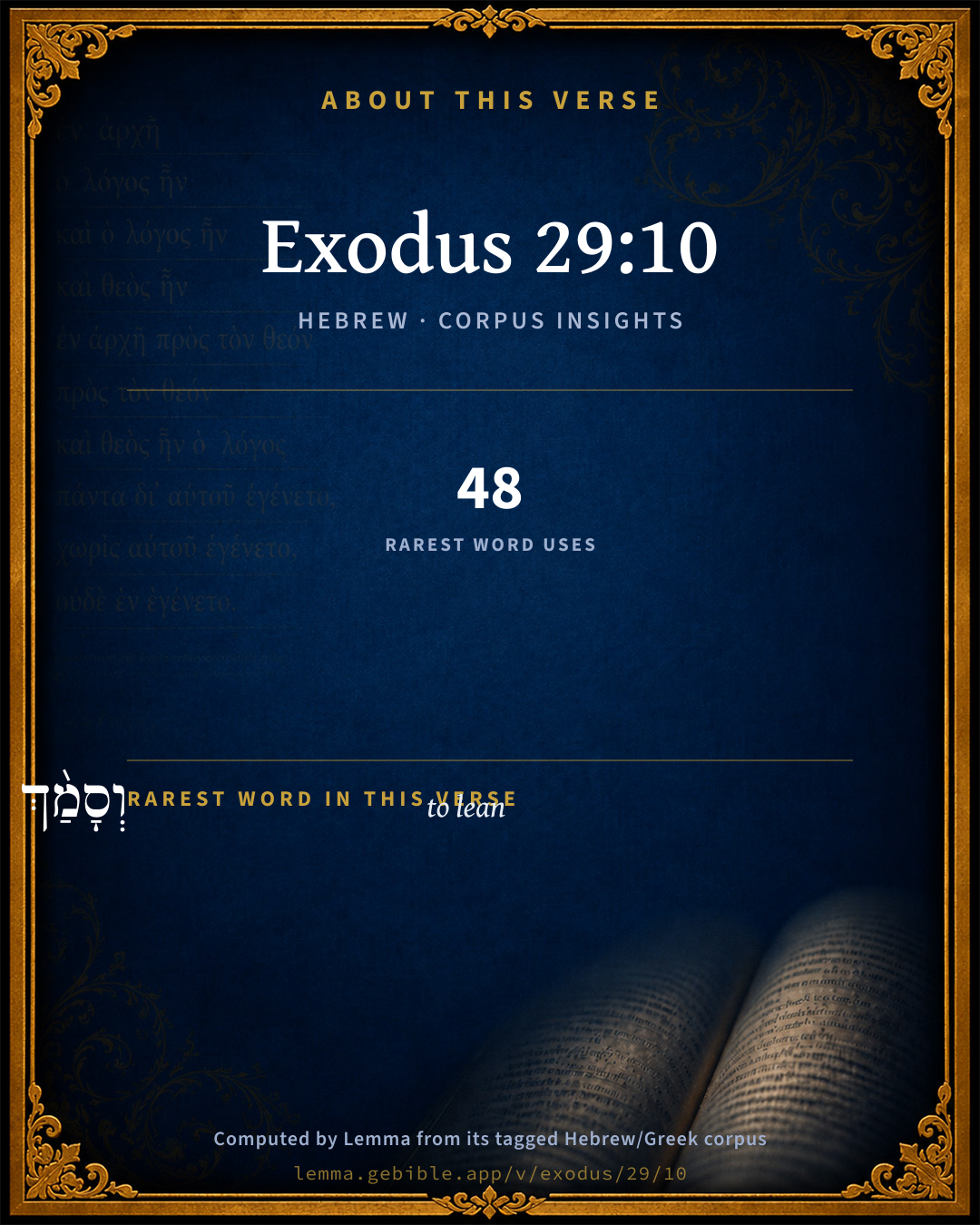
וְסָמַ֨ךְ to lean H5564 occurs in 47 verses of the Hebrew Bible. Also found in:

Grammatical profile

  • 2 verbs
  • 9 nouns
  • 1 preposition
  • 2 particles

Verb forms

  • וְהִקְרַבְתָּ֙ Hiphil · Sequential Perfect
  • וְסָמַ֨ךְ Qal · Sequential Perfect

Repetition

A word recurs within this verse — often emphatic in Hebrew:

  • הַפָּ֔ר bullock H6499 ×2

Hebrew & Septuagint length

In English translation the verse runs 25 words from the Hebrew and 40 from the Septuagint (LXX English) — the Septuagint runs noticeably longer here. See the side-by-side →

A rough comparison of the two English renderings, which tokenize alike — not a word-level alignment.

Word counts can differ between the Hebrew and the Greek without any difference in meaning — e.g. the Hebrew direct-object marker אֵת has no separate Greek word, and Greek often adds the article ὁ.

Cross-references

9

Topical passages linked to Exodus 29:10 in the Treasury of Scripture Knowledge — connected by theme and wording, ordered by reader-vote popularity; previews shown in the World English Bible.

  • Leviticus 1:4 He shall lay his hand on the head of the burnt offering, and it shall be accepted for him to make atonement for him.
  • Leviticus 8:14 He brought the bull of the sin offering, and Aaron and his sons laid their hands on the head of the bull of the sin offering.
  • Exodus 29:15 "You shall also take the one ram; and Aaron and his sons shall lay their hands on the head of the ram.
  • Exodus 29:19 "You shall take the other ram; and Aaron and his sons shall lay their hands on the head of the ram.
  • Leviticus 3:2 He shall lay his hand on the head of his offering, and kill it at the door of the tent of meeting: and Aaron's sons the priests shall sprinkle the blood on the altar round about.
  • Leviticus 8:18 He presented the ram of the burnt offering: and Aaron and his sons laid their hands on the head of the ram.
  • Leviticus 16:21 Aaron shall lay both his hands on the head of the live goat, and confess over him all the iniquities of the children of Israel, and all their transgressions, even all their sins; and he shall put them on the head of the goat, and shall send him away into the wilderness by the hand of a man who is in readiness.
  • Isaiah 53:6 All we like sheep have gone astray; everyone has turned to his own way; and Yahweh has laid on him the iniquity of us all.
  • 2 Corinthians 5:21 For him who knew no sin he made to be sin on our behalf; so that in him we might become the righteousness of God.

Cross-references courtesy of OpenBible.info (CC BY 4.0).

Hebrew and Greek witnesses Masoretic Hebrew ↔ Greek Septuagint

The same verse in the two great witnesses to the Old Testament, shown verse-for-verse.

Here the Septuagint runs noticeably longer than the Hebrew — LXX2012 (modern English Septuagint) 40 words vs World English Bible 25. A rough length comparison of the two English translations, not a word-level alignment — read both below.

These are two independent witnesses, not word-aligned to each other, and the Septuagint is shown in lemma (dictionary) form.

Hebrew Exodus 29:10 Masoretic · Westminster Leningrad Codex

וְהִקְרַבְתָּ֙ אֶת הַפָּ֔ר לִפְנֵ֖י אֹ֣הֶל מוֹעֵ֑ד וְסָמַ֨ךְ אַהֲרֹ֧ן וּבָנָ֛יו אֶת יְדֵיהֶ֖ם עַל רֹ֥אשׁ הַפָּֽר

"You shall bring the bull before the tent of meeting: and Aaron and his sons shall lay their hands on the head of the bull.

World English Bible · Public Domain

Greek LXX Exodus 29:10 Septuagint · lemma form

καί προςἄγω ὁ μόσχος ἐπί ὁ θύρα ὁ σκηνή ὁ μαρτύριον καί ἐπιτίθημι ααρων καί ὁ υἱός αὐτός ὁ χείρ αὐτός ἐπί ὁ κεφαλή ὁ μόσχος ἔναντι κύριος παρά ὁ θύρα ὁ σκηνή ὁ μαρτύριον

And you shall bring the calf to the door of the tabernacle of witness; and Aaron and his sons shall lay their hands on the head of the calf, before the Lord, by the doors of the tabernacle of witness.

LXX2012 (modern English Septuagint) · Public Domain

Hebrew: Westminster Leningrad Codex (CC BY 4.0). Greek: Septuagint (public domain); English from LXX2012 (modern English Septuagint) (Public Domain). How the Septuagint differs from the Hebrew →

Targum (Aramaic paraphrase)

2

The Targum is the ancient Jewish Aramaic paraphrase of the Hebrew Scriptures — an interpretive translation, not the Hebrew text itself. Onkelos (literal) and Pseudo-Jonathan (expansive) render the Torah, and Jonathan the Prophets. Coverage is partial: where no permissively-licensed English translation exists for a verse, only the Aramaic is shown. This is verse-level text, not a word-by-word alignment to the Hebrew.

  1. Targum Onkelos Torah (Genesis–Deuteronomy)
    וּתְקָרֵב יָת תּוֹרָא לִקֳדָם מַשְׁכַּן זִמְנָא וְיִסְמוֹךְ אַהֲרֹן וּבְנוֹהִי יָת יְדֵיהוֹן עַל רֵישׁ תּוֹרָא:

    (no public-domain English translation for this verse)

    Targum Onkelos — Aramaic: “Onkelos Genesis” (public domain); “Onkelos Exodus” (public domain); “Onkelos Leviticus” (public domain); “Onkelos Numbers” (public domain); “Onkelos Deuteronomy” (public domain). English: “Sefaria Community Translation” (CC0 1.0 (public-domain dedication)); “J.W. Etheridge. The Targums of Onkelos and Jonathan Ben Uzziel on the Pentateuch. London: Longmans, Green, 1862” (public domain). Text via Sefaria.

  2. Targum Pseudo-Jonathan Torah (Genesis–Deuteronomy)
    וְתַקְרֵיב יַת תּוֹרָא קֳדָם מַשְׁכַּן זִמְנָא וְיִסְמוֹךְ אַהֲרן וּבְנוֹי יַת יְדֵיהוֹן עַל רֵישׁ תּוֹרָא

    And thou shalt bring the bullock before the tabernacle of ordinance, and Aharon and his sons shall lay their hands upon the head of the bullock,

    Targum Pseudo-Jonathan — Aramaic: “Targum Jonathan on Genesis” (public domain); “Targum Jonathan on Exodus” (public domain); “Targum Jonathan on Leviticus” (public domain); “Targum Jonathan on Numbers” (public domain); “Targum Jonathan on Deuteronomy” (public domain). English: “The Targum of Jonathan ben Uzziel, trans. J. W. Etheridge, London, 1862” (public domain). Text via Sefaria.

Commentary

Notes on Exodus 29:10 from classic Christian and Jewish commentators (each source and its license shown beneath its notes). The classic Christian expositions comment on the surrounding passage and are grouped to its opening verse, so a note may address several verses; the Jewish commentaries on the Tanakh (Rashi and others) are per-verse, so they appear only where the commentator wrote on this verse.

Lemma curates 59 commentaries, every one of them public domain or Creative Commons licensed, each selected and text-cleaned for this edition rather than reprinted as found. About our sources →

Trapp's Complete Commentary

John Trapp

Exo 29:10 And thou shalt cause a bullock to be brought before the tabernacle of the congregation: and Aaron and his sons shall put their hands upon the head of the bullock.

Ver. 10. Shall put their hands.] As transferring the guilt of their sins upon Christ. {Isa 53:6}

John Trapp, A Commentary or Exposition upon All the Books of the Old and New Testament (1647–1656) — public domain. Text from a community e-Sword module.

The Biblical Illustrator

Joseph S. Exell

Exo_29:10

The Tabernacle of the congregation.

The tent of meeting

The Tabernacle of the congregation--or, rather, tent of meeting--was the place where Gods presence was manifested. This was granted to the people of Israel, first in the pillar of fire and cloud, then in the Tabernacle and Temple. And now for us in Jesus Christ there is God manifested in the flesh.

I. In and through Christ God is revealed.

II. Through Him and by Him the Lord God is approached.

1. We have the right of approach through Jesus Christ. His life embodied a perfect righteousness. His death is the accepted sacrifice.

2. We have not only the right of approach, but also the power to approach, sharing the Spirit of the Divine Redeemer; for the final result and crowning proof of our Lords exaltation was this--He sent the Comforter. (J. Aldis.)

The Biblical Illustrator, edited by Joseph S. Exell (c. 1880s–1900s) — public domain. Text from a community e-Sword module.

Joseph Benson's Commentary

Exo 29:10. There must be a sin-offering to make atonement for them. The law made them priests that had infirmity; and therefore they must first offer for their own sins, before they could make atonement for the people, Heb 7:27-28. They were to put their hand on the head of their sacrifice; confessing that they deserved to die for their own sins, and desiring that the killing of the beast might be accepted as a vicarious satisfaction. It was used as other sin-offerings were; only, whereas the flesh of other sin-offerings was eaten by the priests, in token of the priests taking away the sins of the people, this was appointed to be all burned without the camp, to signify the imperfection of the legal dispensation, for the sins of the priests themselves could not be taken away by those sacrifices, but they must expect a better high-priest, and a better sacrifice.

Joseph Benson's Commentary on the Old and New Testaments (1811–1818) — public domain. Text from a community e-Sword module.

Tyndale Open Study Notes

Tyndale Open Resources

29:10-34 The consecration of the priesthood of Aaron involved a sin offering (29:10-14), a burnt offering (29:15-18), and an ordination offering (29:19-28). The same patterns established here are expanded to the regular offerings of the people (see 29:38-46; Lev 1–5). In all three cases, Aaron and his sons lay their hands on [the] head of the sacrificial animals (Exod 29:10, 15, 19), indicating that sin is a matter of life and death, and that it can only be removed by a death. Because it represents life, blood is prominent in these ceremonies (29:12, 16, 20, 21).

Tyndale Open Study Notes — © Tyndale Open Resources, licensed CC BY-SA 4.0. Text via the HelloAO Bible API.

Geneva Bible (1599)

Geneva Bible translators

Signifying that the sacrifice was also offered for them, and that they did approve it.

Geneva Bible (1599) marginal notes — public domain. Text via Bolls.life.

Jamieson, Fausset & Brown

Robert Jamieson, A. R. Fausset & David Brown

And thou shalt cause a bullock to be brought before the tabernacle--This part of the ceremonial consisted of three sacrifices: (1) The sacrifice of a bullock, as a sin offering; and in rendering it, the priest was directed to put his hand upon the head of his sacrifice, expressing by that act a consciousness of personal guilt, and a wish that it might be accepted as a vicarious satisfaction. (2) The sacrifice of a ram as a burnt offering (Exo 29:15-18). The ram was to be wholly burnt, in token of the priest's dedication of himself to God and His service. The sin offering was first to be presented, and then the burnt offering; for until guilt be removed, no acceptable service can be performed. (3) There was to be a peace offering, called "the ram of consecration" (Exo 29:19-22). And there was a marked peculiarity in the manner in which this other ram was to be disposed of. The former was for the glory of God--this was for the comfort of the priest himself; and as a sign of a mutual covenant being ratified, the blood of the sacrifice was divided--part sprinkled on the altar round about, and part upon the persons and garments of the priests. Nay, the blood was, by a singular act, directed to be put upon the extremities of the body, thereby signifying that the benefits of the atonement would be applied to the whole nature of man. Moreover, the flesh of this sacrifice was to be divided, as it were, between God and the priest--part of it to be put into his hand to be waved up and down, in token of its being offered to God, and then it was to be burnt upon the altar; the other part was to be eaten by the priests at the door of the tabernacle--that feast being a symbol of communion or fellowship with God. These ceremonies, performed in the order described, showed the qualifications necessary for the priests. (See Heb 7:26-27; Heb 10:14).

Jamieson, Fausset & Brown — Commentary Critical and Explanatory on the Whole Bible (1871) — public domain (CC PDM 1.0). Text via the HelloAO Bible API.

Adam Clarke's Commentary

Verse 10. Shall put their hands upon the head of the bullock.] By this rite the animal was consecrated to God, and was then proper to be offered in sacrifice. Imposition of hands also signified that they offered the life of this animal as an atonement for their sins, and to redeem their lives from that death which, through their sinfulness, they had deserved. In the case of the sin-offering and trespass-offering, the person who brought the sacrifice placed his hands on the head of the animal between the horns, and confessed his sin over the sin-offering, and his trespass over the trespass-offering, saying, "I have sinned, I have done iniquity; I have trespassed, and have done thus and thus; and do return by repentance before thee, and with this I make atonement." Then the animal was considered as vicariously bearing the sins of the person who brought it. - Ex 29:14

Adam Clarke's Commentary on the Bible (1810–1826) — public domain. Text from a community e-Sword/MySword module.

Ellicott's Commentary for English Readers

(10) Thou shalt cause a bullock to be brought.—Rather, the bullock: i.e., the bullock mentioned in Exo_29:1, which was to be kept in readiness for the consecration sacrifice.

Aaron and his sons shall put their hands upon the head of the bullock.—By this symbolical action, which was commanded in the case of every sin offering (Lev_4:4; Lev_4:15; Lev_4:24; Lev_4:29; Lev_4:33; Lev_16:21, &c.), the offerer identified himself with the animal, and transferred to it the guilt of his own sins and imperfections. The animal thereby became accursed, and its death paid the penalty due to the sins laid upon it, and set free those who had committed them. Similarly, Christ, our sin offering, was “made a curse for us” (Gal_3:13).

A Bible Commentary for English Readers, edited by Charles John Ellicott (1878–1897) — public domain. Text from a community e-Sword module.

The Cambridge Bible for Schools and Colleges

gen. ed. J. J. S. Perowne

10. lay their hands upon] to mark it formally as their sacrifice: see on Lev_1:4; and cf. (in the ritual of the sin-offering) Lev_4:4.

10–14. The sin-offering (see on Leviticus 4.) for Aaron and his sons (Lev_8:14-17).

The Cambridge Bible for Schools and Colleges (gen. ed. J. J. S. Perowne; Cambridge University Press, 1878–1918) — public domain. Text from a community e-Sword module.

John Gill's Exposition

And thou shalt cause a bullock to be brought before the tabernacle of the congregation,.... The same, or of the same kind he was ordered to take, Exo 29:1, and here the place is expressed where it was to be taken, and what was to be done with it:

and Aaron and his sons shall put their hands upon the head of the bullock; not Aaron first alone, and then his sons, as some have thought, Aben Ezra makes mention of; but, as he says, both together, not one before another; declaring it to be their sacrifice, a vicarious one, one in their room and stead, signifying that they deserved to die as that creature would; and by this act putting, as it were, their sins and transgressions upon it, see Lev 16:21 and which was an emblem of the imputation of sin to Christ, and laying upon him the iniquities of us all.

John Gill's Exposition of the Whole Bible (1746–1763) — public domain (CC PDM 1.0). Text via the HelloAO Bible API.

Haydock's Catholic Bible Commentary

Head. Confessing that they are sinners, and deserve to die. Thus they shall substitute the victim instead of themselves, and obtain pardon. In the holocaust, (ver. 15,) and the peace-offering, (ver. 19,) they impose their hands, having first washed them) and pronounce some prayer. (Calmet)

George Leo Haydock (1774–1849), Haydock's Catholic Family Bible and Commentary, 1859 edition — public domain. Excludes Psalms (Douay-Rheims chapter numbering differs from Protestant) and Deuterocanonical books (Catholic canon only).

Matthew Poole's English Annotations

To signify that they offered it for themselves and for their own sins, which the offerer performing this rite was to confess, Lev 16:21, that they acknowledged themselves to deserve that death which was inflicted upon this innocent creature for their sakes, and to testify their faith in the future sacrifice of Christ, upon whom their sins were to be laid, and by whose blood they were expiated, and that they humbly begged God’s mercy in pardoning their sins, and accepting them to and in their holy office.

Matthew Poole's English Annotations on the Holy Bible (1683–1685) — public domain. Text from a community e-Sword/MySword module.

Whedon's Commentary on the Bible

Daniel D. Whedon

10. Cause a bullock to be brought — Rather, as the Revised Version, thou shalt bring the bullock, that is, the bullock mentioned in Exo_29:1. This was to be a sin-offering for Aaron and his sons. Comp. Lev_4:3-12, notes.

Put their hands upon the head — Thus symbolically confessing their sins and transferring them to the substituted victim. See notes on Lev_1:4; Lev_4:4.

Daniel D. Whedon (gen. ed.), Commentary on the Old and New Testaments (1874–1909) — public domain. Text from a community e-Sword module.

The Pulpit Commentary

Vers. 10-34. The Consecration Offerings.

Thou shalt cause a bullock to be brought. Rather, the bullock,i.e. , "the bullock mentioned in ver. 1, which was to be made ready before the ceremonies commenced." Aaron and his sons were to put their hands upon the head of the bullock, in order to identify themselves with it, and transfer to it the guilt of their own sins and imperfections, since it was to be a "sin-offering". (ver. 14; compare Lev_4:4)

The Pulpit Commentary (1880–1919), ed. H.D.M. Spence-Jones & Joseph S. Exell — public domain. Text from a community e-Sword module.

John Wesley's Explanatory Notes

There must be a sin-offering, to make atonement for them. The law made them priests that had infirmity; and therefore they must first offer for their own sin, before they could make atonement for the people, Heb. vii, 27, 28. They were to put their hand on the head of their sacrifice; confessing that they deserved to die for their own sin, and desiring that the killing of the beast might be accepted as a vicarious satisfaction. It was used as other sin-offerings were; only, whereas the flesh of other sin-offerings was eaten by the priests, in token of the priests taking away the sin of the people, this was appointed to be all burnt without the camp, to signify the imperfection of the legal dispensation, for the sins of the priests themselves could not be taken away by those sacrifices, but they must expect a better high priest, and a better sacrifice.

John Wesley, Explanatory Notes Upon the Whole Bible (1754–1765) — public domain. Text via the GEBible commentary corpus.

Scofield Reference Notes

C. I. Scofield

put their hands

(See Scofield "Lev 1:4")

The Scofield Reference Bible (1917 edition), notes by C. I. Scofield — public domain. Text from a community e-Sword module.

unfoldingWord translationNotes

Door43 World Missions Community

General Information:

Yahweh continues speaking to Moses.

tent of meeting

This is another name for the tabernacle. See how you translated this in Exodus 27:21.

You must kill the bull

The bull offering was to be killed by Moses, not the priests, at the doorway, not inside the tent of meeting.

kill the bull

Since the following verses will tell what to do with the blood from the bull, use a term for "kill" that will imply a method similar to "slitting its throat and catch the blood in a bowl." (See: Assumed Knowledge and Implicit Information)

translationWords

cow

tent of meeting

Aaron

hand

Yahweh

unfoldingWord translationNotes — © Distant Shores Media and the Door43 World Missions Community, licensed CC BY-SA 4.0. Source: git.door43.org/Door43/en_tn.

Ramban (Nachmanides)

Rabbi Moshe ben Nachman (Ramban / Nachmanides)

AND THOU SHALT BRING THE BULLOCK BEFORE THE TENT OF MEETING; AND AARON AND HIS SONS SHALL LAY THEIR HANDS UPON THE HEAD OF THE BULLOCK. Rabbi Abraham ibn Ezra commented, that the meaning of it is that when you will bring the bullock before the Tent of Meeting, Aaron and his sons shall lay their hands upon it, for [the bringing of the bullock] has already been mentioned above. The correct interpretation appears to me to be as I have explained, that above He commanded to bring them but did not explain “to the Tent of Meeting,” but only that he bring them; the purport being that he bring them to the place of the priests so that they be ready [for sacrifice], thus it would be sufficient that they be before the door of the court of the Tabernacle. But now He required that they be brought before the Tent of Meeting, to the door of the Tent, as He will explain in connection with the slaughtering thereof, for it is there that the laying of hands will take place.

Ramban (Nachmanides) on the Tanakh — English translation: “Commentary on the Torah by Ramban (Nachmanides). Translated and annotated by Charles B. Chavel. New York, Shilo Pub. House, 1971-1976” (CC BY 4.0). Text via Sefaria.

Lesson kit

Teaching starters — assembled from the data on this page, not authored interpretation. Every prompt links to the verse data it draws on. Edit before teaching.

Exodus, in the Pentateuch, opens this verse with 14 words (12 distinct Hebrew lemmas). Its most distinctive word is çâmak (“to lean”). The Greek Septuagint runs longer here. A historical commentator’s framing appears above. Read the whole chapter for the surrounding context.

Discussion questions

  1. How does “to lean” (çâmak) shape what this verse is saying?
  2. Genesis 27:37 shares the word «to lean» with this verse. How do the two illuminate each other?
  3. “bullock” occurs 2× in this one verse. What is the effect of the repetition?
  4. Compared with the Hebrew, the Septuagint runs longer here. What questions does that raise?
  5. These translations render this verse differently. What is at stake in choosing one wording over another?
  6. The verb «וְהִקְרַבְתָּ֙» is Hiphil Sequential Perfect. How does its form color the action?
  7. Reading how Trapp's Complete Commentary and The Biblical Illustrator read this verse, where do the two commentators agree and where do they part?

Things to notice

Reading settings

Reading text

Shown beneath each verse's original-language words.

Old Testament
Old Testament edition

Read the OT as the Masoretic Hebrew (MT) or the Greek Septuagint (LXX).

English shown for the Greek Septuagint (in the Hebrew ↔ Greek comparison).

Comparing translations? Open the Compare panel on any verse page to stack up to four side by side.