
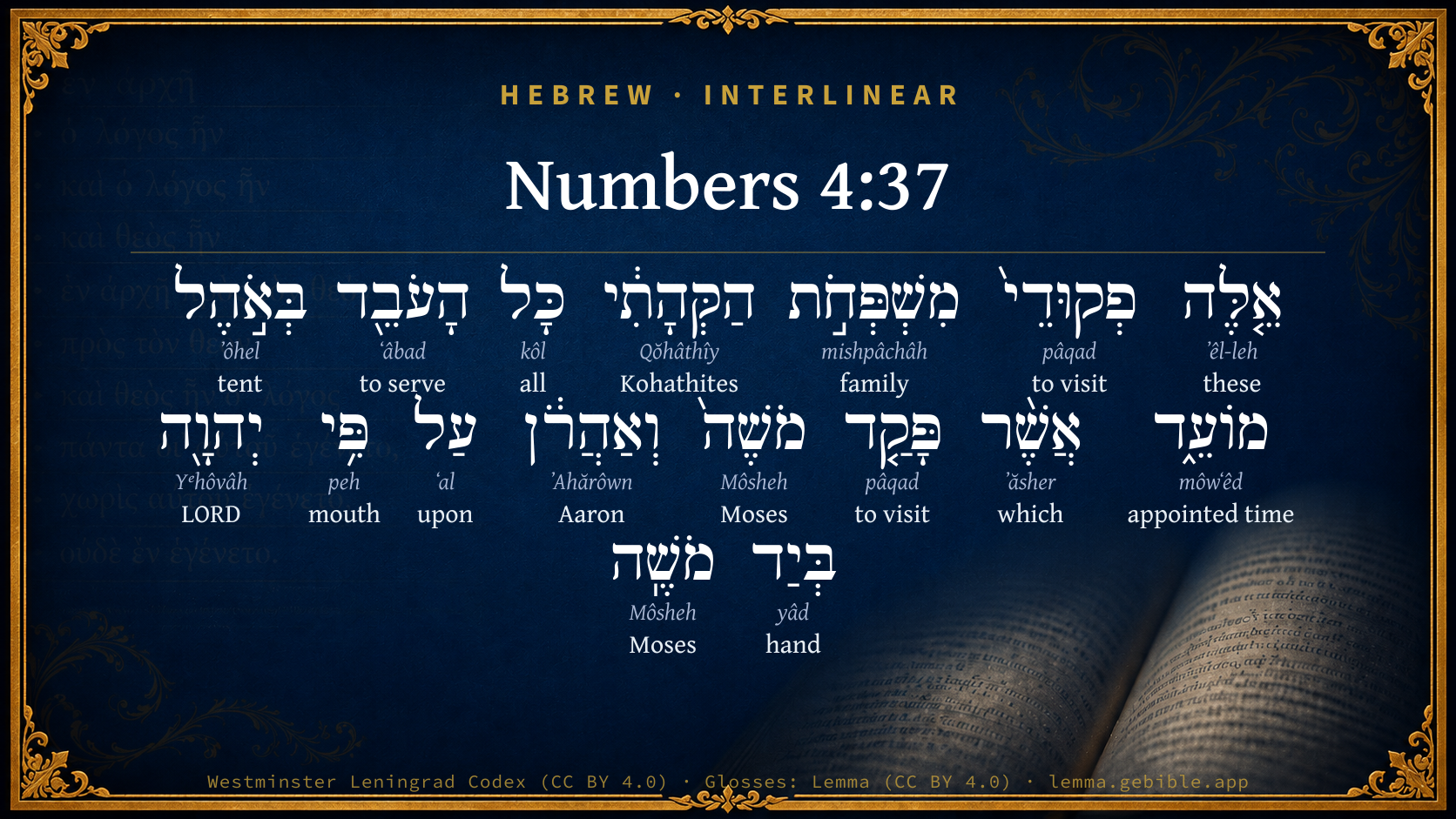
Numbers 4:37

Hebrew (Westminster Leningrad Codex) Numbers 4:37 appears in the Hebrew Old Testament. The text above is from the Westminster Leningrad Codex. Each word links to its Strong’s number, a concise gloss, and parsing drawn from the Open Scriptures Hebrew Bible morphology. Click any word for its full Brown-Driver-Briggs (BDB) entry.
Download image
Cite this verse

Numbers 4:37 (World English Bible). Public Domain. Lemma interlinear Bible study tool, https://lemma.gebible.app/v/numbers/4/37.

Show BibTeX & RIS
BibTeX
RIS
English Translation
These are those who were numbered of the families of the Kohathites, all who served in the Tent of Meeting, whom Moses and Aaron numbered according to the commandment of Yahweh by Moses.
World English Bible · Public Domain
Download a study sheet

One document with this verse’s original text, its word-by-word gloss line, the meaning frame, cross-references with their text, attributed commentary, and full source and license credits — printable, and it pastes into notes with its structure intact.

This verse Autodidact and up

Study sheet (.html) Plain text (.txt)

A passage Seminary Student

Up to 50 verses in one chapter. A passage sheet keeps up to 6 commentary sources and 12 cross-references per verse, in the order this page ranks them, and says so on the sheet whenever that leaves anything out. Ask for a single verse and you get the Autodidact verse sheet above.

Everything on this page stays free to read, with no account — the sheet is a download of what is already on screen, not access to it.

Want to remove ads? Support Godless Engineer
Compare translations 3

The same verse in 3 English versions, stacked beneath the original-language interlinear above. Click any original word for its lexicon entry.

Each is an independent rendering of the whole verse — the interlinear is not word-aligned to these translations.

Highlighted words mark where these versions differ — a whole-verse word diff, not a word-by-word alignment.

  • World English Bible Public Domain
    These are those who were numbered of the families of the Kohathites, all who served in the Tent of Meeting, whom Moses and Aaron numbered according to the commandment of Yahweh by Moses.
  • King James Version Public Domain
    These were they that were numbered of the families of the Kohathites, all that might do service in the tabernacle of the congregation, which Moses and Aaron did number according to the commandment of the LORD by the hand of Moses.
  • unfoldingWord Literal Text CC BY-SA 4.0
    These the counted ones of the clans of the Kohathite, everyone who serves in the tent of meeting, whom Moses and Aaron counted upon the mouth of Yahweh in the hand of Moses.

unfoldingWord Literal Text — © unfoldingWord, licensed CC BY-SA 4.0. Word-aligned USFM3 via Door43 (git.door43.org/unfoldingWord/en_ult).

Versions to compare (up to 4)

3 of 4 selected

Show all 18 translations

Every available English version of this verse, each an independent rendering of the whole verse.

  • World English Bible Public Domain
    These are those who were numbered of the families of the Kohathites, all who served in the Tent of Meeting, whom Moses and Aaron numbered according to the commandment of Yahweh by Moses.
  • Berean Standard Bible Public Domain
    These were counted from the Kohathite clans, everyone who could serve at the Tent of Meeting. Moses and Aaron numbered them according to the command of the LORD through Moses.
  • Majority Standard Bible Public Domain
    These were counted from the Kohathite clans, everyone who could serve at the Tent of Meeting. Moses and Aaron numbered them according to the command of the LORD through Moses.
  • King James Version Public Domain
    These were they that were numbered of the families of the Kohathites, all that might do service in the tabernacle of the congregation, which Moses and Aaron did number according to the commandment of the LORD by the hand of Moses.
  • American Standard Version (1901) Public Domain
    These are they that were numbered of the families of the Kohathites, all that did serve in the tent of meeting, whom Moses and Aaron numbered according to the commandment of Jehovah by Moses.
  • Revised Version (1885) Public Domain
    These are they that were numbered of the families of the Kohathites, all that did serve in the tent of meeting, whom Moses and Aaron numbered according to the commandment of the LORD by the hand of Moses.
  • Geneva Bible (1599) Public Domain
    These are the nombers of the families of the Kohathites, al that serue in the Tabernacle of the Congregation, which Moses and Aaron did nomber according to the commandement of the Lord by the hand of Moses.
  • Douay-Rheims (1899) Public Domain
    This is the number of the people of Caath that go in to the tabernacle of the covenant: these did Moses and Aaron number according to the word of the Lord by the hand of Moses.
  • Young's Literal Translation Public Domain
    These `are' those numbered of the families of the Kohathite, every one who is serving in the tent of meeting, whom Moses and Aaron numbered, by the command of Jehovah, by the hand of Moses.
  • Literal Standard Version CC BY-SA 4.0
    These [are] those numbered of the families of the Kohathite, everyone who is serving in the Tent of Meeting, whom Moses and Aaron numbered by the command of YHWH, by the hand of Moses.
  • Unlocked Literal Bible CC BY-SA 4.0
    Moses and Aaron counted all the men in the clans and families of the Kohathites who serve in the tent of meeting. In doing this, they obeyed what Yahweh had commanded them to do through Moses.
  • unfoldingWord Literal Text CC BY-SA 4.0
    These the counted ones of the clans of the Kohathite, everyone who serves in the tent of meeting, whom Moses and Aaron counted upon the mouth of Yahweh in the hand of Moses.
  • Darby Bible Public Domain
    These are they that were numbered of the families of the Kohathites, every one that served in the tent of meeting, whom Moses and Aaron numbered according to the commandment of Jehovah through Moses.
  • World Messianic Bible Public Domain
    These are those who were counted of the families of the Kohathites, all who served in the Tent of Meeting, whom Moses and Aaron counted according to the commandment of the LORD by Moses.
  • Webster's Bible Public Domain
    These were they that were numbered of the families of the Kohathites, all that might do service in the tabernacle of the congregation, whom Moses and Aaron numbered according to the commandment of the LORD by the hand of Moses.
  • Free Bible Version CC BY-SA 4.0
    This was the total of the families of Kohath—all who were entitled to do the work of serving in the Tent of Meeting. Moses and Aaron registered them in accordance with the Lord's instructions to Moses.
  • Bible in Basic English Public Domain
    This is the number of those of the Kohathites who did the work in the Tent of meeting, as they were numbered by Moses and Aaron at the order of the Lord.
  • JPS Tanakh (1917) Public Domain
    These are they that were numbered of the families of the Kohathites, of all that did serve in the tent of meeting, whom Moses and Aaron numbered according to the commandment of the LORD by the hand of Moses.

Literal Standard Version (2020), Covenant Press — licensed CC BY-SA 4.0. Text via the HelloAO Bible API (eBible.org). Unlocked Literal Bible (unfoldingWord) — licensed CC BY-SA 4.0. Text via the HelloAO Bible API (eBible.org). unfoldingWord Literal Text — © unfoldingWord, licensed CC BY-SA 4.0. Word-aligned USFM3 via Door43 (git.door43.org/unfoldingWord/en_ult). Free Bible Version, Dr. Jonathan Gallagher — licensed CC BY-SA 4.0. Text via the HelloAO Bible API (eBible.org).

Word by word

More ways to search: Search by grammar → Find every occurrence → Compare this word →

Practice this passage: Drill this verse → Learn its vocabulary →

הַקְּהָתִ֔י
Qŏhâthîy
H6956
“the · Kohathites”
Particle, Definite Article + Noun, Gentilic, Masculine, Singular, Absolute
Part of Speech
Particle + Noun
Type
Gentilic
Gender
Masculine
Number
Singular
State
Absolute
Full BDB Definition

Origin: patronymically from H6955

TWOT: None

Kohathites = see Kohath " assembly" - the descendants of Kohath, the 2nd son of Levi
  1. אֵ֤לֶּה ʼêl-leh H428 “these” Pronoun, Demonstrative, Common, Plural
  2. פְקוּדֵי֙ pâqad H6485 “visited” Verb, Qal, Participle Passive, Masculine, Plural, Construct
  3. מִשְׁפְּחֹ֣ת mishpâchâh H4940 “families of” Noun, Common, Feminine, Plural, Construct
  4. כָּל kôl H3605 “all of” Noun, Common, Masculine, Singular, Construct
  5. הָעֹבֵ֖ד ʻâbad H5647 “the · serving” Particle, Definite Article + Verb, Qal, Participle Active, Masculine, Singular, Absolute
  6. בְּאֹ֣הֶל ʼôhel H168 “in/at · tent of” Preposition + Noun, Common, Masculine, Singular, Construct
  7. מוֹעֵ֑ד môwʻêd H4150 “appointed time” Noun, Common, Masculine, Singular, Absolute
  8. אֲשֶׁ֨ר ʼăsher H834 “which” Particle, Relative
  9. פָּקַ֤ד pâqad H6485 “to visit” Verb, Qal, Perfect, 3rd Person, Masculine, Singular
  10. מֹשֶׁה֙ Môsheh H4872 “Moses” Noun, Proper
  11. וְאַהֲרֹ֔ן ʼAhărôwn H175 “and · Aaron” Conjunction + Noun, Proper
  12. עַל ʻal H5921 “upon” Preposition
  13. פִּ֥י peh H6310 “mouth of” Noun, Common, Masculine, Singular, Construct
  14. יְהוָ֖ה Yᵉhôvâh H3068 “LORD” Noun, Proper
  15. בְּיַד yâd H3027 “in/at · hand of” Preposition + Noun, Common, Both, Singular, Construct
  16. מֹשֶֽׁה Môsheh H4872 “Moses” Noun, Proper

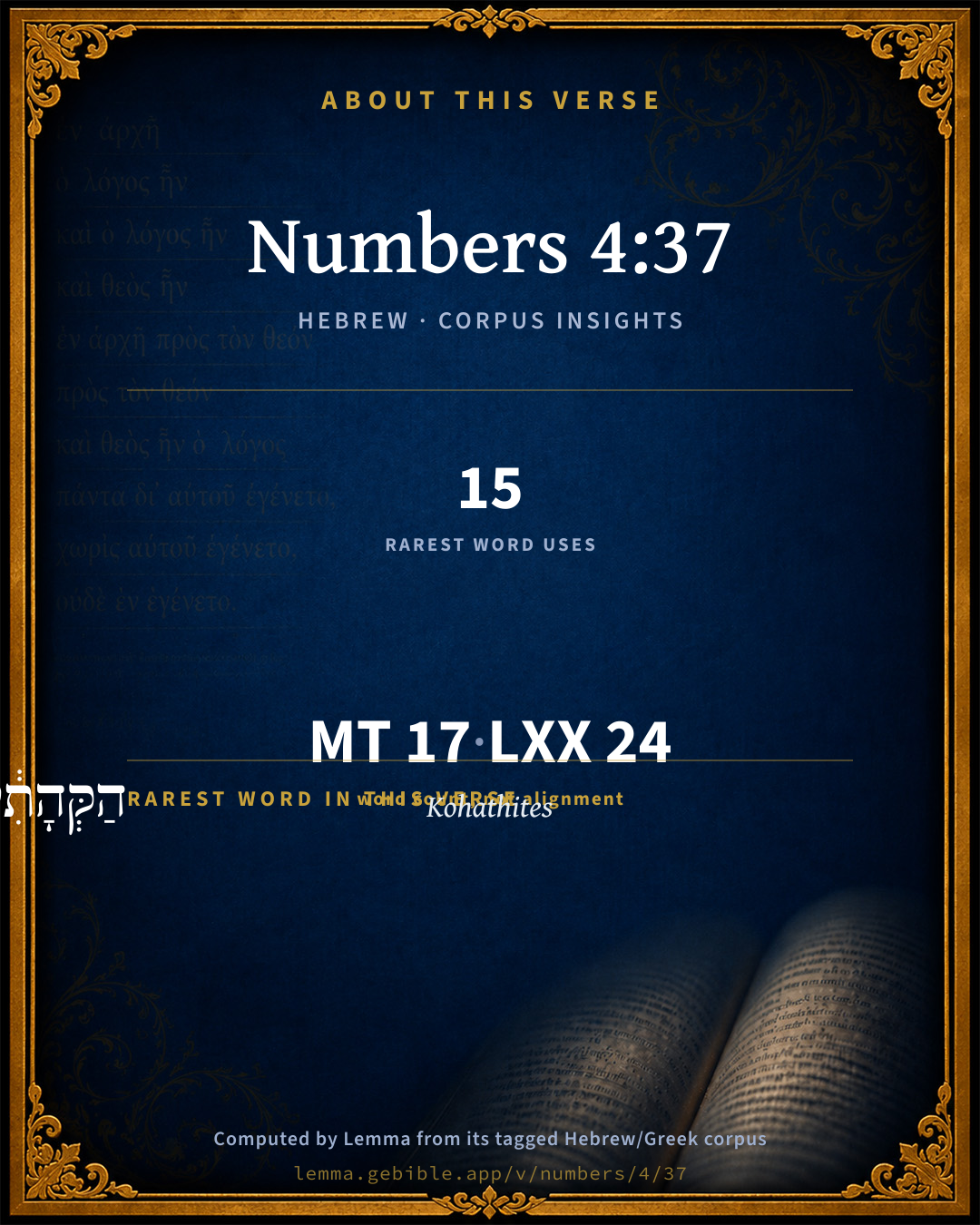
About this verse

These counts appear in no published source. They are computed here, from the morphology-tagged text and Lemma’s own curated glosses. What Lemma adds →

17
words
15
distinct lemmas
Pentateuch
section

Notable vocabulary

The rarest word here is הַקְּהָתִ֔י Kohathites H6956 — appearing just 15 times in the whole Hebrew Bible.

Shared distinctive vocabulary

הַקְּהָתִ֔י Kohathites H6956 occurs in 15 verses of the Hebrew Bible. Also found in:

Grammatical profile

  • 3 verbs
  • 11 nouns
  • 1 pronoun
  • 1 preposition
  • 1 particle

Verb forms

  • פְקוּדֵי֙ Qal · Participle Passive
  • הָעֹבֵ֖ד Qal · Participle Active
  • פָּקַ֤ד Qal · Perfect

Repetition

Words recur within this verse — often emphatic in Hebrew:

  • פְקוּדֵי֙ to visit H6485 ×2
  • מֹשֶׁה֙ Moses H4872 ×2

Hebrew & Septuagint length

In English translation the verse runs 33 words from the Hebrew and 35 from the Septuagint (LXX English) — closely comparable.

A rough comparison of the two English renderings, which tokenize alike — not a word-level alignment.

Word counts can differ between the Hebrew and the Greek without any difference in meaning — e.g. the Hebrew direct-object marker אֵת has no separate Greek word, and Greek often adds the article ὁ.

In the original languages it is 17 Hebrew tokens and 24 Greek tokens — but the two are counted differently (Hebrew bundles its prefixes and suffixes into one token; the Greek is in lemma form), so that isn’t a like-for-like length.

Hebrew and Greek witnesses Masoretic Hebrew ↔ Greek Septuagint

The same verse in the two great witnesses to the Old Testament, shown verse-for-verse.

These are two independent witnesses, not word-aligned to each other, and the Septuagint is shown in lemma (dictionary) form.

Hebrew Numbers 4:37 Masoretic · Westminster Leningrad Codex

אֵ֤לֶּה פְקוּדֵי֙ מִשְׁפְּחֹ֣ת הַקְּהָתִ֔י כָּל הָעֹבֵ֖ד בְּאֹ֣הֶל מוֹעֵ֑ד אֲשֶׁ֨ר פָּקַ֤ד מֹשֶׁה֙ וְאַהֲרֹ֔ן עַל פִּ֥י יְהוָ֖ה בְּיַד מֹשֶֽׁה

These are those who were numbered of the families of the Kohathites, all who served in the Tent of Meeting, whom Moses and Aaron numbered according to the commandment of Yahweh by Moses.

World English Bible · Public Domain

Greek LXX Numbers 4:37 Septuagint · lemma form

οὗτος ὁ ἐπίσκεψις δῆμος κααθ πᾶς ὁ λειτουργέω ἐν ὁ σκηνή ὁ μαρτύριον καθά ἐπισκέπτω μωυσῆς καί ἀαρών διά φωνή κύριος ἐν χείρ μωυσῆ

This is the numbering of the family of Caath, every one that ministers in the tabernacle of witness, as Moses and Aaron numbered them by the word of the Lord, by the hand of Moses.

LXX2012 (modern English Septuagint) · Public Domain

Hebrew: Westminster Leningrad Codex (CC BY 4.0). Greek: Septuagint (public domain); English from LXX2012 (modern English Septuagint) (Public Domain). How the Septuagint differs from the Hebrew →

Targum (Aramaic paraphrase)

2

The Targum is the ancient Jewish Aramaic paraphrase of the Hebrew Scriptures — an interpretive translation, not the Hebrew text itself. Onkelos (literal) and Pseudo-Jonathan (expansive) render the Torah, and Jonathan the Prophets. Coverage is partial: where no permissively-licensed English translation exists for a verse, only the Aramaic is shown. This is verse-level text, not a word-by-word alignment to the Hebrew.

  1. Targum Onkelos Torah (Genesis–Deuteronomy)
    אִלֵין מִנְיָנֵי זַרְעֲיַת קְהָת כָּל דְפָלַח בְּמַשְׁכַּן זִמְנָּא דִי מְנָא משֶׁה וְאַהֲרֹן עַל מֵימְרָא דַיְיָ בִּידָא דְמשֶׁה

    (no public-domain English translation for this verse)

    Targum Onkelos — Aramaic: “Onkelos Genesis” (public domain); “Onkelos Exodus” (public domain); “Onkelos Leviticus” (public domain); “Onkelos Numbers” (public domain); “Onkelos Deuteronomy” (public domain). English: “Sefaria Community Translation” (CC0 1.0 (public-domain dedication)); “J.W. Etheridge. The Targums of Onkelos and Jonathan Ben Uzziel on the Pentateuch. London: Longmans, Green, 1862” (public domain). Text via Sefaria.

  2. Targum Pseudo-Jonathan Torah (Genesis–Deuteronomy)
    אִלֵין מִנְיַן סְכוּמֵי גְנִיסַת קְהָת כָּל דְפָלַח בְּמַשְׁכַּן זִמְנָא דִי מְנָא משֶׁה וְאַהֲרן עַל פּוּם מֵימְרָא דַיְיָ בִּידָא דְמשֶׁה

    These are the numbers of the family of Kehath, of all who ministered in the tabernacle of ordinance; whom Mosheh and Aharon numbered upon the mouth of the Word of the Lord by Mosheh.

    Targum Pseudo-Jonathan — Aramaic: “Targum Jonathan on Genesis” (public domain); “Targum Jonathan on Exodus” (public domain); “Targum Jonathan on Leviticus” (public domain); “Targum Jonathan on Numbers” (public domain); “Targum Jonathan on Deuteronomy” (public domain). English: “The Targum of Jonathan ben Uzziel, trans. J. W. Etheridge, London, 1862” (public domain). Text via Sefaria.

Commentary

Notes on Numbers 4:37 from classic Christian and Jewish commentators (each source and its license shown beneath its notes). The classic Christian expositions comment on the surrounding passage and are grouped to its opening verse, so a note may address several verses; the Jewish commentaries on the Tanakh (Rashi and others) are per-verse, so they appear only where the commentator wrote on this verse.

Lemma curates 59 commentaries, every one of them public domain or Creative Commons licensed, each selected and text-cleaned for this edition rather than reprinted as found. About our sources →

Geneva Bible (1599)

Geneva Bible translators

God appointing Moses to be the minister and executor thereof.

Geneva Bible (1599) marginal notes — public domain. Text via Bolls.life.

John Gill's Exposition

These be those that were numbered of the families of the sons of Merari,.... See Gill on Num 4:34;

;

Numbers 4:46

num 4:46

num 4:46

num 4:46All those that were numbered of the Levites, whom Moses and Aaron and the chief of Israel numbered,.... See Gill on Num 3:34.

John Gill's Exposition of the Whole Bible (1746–1763) — public domain (CC PDM 1.0). Text via the HelloAO Bible API.

unfoldingWord translationNotes

Door43 World Missions Community

translationWords

tent of meeting

obey

Yahweh

command

unfoldingWord translationNotes — © Distant Shores Media and the Door43 World Missions Community, licensed CC BY-SA 4.0. Source: git.door43.org/Door43/en_tn.

Lesson kit

Teaching starters — assembled from the data on this page, not authored interpretation. Every prompt links to the verse data it draws on. Edit before teaching.

Numbers, in the Pentateuch, opens this verse with 17 words (15 distinct Hebrew lemmas). Its most distinctive word is Qŏhâthîy (“Kohathites”). A historical commentator’s framing appears above. Read the whole chapter for the surrounding context.

Discussion questions

  1. How does “Kohathites” (Qŏhâthîy) shape what this verse is saying?
  2. Numbers 3:27 shares the word «Kohathites» with this verse. How do the two illuminate each other?
  3. “to visit” occurs 2× in this one verse. What is the effect of the repetition?
  4. These translations render this verse differently; the difference is in the English rendering, not the original. What questions does that raise?
  5. The verb «פְקוּדֵי֙» is Qal Participle Passive. How does its form color the action?
  6. Reading how Geneva Bible (1599) and John Gill's Exposition read this verse, where do the two commentators agree and where do they part?

Things to notice

Reading settings

Reading text

Shown beneath each verse's original-language words.

Old Testament
Old Testament edition

Read the OT as the Masoretic Hebrew (MT) or the Greek Septuagint (LXX).

English shown for the Greek Septuagint (in the Hebrew ↔ Greek comparison).

Comparing translations? Open the Compare panel on any verse page to stack up to four side by side.