Leviticus 14:11

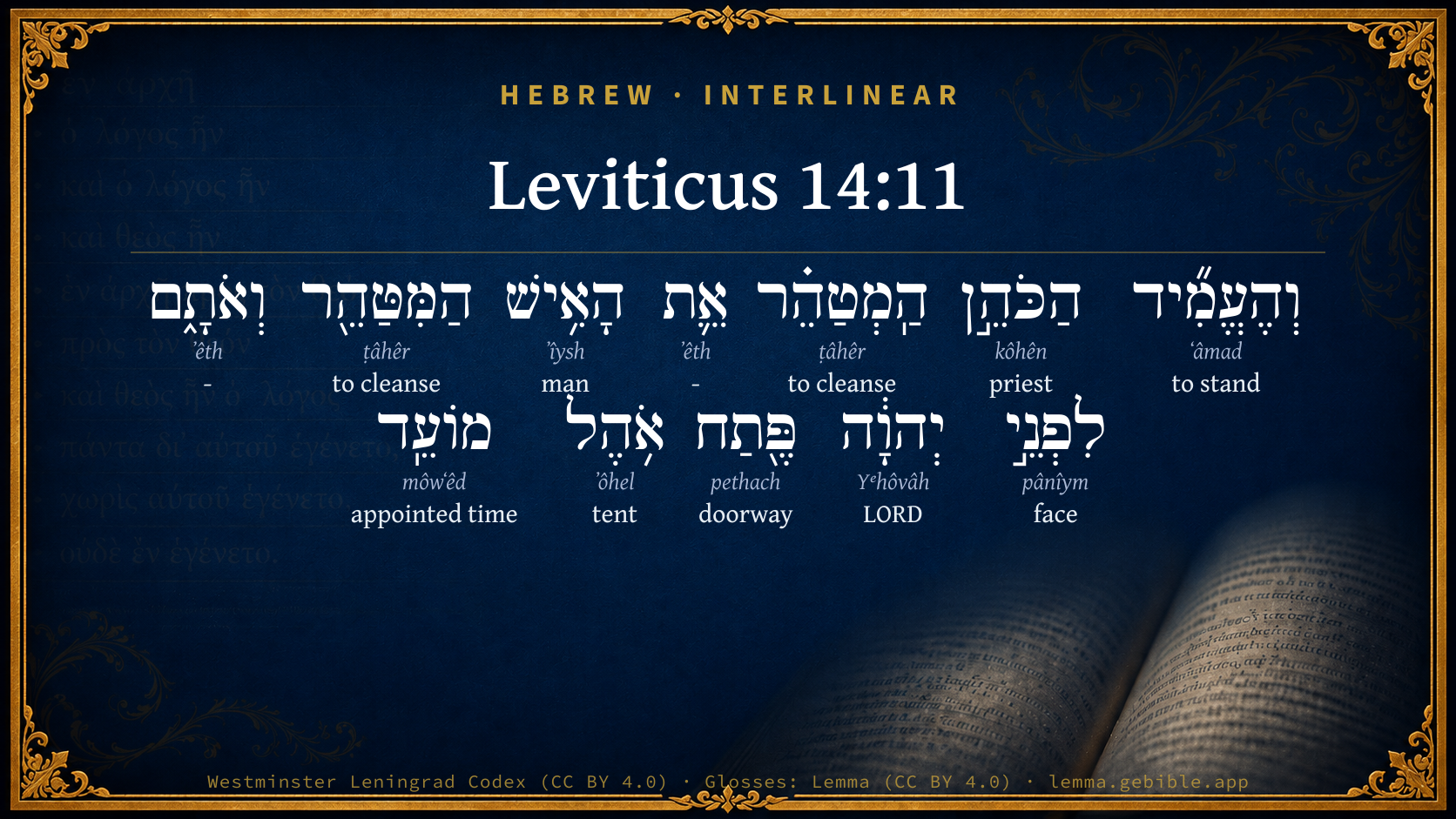
Hebrew (Westminster Leningrad Codex) Leviticus 14:11 appears in the Hebrew Old Testament. The text above is from the Westminster Leningrad Codex. Each word links to its Strong’s number, a concise gloss, and parsing drawn from the Open Scriptures Hebrew Bible morphology. Click any word for its full Brown-Driver-Briggs (BDB) entry.
Download image
Cite this verse

Leviticus 14:11 (World English Bible). Public Domain. Lemma interlinear Bible study tool, https://lemma.gebible.app/v/leviticus/14/11.

Show BibTeX & RIS
BibTeX
RIS
English Translation
The priest who cleanses him shall set the man who is to be cleansed, and those things, before Yahweh, at the door of the Tent of Meeting.
World English Bible · Public Domain
Download a study sheet

One document with this verse’s original text, its word-by-word gloss line, the meaning frame, cross-references with their text, attributed commentary, and full source and license credits — printable, and it pastes into notes with its structure intact.

This verse Autodidact and up

Study sheet (.html) Plain text (.txt)

A passage Seminary Student

Up to 50 verses in one chapter. A passage sheet keeps up to 6 commentary sources and 12 cross-references per verse, in the order this page ranks them, and says so on the sheet whenever that leaves anything out. Ask for a single verse and you get the Autodidact verse sheet above.

Everything on this page stays free to read, with no account — the sheet is a download of what is already on screen, not access to it.

Want to remove ads? Support Godless Engineer
Compare translations 3

The same verse in 3 English versions, stacked beneath the original-language interlinear above. Click any original word for its lexicon entry.

Each is an independent rendering of the whole verse — the interlinear is not word-aligned to these translations.

Highlighted words mark where these versions differ — a whole-verse word diff, not a word-by-word alignment.

  • World English Bible Public Domain
    The priest who cleanses him shall set the man who is to be cleansed, and those things, before Yahweh, at the door of the Tent of Meeting.
  • King James Version Public Domain
    And the priest that maketh him clean shall present the man that is to be made clean, and those things, before the LORD, at the door of the tabernacle of the congregation:
  • unfoldingWord Literal Text CC BY-SA 4.0
    And the priest, the one pronouncing clean, shall make the man, the one being cleansed, and them stand to the face of Yahweh the entrance of the tent of meeting.

unfoldingWord Literal Text — © unfoldingWord, licensed CC BY-SA 4.0. Word-aligned USFM3 via Door43 (git.door43.org/unfoldingWord/en_ult).

Versions to compare (up to 4)

3 of 4 selected

Show all 18 translations

Every available English version of this verse, each an independent rendering of the whole verse.

  • World English Bible Public Domain
    The priest who cleanses him shall set the man who is to be cleansed, and those things, before Yahweh, at the door of the Tent of Meeting.
  • Berean Standard Bible Public Domain
    The priest who performs the cleansing shall present the one to be cleansed, together with these offerings, before the LORD at the entrance to the Tent of Meeting.
  • Majority Standard Bible Public Domain
    The priest who performs the cleansing shall present the one to be cleansed, together with these offerings, before the LORD at the entrance to the Tent of Meeting.
  • King James Version Public Domain
    And the priest that maketh him clean shall present the man that is to be made clean, and those things, before the LORD, at the door of the tabernacle of the congregation:
  • American Standard Version (1901) Public Domain
    And the priest that cleanseth him shall set the man that is to be cleansed, and those things, before Jehovah, at the door of the tent of meeting.
  • Revised Version (1885) Public Domain
    And the priest that cleanseth him shall set the man that is to be cleansed, and those things, before the LORD, at the door of the tent of meeting:
  • Geneva Bible (1599) Public Domain
    And the Priest that maketh him cleane shall bring the man which is to bee made cleane, and those things, before the Lord, at the doore of the Tabernacle of the Congregation.
  • Douay-Rheims (1899) Public Domain
    And when the priest that purifieth the man, hath presented him, and all these things before the Lord, at the door of the tabernacle of the testimony,
  • Young's Literal Translation Public Domain
    `And the priest who is cleansing hath caused the man who is to be cleansed to stand with them before Jehovah, at the opening of the tent of meeting,
  • Literal Standard Version CC BY-SA 4.0
    And the priest who is cleansing has caused the man who is to be cleansed to stand with them before YHWH, at the opening of the Tent of Meeting,
  • Unlocked Literal Bible CC BY-SA 4.0
    The priest who cleanses him will stand the person who is to be cleansed, along with those things, before Yahweh at the entrance to the tent of meeting.
  • unfoldingWord Literal Text CC BY-SA 4.0
    And the priest, the one pronouncing clean, shall make the man, the one being cleansed, and them stand to the face of Yahweh the entrance of the tent of meeting.
  • Darby Bible Public Domain
    And the priest that cleanseth [him] shall present the man that is to be cleansed and those things before Jehovah, at the entrance of the tent of meeting.
  • World Messianic Bible Public Domain
    The priest who cleanses him shall set the man who is to be cleansed, and those things, before the LORD, at the door of the Tent of Meeting.
  • Webster's Bible Public Domain
    And the priest that maketh him clean, shall present the man that is to be made clean, and those things, before the LORD, at the door of the tabernacle of the congregation.
  • Free Bible Version CC BY-SA 4.0
    The priest who conducts the ceremony will present the person to be made clean to the Lord, along with these offerings, at the entrance to the Tent of Meeting.
  • Bible in Basic English Public Domain
    And the priest who is making him clean will put the man who is being made clean, together with these things, before the door of the Tent of meeting.
  • JPS Tanakh (1917) Public Domain
    And the priest that cleanseth him shall set the man that is to be cleansed, and those things, before the LORD, at the door of the tent of meeting.

Literal Standard Version (2020), Covenant Press — licensed CC BY-SA 4.0. Text via the HelloAO Bible API (eBible.org). Unlocked Literal Bible (unfoldingWord) — licensed CC BY-SA 4.0. Text via the HelloAO Bible API (eBible.org). unfoldingWord Literal Text — © unfoldingWord, licensed CC BY-SA 4.0. Word-aligned USFM3 via Door43 (git.door43.org/unfoldingWord/en_ult). Free Bible Version, Dr. Jonathan Gallagher — licensed CC BY-SA 4.0. Text via the HelloAO Bible API (eBible.org).

Word by word

More ways to search: Search by grammar → Find every occurrence → Compare this word →

Practice this passage: Drill this verse → Learn its vocabulary →

הַֽמְטַהֵ֗ר
ṭâhêr
H2891
“the · cleansing”
Particle, Definite Article + Verb, Piel, Participle Active, Masculine, Singular, Absolute
Part of Speech
Particle + Verb
Stem
Piel
Form
Participle Active
Gender
Masculine
Number
Singular
State
Absolute
Full BDB Definition

Origin: a primitive root

TWOT: 792

to be clean, be pure - (Qal) - to be clean (physically - of disease) - to be clean ceremonially - to purify, be clean morally, made clean - (Piel) - to cleanse, purify - physically - ceremonially - morally - to pronounce clean - to perform the ceremony of cleansing - (Pual) to be cleansed, be pronounced clean - (Hithpael) - to purify oneself - ceremonially - morally - to present oneself for purification
  1. וְהֶעֱמִ֞יד ʻâmad H5975 “and · to stand” Conjunction + Verb, Hiphil, Sequential Perfect, 3rd Person, Masculine, Singular
  2. הַכֹּהֵ֣ן kôhên H3548 “the · priest” Particle, Definite Article + Noun, Common, Masculine, Singular, Absolute
  3. אֵ֛ת ʼêth H853 “-” Particle, Direct Object
  4. הָאִ֥ישׁ ʼîysh H376 “the · man” Particle, Definite Article + Noun, Common, Masculine, Singular, Absolute
  5. הַמִּטַּהֵ֖ר ṭâhêr H2891 “the · cleansing” Particle, Definite Article + Verb, Hithpael, Participle Active, Masculine, Singular, Absolute
  6. וְאֹתָ֑ם ʼêth H853 “and · - · them” Conjunction + Particle, Direct Object + Suffix, Personal, 3rd Person, Masculine, Plural
  7. לִפְנֵ֣י pânîym H6440 “to/for · face(s) of” Preposition + Noun, Common, Both, Plural, Construct
  8. יְהוָ֔ה Yᵉhôvâh H3068 “LORD” Noun, Proper
  9. פֶּ֖תַח pethach H6607 “doorway of” Noun, Common, Masculine, Singular, Construct
  10. אֹ֥הֶל ʼôhel H168 “tent of” Noun, Common, Masculine, Singular, Construct
  11. מוֹעֵֽד môwʻêd H4150 “appointed time” Noun, Common, Masculine, Singular, Absolute

About this verse

These counts appear in no published source. They are computed here, from the morphology-tagged text and Lemma’s own curated glosses. What Lemma adds →

12
words
10
distinct lemmas
Pentateuch
section

Grammatical profile

  • 3 verbs
  • 7 nouns
  • 2 particles

Verb forms

  • וְהֶעֱמִ֞יד Hiphil · Sequential Perfect
  • הַֽמְטַהֵ֗ר Piel · Participle Active
  • הַמִּטַּהֵ֖ר Hithpael · Participle Active

Repetition

A word recurs within this verse — often emphatic in Hebrew:

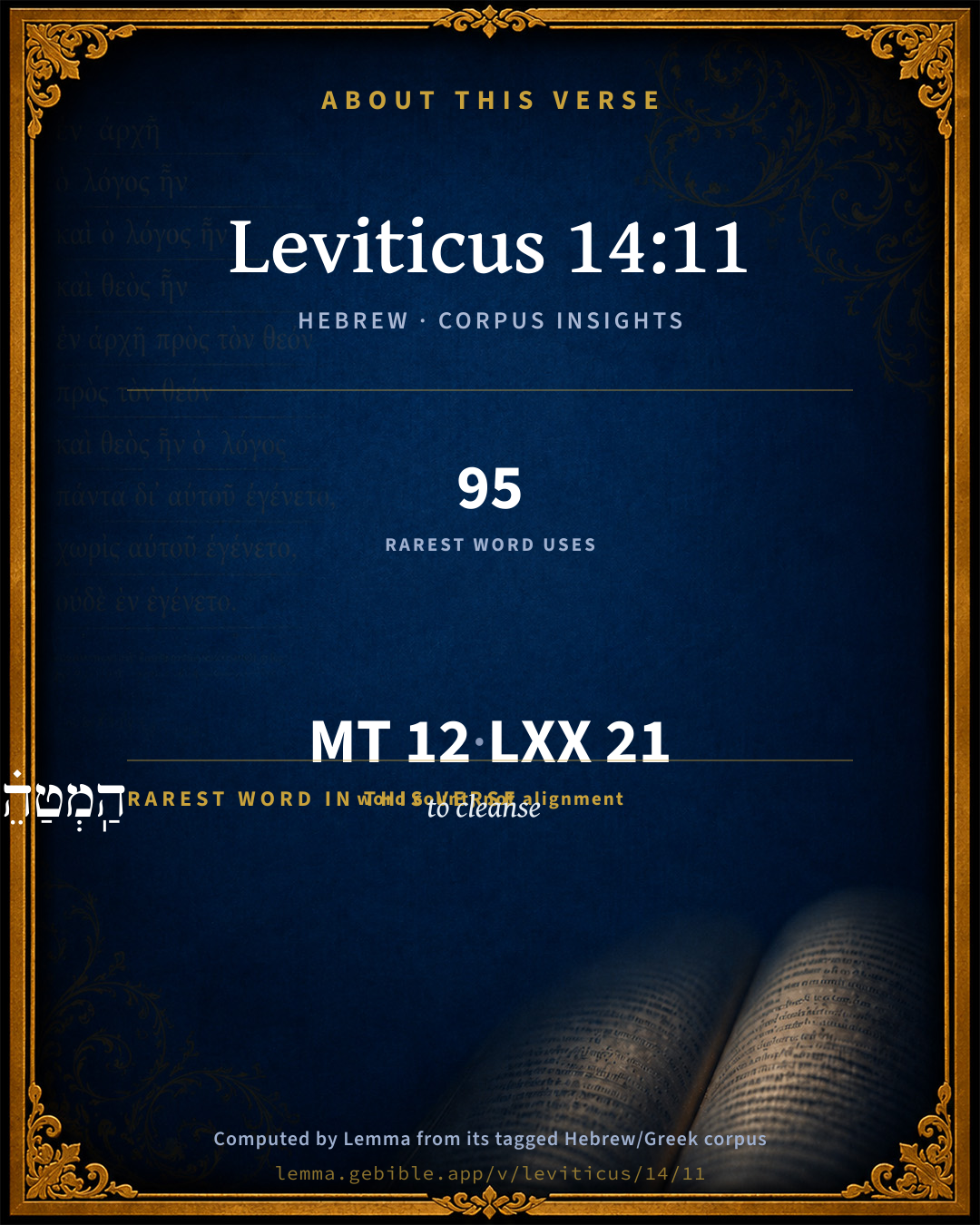
  • הַֽמְטַהֵ֗ר to cleanse H2891 ×2

Hebrew & Septuagint length

In English translation the verse runs 27 words from the Hebrew and 25 from the Septuagint (LXX English) — closely comparable.

A rough comparison of the two English renderings, which tokenize alike — not a word-level alignment.

Word counts can differ between the Hebrew and the Greek without any difference in meaning — e.g. the Hebrew direct-object marker אֵת has no separate Greek word, and Greek often adds the article ὁ.

In the original languages it is 12 Hebrew tokens and 21 Greek tokens — but the two are counted differently (Hebrew bundles its prefixes and suffixes into one token; the Greek is in lemma form), so that isn’t a like-for-like length.

Cross-references

6

Topical passages linked to Leviticus 14:11 in the Treasury of Scripture Knowledge — connected by theme and wording, ordered by reader-vote popularity; previews shown in the World English Bible.

  • Exodus 29:1–4 "This is the thing that you shall do to them to make them holy, to minister to me in the priest's office: take one young bull and two rams without blemish,
  • Leviticus 8:3 and assemble all the congregation at the door of the Tent of Meeting."
  • Numbers 8:6–11 "Take the Levites from among the children of Israel, and cleanse them.
  • Numbers 8:21 The Levites purified themselves from sin, and they washed their clothes; and Aaron offered them for a wave offering before Yahweh; and Aaron made atonement for them to cleanse them.
  • Ephesians 5:26–27 that he might sanctify it, having cleansed it by the washing of water with the word,
  • Jude 1:24 Now to him who is able to keep them from stumbling, and to present you faultless before the presence of his glory in great joy,

Cross-references courtesy of OpenBible.info (CC BY 4.0).

Hebrew and Greek witnesses Masoretic Hebrew ↔ Greek Septuagint

The same verse in the two great witnesses to the Old Testament, shown verse-for-verse.

These are two independent witnesses, not word-aligned to each other, and the Septuagint is shown in lemma (dictionary) form.

Hebrew Leviticus 14:11 Masoretic · Westminster Leningrad Codex

וְהֶעֱמִ֞יד הַכֹּהֵ֣ן הַֽמְטַהֵ֗ר אֵ֛ת הָאִ֥ישׁ הַמִּטַּהֵ֖ר וְאֹתָ֑ם לִפְנֵ֣י יְהוָ֔ה פֶּ֖תַח אֹ֥הֶל מוֹעֵֽד

The priest who cleanses him shall set the man who is to be cleansed, and those things, before Yahweh, at the door of the Tent of Meeting.

World English Bible · Public Domain

Greek LXX Leviticus 14:11 Septuagint · lemma form

καί ἵστημι ὁ ἱερεύς ὁ καθαρίζω ὁ ἄνθρωπος ὁ καθαρίζω καί οὗτος ἔναντι κύριος ἐπί ὁ θύρα ὁ σκηνή ὁ μαρτύριον

And the priest that cleanses shall present the man under purification, and these offerings before the Lord, at the door of the tabernacle of witness.

LXX2012 (modern English Septuagint) · Public Domain

Hebrew: Westminster Leningrad Codex (CC BY 4.0). Greek: Septuagint (public domain); English from LXX2012 (modern English Septuagint) (Public Domain). How the Septuagint differs from the Hebrew →

Targum (Aramaic paraphrase)

2

The Targum is the ancient Jewish Aramaic paraphrase of the Hebrew Scriptures — an interpretive translation, not the Hebrew text itself. Onkelos (literal) and Pseudo-Jonathan (expansive) render the Torah, and Jonathan the Prophets. Coverage is partial: where no permissively-licensed English translation exists for a verse, only the Aramaic is shown. This is verse-level text, not a word-by-word alignment to the Hebrew.

  1. Targum Onkelos Torah (Genesis–Deuteronomy)
    וִיקִים כַּהֲנָא דִמְדַכֵּי יָת גַבְרָא דְמִדַכֵּי וְיָתְהוֹן קֳדָם יְיָ בִּתְרַע מַשְׁכַּן זִמְנָא

    (no public-domain English translation for this verse)

    Targum Onkelos — Aramaic: “Onkelos Genesis” (public domain); “Onkelos Exodus” (public domain); “Onkelos Leviticus” (public domain); “Onkelos Numbers” (public domain); “Onkelos Deuteronomy” (public domain). English: “Sefaria Community Translation” (CC0 1.0 (public-domain dedication)); “J.W. Etheridge. The Targums of Onkelos and Jonathan Ben Uzziel on the Pentateuch. London: Longmans, Green, 1862” (public domain). Text via Sefaria.

  2. Targum Pseudo-Jonathan Torah (Genesis–Deuteronomy)
    וְיוֹקִים כַּהֲנָא דְמִדַכֵּי יַת גַבְרָא דִמְדַכֵּי וְיַת אִימְרַיָא קֳדָם יְיָ בִּתְרַע מַשְׁכַּן זִימְנָא

    And the priest who purifieth the man who is to be cleansed shall make him stand with the lambs before the Lord at the door of the tabernacle of ordinance.

    Targum Pseudo-Jonathan — Aramaic: “Targum Jonathan on Genesis” (public domain); “Targum Jonathan on Exodus” (public domain); “Targum Jonathan on Leviticus” (public domain); “Targum Jonathan on Numbers” (public domain); “Targum Jonathan on Deuteronomy” (public domain). English: “The Targum of Jonathan ben Uzziel, trans. J. W. Etheridge, London, 1862” (public domain). Text via Sefaria.

Commentary

Notes on Leviticus 14:11 from classic Christian and Jewish commentators (each source and its license shown beneath its notes). The classic Christian expositions comment on the surrounding passage and are grouped to its opening verse, so a note may address several verses; the Jewish commentaries on the Tanakh (Rashi and others) are per-verse, so they appear only where the commentator wrote on this verse.

Lemma curates 59 commentaries, every one of them public domain or Creative Commons licensed, each selected and text-cleaned for this edition rather than reprinted as found. About our sources →

Trapp's Complete Commentary

John Trapp

Lev 14:11 And the priest that maketh [him] clean shall present the man that is to be made clean, and those things, before the LORD, [at] the door of the tabernacle of the congregation:

Ver. 11. At the door of the tabernacle.] There God is to be found, viz., in the public assemblies, and that we are indeed, saith one, which we are at the door of the tabernacle.

John Trapp, A Commentary or Exposition upon All the Books of the Old and New Testament (1647–1656) — public domain. Text from a community e-Sword module.

Joseph Benson's Commentary

Lev 14:11. Maketh him clean — The healing is ascribed to God, (Lev 14:13,) but the ceremonial cleansing was an act of the priest, using the rites which God had prescribed.

Joseph Benson's Commentary on the Old and New Testaments (1811–1818) — public domain. Text from a community e-Sword module.

Ellicott's Commentary for English Readers

(11) Shall present the man . . . before the Lord, at the door.—As his purification was not yet effected, since expiation had not yet been made, the convalescent could not enter into the court of the Israelites. Hence, during the second Temple the priest who performed the function of purifying him went close to the gate of Nicanor, between the court of the Women and that of Israel. Here the patient stood with his face towards the sanctuary, which was taken to mean “before the Lord.” The phrase “at the door of the tabernacle of the congregation,” as usual, should be rendered at the entrance of the tent of meeting. (See Lev_1:3.)

A Bible Commentary for English Readers, edited by Charles John Ellicott (1878–1897) — public domain. Text from a community e-Sword module.

John Gill's Exposition

And the priest that maketh him clean,.... By the above rites and ceremonies, and the after sacrifices offered:

shall present the man that is to be made clean, and those things before the Lord; the two he lambs, and the ewe lamb; and it seems also the meat offerings, and the log of oil; but these Ben Gersom excepts, and when the leper, with these, is said to be set or presented before the Lord, this must not be understood of his being introduced, into the tabernacle, had of his being placed in the court itself; for as yet, as Jarchi says, he was "Mechoser Cippurim", one that needed expiation, and therefore, till that was done, could not be admitted; but he was set

at the door of the tabernacle of the congregation; at the eastern gate, which afterwards, when the temple was built, was called the gate of Nicanor, and lay between the court of the women and the court of the Israelites: thus everyone that has received favours from the Lord, by restoration of health, or by deliverance from dangers, or be it in whatsoever way it will, should present himself and his sacrifice of praise unto him; and his case should be presented in a public manner before the congregation of the saints by the minister of it, in token of gratitude and thankfulness for mercies received.

John Gill's Exposition of the Whole Bible (1746–1763) — public domain (CC PDM 1.0). Text via the HelloAO Bible API.

Matthew Poole's English Annotations

The healing is ascribed to God, Lev 14:13, but the ceremonial cleansing or making of him clean and fit for society was an act of the priest using the rites which God had prescribed, whereby the sinner was cleansed.

Matthew Poole's English Annotations on the Holy Bible (1683–1685) — public domain. Text from a community e-Sword/MySword module.

Whedon's Commentary on the Bible

Daniel D. Whedon

11. Maketh clean… made clean — The superiority of the Hebrew to the English is seen in this verse in its employment of the reflexive voice, in the Hiphel form of the verb, declaring the activity of the leper in the cleansing process. “The priest that maketh him clean shall present the man who is making himself clean.” The divine efficiency blends with the human. This is the synergism of our Arminian theology.

Door of the tabernacle — See Lev_1:3, note. It was a great privilege to stand there. The purification without the camp was necessary to the attainment of this right. There are promises which are made only to the regenerate. The Comforter and Sanctifier are sent only to those who already love Christ. Joh_14:15-16.

Daniel D. Whedon (gen. ed.), Commentary on the Old and New Testaments (1874–1909) — public domain. Text from a community e-Sword module.

John Wesley's Explanatory Notes

Maketh him clean - The healing is ascribed to God, ver. 13, but the ceremonial cleansing was an act of the priest using the rites which God had prescribed.

John Wesley, Explanatory Notes Upon the Whole Bible (1754–1765) — public domain. Text via the GEBible commentary corpus.

Rashi

Rabbi Shlomo Yitzchaki (Rashi)

'לפני ה BEFORE THE LORD — i. e. in the gate of Nicanor and not in the court itself (Sifra, Metzora, Section 3 6; Sotah 8a), since he was still short of atonement (as the sin-offering had not yet been brought, and under such circumstances he was not permitted to enter the court).

Rashi on the Tanakh — English translations: “The Judaica Press complete Tanach with Rashi, translated by A. J. Rosenberg” (CC BY 4.0); “Pentateuch with Rashi's commentary by M. Rosenbaum and A.M. Silbermann, 1929-1934” (public domain); “The Metsudah Tanach series, Lakewood, N.J” (CC BY 4.0); and “The Book of Joshua, Metsudah Publications, 1997” (CC BY 4.0). Text via Sefaria.

Lesson kit

Teaching starters — assembled from the data on this page, not authored interpretation. Every prompt links to the verse data it draws on. Edit before teaching.

Leviticus, in the Pentateuch, opens this verse with 12 words (10 distinct Hebrew lemmas). Its most distinctive word is ṭâhêr (“to cleanse”). A historical commentator’s framing appears above. Read the whole chapter for the surrounding context.

Discussion questions

  1. What does “to cleanse” (ṭâhêr) contribute to the verse as a whole?
  2. How does Exodus 29:1–4, which shares this passage’s theme, read alongside this verse?
  3. What does the repetition of “to cleanse” (2× in this one verse) do in this verse?
  4. These translations render this verse differently; the difference is in the English rendering, not the original. What questions does that raise?
  5. «וְהֶעֱמִ֞יד» is a Hiphil Sequential Perfect verb. How does that grammatical form shape the action described?
  6. Compare how Trapp's Complete Commentary and Joseph Benson's Commentary read this verse. Where do they agree or differ?

Things to notice

Reading settings

Reading text

Shown beneath each verse's original-language words.

Old Testament
Old Testament edition

Read the OT as the Masoretic Hebrew (MT) or the Greek Septuagint (LXX).

English shown for the Greek Septuagint (in the Hebrew ↔ Greek comparison).

Comparing translations? Open the Compare panel on any verse page to stack up to four side by side.