
Numbers 11:24

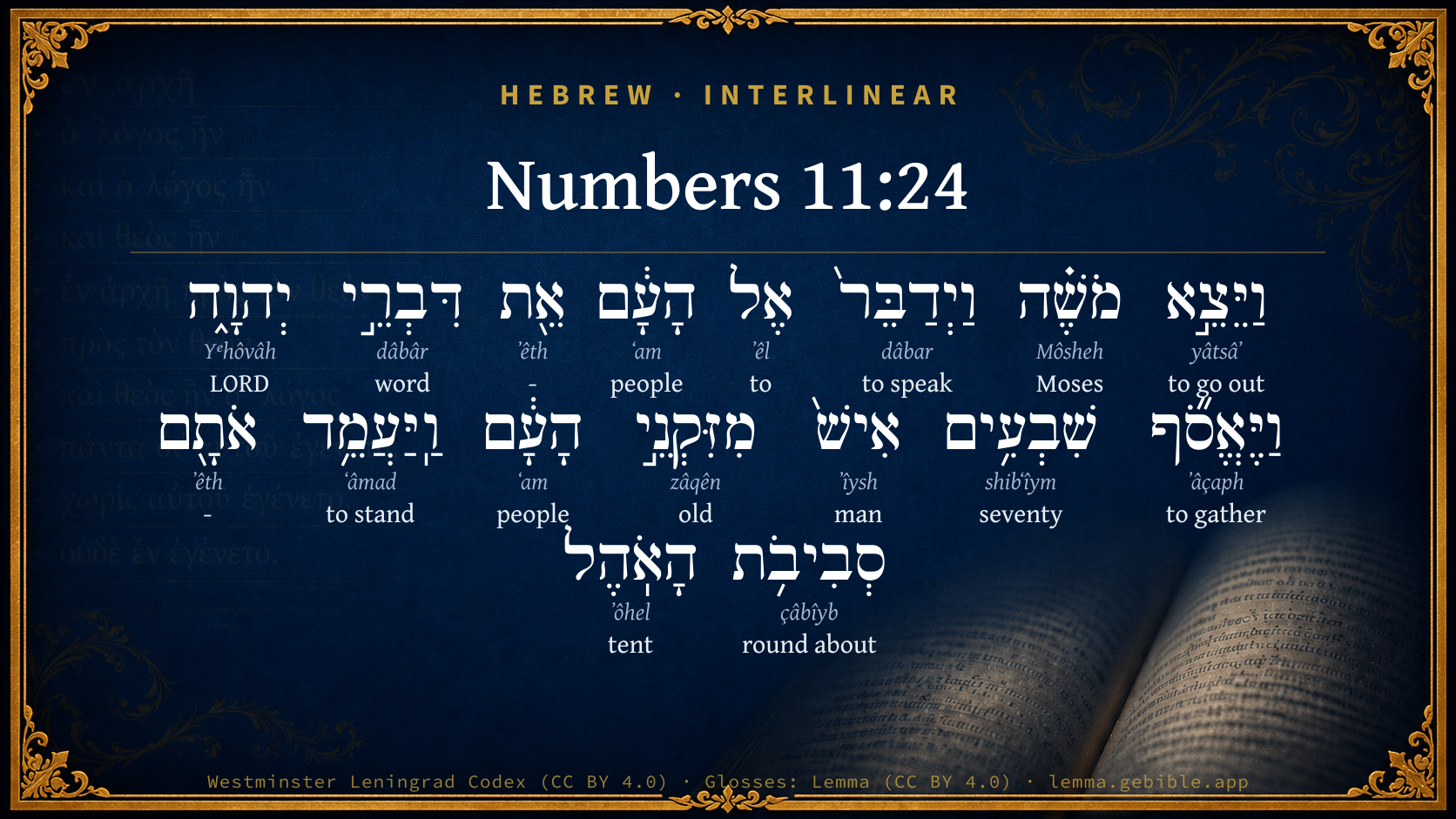
Hebrew (Westminster Leningrad Codex) Numbers 11:24 appears in the Hebrew Old Testament. The text above is from the Westminster Leningrad Codex. Each word links to its Strong’s number, a concise gloss, and parsing drawn from the Open Scriptures Hebrew Bible morphology. Click any word for its full Brown-Driver-Briggs (BDB) entry.
Download image
Cite this verse

Numbers 11:24 (World English Bible). Public Domain. Lemma interlinear Bible study tool, https://lemma.gebible.app/v/numbers/11/24.

Show BibTeX & RIS
BibTeX
RIS
English Translation
Moses went out, and told the people the words of Yahweh: and he gathered seventy men of the elders of the people, and set them round about the Tent.
World English Bible · Public Domain
Download a study sheet

One document with this verse’s original text, its word-by-word gloss line, the meaning frame, cross-references with their text, attributed commentary, and full source and license credits — printable, and it pastes into notes with its structure intact.

This verse Autodidact and up

Study sheet (.html) Plain text (.txt)

A passage Seminary Student

Up to 50 verses in one chapter. A passage sheet keeps up to 6 commentary sources and 12 cross-references per verse, in the order this page ranks them, and says so on the sheet whenever that leaves anything out. Ask for a single verse and you get the Autodidact verse sheet above.

Everything on this page stays free to read, with no account — the sheet is a download of what is already on screen, not access to it.

Want to remove ads? Support Godless Engineer
Compare translations 3

The same verse in 3 English versions, stacked beneath the original-language interlinear above. Click any original word for its lexicon entry.

Each is an independent rendering of the whole verse — the interlinear is not word-aligned to these translations.

Highlighted words mark where these versions differ — a whole-verse word diff, not a word-by-word alignment.

  • World English Bible Public Domain
    Moses went out, and told the people the words of Yahweh: and he gathered seventy men of the elders of the people, and set them round about the Tent.
  • King James Version Public Domain
    And Moses went out, and told the people the words of the LORD, and gathered the seventy men of the elders of the people, and set them round about the tabernacle.
  • unfoldingWord Literal Text CC BY-SA 4.0
    And Moses went out, and he spoke to the people the words of Yahweh. And he gathered 70 men from the elders of the people, and he stood them around the tent.

unfoldingWord Literal Text — © unfoldingWord, licensed CC BY-SA 4.0. Word-aligned USFM3 via Door43 (git.door43.org/unfoldingWord/en_ult).

Versions to compare (up to 4)

3 of 4 selected

Show all 18 translations

Every available English version of this verse, each an independent rendering of the whole verse.

  • World English Bible Public Domain
    Moses went out, and told the people the words of Yahweh: and he gathered seventy men of the elders of the people, and set them round about the Tent.
  • Berean Standard Bible Public Domain
    So Moses went out and relayed to the people the words of the LORD, and he gathered seventy of the elders of the people and had them stand around the tent.
  • Majority Standard Bible Public Domain
    So Moses went out and relayed to the people the words of the LORD, and he gathered seventy of the elders of the people and had them stand around the tent.
  • King James Version Public Domain
    And Moses went out, and told the people the words of the LORD, and gathered the seventy men of the elders of the people, and set them round about the tabernacle.
  • American Standard Version (1901) Public Domain
    And Moses went out, and told the people the words of Jehovah: and he gathered seventy men of the elders of the people, and set them round about the Tent.
  • Revised Version (1885) Public Domain
    And Moses went out, and told the people the words of the LORD: and he gathered seventy men of the elders of the people, and set them round about the Tent.
  • Geneva Bible (1599) Public Domain
    So Moses went out, and told the people the wordes of the Lord, and gathered seuentie men of the Elders of the people, and set them round about the Tabernacle.
  • Douay-Rheims (1899) Public Domain
    Moses therefore came, and told the people the words of the Lord, and assembled seventy men of the ancients of Israel, and made them to stand about the tabernacle.
  • Young's Literal Translation Public Domain
    And Moses goeth out, and speaketh unto the people the words of Jehovah, and gathereth seventy men of the elders of the people, and causeth them to stand round about the tent,
  • Literal Standard Version CC BY-SA 4.0
    And Moses goes out, and speaks the words of YHWH to the people, and gathers seventy men from [the] elderly of the people, and causes them to stand around the tent,
  • Unlocked Literal Bible CC BY-SA 4.0
    Moses went out and told the people Yahweh's words. He gathered seventy of the people's elders and positioned them around the tent.
  • unfoldingWord Literal Text CC BY-SA 4.0
    And Moses went out, and he spoke to the people the words of Yahweh. And he gathered 70 men from the elders of the people, and he stood them around the tent.
  • Darby Bible Public Domain
    And Moses went out and told the people the words of Jehovah; and he gathered the seventy men of the elders of the people, and set them round about the tent.
  • World Messianic Bible Public Domain
    Moses went out, and told the people the LORD’s words; and he gathered seventy men of the elders of the people, and set them around the Tent.
  • Webster's Bible Public Domain
    And Moses went out, and told the people the words of the LORD, and gathered the seventy men of the elders of the people, and set them around the tabernacle.
  • Free Bible Version CC BY-SA 4.0
    Moses went and shared with the people what the Lord said. He summoned seventy elders of the people and had them stand around the tent.
  • Bible in Basic English Public Domain
    And Moses went out and gave the people the words of the Lord: and he took seventy of the responsible men of the people, placing them round the Tent.
  • JPS Tanakh (1917) Public Domain
    And Moses went out, and told the people the words of the LORD; and he gathered seventy men of the elders of the people, and set them round about the Tent.

Literal Standard Version (2020), Covenant Press — licensed CC BY-SA 4.0. Text via the HelloAO Bible API (eBible.org). Unlocked Literal Bible (unfoldingWord) — licensed CC BY-SA 4.0. Text via the HelloAO Bible API (eBible.org). unfoldingWord Literal Text — © unfoldingWord, licensed CC BY-SA 4.0. Word-aligned USFM3 via Door43 (git.door43.org/unfoldingWord/en_ult). Free Bible Version, Dr. Jonathan Gallagher — licensed CC BY-SA 4.0. Text via the HelloAO Bible API (eBible.org).

Word by word

More ways to search: Search by grammar → Find every occurrence → Compare this word →

Practice this passage: Drill this verse → Learn its vocabulary →

שִׁבְעִ֥ים
shibʻîym
H7657
“seventy”
Adjective, Cardinal number, Both, Plural, Absolute
Part of Speech
Adjective
Type
Cardinal number
Gender
Both
Number
Plural
State
Absolute
Full BDB Definition

Origin: multiple of H7651

TWOT: 2318b

seventy
  1. וַיֵּצֵ֣א yâtsâʼ H3318 “and · to go out” Conjunction + Verb, Qal, Sequential Imperfect, 3rd Person, Masculine, Singular
  2. מֹשֶׁ֗ה Môsheh H4872 “Moses” Noun, Proper
  3. וַיְדַבֵּר֙ dâbar H1696 “and · to speak” Conjunction + Verb, Piel, Sequential Imperfect, 3rd Person, Masculine, Singular
  4. אֶל ʼêl H413 “to” Preposition
  5. הָעָ֔ם ʻam H5971 “the · people” Particle, Definite Article + Noun, Common, Masculine, Singular, Absolute
  6. אֵ֖ת ʼêth H853 “-” Particle, Direct Object
  7. דִּבְרֵ֣י dâbâr H1697 “words of” Noun, Common, Masculine, Plural, Construct
  8. יְהוָ֑ה Yᵉhôvâh H3068 “LORD” Noun, Proper
  9. וַיֶּאֱסֹ֞ף ʼâçaph H622 “and · to gather” Conjunction + Verb, Qal, Sequential Imperfect, 3rd Person, Masculine, Singular
  10. אִישׁ֙ ʼîysh H376 “man” Noun, Common, Masculine, Singular, Absolute
  11. מִזִּקְנֵ֣י zâqên H2205 “from · old of” Preposition + Adjective, Adjective, Masculine, Plural, Construct
  12. הָעָ֔ם ʻam H5971 “the · people” Particle, Definite Article + Noun, Common, Masculine, Singular, Absolute
  13. וַֽיַּעֲמֵ֥ד ʻâmad H5975 “and · to stand” Conjunction + Verb, Hiphil, Sequential Imperfect, 3rd Person, Masculine, Singular
  14. אֹתָ֖ם ʼêth H853 “- · them” Particle, Direct Object + Suffix, Personal, 3rd Person, Masculine, Plural
  15. סְבִיבֹ֥ת çâbîyb H5439 “surroundings of” Noun, Common, Both, Plural, Construct
  16. הָאֹֽהֶל ʼôhel H168 “the · tent” Particle, Definite Article + Noun, Common, Masculine, Singular, Absolute

About this verse

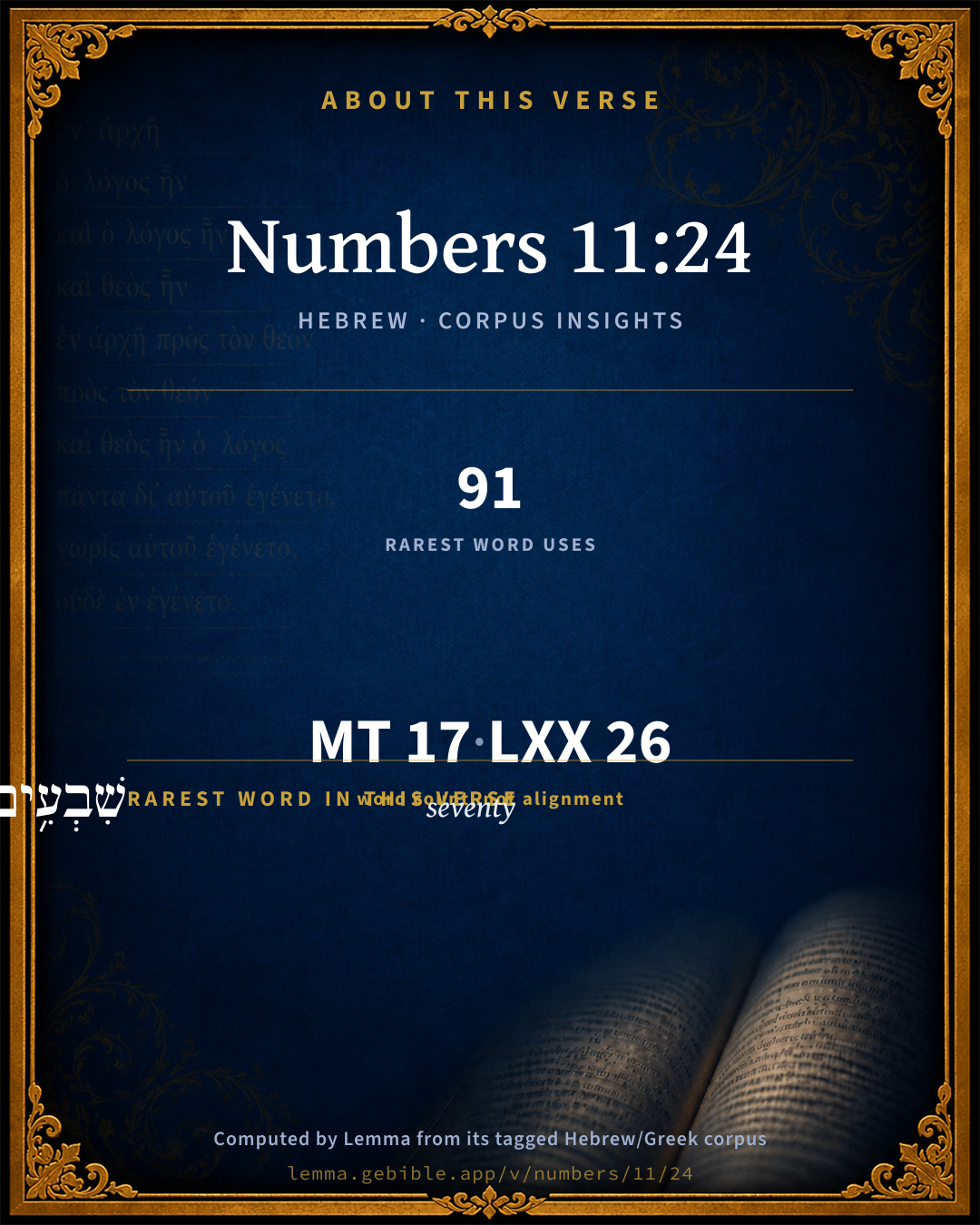
These counts appear in no published source. They are computed here, from the morphology-tagged text and Lemma’s own curated glosses. What Lemma adds →

17
words
15
distinct lemmas
Pentateuch
section

Grammatical profile

  • 4 verbs
  • 8 nouns
  • 2 adjectives
  • 1 preposition
  • 2 particles

Verb forms

  • וַיֵּצֵ֣א Qal · Sequential Imperfect
  • וַיְדַבֵּר֙ Piel · Sequential Imperfect
  • וַיֶּאֱסֹ֞ף Qal · Sequential Imperfect
  • וַֽיַּעֲמֵ֥ד Hiphil · Sequential Imperfect

Repetition

A word recurs within this verse — often emphatic in Hebrew:

  • הָעָ֔ם people H5971 ×2

Hebrew & Septuagint length

In English translation the verse runs 29 words from the Hebrew and 33 from the Septuagint (LXX English) — closely comparable.

A rough comparison of the two English renderings, which tokenize alike — not a word-level alignment.

Word counts can differ between the Hebrew and the Greek without any difference in meaning — e.g. the Hebrew direct-object marker אֵת has no separate Greek word, and Greek often adds the article ὁ.

In the original languages it is 17 Hebrew tokens and 26 Greek tokens — but the two are counted differently (Hebrew bundles its prefixes and suffixes into one token; the Greek is in lemma form), so that isn’t a like-for-like length.

Cross-references

2

Topical passages linked to Numbers 11:24 in the Treasury of Scripture Knowledge — connected by theme and wording, ordered by reader-vote popularity; previews shown in the World English Bible.

  • Numbers 11:16 Yahweh said to Moses, Gather to me seventy men of the elders of Israel, whom you know to be the elders of the people, and officers over them; and bring them to the tent of meeting, that they may stand there with you.
  • Numbers 11:26 But there remained two men in the camp, the name of the one was Eldad, and the name of the other Medad: and the Spirit rested on them; and they were of those who were written, but had not gone out to the Tent; and they prophesied in the camp.

Cross-references courtesy of OpenBible.info (CC BY 4.0).

Hebrew and Greek witnesses Masoretic Hebrew ↔ Greek Septuagint

The same verse in the two great witnesses to the Old Testament, shown verse-for-verse.

These are two independent witnesses, not word-aligned to each other, and the Septuagint is shown in lemma (dictionary) form.

Hebrew Numbers 11:24 Masoretic · Westminster Leningrad Codex

וַיֵּצֵ֣א מֹשֶׁ֗ה וַיְדַבֵּר֙ אֶל הָעָ֔ם אֵ֖ת דִּבְרֵ֣י יְהוָ֑ה וַיֶּאֱסֹ֞ף שִׁבְעִ֥ים אִישׁ֙ מִזִּקְנֵ֣י הָעָ֔ם וַֽיַּעֲמֵ֥ד אֹתָ֖ם סְבִיבֹ֥ת הָאֹֽהֶל

Moses went out, and told the people the words of Yahweh: and he gathered seventy men of the elders of the people, and set them round about the Tent.

World English Bible · Public Domain

Greek LXX Numbers 11:24 Septuagint · lemma form

καί ἐκἔρχομαι μωυσῆς καί λαλέω πρός ὁ λαός ὁ ῥῆμα κύριος καί συνἄγω ἑβδομήκοντα ἀνήρ ἀπό ὁ πρεσβύτερος ὁ λαός καί ἵστημι αὐτός κύκλος ὁ σκηνή

And Moses went out, and spoke the words of the Lord to the people; and he gathered seventy men of the elders of the people, and he set them round about the tabernacle.

LXX2012 (modern English Septuagint) · Public Domain

On this verse, Keil & Delitzsch discusses the Septuagint’s reading. Read the note in Commentary ↓

Hebrew: Westminster Leningrad Codex (CC BY 4.0). Greek: Septuagint (public domain); English from LXX2012 (modern English Septuagint) (Public Domain). How the Septuagint differs from the Hebrew →

Targum (Aramaic paraphrase)

2

The Targum is the ancient Jewish Aramaic paraphrase of the Hebrew Scriptures — an interpretive translation, not the Hebrew text itself. Onkelos (literal) and Pseudo-Jonathan (expansive) render the Torah, and Jonathan the Prophets. Coverage is partial: where no permissively-licensed English translation exists for a verse, only the Aramaic is shown. This is verse-level text, not a word-by-word alignment to the Hebrew.

  1. Targum Onkelos Torah (Genesis–Deuteronomy)
    וּנְפַק משֶׁה וּמַלִיל לְעַמָא יָת פִּתְגָמַיָא דַיְיָ וּכְנַשׁ שַׁבְעִין גַבְרָא מִסָבֵי עַמָא וַאֲקֵים יָתְהוֹן סְחוֹר סְחוֹר לְמַשְׁכְּנָא

    (no public-domain English translation for this verse)

    Targum Onkelos — Aramaic: “Onkelos Genesis” (public domain); “Onkelos Exodus” (public domain); “Onkelos Leviticus” (public domain); “Onkelos Numbers” (public domain); “Onkelos Deuteronomy” (public domain). English: “Sefaria Community Translation” (CC0 1.0 (public-domain dedication)); “J.W. Etheridge. The Targums of Onkelos and Jonathan Ben Uzziel on the Pentateuch. London: Longmans, Green, 1862” (public domain). Text via Sefaria.

  2. Targum Pseudo-Jonathan Torah (Genesis–Deuteronomy)
    וּנְפַק משֶׁה מִמַשְׁכַּן בֵּית שְׁכִינְתָּא וּמַלֵיל עִם עַמָא יַת פִּתְגָמַיָא דַיְיָ וּכְנַשׁ שׁוּבְעִין גוּבְרִין מִסָבֵי יִשְרָאֵל וְאָקִים יַתְהוֹן חֲזוֹר חֲזוֹר לְמַשְׁכְּנָא

    Then Mosheh went forth from the tabernacle, the house of the Shekinah, and told the people the words of the Lord. And he called together the seventy men, the elders of Israel, and placed them around the tabernacle.

    Targum Pseudo-Jonathan — Aramaic: “Targum Jonathan on Genesis” (public domain); “Targum Jonathan on Exodus” (public domain); “Targum Jonathan on Leviticus” (public domain); “Targum Jonathan on Numbers” (public domain); “Targum Jonathan on Deuteronomy” (public domain). English: “The Targum of Jonathan ben Uzziel, trans. J. W. Etheridge, London, 1862” (public domain). Text via Sefaria.

Commentary

Notes on Numbers 11:24 from classic Christian and Jewish commentators (each source and its license shown beneath its notes). The classic Christian expositions comment on the surrounding passage and are grouped to its opening verse, so a note may address several verses; the Jewish commentaries on the Tanakh (Rashi and others) are per-verse, so they appear only where the commentator wrote on this verse.

Lemma curates 59 commentaries, every one of them public domain or Creative Commons licensed, each selected and text-cleaned for this edition rather than reprinted as found. About our sources →

Matthew Henry's Commentary

We have here the performance of God's word to Moses, that he should have help in the government of Israel.

I. Here is the case of the seventy privy-counsellors in general. Moses, though a little disturbed by the tumult of the people, yet was thoroughly composed by the communion he had with God, and soon came to himself again. And according as the matter was concerted, 1. He did his part; he presented the seventy elders before the Lord, round the tabernacle (Num 11:24), that they might there stand ready to receive the grace of God, in the place where he manifested himself, and that the people also might be witnesses of their solemn call. Note, Those that expect favour from God must humbly offer themselves and their service to him. 2. God was not wanting to do his part. He gave of his Spirit to the seventy elders (Num 11:25), which enabled those whose capacities and education set them but on a level with their neighbours of a sudden to say and do that which was extraordinary, and which proved them to be actuated by divine inspiration: they prophesied, and did not cease all that day, and (some think) only that day. They discoursed to the people of the things of God, and perhaps commented upon the law they had lately received with admirable clearness, and fulness, and readiness, and aptness of expression, so that all who heard them might see and say that God was with them of a truth; see Co1 14:24, Co1 14:25. Thus, long afterwards, Saul was marked for the government by the gift of prophecy, which came upon him for a day and a night, Sa1 10:6, Sa1 10:11. When Moses was to fetch Israel out of Egypt, Aaron was appointed to be his prophet, Exo 7:1. But, now that God had called Aaron to other work, in his room Moses has seventy prophets to attend him. Note, Those are fittest to rule in God's Israel that are well acquainted with divine things and are apt to teach to edification.

II. Here is the particular case of two of them, Eldad and Medad, probably two brothers.

1. They were nominated by Moses to be assistants in the government, but they went not out unto the tabernacle as the rest did, Num 11:26. Calvin conjectures that the summons was sent them, but that it did not find them, they being somewhere out of the way; so that, though they were written, yet they were not called. Most think that they declined coming to the tabernacle out of an excess of modesty and humility; being sensible of their own weakness and unworthiness, they desired to be excused from coming into the government. Their principle was their praise, but their practice in not obeying orders was their fault.

2. The Spirit of God found them out in the camp, where they were hidden among the stuff, and there they prophesied, that is, they exercised their gift of praying, preaching, and praising God, in some private tent. Note, The Spirit of God is not tied to the tabernacle, but, like the wind, blows where he listeth, Joh 3:8. Whither can we go from that Spirit? There was a special providence in it that these two should be absent, for thus it appeared that it was indeed a divine Spirit which the elders were actuated by, and that Moses gave them not that Spirit, but God himself. They modestly declined preferment, but God forced it upon them; nay, they have the honour of being named, which the rest have not: for those that humble themselves shall be exalted, and those are most fit for government who are least ambitious of it.

3. Information of this was given to Moses (Num 11:27): "Eldad and Medad do prophesy in the camp; there is a conventicle in such a tent, and Eldad and Medad are holding forth there, from under the inspection and presidency of Moses, and out of the communion of the rest of the elders." Whoever the person was that brought the tidings, he seems to have looked upon it as an irregularity.

4. Joshua moved to have them silenced: My lord Moses, forbid them, Num 11:28. It is probable that Joshua himself was one of the seventy, which made him the more jealous for the honour of their order. He takes it for granted that they were not under any necessitating impulse, for the spirit of the prophets is subject to the prophets, and therefore he would have them either not to prophesy at all or to come to the tabernacle and prophesy in concert with the rest. He does not desire that they should be punished for what they had done, but only restrained for the future. This motion he made from a good principle, not out of any personal dislike to Eldad and Medad, but out of an honest zeal for that which he apprehended to be the unity of the church, and concern for the honour of God and Moses.

5. Moses rejected the motion, and reproved him that made it (v. 29): "Enviest thou for my sake? Thou knowest not what manner of spirit thou art of." Though Joshua was Moses's particular friend and confidant, though he said this out of a respect to Moses, whose honour he was very loth to see lessened by the call of those elders, yet Moses reproves him, and in him all that show such a spirit. (1.) We must not secretly grieve at the gifts, graces, and usefulness of others. It was the fault of John's disciples that they envied Christ's honour because it shaded their master's, Joh 3:26, etc. (2.) We must not be transported into heats against the weaknesses and infirmities of others. Granting that Eldad and Medad were guilty of an irregularity, yet Joshua was too quick and too warm upon them. Our zeal must always be tempered with the meekness of wisdom: the righteousness of God needs not the wrath of man, Jam 1:20. (3.) We must not make even the best and most useful men heads of a party. Paul would not have his name made use of to patronise a faction, Co1 1:12, Co1 1:13. (4.) We must not be forward to condemn and silence those that differ from us, as if they did not follow Christ because they do not follow him with us, Mar 9:38. Shall we reject those whom Christ has owned, or restrain any from doing good because they are not in every thing of our mind? Moses was of another spirit; so far from silencing these two, and quenching the Spirit in them, he wished all the Lord's people were prophets, that is, that he would put his Spirit upon them. Not that he would have any set up for prophets that were not duly qualified, or that he expected that the Spirit of prophecy should be made thus common; but thus he expresses the love and esteem he had for all the Lord's people, the complacency he took in the gifts of others, and how far he was from being displeased at Eldad and Medad's prophesying from under his eye. Such an excellent spirit as this blessed Paul was of, rejoicing that Christ was preached, though it was by those who therein intended to add affliction to his bonds, Phi 1:16. We ought to be pleased that God is served and glorified, and good done, though to the lessening of our credit and the credit of our way.

6. The elders, now newly ordained, immediately entered upon their administration (Num 11:30); when their call was sufficiently attested by their prophesying, they went with Moses to the camp, and applied themselves to business. Having received the gift, they ministered the same as good stewards. And now Moses was pleased that he had so many to share with him in his work and honour. And, (1.) Let the testimony of Moses be credited by those who desire to be in power, that government is a burden. It is a burden of care and trouble to those who make conscience of the duty of it; and to those who do not it will prove a heavier burden in the day of account, when they fall under the doom of the unprofitable servant that buried his talent. (2.) Let the example of Moses be imitated by those that are in power; let them not despise the advice and assistance of others, but desire it, and be thankful for it, not coveting to monopolize wisdom and power. In the multitude of counsellors there is safety.

Matthew Henry's Commentary on the Whole Bible (1708–1710) — public domain (CC PDM 1.0). Text via the HelloAO Bible API.

Trapp's Complete Commentary

John Trapp

Num 11:24 And Moses went out, and told the people the words of the LORD, and gathered the seventy men of the elders of the people, and set them round about the tabernacle.

Ver. 24. And set them roundabout the tabernacle.] That the fear of the Lord might be upon them, &c., {2Ch 19:6-7} and that they might carry themselves worthy of God, who had set them in places of judicature. To the company of the Areopagites (judges in Athens) none were admitted, but wise, wealthy, and noble men, famous for good life and innoceney. Nay, men whose behaviour was intolerable, after they were chosen into the college of the Areopagites, abhorring and blushing at their former disposition, changed their natures and embraced virtue. {a}

{a} δκνουντες τη φυσει χρησθαι.

John Trapp, A Commentary or Exposition upon All the Books of the Old and New Testament (1647–1656) — public domain. Text from a community e-Sword module.

Joseph Benson's Commentary

Num 11:24. Moses went out — Either from the sanctuary, into which he had entered to receive God’s answers from the mercy-seat, or he went out from his tent to the people. And gathered the seventy men — They are called seventy from the stated number, though two of them were lacking, as the apostles are called the twelve, (Mat 26:20,) when one of that number was absent. Round the tabernacle — Partly that the awe of God might be imprinted upon their hearts, that they might more seriously undertake, and more faithfully manage their high employment; but principally, because that was the place where God manifested himself, and therefore there he would bestow his Spirit upon them.

Joseph Benson's Commentary on the Old and New Testaments (1811–1818) — public domain. Text from a community e-Sword module.

Whedon's Commentary on the Bible

Daniel D. Whedon

THE SEVENTY ELDERS ARE APPOINTED AND QUALIFIED, Num_11:24-30.

24. Moses… told the people — In order to quiet their murmurings, not to secure a popular election of the seventy. Moses was the sole judge of their fitness. See Num_11:16, note.

Round about the tabernacle — Why the elders were assembled around the tabernacle and not at the door, the usual place of important gatherings, is unknown. This unique place was in keeping with the unique purpose of the meeting.

Daniel D. Whedon (gen. ed.), Commentary on the Old and New Testaments (1874–1909) — public domain. Text from a community e-Sword module.

Jamieson, Fausset & Brown

Robert Jamieson, A. R. Fausset & David Brown

Moses . . . gathered the seventy men of the elders of the people, &c.--The tabernacle was chosen for the convocation, because, as it was there God manifested Himself, there His Spirit would be directly imparted--there the minds of the elders themselves would be inspired with reverential awe and their office invested with greater respect in the eyes of the people.

Jamieson, Fausset & Brown — Commentary Critical and Explanatory on the Whole Bible (1871) — public domain (CC PDM 1.0). Text via the HelloAO Bible API.

Ellicott's Commentary for English Readers

(24) And Moses went out . . . —i.e., as it should seem, from the tabernacle of the congregation, where he had been conversing with God.

Round about the tabernacle.—This does not necessarily imply that the seventy men were placed so that they surrounded the whole of the tent of meeting. Comp. Exo_7:24, where the word means on both sides of the river; also Job_29:5, where the same word is rendered about.

A Bible Commentary for English Readers, edited by Charles John Ellicott (1878–1897) — public domain. Text from a community e-Sword module.

John Gill's Exposition

And Moses went out,.... Either out of his own tent, about which the people assembled, complaining and weeping, Num 11:10; or rather, as Aben Ezra, out of the tabernacle of the congregation, and the sanctuary where he had been conversing with God, about the affairs complained of both by the people and by himself; so the Targum of Jonathan says, he went out of the tabernacle, the house of the Shechinah or divine Majesty:

and told the people of the words of the Lord; what he had ordered him to do for his ease in the government of them, and how he had promised to give them flesh on the morrow:

and gathered the seventy men of the elders of Israel; sent for them by name, and ordered them to assemble at such a time and place; and though two of them came not, after mentioned, Num 11:26, yet the full number of seventy is given:

and set them round about the tabernacle; they seem to be set not promiscuously in a body together, but distinctly, one by another, in a circular form; that they might be seen, observed, and taken notice of by the people that came about the tabernacle, who they were, what were done to them, and what befell them.

John Gill's Exposition of the Whole Bible (1746–1763) — public domain (CC PDM 1.0). Text via the HelloAO Bible API.

Matthew Poole's English Annotations

Moses went out of the tabernacle, into which he entered to receive God’s answers from the mercy-seat, Num 7:89.

The seventy men, either they are called seventy from the stated number, though two of them were lacking, Num 11:26, as the apostles are called the twelve, Mat 26:20, when one of that number was absent; or he is said to have gathered them, when he gave command to gather them.

Round about the tabernacle; partly, that the awe of God might be imprinted upon their hearts, that they might more seriously undertake and more faithfully manage their high employment; partly, to gain them the more authority and respect from the people; and principally, because that was the place where God manifested himself, and gave his blessings, and therefore there he would bestow his Spirit upon them.

Matthew Poole's English Annotations on the Holy Bible (1683–1685) — public domain. Text from a community e-Sword/MySword module.

The Pulpit Commentary

Moses went out, i.e., out of the tabernacle. It is not stated that he went into the tabernacle to bring his complaint before the Lord, but the narrative obviously implies that he did. (see on Num_7:89)

The Pulpit Commentary (1880–1919), ed. H.D.M. Spence-Jones & Joseph S. Exell — public domain. Text from a community e-Sword module.

John Wesley's Explanatory Notes

Moses went out - Out of the tabernacle, into which he entered to receive God's answers from the mercy-seat. The seventy men - They are called seventy from the stated number, though two of them were lacking, as the Apostles are called the twelve, Matt. xxvi, 20, when one of that number was absent. Round the tabernacle - Partly that the awe of God might be imprinted upon their hearts, that they might more seriously undertake and more faithfully manage their high employment, but principally, because that was the place where God manifested himself, and therefore there he would bestow his spirit upon them.

John Wesley, Explanatory Notes Upon the Whole Bible (1754–1765) — public domain. Text via the GEBible commentary corpus.

Keil & Delitzsch

C. F. Keil & F. Delitzsch

After receiving from the Lord this reply to his complaint. Moses went out (sc., "of the tabernacle," where he had laid his complaint before the Lord) into the camp; and having made known to the people the will of God, gathered together seventy men of the elders of the people, and directed them to station themselves around the tabernacle. "Around the tabernacle," does not signify in this passage on all four sides, but in a semicircle around the front of the tabernacle; the verb is used in this sense in Num 21:4, when it is applied to the march round Edom.

Num 11:25

Jehovah then came down in the cloud, which soared on high above the tabernacle, and now came down to the door of it (Num 12:5; Exo 33:9; Deu 31:15). The statement in ch. Num 9:18., and Exo 40:37-38, that the cloud dwelt (שׁכן) above the dwelling of the tabernacle during the time of encampment, can be reconciled with this without any difficulty; since the only idea that we can form of this "dwelling upon it" is, that the cloud stood still, soaring in quietness above the tabernacle, without moving to and fro like a cloud driven by the wind. There is no such discrepancy, therefore, as Knobel finds in these statements. When Jehovah had come down, He spoke to Moses, sc., to explain to him and to the elders what was about to be done, and then laid upon the seventy elders of the Spirit which was upon him. We are not to understand this as implying, that the fulness of the Spirit possessed by Moses was diminished in consequence; still less to regard it, with Calvin, as signum indignationis, or nota ignominiae, which God intended to stamp upon him. For the Spirit of God is not something material, which is diminished by being divided, but resembles a flame of fire, which does not decrease in intensity, but increases rather by extension. As Theodoret observed, "Just as a person who kindles a thousand flames from one, does not lessen the first, whilst he communicates light to the others, so God did not diminish the grace imparted to Moses by the fact that He communicated of it to the seventy." God did this to show to Moses, as well as to the whole nation, that the Spirit which Moses had received was perfectly sufficient for the performance of the duties of his office, and that no supernatural increase of that Spirit was needed, but simply a strengthening of the natural powers of Moses by the support of men who, when endowed with the power of the Spirit that was taken from him, would help him to bear the burden of his office. We have no description of the way in which this transference took place; it is therefore impossible to determine whether it was effected by a sign which would strike the outward senses, or passed altogether within the sphere of the Spirit's life, in a manner which corresponded to the nature of the Spirit itself. In any case, however, it must have been effected in such a way, that Moses and the elders received a convincing proof of the reality of the affair. When the Spirit descended upon the elders, "they prophesied, and did not add;" i.e., they did not repeat the prophesyings any further. יספוּ ולא is rendered correctly by the lxx, καὶ οὐκ ἔτι προσέθεντο; the rendering supported by the Vulgate and Onkelos, nec ultro cessaverunt ("and ceased not"), is incorrect. התנבּא, "to prophesy," is to be understood generally, and especially here, not as the foretelling of future things, but as speaking in an ecstatic and elevated state of mind, under the impulse and inspiration of the Spirit of God, just like the "speaking with tongues," which frequently followed the gift of the Holy Ghost in the days of the apostles. But we are not to infer from the fact, that the prophesying was not repeated, that the Spirit therefore departed from them after this one extraordinary manifestation. This miraculous manifestation of the Spirit was intended simply to give to the whole nation the visible proof that God had endowed them with His Spirit, as helpers of Moses, and had given them the authority required for the exercise of their calling.

Num 11:26

But in order to prove to the whole congregation that the Spirit of the Lord was working there, the Spirit came not only upon the elders assembled round Moses, and in front of the tabernacle, but also upon two of the persons who had been chosen, viz., Eldad and Medad, who had remained behind in the camp, for some reason that is not reported, so that they also prophesied. "Them that were written," conscripti, for "called," because the calling of the elders generally took place in writing, from which we may see how thoroughly the Israelites had acquired the art of writing in Egypt.

Num 11:27-28

This phenomenon in the camp itself produced such excitement, that a boy (הנּער, with the article like הפּליט in Gen 14:13) reported the thing to Moses, whereupon Joshua requested Moses to prohibit the two from prophesying. Joshua felt himself warranted in doing this, because he had been Moses' servant from his youth up (see at Exo 17:9), and in this capacity he regarded the prophesying of these men in the camp as detracting from the authority of his lord, since they had not received this gift from Moses, at least not through his mediation. Joshua was jealous for the honour of Moses, just as the disciples of Jesus, in Mar 9:38-39, were for the honour of their Lord; and he was reproved by Moses, as the latter afterwards were by Christ.

Num 11:29

Moses replied, "Art thou jealous for me? Would that all the Lord's people were prophets, that Jehovah would put His Spirit upon them!" As a true servant of God, who sought not his own glory, but the glory of his God, and the spread of His kingdom, Moses rejoiced in this manifestation of the Spirit of God in the midst of the nation, and desired that all might become partakers of this grace.

Num 11:30

Moses returned with the elders into the camp, sc., from the tabernacle, which stood upon an open space in the midst of the camp, at some distance from the tents of the Levites and the rest of the tribes of Israel, which were pitched around it, so that whoever wished to go to it, had first of all to go out of his tent.

(Note: For the purpose of overthrowing the historical character of this marvellous event, the critics, from Vater to Knobel, have identified the appointment of the seventy elders to support Moses with the judicial institute established at Sinai by the advice of Jethro (Ex 18), and adduce the obvious differences between these two entirely different institutions as arguments for the supposed diversity of documents and legends. But what ground is there for identifying things so totally different from one another? The assertion of Knobel, that in Deu 1:9-18, Moses "evidently" refers to both events (Ex 18 and Num 11), is unfounded and untrue. Or are the same official duties and rank assigned to the elders who were chosen as judges in Ex 18, as to the seventy elders who were called by God, and endowed with His Spirit, that they might help Moses to govern the people who had rebelled against him and against Jehovah on account of the want of flesh, and to restore and uphold the authority of Moses as the divinely chosen leader of Israel, which had been shaken thereby? Can the judges of a land be identified without reserve with the executive of the land? The mere fact, that this executive court was chosen, like the judges, from the whole body of elders, does not warrant us in identifying the two institutions. Nor does it follow from the fact, that at Sinai seventy of the elders of Israel ascended the mountain with Moses, Aaron, and his sons, and there saw God (Exo 24:9.), that the seventy persons chosen here were the same as the seventy mentioned there. The sameness of the numbers does not prove that the persons were the same, but simply that the number seventy was the most suitable, on account of its historical and symbolical significance, to form a representation of the whole body of the people. For a further refutation of this futile objection, see Ranke, Unterss. b. d. Pent. II. pp. 183ff.)

No account has been handed down of the further action of this committee of elders. It is impossible to determine, therefore, in what way they assisted Moses in bearing the burden of governing the people. All that can be regarded as following unquestionably from the purpose given here is, that they did not form a permanent body, which continued from the time of Moses to the Captivity, and after the Captivity was revived again in the Sanhedrim, as Talmudists, Rabbins, and many of the earlier theologians suppose (see Selden de Synedriis, l. i. c. 14, ii. c. 4; Jo. Marckii sylloge dissertatt. phil. theol. ad V. T. exercit. 12, pp. 343ff.). On the opposite side vid., Relandi Antiquitates, ss. ii. 7, 3; Carpz. apparat. pp. 573f., etc.

Keil & Delitzsch — Biblical Commentary on the Old Testament (1861–1891) — public domain (CC PDM 1.0). Text via the HelloAO Bible API. (Old Testament only.)

unfoldingWord translationNotes

Door43 World Missions Community

Yahweh's words

"what Yahweh had said"

some of the Spirit that was on Moses

The "Spirit" here represents the power that God's Spirit had given to Moses. See how you translated a similar phrase in Numbers 11:17. AT: "some of the power that the Spirit had given to Moses" (See: Metonymy)

put it on the seventy elders

Giving power to the elders is spoken of as putting the Spirit on them. See how you translated a similar phrase in Numbers 11:17. AT: "gave it to the seventy elders" (See: Metaphor)

When the Spirit rested on them

Having power from the Spirit is spoken of as if the Spirit rested on them. AT: "When they had power from the Spirit" (See: Metaphor)

translationWords

Moses

Yahweh

elder

tent

Holy Spirit

prophet

unfoldingWord translationNotes — © Distant Shores Media and the Door43 World Missions Community, licensed CC BY-SA 4.0. Source: git.door43.org/Door43/en_tn.

Lesson kit

Teaching starters — assembled from the data on this page, not authored interpretation. Every prompt links to the verse data it draws on. Edit before teaching.

Numbers, in the Pentateuch, opens this verse with 17 words (15 distinct Hebrew lemmas). Its most distinctive word is shibʻîym (“seventy”). A historical commentator’s framing appears above. Read the whole chapter for the surrounding context.

Discussion questions

  1. The word shibʻîym carries the sense “seventy.” How does it shape the verse?
  2. Numbers 11:16 shares this passage’s theme. How do the two illuminate each other?
  3. “people” occurs 2× in this one verse. What is the effect of the repetition?
  4. These translations render this verse differently. What is at stake in choosing one wording over another?
  5. The verb «וַיֵּצֵ֣א» is Qal Sequential Imperfect. How does its form color the action?
  6. Reading how Matthew Henry's Commentary and Trapp's Complete Commentary read this verse, where do the two commentators agree and where do they part?

Things to notice

Reading settings

Reading text

Shown beneath each verse's original-language words.

Old Testament
Old Testament edition

Read the OT as the Masoretic Hebrew (MT) or the Greek Septuagint (LXX).

English shown for the Greek Septuagint (in the Hebrew ↔ Greek comparison).

Comparing translations? Open the Compare panel on any verse page to stack up to four side by side.