Deuteronomy 31:15

Hebrew (Westminster Leningrad Codex) Deuteronomy 31:15 appears in the Hebrew Old Testament. The text above is from the Westminster Leningrad Codex. Each word links to its Strong’s number, a concise gloss, and parsing drawn from the Open Scriptures Hebrew Bible morphology. Click any word for its full Brown-Driver-Briggs (BDB) entry.
Download image
Cite this verse

Deuteronomy 31:15 (World English Bible). Public Domain. Lemma interlinear Bible study tool, https://lemma.gebible.app/v/deuteronomy/31/15.

Show BibTeX & RIS
BibTeX
RIS
English Translation
Yahweh appeared in the Tent in a pillar of cloud: and the pillar of cloud stood over the door of the Tent.
World English Bible · Public Domain
Download a study sheet

One document with this verse’s original text, its word-by-word gloss line, the meaning frame, cross-references with their text, attributed commentary, and full source and license credits — printable, and it pastes into notes with its structure intact.

This verse Autodidact and up

Study sheet (.html) Plain text (.txt)

A passage Seminary Student

Up to 50 verses in one chapter. A passage sheet keeps up to 6 commentary sources and 12 cross-references per verse, in the order this page ranks them, and says so on the sheet whenever that leaves anything out. Ask for a single verse and you get the Autodidact verse sheet above.

Everything on this page stays free to read, with no account — the sheet is a download of what is already on screen, not access to it.

Want to remove ads? Support Godless Engineer
Compare translations 3

The same verse in 3 English versions, stacked beneath the original-language interlinear above. Click any original word for its lexicon entry.

Each is an independent rendering of the whole verse — the interlinear is not word-aligned to these translations.

Highlighted words mark where these versions differ — a whole-verse word diff, not a word-by-word alignment.

  • World English Bible Public Domain
    Yahweh appeared in the Tent in a pillar of cloud: and the pillar of cloud stood over the door of the Tent.
  • King James Version Public Domain
    And the LORD appeared in the tabernacle in a pillar of a cloud: and the pillar of the cloud stood over the door of the tabernacle.
  • unfoldingWord Literal Text CC BY-SA 4.0
    And Yahweh appeared in the tent in a pillar of cloud, and the pillar of cloud stood over the door of the tent.

unfoldingWord Literal Text — © unfoldingWord, licensed CC BY-SA 4.0. Word-aligned USFM3 via Door43 (git.door43.org/unfoldingWord/en_ult).

Versions to compare (up to 4)

3 of 4 selected

Show all 18 translations

Every available English version of this verse, each an independent rendering of the whole verse.

  • World English Bible Public Domain
    Yahweh appeared in the Tent in a pillar of cloud: and the pillar of cloud stood over the door of the Tent.
  • Berean Standard Bible Public Domain
    Then the LORD appeared at the tent in a pillar of cloud, and the cloud stood over the entrance to the tent.
  • Majority Standard Bible Public Domain
    Then the LORD appeared at the tent in a pillar of cloud, and the cloud stood over the entrance to the tent.
  • King James Version Public Domain
    And the LORD appeared in the tabernacle in a pillar of a cloud: and the pillar of the cloud stood over the door of the tabernacle.
  • American Standard Version (1901) Public Domain
    And Jehovah appeared in the Tent in a pillar of cloud: and the pillar of cloud stood over the door of the Tent.
  • Revised Version (1885) Public Domain
    And the LORD appeared in the Tent in a pillar of cloud: and the pillar of cloud stood over the door of the Tent.
  • Geneva Bible (1599) Public Domain
    And the Lord appeared in the Tabernacle, in the pillar of a cloude: and the pillar of the cloude stoode ouer the doore of the Tabernacle.
  • Douay-Rheims (1899) Public Domain
    And the Lord appeared there in the pillar of a cloud, which stood in the en try of the tabernacle.
  • Young's Literal Translation Public Domain
    and Jehovah is seen in the tent, in a pillar of a cloud; and the pillar of the cloud standeth at the opening of the tent.
  • Literal Standard Version CC BY-SA 4.0
    and YHWH is seen in the tent in a pillar of a cloud; and the pillar of the cloud stands at the opening of the tent.
  • Unlocked Literal Bible CC BY-SA 4.0
    Yahweh appeared in the tent in a pillar of cloud; the pillar of cloud stood over the door of the tent.
  • unfoldingWord Literal Text CC BY-SA 4.0
    And Yahweh appeared in the tent in a pillar of cloud, and the pillar of cloud stood over the door of the tent.
  • Darby Bible Public Domain
    And Jehovah appeared at the tent in the pillar of cloud; and the pillar of cloud stood over the entrance to the tent.
  • World Messianic Bible Public Domain
    The LORD appeared in the Tent in a pillar of cloud, and the pillar of cloud stood over the Tent’s door.
  • Webster's Bible Public Domain
    And the LORD appeared in the tabernacle in a pillar of a cloud; and the pillar of the cloud stood over the door of the tabernacle.
  • Free Bible Version CC BY-SA 4.0
    The Lord appeared there at the tent in a pillar of cloud. The cloud stood at the entrance to the tent.
  • Bible in Basic English Public Domain
    And the Lord was seen in the Tent in a pillar of cloud resting by the door of the Tent.
  • JPS Tanakh (1917) Public Domain
    And the LORD appeared in the Tent in a pillar of cloud; and the pillar of cloud stood over the door of the Tent.

Literal Standard Version (2020), Covenant Press — licensed CC BY-SA 4.0. Text via the HelloAO Bible API (eBible.org). Unlocked Literal Bible (unfoldingWord) — licensed CC BY-SA 4.0. Text via the HelloAO Bible API (eBible.org). unfoldingWord Literal Text — © unfoldingWord, licensed CC BY-SA 4.0. Word-aligned USFM3 via Door43 (git.door43.org/unfoldingWord/en_ult). Free Bible Version, Dr. Jonathan Gallagher — licensed CC BY-SA 4.0. Text via the HelloAO Bible API (eBible.org).

Word by word

More ways to search: Search by grammar → Find every occurrence → Compare this word →

Practice this passage: Drill this verse → Learn its vocabulary →

עָנָ֑ן
ʻânân
H6051
“cloud”
Noun, Common, Masculine, Singular, Absolute
Part of Speech
Noun
Type
Common
Gender
Masculine
Number
Singular
State
Absolute
Full BDB Definition

Origin: from H6049

TWOT: 1655a

cloud, cloudy, cloud-mass - cloud-mass (of theophanic cloud) - cloud
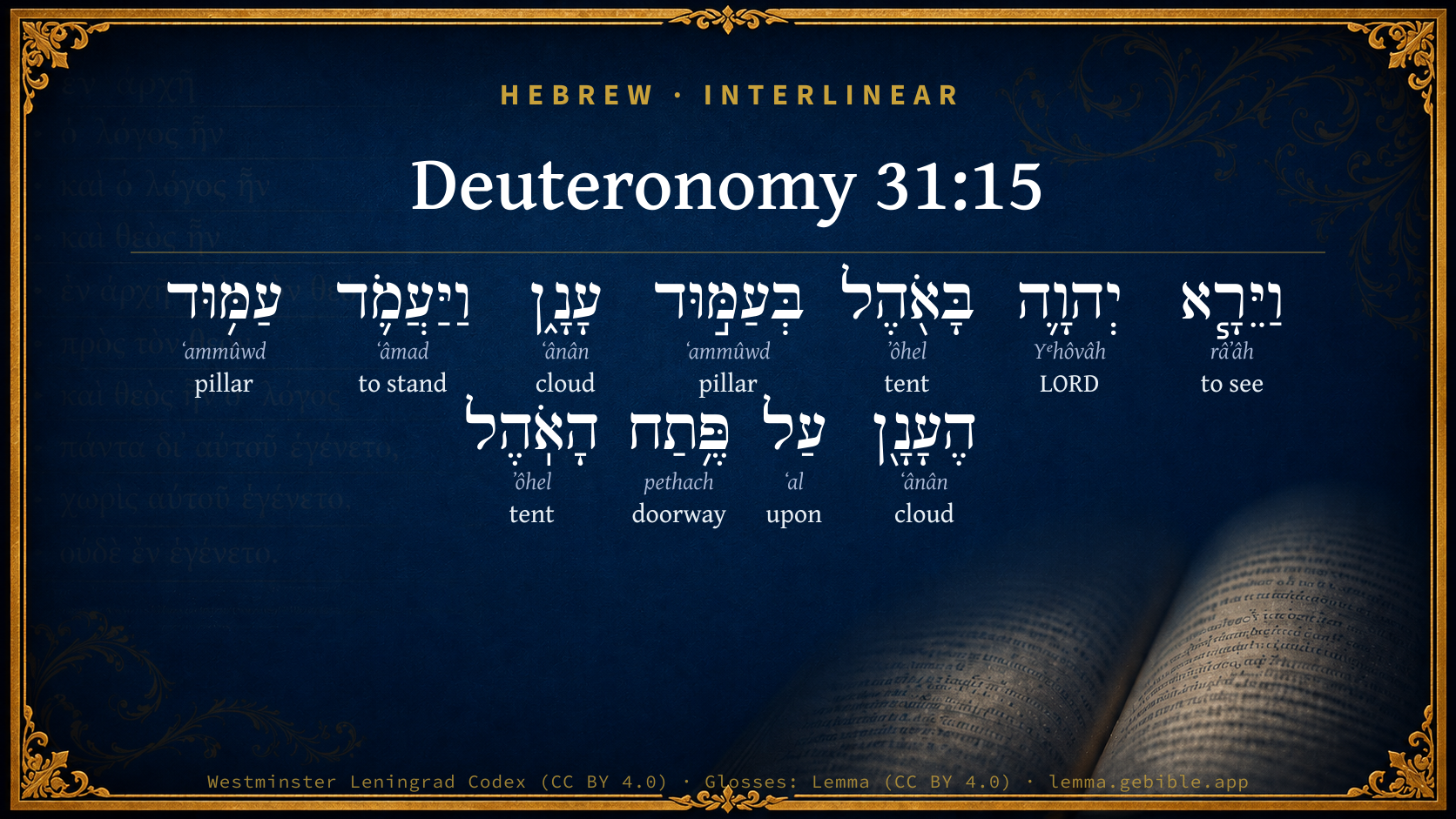
  1. וַיֵּרָ֧א râʼâh H7200 “and · to see” Conjunction + Verb, Niphal, Sequential Imperfect, 3rd Person, Masculine, Singular
  2. יְהוָ֛ה Yᵉhôvâh H3068 “LORD” Noun, Proper
  3. בָּאֹ֖הֶל ʼôhel H168 “in/at the · tent” Preposition, Determined + Noun, Common, Masculine, Singular, Absolute
  4. בְּעַמּ֣וּד ʻammûwd H5982 “in/at · pillar of” Preposition + Noun, Common, Masculine, Singular, Construct
  5. וַיַּעֲמֹ֛ד ʻâmad H5975 “and · to stand” Conjunction + Verb, Qal, Sequential Imperfect, 3rd Person, Masculine, Singular
  6. עַמּ֥וּד ʻammûwd H5982 “pillar of” Noun, Common, Masculine, Singular, Construct
  7. הֶעָנָ֖ן ʻânân H6051 “the · cloud” Particle, Definite Article + Noun, Common, Masculine, Singular, Absolute
  8. עַל ʻal H5921 “upon” Preposition
  9. פֶּ֥תַח pethach H6607 “doorway of” Noun, Common, Masculine, Singular, Construct
  10. הָאֹֽהֶל ʼôhel H168 “the · tent” Particle, Definite Article + Noun, Common, Masculine, Singular, Absolute

About this verse

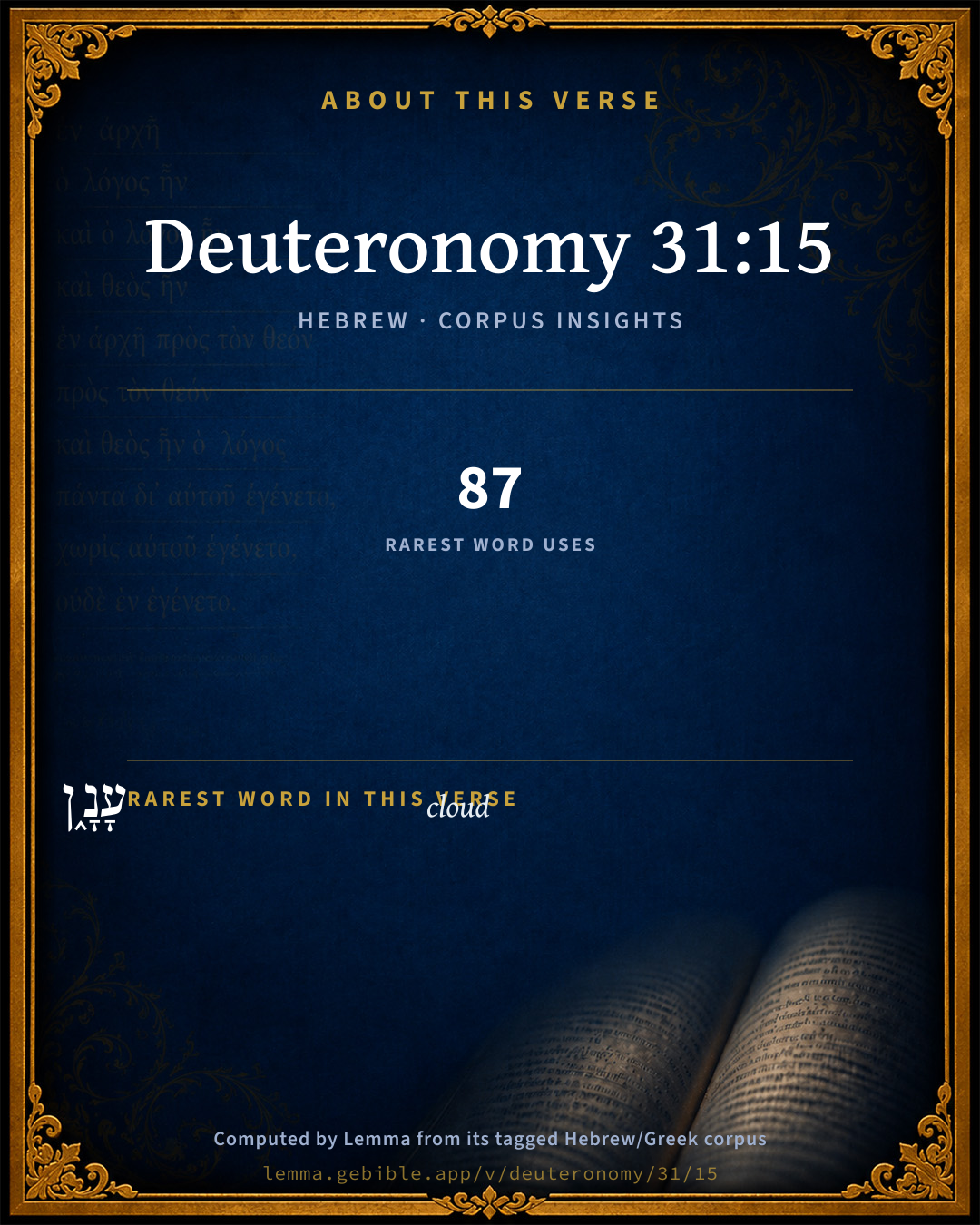
These counts appear in no published source. They are computed here, from the morphology-tagged text and Lemma’s own curated glosses. What Lemma adds →

11
words
8
distinct lemmas
Pentateuch
section

Grammatical profile

  • 2 verbs
  • 8 nouns
  • 1 preposition

Verb forms

  • וַיֵּרָ֧א Niphal · Sequential Imperfect
  • וַיַּעֲמֹ֛ד Qal · Sequential Imperfect

Repetition

Words recur within this verse — often emphatic in Hebrew:

  • בָּאֹ֖הֶל tent H168 ×2
  • בְּעַמּ֣וּד pillar H5982 ×2
  • עָנָ֑ן cloud H6051 ×2

Hebrew & Septuagint length

In English translation the verse runs 22 words from the Hebrew and 32 from the Septuagint (LXX English) — the Septuagint runs noticeably longer here. See the side-by-side →

A rough comparison of the two English renderings, which tokenize alike — not a word-level alignment.

Word counts can differ between the Hebrew and the Greek without any difference in meaning — e.g. the Hebrew direct-object marker אֵת has no separate Greek word, and Greek often adds the article ὁ.

Cross-references

3

Topical passages linked to Deuteronomy 31:15 in the Treasury of Scripture Knowledge — connected by theme and wording, ordered by reader-vote popularity; previews shown in the World English Bible.

  • Exodus 33:9–10 It happened, when Moses entered into the Tent, that the pillar of cloud descended, stood at the door of the Tent, and spoke with Moses.
  • Exodus 40:38 For the cloud of Yahweh was on the tent by day, and there was fire in the cloud by night, in the sight of all the house of Israel, throughout all their journeys.
  • Psalms 99:7 He spoke to them in the pillar of cloud. They kept his testimonies, The statute that he gave them.

Cross-references courtesy of OpenBible.info (CC BY 4.0).

Hebrew and Greek witnesses Masoretic Hebrew ↔ Greek Septuagint

The same verse in the two great witnesses to the Old Testament, shown verse-for-verse.

Here the Septuagint runs noticeably longer than the Hebrew — LXX2012 (modern English Septuagint) 32 words vs World English Bible 22. A rough length comparison of the two English translations, not a word-level alignment — read both below.

These are two independent witnesses, not word-aligned to each other, and the Septuagint is shown in lemma (dictionary) form.

Hebrew Deuteronomy 31:15 Masoretic · Westminster Leningrad Codex

וַיֵּרָ֧א יְהוָ֛ה בָּאֹ֖הֶל בְּעַמּ֣וּד עָנָ֑ן וַיַּעֲמֹ֛ד עַמּ֥וּד הֶעָנָ֖ן עַל פֶּ֥תַח הָאֹֽהֶל

Yahweh appeared in the Tent in a pillar of cloud: and the pillar of cloud stood over the door of the Tent.

World English Bible · Public Domain

Greek LXX Deuteronomy 31:15 Septuagint · lemma form

καί καταβαίνω κύριος ἐν νεφέλη καί ἵστημι παρά ὁ θύρα ὁ σκηνή ὁ μαρτύριον καί ἵστημι ὁ στῦλος ὁ νεφέλη παρά ὁ θύρα ὁ σκηνή

And the Lord descended in a cloud, and stood by the doors of the tabernacle of testimony; and the pillar of the cloud stood by the doors of the tabernacle of testimony.

LXX2012 (modern English Septuagint) · Public Domain

On this verse, The Cambridge Bible for Schools and Colleges discusses the Septuagint’s reading. Read the note in Commentary ↓

Hebrew: Westminster Leningrad Codex (CC BY 4.0). Greek: Septuagint (public domain); English from LXX2012 (modern English Septuagint) (Public Domain). How the Septuagint differs from the Hebrew →

Targum (Aramaic paraphrase)

2

The Targum is the ancient Jewish Aramaic paraphrase of the Hebrew Scriptures — an interpretive translation, not the Hebrew text itself. Onkelos (literal) and Pseudo-Jonathan (expansive) render the Torah, and Jonathan the Prophets. Coverage is partial: where no permissively-licensed English translation exists for a verse, only the Aramaic is shown. This is verse-level text, not a word-by-word alignment to the Hebrew.

  1. Targum Onkelos Torah (Genesis–Deuteronomy)
    וְאִתְגְלִי יְיָ בְּמַשְׁכְּנָא בְּעַמוּדָא דַעֲנָנָא וְקָם עַמוּדָא דַעֲנָנָא עַל תְּרַע מַשְׁכְּנָא

    (no public-domain English translation for this verse)

    Targum Onkelos — Aramaic: “Onkelos Genesis” (public domain); “Onkelos Exodus” (public domain); “Onkelos Leviticus” (public domain); “Onkelos Numbers” (public domain); “Onkelos Deuteronomy” (public domain). English: “Sefaria Community Translation” (CC0 1.0 (public-domain dedication)); “J.W. Etheridge. The Targums of Onkelos and Jonathan Ben Uzziel on the Pentateuch. London: Longmans, Green, 1862” (public domain). Text via Sefaria.

  2. Targum Pseudo-Jonathan Torah (Genesis–Deuteronomy)
    וְאִתְגְלֵי אִיקַר שְׁכִינְתָּא דַיְיָ בְּמַשְׁכְּנָא בְּעַמוּדָא דַעֲנָנָא וְקָם עַמוּדָא דַעֲנָנָא עַל תְּרַע מַשְׁכְּנָא וּמשֶׁה וִיהוֹשֻׁעַ קָמוֹן מִן לְבַר

    And the glorious Shekinah of the Lord revealed itself at the tabernacle in the pillar of the Cloud, and the pillar of the Cloud stood over the door of the tabernacle, and Mosheh and Jehoshua stood without.

    Targum Pseudo-Jonathan — Aramaic: “Targum Jonathan on Genesis” (public domain); “Targum Jonathan on Exodus” (public domain); “Targum Jonathan on Leviticus” (public domain); “Targum Jonathan on Numbers” (public domain); “Targum Jonathan on Deuteronomy” (public domain). English: “The Targum of Jonathan ben Uzziel, trans. J. W. Etheridge, London, 1862” (public domain). Text via Sefaria.

Commentary

Notes on Deuteronomy 31:15 from classic Christian and Jewish commentators (each source and its license shown beneath its notes). The classic Christian expositions comment on the surrounding passage and are grouped to its opening verse, so a note may address several verses; the Jewish commentaries on the Tanakh (Rashi and others) are per-verse, so they appear only where the commentator wrote on this verse.

Lemma curates 59 commentaries, every one of them public domain or Creative Commons licensed, each selected and text-cleaned for this edition rather than reprinted as found. About our sources →

Tyndale Open Study Notes

Tyndale Open Resources

31:15 Since God is spirit, he cannot be seen unless he chooses to manifest his glory physically. The pillar of cloud was such a manifestation, sometimes called a theophany (see study note on 1:33). When the pillar appeared, those who saw it recognized in it the presence of God (see Exod 33:9; Num 12:5).

Tyndale Open Study Notes — © Tyndale Open Resources, licensed CC BY-SA 4.0. Text via the HelloAO Bible API.

Geneva Bible (1599)

Geneva Bible translators

In a cloud that was fashioned like a pillar.

Geneva Bible (1599) marginal notes — public domain. Text via Bolls.life.

The Cambridge Bible for Schools and Colleges

gen. ed. J. J. S. Perowne

15. the Lord appeared … in a pillar of cloud] With LXX (except for a few cursive MSS) omit in the Tent: as the v. goes on to say, the pillar stood over against the door of the Tent. Also it is probable that appeared is an emendation (by the change of one letter) for the more anthropomorphic came down, which we find in E, Exo_33:9, Num_11:25; Num_12:5. On this verse, Deu_31:23 follows immediately (see below).

The Cambridge Bible for Schools and Colleges (gen. ed. J. J. S. Perowne; Cambridge University Press, 1878–1918) — public domain. Text from a community e-Sword module.

John Gill's Exposition

And the Lord said unto Moses,.... Out of the pillar of cloud:

behold, thou shalt sleep with thy fathers; a phrase expressive of death, frequently used both of good and bad men, which serves to render death easy and familiar, and less formidable; and to assure and lead into an expectation of an awaking out of it, or a resurrection from it:

and this people will rise up; in their posterity; for not till after Joshua's death, and the death of the elders of Israel, did they revolt to idolatry, Jos 24:31,

and go a whoring after the gods of the strangers of the land, whither they go to be amongst them; that is, after the gods of the Canaanites, who though at this time the inhabitants of the land, yet when the children of Israel became possessors of it, they were the strangers of it; and being suffered to continue contrary to the directions God had given to destroy them, would be a means of drawing them into the worship of their idols, expressed here by going a whoring after them, or committing whoredom with them. Idolatry in Scripture is frequently signified by fornication and adultery; and, as foretold, this was the case; see Psa 106:35,

and will forsake me: their husband, departing from his worship and service:

and break my covenant which I have made with them at Sinai; and now again in the plains of Moab, and which had the nature of a matrimonial contract; see Jer 31:32.

John Gill's Exposition of the Whole Bible (1746–1763) — public domain (CC PDM 1.0). Text via the HelloAO Bible API.

The Pulpit Commentary

The Lord appeared... in a pillar of a cloud (cf. Exo_33:9 Exo_40:38; Lev_16:2; Num_12:5)

The Pulpit Commentary (1880–1919), ed. H.D.M. Spence-Jones & Joseph S. Exell — public domain. Text from a community e-Sword module.

Ramban (Nachmanides)

Rabbi Moshe ben Nachman (Ramban / Nachmanides)

AND THE ETERNAL APPEARED IN THE TENT IN A PILLAR OF CLOUD. The purport thereof is that the pillar of cloud was over the entrance [of the Tent] and G-d appeared in the Tent — this being the Glory, according to Rabbi Abraham ibn Ezra. In my opinion, this verse is like And the Eternal came down in a pillar of cloud, and stood at the door of the Tent;, 12:5. and, behold, the Glory of the Eternal appeared in the cloud. And the meaning [of the verse here] is that He wanted to speak with Moses so that Joshua would hear, and He would also charge Joshua there. Now, to Moses it was said, And there I will meet with thee, and I will speak with thee from above the ark-cover, 25:22. but Joshua was not of that exalted status [in prophecy] and he was forbidden to enter the Tent altogether. Thus the phrase, and the pillar of cloud stood over the entrance of the Tent reverts to explain that the cloud, in which was the Glory, was above the door of the Tent covering it, and accordingly He was in the Tent [as the verse states, And the Eternal appeared in the Tent in a pillar of cloud].

Ramban (Nachmanides) on the Tanakh — English translation: “Commentary on the Torah by Ramban (Nachmanides). Translated and annotated by Charles B. Chavel. New York, Shilo Pub. House, 1971-1976” (CC BY 4.0). Text via Sefaria.

Lesson kit

Teaching starters — assembled from the data on this page, not authored interpretation. Every prompt links to the verse data it draws on. Edit before teaching.

Deuteronomy, in the Pentateuch, opens this verse with 11 words (8 distinct Hebrew lemmas). Its most distinctive word is ʻânân (“cloud”). The Greek Septuagint runs longer here. A historical commentator’s framing appears above. Read the whole chapter for the surrounding context.

Discussion questions

  1. The word ʻânân carries the sense “cloud.” How does it shape the verse?
  2. How does Exodus 33:9–10, which shares this passage’s theme, read alongside this verse?
  3. What does the repetition of “tent” (2× in this one verse) do in this verse?
  4. The Septuagint runs longer here than the Hebrew. What might account for the difference?
  5. These translations render this verse differently; the difference is in the English rendering, not the original. What questions does that raise?
  6. «וַיֵּרָ֧א» is a Niphal Sequential Imperfect verb. How does that grammatical form shape the action described?
  7. Compare how Tyndale Open Study Notes and Geneva Bible (1599) read this verse. Where do they agree or differ?

Things to notice

  • These translations choose different wording for 4 words in this verse.
  • “tent” occurs 2× in this single verse.
  • 8 distinct Hebrew lemmas span 11 words in this verse.

Reading settings

Reading text

Shown beneath each verse's original-language words.

Old Testament
Old Testament edition

Read the OT as the Masoretic Hebrew (MT) or the Greek Septuagint (LXX).

English shown for the Greek Septuagint (in the Hebrew ↔ Greek comparison).

Comparing translations? Open the Compare panel on any verse page to stack up to four side by side.