
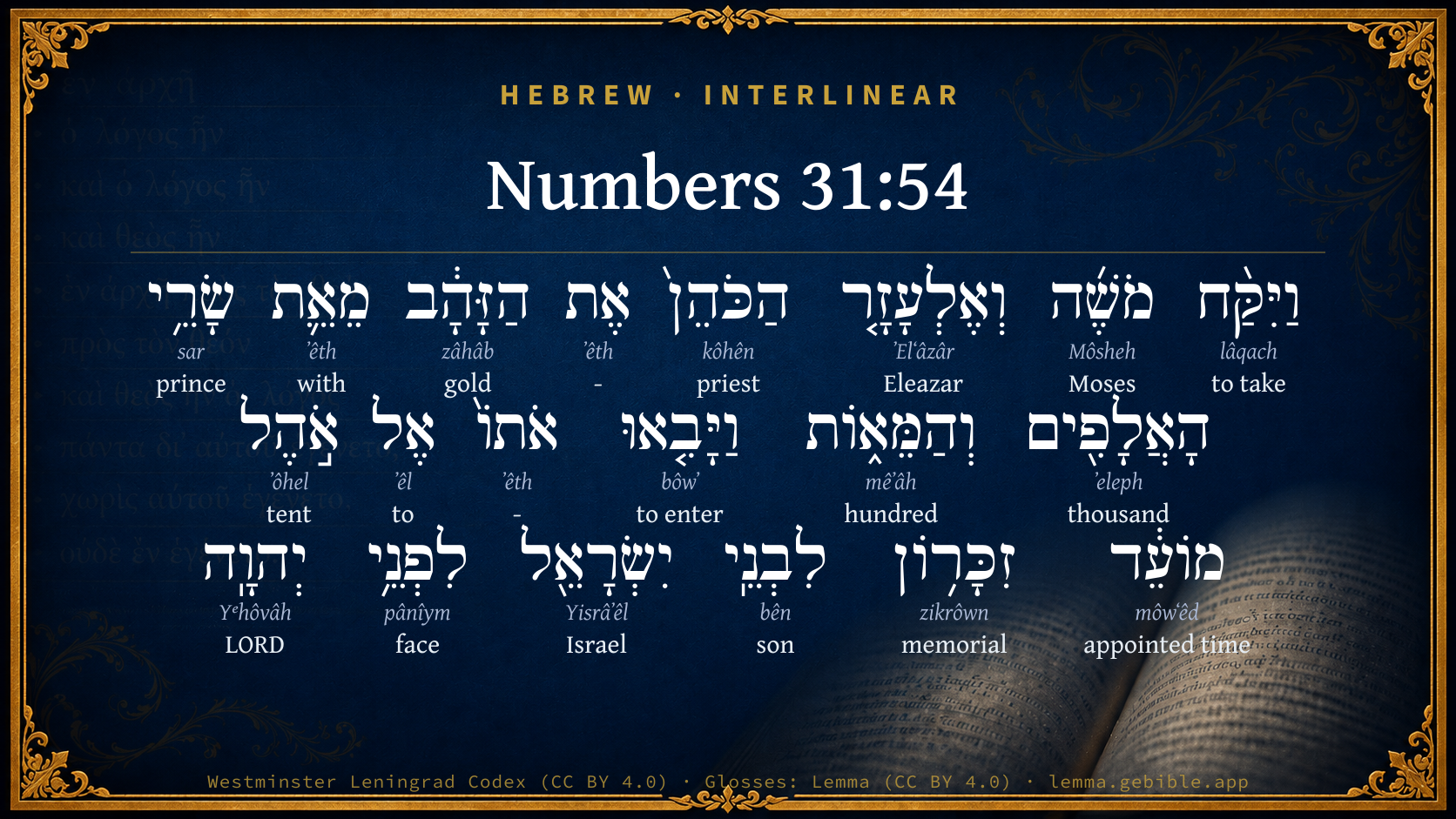
Numbers 31:54

Hebrew (Westminster Leningrad Codex) Numbers 31:54 appears in the Hebrew Old Testament. The text above is from the Westminster Leningrad Codex. Each word links to its Strong’s number, a concise gloss, and parsing drawn from the Open Scriptures Hebrew Bible morphology. Click any word for its full Brown-Driver-Briggs (BDB) entry.
Download image
Cite this verse

Numbers 31:54 (World English Bible). Public Domain. Lemma interlinear Bible study tool, https://lemma.gebible.app/v/numbers/31/54.

Show BibTeX & RIS
BibTeX
RIS
English Translation
Moses and Eleazar the priest took the gold of the captains of thousands and of hundreds, and brought it into the tent of meeting, for a memorial for the children of Israel before Yahweh.
World English Bible · Public Domain
Download a study sheet

One document with this verse’s original text, its word-by-word gloss line, the meaning frame, cross-references with their text, attributed commentary, and full source and license credits — printable, and it pastes into notes with its structure intact.

This verse Autodidact and up

Study sheet (.html) Plain text (.txt)

A passage Seminary Student

Up to 50 verses in one chapter. A passage sheet keeps up to 6 commentary sources and 12 cross-references per verse, in the order this page ranks them, and says so on the sheet whenever that leaves anything out. Ask for a single verse and you get the Autodidact verse sheet above.

Everything on this page stays free to read, with no account — the sheet is a download of what is already on screen, not access to it.

Want to remove ads? Support Godless Engineer
Compare translations 3

The same verse in 3 English versions, stacked beneath the original-language interlinear above. Click any original word for its lexicon entry.

Each is an independent rendering of the whole verse — the interlinear is not word-aligned to these translations.

Highlighted words mark where these versions differ — a whole-verse word diff, not a word-by-word alignment.

  • World English Bible Public Domain
    Moses and Eleazar the priest took the gold of the captains of thousands and of hundreds, and brought it into the tent of meeting, for a memorial for the children of Israel before Yahweh.
  • King James Version Public Domain
    And Moses and Eleazar the priest took the gold of the captains of thousands and of hundreds, and brought it into the tabernacle of the congregation, for a memorial for the children of Israel before the LORD.
  • unfoldingWord Literal Text CC BY-SA 4.0
    And Moses and Eleazar the priest took the gold from with the leaders of the thousands and the hundreds, and they brought it to the tent of meeting, a memorial for the sons of Israel before the face of Yahweh.

unfoldingWord Literal Text — © unfoldingWord, licensed CC BY-SA 4.0. Word-aligned USFM3 via Door43 (git.door43.org/unfoldingWord/en_ult).

Versions to compare (up to 4)

3 of 4 selected

Show all 18 translations

Every available English version of this verse, each an independent rendering of the whole verse.

  • World English Bible Public Domain
    Moses and Eleazar the priest took the gold of the captains of thousands and of hundreds, and brought it into the tent of meeting, for a memorial for the children of Israel before Yahweh.
  • Berean Standard Bible Public Domain
    And Moses and Eleazar the priest received the gold from the commanders of thousands and of hundreds and brought it into the Tent of Meeting as a memorial for the Israelites before the LORD.
  • Majority Standard Bible Public Domain
    And Moses and Eleazar the priest received the gold from the commanders of thousands and of hundreds and brought it into the Tent of Meeting as a memorial for the Israelites before the LORD.
  • King James Version Public Domain
    And Moses and Eleazar the priest took the gold of the captains of thousands and of hundreds, and brought it into the tabernacle of the congregation, for a memorial for the children of Israel before the LORD.
  • American Standard Version (1901) Public Domain
    And Moses and Eleazar the priest took the gold of the captains of thousands and of hundreds, and brought it into the tent of meeting, for a memorial for the children of Israel before Jehovah.
  • Revised Version (1885) Public Domain
    And Moses and Eleazar the priest took the gold of the captains of thousands and of hundreds, and brought it into the tent of meeting, for a memorial for the children of Israel before the LORD.
  • Geneva Bible (1599) Public Domain
    And Moses and Eleazar the Priest tooke the golde of the captaines ouer the thousandes, and ouer the hundreds, and brought it into the Tabernacle of the Congregation, for a memoriall of the children of Israel before the Lord.
  • Douay-Rheims (1899) Public Domain
    And that which was received they brought into the tabernacle of the testimony, for a memorial of the children of Israel before the Lord.
  • Young's Literal Translation Public Domain
    and Moses taketh -- Eleazar the priest also -- the gold from the heads of the thousands and of the hundreds, and they bring it in unto the tent of meeting -- a memorial for the sons of Israel before Jehovah.
  • Literal Standard Version CC BY-SA 4.0
    and Moses takes—Eleazar the priest also—the gold from the heads of the thousands and of the hundreds, and they bring it into the Tent of Meeting [as] a memorial for the sons of Israel before YHWH.
  • Unlocked Literal Bible CC BY-SA 4.0
    Moses and Eleazar the priest took the gold from the commanders of thousands and captains of hundreds. They took it into the tent of meeting as a reminder of the people of Israel for Yahweh.
  • unfoldingWord Literal Text CC BY-SA 4.0
    And Moses and Eleazar the priest took the gold from with the leaders of the thousands and the hundreds, and they brought it to the tent of meeting, a memorial for the sons of Israel before the face of Yahweh.
  • Darby Bible Public Domain
    And Moses and Eleazar the priest took the gold of the captains of thousands and of hundreds, and brought it into the tent of meeting, as a memorial for the children of Israel before Jehovah.
  • World Messianic Bible Public Domain
    Moses and Eleazar the priest took the gold of the captains of thousands and of hundreds, and brought it into the Tent of Meeting for a memorial for the children of Israel before the LORD.
  • Webster's Bible Public Domain
    And Moses and Eleazar the priest took the gold of the captains of thousands, and of hundreds, and brought it into the tabernacle of the congregation, for a memorial for the children of Israel before the LORD.
  • Free Bible Version CC BY-SA 4.0
    Moses and Eleazar the priest accepted the gold from the commanders of thousands and of hundreds and took it into the Tent of Meeting as a memorial offering for the Israelites in the presence of the Lord.
  • Bible in Basic English Public Domain
    Then Moses and Eleazar the priest took the gold given by the captains of thousands and captains of hundreds, and took it into the Tent of meeting, to be a sign in memory of the children of Israel before the Lord.
  • JPS Tanakh (1917) Public Domain
    And Moses and Eleazar the priest took the gold of the captains of thousands and of hundreds, and brought it into the tent of meeting, for a memorial for the children of Israel before the LORD.

Literal Standard Version (2020), Covenant Press — licensed CC BY-SA 4.0. Text via the HelloAO Bible API (eBible.org). Unlocked Literal Bible (unfoldingWord) — licensed CC BY-SA 4.0. Text via the HelloAO Bible API (eBible.org). unfoldingWord Literal Text — © unfoldingWord, licensed CC BY-SA 4.0. Word-aligned USFM3 via Door43 (git.door43.org/unfoldingWord/en_ult). Free Bible Version, Dr. Jonathan Gallagher — licensed CC BY-SA 4.0. Text via the HelloAO Bible API (eBible.org).

Word by word

More ways to search: Search by grammar → Find every occurrence → Compare this word →

Practice this passage: Drill this verse → Learn its vocabulary →

זִכָּר֥וֹן
zikrôwn
H2146
“memorial”
Noun, Common, Masculine, Singular, Absolute
Part of Speech
Noun
Type
Common
Gender
Masculine
Number
Singular
State
Absolute
Full BDB Definition

Origin: from H2142

TWOT: 551b

memorial, reminder, remembrance
  1. וַיִּקַּ֨ח lâqach H3947 “and · to take” Conjunction + Verb, Qal, Sequential Imperfect, 3rd Person, Masculine, Singular
  2. מֹשֶׁ֜ה Môsheh H4872 “Moses” Noun, Proper
  3. וְאֶלְעָזָ֤ר ʼElʻâzâr H499 “and · Eleazar” Conjunction + Noun, Proper
  4. הַכֹּהֵן֙ kôhên H3548 “the · priest” Particle, Definite Article + Noun, Common, Masculine, Singular, Absolute
  5. אֶת ʼêth H853 “-” Particle, Direct Object
  6. הַזָּהָ֔ב zâhâb H2091 “the · gold” Particle, Definite Article + Noun, Common, Masculine, Singular, Absolute
  7. מֵאֵ֛ת ʼêth H854 “from · with” Preposition + Preposition
  8. שָׂרֵ֥י sar H8269 “princes of” Noun, Common, Masculine, Plural, Construct
  9. הָאֲלָפִ֖ים ʼeleph H505 “the · thousand” Particle, Definite Article + Adjective, Cardinal number, Both, Plural, Absolute
  10. וְהַמֵּא֑וֹת mêʼâh H3967 “and · the · hundred” Conjunction + Particle, Definite Article + Adjective, Cardinal number, Both, Plural, Absolute
  11. וַיָּבִ֤אוּ bôwʼ H935 “and · to enter” Conjunction + Verb, Hiphil, Sequential Imperfect, 3rd Person, Masculine, Plural
  12. אֹתוֹ֙ ʼêth H853 “- · him” Particle, Direct Object + Suffix, Personal, 3rd Person, Masculine, Singular
  13. אֶל ʼêl H413 “to” Preposition
  14. אֹ֣הֶל ʼôhel H168 “tent of” Noun, Common, Masculine, Singular, Construct
  15. מוֹעֵ֔ד môwʻêd H4150 “appointed time” Noun, Common, Masculine, Singular, Absolute
  16. לִבְנֵֽי bên H1121 “to/for · sons of” Preposition + Noun, Common, Masculine, Plural, Construct
  17. יִשְׂרָאֵ֖ל Yisrâʼêl H3478 “Israel” Noun, Proper
  18. לִפְנֵ֥י pânîym H6440 “to/for · face(s) of” Preposition + Noun, Common, Both, Plural, Construct
  19. יְהוָֽה Yᵉhôvâh H3068 “LORD” Noun, Proper

About this verse

These counts appear in no published source. They are computed here, from the morphology-tagged text and Lemma’s own curated glosses. What Lemma adds →

20
words
19
distinct lemmas
Pentateuch
section

Notable vocabulary

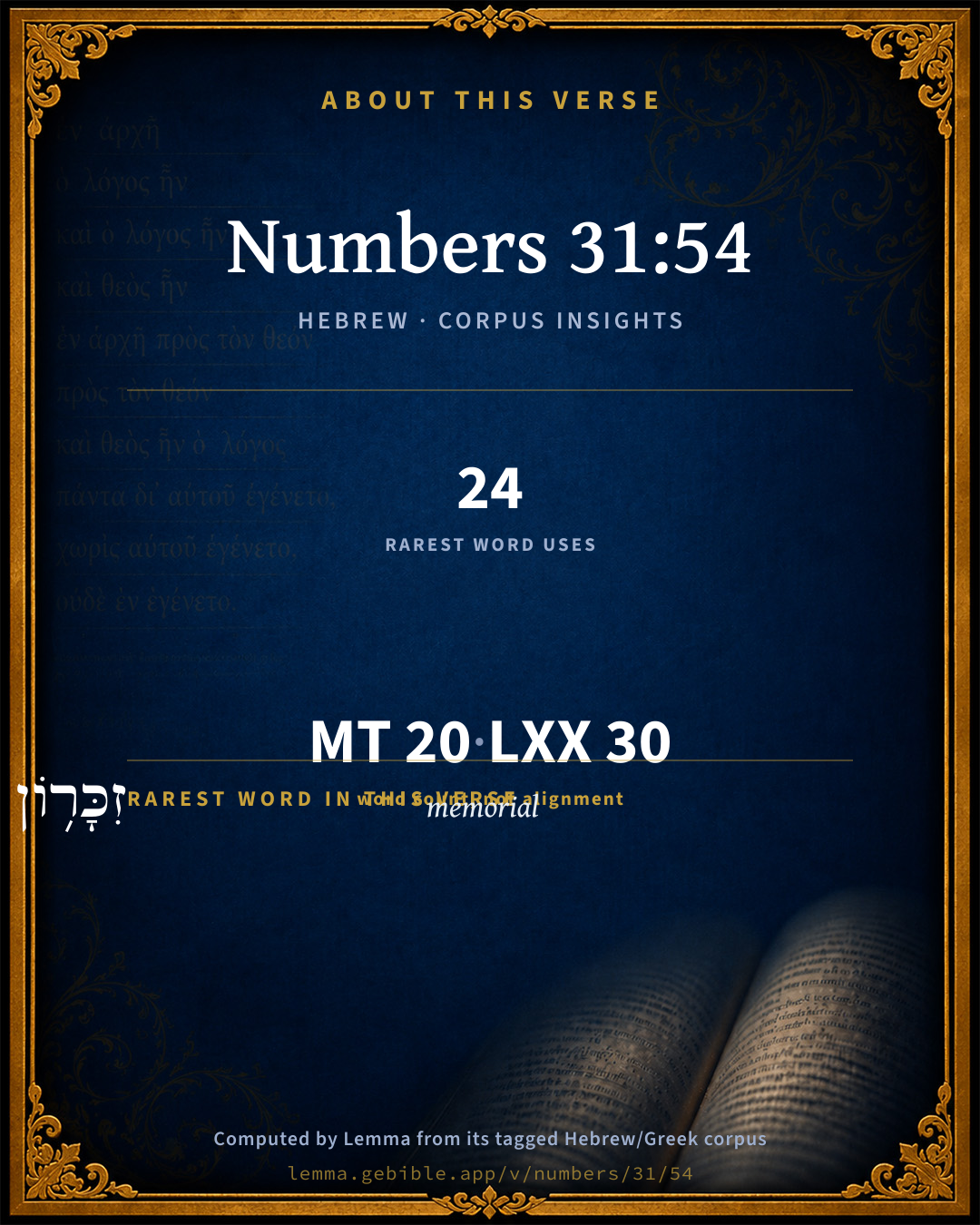
The rarest word here is זִכָּר֥וֹן memorial H2146 — appearing just 24 times in the whole Hebrew Bible.

Shared distinctive vocabulary

זִכָּר֥וֹן memorial H2146 occurs in 22 verses of the Hebrew Bible. Also found in:

Grammatical profile

  • 2 verbs
  • 12 nouns
  • 2 adjectives
  • 2 prepositions
  • 2 particles

Verb forms

  • וַיִּקַּ֨ח Qal · Sequential Imperfect
  • וַיָּבִ֤אוּ Hiphil · Sequential Imperfect

Hebrew & Septuagint length

In English translation the verse runs 34 words from the Hebrew and 37 from the Septuagint (LXX English) — closely comparable.

A rough comparison of the two English renderings, which tokenize alike — not a word-level alignment.

Word counts can differ between the Hebrew and the Greek without any difference in meaning — e.g. the Hebrew direct-object marker אֵת has no separate Greek word, and Greek often adds the article ὁ.

In the original languages it is 20 Hebrew tokens and 30 Greek tokens — but the two are counted differently (Hebrew bundles its prefixes and suffixes into one token; the Greek is in lemma form), so that isn’t a like-for-like length.

Cross-references

10

Topical passages linked to Numbers 31:54 in the Treasury of Scripture Knowledge — connected by theme and wording, ordered by reader-vote popularity; previews shown in the World English Bible.

  • Exodus 30:16 You shall take the atonement money from the children of Israel, and shall appoint it for the service of the tent of meeting; that it may be a memorial for the children of Israel before Yahweh, to make atonement for your souls."
  • Zechariah 6:14 The crowns shall be to Helem, and to Tobijah, and to Jedaiah, and to Hen the son of Zephaniah, for a memorial in the temple of Yahweh.
  • Numbers 16:40 to be a memorial to the children of Israel, to the end that no stranger, who isn't of the seed of Aaron, comes near to burn incense before Yahweh; that he not be as Korah, and as his company: as Yahweh spoke to him by Moses.
  • Joshua 4:7 then you shall tell them, Because the waters of the Jordan were cut off before the ark of the covenant of Yahweh; when it passed over the Jordan, the waters of the Jordan were cut off: and these stones shall be for a memorial to the children of Israel forever.
  • Psalms 18:49 Therefore I will give thanks to you, Yahweh, among the nations, And will sing praises to your name.
  • Psalms 103:1–2 Praise Yahweh, my soul! All that is within me, praise his holy name!
  • Psalms 115:1 Not to us, Yahweh, not to us, But to your name give glory, For your loving kindness, and for your truth's sake.
  • Psalms 145:7 They will utter the memory of your great goodness, And will sing of your righteousness.
  • Luke 22:19 He took bread, and when he had given thanks, he broke it, and gave to them, saying, "This is my body which is given for you. Do this in memory of me."
  • Acts 10:4 He, fastening his eyes on him, and being frightened, said, "What is it, Lord?" He said to him, "Your prayers and your gifts to the needy have gone up for a memorial before God.

Cross-references courtesy of OpenBible.info (CC BY 4.0).

Hebrew and Greek witnesses Masoretic Hebrew ↔ Greek Septuagint

The same verse in the two great witnesses to the Old Testament, shown verse-for-verse.

These are two independent witnesses, not word-aligned to each other, and the Septuagint is shown in lemma (dictionary) form.

Hebrew Numbers 31:54 Masoretic · Westminster Leningrad Codex

וַיִּקַּ֨ח מֹשֶׁ֜ה וְאֶלְעָזָ֤ר הַכֹּהֵן֙ אֶת הַזָּהָ֔ב מֵאֵ֛ת שָׂרֵ֥י הָאֲלָפִ֖ים וְהַמֵּא֑וֹת וַיָּבִ֤אוּ אֹתוֹ֙ אֶל אֹ֣הֶל מוֹעֵ֔ד זִכָּר֥וֹן לִבְנֵֽי יִשְׂרָאֵ֖ל לִפְנֵ֥י יְהוָֽה

Moses and Eleazar the priest took the gold of the captains of thousands and of hundreds, and brought it into the tent of meeting, for a memorial for the children of Israel before Yahweh.

World English Bible · Public Domain

Greek LXX Numbers 31:54 Septuagint · lemma form

καί λαμβάνω μωυσῆς καί ελεαζαρ ὁ ἱερεύς ὁ χρυσίον παρά ὁ χιλίαρχος καί παρά ὁ ἑκατόνταρχος καί εἰςφέρω αὐτός εἰς ὁ σκηνή ὁ μαρτύριον μνημόσυνον ὁ υἱός ἰσραήλ ἔναντι κύριος

And Moses and Eleazar the priest took the gold from the captains of thousands and captains of hundreds, and brought the vessels into the tabernacle of witness, a memorial of the children of Israel before the Lord.

LXX2012 (modern English Septuagint) · Public Domain

On this verse, The Pulpit Commentary discusses the Septuagint’s reading. Read the note in Commentary ↓

Hebrew: Westminster Leningrad Codex (CC BY 4.0). Greek: Septuagint (public domain); English from LXX2012 (modern English Septuagint) (Public Domain). How the Septuagint differs from the Hebrew →

Targum (Aramaic paraphrase)

2

The Targum is the ancient Jewish Aramaic paraphrase of the Hebrew Scriptures — an interpretive translation, not the Hebrew text itself. Onkelos (literal) and Pseudo-Jonathan (expansive) render the Torah, and Jonathan the Prophets. Coverage is partial: where no permissively-licensed English translation exists for a verse, only the Aramaic is shown. This is verse-level text, not a word-by-word alignment to the Hebrew.

  1. Targum Onkelos Torah (Genesis–Deuteronomy)
    וּנְסֵיב משֶׁה וְאֶלְעָזָר כַּהֲנָא יָת דַהֲבָא מִן רַבָּנֵי אַלְפִין וּמַאֲוָתָא וְאַיְתִיאוּ יָתֵיהּ לְמַשְׁכַּן זִמְנָא דָכְרָנָא לִבְנֵי יִשְׂרָאֵל קֳדָם יְיָ

    (no public-domain English translation for this verse)

    Targum Onkelos — Aramaic: “Onkelos Genesis” (public domain); “Onkelos Exodus” (public domain); “Onkelos Leviticus” (public domain); “Onkelos Numbers” (public domain); “Onkelos Deuteronomy” (public domain). English: “Sefaria Community Translation” (CC0 1.0 (public-domain dedication)); “J.W. Etheridge. The Targums of Onkelos and Jonathan Ben Uzziel on the Pentateuch. London: Longmans, Green, 1862” (public domain). Text via Sefaria.

  2. Targum Pseudo-Jonathan Torah (Genesis–Deuteronomy)
    וּנְסֵיב משֶׁה וְאֶלְעָזָר כַּהֲנָא יַת דַהֲבָא מִן רַבָּנֵי אַלְפִין וּמַאֲוָותָא וְאַיְתִיאוּ יָתֵיהּ לְמַשְׁכַּן זִמְנָא דוּכְרָנָא טָבָא לִבְנֵי יִשְרָאֵל קֳדָם יְיָ

    And Mosheh and Elazar the priest took the gold from the captains of thousands and of hundreds, and brought it into the tabernacle of ordinance, a good memorial of the sons of Israel before the Lord.

    Targum Pseudo-Jonathan — Aramaic: “Targum Jonathan on Genesis” (public domain); “Targum Jonathan on Exodus” (public domain); “Targum Jonathan on Leviticus” (public domain); “Targum Jonathan on Numbers” (public domain); “Targum Jonathan on Deuteronomy” (public domain). English: “The Targum of Jonathan ben Uzziel, trans. J. W. Etheridge, London, 1862” (public domain). Text via Sefaria.

Commentary

Notes on Numbers 31:54 from classic Christian and Jewish commentators (each source and its license shown beneath its notes). The classic Christian expositions comment on the surrounding passage and are grouped to its opening verse, so a note may address several verses; the Jewish commentaries on the Tanakh (Rashi and others) are per-verse, so they appear only where the commentator wrote on this verse.

Lemma curates 59 commentaries, every one of them public domain or Creative Commons licensed, each selected and text-cleaned for this edition rather than reprinted as found. About our sources →

Geneva Bible (1599)

Geneva Bible translators

That the Lord might remember the children of Israel.

Geneva Bible (1599) marginal notes — public domain. Text via Bolls.life.

Whedon's Commentary on the Bible

Daniel D. Whedon

54. A memorial — The ornaments may have been melted and wrought up into one piece of a monumental form.

Daniel D. Whedon (gen. ed.), Commentary on the Old and New Testaments (1874–1909) — public domain. Text from a community e-Sword module.

The Pulpit Commentary

Brought it into the tabernacle of the congregation. It is not said what was done with this enormous quantity of gold, which must have been a cause of anxiety as well as of pride to the priests. It may have formed a fund for the support of the tabernacle services during the long years of neglect which followed the conquest, or it may have been drawn upon for national purposes. A memorial. To bring them into favourable remembrance with the Lord. For this sense of wOrKzi (Septuagint, mnhmosunon ) cf. Exo_28:12, Exo_28:29.

The Pulpit Commentary (1880–1919), ed. H.D.M. Spence-Jones & Joseph S. Exell — public domain. Text from a community e-Sword module.

Ramban (Nachmanides)

Rabbi Moshe ben Nachman (Ramban / Nachmanides)

AND THEY BROUGHT IT INTO THE TENT OF MEETING, FOR A MEMORIAL FOR THE CHILDREN OF ISRAEL BEFORE THE ETERNAL. It would appear from this verse that they made them [the ornaments they had captured] into vessels to be used for the Service [in the Sanctuary], and handed them over to the public for a memorial for all the children of Israel with which to perform the Service of G-d throughout their generations. For had these vessels [merely] gone to the treasury of the House of G-d [rather than actually being used for the Divine Service], the verse should rather have said, “a memorial ‘for them’ before the Eternal,” but [the phrase] the children of Israel [a memorial for ‘the children of Israel’] includes all the people, and [it means] that the memorial consists of something permanent. to the donors, whereas now that they themselves were used as vessels in the Divine Service, they served as a memorial for all the children of Israel for all times, as the Service in the Sanctuary is designated for all generations (see e.g. Exodus 29:42).

Ramban (Nachmanides) on the Tanakh — English translation: “Commentary on the Torah by Ramban (Nachmanides). Translated and annotated by Charles B. Chavel. New York, Shilo Pub. House, 1971-1976” (CC BY 4.0). Text via Sefaria.

Lesson kit

Teaching starters — assembled from the data on this page, not authored interpretation. Every prompt links to the verse data it draws on. Edit before teaching.

Numbers, in the Pentateuch, opens this verse with 20 words (19 distinct Hebrew lemmas). Its most distinctive word is zikrôwn (“memorial”). A historical commentator’s framing appears above. Read the whole chapter for the surrounding context.

Discussion questions

  1. What does “memorial” (zikrôwn) contribute to the verse as a whole?
  2. How does Exodus 12:14, which shares the word «memorial», read alongside this verse?
  3. The translations on this page render this verse differently — a whole-verse word diff, not a word-by-word alignment. What might account for the different wordings?
  4. «וַיִּקַּ֨ח» is a Qal Sequential Imperfect verb. How does that grammatical form shape the action described?
  5. Compare how Geneva Bible (1599) and Whedon's Commentary on the Bible read this verse. Where do they agree or differ?

Things to notice

Reading settings

Reading text

Shown beneath each verse's original-language words.

Old Testament
Old Testament edition

Read the OT as the Masoretic Hebrew (MT) or the Greek Septuagint (LXX).

English shown for the Greek Septuagint (in the Hebrew ↔ Greek comparison).

Comparing translations? Open the Compare panel on any verse page to stack up to four side by side.