
Numbers 18:2

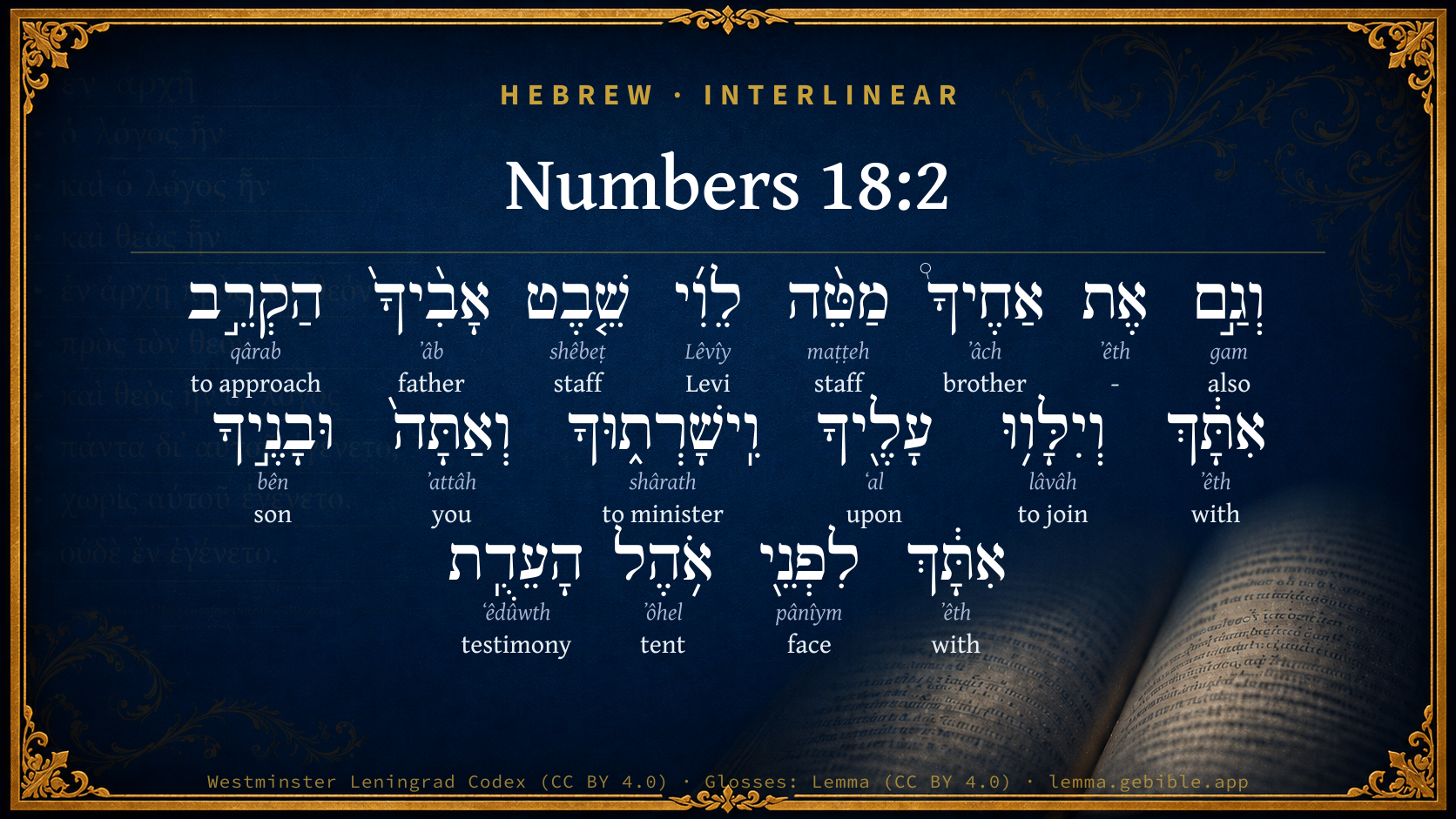
Hebrew (Westminster Leningrad Codex) Numbers 18:2 appears in the Hebrew Old Testament. The text above is from the Westminster Leningrad Codex. Each word links to its Strong’s number, a concise gloss, and parsing drawn from the Open Scriptures Hebrew Bible morphology. Click any word for its full Brown-Driver-Briggs (BDB) entry.
Download image
Cite this verse

Numbers 18:2 (World English Bible). Public Domain. Lemma interlinear Bible study tool, https://lemma.gebible.app/v/numbers/18/2.

Show BibTeX & RIS
BibTeX
RIS
English Translation
Your brothers also, the tribe of Levi, the tribe of your father, bring you near with you, that they may be joined to you, and minister to you: but you and your sons with you shall be before the tent of the testimony.
World English Bible · Public Domain
Download a study sheet

One document with this verse’s original text, its word-by-word gloss line, the meaning frame, cross-references with their text, attributed commentary, and full source and license credits — printable, and it pastes into notes with its structure intact.

This verse Autodidact and up

Study sheet (.html) Plain text (.txt)

A passage Seminary Student

Up to 50 verses in one chapter. A passage sheet keeps up to 6 commentary sources and 12 cross-references per verse, in the order this page ranks them, and says so on the sheet whenever that leaves anything out. Ask for a single verse and you get the Autodidact verse sheet above.

Everything on this page stays free to read, with no account — the sheet is a download of what is already on screen, not access to it.

Want to remove ads? Support Godless Engineer
Compare translations 3

The same verse in 3 English versions, stacked beneath the original-language interlinear above. Click any original word for its lexicon entry.

Each is an independent rendering of the whole verse — the interlinear is not word-aligned to these translations.

Highlighted words mark where these versions differ — a whole-verse word diff, not a word-by-word alignment.

  • World English Bible Public Domain
    Your brothers also, the tribe of Levi, the tribe of your father, bring you near with you, that they may be joined to you, and minister to you: but you and your sons with you shall be before the tent of the testimony.
  • King James Version Public Domain
    And thy brethren also of the tribe of Levi, the tribe of thy father, bring thou with thee, that they may be joined unto thee, and minister unto thee: but thou and thy sons with thee shall minister before the tabernacle of witness.
  • unfoldingWord Literal Text CC BY-SA 4.0
    And also bring near with you your brothers, the tribe of Levi, the tribe of your father, and they shall be joined to you and shall minister to you. And you and your sons with you to the face of the tent of the Testimony.

unfoldingWord Literal Text — © unfoldingWord, licensed CC BY-SA 4.0. Word-aligned USFM3 via Door43 (git.door43.org/unfoldingWord/en_ult).

Versions to compare (up to 4)

3 of 4 selected

Show all 18 translations

Every available English version of this verse, each an independent rendering of the whole verse.

  • World English Bible Public Domain
    Your brothers also, the tribe of Levi, the tribe of your father, bring you near with you, that they may be joined to you, and minister to you: but you and your sons with you shall be before the tent of the testimony.
  • Berean Standard Bible Public Domain
    But bring with you also your brothers from the tribe of Levi, the tribe of your father, that they may join you and assist you and your sons before the Tent of the Testimony.
  • Majority Standard Bible Public Domain
    But bring with you also your brothers from the tribe of Levi, the tribe of your father, that they may join you and assist you and your sons before the Tent of the Testimony.
  • King James Version Public Domain
    And thy brethren also of the tribe of Levi, the tribe of thy father, bring thou with thee, that they may be joined unto thee, and minister unto thee: but thou and thy sons with thee shall minister before the tabernacle of witness.
  • American Standard Version (1901) Public Domain
    And thy brethren also, the tribe of Levi, the tribe of thy father, bring thou near with thee, that they may be joined unto thee, and minister unto thee: but thou and thy sons with thee shall be before the tent of the testimony.
  • Revised Version (1885) Public Domain
    And thy brethren also, the tribe of Levi, the tribe of thy father, bring thou near with thee, that they may be joined unto thee, and minister unto thee: but thou and thy sons with thee shall be before the tent of the testimony.
  • Geneva Bible (1599) Public Domain
    And bring also with thee thy brethren of the tribe of Leui of ye familie of thy father, which shalbe ioyned with thee, and minister vnto thee: but thou, and thy sonnes with thee shall minister before the Tabernacle of the Testimonie:
  • Douay-Rheims (1899) Public Domain
    And take with thee thy brethren also of the tribe of Levi, and the sceptre of thy father, and let them be ready in hand, and minister to thee: but thou and thy sons shall minister in the tabernacle of the testimony.
  • Young's Literal Translation Public Domain
    and also thy brethren, the tribe of Levi, the tribe of thy father, bring near with thee, and they are joined unto thee, and serve thee, even thou and thy sons with thee, before the tent of the testimony.
  • Literal Standard Version CC BY-SA 4.0
    and also your brothers, the tribe of Levi, the tribe of your father, bring near with you, and they are joined to you, and serve you, even you and your sons with you, before the Tent of the Testimony.
  • Unlocked Literal Bible CC BY-SA 4.0
    As for your fellow members of the tribe of Levi, your ancestors' tribe, you must bring them with you so they may join you and help you when you and your sons serve in front of the tent of the covenant decrees.
  • unfoldingWord Literal Text CC BY-SA 4.0
    And also bring near with you your brothers, the tribe of Levi, the tribe of your father, and they shall be joined to you and shall minister to you. And you and your sons with you to the face of the tent of the Testimony.
  • Darby Bible Public Domain
    And thy brethren also, the tribe of Levi, the tribe of thy father, bring near with thee, that they may unite with thee, and minister unto thee; but thou and thy sons with thee [shall serve] before the tent of the testimony.
  • World Messianic Bible Public Domain
    Bring your brothers also, the tribe of Levi, the tribe of your father, near with you, that they may be joined to you, and minister to you; but you and your sons with you shall be before the Tent of the Testimony.
  • Webster's Bible Public Domain
    And thy brethren also of the tribe of Levi, the tribe of thy father, bring thou with thee, that they may be joined to thee, and minister to thee: but thou and thy sons with thee shall minister before the tabernacle of witness.
  • Free Bible Version CC BY-SA 4.0
    Have your brothers from the tribe of Levi, your father's tribe, join you to help you and your sons with your service in the Tent of the Testimony.
  • Bible in Basic English Public Domain
    Let your brothers, the family of Levi, come near with you, so that they may be joined with you and be your servants: but you and your sons with you are to go in before the ark of witness.
  • JPS Tanakh (1917) Public Domain
    And thy brethren also, the tribe of Levi, the tribe of thy father, bring thou near with thee, that they may be joined unto thee, and minister unto thee, thou and thy sons with thee being before the tent of the testimony.

Literal Standard Version (2020), Covenant Press — licensed CC BY-SA 4.0. Text via the HelloAO Bible API (eBible.org). Unlocked Literal Bible (unfoldingWord) — licensed CC BY-SA 4.0. Text via the HelloAO Bible API (eBible.org). unfoldingWord Literal Text — © unfoldingWord, licensed CC BY-SA 4.0. Word-aligned USFM3 via Door43 (git.door43.org/unfoldingWord/en_ult). Free Bible Version, Dr. Jonathan Gallagher — licensed CC BY-SA 4.0. Text via the HelloAO Bible API (eBible.org).

Word by word

More ways to search: Search by grammar → Find every occurrence → Compare this word →

Practice this passage: Drill this verse → Learn its vocabulary →

וְיִלָּו֥וּ
lâvâh
H3867
“and · to join”
Conjunction + Verb, Niphal, Imperfect, 3rd Person, Masculine, Plural
Part of Speech
Conjunction + Verb
Stem
Niphal
Form
Imperfect
Person
3rd Person
Gender
Masculine
Number
Plural
Full BDB Definition

Origin: a primitive root

TWOT: 1087 , 1088

to join, be joined - (Qal) to join, be joined, attend - (Niphal) to join oneself to, be joined unto - to borrow, lend - (Qal) to borrow - (Hiphil) to cause to borrow, lend to
  1. וְגַ֣ם gam H1571 “and · also” Conjunction + Particle, Accusative
  2. אֶת ʼêth H853 “-” Particle, Direct Object
  3. אַחֶיךָ֩ ʼâch H251 “brothers · your” Noun, Common, Masculine, Plural, Construct + Suffix, Personal, 2nd Person, Masculine, Singular
  4. מַטֵּ֨ה maṭṭeh H4294 “staff of” Noun, Common, Masculine, Singular, Construct
  5. לֵוִ֜י Lêvîy H3878 “Levi” Noun, Proper
  6. שֵׁ֤בֶט shêbeṭ H7626 “staff of” Noun, Common, Masculine, Singular, Construct
  7. אָבִ֨יךָ֙ ʼâb H1 “father · your” Noun, Common, Masculine, Singular, Construct + Suffix, Personal, 2nd Person, Masculine, Singular
  8. הַקְרֵ֣ב qârab H7126 “approach” Verb, Hiphil, Imperative, 2nd Person, Masculine, Singular
  9. אִתָּ֔ךְ ʼêth H854 “with · you” Preposition + Suffix, Personal, 2nd Person, Feminine, Singular
  10. עָלֶ֖יךָ ʻal H5921 “upon · you” Preposition + Suffix, Personal, 2nd Person, Masculine, Singular
  11. וִֽישָׁרְת֑וּךָ shârath H8334 “and · to minister · you” Conjunction + Verb, Piel, Imperfect, 3rd Person, Masculine, Plural + Suffix, Personal, 2nd Person, Masculine, Singular
  12. וְאַתָּה֙ ʼattâh H859 “and · you” Conjunction + Pronoun, Personal, 2nd Person, Masculine, Singular
  13. וּבָנֶ֣יךָ bên H1121 “and · sons · your” Conjunction + Noun, Common, Masculine, Plural, Construct + Suffix, Personal, 2nd Person, Masculine, Singular
  14. אִתָּ֔ךְ ʼêth H854 “with · you” Preposition + Suffix, Personal, 2nd Person, Feminine, Singular
  15. לִפְנֵ֖י pânîym H6440 “to/for · face(s) of” Preposition + Noun, Common, Both, Plural, Construct
  16. אֹ֥הֶל ʼôhel H168 “tent of” Noun, Common, Masculine, Singular, Construct
  17. הָעֵדֻֽת ʻêdûwth H5715 “the · testimony” Particle, Definite Article + Noun, Common, Feminine, Singular, Absolute

About this verse

These counts appear in no published source. They are computed here, from the morphology-tagged text and Lemma’s own curated glosses. What Lemma adds →

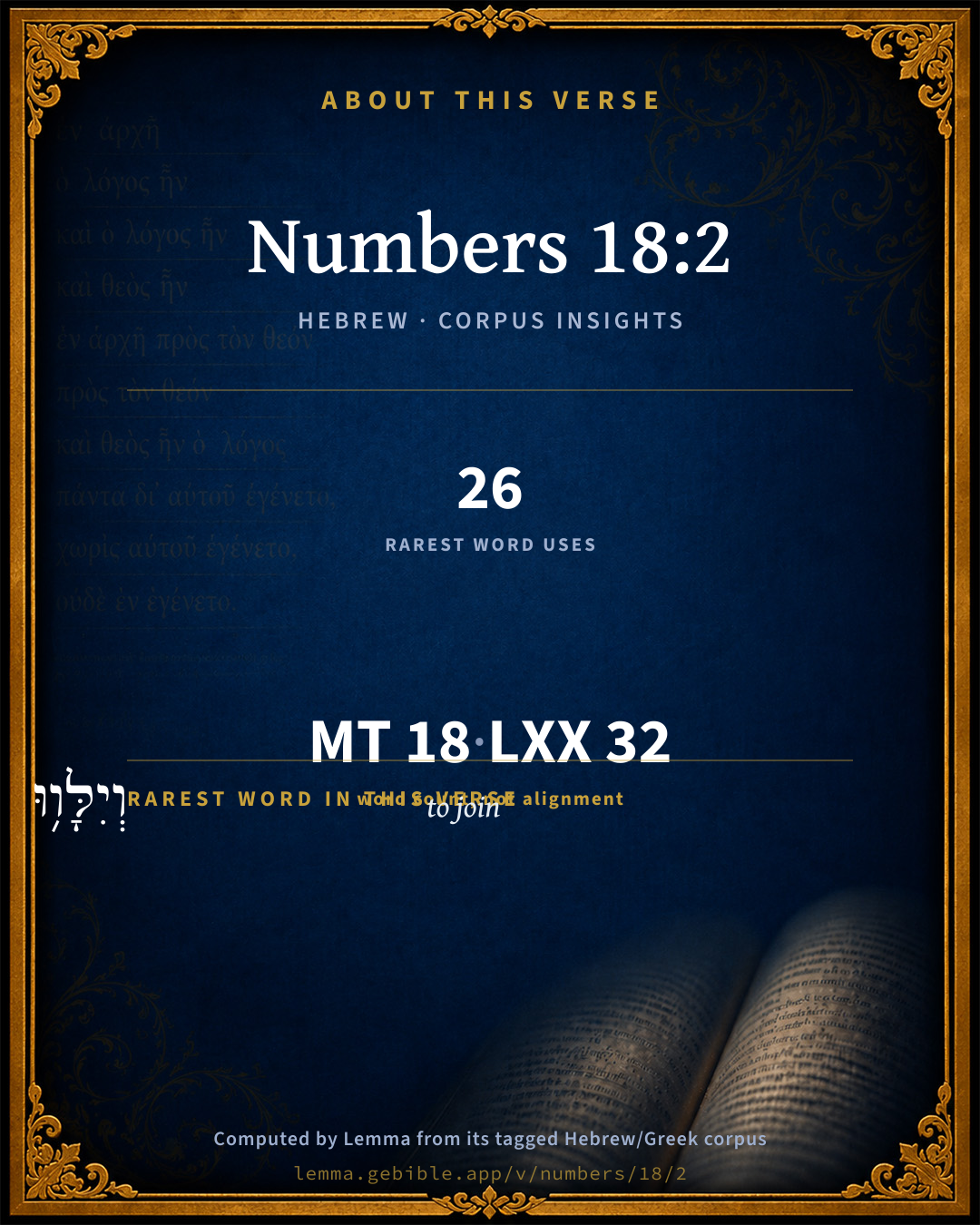
18
words
17
distinct lemmas
Pentateuch
section

Shared distinctive vocabulary

וְיִלָּו֥וּ to join H3867 occurs in 22 verses of the Hebrew Bible. Also found in:

Grammatical profile

  • 3 verbs
  • 9 nouns
  • 1 pronoun
  • 3 prepositions
  • 2 particles

Verb forms

  • הַקְרֵ֣ב Hiphil · Imperative
  • וְיִלָּו֥וּ Niphal · Imperfect
  • וִֽישָׁרְת֑וּךָ Piel · Imperfect

Repetition

A word recurs within this verse — often emphatic in Hebrew:

  • אִתָּ֔ךְ with H854 ×2

Hebrew & Septuagint length

In English translation the verse runs 43 words from the Hebrew and 42 from the Septuagint (LXX English) — closely comparable.

A rough comparison of the two English renderings, which tokenize alike — not a word-level alignment.

Word counts can differ between the Hebrew and the Greek without any difference in meaning — e.g. the Hebrew direct-object marker אֵת has no separate Greek word, and Greek often adds the article ὁ.

In the original languages it is 18 Hebrew tokens and 32 Greek tokens — but the two are counted differently (Hebrew bundles its prefixes and suffixes into one token; the Greek is in lemma form), so that isn’t a like-for-like length.

Cross-references

11

Topical passages linked to Numbers 18:2 in the Treasury of Scripture Knowledge — connected by theme and wording, ordered by reader-vote popularity; previews shown in the World English Bible.

  • Genesis 29:34 She conceived again, and bare a son. Said, "Now this time will my husband be joined to me, because I have borne him three sons." Therefore was his name called Levi.
  • Numbers 3:6–13 "Bring the tribe of Levi near, and set them before Aaron the priest, that they may minister to him.
  • Numbers 4:15 "When Aaron and his sons have finished covering the sanctuary, and all the furniture of the sanctuary, as the camp moves forward; after that, the sons of Kohath shall come to carry it: but they shall not touch the sanctuary, lest they die. These things are the burden of the sons of Kohath in the Tent of Meeting.
  • Numbers 8:19 I have given the Levites as a gift to Aaron and to his sons from among the children of Israel, to do the service of the children of Israel in the Tent of Meeting, and to make atonement for the children of Israel; that there be no plague among the children of Israel, when the children of Israel come near to the sanctuary."
  • Numbers 8:22 After that, the Levites went in to do their service in the Tent of Meeting before Aaron, and before his sons: as Yahweh had commanded Moses concerning the Levites, so they did to them.
  • Numbers 16:40 to be a memorial to the children of Israel, to the end that no stranger, who isn't of the seed of Aaron, comes near to burn incense before Yahweh; that he not be as Korah, and as his company: as Yahweh spoke to him by Moses.
  • Numbers 17:7 Moses laid up the rods before Yahweh in the tent of the testimony.
  • Numbers 18:4 They shall be joined to you, and keep the charge of the tent of meeting, for all the service of the Tent: and a stranger shall not come near to you.
  • 1 Chronicles 16:39–40 and Zadok the priest, and his brothers the priests, before the tent of Yahweh in the high place that was at Gibeon,
  • 2 Chronicles 30:16 They stood in their place after their order, according to the law of Moses the man of God: the priests sprinkled the blood [which they received] of the hand of the Levites.
  • Ezekiel 44:15 But the priests the Levites, the sons of Zadok, who kept the charge of my sanctuary when the children of Israel went astray from me, they shall come near to me to minister to me; and they shall stand before me to offer to me the fat and the blood, says the Lord Yahweh:

Cross-references courtesy of OpenBible.info (CC BY 4.0).

Hebrew and Greek witnesses Masoretic Hebrew ↔ Greek Septuagint

The same verse in the two great witnesses to the Old Testament, shown verse-for-verse.

These are two independent witnesses, not word-aligned to each other, and the Septuagint is shown in lemma (dictionary) form.

Hebrew Numbers 18:2 Masoretic · Westminster Leningrad Codex

וְגַ֣ם אֶת אַחֶיךָ֩ מַטֵּ֨ה לֵוִ֜י שֵׁ֤בֶט אָבִ֨יךָ֙ הַקְרֵ֣ב אִתָּ֔ךְ וְיִלָּו֥וּ עָלֶ֖יךָ וִֽישָׁרְת֑וּךָ וְאַתָּה֙ וּבָנֶ֣יךָ אִתָּ֔ךְ לִפְנֵ֖י אֹ֥הֶל הָעֵדֻֽת

Your brothers also, the tribe of Levi, the tribe of your father, bring you near with you, that they may be joined to you, and minister to you: but you and your sons with you shall be before the tent of the testimony.

World English Bible · Public Domain

Greek LXX Numbers 18:2 Septuagint · lemma form

καί ὁ ἀδελφός σύ φυλή λευί δῆμος ὁ πατήρ σύ προςἄγω πρός σεαυτοῦ καί προςτίθημι σύ καί λειτουργέω σύ καί σύ καί ὁ υἱός σύ μετά σύ ἀπέναντι ὁ σκηνή ὁ μαρτύριον

And take to yourself your brethren the tribe of Levi, the family of your father, and let them be joined to you, and let them minister to you; and you and your sons with you shall minister before the tabernacle of witness.

LXX2012 (modern English Septuagint) · Public Domain

On this verse, The Pulpit Commentary discusses the Septuagint’s reading. Read the note in Commentary ↓

Hebrew: Westminster Leningrad Codex (CC BY 4.0). Greek: Septuagint (public domain); English from LXX2012 (modern English Septuagint) (Public Domain). How the Septuagint differs from the Hebrew →

Targum (Aramaic paraphrase)

2

The Targum is the ancient Jewish Aramaic paraphrase of the Hebrew Scriptures — an interpretive translation, not the Hebrew text itself. Onkelos (literal) and Pseudo-Jonathan (expansive) render the Torah, and Jonathan the Prophets. Coverage is partial: where no permissively-licensed English translation exists for a verse, only the Aramaic is shown. This is verse-level text, not a word-by-word alignment to the Hebrew.

  1. Targum Onkelos Torah (Genesis–Deuteronomy)
    וְאַף יָת אֲחָיךְ שִׁבְטָא דְלֵוִי שִׁבְטָא דַאֲבוּךְ קָרֵיב לְוָתָךְ וְיִתּוֹסְפוּן עֲלָךְ וִישַׁמְשׁוּנָךְ וְאַתְּ וּבְנָךְ עִמָךְ קֳדָם מַשְׁכְּנָא דְסַהֲדוּתָא

    (no public-domain English translation for this verse)

    Targum Onkelos — Aramaic: “Onkelos Genesis” (public domain); “Onkelos Exodus” (public domain); “Onkelos Leviticus” (public domain); “Onkelos Numbers” (public domain); “Onkelos Deuteronomy” (public domain). English: “Sefaria Community Translation” (CC0 1.0 (public-domain dedication)); “J.W. Etheridge. The Targums of Onkelos and Jonathan Ben Uzziel on the Pentateuch. London: Longmans, Green, 1862” (public domain). Text via Sefaria.

  2. Targum Pseudo-Jonathan Torah (Genesis–Deuteronomy)
    וְאוּף יַת אָחָךְ שִׁבְטָא דְלֵוִי דְמִתְקְרֵי עַל שְׁמָא דְעַמְרָם אַבָּךְ קָרֵיב לְוָתָךְ וְיִתְחַבְּרוּן לְוָתָךְ וִישַׁמְשׁוּנָךְ וְאַנְתְּ וּבְנָךְ עִמָךְ תְּקוּמוּן קֳדָם מַשְׁכְּנָא דְסַהֲדוּתָא

    And thy brethren also of the tribe of Levi, who are called by the name of Amram thy father, shalt thou bring near to thee, that they may consociate with and minister to thee. But thou, and thy sons with thee, (only) shall stand before the tabernacle of the testimony.

    Targum Pseudo-Jonathan — Aramaic: “Targum Jonathan on Genesis” (public domain); “Targum Jonathan on Exodus” (public domain); “Targum Jonathan on Leviticus” (public domain); “Targum Jonathan on Numbers” (public domain); “Targum Jonathan on Deuteronomy” (public domain). English: “The Targum of Jonathan ben Uzziel, trans. J. W. Etheridge, London, 1862” (public domain). Text via Sefaria.

Commentary

Notes on Numbers 18:2 from classic Christian and Jewish commentators (each source and its license shown beneath its notes). The classic Christian expositions comment on the surrounding passage and are grouped to its opening verse, so a note may address several verses; the Jewish commentaries on the Tanakh (Rashi and others) are per-verse, so they appear only where the commentator wrote on this verse.

Lemma curates 59 commentaries, every one of them public domain or Creative Commons licensed, each selected and text-cleaned for this edition rather than reprinted as found. About our sources →

Joseph Benson's Commentary

Num 18:2-3. Minister unto thee — About sacrifices, and offerings, and other things, according to the rules I have prescribed them. The Levites are said to minister to Aaron here; to the church, Num 16:9; and to God, Deu 10:8. They shall not contend with thee for superiority, as they have done, but shall be subordinate to thee. Thy sons with thee — Or, both to thee and to thy sons with thee — Which translation seems to be favoured by the following words, before the tabernacle; which was the proper place where the Levites ministered. Besides, both the foregoing words and the two following verses entirely speak of the ministry of the Levites, and the ministry of the priests is distinctly spoken of, Num 18:5. Thy charge — That which thou shalt command them and commit unto them.

Joseph Benson's Commentary on the Old and New Testaments (1811–1818) — public domain. Text from a community e-Sword module.

Jamieson, Fausset & Brown

Robert Jamieson, A. R. Fausset & David Brown

thy brethren also of the tribe of Levi--The departments of the sacred office, to be filled respectively by the priests and Levites, are here assigned to each. To the priests was committed the charge of the sanctuary and the altar, while the Levites were to take care of everything else about the tabernacle. The Levites were to attend the priests as servants--bestowed on them as "gifts" to aid in the service of the tabernacle--while the high and dignified office of the priesthood was a "service of gift." "A stranger," that is, one, neither a priest nor a Levite, who should intrude into any departments of the sacred office, should incur the penalty of death.

Jamieson, Fausset & Brown — Commentary Critical and Explanatory on the Whole Bible (1871) — public domain (CC PDM 1.0). Text via the HelloAO Bible API.

Adam Clarke's Commentary

Verse 2. Thy brethren also of the tribe of Levi - may be joined unto thee] There is a fine paronomasia, or play upon words, in the original. לוי Levi comes from the root לוה lavah, to join to, couple, associate: hence Moses says, the Levites, ילוו yillavu, shall be joined, or associated with the priests; they shall conjointly perform the whole of the sacred office, but the priests shall be principal, the Levites only their associates or assistants. For an explanation of many parts of this chapter, see the notes on several of the passages referred to in the margin.

Adam Clarke's Commentary on the Bible (1810–1826) — public domain. Text from a community e-Sword/MySword module.

Ellicott's Commentary for English Readers

(2) That they may be joined unto thee.—There is an allusion here to the meaning of the name Levi, which was given to Leah’s third son. (See Gen_29:34.) The Hebrew verb is the same as that which occurs in the speech of Leah.

And minister unto thee: but thou and thy sons . . . —Or, and they shall minister unto thee, both unto thee and to thy sons with thee, before the tent of witness. The service of the Levites was executed before the tent—i.e., in the court; that of the priests was in the holy place, as well as in the court (Num_18:7).

A Bible Commentary for English Readers, edited by Charles John Ellicott (1878–1897) — public domain. Text from a community e-Sword module.

The Cambridge Bible for Schools and Colleges

gen. ed. J. J. S. Perowne

2. that they may be joined] This is a play on words, similar to that in Gen_29:34, the verb lâwâh (לוה) being employed to explain the word Lçwî ‘Levite,’ so that the latter is understood to denote ‘one who is joined to the priests as a servant.’ Whether this was the original meaning and derivation is doubtful.

shall be before the tent] shall preside over the tent. The preposition is not local, but comprises sacred duties both within the tent and outside in the court.

The Cambridge Bible for Schools and Colleges (gen. ed. J. J. S. Perowne; Cambridge University Press, 1878–1918) — public domain. Text from a community e-Sword module.

John Gill's Exposition

And to thy brethren also of the tribe of Levi, the tribe of thy father,.... For his father Amram was of that tribe, and so the Levites were his brethren, as he is directed to consider them; which might serve to conciliate their minds, and make them easy with respect to his enjoyment of the priesthood:

bring them with thee; into the court of the tabernacle, for further they might not go:

that they maybe joined unto thee: as their name of Levites signifies, persons joined and united to others, as they were to the priests: see reason of their patriarch's name Levi in Gen 29:34,

and minister unto thee: be assisting to the priests in killing the sacrifices, receiving the blood, and flaying the beasts, and in other things about the sanctuary, Num 3:6,

but thou, and thy sons with thee, shall minister before the tabernacle of witness; which was the most holy place, where were the ark of the testimony or witness, and the tables of the covenant; and they might be said to minister before that, when they ministered in the holy place, which was before it, when they burned incense upon the altar of incense, ordered the shewbread, and trimmed the lamps of the candlestick, which none but the priests the sons of Aaron might do.

John Gill's Exposition of the Whole Bible (1746–1763) — public domain (CC PDM 1.0). Text via the HelloAO Bible API.

Haydock's Catholic Bible Commentary

Sceptre. Hebrew shebet, denotes also "tribe, family," &c. The princes of families probably bore a sceptre, as we find all magistrates did in the days of Homer. (Iliad i.; Virgil, Æneid xii.) (Calmet) --- All the other children of Aaron’s father, were to be in the order of the Levites, among whom even Moses left his own family, though he was himself an extraordinary priest. (Haydock)

George Leo Haydock (1774–1849), Haydock's Catholic Family Bible and Commentary, 1859 edition — public domain. Excludes Psalms (Douay-Rheims chapter numbering differs from Protestant) and Deuterocanonical books (Catholic canon only).

Matthew Poole's English Annotations

Minister unto thee, about sacrifices and offerings and other things, according to the rules and limits I have prescribed them. The Levites are said to minister to Aaron here, to the church, Num 16:9, and to God, Deu 10:8. They shall not contend with thee for superiority, as they have done, but they shall be subordinate and servants to thee.

Thou and thy sons with thee, or, both to thee, and to thy sons with thee; which translation may seem to be favoured by the following words,

before the tabernacle, which was the proper place where the Levites ministered, whereas the priests did minister to God both before and in the tabernacle. Besides, both the foregoing words, and the two following verses, do entirely speak of the ministry of the Levites, and the ministry of the priests is distinctly spoken of Num 18:5.

Matthew Poole's English Annotations on the Holy Bible (1683–1685) — public domain. Text from a community e-Sword/MySword module.

Whedon's Commentary on the Bible

Daniel D. Whedon

2-5. Thy brethren — The Gershonites and Merarites might serve before the tabernacle, but not within it, nor near the vessels and the altar, lest both they and the priests should die. See Num_4:18, note. “While the Levitical law does not define the sanctuary duties of the Levites, but leaves them, as they might naturally be left at the outset, to perform such services as the priest might require of them, long usage gradually assigned to them specific tasks, as the charge of the gates, slaying the sacrifices, boiling or roasting their flesh, etc. 2Ch_23:4; 2Ch_30:17.” — Dr. W.H. Green. These directions are made in view of the judgment fires which had already burned around the divine altars in the cases of the irreverent sons of Aaron (Leviticus x) and of Korah and his company. Chap. 16.

Daniel D. Whedon (gen. ed.), Commentary on the Old and New Testaments (1874–1909) — public domain. Text from a community e-Sword module.

The Pulpit Commentary

Thy brethren also of the tribe of Levi. The Levites generally, as distinguished from the Kohathites in particular. (see on Nu 3) That they may be joined unto thee. WwLyw, a play upon the name Levi. (see on Gen_29:34) But thou and thy sons with thee shall minister before the tabernacle of witness. The Hebrew has only hTaw, which may be rendered, "And thou and thy sons with thee (shall be)," &c., or more naturally read with what goes before, "that they may minister unto thee; both thee and thy sons with thee," &c. The Septuagint and the Targums appear to favour the former rendering, but it is not evident what distinction could be drawn between priests and Levites as to the mere fact of being before the tabernacle. ;

Vers. 2-7. Aaron and his helpers.

I AARON HAD MANY HELPERS. No less than a whole tribe of Israel, 22, 000 in number. (Num_3:39) And if it be said, "What work could be found about the tabernacle for so many?" the answer is given in the portioning out of the work among the three great divisions of the tribe. The Levites were not around Aaron like the embellishments of a court, merely to impress the vulgar mind. They were there for work real, necessary, honourable, beneficial work. A great deal of it might seem humble, but it could not be done without. So notice how Jesus gathered helpers around himself. It was one of the earliest things he did. He gave them also great power, such as to heal diseases, raise dead persons, and cast out demons; that thus they might authenticate the gracious and momentous message with which he had intrusted them. And in the course of ages how the helpers have increased in numbers and in variety of service! Doubtless when Israel settled in Canaan, and the Levites became distributed over the land, it was found that they were not at all too numerous for the religious requirements of the people. Christ is the center and the guide of an immense amount of spiritual industry; nevertheless, the cry goes out that many more hearts and hands might be engaged helping the Divine Saviour of men. (Joh_4:35-38) It will be a long time before the Church has occasion to complain, with respect to labourers together with God, that the supply exceeds the demand. The householder had work to be done in his vineyard even at the eleventh hour.

II THESE HELPERS MUST BE DULY QUALIFIED. They must all be of the tribe of Levi. Levi was taken in place of the first-born of Israel, and when the first-born were numbered it was found that they somewhat exceeded the number of qualified persons among the Levites. But God did not make up the deficiency by taking from other tribes; he kept the tabernacle service within the limits of Levi, and provided for a ransom instead. (Num_3:39-51) The service was thus to be a matter of inheritance. Aaron and his sons had their portion Kohathite, Gershonite, Merarite, each had his own field of work, and was not to transgress it. Strangers were cautioned against putting unauthorized hands on the tabernacle. It was as real a violation of the sanctuary for a common Israelite to touch even a peg of the tabernacle as to intrude within the veil itself. So we should ever look with great jealousy and carefulness on the qualifications for serving Jesus. There have been great hindrances, occasions for blasphemy, because unclean hands have not only meddled with holy things, but kept them long in charge. The service of Jesus should go down by spiritual inheritance. We take care in affairs of this world that there shall be due apprenticeship and preparation, ascertained fitness, the tools intrusted to those who can handle them, and surely there is equal if not greater need in the supremely important affairs of Christ"s kingdom. Spiritual things should eve, be in charge of those who have spiritual discernment.

III THOSE QUALIFIED WERE THEREBY PLACED UNDER OBLIGATION TO SERVE. As the service was confined to Levi, so every Levite, not otherwise disqualified, had to take part in it. There was nothing else for a Levite to do than serve God in connection with the sanctuary. He had no land; he was a substitute for others in holy service, and therefore they had to provide him with the necessaries of life. Thus his way in life was made clear; there was no need to consult personal inclination, and no room for reasonable doubt. And so, generally speaking", what service God expects from us we may be sure he will signify in the clearest manner. If we allow personal inclination to be the great prompter and decider, there is very little we shall do. Many there are whose personal inclinations lead them into some sort of connection with the Church of Christ, and keep them there, yet they never enter into anything like real service. They have a name to serve, yet are only idly busy. Personal inclination is a very small factor in Christian service, at least at the beginning, else Christ would not have been so urgent in his demands for self-denial. Not much, of course, can be done without love; but duty, the sense of what we ought to do, is to be the great power at the beginning. Those who have had the five talents from God may have to appear in his presence to be judged, conscious that not only have the talents been lost to him, but used so selfishly as rather to have gained five talents besides in worldly possessions, influence, and reputation. It is a monstrous sin to use God"s property for the low, injurious aims of self. "Power," said John Foster, "to its very last particle, is duty.

IV THOUGH THEY WERE HELPERS OF AARON, THEY COULD NOT BE HIS SUBSTITUTES. When the priest dies, it is not some experienced and sagacious Levite who can take his place; the priesthood is to be kept in the priest"s own family. The hand cannot supply the place of the head. Take away the priest, and the head is gone. Aaron, if it had been necessary, could have stooped to do the humblest Levitical service, but not even the highest of the Kohathites could enter within the veil. And thus must the helpers of Christ ever look on him as separated by his nature and person to a work which no other human being can do. lie did indeed himself take up the work of the Baptist at one time, preaching repentance, (Mat_4:17) and he also at times became his own apostle in proclaiming the gospel; but to his own peculiar work neither Baptist nor apostle could rise. Whatever responsibility be laid on us, we are only helpers at best. Let no admiration we feel for the achievements of the men famous in Church history allow us to forget that their work has been really Christian and beneficial just in proportion as they made themselves secondary and subordinate to Christ. We do not sufficiently appreciate the service of any Christian, unless as we trace in it the sustaining and guiding power of Christ himself. In the Church one generation goeth and another cometh, but Christ abideth for ever. Y.

The Pulpit Commentary (1880–1919), ed. H.D.M. Spence-Jones & Joseph S. Exell — public domain. Text from a community e-Sword module.

John Wesley's Explanatory Notes

Unto thee - About sacrifices and offerings and other things, according to the rules I have prescribed them. The Levites are said to minister to Aaron here, to the church, chap. xvi, 9, and to God, Deut. x, 8. They shall not contend with thee for superiority, as they have done, but shall be subordinate to thee. Thy sons with thee - Or, both to thee, and to thy sons with thee: Which translation may seem to be favoured by the following words, before the tabernacle, which was the proper place where the Levites ministered. Besides, both the foregoing words, and the two following verses, entirely speak of the ministry of the Levites, and the ministry of the priests is distinctly spoken of, ver. 5.

John Wesley, Explanatory Notes Upon the Whole Bible (1754–1765) — public domain. Text via the GEBible commentary corpus.

Rashi

Rabbi Shlomo Yitzchaki (Rashi)

וגם את אחיך AND ALSO THY BRETHREN — i.e. the sons of Gershon and the sons of Merari.

וילוו means THAT THEY MAY JOIN THEMSELVES UNTO THEE to warn also the strangers (the ordinary Israelites) not to come near to them.

וישרתוך AND THEY SHALL MINISTER UNTO THEE by guarding the Temple gates and by appointing from among them (cf. Arakhin 11b) keepers of the Temple treasury and superintendents over these (Sifrei Bamidbar 116:1).

Rashi on the Tanakh — English translations: “The Judaica Press complete Tanach with Rashi, translated by A. J. Rosenberg” (CC BY 4.0); “Pentateuch with Rashi's commentary by M. Rosenbaum and A.M. Silbermann, 1929-1934” (public domain); “The Metsudah Tanach series, Lakewood, N.J” (CC BY 4.0); and “The Book of Joshua, Metsudah Publications, 1997” (CC BY 4.0). Text via Sefaria.

Lesson kit

Teaching starters — assembled from the data on this page, not authored interpretation. Every prompt links to the verse data it draws on. Edit before teaching.

Numbers, in the Pentateuch, opens this verse with 18 words (17 distinct Hebrew lemmas). Its most distinctive word is lâvâh (“to join”). A historical commentator’s framing appears above. Read the whole chapter for the surrounding context.

Discussion questions

  1. The word lâvâh carries the sense “to join.” How does it shape the verse?
  2. How does Genesis 29:34, which shares the word «to join», read alongside this verse?
  3. What does the repetition of “with” (2× in this one verse) do in this verse?
  4. These translations render this verse differently. What is at stake in choosing one wording over another?
  5. «הַקְרֵ֣ב» is a Hiphil Imperative verb. How does that grammatical form shape the action described?
  6. Compare how Joseph Benson's Commentary and Jamieson, Fausset & Brown read this verse. Where do they agree or differ?

Things to notice

Reading settings

Reading text

Shown beneath each verse's original-language words.

Old Testament
Old Testament edition

Read the OT as the Masoretic Hebrew (MT) or the Greek Septuagint (LXX).

English shown for the Greek Septuagint (in the Hebrew ↔ Greek comparison).

Comparing translations? Open the Compare panel on any verse page to stack up to four side by side.