
Exodus 40:2

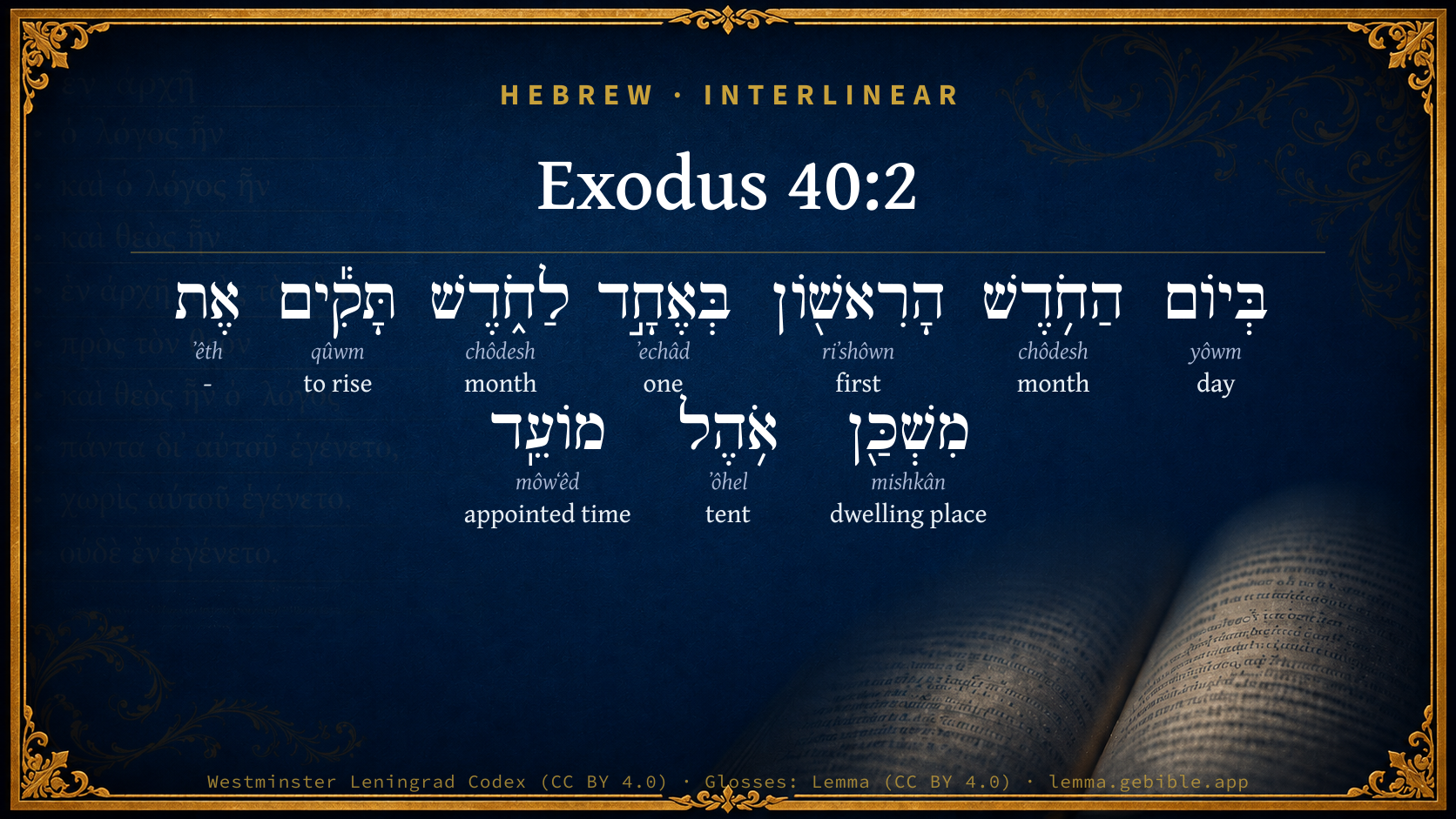
Hebrew (Westminster Leningrad Codex) Exodus 40:2 appears in the Hebrew Old Testament. The text above is from the Westminster Leningrad Codex. Each word links to its Strong’s number, a concise gloss, and parsing drawn from the Open Scriptures Hebrew Bible morphology. Click any word for its full Brown-Driver-Briggs (BDB) entry.
Download image
Cite this verse

Exodus 40:2 (World English Bible). Public Domain. Lemma interlinear Bible study tool, https://lemma.gebible.app/v/exodus/40/2.

Show BibTeX & RIS
BibTeX
RIS
English Translation
"On the first day of the first month you shall raise up the tent of the Tent of Meeting.
World English Bible · Public Domain
Download a study sheet

One document with this verse’s original text, its word-by-word gloss line, the meaning frame, cross-references with their text, attributed commentary, and full source and license credits — printable, and it pastes into notes with its structure intact.

This verse Autodidact and up

Study sheet (.html) Plain text (.txt)

A passage Seminary Student

Up to 50 verses in one chapter. A passage sheet keeps up to 6 commentary sources and 12 cross-references per verse, in the order this page ranks them, and says so on the sheet whenever that leaves anything out. Ask for a single verse and you get the Autodidact verse sheet above.

Everything on this page stays free to read, with no account — the sheet is a download of what is already on screen, not access to it.

Want to remove ads? Support Godless Engineer
Compare translations 3

The same verse in 3 English versions, stacked beneath the original-language interlinear above. Click any original word for its lexicon entry.

Each is an independent rendering of the whole verse — the interlinear is not word-aligned to these translations.

Highlighted words mark where these versions differ — a whole-verse word diff, not a word-by-word alignment.

  • World English Bible Public Domain
    "On the first day of the first month you shall raise up the tent of the Tent of Meeting.
  • King James Version Public Domain
    On the first day of the first month shalt thou set up the tabernacle of the tent of the congregation.
  • unfoldingWord Literal Text CC BY-SA 4.0
    “On the first day of the month, in the first month, you shall raise up the Dwelling of the tent of meeting.

unfoldingWord Literal Text — © unfoldingWord, licensed CC BY-SA 4.0. Word-aligned USFM3 via Door43 (git.door43.org/unfoldingWord/en_ult).

Versions to compare (up to 4)

3 of 4 selected

Show all 18 translations

Every available English version of this verse, each an independent rendering of the whole verse.

  • World English Bible Public Domain
    "On the first day of the first month you shall raise up the tent of the Tent of Meeting.
  • Berean Standard Bible Public Domain
    “On the first day of the first month you are to set up the tabernacle, the Tent of Meeting.
  • Majority Standard Bible Public Domain
    “On the first day of the first month you are to set up the tabernacle, the Tent of Meeting.
  • King James Version Public Domain
    On the first day of the first month shalt thou set up the tabernacle of the tent of the congregation.
  • American Standard Version (1901) Public Domain
    On the first day of the first month shalt thou rear up the tabernacle of the tent of meeting.
  • Revised Version (1885) Public Domain
    On the first day of the first month shalt thou rear up the tabernacle of the tent of meeting.
  • Geneva Bible (1599) Public Domain
    In the first day of the first moneth in the very first of the same moneth shalt thou set vp the Tabernacle, called ye Tabernacle of the Congregation:
  • Douay-Rheims (1899) Public Domain
    The first month, the first day of the month, thou shalt set up the tabernacle of the testimony,
  • Young's Literal Translation Public Domain
    `On the first day of the month, in the first month, thou dost raise up the tabernacle of the tent of meeting,
  • Literal Standard Version CC BY-SA 4.0
    “On the first day of the month, in the first month, you raise up the Dwelling Place of the Tent of Meeting,
  • Unlocked Literal Bible CC BY-SA 4.0
    “On the first day of the first month of the new year you must set up the tabernacle, the tent of meeting.
  • unfoldingWord Literal Text CC BY-SA 4.0
    “On the first day of the month, in the first month, you shall raise up the Dwelling of the tent of meeting.
  • Darby Bible Public Domain
    On the day of the first month, on the first of the month, shalt thou set up the tabernacle of the tent of meeting.
  • World Messianic Bible Public Domain
    “On the first day of the first month you shall raise up the tabernacle of the Tent of Meeting.
  • Webster's Bible Public Domain
    On the first day of the first month shalt thou set up the tabernacle of the tent of the congregation.
  • Free Bible Version CC BY-SA 4.0
    “Put up the Tabernacle, the Tent of Meeting, on the first day of the first month of the year.
  • Bible in Basic English Public Domain
    On the first day of the first month you are to put up the House of the Tent of meeting.
  • JPS Tanakh (1917) Public Domain
    'On the first day of the first month shalt thou rear up the tabernacle of the tent of meeting.

Literal Standard Version (2020), Covenant Press — licensed CC BY-SA 4.0. Text via the HelloAO Bible API (eBible.org). Unlocked Literal Bible (unfoldingWord) — licensed CC BY-SA 4.0. Text via the HelloAO Bible API (eBible.org). unfoldingWord Literal Text — © unfoldingWord, licensed CC BY-SA 4.0. Word-aligned USFM3 via Door43 (git.door43.org/unfoldingWord/en_ult). Free Bible Version, Dr. Jonathan Gallagher — licensed CC BY-SA 4.0. Text via the HelloAO Bible API (eBible.org).

Word by word

More ways to search: Search by grammar → Find every occurrence → Compare this word →

Practice this passage: Drill this verse → Learn its vocabulary →

מִשְׁכַּ֖ן
mishkân
H4908
“dwelling place of”
Noun, Common, Masculine, Singular, Construct
Part of Speech
Noun
Type
Common
Gender
Masculine
Number
Singular
State
Construct
Full BDB Definition

Origin: from H7931

TWOT: 2387c

dwelling place, tabernacle - dwelling-place - dwellings
  1. בְּיוֹם yôwm H3117 “in/at · day of” Preposition + Noun, Common, Masculine, Singular, Construct
  2. הַחֹ֥דֶשׁ chôdesh H2320 “the · month” Particle, Definite Article + Noun, Common, Masculine, Singular, Absolute
  3. הָרִאשׁ֖וֹן riʼshôwn H7223 “the · first” Particle, Definite Article + Adjective, Ordinal number, Masculine, Singular, Absolute
  4. בְּאֶחָ֣ד ʼechâd H259 “in/at · one” Preposition + Adjective, Cardinal number, Masculine, Singular, Absolute
  5. לַחֹ֑דֶשׁ chôdesh H2320 “to/for the · month” Preposition, Determined + Noun, Common, Masculine, Singular, Absolute
  6. תָּקִ֕ים qûwm H6965 “to rise” Verb, Hiphil, Imperfect, 2nd Person, Masculine, Singular
  7. אֶת ʼêth H853 “-” Particle, Direct Object
  8. אֹ֥הֶל ʼôhel H168 “tent of” Noun, Common, Masculine, Singular, Construct
  9. מוֹעֵֽד môwʻêd H4150 “appointed time” Noun, Common, Masculine, Singular, Absolute

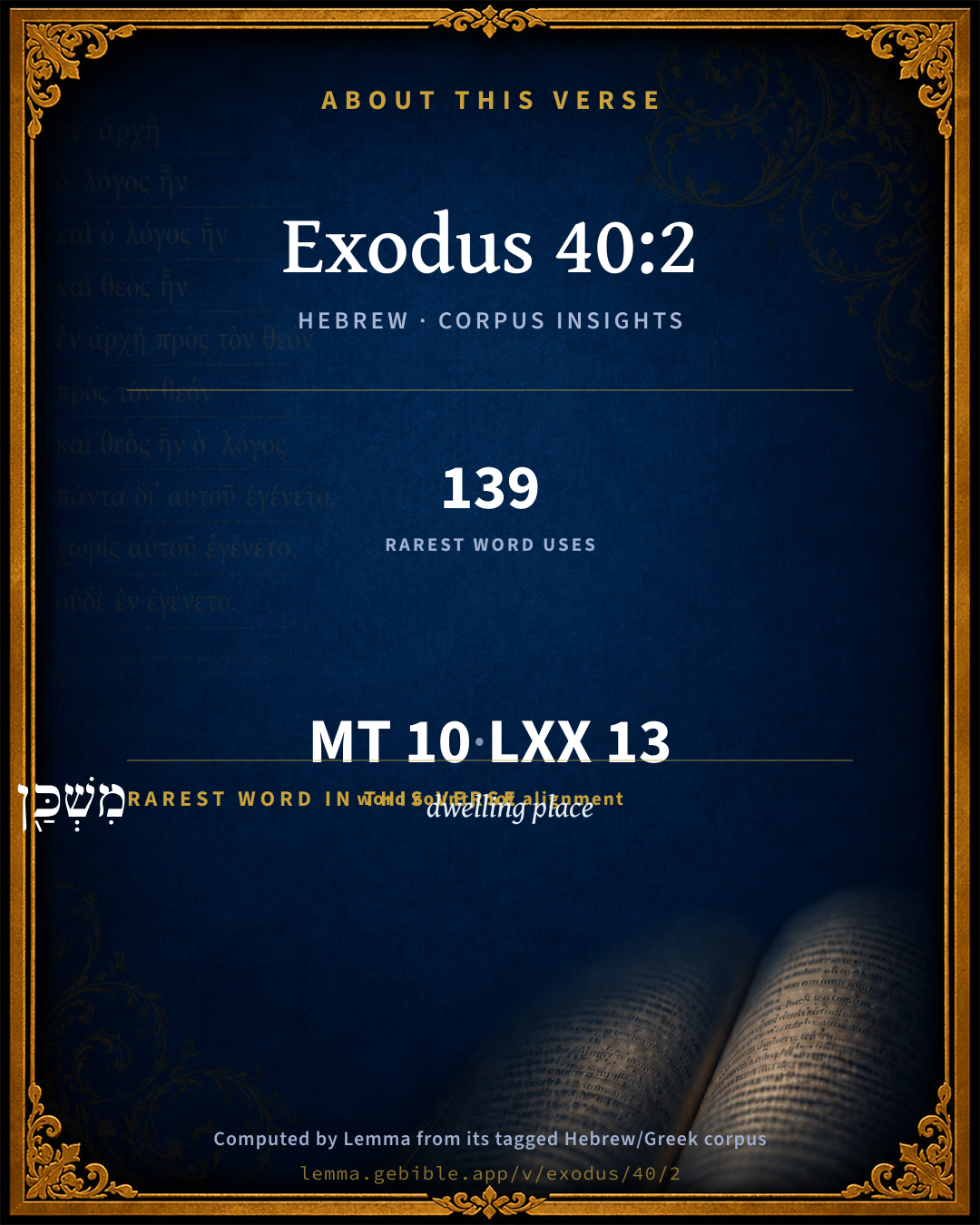
About this verse

These counts appear in no published source. They are computed here, from the morphology-tagged text and Lemma’s own curated glosses. What Lemma adds →

10
words
9
distinct lemmas
Pentateuch
section

Grammatical profile

  • 1 verb
  • 6 nouns
  • 2 adjectives
  • 1 particle

Verb forms

  • תָּקִ֕ים Hiphil · Imperfect

Repetition

A word recurs within this verse — often emphatic in Hebrew:

  • הַחֹ֥דֶשׁ month H2320 ×2

Hebrew & Septuagint length

In English translation the verse runs 19 words from the Hebrew and 20 from the Septuagint (LXX English) — closely comparable.

A rough comparison of the two English renderings, which tokenize alike — not a word-level alignment.

Word counts can differ between the Hebrew and the Greek without any difference in meaning — e.g. the Hebrew direct-object marker אֵת has no separate Greek word, and Greek often adds the article ὁ.

In the original languages it is 10 Hebrew tokens and 13 Greek tokens — but the two are counted differently (Hebrew bundles its prefixes and suffixes into one token; the Greek is in lemma form), so that isn’t a like-for-like length.

Cross-references

13

Topical passages linked to Exodus 40:2 in the Treasury of Scripture Knowledge — connected by theme and wording, ordered by reader-vote popularity; previews shown in the World English Bible.

  • Exodus 26:30 You shall set up the tent according to the way that it was shown to you on the mountain.
  • Exodus 13:4 This day you go forth in the month Abib.
  • Exodus 12:1–2 Yahweh spoke to Moses and Aaron in the land of Egypt, saying,
  • Exodus 40:17–19 It happened in the first month in the second year, on the first day of the month, that the tent was raised up.
  • Numbers 1:1 Yahweh spoke to Moses in the wilderness of Sinai, in the Tent of Meeting, on the first day of the second month, in the second year after they had come out of the land of Egypt, saying,
  • Numbers 7:1 It happened on the day that Moses had finished setting up the tabernacle, and had anointed it and sanctified it, with all its furniture, and the altar with all its vessels, and had anointed and sanctified them;
  • Exodus 26:1 "Moreover you shall make the tent with ten curtains; of fine twined linen, and blue, and purple, and scarlet, with cherubim. The work of the skillful workman you shall make them.
  • Exodus 26:7 "You shall make curtains of goats' hair for a covering over the tent: eleven curtains shall you make them.
  • Exodus 27:21 In the tent of meeting, outside the veil which is before the testimony, Aaron and his sons shall keep it in order from evening to morning before Yahweh: it shall be a statute forever throughout their generations on the behalf of the children of Israel.
  • Exodus 30:36 and you shall beat some of it very small, and put some of it before the testimony in the tent of meeting, where I will meet with you. It shall be to you most holy.
  • Exodus 35:11 the tent, its outer covering, its roof, its clasps, its boards, its bars, its pillars, and its sockets;
  • Exodus 36:18 He made fifty clasps of brass to couple the tent together, that it might be a unit.
  • Exodus 40:6 You shall set the altar of burnt offering before the door of the tent of the tent of meeting.

Cross-references courtesy of OpenBible.info (CC BY 4.0).

Hebrew and Greek witnesses Masoretic Hebrew ↔ Greek Septuagint

The same verse in the two great witnesses to the Old Testament, shown verse-for-verse.

These are two independent witnesses, not word-aligned to each other, and the Septuagint is shown in lemma (dictionary) form.

Hebrew Exodus 40:2 Masoretic · Westminster Leningrad Codex

בְּיוֹם הַחֹ֥דֶשׁ הָרִאשׁ֖וֹן בְּאֶחָ֣ד לַחֹ֑דֶשׁ תָּקִ֕ים אֶת מִשְׁכַּ֖ן אֹ֥הֶל מוֹעֵֽד

"On the first day of the first month you shall raise up the tent of the Tent of Meeting.

World English Bible · Public Domain

Greek LXX Exodus 40:2 Septuagint · lemma form

ἐν ἡμέρα εἷς ὁ μήν ὁ πρῶτος νουμηνία ἵστημι ὁ σκηνή ὁ μαρτύριον

On the first day of the first month, at the new moon, you shall set up the tabernacle of witness,

LXX2012 (modern English Septuagint) · Public Domain

Hebrew: Westminster Leningrad Codex (CC BY 4.0). Greek: Septuagint (public domain); English from LXX2012 (modern English Septuagint) (Public Domain). How the Septuagint differs from the Hebrew →

Targum (Aramaic paraphrase)

2

The Targum is the ancient Jewish Aramaic paraphrase of the Hebrew Scriptures — an interpretive translation, not the Hebrew text itself. Onkelos (literal) and Pseudo-Jonathan (expansive) render the Torah, and Jonathan the Prophets. Coverage is partial: where no permissively-licensed English translation exists for a verse, only the Aramaic is shown. This is verse-level text, not a word-by-word alignment to the Hebrew.

  1. Targum Onkelos Torah (Genesis–Deuteronomy)
    בְּיוֹמָא יַרְחָא קַדְמָאָה בְּחַד לְיַרְחָא תְּקִים יָת מַשְׁכְּנָא מַשְּׁכַּן זִמְנָא:

    (no public-domain English translation for this verse)

    Targum Onkelos — Aramaic: “Onkelos Genesis” (public domain); “Onkelos Exodus” (public domain); “Onkelos Leviticus” (public domain); “Onkelos Numbers” (public domain); “Onkelos Deuteronomy” (public domain). English: “Sefaria Community Translation” (CC0 1.0 (public-domain dedication)); “J.W. Etheridge. The Targums of Onkelos and Jonathan Ben Uzziel on the Pentateuch. London: Longmans, Green, 1862” (public domain). Text via Sefaria.

  2. Targum Pseudo-Jonathan Torah (Genesis–Deuteronomy)
    בְּיוֹמָא דְיַרְחָא קַדְמָאָה הוּא יַרְחָא דְנִיסָן בְּחַד לְיַרְחָא תְּקִים יַת מַשְׁכְּנָא מַשְׁכַּן זִימְנָא

    On the day of the first month, that is the month of Nisan, on the first of the month, thou shalt rear up the tabernacle, the tabernacle of ordinance.

    Targum Pseudo-Jonathan — Aramaic: “Targum Jonathan on Genesis” (public domain); “Targum Jonathan on Exodus” (public domain); “Targum Jonathan on Leviticus” (public domain); “Targum Jonathan on Numbers” (public domain); “Targum Jonathan on Deuteronomy” (public domain). English: “The Targum of Jonathan ben Uzziel, trans. J. W. Etheridge, London, 1862” (public domain). Text via Sefaria.

Commentary

Notes on Exodus 40:2 from classic Christian and Jewish commentators (each source and its license shown beneath its notes). The classic Christian expositions comment on the surrounding passage and are grouped to its opening verse, so a note may address several verses; the Jewish commentaries on the Tanakh (Rashi and others) are per-verse, so they appear only where the commentator wrote on this verse.

Lemma curates 59 commentaries, every one of them public domain or Creative Commons licensed, each selected and text-cleaned for this edition rather than reprinted as found. About our sources →

Joseph Benson's Commentary

Exo 40:2. Thou shalt set up the tabernacle — The time for doing this was, On the first day of the first month — This wanted but fourteen days of a year since they came out of Egypt. Probably the work was made ready just at the end of the year, so that the appointing this day gave no delay. In Hezekiah’s time they began to sanctify the temple on the first day of the first month, 2Ch 29:17. The new moon (which, by their computation, was the first day of every month) was observed by them with some solemnity; and therefore this first new moon of the year was thus made remarkable.

Joseph Benson's Commentary on the Old and New Testaments (1811–1818) — public domain. Text from a community e-Sword module.

Geneva Bible (1599)

Geneva Bible translators

After that Moses had been 40 days, and 40 nights in the mount, that is, from the beginning of August to the tenth of September, he came down, and caused this work to be done: which being finished, was set up in Abib, which month containeth half March and half April.

Geneva Bible (1599) marginal notes — public domain. Text via Bolls.life.

Adam Clarke's Commentary

Verse 2. The first day of the first month] It Is generally supposed that the Israelites began the work of the tabernacle about the sixth month after they had left Egypt; and as the work was finished about the end of the first year of their exodus, (for it was set up the first day of the second year,) that therefore they had spent about six months in making it: so that the tabernacle was erected one year all but fifteen days after they had left Egypt. Such a building, with such a profusion of curious and costly workmanship, was never got up in so short a time. But it was the work of the Lord, and the people did service as unto the Lord; for the people had a mind to work.

Adam Clarke's Commentary on the Bible (1810–1826) — public domain. Text from a community e-Sword/MySword module.

Ellicott's Commentary for English Readers

(2) On the first day of the first month.—The Israelites had quitted Egypt on the fourteenth day of the first month, Abib (Exo_12:6). They had reached the wilderness of Sinai in the course of the third month, Sivan, and encamped in front of Sinai shortly after (Exo_19:1-2). The two long absences of Moses in the Mount had occupied nearly three months, and were separated by an interval probably of several days. It must have been the sixth or seventh month before the work was commenced, and very late in the year—the eleventh or twelfth month—before it was accomplished. Hence, the new year was now approaching, and, as it was approaching, its first day was naturally chosen as most fit for the inauguration of the new structure.

The tabernacle of the tent of the congregation.—Rather, the tabernacle, the tent of meeting. The words mishhan and ‘ohel are in apposition, not in regimen. (So also in Exo_40:6.)

A Bible Commentary for English Readers, edited by Charles John Ellicott (1878–1897) — public domain. Text from a community e-Sword module.

The Cambridge Bible for Schools and Colleges

gen. ed. J. J. S. Perowne

2. the first day of the first month] viz. (v. 17) of the second year of the Exodus, nine months since the arrival at Sinai (Exo_19:1).

the Dwelling of the tent of meeting] as Exo_39:32.

The Cambridge Bible for Schools and Colleges (gen. ed. J. J. S. Perowne; Cambridge University Press, 1878–1918) — public domain. Text from a community e-Sword module.

John Gill's Exposition

On the first day of the first month,.... Which was the month Nisan, as the Targum of Jonathan expresses it; which was the month the children of Israel came out of Egypt, out of which they had now been a whole year, excepting fourteen days:

shalt thou set up the tabernacle of the tent of the congregation; the tabernacle, which had a tent or covering over it, to which the people were gathered at times for religious service.

John Gill's Exposition of the Whole Bible (1746–1763) — public domain (CC PDM 1.0). Text via the HelloAO Bible API.

Albert Barnes' Notes on the Bible

See Exo 40:17.

Albert Barnes' Notes on the Bible (1834–1885) — public domain. Text from a community e-Sword/MySword module.

Haydock's Catholic Bible Commentary

Month of the second year, ver. 15. The first day of every month was kept with some degree of solemnity, though it was not a day of rest. (Numbers xxxiii. 11.; 1 Kings xx. 5.; &c.) (Calmet)

George Leo Haydock (1774–1849), Haydock's Catholic Family Bible and Commentary, 1859 edition — public domain. Excludes Psalms (Douay-Rheims chapter numbering differs from Protestant) and Deuterocanonical books (Catholic canon only).

Matthew Poole's English Annotations

To wit, of the second year after their coming out of Egypt, as is evident.

Matthew Poole's English Annotations on the Holy Bible (1683–1685) — public domain. Text from a community e-Sword/MySword module.

The Pulpit Commentary

On the first day of the first month. The first of Abib, or Nisan, the "New Year"s Day" of Israel, coinciding nearly with the opening of the vernal equinox, a very suitable day for the inauguration of a place of worship. The tabernacle was to be set up first of all; then the tent was to be placed over it. See vers. 18, 19.

The Pulpit Commentary (1880–1919), ed. H.D.M. Spence-Jones & Joseph S. Exell — public domain. Text from a community e-Sword module.

John Wesley's Explanatory Notes

The time for doing this is, On the first day of the first month - This wanted but fourteen days of a year since they came out of Egypt. Probably the work was made ready just at the end of the year, so that the appointing this day gave no delay. In Hezekiah's time they began to sanctify the temple on the first day of the first month, 2 Chron. xxix, 17. The new moon (which by their computation was the first day of every month) was observed by them with some solemnity; and therefore this first new moon of the year was thus made remarkable.

John Wesley, Explanatory Notes Upon the Whole Bible (1754–1765) — public domain. Text via the GEBible commentary corpus.

Scofield Reference Notes

C. I. Scofield

first month

i.e. April.

The Scofield Reference Bible (1917 edition), notes by C. I. Scofield — public domain. Text from a community e-Sword module.

Ramban (Nachmanides)

Rabbi Moshe ben Nachman (Ramban / Nachmanides)

ON THE FIRST DAY OF THE FIRST MONTH SHALT THOU SET UP THE TABERNACLE OF THE TENT OF MEETING. In the opinion of our Rabbis. who say that this was on the eighth day of the installation [of the priests into their sacred office], must mean “set it up permanently etc.,” the meaning of the verse is: “you are to put up the Tabernacle and it should remain so; do not dismantle it and do not put it up again, for when the camps will move, the Levites will dismantle it and put it up.” It was not necessary that G-d should command Moses now about the putting up of the Tabernacle during the first seven days, since He had told him at the start, And thou shalt set up the Tabernacle according to the fashion thereof which hath been shown thee in the mountain. Now since He explained to him here that On the first day of the first month the setting up of the Tabernacle would be of a permanent nature, Moses thus understood that during [each of] the seven days of installation it would be necessary for him to put it up and to dismantle it. Perhaps this was done in order to train the Levites how to do it, for they would see how he did it and would do likewise. Or it may be that this was done in order to crown the eighth day with this special crown [that the Tabernacle was for the first time not dismantled on that day].It would appear according to the opinion of the Rabbis that on the first seven days Moses put up the Tabernacle each morning, and it remained standing all day and all the following night, and at each dawn he would dismantle it and put it up again immediately, for Scripture says, And at the door of the Tent of Meeting shall ye abide day and night for seven days, and there could be no “door” to the Tent of Meeting except at the time when it was erected., we must therefore conclude that the Tabernacle was dismantled at dawn and put up again immediately. The Sages have already interpreted: 4. “he shall bring it to the door of the Tent of Meeting — at the time when it is open, and not when [the Tent of Meeting] is taken to pieces.” Similarly, the Rabbis have said: “Peace-offerings which have been slaughtered before the doors of the Sanctuary were opened are invalid, because it is said, and he shall slaughter it at the door of the Tent of Meeting — at the time it is open, and not when it is locked.” Similarly, “at the Tabernacle, [peace-offerings which were slaughtered] before the Levites put up the Tabernacle, or after the Levites had dismantled it, were invalid.” Moreover, [during the first seven days of installation, Moses] used to sacrifice the Daily Offering of the evening and kindle the lamps at night. And in Vayikra Rabbah, 11. I have seen [the following text]: “Moses used to put up the Tabernacle and dismantle it twice every day. Rabbi Chanina the Great says: three times every day, for [the phrase ‘putting up’ of the Tabernacle] is mentioned three times: thou shalt put up; the Tabernacle was put up; and Moses put up the Tabernacle., Verse 18. Once it was put up for the Daily Offering of the morning, and once for the special offerings of the installation, and once for the Daily Offering of the evening.” It is possible that all this was done for the sake of practice, so that they would know the procedure for putting it up, and which order to follow, but they never left it in a dismantled state at all [during the seven days of installation].And that which Scripture states here, And the cloud covered the Tent of Meeting, and the Glory of the Eternal filled the Tabernacle, Verse 34. in the opinion of the Rabbis it refers to the eighth day, for Scripture says, So Moses finished the work, Verse 33. and when he had completed this erection on the first of Nisan, the cloud covered the Tabernacle. Now Rashi has already mentioned the interpretation of the Rabbis: “And they came out and blessed the people. During all the seven days of installation when Moses was putting up the Tabernacle, and officiating therein, and dismantling it, the Divine Glory did not rest upon it, and the Israelites felt ashamed, and they said to Moses: ‘Our master! All the trouble which we have taken was only so that the Divine Glory would dwell amongst us, and that we would know that the sin of the calf has been atoned for!’ Then Moses said to them: ‘My brother Aaron is more worthy and meritorious than I am, and it is through his offerings and service that the Divine Glory will rest upon us.’”And in the Parshath Hamiluim. (the Chapter of the Installation) we find written: “I might think that the Tabernacle was put up on the first of the month of Nisan, and that the Divine Glory did not rest thereon until the eighth day of the month. Scripture therefore says, And on the day that the Tabernacle was put up, the cloud covered the Tabernacle, even the Tent of Meeting. This teaches us that on the day the Tabernacle was put up, the Divine Glory rested thereon through the service of Aaron.” Thus the Rabbis are clearly saying that the cloud covering the Tabernacle was on the eighth day of the installation, which was on the first day of Nisan.If this is so, then this whole chapter, in the opinion of the Rabbis, took place on the eighth day of the installation. This is indeed so, because Scripture describes the sequence of events as follows: G-d commanded Moses that the final putting up of the Tabernacle should be on the first day of the first month, and then it states that Moses did so and finished the whole work, Verse 33. [of the seven days of installation], and then [on the eighth day] the cloud covered the tent, Verse 34. and so it was always [henceforth whenever they journeyed and put up the Tabernacle at their new place of encampment]. Then Scripture goes back to the beginning of the communication which came to Moses from the Tent, saying, And He called unto Moses. All this is now in proper order.A kind of proof to what the Rabbis have said, [that during the seven days of installation the Tabernacle was dismantled every day], is what Scripture says, And it came to pass on the day that Moses had made an end of setting up the Tabernacle. Now if he did not dismantle it, what sense is there to the expression, the day that he ‘made an end’ of setting up the Tabernacle, since he began and finished all the work in one day? In that case it should rather have said: “and it came to pass on the day that Moses set up the Tabernacle.” Moreover, it says there [with reference to the eighth day], This is the thing which the Eternal commanded that ye should do; and the Glory of the Eternal appeared unto all the people., Verse 23. The implication of these verses is that the cloud had not yet covered the Tent of Meeting, and the Glory of the Eternal did not yet fill the Tabernacle.However it may be, from the first day of the installation G-d communicated to Moses from the Tabernacle all the sections from the beginning of the Book of Leviticus until And it came to pass on the eighth day., 9:1. But the cloud did not cover the Tabernacle, and the people therefore thought that the communication from there to Moses was directly from heaven, just as it was in the land of Egypt. But in the Midrash Chazit I have found the following text: “And it came to pass on the eighth day., 9:1. This really should have been the beginning of the Book of Leviticus. Why then was it written here? Because there is no strict chronological order in the narrative of the Torah.” Now if this is so, then the chapter beginning And He called unto Moses… out of the Tent of Meeting happened after and the Glory of the Eternal appeared unto all the people. And there came forth fire from before the Eternal, and consumed upon the altar; and the communication addressed to Aaron, drink no wine or strong drink, 10:9. took place on the following day, for it is impossible that G-d should speak to Aaron from the Tent of Meeting before He had spoken to Moses., took place on the eighth day of the installation. But I do not know whether this Midrash represents the unanimous opinion of all the Sages, or whether they are the words of a single Sage, for they are mentioned there in the Midrash with reference to Rabbi Yishmael.

THOU SHALT SET UP THE TABERNACLE OF THE TENT OF MEETING. G-d did not explain to Moses in this command the order of putting it up, as it is clearly set forth in the actual construction: and he laid its sockets, and set up the boards thereof etc. The reason for His not explaining it here is because He had already shown it to him visually, as He said, And thou shalt put up the Tabernacle according to the fashion thereof which hath been shown thee in the mountain. Similarly, He shortened the account here, saying, And thou shalt put therein the ark of the Testimony, and did not mention and in the ark thou shalt put the Testimony, for since He used the phrase: the ark of the Testimony, Moses would understand this, since the ark is only termed “the ark of the Testimony” when the Tablets of the Testimony are in it, and they were already commanded at the beginning, And thou shalt put the ark-cover above upon the ark; and in the ark thou shalt put the Testimony that I shall give thee. It was necessary here to mention it only in order to tell him the order of priority, namely that the putting of the ark with the Tablets [into the Tabernacle] should precede the setting up of all other vessels. Similarly He shortened the account of the table and the candelabrum, since He had already commanded him in what place of the Tabernacle they were to be set up., 26:35. He also shortened the subject of the dressing of Aaron and his sons, saying merely, And thou shalt put upon Aaron the holy garments, and with reference to Aaron’s sons He said, and thou shalt put tunics upon them, Verse 14. for He had already told and commanded Moses in detail about the order of putting on their garments. Here the intention was only to fix the time of the dressing in its correct order, namely, after the whole Tabernacle had been set up. Of the priestly garments He mentioned only the tunics, because it is with them that the dressing began.

Ramban (Nachmanides) on the Tanakh — English translation: “Commentary on the Torah by Ramban (Nachmanides). Translated and annotated by Charles B. Chavel. New York, Shilo Pub. House, 1971-1976” (CC BY 4.0). Text via Sefaria.

Lesson kit

Teaching starters — assembled from the data on this page, not authored interpretation. Every prompt links to the verse data it draws on. Edit before teaching.

Exodus, in the Pentateuch, opens this verse with 10 words (9 distinct Hebrew lemmas). Its most distinctive word is mishkân (“dwelling place”). A historical commentator’s framing appears above. Read the whole chapter for the surrounding context.

Discussion questions

  1. What does “dwelling place” (mishkân) contribute to the verse as a whole?
  2. Exodus 26:30 shares this passage’s theme. How do the two illuminate each other?
  3. “month” occurs 2× in this one verse. What is the effect of the repetition?
  4. These translations render this verse differently. What is at stake in choosing one wording over another?
  5. The verb «תָּקִ֕ים» is Hiphil Imperfect. How does its form color the action?
  6. Reading how Joseph Benson's Commentary and Geneva Bible (1599) read this verse, where do the two commentators agree and where do they part?

Things to notice

Reading settings

Reading text

Shown beneath each verse's original-language words.

Old Testament
Old Testament edition

Read the OT as the Masoretic Hebrew (MT) or the Greek Septuagint (LXX).

English shown for the Greek Septuagint (in the Hebrew ↔ Greek comparison).

Comparing translations? Open the Compare panel on any verse page to stack up to four side by side.