Genesis 31:25

Hebrew (Westminster Leningrad Codex) Genesis 31:25 appears in the Hebrew Old Testament. The text above is from the Westminster Leningrad Codex. Each word links to its Strong’s number, a concise gloss, and parsing drawn from the Open Scriptures Hebrew Bible morphology. Click any word for its full Brown-Driver-Briggs (BDB) entry.
Download image
Cite this verse

Genesis 31:25 (World English Bible). Public Domain. Lemma interlinear Bible study tool, https://lemma.gebible.app/v/genesis/31/25.

Show BibTeX & RIS
BibTeX
RIS
English Translation
Laban caught up with Jacob. Now Jacob had pitched his tent in the mountain, and Laban with his relatives encamped in the mountain of Gilead.
World English Bible · Public Domain
Highlights
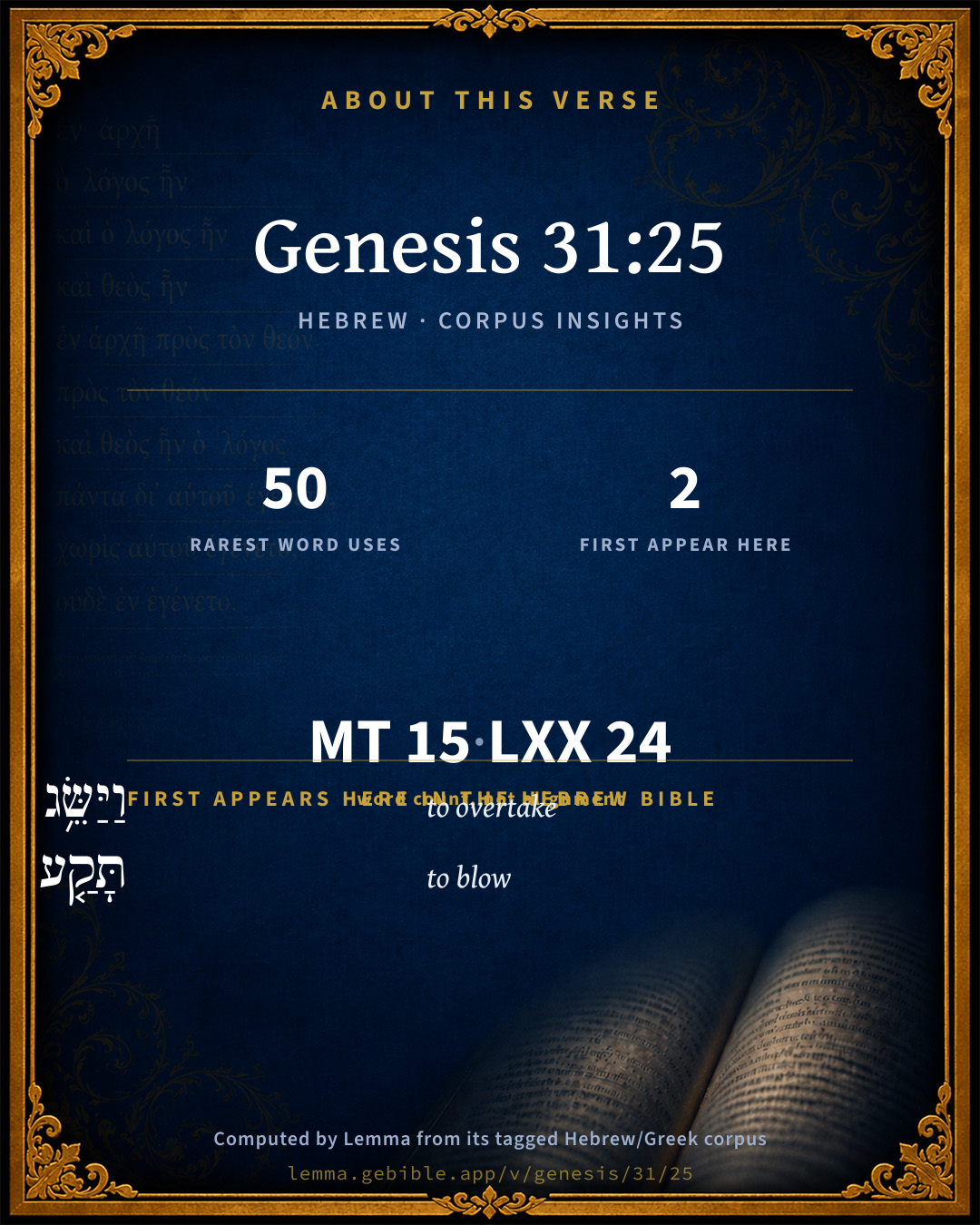
  • 2 first appearances in the Hebrew Bible
Full analysis ↓
Download a study sheet

One document with this verse’s original text, its word-by-word gloss line, the meaning frame, cross-references with their text, attributed commentary, and full source and license credits — printable, and it pastes into notes with its structure intact.

This verse Autodidact and up

Study sheet (.html) Plain text (.txt)

A passage Seminary Student

Up to 50 verses in one chapter. A passage sheet keeps up to 6 commentary sources and 12 cross-references per verse, in the order this page ranks them, and says so on the sheet whenever that leaves anything out. Ask for a single verse and you get the Autodidact verse sheet above.

Everything on this page stays free to read, with no account — the sheet is a download of what is already on screen, not access to it.

Want to remove ads? Support Godless Engineer
Compare translations 3

The same verse in 3 English versions, stacked beneath the original-language interlinear above. Click any original word for its lexicon entry.

Each is an independent rendering of the whole verse — the interlinear is not word-aligned to these translations.

Highlighted words mark where these versions differ — a whole-verse word diff, not a word-by-word alignment.

  • World English Bible Public Domain
    Laban caught up with Jacob. Now Jacob had pitched his tent in the mountain, and Laban with his relatives encamped in the mountain of Gilead.
  • King James Version Public Domain
    Then Laban overtook Jacob. Now Jacob had pitched his tent in the mount: and Laban with his brethren pitched in the mount of Gilead.
  • unfoldingWord Literal Text CC BY-SA 4.0
    And Laban overtook Jacob, and Jacob had pitched his tent in the mountain, so Laban with his relatives pitched in the mountain of Gilead.

unfoldingWord Literal Text — © unfoldingWord, licensed CC BY-SA 4.0. Word-aligned USFM3 via Door43 (git.door43.org/unfoldingWord/en_ult).

Versions to compare (up to 4)

3 of 4 selected

Show all 18 translations

Every available English version of this verse, each an independent rendering of the whole verse.

  • World English Bible Public Domain
    Laban caught up with Jacob. Now Jacob had pitched his tent in the mountain, and Laban with his relatives encamped in the mountain of Gilead.
  • Berean Standard Bible Public Domain
    Now Jacob had pitched his tent in the hill country of Gilead when Laban overtook him, and Laban and his relatives camped there as well.
  • Majority Standard Bible Public Domain
    Now Jacob had pitched his tent in the hill country of Gilead when Laban overtook him, and Laban and his relatives camped there as well.
  • King James Version Public Domain
    Then Laban overtook Jacob. Now Jacob had pitched his tent in the mount: and Laban with his brethren pitched in the mount of Gilead.
  • American Standard Version (1901) Public Domain
    And Laban came up with Jacob. Now Jacob had pitched his tent in the mountain: and Laban with his brethren encamped in the mountain of Gilead.
  • Revised Version (1885) Public Domain
    And Laban came up with Jacob. Now Jacob had pitched his tent in the mountain: and Laban with his brethren pitched in the mountain of Gilead.
  • Geneva Bible (1599) Public Domain
    Then Laban ouertooke Iaakob, and Iaakob had pitched his tent in the mount: and Laban also with his brethren pitched vpon mount Gilead.
  • Douay-Rheims (1899) Public Domain
    Now Jacob had pitched his tent in the mountain: and when he with his brethren had overtaken him, he pitched his tent in the same mount of Galaad.
  • Young's Literal Translation Public Domain
    And Laban overtaketh Jacob; and Jacob hath fixed his tent in the mount; and Laban with his brethren have fixed `theirs' in the mount of Gilead.
  • Literal Standard Version CC BY-SA 4.0
    And Laban overtakes Jacob; and Jacob has fixed his tent in the mountain; and Laban with his brothers have fixed [theirs] in the Mount of Gilead.
  • Unlocked Literal Bible CC BY-SA 4.0
    Laban overtook Jacob. Now Jacob had pitched his tent in the hill country. Laban also camped with his relatives in the hill country of Gilead.
  • unfoldingWord Literal Text CC BY-SA 4.0
    And Laban overtook Jacob, and Jacob had pitched his tent in the mountain, so Laban with his relatives pitched in the mountain of Gilead.
  • Darby Bible Public Domain
    And Laban came up with Jacob; and Jacob had pitched his tent on the mountain; Laban also with his brethren pitched on mount Gilead.
  • World Messianic Bible Public Domain
    Laban caught up with Jacob. Now Jacob had pitched his tent in the mountain, and Laban with his relatives encamped in the mountain of Gilead.
  • Webster's Bible Public Domain
    Then Laban overtook Jacob. Now Jacob had pitched his tent in the mount: and Laban, with his brethren, pitched in the mount of Gilead.
  • Free Bible Version CC BY-SA 4.0
    Jacob had set up his tents in the hill country of Gilead when Laban caught up with him, so Laban and his relatives did the same.
  • Bible in Basic English Public Domain
    Now when Laban overtook him, Jacob had put up his tent in the hill-country; and Laban and his brothers put up their tents in the hill-country of Gilead.
  • JPS Tanakh (1917) Public Domain
    And Laban came up with Jacob. Now Jacob had pitched his tent in the mountain; and Laban with his brethren pitched in the mountain of Gilead.

Literal Standard Version (2020), Covenant Press — licensed CC BY-SA 4.0. Text via the HelloAO Bible API (eBible.org). Unlocked Literal Bible (unfoldingWord) — licensed CC BY-SA 4.0. Text via the HelloAO Bible API (eBible.org). unfoldingWord Literal Text — © unfoldingWord, licensed CC BY-SA 4.0. Word-aligned USFM3 via Door43 (git.door43.org/unfoldingWord/en_ult). Free Bible Version, Dr. Jonathan Gallagher — licensed CC BY-SA 4.0. Text via the HelloAO Bible API (eBible.org).

Word by word

More ways to search: Search by grammar → Find every occurrence → Compare this word →

Practice this passage: Drill this verse → Learn its vocabulary →

וַיַּשֵּׂ֥ג
nâsag
H5381
“and · to overtake”
Conjunction + Verb, Hiphil, Sequential Imperfect, 3rd Person, Masculine, Singular
Part of Speech
Conjunction + Verb
Stem
Hiphil
Form
Sequential Imperfect
Person
3rd Person
Gender
Masculine
Number
Singular
Full BDB Definition

Origin: a primitive root

TWOT: 1422

to reach, overtake, take hold upon - (Hiphil) - to overtake - to reach, attain to, cause to reach - to be able to secure, reach, have enough
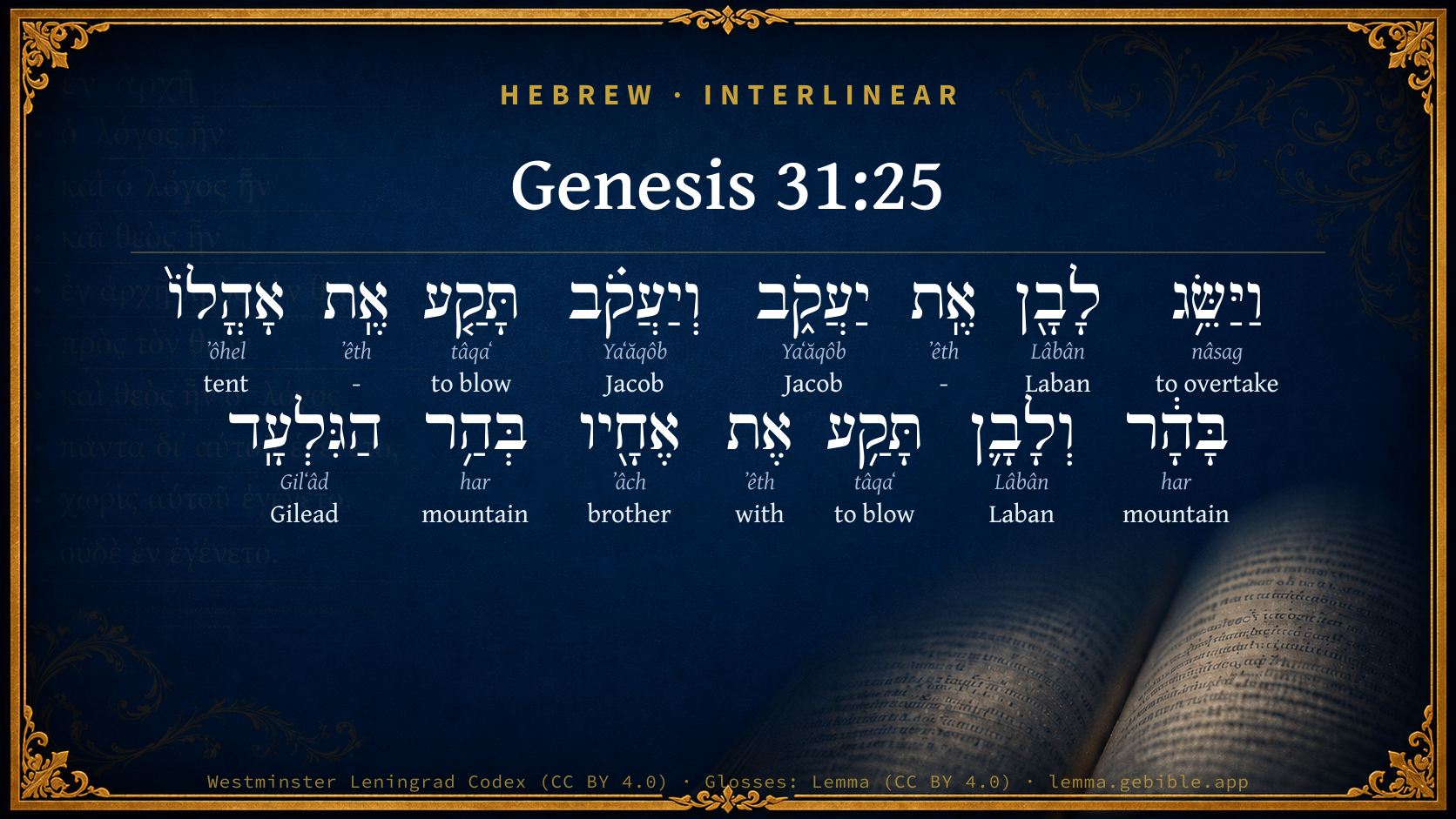
  1. לָבָ֖ן Lâbân H3837 “Laban” Noun, Proper
  2. אֶֽת ʼêth H853 “-” Particle, Direct Object
  3. יַעֲקֹ֑ב Yaʻăqôb H3290 “Jacob” Noun, Proper
  4. וְיַעֲקֹ֗ב Yaʻăqôb H3290 “and · Jacob” Conjunction + Noun, Proper
  5. תָּקַ֤ע tâqaʻ H8628 “to blow” Verb, Qal, Perfect, 3rd Person, Masculine, Singular
  6. אֶֽת ʼêth H853 “-” Particle, Direct Object
  7. אָהֳלוֹ֙ ʼôhel H168 “tent · his” Noun, Common, Masculine, Singular, Construct + Suffix, Personal, 3rd Person, Masculine, Singular
  8. בָּהָ֔ר har H2022 “in/at the · mountain” Preposition, Determined + Noun, Common, Masculine, Singular, Absolute
  9. וְלָבָ֛ן Lâbân H3837 “and · Laban” Conjunction + Noun, Proper
  10. תָּקַ֥ע tâqaʻ H8628 “to blow” Verb, Qal, Perfect, 3rd Person, Masculine, Singular
  11. אֶת ʼêth H854 “with” Preposition
  12. אֶחָ֖יו ʼâch H251 “brothers · his” Noun, Common, Masculine, Plural, Construct + Suffix, Personal, 3rd Person, Masculine, Singular
  13. בְּהַ֥ר har H2022 “in/at · mountain of” Preposition + Noun, Common, Masculine, Singular, Construct
  14. הַגִּלְעָֽד Gilʻâd H1568 “the · Gilead” Particle, Definite Article + Noun, Proper

About this verse

These counts appear in no published source. They are computed here, from the morphology-tagged text and Lemma’s own curated glosses. What Lemma adds →

15
words
10
distinct lemmas
Pentateuch
section

First appearance in Scripture

These words make their first canonical appearance in the Hebrew Bible here:

  • וַיַּשֵּׂ֥ג to overtake H5381
  • תָּקַ֤ע to blow H8628

Shared distinctive vocabulary

וַיַּשֵּׂ֥ג to overtake H5381 occurs in 47 verses of the Hebrew Bible. Also found in:

Grammatical profile

  • 3 verbs
  • 9 nouns
  • 1 preposition
  • 2 particles

Verb forms

  • וַיַּשֵּׂ֥ג Hiphil · Sequential Imperfect
  • תָּקַ֤ע Qal · Perfect
  • תָּקַ֥ע Qal · Perfect

Repetition

Words recur within this verse — often emphatic in Hebrew:

  • לָבָ֖ן Laban H3837 ×2
  • יַעֲקֹ֑ב Jacob H3290 ×2
  • תָּקַ֤ע to blow H8628 ×2
  • בָּהָ֔ר mountain H2022 ×2

Hebrew & Septuagint length

In English translation the verse runs 25 words from the Hebrew and 21 from the Septuagint (LXX English) — closely comparable.

A rough comparison of the two English renderings, which tokenize alike — not a word-level alignment.

Word counts can differ between the Hebrew and the Greek without any difference in meaning — e.g. the Hebrew direct-object marker אֵת has no separate Greek word, and Greek often adds the article ὁ.

In the original languages it is 15 Hebrew tokens and 24 Greek tokens — but the two are counted differently (Hebrew bundles its prefixes and suffixes into one token; the Greek is in lemma form), so that isn’t a like-for-like length.

Cross-references

3

Topical passages linked to Genesis 31:25 in the Treasury of Scripture Knowledge — connected by theme and wording, ordered by reader-vote popularity; previews shown in the World English Bible.

  • Genesis 12:8 He left from there to the mountain on the east of Bethel, and pitched his tent, having Bethel on the west, and Ai on the east. There he built an altar to Yahweh, and called on the name of Yahweh.
  • Genesis 33:18 Jacob came in peace to the city of Shechem, which is in the land of Canaan, when he came from Paddan Aram; and encamped before the city.
  • Hebrews 11:9 By faith, he lived as an alien in the land of promise, as in a land not his own, dwelling in tents, with Isaac and Jacob, the heirs with him of the same promise.

Cross-references courtesy of OpenBible.info (CC BY 4.0).

Hebrew and Greek witnesses Masoretic Hebrew ↔ Greek Septuagint

The same verse in the two great witnesses to the Old Testament, shown verse-for-verse.

These are two independent witnesses, not word-aligned to each other, and the Septuagint is shown in lemma (dictionary) form.

Hebrew Genesis 31:25 Masoretic · Westminster Leningrad Codex

וַיַּשֵּׂ֥ג לָבָ֖ן אֶֽת יַעֲקֹ֑ב וְיַעֲקֹ֗ב תָּקַ֤ע אֶֽת אָהֳלוֹ֙ בָּהָ֔ר וְלָבָ֛ן תָּקַ֥ע אֶת אֶחָ֖יו בְּהַ֥ר הַגִּלְעָֽד

Laban caught up with Jacob. Now Jacob had pitched his tent in the mountain, and Laban with his relatives encamped in the mountain of Gilead.

World English Bible · Public Domain

Greek LXX Genesis 31:25 Septuagint · lemma form

καί καταλαμβάνω λαβαν ὁ ἰακώβ ἰακώβ δέ πήγνυμι ὁ σκηνή αὐτός ἐν ὁ ὄρος λαβαν δέ ἵστημι ὁ ἀδελφός αὐτός ἐν ὁ ὄρος γαλαάδ

And Laban overtook Jacob; and Jacob pitched his tent in the mountain; and Laban stationed his brothers in the mount Galaad.

LXX2012 (modern English Septuagint) · Public Domain

Hebrew: Westminster Leningrad Codex (CC BY 4.0). Greek: Septuagint (public domain); English from LXX2012 (modern English Septuagint) (Public Domain). How the Septuagint differs from the Hebrew →

Targum (Aramaic paraphrase)

2

The Targum is the ancient Jewish Aramaic paraphrase of the Hebrew Scriptures — an interpretive translation, not the Hebrew text itself. Onkelos (literal) and Pseudo-Jonathan (expansive) render the Torah, and Jonathan the Prophets. Coverage is partial: where no permissively-licensed English translation exists for a verse, only the Aramaic is shown. This is verse-level text, not a word-by-word alignment to the Hebrew.

  1. Targum Onkelos Torah (Genesis–Deuteronomy)
    וְאַדְבֵּיק לָבָן יָת יַעֲקֹב וְיַעֲקֹב פְּרַס יָת מַשְׁכְּנֵהּ בְּטוּרָא וְלָבָן אַשְׁרֵי יָת אֲחוֹהִי בְּטוּרָא דְגִלְעָד

    (no public-domain English translation for this verse)

    Targum Onkelos — Aramaic: “Onkelos Genesis” (public domain); “Onkelos Exodus” (public domain); “Onkelos Leviticus” (public domain); “Onkelos Numbers” (public domain); “Onkelos Deuteronomy” (public domain). English: “Sefaria Community Translation” (CC0 1.0 (public-domain dedication)); “J.W. Etheridge. The Targums of Onkelos and Jonathan Ben Uzziel on the Pentateuch. London: Longmans, Green, 1862” (public domain). Text via Sefaria.

  2. Targum Pseudo-Jonathan Torah (Genesis–Deuteronomy)
    וְאַדְבֵּק לָבָן יַת יַעֲקב וְיַעֲקב פְּרַס יַת מַשְׁכְּנֵיהּ בְּטַוְורָא וְלָבָן אַשְׁרֵי יַת אָחוֹי בְּהַהוּא טַוְורָא דְגִלְעָד

    And Laban came upon Jakob. And Jakob had spread his tent in the mountain, and Laban made his brethren abide in the mount of Gilead.

    Targum Pseudo-Jonathan — Aramaic: “Targum Jonathan on Genesis” (public domain); “Targum Jonathan on Exodus” (public domain); “Targum Jonathan on Leviticus” (public domain); “Targum Jonathan on Numbers” (public domain); “Targum Jonathan on Deuteronomy” (public domain). English: “The Targum of Jonathan ben Uzziel, trans. J. W. Etheridge, London, 1862” (public domain). Text via Sefaria.

Commentary

Notes on Genesis 31:25 from classic Christian and Jewish commentators (each source and its license shown beneath its notes). The classic Christian expositions comment on the surrounding passage and are grouped to its opening verse, so a note may address several verses; the Jewish commentaries on the Tanakh (Rashi and others) are per-verse, so they appear only where the commentator wrote on this verse.

Lemma curates 59 commentaries, every one of them public domain or Creative Commons licensed, each selected and text-cleaned for this edition rather than reprinted as found. About our sources →

Matthew Henry's Commentary

We have here the reasoning, not to say the rallying, that took place between Laban and Jacob at their meeting, in that mountain which was afterwards called Gilead, Gen 31:25. Here is,

I. The high charge which Laban exhibited against him. He accuses him,

1. As a renegade that had unjustly deserted his service. To represent Jacob as a criminal, he will have it thought that he intended kindness to his daughters (Gen 31:27, Gen 31:28), that he would have dismissed them with all the marks of love and honour that could be, that he would have made a solemn business of it, would have kissed his little grandchildren (and that was all he would have given them), and, according to the foolish custom of the country, would have sent them away with mirth, and with songs, with tabret, and with harp: not as Rebekah was sent away out of the same family, above 120 years before, with prayers and blessings (Gen 24:60), but with sport and merriment, which was a sign that religion had very much decayed in the family, and that they had lost their seriousness. However, he pretends they would have been treated with respect at parting. Note, It is common for bad men, when they are disappointed in their malicious projects, to pretend that they designed nothing but what was kind and fair. When they cannot do the mischief they intended, they are loth it should be thought that they ever did intend it. When they have not done what they should have done they come off with this excuse, that they would have done it. Men may thus be deceived, but God cannot. He likewise suggests that Jacob had some bad design in stealing away thus (Gen 31:26), that he took his wives away as captives. Note, Those that mean ill themselves are most apt to put the worst construction upon what others do innocently. The insinuating and the aggravating of faults are the artifices of a designing malice, and those must be represented (though never so unjustly) as intending ill against whom ill is intended. Upon the whole matter, (1.) He boasts of his own power (Gen 31:29): It is in the power of my hand to do you hurt. He supposes that he had both right on his side (a good action, as we say, against Jacob) and strength on his side, either to avenge the wrong or recover the right. Note, Bad people commonly value themselves much upon their power to do hurt, whereas a power to do good is much more valuable. Those that will do nothing to make themselves amiable love to be thought formidable. And yet, (2.) He owns himself under the check and restraint of God's power; and, though it redounds much to the credit and comfort of Jacob, he cannot avoid telling him the caution God had given him the night before in a dream, Speak not to Jacob good nor bad. Note, As God has all wicked instruments in a chain, so when he pleases he can make them sensible of it, and force them to own it to his praise, as protector of the good, as Balaam did. Or we may look upon this as an instance of some conscientious regard felt by Laban for God's express prohibitions. As bad as he was he durst not injure one whom he saw to be the particular care of Heaven. Note, A great deal of mischief would be prevented if men would but attend to the caveats which their own consciences give them in slumberings upon the bed, and regard the voice of God in them.

2. As a thief, Gen 31:30. Rather than own that he had given him any colour of provocation to depart, he is willing to impute it to a foolish fondness for his father's house, which made him that he would needs begone; but then (says he) wherefore hast thou stolen my gods? Foolish man! to call those his gods that could be stolen! Could he expect protection from those that could neither resist nor discover their invaders? Happy are those who have the Lord for their God, for they have a God that they cannot be robbed of. Enemies may steal our goods, but not our God. Here Laban lays to Jacob's charge things that he knew not, the common distress of oppressed innocency.

II. Jacob's apology for himself. Those that commit their cause to God, yet are not forbidden to plead it themselves with meekness and fear. 1. As to the charge of stealing away his own wives he clears himself by giving the true reason why he went away unknown to Laban, Gen 31:31. He feared lest Laban would by force take away his daughters, and so oblige him, by the bond of his affection to his wives, to continue in his service. Note, Those that are unjust in the least, it may be suspected, will be unjust also in much, Luk 16:10. If Laban deceive Jacob in his wages, it is likely he will make no conscience of robbing him of his wives, and putting those asunder whom God has joined together. What may not be feared from men that have no principle of honesty? 2. As to the charge of stealing Laban's gods he pleads not guilty, Gen 31:32. He not only did not take them himself (he was not so fond of them), but he did not know that they were taken. Yet perhaps he spoke too hastily and inconsiderately when he said, "Whoever had taken them, let him not live;" upon this he might reflect with some bitterness when, not long after, Rachel who had taken them died suddenly in travail. How just soever we think ourselves to be, it is best to forbear imprecations, lest they fall heavier than we imagine.

III. The diligent search Laban made for his gods (Gen 31:33-35), partly out of hatred to Jacob, whom he would gladly have an occasion to quarrel with, partly out of love to his idols, which he was loth to part with. We do not find that he searched Jacob's flocks for stolen cattle; but he searched his furniture for stolen gods. He was of Micah's mind, You have taken away my gods, and what have I more? Jdg 18:24. Were the worshippers of false gods so set upon their idols? did they thus walk in the name of their gods? and shall not we be as solicitous in our enquires after the true God? When he has justly departed from us, how carefully should we ask, Where is God my Maker? O that I knew where I might find him! Job 23:3. Laban, after all his searches, missed of finding his gods, and was baffled in his enquiry with a sham; but our God will not only by found of those that seek him, but they shall find him their bountiful rewarder.

Matthew Henry's Commentary on the Whole Bible (1708–1710) — public domain (CC PDM 1.0). Text via the HelloAO Bible API.

Trapp's Complete Commentary

John Trapp

Gen 31:25 Then Laban overtook Jacob. Now Jacob had pitched his tent in the mount: and Laban with his brethren pitched in the mount of Gilead.

Ver. 25. Jacob had pitched his tent.] Seeing Laban so near, he set himself in as good order as he could, fearing the worst, saith Musculus. But God was better to him than his fears. He spake for him; and so he can, and doth oft for us, in the hearts of our enemies. See Isa 41:9. Charles V - than {a} whom, all Christendom had not a more prudent prince, nor the Church of Christ almost a sorer enemy, - when he had in his hand Luther dead, and Melancthon, Pomeran, and certain other preachers of the gospel alive, he not only determined not anything extremely against them, or violated their graves; but also, entreating them gently, sent them away, not so much as once forbidding them to publish openly the doctrine that they professed.

{a} Act. and Mon., fol. 1784.

John Trapp, A Commentary or Exposition upon All the Books of the Old and New Testament (1647–1656) — public domain. Text from a community e-Sword module.

Tyndale Open Study Notes

Tyndale Open Resources

31:25-30 The dispute between the two men used the language of legal controversies and lawsuits (see also 31:36). In his first argument, Laban presented himself as a wounded party that Jacob had robbed.

Tyndale Open Study Notes — © Tyndale Open Resources, licensed CC BY-SA 4.0. Text via the HelloAO Bible API.

The Cambridge Bible for Schools and Colleges

gen. ed. J. J. S. Perowne

25. in the mountain] Very probably the name has dropped out of the text. We should expect a proper name to balance “the mountain of Gilead” in the second clause. The opposing camps were lodged on hill-tops over against each other. Perhaps Mizpah, mentioned in Gen_31:49, was the name that is here missing.

The Cambridge Bible for Schools and Colleges (gen. ed. J. J. S. Perowne; Cambridge University Press, 1878–1918) — public domain. Text from a community e-Sword module.

John Gill's Exposition

Wherefore didst thou flee away secretly, and steal away from me?.... Intimating as if he should not have been against his departure, if he had but acquainted him with it, and the reasons of it; so that he had no need to have used such privacy, and go away like a thief by stealth, as if he had done something he had reason to be ashamed of:

and didst not tell me, that I might have sent thee away with mirth,

and with songs, with tabret and with harp: pretending that he would have given him leave to depart; and not only have dismissed him from his house and service in an honourable way, but very cheerfully and pleasantly: he would have got a band of music, men singers and women singers, and others to play on musical instruments, as the tabret and harp; and so had a concert of vocal and instrumental music, which would have shown that they parted by consent, and as good friends: whether this was an usual custom in this country, of parting with friends, I cannot say, but it seems to be very odd; for usually relations and friends, that have a cordial affection for each other, part with grief and tears: by this Laban appears to be a carnal man, and had but little sense of religion, as well as acted the hypocritical part.

John Gill's Exposition of the Whole Bible (1746–1763) — public domain (CC PDM 1.0). Text via the HelloAO Bible API.

Whedon's Commentary on the Bible

Daniel D. Whedon

25. Laban overtook Jacob — At this it was evident that a serious controversy must be held, and accordingly both Jacob and Laban pitched their tents, and made ready for a great council.

Daniel D. Whedon (gen. ed.), Commentary on the Old and New Testaments (1874–1909) — public domain. Text from a community e-Sword module.

Kretzmann's Popular Commentary

Paul E. Kretzmann

Laban Scolds Jacob

v. 25. Then Laban overtook Jacob. Now Jacob had pitched his tent in the mount; and Laban with his brethren pitched in the mount of Gilead. So Jacob had gone into camp on the height of the mountain range of which Mount Gilead was the highest peak, and Laban, in overtaking him with his kinsmen, also pitched his tent.

v. 26. And Laban said to Jacob, What hast thou done that thou hast stolen away unawares to me, and carried away my daughters as captives taken with the sword? Laban believed that he would make the greatest impression upon Jacob by feigning outraged fatherly love and acted accordingly, accusing him of leading his daughters off like captives of war, against their will.

v. 27. Wherefore didst thou flee away secretly, and steal away from me; and didst not tell me, that I might have sent thee away with mirth, and with songs, with tabret, and with harp? In his passionate reproach Laban heaps the expressions which are intended to make Jacob appear as a low sneak, whereas he intimates that his own generosity would not have failed to provide an appropriate farewell festival, with joy and with songs, with drum, or tabret, and with zither.

v. 28. And hast not suffered me to kiss my sons and my daughters? Thou hast now done foolishly in so doing. The entire behavior of Jacob is here labeled downright folly by Laban.

v. 29. It is in the power of my hand to do you hurt; but the God of your father spake unto me yesternight, saying, Take thou heed that thou speak not to Jacob either good or bad. The band which Laban had brought along was indeed large enough to inflict severe harm upon Jacob, and it was only the fear of God’s punishment which deterred him from following his inclination. At this point the animosity of Laban evidently caused him to forget all prudence and to betray his bitterness and his real intention.

v. 30. And now, though thou wouldest needs be gone, because thou sore longedst after thy father’s house, yet wherefore hast thou stolen my gods? Laban means to say that there is some explanation for Jacob’s leaving, even if it was done in secret, but no excuse could be found for the stealing of his gods, of which he now accuses Jacob outright.

v. 31. And Jacob answered and said to Laban, Because I was afraid; for I said, Peradventure thou wouldest take by force thy daughters from me. That was answering the first question of Laban, as to why Jacob had left Mesopotamia in the manner he did, and it did not reveal the most flattering opinion of Laban. And so far as the accusation was concerned:

v. 32. With whomsoever thou findest thy gods, let him not live; before our brethren discern thou what is thine with me, and take it to thee. The statement shows the emphasis with which Jacob resented the suspicion of thieving which was raised against him. He boldly invited Laban to institute a search in the presence of their kinsmen and declares that the person with whom the images should be found had merited death. For Jacob knew not that Rachel had stolen them.

v. 33. And Laban went into Jacob’s tent, and into Leah’s tent, and into the two maid-servants tents; but he found them not. Then went he out of Leah’s tent, and entered into Rachel’s tent. So sure was Laban of his ground that he made his search very thorough. There is an irony in the fact that the idolater searches for his gods and cannot find them.

v. 34. Now Rachel had taken the images, and put them in the camel’s furniture, under the large saddle with its heavy hangings and deep basket, and sat upon them. And Laban searched all the tent, but found them not. He went over everything in the tent very thoroughly, not only peering around, but even feeling with his hands.

v. 35. And she said to her father, Let it not displease my lord that I cannot rise up before thee, as filial respect would have demanded; for the custom of women is upon me. Whether this was actually true or not, she proved herself a worthy daughter of a cunning father, for the ruse served to keep Laban from looking under the saddle which Rachel was using as a couch. At a later period this matter was regulated by law, Lev 15:19 ff. Thus the Lord did not permit Jacob, who knew nothing of Rachel’s trick, to be put to shame.

Paul E. Kretzmann, Popular Commentary of the Bible (1921–1924) — public domain. Text from a community e-Sword module.

Radak

Rabbi David Kimhi (Radak)

וישג...בהר, at the very mountain where Lavan was going to accuse Yaakov of having fled from him, תקע את אחיו, he encamped with his kinsmen. As a result, they were both encamped at the same mountain facing each other. Alternatively, the meaning may be (Onkelos)אשרי ית אחוהי, “erected his tent there with his brothers.

Radak on the Tanakh — English translations: “Sefaria Community Translation” (CC0 1.0 (public-domain dedication)); “Eliyahu Munk, HaChut Hameshulash” (CC BY 4.0); “Rabbi Mike Feuer, Jerusalem Anthology” (CC BY 4.0); and “R. David Kimhi on the first book of Psalms, Translated by R.G. Finch, London, 1919” (public domain). Text via Sefaria.

Lesson kit

Teaching starters — assembled from the data on this page, not authored interpretation. Every prompt links to the verse data it draws on. Edit before teaching.

Genesis, in the Pentateuch, opens this verse with 15 words (10 distinct Hebrew lemmas). Its most distinctive word is nâsag (“to overtake”). A historical commentator’s framing appears above. Read the whole chapter for the surrounding context.

Discussion questions

  1. The word nâsag carries the sense “to overtake.” How does it shape the verse?
  2. 2 words make their first appearance in Scripture here. What does this debut establish?
  3. How does Genesis 44:4, which shares the word «to overtake», read alongside this verse?
  4. What does the repetition of “Laban” (2× in this one verse) do in this verse?
  5. These translations render this verse differently; the difference is in the English rendering, not the original. What questions does that raise?
  6. «וַיַּשֵּׂ֥ג» is a Hiphil Sequential Imperfect verb. How does that grammatical form shape the action described?
  7. Compare how Matthew Henry's Commentary and Trapp's Complete Commentary read this verse. Where do they agree or differ?

Things to notice

Reading settings

Reading text

Shown beneath each verse's original-language words.

Old Testament
Old Testament edition

Read the OT as the Masoretic Hebrew (MT) or the Greek Septuagint (LXX).

English shown for the Greek Septuagint (in the Hebrew ↔ Greek comparison).

Comparing translations? Open the Compare panel on any verse page to stack up to four side by side.