
Numbers 11:10

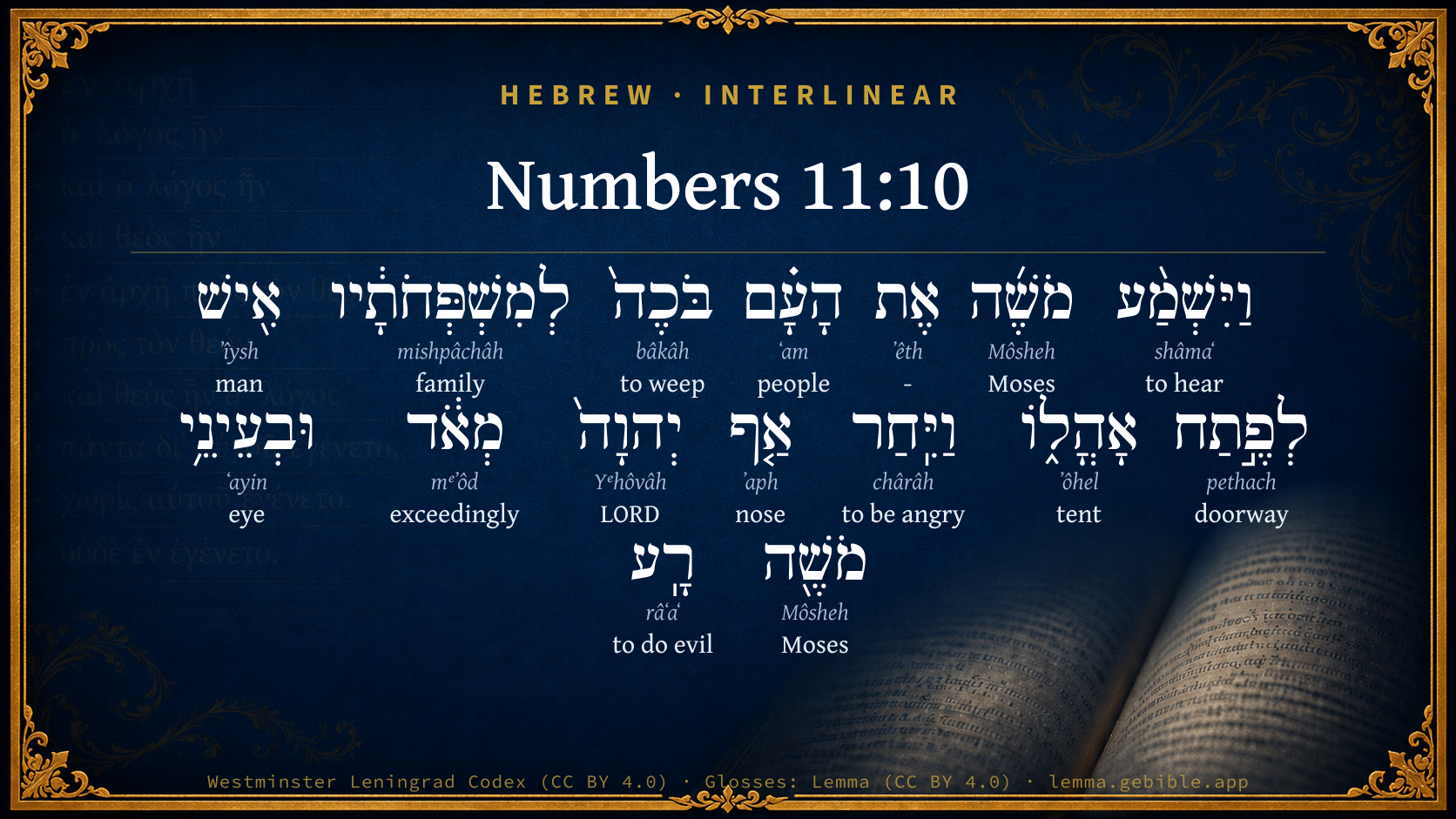
Hebrew (Westminster Leningrad Codex) Numbers 11:10 appears in the Hebrew Old Testament. The text above is from the Westminster Leningrad Codex. Each word links to its Strong’s number, a concise gloss, and parsing drawn from the Open Scriptures Hebrew Bible morphology. Click any word for its full Brown-Driver-Briggs (BDB) entry.
Download image
Cite this verse

Numbers 11:10 (World English Bible). Public Domain. Lemma interlinear Bible study tool, https://lemma.gebible.app/v/numbers/11/10.

Show BibTeX & RIS
BibTeX
RIS
English Translation
Moses heard the people weeping throughout their families, every man at the door of his tent: and the anger of Yahweh was kindled greatly; and Moses was displeased.
World English Bible · Public Domain
Download a study sheet

One document with this verse’s original text, its word-by-word gloss line, the meaning frame, cross-references with their text, attributed commentary, and full source and license credits — printable, and it pastes into notes with its structure intact.

This verse Autodidact and up

Study sheet (.html) Plain text (.txt)

A passage Seminary Student

Up to 50 verses in one chapter. A passage sheet keeps up to 6 commentary sources and 12 cross-references per verse, in the order this page ranks them, and says so on the sheet whenever that leaves anything out. Ask for a single verse and you get the Autodidact verse sheet above.

Everything on this page stays free to read, with no account — the sheet is a download of what is already on screen, not access to it.

Want to remove ads? Support Godless Engineer
Compare translations 3

The same verse in 3 English versions, stacked beneath the original-language interlinear above. Click any original word for its lexicon entry.

Each is an independent rendering of the whole verse — the interlinear is not word-aligned to these translations.

Highlighted words mark where these versions differ — a whole-verse word diff, not a word-by-word alignment.

  • World English Bible Public Domain
    Moses heard the people weeping throughout their families, every man at the door of his tent: and the anger of Yahweh was kindled greatly; and Moses was displeased.
  • King James Version Public Domain
    Then Moses heard the people weep throughout their families, every man in the door of his tent: and the anger of the LORD was kindled greatly; Moses also was displeased.
  • unfoldingWord Literal Text CC BY-SA 4.0
    And Moses heard the people weeping according to its clans, a man to the opening of his tent; and the nose of Yahweh burned exceedingly, and in the eyes of Moses evil.

unfoldingWord Literal Text — © unfoldingWord, licensed CC BY-SA 4.0. Word-aligned USFM3 via Door43 (git.door43.org/unfoldingWord/en_ult).

Versions to compare (up to 4)

3 of 4 selected

Show all 18 translations

Every available English version of this verse, each an independent rendering of the whole verse.

  • World English Bible Public Domain
    Moses heard the people weeping throughout their families, every man at the door of his tent: and the anger of Yahweh was kindled greatly; and Moses was displeased.
  • Berean Standard Bible Public Domain
    Then Moses heard the people of family after family weeping at the entrances to their tents, and the anger of the LORD was kindled greatly, and Moses was also displeased.
  • Majority Standard Bible Public Domain
    Then Moses heard the people of family after family weeping at the entrances to their tents, and the anger of the LORD was kindled greatly, and Moses was also displeased.
  • King James Version Public Domain
    Then Moses heard the people weep throughout their families, every man in the door of his tent: and the anger of the LORD was kindled greatly; Moses also was displeased.
  • American Standard Version (1901) Public Domain
    And Moses heard the people weeping throughout their families, every man at the door of his tent: and the anger of Jehovah was kindled greatly; and Moses was displeased.
  • Revised Version (1885) Public Domain
    And Moses heard the people weeping throughout their families, every man at the door of his tent: and the anger of the LORD was kindled greatly; and Moses was displeased.
  • Geneva Bible (1599) Public Domain
    Then Moses heard the people weepe throughout their families, euery man in the doore of his tent, and the wrath of the Lord was grieuously kindled: also Moses was grieued.
  • Douay-Rheims (1899) Public Domain
    Now Moses heard the people weeping by their families, every one at the door of his tent. And the wrath of the Lord was exceedingly enkindled: to Moses also the thing seemed insupportable.
  • Young's Literal Translation Public Domain
    And Moses heareth the people weeping by its families, each at the opening of his tent, and the anger of Jehovah burneth exceedingly, and in the eyes of Moses `it is' evil.
  • Literal Standard Version CC BY-SA 4.0
    And Moses hears the people weeping by its families, each at the opening of his tent, and the anger of YHWH burns exceedingly, and in the eyes of Moses [it is] evil.
  • Unlocked Literal Bible CC BY-SA 4.0
    Moses heard the people weeping in their families, and every man was at the entrance to his tent. Yahweh was very angry, and in Moses' eyes their complaining was wrong.
  • unfoldingWord Literal Text CC BY-SA 4.0
    And Moses heard the people weeping according to its clans, a man to the opening of his tent; and the nose of Yahweh burned exceedingly, and in the eyes of Moses evil.
  • Darby Bible Public Domain
    And Moses heard the people weep throughout their families, every one at the entrance of his tent; and the anger of Jehovah was kindled greatly; it was also evil in the eyes of Moses.
  • World Messianic Bible Public Domain
    Moses heard the people weeping throughout their families, every man at the door of his tent; and the LORD’s anger burned greatly; and Moses was displeased.
  • Webster's Bible Public Domain
    Then Moses heard the people weeping throughout their families, every man in the door of his tent: and the anger of the LORD was kindled greatly: Moses also was displeased.
  • Free Bible Version CC BY-SA 4.0
    Moses heard all the families crying at the entrance to their tents. The Lord became very angry, and Moses was also upset.
  • Bible in Basic English Public Domain
    And at the sound of the people weeping, every man at his tent-door, the wrath of the Lord was great, and Moses was very angry.
  • JPS Tanakh (1917) Public Domain
    And Moses heard the people weeping, family by family, every man at the door of his tent; and the anger of the LORD was kindled greatly; and Moses was displeased.

Literal Standard Version (2020), Covenant Press — licensed CC BY-SA 4.0. Text via the HelloAO Bible API (eBible.org). Unlocked Literal Bible (unfoldingWord) — licensed CC BY-SA 4.0. Text via the HelloAO Bible API (eBible.org). unfoldingWord Literal Text — © unfoldingWord, licensed CC BY-SA 4.0. Word-aligned USFM3 via Door43 (git.door43.org/unfoldingWord/en_ult). Free Bible Version, Dr. Jonathan Gallagher — licensed CC BY-SA 4.0. Text via the HelloAO Bible API (eBible.org).

Word by word

More ways to search: Search by grammar → Find every occurrence → Compare this word →

Practice this passage: Drill this verse → Learn its vocabulary →

וַיִּֽחַר
chârâh
H2734
“and · to be angry”
Conjunction + Verb, Qal, Sequential Imperfect, 3rd Person, Masculine, Singular
Part of Speech
Conjunction + Verb
Stem
Qal
Form
Sequential Imperfect
Person
3rd Person
Gender
Masculine
Number
Singular
Full BDB Definition

Origin: a primitive root [compare H2787 ]

TWOT: 736

to be hot, furious, burn, become angry, be kindled - (Qal) to burn, kindle (anger) - (Niphal) to be angry with, be incensed - (Hiphil) to burn, kindle - (Hithpael) to heat oneself in vexation
  1. וַיִּשְׁמַ֨ע shâmaʻ H8085 “and · to hear” Conjunction + Verb, Qal, Sequential Imperfect, 3rd Person, Masculine, Singular
  2. מֹשֶׁ֜ה Môsheh H4872 “Moses” Noun, Proper
  3. אֶת ʼêth H853 “-” Particle, Direct Object
  4. הָעָ֗ם ʻam H5971 “the · people” Particle, Definite Article + Noun, Common, Masculine, Singular, Absolute
  5. בֹּכֶה֙ bâkâh H1058 “weeping” Verb, Qal, Participle Active, Masculine, Singular, Absolute
  6. לְמִשְׁפְּחֹתָ֔יו mishpâchâh H4940 “to/for · families · his” Preposition + Noun, Common, Feminine, Plural, Construct + Suffix, Personal, 3rd Person, Masculine, Singular
  7. אִ֖ישׁ ʼîysh H376 “man” Noun, Common, Masculine, Singular, Absolute
  8. לְפֶ֣תַח pethach H6607 “to/for · doorway of” Preposition + Noun, Common, Masculine, Singular, Construct
  9. אָהֳל֑וֹ ʼôhel H168 “tent · his” Noun, Common, Masculine, Singular, Construct + Suffix, Personal, 3rd Person, Masculine, Singular
  10. אַ֤ף ʼaph H639 “nose” Particle, Accusative
  11. יְהוָה֙ Yᵉhôvâh H3068 “LORD” Noun, Proper
  12. מְאֹ֔ד mᵉʼôd H3966 “exceedingly” Adverb
  13. וּבְעֵינֵ֥י ʻayin H5869 “and · in/at · eyes of” Conjunction + Preposition + Noun, Common, Both, Dual, Construct
  14. מֹשֶׁ֖ה Môsheh H4872 “Moses” Noun, Proper
  15. רָֽע râʻaʻ H7489 “evil” Adjective, Adjective, Masculine, Singular, Absolute

About this verse

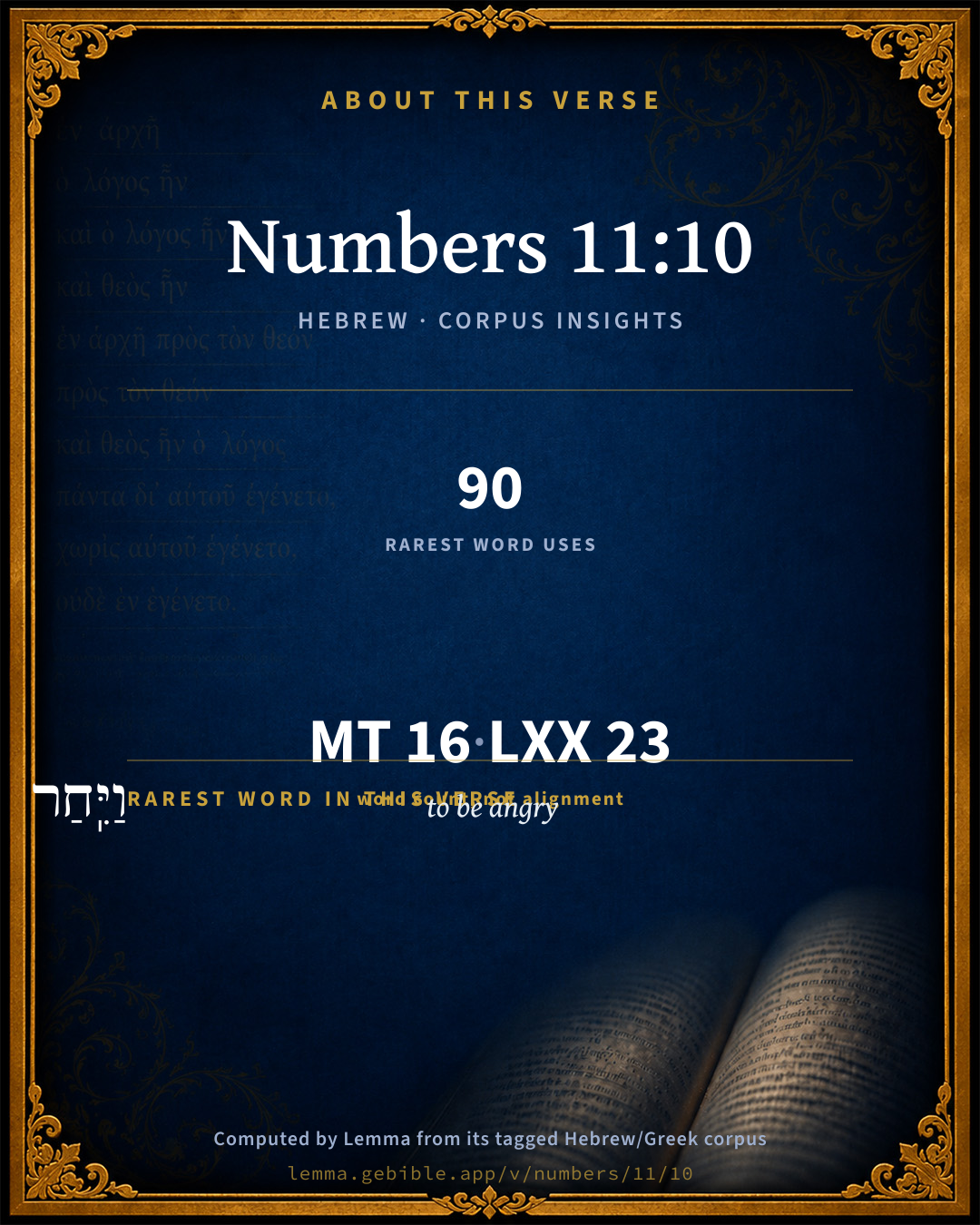
These counts appear in no published source. They are computed here, from the morphology-tagged text and Lemma’s own curated glosses. What Lemma adds →

16
words
15
distinct lemmas
Pentateuch
section

Grammatical profile

  • 3 verbs
  • 9 nouns
  • 1 adjective
  • 1 adverb
  • 2 particles

Verb forms

  • וַיִּשְׁמַ֨ע Qal · Sequential Imperfect
  • בֹּכֶה֙ Qal · Participle Active
  • וַיִּֽחַר Qal · Sequential Imperfect

Repetition

A word recurs within this verse — often emphatic in Hebrew:

  • מֹשֶׁ֜ה Moses H4872 ×2

Hebrew & Septuagint length

In English translation the verse runs 28 words from the Hebrew and 29 from the Septuagint (LXX English) — closely comparable.

A rough comparison of the two English renderings, which tokenize alike — not a word-level alignment.

Word counts can differ between the Hebrew and the Greek without any difference in meaning — e.g. the Hebrew direct-object marker אֵת has no separate Greek word, and Greek often adds the article ὁ.

In the original languages it is 16 Hebrew tokens and 23 Greek tokens — but the two are counted differently (Hebrew bundles its prefixes and suffixes into one token; the Greek is in lemma form), so that isn’t a like-for-like length.

Cross-references

16

Topical passages linked to Numbers 11:10 in the Treasury of Scripture Knowledge — connected by theme and wording, ordered by reader-vote popularity; previews shown in the World English Bible.

  • Psalms 78:21 Therefore Yahweh heard, and was angry. A fire was kindled against Jacob, Anger also went up against Israel,
  • Numbers 11:1 The people were as murmurers, [speaking] evil in the ears of Yahweh: and when Yahweh heard it, his anger was kindled; and the fire of Yahweh burnt among them, and devoured in the uttermost part of the camp.
  • Numbers 12:3 Now the man Moses was very humble, above all the men who were on the surface of the earth.
  • Numbers 14:1–2 All the congregation lifted up their voice, and cried; and the people wept that night.
  • Numbers 16:27 So they got them up from the tent of Korah, Dathan, and Abiram, on every side: and Dathan and Abiram came out, and stood at the door of their tents, and their wives, and their sons, and their little ones.
  • Numbers 20:10–13 Moses and Aaron gathered the assembly together before the rock, and he said to them, Hear now, you rebels; shall we bring you forth water out of this rock?
  • Numbers 21:5 The people spoke against God, and against Moses, Why have you brought us up out of Egypt to die in the wilderness? for there is no bread, and there is no water; and our soul loathes this light bread.
  • Deuteronomy 32:22 For a fire is kindled in my anger, Burns to the lowest Sheol, Devours the earth with its increase, Sets on fire the foundations of the mountains.
  • Psalms 78:59 When God heard this, he was angry, And greatly abhorred Israel;
  • Psalms 106:25 But murmured in their tents, And didn't listen to Yahweh's voice.
  • Psalms 106:32–33 They angered him also at the waters of Meribah, So that Moses was troubled for their sakes;
  • Psalms 139:21 Yahweh, don't I hate those who hate you? Am I not grieved with those who rise up against you?
  • Isaiah 5:25 Therefore Yahweh's anger burns against his people, And he has stretched out his hand against them, and has struck them. The mountains tremble, And their dead bodies are as refuse in the midst of the streets. For all this, his anger is not turned away, But his hand is still stretched out.
  • Jeremiah 17:4 You, even of yourself, shall discontinue from your heritage that I gave you; and I will cause you to serve your enemies in the land which you don't know: for you have kindled a fire in my anger which shall burn forever.
  • Mark 3:5 When he had looked around at them with anger, being grieved at the hardening of their hearts, he said to the man, "Stretch out your hand." He stretched it out, and his hand was restored as healthy as the other.
  • Mark 10:14 But when Jesus saw it, he was moved with indignation, and said to them, "Allow the little children to come to me! Don't forbid them, for the Kingdom of God belongs to such as these.

Cross-references courtesy of OpenBible.info (CC BY 4.0).

Hebrew and Greek witnesses Masoretic Hebrew ↔ Greek Septuagint

The same verse in the two great witnesses to the Old Testament, shown verse-for-verse.

These are two independent witnesses, not word-aligned to each other, and the Septuagint is shown in lemma (dictionary) form.

Hebrew Numbers 11:10 Masoretic · Westminster Leningrad Codex

וַיִּשְׁמַ֨ע מֹשֶׁ֜ה אֶת הָעָ֗ם בֹּכֶה֙ לְמִשְׁפְּחֹתָ֔יו אִ֖ישׁ לְפֶ֣תַח אָהֳל֑וֹ וַיִּֽחַר אַ֤ף יְהוָה֙ מְאֹ֔ד וּבְעֵינֵ֥י מֹשֶׁ֖ה רָֽע

Moses heard the people weeping throughout their families, every man at the door of his tent: and the anger of Yahweh was kindled greatly; and Moses was displeased.

World English Bible · Public Domain

Greek LXX Numbers 11:10 Septuagint · lemma form

καί ἀκούω μωυσῆς κλαίω αὐτός κατά δῆμος αὐτός ἕκαστος ἐπί ὁ θύρα αὐτός καί θυμόω ὀργή κύριος σφόδρα καί ἔναντι μωυσῆς εἰμί πονηρός

And Moses heard them weeping by their families, every one in his door: and the Lord was very angry; and the thing was evil in the sight of Moses.

LXX2012 (modern English Septuagint) · Public Domain

Hebrew: Westminster Leningrad Codex (CC BY 4.0). Greek: Septuagint (public domain); English from LXX2012 (modern English Septuagint) (Public Domain). How the Septuagint differs from the Hebrew →

Targum (Aramaic paraphrase)

2

The Targum is the ancient Jewish Aramaic paraphrase of the Hebrew Scriptures — an interpretive translation, not the Hebrew text itself. Onkelos (literal) and Pseudo-Jonathan (expansive) render the Torah, and Jonathan the Prophets. Coverage is partial: where no permissively-licensed English translation exists for a verse, only the Aramaic is shown. This is verse-level text, not a word-by-word alignment to the Hebrew.

  1. Targum Onkelos Torah (Genesis–Deuteronomy)
    וּשְׁמַע משֶׁה יָת עַמָא בָּכַן לְזַרְעֲיַתְהוֹן גְבַר בִּתְרַע מַשְׁכְּנֵה וּתְקֵף רוּגְזָא דַיְיָ לַחֲדָא וּבְעֵינֵי משֶׁה בִּישׁ

    (no public-domain English translation for this verse)

    Targum Onkelos — Aramaic: “Onkelos Genesis” (public domain); “Onkelos Exodus” (public domain); “Onkelos Leviticus” (public domain); “Onkelos Numbers” (public domain); “Onkelos Deuteronomy” (public domain). English: “Sefaria Community Translation” (CC0 1.0 (public-domain dedication)); “J.W. Etheridge. The Targums of Onkelos and Jonathan Ben Uzziel on the Pentateuch. London: Longmans, Green, 1862” (public domain). Text via Sefaria.

  2. Targum Pseudo-Jonathan Torah (Genesis–Deuteronomy)
    וּשְׁמַע משֶׁה יַת עַמָא בָּכֵי עַל קְרֵיבְתָּא דְמִתְאַסְרָן לְהוֹן גְבַר לִתְרַע מַשְׁכְּנֵיהּ וּתְקֵיף רוּגְזָא דַיְיָ לַחֲדָא וּבְעֵינֵי משֶׁה בִּישׁ

    And Mosheh heard the people lamenting with their neighbours, who had gathered every man at the gate of his tent and the displeasure of the Lord was strongly moved, and in the eyes of Mosheh it was evil;

    Targum Pseudo-Jonathan — Aramaic: “Targum Jonathan on Genesis” (public domain); “Targum Jonathan on Exodus” (public domain); “Targum Jonathan on Leviticus” (public domain); “Targum Jonathan on Numbers” (public domain); “Targum Jonathan on Deuteronomy” (public domain). English: “The Targum of Jonathan ben Uzziel, trans. J. W. Etheridge, London, 1862” (public domain). Text via Sefaria.

Commentary

Notes on Numbers 11:10 from classic Christian and Jewish commentators (each source and its license shown beneath its notes). The classic Christian expositions comment on the surrounding passage and are grouped to its opening verse, so a note may address several verses; the Jewish commentaries on the Tanakh (Rashi and others) are per-verse, so they appear only where the commentator wrote on this verse.

Lemma curates 59 commentaries, every one of them public domain or Creative Commons licensed, each selected and text-cleaned for this edition rather than reprinted as found. About our sources →

Trapp's Complete Commentary

John Trapp

Num 11:10 Then Moses heard the people weep throughout their families, every man in the door of his tent: and the anger of the LORD was kindled greatly; Moses also was displeased.

Ver. 10. Weep throughout their families.] Generally and openly they rebelled and murmured, though so lately they had smarted at Taberah. And this they did, not once or twice, but ten times over; whereby it appears that God chose this unthankful people, not for their merits, sed ex mera et mira misericordia. He chose them for his love, and loved them for his choice.

John Trapp, A Commentary or Exposition upon All the Books of the Old and New Testament (1647–1656) — public domain. Text from a community e-Sword module.

The Biblical Illustrator

Joseph S. Exell

Num_11:10-15

Wherefore hast Thou afflicted Thy servant?

The sufferings of the good in the path of duty

I. Look at the afflictions of godly men in the path of duty as a fact.

1. Good men suffer afflictions.

2. Good men suffer affliction in the path of duty.

II. Look at the afflictions of godly men in the path of duty as a problem.

1. A difficulty. Moses felt it.

2. Faith in the power of God to remove the difficulty.

III. Offer some hints towards the solution of the problem. The afflictions of the good in the path of duty, under the blessing of God, tend.

1. To test their faith. Character, says Dr. Huntington, depends on inward strength. But this strength has two conditions; it is increased only by being put forth, and it is tested only by some resistance. So, if the spiritual force or character in you is to be strong, it must be measured against some competition. It must enter into conflict with an antagonist. It must stand in comparison with something formidable enough to be a standard of its power Suffering, then, in some of its forms, must be introduced--the appointed minister, the great essayist--to put the genuineness of faith to the proof and purify it of its dross.

2. To promote their perfection. As the Perfect One reached His perfectness through suffering, says Dr. Ferguson, so it was with His servant. It was through the fire and the flame that the law of separation and refinement acted on the whole nature, and gave to it higher worth and glory. Trial ripened his manly spirit and made it patient to endure.

3. To enhance their joy hereafter (cf. Mat_5:10-12; Rom_8:17-18; 2Co_4:17-18; Rev_7:14-17).

4. To promote the good of the race. The Christian is called to know the fellowship of Christs sufferings--to suffer vicariously with Him that others may be saved and blessed. In the privilege of this high fellowship the sharpest sufferings become sacred and exalting services.

Conclusion:

1. Severe afflictions in the path of duty are in full accord with the character of God.

2. Such sufferings are quite compatible with the favour of God towards us (cf. Heb_12:5-11)

.

3. When severe suffering leads to sore perplexity let us seek help of God (cf. Psa_73:16-17)

. (W. Jones.)

The burdens of leadership

I. That the position of leader or governor of men is a very trying one.

1. Because of the responsible nature of the duties of leadership.

2. Because of the interest which the true leader takes in his charge.

3. Because of the intractableness of men.

II. The true leader of men must often be painfully conscious of his insufficiency.

III. The ablest and holiest leaders of men sometimes fail under the burdens of their position. Conclusion:

1. Great honours involve great obligations.

2. A man may fail even in the strongest point of his character. Moses was pre-eminently meek, yet here he is petulant, &c. Therefore, Watch thou in all things, &c.

3. It is the duty of men not to increase, but if possible to lessen the difficulties and trials of leadership. (W. Jones.)

Seeing afflictions from Gods standpoin:

Christian friend, did you ever take your stand beside your God, and see what there is to be seen? Do so; and it may be that, in your deprivations and disappointments, you will behold a wonderful and beautiful arrangement by which you can glorify God far better than by the gratification of your own selfish and earth-bound desires. Never were the Israelites better off than when they had just enough manna for the day, and not a morsel over; and it may be you are richer and happier in your present condition than you could have been in any other. See if it be not so! I thank God! said one, that I lost my all; for it has led me up into many blessed experiences with my God which I never knew while I was held down by the golden chain of worldly possessions. Then my affections were set on things on the earth, but now they rise to heaven. If you see things from Gods standpoint your black trouble will appear fringed with brightness, relieving the monotonous darkness upon which you have fixed your steady gaze far too long already. Look at your prolonged affliction from this point of view, and you will discern secret fingers carving the delicate lily work which shall adorn you in the upper sanctuary, when you become a pillar in the temple of your God. It may be by the very method so distasteful to you, the cherubim of adoring reverence are being woven into the texture of your being. Yes, do see what there is to be seen, for in every dispensation there is the hand of a Divine purpose, full of love, and wisdom, and grace. (C. H. Spurgeon.)

Afflictions may be full of mercies

In one of the German picture galleries is a painting called Cloudland. It hangs at the end of a long gallery, and, at first sight, It looks like a huge, repulsive daub of confused colour, without form or comeliness. As you walk toward it the picture begins to take shape. It proves to be a mass of exquisite little cherub faces, like those at the head of the canvas in Raphaels Madonna San Sisto. If you come close to the picture you see only an innumerable company of little angels and cherubims. How often the soul that is frightened by trials sees nothing but a confused and repulsive mass of broken expectations and crushed hopes I But if that soul, instead of fleeing away into unbelief and despair, would only draw up near to God, it would soon discover that the cloud was full of angels Of mercy. In one cherub face it would see, Whom I love, I chasten. Another angel would say, All things work together for good to them that love God. (T. L. Cuyler.)

Affliction preferable to sin

Here are two guests come to my door; both of them ask to have a lodging with me. The one is called Affliction; he has a very grave voice, and a very heavy hand, and he looks at me with fierce eyes. The other is called Sin, and he is very soft-spoken, and very fair, and his words are softer than butter. Let me scan their faces, let me examine them as to their character, I must not be deceived by appearances. I will ask my two friends who would lodge with me, to open their hands. When my friend Affliction, with some little difficulty opens his hand, I find that, rough as it is, he carries a jewel inside it, and that he meant to leave that jewel at my house. But as for my soft-spoken friend Sin, when I force him to show me what that is which he hides in his sleeve, I find that it is a dagger with which he would have stabbed me. What shall I do, then, if I am wise? Why, I should be very glad if they would both be good enough to go and stop somewhere else, but if I must entertain one of the two, I would shut my door in the face of smooth-spoken Sin, and say to the rougher and uglier visitor, Affliction, Come and stop with me, for may be God sent you as a messenger of mercy to my soul. (C. H. Spurgeon.)

The Biblical Illustrator, edited by Joseph S. Exell (c. 1880s–1900s) — public domain. Text from a community e-Sword module.

Joseph Benson's Commentary

Num 11:10-14. Every man in the door of his tent — To denote they were not ashamed of their sin. Have I not found favour — Why didst thou not hear my prayer when I desired thou wouldst excuse me, and commit the care of this unruly people to some other person? Have I begotten them? —

Are they my children, that I should be obliged to provide food and all things for their necessity and desire? To bear — The burden of providing for and satisfying them. Alone — Others were only assistant to him in smaller matters; but the harder and greater affairs, such as this unquestionably was, were brought to Moses and determined by him alone.

Joseph Benson's Commentary on the Old and New Testaments (1811–1818) — public domain. Text from a community e-Sword module.

Whedon's Commentary on the Bible

Daniel D. Whedon

THE COMPLAINT OF MOSES, Num_11:10-15.

The human infirmity of Moses, and his imperfection as a mediator, here strikingly appear. His faith, his repose of soul in the Almighty, is evidently shaken. He had not learned that God strengthens the back while he increases the burden, the lesson so well learned by St. Paul: “I can do all things through Christ which strengtheneth me.” The sensuality and insubordination of this company of serfs, just set free from the brickkilns of Egypt, greatly aggravated the burdens of Moses as the national executive, and justify his appeal to the Lord.

10. Every man — This indicates the universality of the disaffection.

In the door of his tent — Not secretly but publicly giving vent to his tears and complaints. The anger of the Lord was justly kindled in view of the ingratitude of the people for their deliverance from bondage, their forgetfulness of past mercies, their contempt for present blessings, and their distrust of the divine guidance. Faith never complains.

Moses also was displeased — His very sympathy with Jehovah required this displeasure. Anger in the interest of God and justice, and not asthe expression of personal resentment, is not only innocent but is demanded. Plato says, that he who cannot be angry at an outrage upon innocence is like a man with a withered muscle.

Daniel D. Whedon (gen. ed.), Commentary on the Old and New Testaments (1874–1909) — public domain. Text from a community e-Sword module.

Keil & Delitzsch

C. F. Keil & F. Delitzsch

When Moses heard the people weep, "according to their families, every one before the door of his tent," i.e., heard complaining in all the families in front of every tent, so that the weeping had become universal throughout the whole nation (cf. Zac 12:12.), and the wrath of the Lord burned on account of it, and the thing displeased Moses also, he brought his complaint to the Lord. The words "Moses also was displeased," are introduced as a circumstantial clause, to explain the matter more clearly, and show the reason for the complaint which Moses poured out before the Lord, and do not refer exclusively either to the murmuring of the people or to the wrath of Jehovah, but to both together. This follows evidently from the position in which the clause stands between the two antecedent clauses in Num 11:10 and the apodosis in Num 11:11, and still more evidently from the complaint of Moses which follows. For "the whole attitude of Moses shows that his displeasure was excited not merely by the unrestrained rebellion of the people against Jehovah, but also by the unrestrained wrath of Jehovah against the nation" (Kurtz). But in what was the wrath of Jehovah manifested? It broke out against the people first of all when they had been satiated with flesh (Num 11:33). There is no mention of any earlier manifestation. Hence Moses can only have discovered a sign of the burning wrath of Jehovah in the fact that, although the discontent of the people burst forth in loud cries, God did not help, but withdrew with His help, and let the whole storm of the infuriated people burst upon him.

Num 11:11-14

In Moses' complaint there is an unmistakeable discontent arising from the excessive burden of his office. "Why hast Thou done evil to Thy servant? and why have I not found favour in Thy sight, to lay upon me the burden of all this people?" The "burden of all this people" is the expression which he uses to denote "the care of governing the people, and providing everything for it" (C. a. Lap.). This burden, which God imposed upon him in connection with his office, appeared to him a bad and ungracious treatment on the part of God. This is the language of the discontent of despair, which differs from the murmuring of unbelief, in the fact that it is addressed to God, for the purpose of entreating help and deliverance from Him; whereas unbelief complains of the ways of God, but while complaining of its troubles, does not pray to the Lord its God. "Have I conceived all this people," Moses continues, "or have I brought it forth, that Thou requirest me to carry it in my bosom, as a nursing father carries the suckling, into the promised land?" He does not intend by these words to throw off entirely all care for the people, but simply to plead with God that the duty of carrying and providing for Israel rests with Him, the Creator and Father of Israel (Exo 4:22; Isa 63:16). Moses, a weak man, was wanting in the omnipotent power which alone could satisfy the crying of the people for flesh. עלי יבכּוּ, "they weep unto me," i.e., they come weeping to ask me to relieve their distress. "I am not able to carry this burden alone; it is too heavy for me."

Num 11:15

"If Thou deal thus with me, then kill me quite (הרג inf. abs., expressive of the uninterrupted process of killing; see Ewald, 280, b.), if I have found favour in Thine eyes (i.e., if Thou wilt show me favour), and let me not see my misfortune." "My misfortune:" i.e., the calamity to which I must eventually succumb.

Keil & Delitzsch — Biblical Commentary on the Old Testament (1861–1891) — public domain (CC PDM 1.0). Text via the HelloAO Bible API. (Old Testament only.)

Tyndale Open Study Notes

Tyndale Open Resources

11:10-15 The Israelites’ persistent whining led a frustrated Moses to register his own complaints with God. With biting sarcasm, Moses reminded God that he had not wanted this job in the first place (cp. Exod 4:10). Israel became such a burden that Moses wished that God would do him the favor of killing him (cp. Job 6:9). • Moses’ complaint was acceptable, unlike the complaints of the people, because he was seeking the Lord rather than pining for the delights of Egypt.

Tyndale Open Study Notes — © Tyndale Open Resources, licensed CC BY-SA 4.0. Text via the HelloAO Bible API.

Jamieson, Fausset & Brown

Robert Jamieson, A. R. Fausset & David Brown

Moses said unto the Lord, Wherefore hast thou afflicted thy servant, &c.--It is impossible not to sympathize with his feelings although the tone and language of his remonstrances to God cannot be justified. He was in a most distressing situation--having a mighty multitude under his care, with no means of satisfying their clamorous demands. Their conduct shows how deeply they had been debased and demoralized by long oppression: while his reveals a state of mind agonized and almost overwhelmed by a sense of the undivided responsibilities of his office.

Jamieson, Fausset & Brown — Commentary Critical and Explanatory on the Whole Bible (1871) — public domain (CC PDM 1.0). Text via the HelloAO Bible API.

Ellicott's Commentary for English Readers

(10) Moses also was displeased.—Or, And it was evil (or, displeasing) in the eyes of Moses. Moses was displeased with the people on account of their murmuring, and he was oppressed with the heavy burden of responsibility to which he felt himself unequal.

A Bible Commentary for English Readers, edited by Charles John Ellicott (1878–1897) — public domain. Text from a community e-Sword module.

John Gill's Exposition

Then Moses heard the people weep throughout their families,.... So general was their lusting after flesh, and their discontent for want of it; and so great their distress and uneasiness about it, that they wept and cried for it, and so loud and clamorous, that Moses heard the noise and outcry they made:

every man in the door of his tent: openly and publicly, were not ashamed of their evil and unbecoming behaviour, and in order to excite and encourage the like temper and disposition in others; though it may have respect, as some have observed, to the door of the tent of Moses, about which they gathered and mutinied; and which better accounts for his hearing the general cry they made; and so in an ancient writing of the Jews it is said (l), they were waiting for Moses until he came out at the door of the school; and they were sitting and murmuring:

and the anger of the Lord was kindled greatly; because of their ingratitude to him, their contempt of the manna he had provided for them, and their hankering after their poor fare in Egypt, and for which they had endured so much hardship and ill usage, and for the noise and clamour they now made:

Moses also was displeased; with the people on the same account, and with the Lord also for laying and continuing so great a burden upon him, as the care of this people, which appears by what follows.

(l) Siphri apud Yalkut in loc.

John Gill's Exposition of the Whole Bible (1746–1763) — public domain (CC PDM 1.0). Text via the HelloAO Bible API.

Haydock's Catholic Bible Commentary

By. Hebrew, "for." Jonathan and others endeavour to excuse their ancestors, by saying that they wept because they were forbidden to marry their near relations. --- His tent. Some explain the Hebrew of the tent of Moses. But the Israelites more probably staid at home.

George Leo Haydock (1774–1849), Haydock's Catholic Family Bible and Commentary, 1859 edition — public domain. Excludes Psalms (Douay-Rheims chapter numbering differs from Protestant) and Deuterocanonical books (Catholic canon only).

Matthew Poole's English Annotations

In the door of his tent; to note, that they were not ashamed of their sin.

Moses was displeased; partly, for their great unthankfulness; partly, foreseeing the dreadful judgments coming upon them, and partly, for his own burden expressed in the following verses.

Matthew Poole's English Annotations on the Holy Bible (1683–1685) — public domain. Text from a community e-Sword/MySword module.

The Pulpit Commentary

Throughout their families. Every family weeping by itself. Such was the contagion of evil, that every family was infected. Compare Zec_12:12 for a description of a weeping similar in character, although very different in its cause. Every man in the door of his tent. So that his wailing might be heard by all. So public and obtrusive a demonstration of grief must of course have been pre-arranged. They doubtless acted thus under the impression that if they made themselves sufficiently troublesome and disagreeable they would get all they wanted; in this, as in much else, they behaved exactly like ill-trained children. Moses also was displeased. The word "also" clearly compares and unites his displeasure with that of God. The murmuring indeed of the people was directed against God, and against Moses as his minister. The invisible King and his visible viceroy could not be separated in the regard of the people, and their concerted exhibition of misery was intended primarily for the eye of the latter. It was, therefore, no wonder that such conduct roused the wrath of Moses, who had no right to be angry, as well as the wrath of God, who had every right to be. angry. Moses sinned because he failed to restrain his temper within the exact limits of what befits the creature, and to distinguish carefully between a righteous indignation for Cod and an angry impatience with men. But he sinned under very sore provocation.

HOMILIES BY E.S. PROUT Ver. 10. The disastrous consequences of the sin of discontent.

Discontent springs from distrust. Dis trust is a root-sin from which different kindred evils spring, such as dis content, dis satisfaction, disgust, disobedience, and other dis agreeable states of mind. But "those that know thy name," &c. ; (Psa_9:10 Lam_3:24) From these strange cairns in the wilderness,"the graves of lust," we hear a voice. (1Co_10:6)

I THE DISCONTENT OF THE ISRAELITES.

II ITS DISASTROUS CONSEQUENCES.

I 1. Its disgraceful origin: "the mixed multitude," "hangers-on," "rift-raft." The chosen people of God listened and sympathized with them rather than with Moses and God. Apply to worldlings grumbling about weather, homes, situations, incomes, &c. ; (Pro_1:10 Rom_12:2 2Co_6:14)

2. The gross ingratitude of it. They were dissatisfied with the manna, which was wholesome, abundant, and adapted to various uses (verses 7-9), as though Hindoos should quarrel with their rice or the English with their wheat. (1Ti_6:8) They recollect certain casual sensual advantages of past bondage, but forget its cruelties and degradation (verses 4-6). Why not remember the whips and fetters and infanticide? They think of suppers more than sufferings, of full stomachs rather than of famished souls. Let Christians beware of hankering after the indulgences of their old life. (Pro_23:3 1Jn_2:15) And they complain of temporary deprivations, though hastening to a home of permanent and abundant good. They were passing through "that great and terrible wilderness" (Paran) because it was the direct route to the promised land. (Deu_1:19; cf. 1Pe_1:13 1Pe_2:11)

3. The aggravations of it. For they had seen God"s power already. (Exo_16:13 Psa_78:19, Psa_78:20) And have not we? (cf. Psa_22:4, Psa_22:5, Psa_22:9, Psa_22:10) And they overlooked recent chastisement (verse 1). God forbid that Isa_26:11 should be true of us, lest Proverbs 29, I should be also.

II The disastrous results of their sin.

1. They angered Jehovah. Discontent in the guests of his bounty dishonours their generous host, as though Reuben bad complained because Joseph gave more to Benjamin. (Gen_43:34)

2. They grieved Moses, and even infected him with their own desponding spirit (verses 11-15; see sketch below). Note how sin may become epidemic, spreading from the mixed multitude to the Israelites, and thence to Moses, like a disease introduced by foreign sailors spreading to our homes and palaces. Beware of carrying infection. (Illustration, Asaph, Psa_73:11-15)

3. They got what they desired, but are ruined thereby. Moses" prayer for help is answered in mercy (verses 16, 17); theirs for flesh, in judgment (verses 18-20). They probably added gluttony to lust, and perished in the sight of plenty and at the moment of gratification. (cf. Job_20:22, 23 Psa_78:30, Psa_78:31)

Learn

1. Prayers of discontent may bring answers of destruction. E.g., Rachel demanding children, and the Israelites a king. Greater wealth but worse health; (Ecc_6:1, Ecc_6:2) worldly prosperity, but leanness of soul. (Psa_106:15 1Ti_6:9 Jam_4:4)

2. The blessedness of a contented trust. P. (Php_4:11-13 Heb_13:5)

Vers. 10-15. The expostulation of Moses.

Jehovah and his servant Moses are very differently affected by this universal complaint of the Israelites. "The anger of the Lord was kindled greatly;" how it was expressed, we see later on. At present we have to consider the displeasure of Moses. God was made angry by the unbelief and ingratitude of the people, but Moses is chiefly concerned because of the great straits into which he himself is being brought. Hence his expostulation.

I IT CONTAINS A CLEAR RECOGNITION OF DUTY. Duty may be perfectly clear, even when there is much perplexity as to how it is to be performed. Moses had no manner of doubt that God had put him in his present position. Intolerable was the burden and keen the pain, but they had not come through any ambition of his own, and this in itself made a great deal of difference. If Moses had led the Israelites into the wilderness for his own purposes, he could not have spoken in the way he did. From the intolerable burden there were two ways of escape, flight and death death did suggest itself, but flight never. Moses even in his very complaining is nobler than Jonah running away. As we see him thus suffering this great pressure for the sins of the people, we cannot help thinking of Jesus in the garden, praying that, it possible, the cup might pass from him. So Paul tells us that, in addition to things from without, the care (merimna ) of all the Churches came upon him. (2Co_11:28) It may be our duty, in the name of God, and at his clear command, to attempt what the world, following out its own order of thinking, calls impossible.

II IT INDICATES A TOO FAVOURABLE ESTIMATE OF HUMAN NATURE, AS HAVING BEEN ENTERTAINED BY MOSES. He must have thought better of his followers and fellow-countrymen than they deserved. Not that he who had seen so much of them could possibly be blind to their faults; but we may well suppose that he expected too great a change from the influences of the sojourn near Sinai. He gave them credit, probably, for something of his own feeling, full of expectation and of joy in the abiding favour and protection of God. And now, when the reality appears in all its hideousness, there is a corresponding reaction. Unregenerate human nature must always be regarded with very moderate expectations. At its best it is a reed easily broken. How much higher than Moses is Jesus! He knew what was in man. (Mat_7:13, 14 13:13-15 18:21-22 26:31-35 Mar_14:18-20) And what light he gave to his apostles on this subject, e.g., to Paul, who saw and declared so distinctly the weakness of law to do anything save expose and condemn. It is not possible for us to make too much allowance for the corruption and degradation of human nature through sin. Only thus shall we appreciate the change to be effected before men are what God would have them to be.

III THE REACTION FROM THIS TOO FAVOURABLE ESTIMATE SHOWS ITSELF IN THE DESPAIRING LANGUAGE OF MOSES. He goes from one extreme to the other. Having thought too well of Israel he now speaks of them below the truth. They are but sucking children. The many thousands of Israel have been thrown like helpless infants on his bands. We see presently that seventy men out of this very multitude are found fit to assist him, but in his confusion and despair he cannot stop to think of anything but death. He saw only the cloud and not the silver lining. Life henceforth meant nothing but wretchedness, and God"s greatest boon would be to take it away. He wanted to be in that refuge which Job sought after his calamities, where the wicked cease from troubling, and the weary are at rest (Job 3, the whole chapter). It is worth while again contrasting Moses under the law with the apostles,ruder the gospel. When Moses feels the heavily-pressing burden, he loses his presence of mind and begins to talk of death. When the apostles have the murmurers coming to them, they at once in a calm and orderly way prepare to get assistance. Y. (Act_6:1-6)

The Pulpit Commentary (1880–1919), ed. H.D.M. Spence-Jones & Joseph S. Exell — public domain. Text from a community e-Sword module.

John Wesley's Explanatory Notes

In the door of his tent - To note they were not ashamed of their sin.

John Wesley, Explanatory Notes Upon the Whole Bible (1754–1765) — public domain. Text via the GEBible commentary corpus.

Kretzmann's Popular Commentary

Paul E. Kretzmann

Moses is Given Assistants

v. 10. Then Moses heard the people weep throughout their families, every man in the door of his tent, for the contagion of dissatisfaction had spread throughout the camp like a virulent pestilence; and the anger of the Lord was kindled greatly; Moses also was displeased. With this second outbreak of dissatisfaction, Moses felt the whole wrath of God in his inmost soul, and he feared that his entire mission was a failure.

v. 11. And Moses said unto the Lord, in his deep grief at the turn of events. Wherefore hast Thou afflicted Thy servant? And wherefore have I not found favor in Thy sight that Thou layest the burden of all this people upon me? He felt that the care of the entire people in governing and leading them was so grievous as to seem an unmerciful treatment on the part of God. This was the language of despondency, not of the kind that murmurs against the Lord in secret, but of that which seeks help and strength from Him alone. It is the complaint of weakness, but not the grumbling of unbelief.

v. 12. Have I conceived all this people, have I begotten them, that Thou shouldest say unto me, Carry them in thy bosom, as a nursing father beareth the sucking child, the nurse taking care of the helpless infant, unto the land which Thou swarest unto their fathers? It was not natural, it was not meet that Moses should bear the responsibility for the entire people alone; he meant to imply that God, as the Creator and Father of Israel, Exo 4:22; Isa 63:16, should make some provision by which he, a poor weak man, might be relieved of his great burden.

v. 13. Whence should I have flesh to give unto all this people? For they weep unto me, saying, Give us flesh that we may eat. They behaved like screaming, self-willed infants, who will not listen to reason.

v. 14. I am not able to bear all this people alone, because it is too heavy for me; his feeble strength could not hold up the burden which had been laid upon him.

v. 15. And if Thou deal thus with me, if the Lord really intended that he should continue bearing the burden, kill me, I pray Thee, out of hand, at once, without further torture, if I have found favor in Thy sight, for death would be a merciful deliverance in the circumstances; and let me not see my wretchedness, this great misfortune, which would surely kill him by inches. The experience of Moses and his manner of acting is that of many spiritual leaders of the people to this day, if all their efforts in behalf of the souls entrusted to them meet with little or no appreciation. Fortunate is the man who at that time turns to the Lord, even with an importunate prayer, and lays the matter entirely in the hands of Him who rules all things.

v. 16. And the Lord said unto Moses, Gather unto Me seventy men of the elders of Israel, whom thou knowest to be the elders of the people, and officers over them, men who had held these offices by virtue of the arrangement in force at that time, Exo 18:13-26; and bring them unto the Tabernacle of the Congregation that they may stand there with thee.

v. 17. And I will come down and talk with thee there; and I will take of the spirit which is upon thee and will put it upon them, not that Moses would possess so much less of the spirit of wisdom, but that they would all be kindled with the flame of the same understanding; and they shall bear the burden of the people with thee that thou bear it not thyself alone.

v. 18. And say thou unto the people, Sanctify yourselves against tomorrow, and ye shall eat flesh, they would have their longing satisfied; for ye have wept in the ears of the Lord, saying, Who shall give us flesh to eat? For it was well with us in Egypt; therefore the Lord will give you flesh, and ye shall eat. It was a command rather than a concession, as here made.

v. 19. Ye shall not eat one day, nor two days, nor five days, neither ten days, nor twenty days;

v. 20. but even a whole month, until it come out at your nostrils, and it be loathsome unto you, until the very thought of flesh would nauseate them; because that ye have despised the Lord, which is among you, and have wept before Him, saying, Why came we forth out of Egypt? The very tone in which the request of the people was granted should have sounded a warning to them and called them to true repentance.

v. 21. And Moses said, The people among whom I am are six hundred thousand footmen, so many able-bodied men alone; and Thou hast said, I will give them flesh that they may eat a whole month. This was apparently not doubt on the part of Moses, but an expression of surprise and a hint that he would like to know in what way this would be accomplished.

v. 22. Shall the flocks and the herds be slain for them to suffice them? Would that be enough to satisfy this demand? Or shall all the fish of the sea be gathered together for them to suffice them?

v. 23. And the Lord said unto Moses, Is the Lord’s hand waxed short, shorter than it has been, in not being able to reach the people and in helping them in their real needs? Thou shalt see now whether My word shall come to pass unto thee or not. Jehovah refused Moses an explanation as to the form of the intended miracle; He demanded of His servant unconditional faith in His almighty power and in the efficacy of His promises. And Moses believed and obeyed.

v. 24. And Moses went out, namely, from the Tabernacle, where he had brought his complaint before the Lord, and told the people the words of the Lord, and gathered the seventy men of the elders of the people, and set them. round about the Tabernacle, probably in a semicircle, on the side facing the east.

v. 25. And the Lord came down in a cloud and spake unto him, the cloud, which ordinarily stood still above the tent, sank down to its door, and Jehovah addressed His servant, and took of the Spirit that was upon him and gave it unto the seventy elders, filled them with the same wisdom and understanding which characterized Moses, though not in the same degree. And it came to pass that, when the Spirit rested upon them, they prophesied and did not cease; for that one time they were filled with a peculiar ecstasy wrought by the Holy Spirit, which caused them to utter inspired messages.

v. 26. But there remained two of the men in the camp, of the elders who should have been at the Tabernacle; the name of the one was Eldad and the name of the other Medad; and the Spirit rested upon them; and they were of them that were written, their names were included in the list made by Moses, but went not out unto the Tabernacle; and they prophesied in the camp.

v. 27. And there ran a young man, and told Moses, and said, Eldad and Medad do prophesy in the camp; it was such an unusual occurrence that he thought a report should be made.

v. 28. And Joshua, the son of Nun, the servant of Moses, one of his young men, answered and said, My lord Moses, forbid them. He believed that the prophesying done by these men was a presumptuous act on their part. But Moses quenched his mistaken zeal, as the Lord did upon a similar occasion. Mar 9:38-39.

v. 29. And Moses said unto him, Enviest thou for my sake? "Would God that all the Lord’s people were prophets and that the Lord would put His Spirit upon them! As a true servant of God, who was not jealous for his own honor, but desired only the extension of God’s influence and power, Moses wished only for a further extension of the Lord’s gift of grace. A little more of this same Spirit in our days would help to solve many of the problems of the Church.

v. 30. And Moses gat him into the camp, he and the elders of Israel; they all returned to their own tents, which were at some distance from the Tabernacle. Moses had his assistants, and he felt the relief. At present the Lord also gives understanding and wisdom to the men that are holding various offices in the Church, if they but use proper meekness in their work.

Paul E. Kretzmann, Popular Commentary of the Bible (1921–1924) — public domain. Text from a community e-Sword module.

Rashi

Rabbi Shlomo Yitzchaki (Rashi)

בכה למשפחתיו [THEN MOSES HEARD THE PEOPLE] WEEP THROUGHOUT THEIR FAMILIES — i.e. the members of each family gathered together and wept in order to display their discontent in public. Our Rabbis, however, said that למשפחתיו means “the people wept because of family affairs” — because of the intermarriage of blood-relaltives that had been forbidden to them (Sifrei Bamidbar 90; Yoma 75a).

Rashi on the Tanakh — English translations: “The Judaica Press complete Tanach with Rashi, translated by A. J. Rosenberg” (CC BY 4.0); “Pentateuch with Rashi's commentary by M. Rosenbaum and A.M. Silbermann, 1929-1934” (public domain); “The Metsudah Tanach series, Lakewood, N.J” (CC BY 4.0); and “The Book of Joshua, Metsudah Publications, 1997” (CC BY 4.0). Text via Sefaria.

Lesson kit

Teaching starters — assembled from the data on this page, not authored interpretation. Every prompt links to the verse data it draws on. Edit before teaching.

Numbers, in the Pentateuch, opens this verse with 16 words (15 distinct Hebrew lemmas). Its most distinctive word is chârâh (“to be angry”). A historical commentator’s framing appears above. Read the whole chapter for the surrounding context.

Discussion questions

  1. What does “to be angry” (chârâh) contribute to the verse as a whole?
  2. How does Psalms 78:21, which shares this passage’s theme, read alongside this verse?
  3. What does the repetition of “Moses” (2× in this one verse) do in this verse?
  4. These translations render this verse differently; the difference is in the English rendering, not the original. What questions does that raise?
  5. «וַיִּשְׁמַ֨ע» is a Qal Sequential Imperfect verb. How does that grammatical form shape the action described?
  6. Compare how Trapp's Complete Commentary and The Biblical Illustrator read this verse. Where do they agree or differ?

Things to notice

Reading settings

Reading text

Shown beneath each verse's original-language words.

Old Testament
Old Testament edition

Read the OT as the Masoretic Hebrew (MT) or the Greek Septuagint (LXX).

English shown for the Greek Septuagint (in the Hebrew ↔ Greek comparison).

Comparing translations? Open the Compare panel on any verse page to stack up to four side by side.