Leviticus 6:26

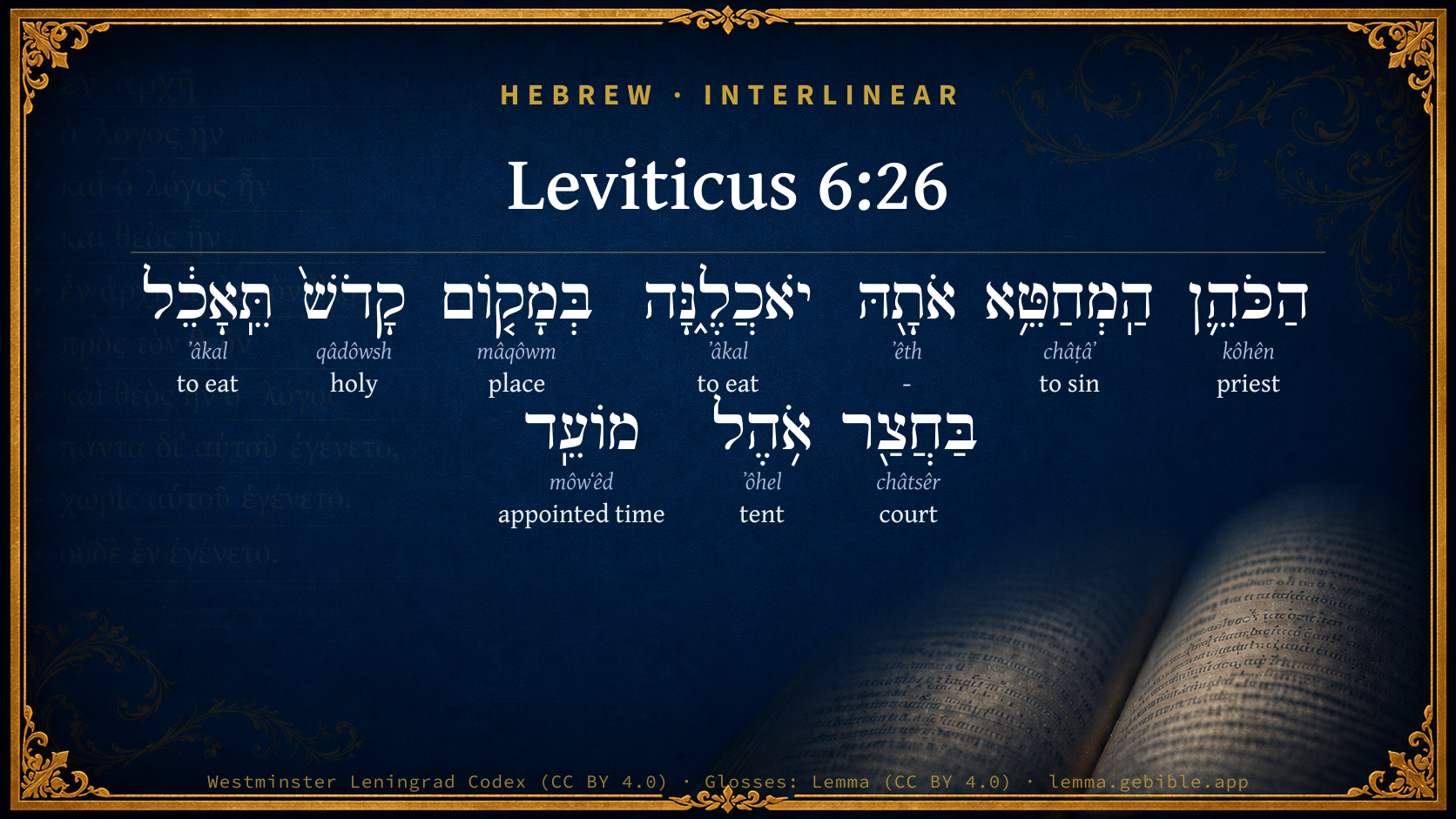
Hebrew (Westminster Leningrad Codex) Leviticus 6:26 appears in the Hebrew Old Testament. The text above is from the Westminster Leningrad Codex. Each word links to its Strong’s number, a concise gloss, and parsing drawn from the Open Scriptures Hebrew Bible morphology. Click any word for its full Brown-Driver-Briggs (BDB) entry.
Download image
Cite this verse

Leviticus 6:26 (World English Bible). Public Domain. Lemma interlinear Bible study tool, https://lemma.gebible.app/v/leviticus/6/26.

Show BibTeX & RIS
BibTeX
RIS
English Translation
The priest who offers it for sin shall eat it. It shall be eaten in a holy place, in the court of the Tent of Meeting.
World English Bible · Public Domain
Download a study sheet

One document with this verse’s original text, its word-by-word gloss line, the meaning frame, cross-references with their text, attributed commentary, and full source and license credits — printable, and it pastes into notes with its structure intact.

This verse Autodidact and up

Study sheet (.html) Plain text (.txt)

A passage Seminary Student

Up to 50 verses in one chapter. A passage sheet keeps up to 6 commentary sources and 12 cross-references per verse, in the order this page ranks them, and says so on the sheet whenever that leaves anything out. Ask for a single verse and you get the Autodidact verse sheet above.

Everything on this page stays free to read, with no account — the sheet is a download of what is already on screen, not access to it.

Want to remove ads? Support Godless Engineer
Compare translations 3

The same verse in 3 English versions, stacked beneath the original-language interlinear above. Click any original word for its lexicon entry.

Each is an independent rendering of the whole verse — the interlinear is not word-aligned to these translations.

Highlighted words mark where these versions differ — a whole-verse word diff, not a word-by-word alignment.

  • World English Bible Public Domain
    The priest who offers it for sin shall eat it. It shall be eaten in a holy place, in the court of the Tent of Meeting.
  • King James Version Public Domain
    The priest that offereth it for sin shall eat it: in the holy place shall it be eaten, in the court of the tabernacle of the congregation.
  • unfoldingWord Literal Text CC BY-SA 4.0
    The priest who presents it for a sin offering, he shall eat it. In a holy place, it shall be eaten, in the courtyard of the tent of meeting.

unfoldingWord Literal Text — © unfoldingWord, licensed CC BY-SA 4.0. Word-aligned USFM3 via Door43 (git.door43.org/unfoldingWord/en_ult).

Versions to compare (up to 4)

3 of 4 selected

Show all 16 translations

Every available English version of this verse, each an independent rendering of the whole verse.

  • World English Bible Public Domain
    The priest who offers it for sin shall eat it. It shall be eaten in a holy place, in the court of the Tent of Meeting.
  • Berean Standard Bible Public Domain
    The priest who offers it shall eat it; it must be eaten in a holy place, in the courtyard of the Tent of Meeting.
  • Majority Standard Bible Public Domain
    The priest who offers it shall eat it; it must be eaten in a holy place, in the courtyard of the Tent of Meeting.
  • King James Version Public Domain
    The priest that offereth it for sin shall eat it: in the holy place shall it be eaten, in the court of the tabernacle of the congregation.
  • American Standard Version (1901) Public Domain
    The priest that offereth it for sin shall eat it: in a holy place shall it be eaten, in the court of the tent of meeting.
  • Revised Version (1885) Public Domain
    The priest that offereth it for sin shall eat it: in a holy place shall it be eaten, in the court of the tent of meeting.
  • Geneva Bible (1599) Public Domain
    The Priest that offreth this sinne offring, shall eate it: in the holy place shall it be eaten, in the court of ye Tabernacle of the Congregation.
  • Douay-Rheims (1899) Public Domain
    The priest that offereth it, shall eat it in a holy place, in the court of the tabernacle.
  • Young's Literal Translation Public Domain
    `The priest who is making atonement with it doth eat it, in the holy place it is eaten, in the court of the tent of meeting;
  • Literal Standard Version CC BY-SA 4.0
    The priest who is making atonement with it eats it; it is eaten in a holy place, in the court of the Tent of Meeting;
  • Unlocked Literal Bible CC BY-SA 4.0
    The priest who offers it for sin will eat it. It must be eaten in a holy place in the courtyard of the tent of meeting.
  • unfoldingWord Literal Text CC BY-SA 4.0
    The priest who presents it for a sin offering, he shall eat it. In a holy place, it shall be eaten, in the courtyard of the tent of meeting.
  • Darby Bible Public Domain
    The priest that offereth it for sin shall eat it: in a holy place shall it be eaten, in the court of the tent of meeting.
  • World Messianic Bible Public Domain
    The priest who offers it for sin shall eat it. It shall be eaten in a holy place, in the court of the Tent of Meeting.
  • Free Bible Version CC BY-SA 4.0
    The priest who offers the sin offering is to eat it. It must be eaten without yeast in a holy place—the courtyard of the Tent of Meeting.
  • JPS Tanakh (1917) Public Domain
    (6-19) The priest that offereth it for sin shall eat it; in a holy place shall it be eaten, in the court of the tent of meeting.

Literal Standard Version (2020), Covenant Press — licensed CC BY-SA 4.0. Text via the HelloAO Bible API (eBible.org). Unlocked Literal Bible (unfoldingWord) — licensed CC BY-SA 4.0. Text via the HelloAO Bible API (eBible.org). unfoldingWord Literal Text — © unfoldingWord, licensed CC BY-SA 4.0. Word-aligned USFM3 via Door43 (git.door43.org/unfoldingWord/en_ult). Free Bible Version, Dr. Jonathan Gallagher — licensed CC BY-SA 4.0. Text via the HelloAO Bible API (eBible.org).

Word by word

More ways to search: Search by grammar → Find every occurrence → Compare this word →

Practice this passage: Drill this verse → Learn its vocabulary →

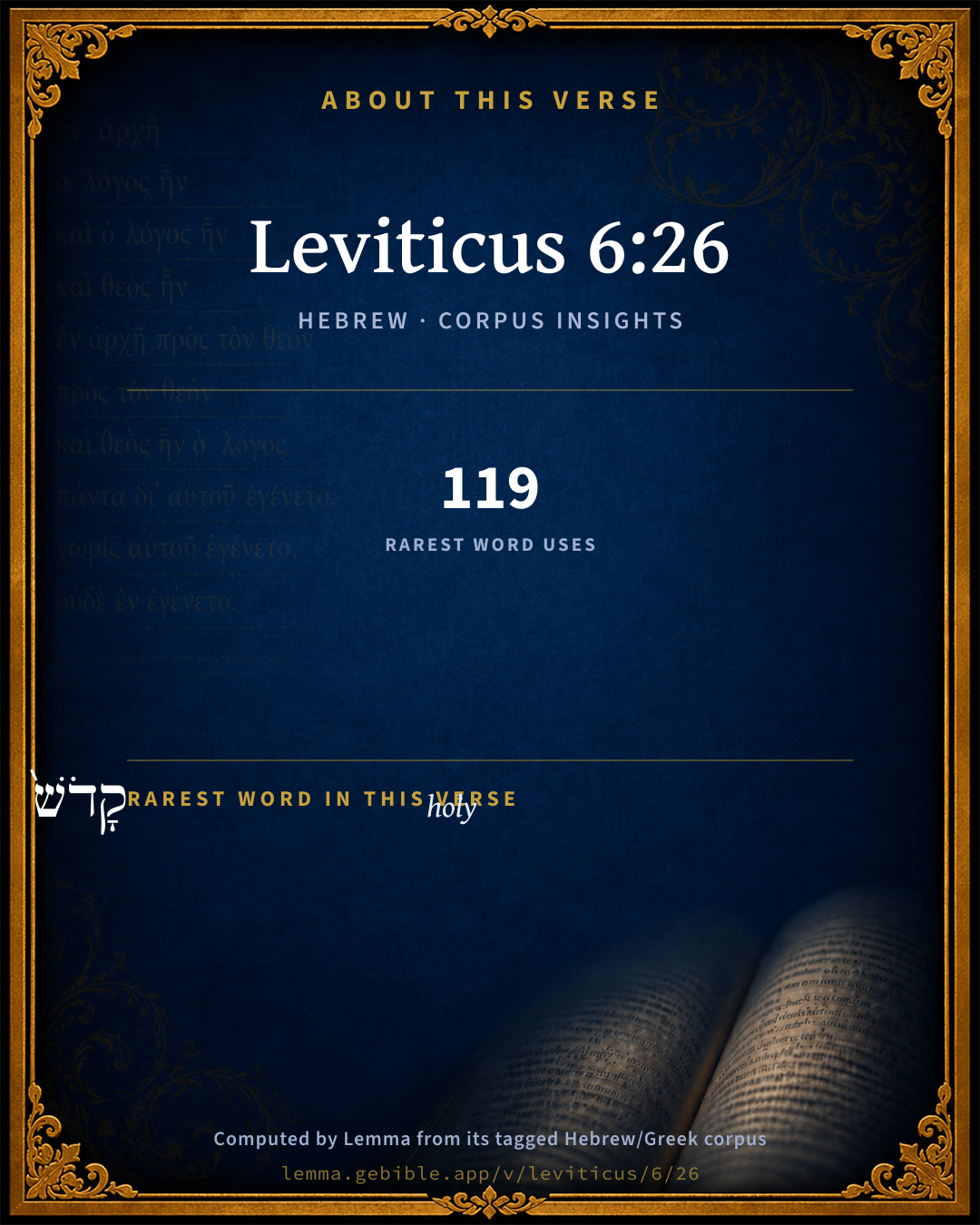
קָדֹשׁ֙
qâdôwsh
H6918
“holy”
Adjective, Adjective, Masculine, Singular, Absolute
Part of Speech
Adjective
Type
Adjective
Gender
Masculine
Number
Singular
State
Absolute
Full BDB Definition

Origin: from H6942

TWOT: 1990b

sacred, holy, Holy One, saint, set apart
  1. הַכֹּהֵ֛ן kôhên H3548 “the · priest” Particle, Definite Article + Noun, Common, Masculine, Singular, Absolute
  2. הַֽמְחַטֵּ֥א châṭâʼ H2398 “the · sinning” Particle, Definite Article + Verb, Piel, Participle Active, Masculine, Singular, Absolute
  3. אֹתָ֖הּ ʼêth H853 “- · her” Particle, Direct Object + Suffix, Personal, 3rd Person, Feminine, Singular
  4. יֹאכֲלֶ֑נָּה ʼâkal H398 “to eat · her” Verb, Qal, Imperfect, 3rd Person, Masculine, Singular + Suffix, Personal, 3rd Person, Feminine, Singular
  5. בְּמָק֤וֹם mâqôwm H4725 “in/at · place” Preposition + Noun, Common, Masculine, Singular, Absolute
  6. תֵּֽאָכֵ֔ל ʼâkal H398 “to eat” Verb, Niphal, Imperfect, 3rd Person, Feminine, Singular
  7. בַּחֲצַ֖ר châtsêr H2691 “in/at · court of” Preposition + Noun, Common, Both, Singular, Construct
  8. אֹ֥הֶל ʼôhel H168 “tent of” Noun, Common, Masculine, Singular, Construct
  9. מוֹעֵֽד môwʻêd H4150 “appointed time” Noun, Common, Masculine, Singular, Absolute

About this verse

These counts appear in no published source. They are computed here, from the morphology-tagged text and Lemma’s own curated glosses. What Lemma adds →

10
words
9
distinct lemmas
Pentateuch
section

Grammatical profile

  • 3 verbs
  • 5 nouns
  • 1 adjective
  • 1 particle

Verb forms

  • הַֽמְחַטֵּ֥א Piel · Participle Active
  • יֹאכֲלֶ֑נָּה Qal · Imperfect
  • תֵּֽאָכֵ֔ל Niphal · Imperfect

Repetition

A word recurs within this verse — often emphatic in Hebrew:

  • יֹאכֲלֶ֑נָּה to eat H398 ×2

Hebrew & Septuagint length

In English translation the verse runs 26 words from the Hebrew and 24 from the Septuagint (LXX English) — closely comparable.

A rough comparison of the two English renderings, which tokenize alike — not a word-level alignment.

Word counts can differ between the Hebrew and the Greek without any difference in meaning — e.g. the Hebrew direct-object marker אֵת has no separate Greek word, and Greek often adds the article ὁ.

Cross-references

10

Topical passages linked to Leviticus 6:26 in the Treasury of Scripture Knowledge — connected by theme and wording, ordered by reader-vote popularity; previews shown in the World English Bible.

  • Leviticus 10:17–18 "Why haven't you eaten the sin offering in the place of the sanctuary, seeing it is most holy, and he has given it you to bear the iniquity of the congregation, to make atonement for them before Yahweh?
  • Ezekiel 44:28–29 They shall have an inheritance: I am their inheritance; and you shall give them no possession in Israel; I am their possession.
  • Ezekiel 42:13 Then said he to me, The north chambers and the south chambers, which are before the separate place, they are the holy chambers, where the priests who are near to Yahweh shall eat the most holy things: there shall they lay the most holy things, and the meal-offering, and the sin-offering, and the trespass-offering; for the place is holy.
  • Ezekiel 46:20 He said to me, This is the place where the priests shall boil the trespass-offering and the sin-offering, [and] where they shall bake the meal-offering; that they not bring them forth into the outer court, to sanctify the people.
  • Hosea 4:8 They feed on the sin of my people, And set their heart on their iniquity.
  • Exodus 27:9–18 "You shall make the court of the tent: for the south side southward there shall be hangings for the court of fine twined linen one hundred cubits long for one side:
  • Exodus 38:9–19 He made the court: for the south side southward the hangings of the court were of fine twined linen, one hundred cubits;
  • Exodus 40:33 He raised up the court around the tent and the altar, and set up the screen of the gate of the court. So Moses finished the work.
  • Leviticus 6:16 That which is left of it Aaron and his sons shall eat. It shall be eaten without yeast in a holy place. They shall eat it in the court of the Tent of Meeting
  • Numbers 18:9–10 This shall be your of the most holy things, [reserved] from the fire: every offering of theirs, even every meal-offering of theirs, and every sin-offering of theirs, and every trespass-offering of theirs, which they shall render to me, shall be most holy for you and for your sons.

Cross-references courtesy of OpenBible.info (CC BY 4.0).

Hebrew and Greek witnesses Masoretic Hebrew ↔ Greek Septuagint

The same verse in the two great witnesses to the Old Testament, shown verse-for-verse.

These are two independent witnesses, not word-aligned to each other, and the Septuagint is shown in lemma (dictionary) form.

Hebrew Leviticus 6:26 Masoretic · Westminster Leningrad Codex

הַכֹּהֵ֛ן הַֽמְחַטֵּ֥א אֹתָ֖הּ יֹאכֲלֶ֑נָּה בְּמָק֤וֹם קָדֹשׁ֙ תֵּֽאָכֵ֔ל בַּחֲצַ֖ר אֹ֥הֶל מוֹעֵֽד

The priest who offers it for sin shall eat it. It shall be eaten in a holy place, in the court of the Tent of Meeting.

World English Bible · Public Domain

Greek LXX Leviticus 6:26 Septuagint · lemma form
The priest that offers it shall eat it: in a holy place it shall be eaten, in the court of the tabernacle of witness.

LXX2012 (modern English Septuagint) · Public Domain

Hebrew: Westminster Leningrad Codex (CC BY 4.0). Greek: Septuagint (public domain); English from LXX2012 (modern English Septuagint) (Public Domain). How the Septuagint differs from the Hebrew →

Commentary

Notes on Leviticus 6:26 from classic Christian and Jewish commentators (each source and its license shown beneath its notes). The classic Christian expositions comment on the surrounding passage and are grouped to its opening verse, so a note may address several verses; the Jewish commentaries on the Tanakh (Rashi and others) are per-verse, so they appear only where the commentator wrote on this verse.

Lemma curates 59 commentaries, every one of them public domain or Creative Commons licensed, each selected and text-cleaned for this edition rather than reprinted as found. About our sources →

The Cambridge Bible for Schools and Colleges

gen. ed. J. J. S. Perowne

26. What remains after the sacrifice has been offered (except in the cases specified in Lev_6:30 and Lev_4:3-21) is ‘most holy’—to be eaten in the same place and manner as the Meal-Offering (Lev_6:16-18).

in a holy place] Here and in Lev_6:16 further designated as ‘the court of the tent of meeting’ and prescribed for the Guilt-Offering in Lev_7:6. Cp. the command to eat the flesh of the ram of consecration at ‘the door of the tent of meeting’ (Exo_29:32). The remainder belongs to the priest who officiates, but any male among the priests may join in eating it (Lev_6:29).

The passages which assign a portion of the sacrifice to the officiating priest are Lev_6:26 a, Lev_7:7-10; Lev_7:33. May these be parts of a law of sacrifice which has been combined with rest of Lev_6:8 to Lev_7:38? If on a particular occasion the priestly dues of a sacrifice fell to any one priest, he might invite his fellow priests to share in the meal, and the custom of eating these portions of the sacrifice together would be embodied in a law which asserted the right of all priests to partake of the sacrificial meal.

The Cambridge Bible for Schools and Colleges (gen. ed. J. J. S. Perowne; Cambridge University Press, 1878–1918) — public domain. Text from a community e-Sword module.

Trapp's Complete Commentary

John Trapp

Lev 6:26 The priest that offereth it for sin shall eat it: in the holy place shall it be eaten, in the court of the tabernacle of the congregation.

Ver. 26. Shall eat it.] Except in that case, Lev 6:30.

John Trapp, A Commentary or Exposition upon All the Books of the Old and New Testament (1647–1656) — public domain. Text from a community e-Sword module.

Joseph Benson's Commentary

Lev 6:26. The priest that offereth it for sin — For the sins of the rulers, or of the people, or any of them, but not for the sins of the priests; for then its blood was brought into the tabernacle, and therefore it might not be eaten.

Joseph Benson's Commentary on the Old and New Testaments (1811–1818) — public domain. Text from a community e-Sword module.

Adam Clarke's Commentary

Verse 26. The priest - shall eat it] From the expostulation of Moses with Aaron, Le 10:17, we learn that the priest, by eating the sin-offering of the people, was considered as bearing their sin, and typically removing it from them: and besides, this was a part of their maintenance, or what the Scripture calls their inheritance; see Eze 44:27-30. This was afterwards greatly abused; for improper persons endeavoured to get into the priest's office merely that they might get a secular provision, which is a horrible profanity in the sight of God. See 1Sa 2:36; Jer 23:12; Eze 34:2-4; and Ho 4:8.

Adam Clarke's Commentary on the Bible (1810–1826) — public domain. Text from a community e-Sword/MySword module.

Ellicott's Commentary for English Readers

(26) The priest that offereth it for sin.—Rather, the priest that offereth it for expiation, or, the priest that expiateth sin by it. That is, who makes atonement by the blood thereof. (See Lev_9:15.)

Shall eat it.—God gave the sin offering as food for the priests to bear the iniquity of the congregation, and to make atonement for them (Lev_10:17). It constituted a part of their livelihood (Eze_44:28-29). The officiating priest to whom fell this perquisite could invite not only his family but other priests and their sons to partake of it. Covetous priests abused this gift (Hos_4:8).

In the holy place shall it be eaten.—That is, within the forecourt of the sanctuary. Eight of the offerings had to be eaten in the precincts of the sanctuary: (1) the flesh of the sin offering (Lev_4:26); (2); the flesh of the trespass offering (Lev_7:6); (3) the peace offering of the congregation (Lev_23:19-20); (4), the remainder of the omer (Lev_23:10-11); (5), of the meat offering of the Israelites (Leviticus 2, 3-10); (6), the two loaves (Leviticus 23, 20); (7), the shew-bread (Lev_24:9); and (8), the leper’s log of oil (Lev_14:10-13).

A Bible Commentary for English Readers, edited by Charles John Ellicott (1878–1897) — public domain. Text from a community e-Sword module.

John Gill's Exposition

Whatsoever shall touch the flesh thereof shall be holy,.... None but holy persons, such as were devoted to holy services, even the priests and their sons, might touch and eat of the flesh of the sin offering: all that did so were sacred persons; and even what were used in eating it, dishes and knives, were to be put to no other use, not to any common service, or for anything but holy things; which was done to keep up a veneration for the sacrifices, and especially for the great sacrifice they typified, the sacrifice of Christ, whose flesh is meat indeed; and whoever eats of that by faith dwells in Christ, and Christ dwells in him, Joh 6:55,

and when there is sprinkled of the blood thereof upon any garment; the garment of the priest that slays and offers it:

thou shalt wash that whereon it was sprinkled in the holy place; it was not to be carried out of the tabernacle, and washed elsewhere, but in the sanctuary; either at the laver, where the priests washed their hands and feet, or in some room in the court for that purpose. This was done to preserve an esteem and value for the blood of the sacrifice, as typical of the precious blood of Christ.

John Gill's Exposition of the Whole Bible (1746–1763) — public domain (CC PDM 1.0). Text via the HelloAO Bible API.

Haydock's Catholic Bible Commentary

Tabernacle. No part shall be given to those who are not of the sacerdotal race. (Calmet)

George Leo Haydock (1774–1849), Haydock's Catholic Family Bible and Commentary, 1859 edition — public domain. Excludes Psalms (Douay-Rheims chapter numbering differs from Protestant) and Deuterocanonical books (Catholic canon only).

Matthew Poole's English Annotations

For sin; for the sins of the rulers, or of the people, or any of them, but not for the sins of the priests; for then its blood was brought into the tabernacle, and therefore it might not be eaten.

Matthew Poole's English Annotations on the Holy Bible (1683–1685) — public domain. Text from a community e-Sword/MySword module.

Whedon's Commentary on the Bible

Daniel D. Whedon

26. The priest… shall eat — God required the priests to eat the flesh in order that they might “bear (away, or expiate) the iniquity of the congregation, to make atonement for them.” Lev_10:17. Eating symbolizes the complete reception of any thing. Jer_15:16; Joh_6:51. Hence the priests, as God’s representatives, by their incorporation with the sin offering gave assurance of the completeness of the reconciliation, and demonstrated that the sacrifice which entirely removes guilt, is converted even into the nutriment of the holiest life. Jesus is both our propitiation and our bread of life.

That offereth it for sin —

Or expiates sin by it. The word expiates sin, in the Hebrew, is from the same radicals with sin offering. See 2Co_5:21.

Daniel D. Whedon (gen. ed.), Commentary on the Old and New Testaments (1874–1909) — public domain. Text from a community e-Sword module.

John Wesley's Explanatory Notes

For sin - For the sins of the rulers, or of the people, or any of them, but not for the sins of the priests; for then its blood was brought into the tabernacle, and therefore it might not be eaten.

John Wesley, Explanatory Notes Upon the Whole Bible (1754–1765) — public domain. Text via the GEBible commentary corpus.

Lesson kit

Teaching starters — assembled from the data on this page, not authored interpretation. Every prompt links to the verse data it draws on. Edit before teaching.

Leviticus, in the Pentateuch, opens this verse with 10 words (9 distinct Hebrew lemmas). Its most distinctive word is qâdôwsh (“holy”). A historical commentator’s framing appears above. Read the whole chapter for the surrounding context.

Discussion questions

  1. How does “holy” (qâdôwsh) shape what this verse is saying?
  2. Leviticus 10:17–18 shares this passage’s theme. How do the two illuminate each other?
  3. “to eat” occurs 2× in this one verse. What is the effect of the repetition?
  4. These translations render this verse differently. What is at stake in choosing one wording over another?
  5. The verb «הַֽמְחַטֵּ֥א» is Piel Participle Active. How does its form color the action?
  6. Reading how The Cambridge Bible for Schools and Colleges and Trapp's Complete Commentary read this verse, where do the two commentators agree and where do they part?

Things to notice

Reading settings

Reading text

Shown beneath each verse's original-language words.

Old Testament
Old Testament edition

Read the OT as the Masoretic Hebrew (MT) or the Greek Septuagint (LXX).

English shown for the Greek Septuagint (in the Hebrew ↔ Greek comparison).

Comparing translations? Open the Compare panel on any verse page to stack up to four side by side.