Exodus 29:4

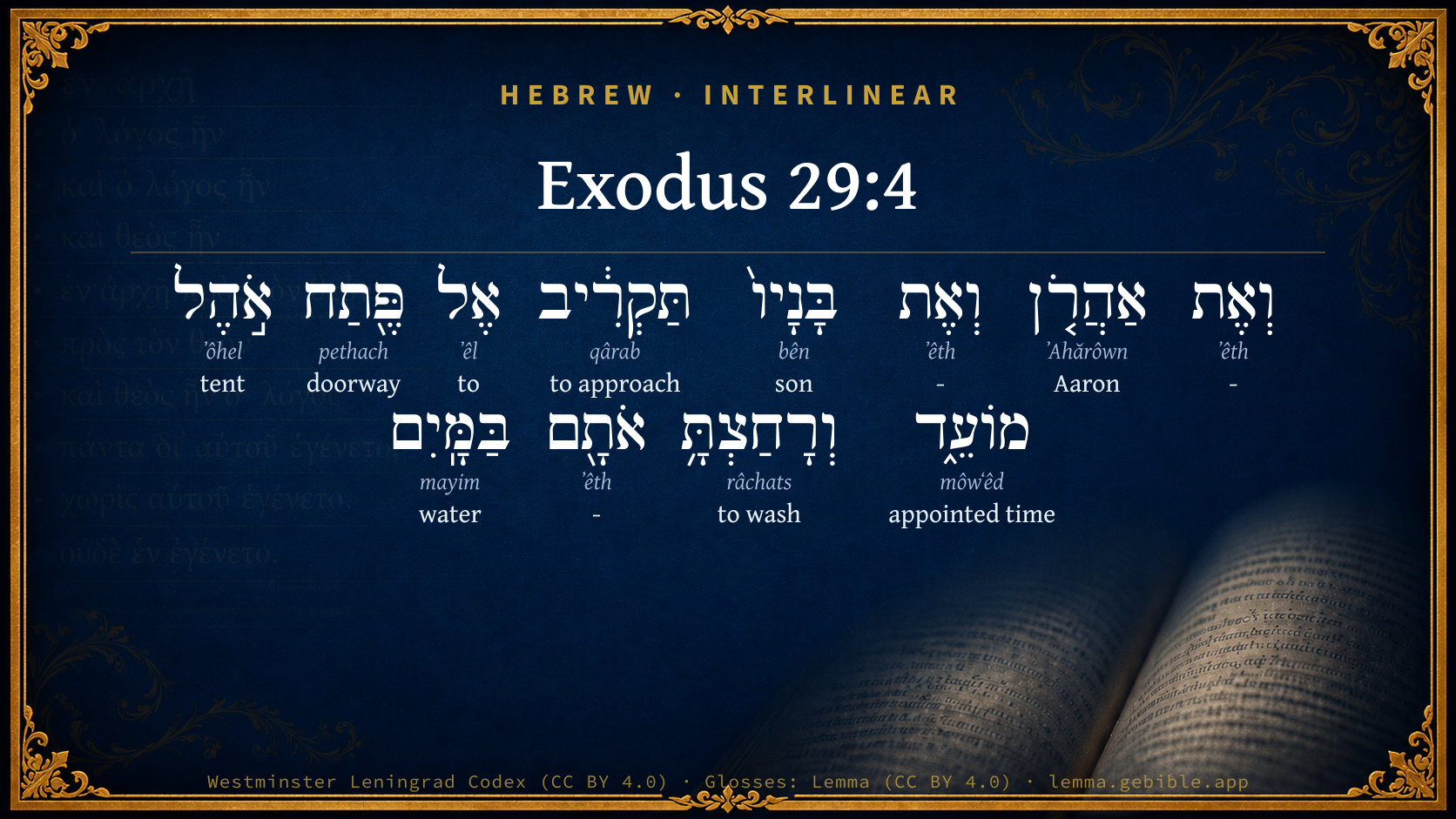
Hebrew (Westminster Leningrad Codex) Exodus 29:4 appears in the Hebrew Old Testament. The text above is from the Westminster Leningrad Codex. Each word links to its Strong’s number, a concise gloss, and parsing drawn from the Open Scriptures Hebrew Bible morphology. Click any word for its full Brown-Driver-Briggs (BDB) entry.
Download image
Cite this verse

Exodus 29:4 (World English Bible). Public Domain. Lemma interlinear Bible study tool, https://lemma.gebible.app/v/exodus/29/4.

Show BibTeX & RIS
BibTeX
RIS
English Translation
You shall bring Aaron and his sons to the door of the tent of meeting, and shall wash them with water.
World English Bible · Public Domain
Download a study sheet

One document with this verse’s original text, its word-by-word gloss line, the meaning frame, cross-references with their text, attributed commentary, and full source and license credits — printable, and it pastes into notes with its structure intact.

This verse Autodidact and up

Study sheet (.html) Plain text (.txt)

A passage Seminary Student

Up to 50 verses in one chapter. A passage sheet keeps up to 6 commentary sources and 12 cross-references per verse, in the order this page ranks them, and says so on the sheet whenever that leaves anything out. Ask for a single verse and you get the Autodidact verse sheet above.

Everything on this page stays free to read, with no account — the sheet is a download of what is already on screen, not access to it.

Want to remove ads? Support Godless Engineer
Compare translations 3

The same verse in 3 English versions, stacked beneath the original-language interlinear above. Click any original word for its lexicon entry.

Each is an independent rendering of the whole verse — the interlinear is not word-aligned to these translations.

Highlighted words mark where these versions differ — a whole-verse word diff, not a word-by-word alignment.

  • World English Bible Public Domain
    You shall bring Aaron and his sons to the door of the tent of meeting, and shall wash them with water.
  • King James Version Public Domain
    And Aaron and his sons thou shalt bring unto the door of the tabernacle of the congregation, and shalt wash them with water.
  • unfoldingWord Literal Text CC BY-SA 4.0
    And you shall bring Aaron and his sons near to the entrance of the tent of meeting. And you shall wash them with water.

unfoldingWord Literal Text — © unfoldingWord, licensed CC BY-SA 4.0. Word-aligned USFM3 via Door43 (git.door43.org/unfoldingWord/en_ult).

Versions to compare (up to 4)

3 of 4 selected

Show all 18 translations

Every available English version of this verse, each an independent rendering of the whole verse.

  • World English Bible Public Domain
    You shall bring Aaron and his sons to the door of the tent of meeting, and shall wash them with water.
  • Berean Standard Bible Public Domain
    Then present Aaron and his sons at the entrance to the Tent of Meeting and wash them with water.
  • Majority Standard Bible Public Domain
    Then present Aaron and his sons at the entrance to the Tent of Meeting and wash them with water.
  • King James Version Public Domain
    And Aaron and his sons thou shalt bring unto the door of the tabernacle of the congregation, and shalt wash them with water.
  • American Standard Version (1901) Public Domain
    And Aaron and his sons thou shalt bring unto the door of the tent of meeting, and shalt wash them with water.
  • Revised Version (1885) Public Domain
    And Aaron and his sons thou shalt bring unto the door of the tent of meeting, and shalt wash them with water.
  • Geneva Bible (1599) Public Domain
    And shalt bring Aaron and his sonnes vnto the doore of the Tabernacle of the Congregation, and wash them with water.
  • Douay-Rheims (1899) Public Domain
    And thou shalt bring Aaron and his sons to the door of the tabernacle of the testimony. And when thou hast washed the father and his sons with water,
  • Young's Literal Translation Public Domain
    `And Aaron and his sons thou dost bring near unto the opening of the tent of meeting, and hast bathed them with water;
  • Literal Standard Version CC BY-SA 4.0
    And you bring Aaron and his sons near to the opening of the Tent of Meeting, and have bathed them with water;
  • Unlocked Literal Bible CC BY-SA 4.0
    You must present Aaron and his sons at the entrance to the tent of meeting. You must wash Aaron and his sons in water.
  • unfoldingWord Literal Text CC BY-SA 4.0
    And you shall bring Aaron and his sons near to the entrance of the tent of meeting. And you shall wash them with water.
  • Darby Bible Public Domain
    And Aaron and his sons thou shalt bring near the entrance of the tent of meeting, and shalt bathe them with water.
  • World Messianic Bible Public Domain
    You shall bring Aaron and his sons to the door of the Tent of Meeting, and shall wash them with water.
  • Webster's Bible Public Domain
    And Aaron and his sons thou shalt bring to the door of the tabernacle of the congregation, and shalt wash them with water.
  • Free Bible Version CC BY-SA 4.0
    Then bring Aaron and his sons to the entrance of the Tent of Meeting, and wash them with water.
  • Bible in Basic English Public Domain
    And let Aaron and his sons come to the door of the Tent of meeting, and there let them be washed with water.
  • JPS Tanakh (1917) Public Domain
    And Aaron and his sons thou shalt bring unto the door of the tent of meeting, and shalt wash them with water.

Literal Standard Version (2020), Covenant Press — licensed CC BY-SA 4.0. Text via the HelloAO Bible API (eBible.org). Unlocked Literal Bible (unfoldingWord) — licensed CC BY-SA 4.0. Text via the HelloAO Bible API (eBible.org). unfoldingWord Literal Text — © unfoldingWord, licensed CC BY-SA 4.0. Word-aligned USFM3 via Door43 (git.door43.org/unfoldingWord/en_ult). Free Bible Version, Dr. Jonathan Gallagher — licensed CC BY-SA 4.0. Text via the HelloAO Bible API (eBible.org).

Word by word

More ways to search: Search by grammar → Find every occurrence → Compare this word →

Practice this passage: Drill this verse → Learn its vocabulary →

וְרָחַצְתָּ֥
râchats
H7364
“and · to wash”
Conjunction + Verb, Qal, Sequential Perfect, 2nd Person, Masculine, Singular
Part of Speech
Conjunction + Verb
Stem
Qal
Form
Sequential Perfect
Person
2nd Person
Gender
Masculine
Number
Singular
Full BDB Definition

Origin: a primitive root

TWOT: 2150

to wash, wash off, wash away, bathe - (Qal) - to wash, wash off, wash away - to wash, bathe (oneself) - (Pual) to be washed - (Hithpael) to wash oneself
  1. וְאֶת ʼêth H853 “and · -” Conjunction + Particle, Direct Object
  2. אַהֲרֹ֤ן ʼAhărôwn H175 “Aaron” Noun, Proper
  3. וְאֶת ʼêth H853 “and · -” Conjunction + Particle, Direct Object
  4. בָּנָיו֙ bên H1121 “sons · his” Noun, Common, Masculine, Plural, Construct + Suffix, Personal, 3rd Person, Masculine, Singular
  5. תַּקְרִ֔יב qârab H7126 “to approach” Verb, Hiphil, Imperfect, 2nd Person, Masculine, Singular
  6. אֶל ʼêl H413 “to” Preposition
  7. פֶּ֖תַח pethach H6607 “doorway of” Noun, Common, Masculine, Singular, Construct
  8. אֹ֣הֶל ʼôhel H168 “tent of” Noun, Common, Masculine, Singular, Construct
  9. מוֹעֵ֑ד môwʻêd H4150 “appointed time” Noun, Common, Masculine, Singular, Absolute
  10. אֹתָ֖ם ʼêth H853 “- · them” Particle, Direct Object + Suffix, Personal, 3rd Person, Masculine, Plural
  11. בַּמָּֽיִם mayim H4325 “in/at the · water(s)” Preposition, Determined + Noun, Common, Masculine, Plural, Absolute

About this verse

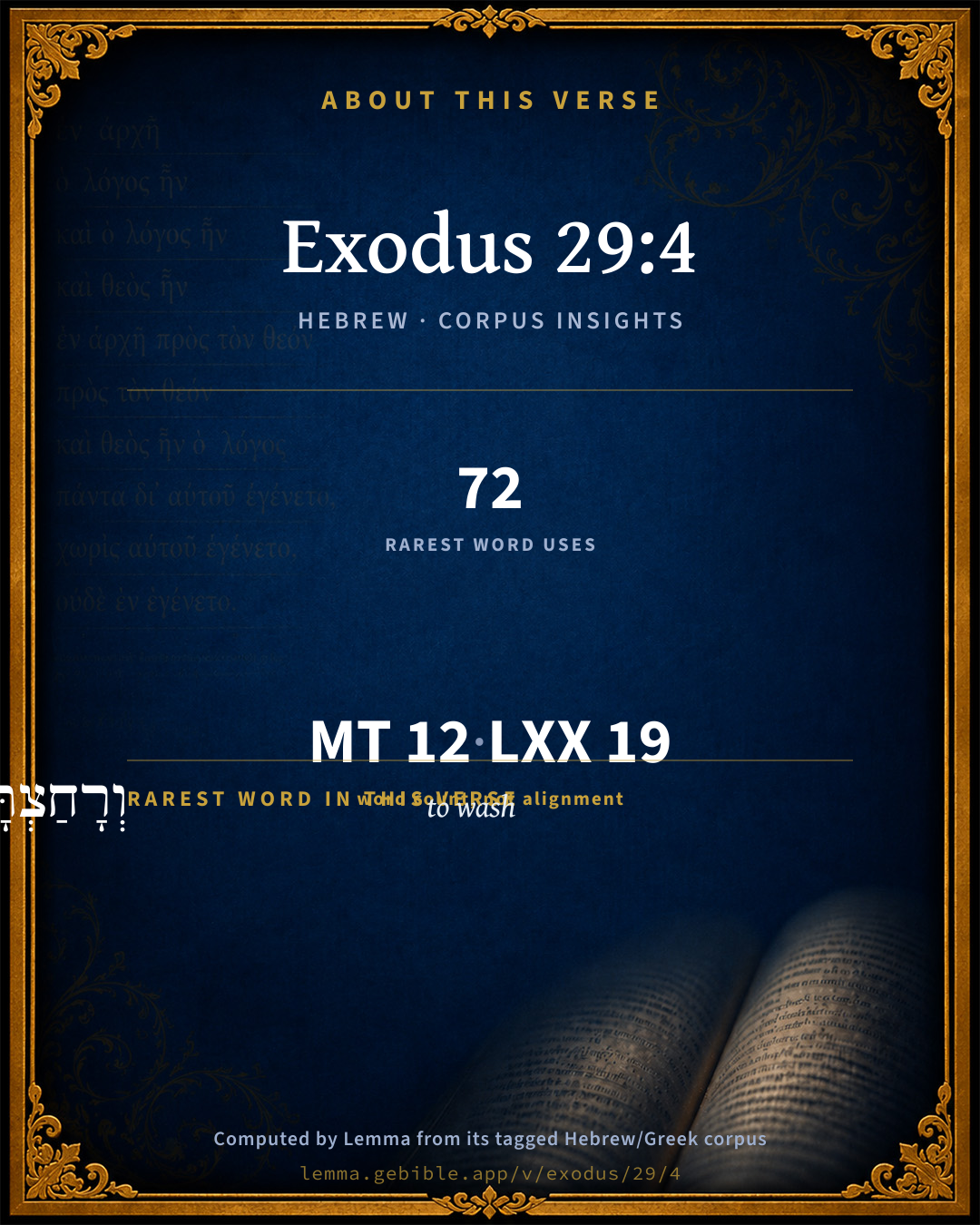
These counts appear in no published source. They are computed here, from the morphology-tagged text and Lemma’s own curated glosses. What Lemma adds →

12
words
10
distinct lemmas
Pentateuch
section

Grammatical profile

  • 2 verbs
  • 6 nouns
  • 1 preposition
  • 3 particles

Verb forms

  • תַּקְרִ֔יב Hiphil · Imperfect
  • וְרָחַצְתָּ֥ Qal · Sequential Perfect

Hebrew & Septuagint length

In English translation the verse runs 21 words from the Hebrew and 23 from the Septuagint (LXX English) — closely comparable.

A rough comparison of the two English renderings, which tokenize alike — not a word-level alignment.

Word counts can differ between the Hebrew and the Greek without any difference in meaning — e.g. the Hebrew direct-object marker אֵת has no separate Greek word, and Greek often adds the article ὁ.

In the original languages it is 12 Hebrew tokens and 19 Greek tokens — but the two are counted differently (Hebrew bundles its prefixes and suffixes into one token; the Greek is in lemma form), so that isn’t a like-for-like length.

Cross-references

14

Topical passages linked to Exodus 29:4 in the Treasury of Scripture Knowledge — connected by theme and wording, ordered by reader-vote popularity; previews shown in the World English Bible.

  • Exodus 40:12 You shall bring Aaron and his sons to the door of the tent of meeting, and shall wash them with water.
  • Hebrews 10:22 let's draw near with a true heart in fullness of faith, having our hearts sprinkled from an evil conscience, and having our body washed with pure water,
  • Exodus 26:36 "You shall make a screen for the door of the Tent, of blue, and purple, and scarlet, and fine twined linen, the work of the embroiderer.
  • Exodus 30:18–21 "You shall also make a basin of brass, and the base of it of brass, in which to wash. You shall put it between the tent of meeting and the altar, and you shall put water in it.
  • Exodus 40:28 He put up the screen of the door to the tent.
  • Leviticus 8:3–6 and assemble all the congregation at the door of the Tent of Meeting."
  • Leviticus 14:8 "He who is to be cleansed shall wash his clothes, and shave off all his hair, and bathe himself in water; and he shall be clean. After that he shall come into the camp, but shall dwell outside his tent seven days.
  • Deuteronomy 23:11 but it shall be, when evening comes on, he shall bathe himself in water; and when the sun is down, he shall come within the camp.
  • Ezekiel 36:25 I will sprinkle clean water on you, and you shall be clean: from all your filthiness, and from all your idols, will I cleanse you.
  • John 13:8–10 Peter said to him, "You will never wash my feet!" Jesus answered him, "If I don't wash you, you have no part with me."
  • Ephesians 5:26 that he might sanctify it, having cleansed it by the washing of water with the word,
  • Titus 3:5 not by works of righteousness, which we did ourselves, but according to his mercy, he saved us, through the washing of regeneration and renewing by the Holy Spirit,
  • 1 Peter 3:21 This is a symbol of baptism, which now saves you-- not the putting away of the filth of the flesh, but the answer of a good conscience toward God, through the resurrection of Jesus Christ,
  • Revelation 1:5–6 and from Jesus Christ, the faithful witness, the firstborn of the dead, and the ruler of the kings of the earth. To him who loves us, and washed us from our sins by his blood;

Cross-references courtesy of OpenBible.info (CC BY 4.0).

Hebrew and Greek witnesses Masoretic Hebrew ↔ Greek Septuagint

The same verse in the two great witnesses to the Old Testament, shown verse-for-verse.

These are two independent witnesses, not word-aligned to each other, and the Septuagint is shown in lemma (dictionary) form.

Hebrew Exodus 29:4 Masoretic · Westminster Leningrad Codex

וְאֶת אַהֲרֹ֤ן וְאֶת בָּנָיו֙ תַּקְרִ֔יב אֶל פֶּ֖תַח אֹ֣הֶל מוֹעֵ֑ד וְרָחַצְתָּ֥ אֹתָ֖ם בַּמָּֽיִם

You shall bring Aaron and his sons to the door of the tent of meeting, and shall wash them with water.

World English Bible · Public Domain

Greek LXX Exodus 29:4 Septuagint · lemma form

καί ααρων καί ὁ υἱός αὐτός προςἄγω ἐπί ὁ θύρα ὁ σκηνή ὁ μαρτύριον καί λούω αὐτός ἐν ὕδωρ

And you shall bring Aaron and his sons to the doors of the tabernacle of testimony, and you shall wash them with water.

LXX2012 (modern English Septuagint) · Public Domain

Hebrew: Westminster Leningrad Codex (CC BY 4.0). Greek: Septuagint (public domain); English from LXX2012 (modern English Septuagint) (Public Domain). How the Septuagint differs from the Hebrew →

Targum (Aramaic paraphrase)

2

The Targum is the ancient Jewish Aramaic paraphrase of the Hebrew Scriptures — an interpretive translation, not the Hebrew text itself. Onkelos (literal) and Pseudo-Jonathan (expansive) render the Torah, and Jonathan the Prophets. Coverage is partial: where no permissively-licensed English translation exists for a verse, only the Aramaic is shown. This is verse-level text, not a word-by-word alignment to the Hebrew.

  1. Targum Onkelos Torah (Genesis–Deuteronomy)
    וְיָת אַהֲרֹן וְיָת בְּנוֹהִי תְּקָרֵב לִתְרַע מַשְׁכַּן זִמְנָא וְתַסְחֵי יָתְהוֹן בְּמַיָא:

    (no public-domain English translation for this verse)

    Targum Onkelos — Aramaic: “Onkelos Genesis” (public domain); “Onkelos Exodus” (public domain); “Onkelos Leviticus” (public domain); “Onkelos Numbers” (public domain); “Onkelos Deuteronomy” (public domain). English: “Sefaria Community Translation” (CC0 1.0 (public-domain dedication)); “J.W. Etheridge. The Targums of Onkelos and Jonathan Ben Uzziel on the Pentateuch. London: Longmans, Green, 1862” (public domain). Text via Sefaria.

  2. Targum Pseudo-Jonathan Torah (Genesis–Deuteronomy)
    וְיַת אַהֲרן וְיַת בְּנוֹי תִּקְרַב לִתְרַע מַשְׁכַּן זִמְנָא וְתִּטְבּוֹל יַתְהוֹן בְּאַרְבְּעִין סְאִין דְּמַיָין חַיָין

    And Aharon and his two sons thou shalt bring near to the door of the tabernacle of testimony, and wash them, in four measures of living water.

    Targum Pseudo-Jonathan — Aramaic: “Targum Jonathan on Genesis” (public domain); “Targum Jonathan on Exodus” (public domain); “Targum Jonathan on Leviticus” (public domain); “Targum Jonathan on Numbers” (public domain); “Targum Jonathan on Deuteronomy” (public domain). English: “The Targum of Jonathan ben Uzziel, trans. J. W. Etheridge, London, 1862” (public domain). Text via Sefaria.

Commentary

Notes on Exodus 29:4 from classic Christian and Jewish commentators (each source and its license shown beneath its notes). The classic Christian expositions comment on the surrounding passage and are grouped to its opening verse, so a note may address several verses; the Jewish commentaries on the Tanakh (Rashi and others) are per-verse, so they appear only where the commentator wrote on this verse.

Lemma curates 59 commentaries, every one of them public domain or Creative Commons licensed, each selected and text-cleaned for this edition rather than reprinted as found. About our sources →

Trapp's Complete Commentary

John Trapp

Exo 29:4 And Aaron and his sons thou shalt bring unto the door of the tabernacle of the congregation, and shalt wash them with water.

Ver. 4. Wash them with water.] A type of Christ’s baptism. {Mat 3:13-17}

John Trapp, A Commentary or Exposition upon All the Books of the Old and New Testament (1647–1656) — public domain. Text from a community e-Sword module.

Joseph Benson's Commentary

Exo 29:4. Unto the door of the tabernacle — God was pleased to dwell in the tabernacle, the people attending in the courts, so that the door between the court and the tabernacle was the fittest place for them to be consecrated in who were to mediate between God and man, to stand between both, and, as it were, lay their hands on both. Thou shalt wash them with water — To signify that they must be clean who bear the vessels of the Lord, Psa 50:16; Isa 52:11. Ablution was an ancient rite in all acts of worship, as a proper emblem of sanctifying grace, and internal purity, without which external oblations and services are of little signification before God. As this was the first thing that was done for hallowing the priests, (Leviticus 8.,) it is probable their whole bodies were now washed, in token of the necessity of their being washed from all their sins by pardon and regeneration, and thoroughly renewed in heart and life, that they might begin their services aright: but afterward they were appointed to wash only their hands and their feet before they entered the tabernacle, (Exo 30:19, &c.,) to remind them of those daily imperfections from which even such as are regenerated and created anew have need to be cleansed by a daily application of pardoning mercy, through the blood of atonement. Thus the Lord Jesus, “He that is washed needeth not save to wash his feet, but is clean every whit.”

Joseph Benson's Commentary on the Old and New Testaments (1811–1818) — public domain. Text from a community e-Sword module.

Scofield Reference Notes

C. I. Scofield

Aaron shares in the washing (i.e., symbol of regeneration), Tit 3:5; Joh 3:5; Joh 3:6

(1) as needing it, be in this in contrast with Christ Heb 7:26-28

(2) to typify Christ’s action, who received the baptism of John, not as needing it, but as thus identifying Himself with sinners, and as fulfilling the Aaronic type. As in Aaron’s case, His anointing followed the washing Exo 29:4; Exo 29:7; Mat 3:14-16.

wash Distinguish the washing from the use of the laver.

Exo 30:18-21 This washing typifies regeneration

Tit 3:5 the laver, daily cleansing

1Jn 1:9 See both Joh 13:10.

The Scofield Reference Bible (1917 edition), notes by C. I. Scofield — public domain. Text from a community e-Sword module.

Tyndale Open Study Notes

Tyndale Open Resources

29:4 wash them with water: This act dramatized the truth that no one can live in God’s presence with the filth of sin in their lives (29:21).

Tyndale Open Study Notes — © Tyndale Open Resources, licensed CC BY-SA 4.0. Text via the HelloAO Bible API.

Jamieson, Fausset & Brown

Robert Jamieson, A. R. Fausset & David Brown

Aaron and his sons thou shalt bring unto the door of the tabernacle--as occupying the intermediate space between the court where the people stood, and the dwelling-place of Israel's king, and therefore the fittest spot for the priests being duly prepared for entrance, and the people witnessing the ceremony of inauguration.

wash them with water. And . . . take the garments--The manner in which these parts of the ceremonial were performed is minutely described, and in discovering their symbolical import, which indeed, is sufficiently plain and obvious, we have inspired authority to guide us. It signified the necessity and importance of moral purity or holiness (Isa 52:11; Joh 13:10; Co2 7:1; Pe1 3:21). In like manner, the investiture with the holy garments signified their being clothed with righteousness (Rev 19:8) and equipped as men active and well-prepared for the service of God; the anointing the high priest with oil denoted that he was to be filled with the influences of the Spirit, for the edification and delight of the church (Lev 10:7; Psa 45:7; Isa 61:1; Jo1 2:27), and as he was officially a type of Christ (Heb 7:26; Joh 3:34; also Mat 3:16; Mat 11:29).

Jamieson, Fausset & Brown — Commentary Critical and Explanatory on the Whole Bible (1871) — public domain (CC PDM 1.0). Text via the HelloAO Bible API.

Adam Clarke's Commentary

Verse 4. Thou - shalt wash them] This was done emblematically, to signify that they were to put away all filthiness of the flesh and spirit, and perfect holiness in the fear of God; 2Co 7:1.

Adam Clarke's Commentary on the Bible (1810–1826) — public domain. Text from a community e-Sword/MySword module.

Ellicott's Commentary for English Readers

(4) Aaron and his sons thou shalt bring unto the door . . . —The place of the laver, not yet mentioned, but designed in God’s counsels, was between the brazen altar and the Tabernacle (Exo_30:18), and consequently near the door of the latter. Rabbinical tradition says that it was not placed exactly opposite the door, but a little towards the south side of the court.

And shalt wash them.—This is the first mention in Scripture of a religious ablution. Water is so natural a symbol of purity, and ablution so apt a representative of the purging from sin, that we can feel surprise neither at the widespread use of the symbolism in religions of very different characters, nor at its adoption into the system at this time imposed by Divine Providence upon the Hebrews. As it was to maintain its place even in the Divinely-appointed ceremonial of Christianity, it must have been à fortiori suitable for the earlier and less spiritual dispensation. The widespread employment of it in other religions—e.g., in Egypt (Herod. ii. 37); in Persia (Zendavesta, 8 p. 271. Spiegel’s translation); in Greece (Döllinger, Jew and Gentile, vol. i., p. 220); in Italy (Dict. of Greek and Rom. Antiq., p. 719), and elsewhere—was no argument against its adoption into the Mosaic ceremonial, since the Divine legislation of Sinai was not intended to annul or supersede natural religion, but only to improve and expand it.

A Bible Commentary for English Readers, edited by Charles John Ellicott (1878–1897) — public domain. Text from a community e-Sword module.

The Cambridge Bible for Schools and Colleges

gen. ed. J. J. S. Perowne

4. Washing of Aaron and his ‘sons’ (i.e. the common priests, as distinguished from the high priest); cf. Lev_8:6. This washing extended to the entire person; and was different from the subsequent ordinary washings of the hands and feet before the daily ministrations (Exo_30:19 f.).

The Cambridge Bible for Schools and Colleges (gen. ed. J. J. S. Perowne; Cambridge University Press, 1878–1918) — public domain. Text from a community e-Sword module.

John Gill's Exposition

And Aaron and his sons thou shalt bring unto the door of the tabernacle of the congregation,.... That is, order and direct them to come thither; for it cannot be thought he was to carry them in his arms or on his shoulders, or have them thither by force, whether they would or not; but he was to declare to them that it was the will of the Lord they should appear there:

and shalt wash them with water; out of the laver after mentioned, which stood between the door of the tabernacle of the congregation and the altar: the Targum of Jonathan says, this washing was performed in forty seahs of living or spring water, which was sufficient for the immersion of the whole body, which it is highly probable was the case; and so Jarchi interprets it of the dipping of the whole body, and which seems to have been necessary, upon their entrance on their office, to denote their complete purity and holiness, though afterwards, when they entered on service, they only washed their hands and feet, see Exo 30:18 to which our Lord seems to allude, Joh 13:10 this washing shows what purity and holiness were necessary to the priests of the Lord, and that they ought to be clean that bear the vessels of his house, or minister in his sanctuary, and which were in Christ in their full perfection; and such an high priest became us, who is holy, harmless, and undefiled, and so could offer himself without spot, and was a fit person to take away sin by sacrifice, and to be an advocate for his people: this may also point at his baptism, which he submitted to before he entered on his office in a public manner, and which was performed by immersion; and in this way ought all his priests, his saints, to be washed, as well as with the washing of regeneration, and with the blood of Christ; and which is necessary to their officiating as priests, or drawing nigh to God, and requisite to their communion with God and Christ.

John Gill's Exposition of the Whole Bible (1746–1763) — public domain (CC PDM 1.0). Text via the HelloAO Bible API.

Haydock's Catholic Bible Commentary

Washed. The pagans never approached their mysteries, without divers purifications and washing. (Clement of Alexandria, strom. 5.) Exterior cleanliness was designed to signify the purity of the heart, with which we must appear before God. (Calmet) --- It is for this reason we take holy-water, when we go into our chapels, and we wash our fingers before and during Mass. (Haydock)

George Leo Haydock (1774–1849), Haydock's Catholic Family Bible and Commentary, 1859 edition — public domain. Excludes Psalms (Douay-Rheims chapter numbering differs from Protestant) and Deuterocanonical books (Catholic canon only).

Matthew Poole's English Annotations

Taken out of that laver, Exo 30:18. This signified the universal pollution of all men, and the absolute need they have of washing, especially when they are to draw nigh to God. And this outward washing was only typical of their spiritual washing by the blood and Spirit of Christ in order to their acceptance with God.

Matthew Poole's English Annotations on the Holy Bible (1683–1685) — public domain. Text from a community e-Sword/MySword module.

Whedon's Commentary on the Bible

Daniel D. Whedon

4. Wash them with water — Comp. Lev_8:6; Lev_16:4. Cleanness, purity, symbolizing holiness, was important to be observed, and is made emphatic in this ceremony.

Daniel D. Whedon (gen. ed.), Commentary on the Old and New Testaments (1874–1909) — public domain. Text from a community e-Sword module.

The Pulpit Commentary

The Ablution.

Unto the door of the tabernacle. The great laver was to be placed between the entrance to the tabernacle and the altar of burnt-offering. (Exo_30:18) It was to this probably that Aaron and his sons were to be brought. Its main purpose was to be a lustral vessel, placed ready for the various ablutions which the law required (ib, 19-21). Thou .... shalt wash them with water. Ablutions were an important part of the ceremonial of almost all ancient religions. In Egypt, the priests were compelled to wash themselves from head to foot in cold water twice every day, and twice every night (Heb 2:37). In the religion of Zoroaster frequent washing with water was prescribed for many kinds of impurity (Zendavesta, 8. p. 271, et seq.). The Greeks were particularly addicted to ceremonies of which ablution formed a part; and it is to Rome that we are indebted both for the word and for the idea of "lustration." It is a true instinct which has taught men the analogy between physical and moral purity, and led them to typify the removal of spiritual, by the cleansing from physical, defilement. The religion given at Sinai set a stamp of approval in many points on what may be called "the religion of nature;" and among them on this. Ablutions were required of the priests, not only at consecration, but every time that they entered the tabernacle, or sacrificed on the altar of burnt-offering. (Exo_30:20) Washing was a main feature in the cleansing of leprosy. (Lev_13:54, Lev_13:58) and of the leper. (Lev_14:8) It was also employed for the purification of many minor defilements. (Lev_11:25 Lev_15:5 Lev_17:15, etc.) At what date it first came into use in the admission of proselytes is uncertain. Whether the washing of consecration extended to the whole body, or was limited to the hands and feet, is also a point on which critics have disagreed, but one of no great importance. (see Joh_13:9, Joh_13:10)

The Pulpit Commentary (1880–1919), ed. H.D.M. Spence-Jones & Joseph S. Exell — public domain. Text from a community e-Sword module.

John Wesley's Explanatory Notes

They were to be consecrated at the door of the tabernacle - God was pleased to dwell in the tabernacle, the people attending in the courts, so that the door between the court and the tabernacle was the fittest place for them to be consecrated in, who were to mediate between God and man, and to stand between both, and lay their hands (as it were) upon both. Here they were to be washed, signifying that they must be clean who bear the vessels of the Lord, Isaiah lii, 11. And they were to be clothed with the holy garments, to signify that it was not sufficient for them to put away the pollutions of sin, but they must put on the graces of the Spirit, be clothed with righteousness, Psalm 1xxxii, 9. They must be girded, as men prepared and strengthened for their work; and they must be robed and crowned, as men that counted their work and office their true honour.

John Wesley, Explanatory Notes Upon the Whole Bible (1754–1765) — public domain. Text via the GEBible commentary corpus.

Rashi

Rabbi Shlomo Yitzchaki (Rashi)

ורחצת AND THOU SHALT WASH [THEM] — This signifies the immersion of the entire body (cf. Targum Jonathan).

Rashi on the Tanakh — English translations: “The Judaica Press complete Tanach with Rashi, translated by A. J. Rosenberg” (CC BY 4.0); “Pentateuch with Rashi's commentary by M. Rosenbaum and A.M. Silbermann, 1929-1934” (public domain); “The Metsudah Tanach series, Lakewood, N.J” (CC BY 4.0); and “The Book of Joshua, Metsudah Publications, 1997” (CC BY 4.0). Text via Sefaria.

Lesson kit

Teaching starters — assembled from the data on this page, not authored interpretation. Every prompt links to the verse data it draws on. Edit before teaching.

Exodus, in the Pentateuch, opens this verse with 12 words (10 distinct Hebrew lemmas). Its most distinctive word is râchats (“to wash”). A historical commentator’s framing appears above. Read the whole chapter for the surrounding context.

Discussion questions

  1. How does “to wash” (râchats) shape what this verse is saying?
  2. How does Exodus 40:12, which shares this passage’s theme, read alongside this verse?
  3. The translations on this page render this verse differently — a whole-verse word diff, not a word-by-word alignment. What might account for the different wordings?
  4. «תַּקְרִ֔יב» is a Hiphil Imperfect verb. How does that grammatical form shape the action described?
  5. Compare how Trapp's Complete Commentary and Joseph Benson's Commentary read this verse. Where do they agree or differ?

Things to notice

Reading settings

Reading text

Shown beneath each verse's original-language words.

Old Testament
Old Testament edition

Read the OT as the Masoretic Hebrew (MT) or the Greek Septuagint (LXX).

English shown for the Greek Septuagint (in the Hebrew ↔ Greek comparison).

Comparing translations? Open the Compare panel on any verse page to stack up to four side by side.