Numbers 16:19

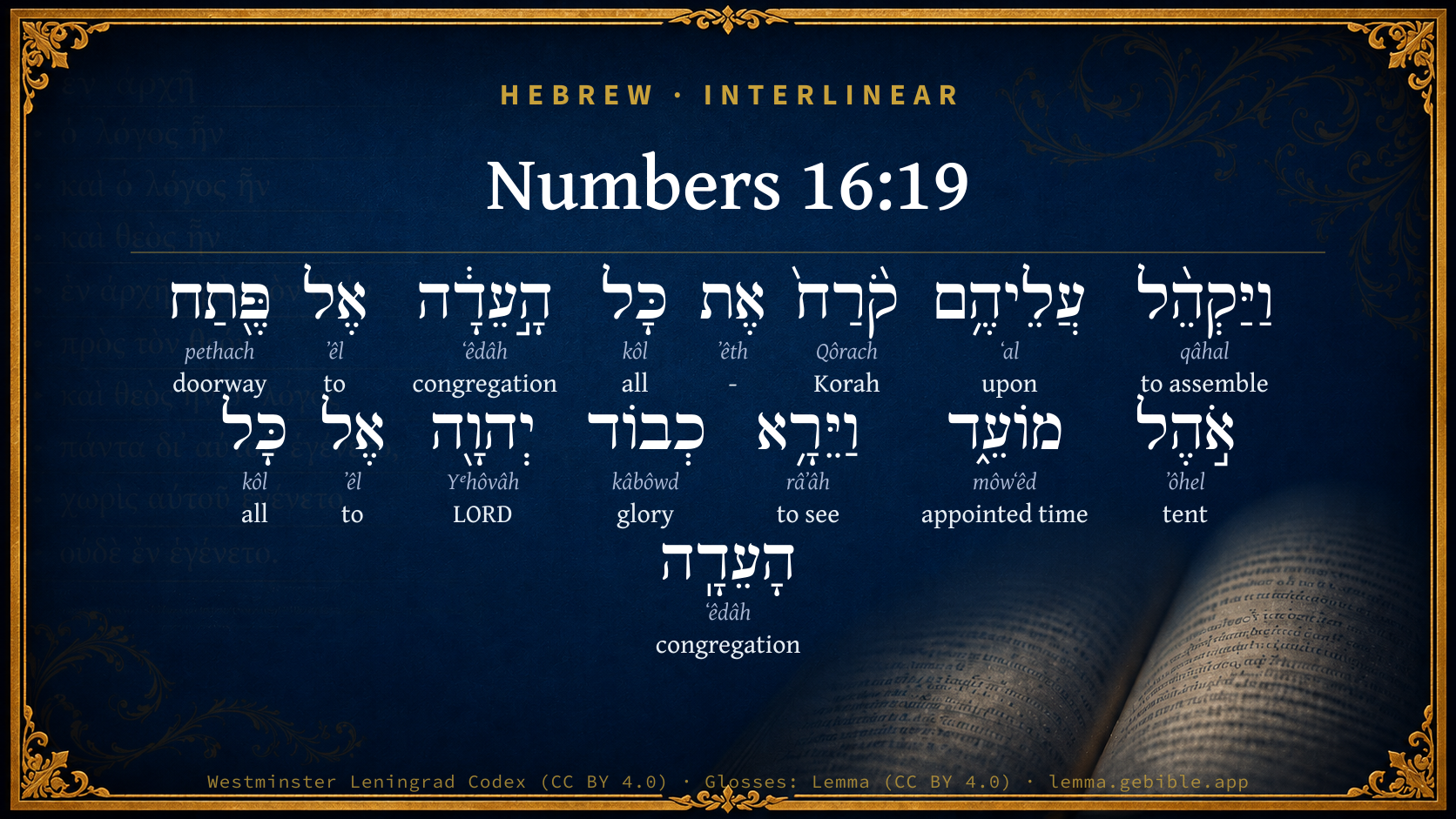
Hebrew (Westminster Leningrad Codex) Numbers 16:19 appears in the Hebrew Old Testament. The text above is from the Westminster Leningrad Codex. Each word links to its Strong’s number, a concise gloss, and parsing drawn from the Open Scriptures Hebrew Bible morphology. Click any word for its full Brown-Driver-Briggs (BDB) entry.
Download image
Cite this verse

Numbers 16:19 (World English Bible). Public Domain. Lemma interlinear Bible study tool, https://lemma.gebible.app/v/numbers/16/19.

Show BibTeX & RIS
BibTeX
RIS
English Translation
Korah assembled all the congregation against them to the door of the tent of meeting: and the glory of Yahweh appeared to all the congregation.
World English Bible · Public Domain
Download a study sheet

One document with this verse’s original text, its word-by-word gloss line, the meaning frame, cross-references with their text, attributed commentary, and full source and license credits — printable, and it pastes into notes with its structure intact.

This verse Autodidact and up

Study sheet (.html) Plain text (.txt)

A passage Seminary Student

Up to 50 verses in one chapter. A passage sheet keeps up to 6 commentary sources and 12 cross-references per verse, in the order this page ranks them, and says so on the sheet whenever that leaves anything out. Ask for a single verse and you get the Autodidact verse sheet above.

Everything on this page stays free to read, with no account — the sheet is a download of what is already on screen, not access to it.

Want to remove ads? Support Godless Engineer
Compare translations 3

The same verse in 3 English versions, stacked beneath the original-language interlinear above. Click any original word for its lexicon entry.

Each is an independent rendering of the whole verse — the interlinear is not word-aligned to these translations.

Highlighted words mark where these versions differ — a whole-verse word diff, not a word-by-word alignment.

  • World English Bible Public Domain
    Korah assembled all the congregation against them to the door of the tent of meeting: and the glory of Yahweh appeared to all the congregation.
  • King James Version Public Domain
    And Korah gathered all the congregation against them unto the door of the tabernacle of the congregation: and the glory of the LORD appeared unto all the congregation.
  • unfoldingWord Literal Text CC BY-SA 4.0
    And Korah assembled all the congregation against them to the opening of the tent of meeting, and the glory of Yahweh appeared to all the congregation.

unfoldingWord Literal Text — © unfoldingWord, licensed CC BY-SA 4.0. Word-aligned USFM3 via Door43 (git.door43.org/unfoldingWord/en_ult).

Versions to compare (up to 4)

3 of 4 selected

Show all 18 translations

Every available English version of this verse, each an independent rendering of the whole verse.

  • World English Bible Public Domain
    Korah assembled all the congregation against them to the door of the tent of meeting: and the glory of Yahweh appeared to all the congregation.
  • Berean Standard Bible Public Domain
    When Korah had gathered his whole assembly against them at the entrance to the Tent of Meeting, the glory of the LORD appeared to the whole congregation.
  • Majority Standard Bible Public Domain
    When Korah had gathered his whole assembly against them at the entrance to the Tent of Meeting, the glory of the LORD appeared to the whole congregation.
  • King James Version Public Domain
    And Korah gathered all the congregation against them unto the door of the tabernacle of the congregation: and the glory of the LORD appeared unto all the congregation.
  • American Standard Version (1901) Public Domain
    And Korah assembled all the congregation against them unto the door of the tent of meeting: and the glory of Jehovah appeared unto all the congregation.
  • Revised Version (1885) Public Domain
    And Korah assembled all the congregation against them unto the door of the tent of meeting: and the glory of the LORD appeared unto all the congregation.
  • Geneva Bible (1599) Public Domain
    And Korah gathered all the multitude against them vnto the doore of the Tabernacle of the Congregation: then the glorie of the Lord appeared vnto all the Congregation.
  • Douay-Rheims (1899) Public Domain
    And had drawn up all the multitude against them to the door of the tabernacle, the glory of the Lord appeared to them all.
  • Young's Literal Translation Public Domain
    And Korah assembleth against them all the company unto the opening of the tent of meeting, and the honour of Jehovah is seen by all the company.
  • Literal Standard Version CC BY-SA 4.0
    And Korah assembles all the congregation against them at the opening of the Tent of Meeting, and the glory of YHWH is seen by all the congregation.
  • Unlocked Literal Bible CC BY-SA 4.0
    Korah assembled all the community against Moses and Aaron at the entrance to the tent of meeting, and Yahweh's glory appeared to all the community.
  • unfoldingWord Literal Text CC BY-SA 4.0
    And Korah assembled all the congregation against them to the opening of the tent of meeting, and the glory of Yahweh appeared to all the congregation.
  • Darby Bible Public Domain
    And Korah gathered the whole assembly against them to the entrance of the tent of meeting. And the glory of Jehovah appeared to all the assembly.
  • World Messianic Bible Public Domain
    Korah assembled all the congregation opposite them to the door of the Tent of Meeting. The LORD’s glory appeared to all the congregation.
  • Webster's Bible Public Domain
    And Korah gathered all the congregation against them to the door of the tabernacle of the congregation: and the glory of the LORD appeared to all the congregation.
  • Free Bible Version CC BY-SA 4.0
    When Korah had gathered all his rebellious group at the entrance to the Tent of Meeting, the Lord's glory appeared before the whole congregation.
  • Bible in Basic English Public Domain
    And Korah made all the people come together against them to the door of the Tent of meeting: and the glory of the Lord was seen by all the people.
  • JPS Tanakh (1917) Public Domain
    And Korah assembled all the congregation against them unto the door of the tent of meeting; and the glory of the LORD appeared unto all the congregation.

Literal Standard Version (2020), Covenant Press — licensed CC BY-SA 4.0. Text via the HelloAO Bible API (eBible.org). Unlocked Literal Bible (unfoldingWord) — licensed CC BY-SA 4.0. Text via the HelloAO Bible API (eBible.org). unfoldingWord Literal Text — © unfoldingWord, licensed CC BY-SA 4.0. Word-aligned USFM3 via Door43 (git.door43.org/unfoldingWord/en_ult). Free Bible Version, Dr. Jonathan Gallagher — licensed CC BY-SA 4.0. Text via the HelloAO Bible API (eBible.org).

Word by word

More ways to search: Search by grammar → Find every occurrence → Compare this word →

Practice this passage: Drill this verse → Learn its vocabulary →

קֹ֨רַח֙
Qôrach
H7141
“Korah”
Noun, Proper
Part of Speech
Noun
Type
Proper
Full BDB Definition

Origin: from H7139

TWOT: None

Korah = "bald" - son of Izhar, grandson of Kohath, great grandson of Levi and leader of the rebellion of the Israelites against Moses and Aaron while in the wilderness; punished and died by an earthquake and flames of fire - the 3rd son of Esau by Aholibamah and one of the dukes of Edom - son of Eliphaz by Adah, duke of Edom, and nephew of 1 - one of the 'sons' of Hebron
  1. וַיַּקְהֵ֨ל qâhal H6950 “and · to assemble” Conjunction + Verb, Hiphil, Sequential Imperfect, 3rd Person, Masculine, Singular
  2. עֲלֵיהֶ֥ם ʻal H5921 “upon · them” Preposition + Suffix, Personal, 3rd Person, Masculine, Plural
  3. אֶת ʼêth H853 “-” Particle, Direct Object
  4. כָּל kôl H3605 “all of” Noun, Common, Masculine, Singular, Construct
  5. הָ֣עֵדָ֔ה ʻêdâh H5712 “the · congregation” Particle, Definite Article + Noun, Common, Feminine, Singular, Absolute
  6. אֶל ʼêl H413 “to” Preposition
  7. פֶּ֖תַח pethach H6607 “doorway of” Noun, Common, Masculine, Singular, Construct
  8. אֹ֣הֶל ʼôhel H168 “tent of” Noun, Common, Masculine, Singular, Construct
  9. מוֹעֵ֑ד môwʻêd H4150 “appointed time” Noun, Common, Masculine, Singular, Absolute
  10. וַיֵּרָ֥א râʼâh H7200 “and · to see” Conjunction + Verb, Niphal, Sequential Imperfect, 3rd Person, Masculine, Singular
  11. כְבוֹד kâbôwd H3519 “glory of” Noun, Common, Both, Singular, Construct
  12. יְהוָ֖ה Yᵉhôvâh H3068 “LORD” Noun, Proper
  13. אֶל ʼêl H413 “to” Preposition
  14. כָּל kôl H3605 “all of” Noun, Common, Masculine, Singular, Construct
  15. הָעֵדָֽה ʻêdâh H5712 “the · congregation” Particle, Definite Article + Noun, Common, Feminine, Singular, Absolute

About this verse

These counts appear in no published source. They are computed here, from the morphology-tagged text and Lemma’s own curated glosses. What Lemma adds →

16
words
13
distinct lemmas
Pentateuch
section

Shared distinctive vocabulary

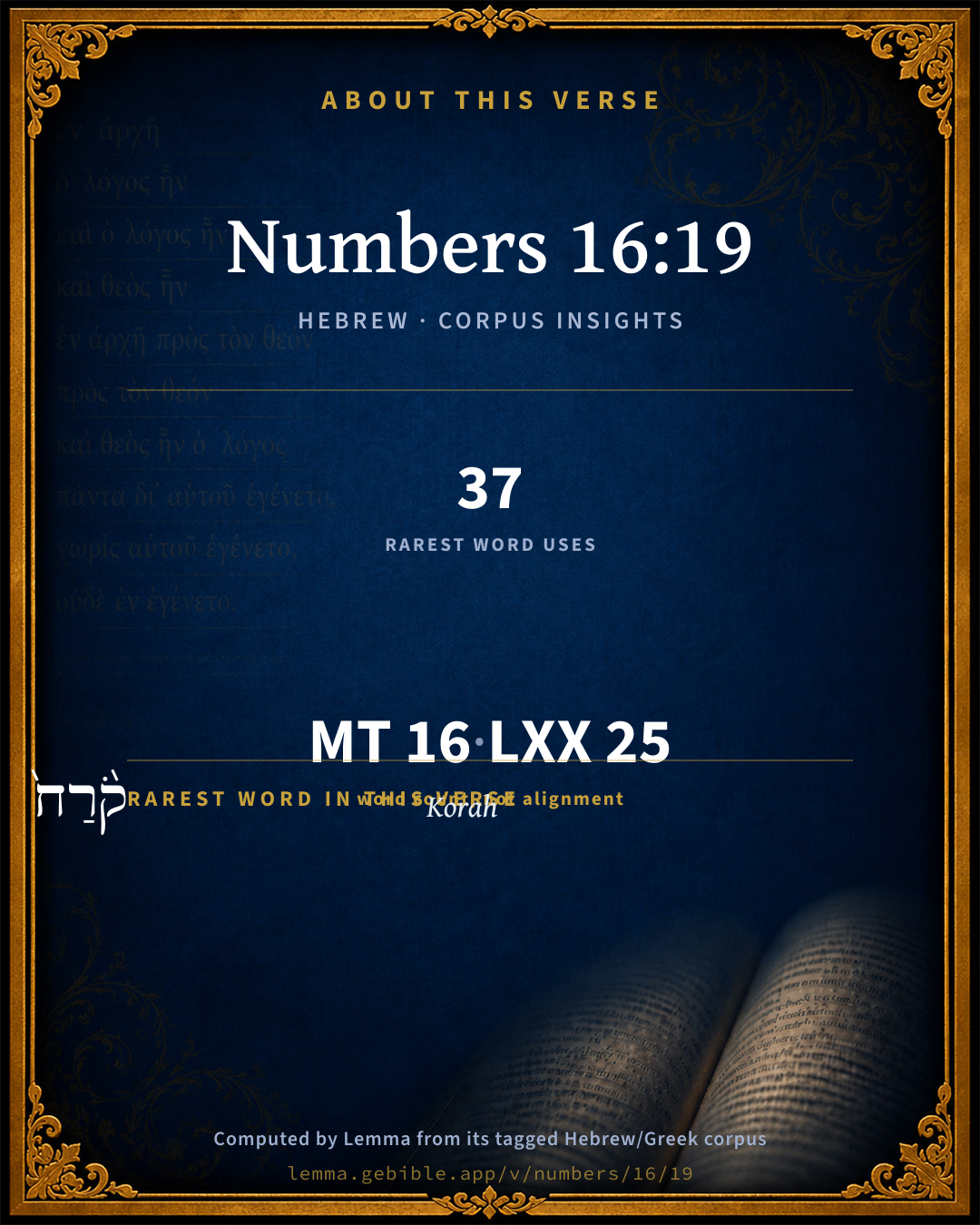
קֹ֨רַח֙ Korah H7141 occurs in 37 verses of the Hebrew Bible. Also found in:

Grammatical profile

  • 2 verbs
  • 10 nouns
  • 3 prepositions
  • 1 particle

Verb forms

  • וַיַּקְהֵ֨ל Hiphil · Sequential Imperfect
  • וַיֵּרָ֥א Niphal · Sequential Imperfect

Repetition

Words recur within this verse — often emphatic in Hebrew:

  • כָּל all H3605 ×2
  • הָ֣עֵדָ֔ה congregation H5712 ×2
  • אֶל to H413 ×2

Hebrew & Septuagint length

In English translation the verse runs 25 words from the Hebrew and 28 from the Septuagint (LXX English) — closely comparable.

A rough comparison of the two English renderings, which tokenize alike — not a word-level alignment.

Word counts can differ between the Hebrew and the Greek without any difference in meaning — e.g. the Hebrew direct-object marker אֵת has no separate Greek word, and Greek often adds the article ὁ.

In the original languages it is 16 Hebrew tokens and 25 Greek tokens — but the two are counted differently (Hebrew bundles its prefixes and suffixes into one token; the Greek is in lemma form), so that isn’t a like-for-like length.

Cross-references

9

Topical passages linked to Numbers 16:19 in the Treasury of Scripture Knowledge — connected by theme and wording, ordered by reader-vote popularity; previews shown in the World English Bible.

  • Numbers 14:10 But all the congregation bade stone them with stones. The glory of Yahweh appeared in the tent of meeting to all the children of Israel.
  • Numbers 16:42 It happened, when the congregation was assembled against Moses and against Aaron, that they looked toward the tent of meeting: and, behold, the cloud covered it, and the glory of Yahweh appeared.
  • Exodus 16:7 and in the morning, then you shall see the glory of Yahweh; because he hears your murmurings against Yahweh. Who are we, that you murmur against us?"
  • Leviticus 9:23 Moses and Aaron went into the Tent of Meeting, and came out, and blessed the people: and the glory of Yahweh appeared to all the people.
  • Exodus 16:10 It happened, as Aaron spoke to the whole congregation of the children of Israel, that they looked toward the wilderness, and, behold, the glory of Yahweh appeared in the cloud.
  • Leviticus 9:6 Moses said, "This is the thing which Yahweh commanded that you should do: and the glory of Yahweh shall appear to you."
  • Numbers 12:5 Yahweh came down in a pillar of cloud, and stood at the door of the Tent, and called Aaron and Miriam; and they both came forth.
  • Numbers 16:1–2 Now Korah, the son of Izhar, the son of Kohath, the son of Levi, with Dathan and Abiram, the sons of Eliab, and On, the son of Peleth, sons of Reuben, took [men]:
  • Numbers 20:6 Moses and Aaron went from the presence of the assembly to the door of the tent of meeting, and fell on their faces: and the glory of Yahweh appeared to them.

Cross-references courtesy of OpenBible.info (CC BY 4.0).

Hebrew and Greek witnesses Masoretic Hebrew ↔ Greek Septuagint

The same verse in the two great witnesses to the Old Testament, shown verse-for-verse.

These are two independent witnesses, not word-aligned to each other, and the Septuagint is shown in lemma (dictionary) form.

Hebrew Numbers 16:19 Masoretic · Westminster Leningrad Codex

וַיַּקְהֵ֨ל עֲלֵיהֶ֥ם קֹ֨רַח֙ אֶת כָּל הָ֣עֵדָ֔ה אֶל פֶּ֖תַח אֹ֣הֶל מוֹעֵ֑ד וַיֵּרָ֥א כְבוֹד יְהוָ֖ה אֶל כָּל הָעֵדָֽה

Korah assembled all the congregation against them to the door of the tent of meeting: and the glory of Yahweh appeared to all the congregation.

World English Bible · Public Domain

Greek LXX Numbers 16:19 Septuagint · lemma form

καί ἐπι συνἵστημι ἐπί αὐτός κορε ὁ πᾶς αὐτός συναγωγή παρά ὁ θύρα ὁ σκηνή ὁ μαρτύριον καί ὁράω ὁ δόξα κύριος πᾶς ὁ συναγωγή

And Core raised up against them all his company by the door of the tabernacle of witness; and the glory of the Lord appeared to all the congregation.

LXX2012 (modern English Septuagint) · Public Domain

Hebrew: Westminster Leningrad Codex (CC BY 4.0). Greek: Septuagint (public domain); English from LXX2012 (modern English Septuagint) (Public Domain). How the Septuagint differs from the Hebrew →

Targum (Aramaic paraphrase)

2

The Targum is the ancient Jewish Aramaic paraphrase of the Hebrew Scriptures — an interpretive translation, not the Hebrew text itself. Onkelos (literal) and Pseudo-Jonathan (expansive) render the Torah, and Jonathan the Prophets. Coverage is partial: where no permissively-licensed English translation exists for a verse, only the Aramaic is shown. This is verse-level text, not a word-by-word alignment to the Hebrew.

  1. Targum Onkelos Torah (Genesis–Deuteronomy)
    וְאַכְנֵשׁ עֲלֵיהוֹן קֹרַח יָת כָּל כְּנִשְׁתָּא לִתְרַע מַשְׁכַּן זִמְנָא וְאִתְגְלֵי יְקָרָא דַיְיָ לְכָל כְּנִשְׁתָּא

    (no public-domain English translation for this verse)

    Targum Onkelos — Aramaic: “Onkelos Genesis” (public domain); “Onkelos Exodus” (public domain); “Onkelos Leviticus” (public domain); “Onkelos Numbers” (public domain); “Onkelos Deuteronomy” (public domain). English: “Sefaria Community Translation” (CC0 1.0 (public-domain dedication)); “J.W. Etheridge. The Targums of Onkelos and Jonathan Ben Uzziel on the Pentateuch. London: Longmans, Green, 1862” (public domain). Text via Sefaria.

  2. Targum Pseudo-Jonathan Torah (Genesis–Deuteronomy)
    וּכְנַשׁ עֲלֵיהוֹן קרַח יַת כָּל כְּנִישְׁתָּא לִתְרַע מַשְׁכַּן זִמְנָא וְאִתְנַטַל בְּעוּתְרֵיהּ דְאַשְׁכַּח תְּרֵין אוֹצְרִין מִן אוֹצְרוֹי דְיוֹסֵף מַלְיָין כְּסַף וּדְהַב וּבְעָא לְמִטְרַד בְּהַהוּא עוּתְרָא יַת משֶׁה וְיַת אַהֲרן מִן עַלְמָא אִילוּלֵי דְאִתְגְלֵי אִיקָרָא דַיְיָ לְכָל כְּנִישְׁתָּא

    And Korach gathered to them the whole congregation at the door of the tabernacle. And he had brought forth, from his riches, two treasures which he had found among the treasures of Joseph filled with silver and gold, and sought with them to drive the riches of Mosheh and Aharon out of the world; but the glory of the Lord revealed itself to all the congregation.

    Targum Pseudo-Jonathan — Aramaic: “Targum Jonathan on Genesis” (public domain); “Targum Jonathan on Exodus” (public domain); “Targum Jonathan on Leviticus” (public domain); “Targum Jonathan on Numbers” (public domain); “Targum Jonathan on Deuteronomy” (public domain). English: “The Targum of Jonathan ben Uzziel, trans. J. W. Etheridge, London, 1862” (public domain). Text via Sefaria.

Commentary

Notes on Numbers 16:19 from classic Christian and Jewish commentators (each source and its license shown beneath its notes). The classic Christian expositions comment on the surrounding passage and are grouped to its opening verse, so a note may address several verses; the Jewish commentaries on the Tanakh (Rashi and others) are per-verse, so they appear only where the commentator wrote on this verse.

Lemma curates 59 commentaries, every one of them public domain or Creative Commons licensed, each selected and text-cleaned for this edition rather than reprinted as found. About our sources →

Trapp's Complete Commentary

John Trapp

Num 16:19 And Korah gathered all the congregation against them unto the door of the tabernacle of the congregation: and the glory of the LORD appeared unto all the congregation.

Ver. 19. All the congregation.] Not his own company only: for the whole multitude was too ready to favour his attempt, as he persuaded them God also would, his design being to introduce an equal popularity.

And the glory of the Lord.] Shining in the cloud over the sanctuary as at other times in like cases. {Num 16:42 Num 14:10 Exo 40:34}

John Trapp, A Commentary or Exposition upon All the Books of the Old and New Testament (1647–1656) — public domain. Text from a community e-Sword module.

Joseph Benson's Commentary

Num 16:19. Korah gathered all the congregation — That they might be witnesses of the event, and, upon their success, which they doubted not of, might fall upon Moses and Aaron. And it seems by this that the people were generally incensed against Moses, and inclined to Korah’s side. The glory of the Lord appeared — In the cloud, which then shone with greater brightness and majesty, as a token of God’s approach and presence.

Joseph Benson's Commentary on the Old and New Testaments (1811–1818) — public domain. Text from a community e-Sword module.

Tyndale Open Study Notes

Tyndale Open Resources

16:19 The community . . . gathered at the Tabernacle entrance, either to see the test or to overthrow Moses and Aaron.

Tyndale Open Study Notes — © Tyndale Open Resources, licensed CC BY-SA 4.0. Text via the HelloAO Bible API.

Geneva Bible (1599)

Geneva Bible translators

All that were of their faction.

Geneva Bible (1599) marginal notes — public domain. Text via Bolls.life.

Ellicott's Commentary for English Readers

(19) All the congregation.—It is evident from these words that there was a general disposition on the part of the people to favour the insurrection of Korah against Moses and Aaron.

A Bible Commentary for English Readers, edited by Charles John Ellicott (1878–1897) — public domain. Text from a community e-Sword module.

The Cambridge Bible for Schools and Colleges

gen. ed. J. J. S. Perowne

19. Korah assembled all the congregation] He was upholding the claims of the whole of Israel against the Levites, so he brought them to witness the test.

against them] This perhaps implies that all Israel as a whole favoured Korah; and this would explain God’s words in Num_16:21.

The Cambridge Bible for Schools and Colleges (gen. ed. J. J. S. Perowne; Cambridge University Press, 1878–1918) — public domain. Text from a community e-Sword module.

John Gill's Exposition

And Korah gathered all the congregation against them,.... Not his own company only, but as many of the whole congregation of Israel as he could get together, and especially the principal men; so that it seems there was a, general prevailing inclination in the people to take part with him against Moses and Aaron, who wished him success in his undertaking, and readily came together to animate and encourage him in it, and to see the issue of it. Jarchi suggests, that all night he was going to the several tribes, persuading them that it was not for his own private interest, but for the public good, that he acted against two men, who had taken to themselves, the one the kingdom, and the other the priesthood, and by this means got a great multitude together:

unto the door of the tabernacle of the congregation; that is, before it, where Korah and his company stood, whose part they took, and had like to have suffered severely for it, had it not been for the interposition of Moses and Aaron:

and the glory of the Lord appeared unto all the congregation; the Shechinah, or divine Majesty, which dwelt between the cherubim in the most holy place, removed and came to the door of the tabernacle, where the people were assembled, in the sight of them, showing some visible token of his presence, though no similitude of himself was seen; or, however, he appeared in the cloud that was over the tabernacle, in which was seen a glory, a brightness and splendour, or such coruscations and flashes of lightning as were very unusual and amazing, and plainly showed the Lord was there; so Jarchi says, that he came in the pillar of cloud.

John Gill's Exposition of the Whole Bible (1746–1763) — public domain (CC PDM 1.0). Text via the HelloAO Bible API.

Matthew Poole's English Annotations

Korah gathered the congregation, that they might be witnesses of the event, and, upon their success, which they doubted not of, might fall upon Moses and Aaron with popular rage, and destroy them. And it seems by this that the people were generally incensed against Moses, and inclined to Korah’s side.

The glory of the Lord appeared in the cloud, which then shone with greater brightness and majesty, as a token of God’s approach and presence. See Exo 16:7,10; Le 9:6,23; Num 20:6.

Matthew Poole's English Annotations on the Holy Bible (1683–1685) — public domain. Text from a community e-Sword/MySword module.

Whedon's Commentary on the Bible

Daniel D. Whedon

19. Korah gathered all the congregation — This is one of Colenso’s difficulties, the massing of more than a million of people before the narrow front of the tabernacle. See Num_1:18; Num_14:2; Num_14:7, notes. The insurrection evidently had a wide popular sympathy. It had infected the majority of Israel. The Seventy translate thus: “And Korah gathered all his congregation,” that is, his partisans.

The glory of the Lord — A supernatural resplendence flashed forth from the pillar of cloud premonitory of a stroke of judgment. See Num_14:10; Num_20:6, notes.

Daniel D. Whedon (gen. ed.), Commentary on the Old and New Testaments (1874–1909) — public domain. Text from a community e-Sword module.

The Pulpit Commentary

And Korah gathered all the congregation against them. It does not follow that the whole congregation was actively or deliberately on Korah"s side. But a movement ostensibly in behalf of the many as against the few is sure to enlist a general, if not a deep, sympathy; nor is it to be supposed that Moses and Aaron could escape a large amount of unpopularity under the grievous circumstances of the time. The thoughtless multitude would have hailed their downfall with real though short-lived satisfaction. The glory of the Lord appeared. As before, (Num_14:10) filling the tabernacle probably, and flashing out before the eyes of all

Vers. 19-22, 41-50. Korah"s rebellion.

How the congregation abetted the rebels, and were only saved through the intercession of Moses and Aaron. Bold and crafty as Korah was, he could not have done so much mischief if elements of mischief had not been everywhere rife in the comp. Many things conspire to show that his policy was to inflame and turn to bad account discontents previously existing among the people. The existence of these discontents is not inexplicable. A crowd of bondmen are not to be transferred into a nation of reasonable free men all at once. Moreover, the circumstances of the congregation at Kadesh Barnea were not fitted to make the task of Moses an easy one. After having reached the threshold of Canaan, the people had been turned back and condemned to pass the rest of their days in the wilderness. To be sure they had no one but themselves to blame; but this did not mend the matter. The consciousness that the ditch into which a man has fallen is a ditch of his own digging does not always move a man to take his fall meekly. Penitent hearts may be silent under God"s chastisement; but impenitent hearts blaspheme him the more for what they suffer. We need not marvel, therefore, that there were many in the congregation, besides his active coadjutors, who were ready to lend their countenance to Korah in his rebellion.

I THE SYMPATHY OF THE PEOPLE WITH KORAH showed itself in various ways.

1. They did not rise and vindicate the government of Moses, as they ought to have done.

2. In the crisis of the rebellion they gathered together in front of the tabernacle to encourage Korah and his two hundred and fifty with their countenance. Probably enough they did this with light hearts. Individuals moving with a crowd are apt to lose the sense of personal responsibility. But we shall have to answer to God for what we do, none the less because many others are doing it along with us. In the case in hand the general countenance given to the rebels was so deeply resented by God that it had almost proved fatal to the whole nation. To swell with our voice the shouts of a popular assembly may seem a trifle; but if the shouts are directed against the maintainers of truth and righteousness, we cannot take part without sin and danger.

3. When the rebels died for their sin, the people charged Moses and Aaron with their blood (verse 41). A fresh example of perversity which again had almost proved fatal to the whole nation.

II It is a relief to turn from the perverse ungodliness of the people to THE MEEKNESS AND UNSELFISH ZEAL OF MOSES AND AARON. When the Reubenite rebels and the 250 conspirators perished, Moses did not utter a word in deprecation of their terrible doom. A signal example had become necessary. But when the whole people was threatened, he fell on his face and pleaded for it. This he did twice, he and Aaron.

1. When the people abetted Korah and his company before the tabernacle (verse 22). Twice before Moses had been tempted to desert his office of intercessor, and to separate his fortunes from those of his brethren. (cf. Exo_32:10-13 Num_14:12) On this third occasion, as on the two former, he refuses to do so. On the contrary, he intercedes with the energy of a man pleading for his own life. When sin abounds and judgments threaten, may the Lord always raise up among us intercessors like Moses and Aaron!

2. When the people charged him with the death of the rebels (verse 41).This time his intercession took a new form. While the people were murmuring the plague was breaking out in the comp. How shall it be stayed? Let Aaron show himself a true priest by making atonement for the people. There is no time for presenting a sin offering. Let him instead fill his censer with coals from the altar of sacrifice, and run in between the living and the dead, burning incense. It was a palpable token and demonstration of the Divine authority of the priesthood which the rebels had affected to condemn, that whereas the two hundred and fifty had by their incense-burning brought on themselves death, Aaron by his incense-burning warded off death, and that not only from himself but from the whole congregation.

General lessons:

1. The greatest storm of trial will not overthrow the man who makes God his strength. Moses begins, carries on, finishes his conflict against Korah with prayer (verses 4, 22, 45). Hence his unfailing meekness.

2. General demonstrations of sympathy with men who are the champions of error and unrighteousness bring guilt on the community, are displeasing to God, and may be expected to bring down his chastisements.

3. Moses, in his meek endurance of obloquy and his successful intercession for those who assailed him with it, is the figure of our blessed Lord. He endured the contradiction of sinners against himself. He prayed, "Father, forgive them." And thousands of them were forgiven. Christ"s priesthood which men despise, how often is it glorified in their salvation!

4. The best answer that a Church or a ministry can give to men by whom their legitimacy is challenged or derided, is to bestir themselves like Aaron, standing between the dead and the living, and turning back the tide of destruction. B.

The Pulpit Commentary (1880–1919), ed. H.D.M. Spence-Jones & Joseph S. Exell — public domain. Text from a community e-Sword module.

John Wesley's Explanatory Notes

Against them - That they might be witnesses of the event, and, upon their success, which they doubted not of, might fall upon Moses and Aaron. And it seems by this that the people were generally incensed against Moses, and inclined to Korah's side. The glory appeared -In the cloud, which then shone with greater brightness and majesty, as a token of God's approach and presence.

John Wesley, Explanatory Notes Upon the Whole Bible (1754–1765) — public domain. Text via the GEBible commentary corpus.

Rashi

Rabbi Shlomo Yitzchaki (Rashi)

ויקהל עליהם קרח AND KORAH CONVENED [ALL THE CONGREGATION] AGAINST THEM, by means of scoffing language: that whole night he went round to all the tribes and tried to win them over: “Do you really think that I care for myself alone? It is only for all of you that I have a care! These men come and occupy every high office: royal rank for himself, for his brother the priesthood!” — until in the end all of them submitted to his persuasion (Midrash Tanchuma, Korach 7).

וירא כבוד ה׳ AND THE GLORY OF THE LORD APPEARED [UNTO ALL THE CONGREGATION] — He came in a pillar of cloud.

Rashi on the Tanakh — English translations: “The Judaica Press complete Tanach with Rashi, translated by A. J. Rosenberg” (CC BY 4.0); “Pentateuch with Rashi's commentary by M. Rosenbaum and A.M. Silbermann, 1929-1934” (public domain); “The Metsudah Tanach series, Lakewood, N.J” (CC BY 4.0); and “The Book of Joshua, Metsudah Publications, 1997” (CC BY 4.0). Text via Sefaria.

Ramban (Nachmanides)

Rabbi Moshe ben Nachman (Ramban / Nachmanides)

AND KORACH ASSEMBLED ALL THE CONGREGATION AGAINST THEM. The meaning of [the phrase “all the congregation” is] the leading men of all tribes, who are always summoned [as the congregation’s representatives] unto the door of the Tent of Meeting, or [it may refer to] the firstborn of all Israel who were [originally] eligible for the service [of the offerings]. Scripture does not mention [that Korach assembled] “the people,” [a phrase which it uses in the incidents of the [golden] calf and the spies,? for if all Israel were guilty [here in the rebellion of Korach] He would have said: “that I may consume them in a moment — and will make thee a nation.” used here, it implies that He did not want to direct His punishment to the whole congregation. Now all that I have mentioned [above] about the firstborn is in accordance with the explanation of our Rabbis, who say that the service [of the offerings before the building of the Tabernacle] was performed by the firstborn. But according to the plain meaning of Scripture, all the Israelites [without exception] were at first eligible for the service of the offerings, for such is [indeed] always the law with respect to a High Place of an individual, and Aaron was chosen for the Service in the Tabernacle and Sanctuary. Korach thus was protesting against this selection [of Aaron alone], and wanted to restore the service [of the offerings] to all the Israelites, seeing all the congregation are holy.

Ramban (Nachmanides) on the Tanakh — English translation: “Commentary on the Torah by Ramban (Nachmanides). Translated and annotated by Charles B. Chavel. New York, Shilo Pub. House, 1971-1976” (CC BY 4.0). Text via Sefaria.

Lesson kit

Teaching starters — assembled from the data on this page, not authored interpretation. Every prompt links to the verse data it draws on. Edit before teaching.

Numbers, in the Pentateuch, opens this verse with 16 words (13 distinct Hebrew lemmas). Its most distinctive word is Qôrach (“Korah”). A historical commentator’s framing appears above. Read the whole chapter for the surrounding context.

Discussion questions

  1. What does “Korah” (Qôrach) contribute to the verse as a whole?
  2. How does Genesis 36:5, which shares the word «Korah», read alongside this verse?
  3. What does the repetition of “all” (2× in this one verse) do in this verse?
  4. These translations render this verse differently. What is at stake in choosing one wording over another?
  5. «וַיַּקְהֵ֨ל» is a Hiphil Sequential Imperfect verb. How does that grammatical form shape the action described?
  6. Compare how Trapp's Complete Commentary and Joseph Benson's Commentary read this verse. Where do they agree or differ?

Things to notice

Reading settings

Reading text

Shown beneath each verse's original-language words.

Old Testament
Old Testament edition

Read the OT as the Masoretic Hebrew (MT) or the Greek Septuagint (LXX).

English shown for the Greek Septuagint (in the Hebrew ↔ Greek comparison).

Comparing translations? Open the Compare panel on any verse page to stack up to four side by side.