Numbers 3:7

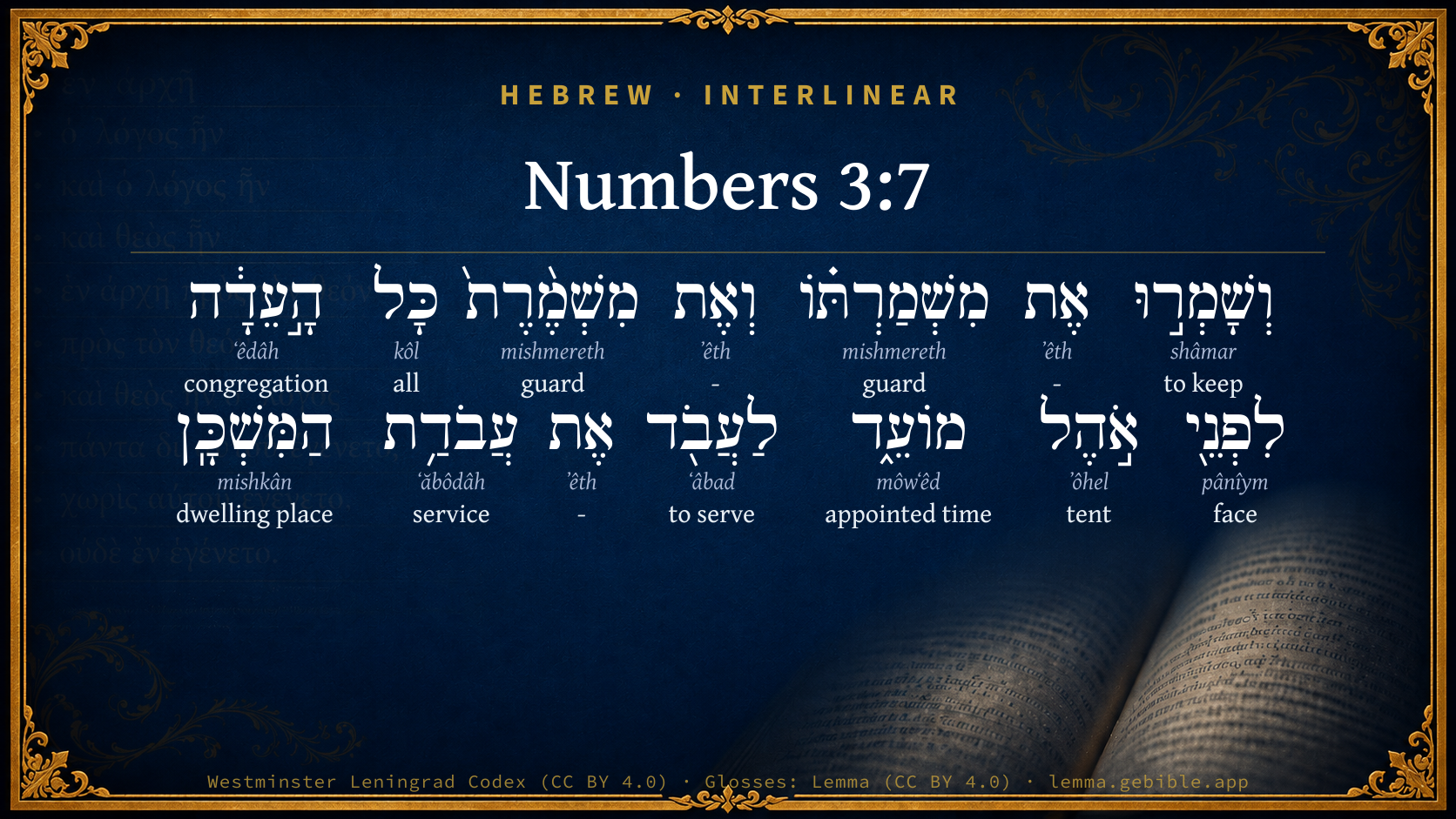
Hebrew (Westminster Leningrad Codex) Numbers 3:7 appears in the Hebrew Old Testament. The text above is from the Westminster Leningrad Codex. Each word links to its Strong’s number, a concise gloss, and parsing drawn from the Open Scriptures Hebrew Bible morphology. Click any word for its full Brown-Driver-Briggs (BDB) entry.
Download image
Cite this verse

Numbers 3:7 (World English Bible). Public Domain. Lemma interlinear Bible study tool, https://lemma.gebible.app/v/numbers/3/7.

Show BibTeX & RIS
BibTeX
RIS
English Translation
They shall keep his charge, and the charge of the whole congregation before the Tent of Meeting, to do the service of the tabernacle.
World English Bible · Public Domain
Download a study sheet

One document with this verse’s original text, its word-by-word gloss line, the meaning frame, cross-references with their text, attributed commentary, and full source and license credits — printable, and it pastes into notes with its structure intact.

This verse Autodidact and up

Study sheet (.html) Plain text (.txt)

A passage Seminary Student

Up to 50 verses in one chapter. A passage sheet keeps up to 6 commentary sources and 12 cross-references per verse, in the order this page ranks them, and says so on the sheet whenever that leaves anything out. Ask for a single verse and you get the Autodidact verse sheet above.

Everything on this page stays free to read, with no account — the sheet is a download of what is already on screen, not access to it.

Want to remove ads? Support Godless Engineer
Compare translations 3

The same verse in 3 English versions, stacked beneath the original-language interlinear above. Click any original word for its lexicon entry.

Each is an independent rendering of the whole verse — the interlinear is not word-aligned to these translations.

Highlighted words mark where these versions differ — a whole-verse word diff, not a word-by-word alignment.

  • World English Bible Public Domain
    They shall keep his charge, and the charge of the whole congregation before the Tent of Meeting, to do the service of the tabernacle.
  • King James Version Public Domain
    And they shall keep his charge, and the charge of the whole congregation before the tabernacle of the congregation, to do the service of the tabernacle.
  • unfoldingWord Literal Text CC BY-SA 4.0
    And they shall keep his keeping and the keeping of all the congregation to the face of the tent of meeting, to serve the service of the Dwelling.

unfoldingWord Literal Text — © unfoldingWord, licensed CC BY-SA 4.0. Word-aligned USFM3 via Door43 (git.door43.org/unfoldingWord/en_ult).

Versions to compare (up to 4)

3 of 4 selected

Show all 18 translations

Every available English version of this verse, each an independent rendering of the whole verse.

  • World English Bible Public Domain
    They shall keep his charge, and the charge of the whole congregation before the Tent of Meeting, to do the service of the tabernacle.
  • Berean Standard Bible Public Domain
    They are to perform duties for him and for the whole congregation before the Tent of Meeting, attending to the service of the tabernacle.
  • Majority Standard Bible Public Domain
    They are to perform duties for him and for the whole congregation before the Tent of Meeting, attending to the service of the tabernacle.
  • King James Version Public Domain
    And they shall keep his charge, and the charge of the whole congregation before the tabernacle of the congregation, to do the service of the tabernacle.
  • American Standard Version (1901) Public Domain
    And they shall keep his charge, and the charge of the whole congregation before the tent of meeting, to do the service of the tabernacle.
  • Revised Version (1885) Public Domain
    And they shall keep his charge, and the charge of the whole congregation before the tent of meeting, to do the service of the tabernacle.
  • Geneva Bible (1599) Public Domain
    And take the charge with him, euen the charge of the whole Congregation before the Tabernacle of the Congregation to doe the seruice of the Tabernacle.
  • Douay-Rheims (1899) Public Domain
    And observe whatsoever appertaineth to the service of the multitude before the tabernacle of the testimony,
  • Young's Literal Translation Public Domain
    and kept his charge, and the charge of all the company before the tent of meeting, to do the service of the tabernacle;
  • Literal Standard Version CC BY-SA 4.0
    and kept his charge, and the charge of all the congregation before the Tent of Meeting, to do the service of the Dwelling Place;
  • Unlocked Literal Bible CC BY-SA 4.0
    They must perform the duties on behalf of Aaron and the whole community before the tent of meeting. They must serve in the tabernacle.
  • unfoldingWord Literal Text CC BY-SA 4.0
    And they shall keep his keeping and the keeping of all the congregation to the face of the tent of meeting, to serve the service of the Dwelling.
  • Darby Bible Public Domain
    and they shall keep his charge, and the charge of the whole assembly, before the tent of meeting, to do the service of the tabernacle.
  • World Messianic Bible Public Domain
    They shall keep his requirements, and the requirements of the whole congregation before the Tent of Meeting, to do the service of the tabernacle.
  • Webster's Bible Public Domain
    And they shall keep his charge, and the charge of the whole congregation before the tabernacle of the congregation, to do the service of the tabernacle.
  • Free Bible Version CC BY-SA 4.0
    They are to carry out duties on his behalf and for all the Israelites at the Tent of Meeting, looking after the service of the Tabernacle.
  • Bible in Basic English Public Domain
    In order that they may be responsible to him and to all Israel for the care of the Tent of meeting, and to do the work of the House;
  • JPS Tanakh (1917) Public Domain
    And they shall keep his charge, and the charge of the whole congregation before the tent of meeting, to do the service of the tabernacle.

Literal Standard Version (2020), Covenant Press — licensed CC BY-SA 4.0. Text via the HelloAO Bible API (eBible.org). Unlocked Literal Bible (unfoldingWord) — licensed CC BY-SA 4.0. Text via the HelloAO Bible API (eBible.org). unfoldingWord Literal Text — © unfoldingWord, licensed CC BY-SA 4.0. Word-aligned USFM3 via Door43 (git.door43.org/unfoldingWord/en_ult). Free Bible Version, Dr. Jonathan Gallagher — licensed CC BY-SA 4.0. Text via the HelloAO Bible API (eBible.org).

Word by word

More ways to search: Search by grammar → Find every occurrence → Compare this word →

Practice this passage: Drill this verse → Learn its vocabulary →

מִשְׁמַרְתּ֗וֹ
mishmereth
H4931
“guard · his”
Noun, Common, Feminine, Singular, Construct + Suffix, Personal, 3rd Person, Masculine, Singular
Part of Speech
Noun
Type
Common
Gender
Feminine
Number
Singular
State
Construct
Full BDB Definition

Origin: from H4929

TWOT: 2414g

guard, charge, function, obligation, service, watch - guard, watch, house of detention or confinement - keeping, preserving - charge, injunction - office, function (ceremonial)
  1. וְשָׁמְר֣וּ shâmar H8104 “and · to keep” Conjunction + Verb, Qal, Sequential Perfect, 3rd Person, Common, Plural
  2. אֶת ʼêth H853 “-” Particle, Direct Object
  3. וְאֶת ʼêth H853 “and · -” Conjunction + Particle, Direct Object
  4. מִשְׁמֶ֨רֶת֙ mishmereth H4931 “guard of” Noun, Common, Feminine, Singular, Construct
  5. כָּל kôl H3605 “all of” Noun, Common, Masculine, Singular, Construct
  6. הָ֣עֵדָ֔ה ʻêdâh H5712 “the · congregation” Particle, Definite Article + Noun, Common, Feminine, Singular, Absolute
  7. לִפְנֵ֖י pânîym H6440 “to/for · face(s) of” Preposition + Noun, Common, Both, Plural, Construct
  8. אֹ֣הֶל ʼôhel H168 “tent of” Noun, Common, Masculine, Singular, Construct
  9. מוֹעֵ֑ד môwʻêd H4150 “appointed time” Noun, Common, Masculine, Singular, Absolute
  10. לַעֲבֹ֖ד ʻâbad H5647 “to serve” Preposition + Verb, Qal, Infinitive Construct
  11. אֶת ʼêth H853 “-” Particle, Direct Object
  12. עֲבֹדַ֥ת ʻăbôdâh H5656 “service of” Noun, Common, Feminine, Singular, Construct
  13. הַמִּשְׁכָּֽן mishkân H4908 “the · dwelling place” Particle, Definite Article + Noun, Common, Masculine, Singular, Absolute

About this verse

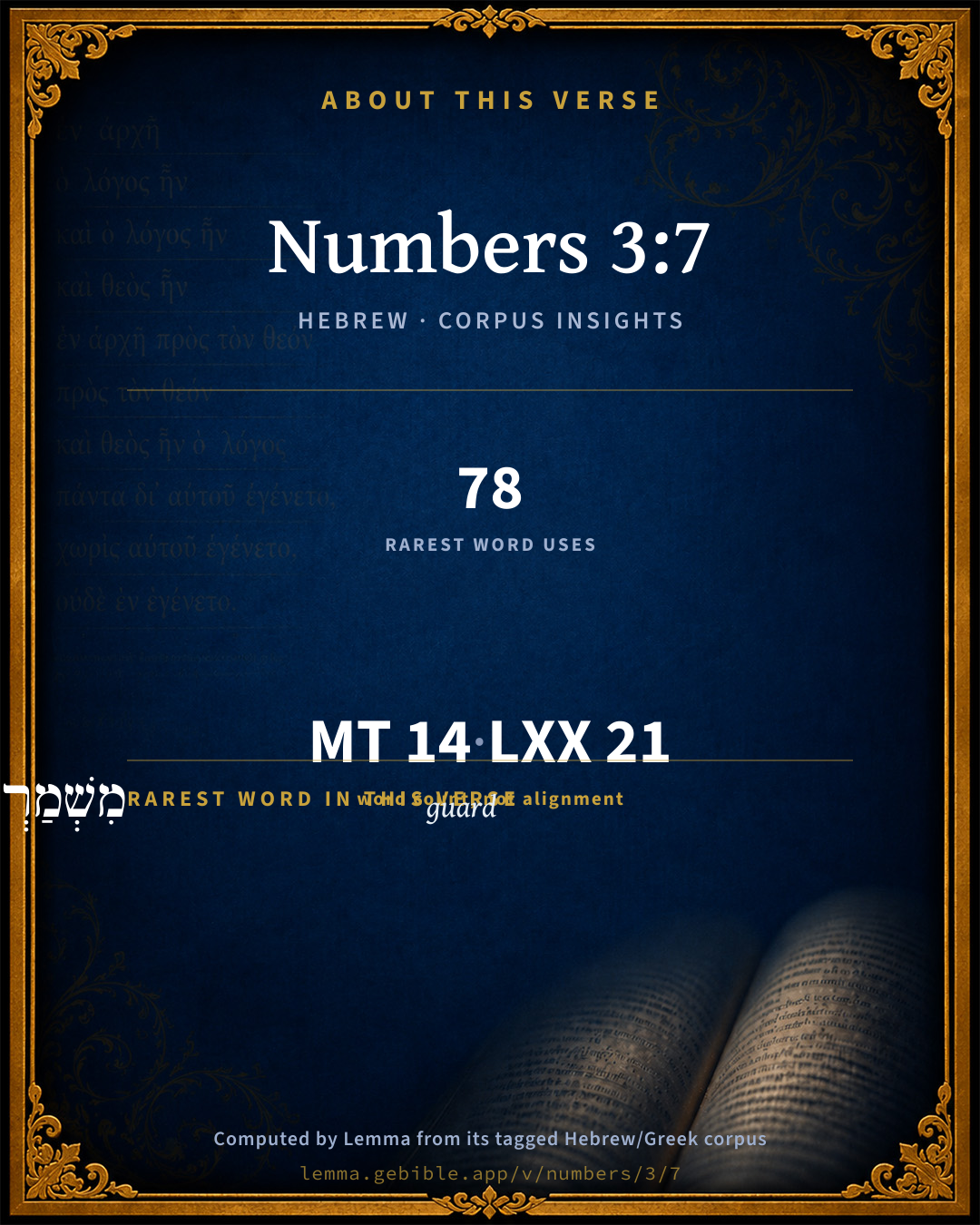
These counts appear in no published source. They are computed here, from the morphology-tagged text and Lemma’s own curated glosses. What Lemma adds →

14
words
11
distinct lemmas
Pentateuch
section

Grammatical profile

  • 2 verbs
  • 9 nouns
  • 3 particles

Verb forms

  • וְשָׁמְר֣וּ Qal · Sequential Perfect
  • לַעֲבֹ֖ד Qal · Infinitive Construct

Repetition

A word recurs within this verse — often emphatic in Hebrew:

  • מִשְׁמַרְתּ֗וֹ guard H4931 ×2

Hebrew & Septuagint length

In English translation the verse runs 24 words from the Hebrew and 25 from the Septuagint (LXX English) — closely comparable.

A rough comparison of the two English renderings, which tokenize alike — not a word-level alignment.

Word counts can differ between the Hebrew and the Greek without any difference in meaning — e.g. the Hebrew direct-object marker אֵת has no separate Greek word, and Greek often adds the article ὁ.

In the original languages it is 14 Hebrew tokens and 21 Greek tokens — but the two are counted differently (Hebrew bundles its prefixes and suffixes into one token; the Greek is in lemma form), so that isn’t a like-for-like length.

Cross-references

10

Topical passages linked to Numbers 3:7 in the Treasury of Scripture Knowledge — connected by theme and wording, ordered by reader-vote popularity; previews shown in the World English Bible.

  • Numbers 1:50 but appoint the Levites over the Tabernacle of the Testimony, and over all its furnishings, and over all that belongs to it. They shall carry the tabernacle, and all its furnishings; and they shall take care of it, and shall encamp around it.
  • Numbers 8:11 and Aaron shall offer the Levites before Yahweh for a wave offering, on the behalf of the children of Israel, that it may be theirs to do the service of Yahweh.
  • Numbers 8:15 "After that, the Levites shall go in to do the service of the Tent of Meeting: and you shall cleanse them, and offer them as a wave offering.
  • Numbers 3:32 Eleazar the son of Aaron the priest shall be prince of the princes of the Levites, with the oversight of those who keep the charge of the sanctuary.
  • Numbers 8:24–26 "This is that which belongs to the Levites: from twenty-five years old and upward they shall go in to wait on the service in the work of the Tent of Meeting;
  • Numbers 31:30 Of the children of Israel's half, you shall take one drawn out of every fifty, of the persons, of the oxen, of the donkeys, and of the flocks, [even] of all the cattle, and give them to the Levites, who keep the charge of the tent of Yahweh.
  • 1 Chronicles 23:28–32 For their office was to wait on the sons of Aaron for the service of the house of Yahweh, in the courts, and in the chambers, and in the purifying of all holy things, even the work of the service of the house of God;
  • 1 Chronicles 26:20 Of the Levites, Ahijah was over the treasures of the house of God, and over the treasures of the dedicated things.
  • 1 Chronicles 26:22 The sons of Jehieli: Zetham, and Joel his brother, over the treasures of the house of Yahweh.
  • 1 Chronicles 26:26 This Shelomoth and his brothers were over all the treasures of the dedicated things, which David the king, and the heads of the fathers' [houses], the captains over thousands and hundreds, and the captains of the host, had dedicated.

Cross-references courtesy of OpenBible.info (CC BY 4.0).

Hebrew and Greek witnesses Masoretic Hebrew ↔ Greek Septuagint

The same verse in the two great witnesses to the Old Testament, shown verse-for-verse.

These are two independent witnesses, not word-aligned to each other, and the Septuagint is shown in lemma (dictionary) form.

Hebrew Numbers 3:7 Masoretic · Westminster Leningrad Codex

וְשָׁמְר֣וּ אֶת מִשְׁמַרְתּ֗וֹ וְאֶת מִשְׁמֶ֨רֶת֙ כָּל הָ֣עֵדָ֔ה לִפְנֵ֖י אֹ֣הֶל מוֹעֵ֑ד לַעֲבֹ֖ד אֶת עֲבֹדַ֥ת הַמִּשְׁכָּֽן

They shall keep his charge, and the charge of the whole congregation before the Tent of Meeting, to do the service of the tabernacle.

World English Bible · Public Domain

Greek LXX Numbers 3:7 Septuagint · lemma form

καί φυλάσσω ὁ φυλακή αὐτός καί ὁ φυλακή ὁ υἱός ἰσραήλ ἔναντι ὁ σκηνή ὁ μαρτύριον ἐργάζομαι ὁ ἔργον ὁ σκηνή

and shall keep his charges, and the charges of the children of Israel, before the tabernacle of witness, to do the works of the tabernacle.

LXX2012 (modern English Septuagint) · Public Domain

On this verse, The Pulpit Commentary discusses the Septuagint’s reading. Read the note in Commentary ↓

Hebrew: Westminster Leningrad Codex (CC BY 4.0). Greek: Septuagint (public domain); English from LXX2012 (modern English Septuagint) (Public Domain). How the Septuagint differs from the Hebrew →

Targum (Aramaic paraphrase)

2

The Targum is the ancient Jewish Aramaic paraphrase of the Hebrew Scriptures — an interpretive translation, not the Hebrew text itself. Onkelos (literal) and Pseudo-Jonathan (expansive) render the Torah, and Jonathan the Prophets. Coverage is partial: where no permissively-licensed English translation exists for a verse, only the Aramaic is shown. This is verse-level text, not a word-by-word alignment to the Hebrew.

  1. Targum Onkelos Torah (Genesis–Deuteronomy)
    וְיִטְרוּן יָת מַטַרְתֵּהּ וְיָת מַטְרַת כָּל כְּנִשְׁתָּא קֳדָם מַשְׁכַּן זִמְנָא לְמִפְלַח יָת פָּלְחַן מַשְׁכְּנָא

    (no public-domain English translation for this verse)

    Targum Onkelos — Aramaic: “Onkelos Genesis” (public domain); “Onkelos Exodus” (public domain); “Onkelos Leviticus” (public domain); “Onkelos Numbers” (public domain); “Onkelos Deuteronomy” (public domain). English: “Sefaria Community Translation” (CC0 1.0 (public-domain dedication)); “J.W. Etheridge. The Targums of Onkelos and Jonathan Ben Uzziel on the Pentateuch. London: Longmans, Green, 1862” (public domain). Text via Sefaria.

  2. Targum Pseudo-Jonathan Torah (Genesis–Deuteronomy)
    וְיִתְפַּלְגוּן לְעֶשְרִין וְאַרְבַּע חוּלְקִין וְיִטְרוּן יַת מַטַרְתֵּיהּ וְיַת מַטְרַת כָּל כְּנִישְׁתָּא לִקֳדָם מַשְׁכַּן זִמְנָא לְמִפְלַח יַת פּוּלְחַן מַשְׁכְּנָא

    and let them be divided into twenty and four parties, and they shall keep his charge, and the charge of all the congregation before the tabernacle of ordinance, to perform the work of the tabernacle;

    Targum Pseudo-Jonathan — Aramaic: “Targum Jonathan on Genesis” (public domain); “Targum Jonathan on Exodus” (public domain); “Targum Jonathan on Leviticus” (public domain); “Targum Jonathan on Numbers” (public domain); “Targum Jonathan on Deuteronomy” (public domain). English: “The Targum of Jonathan ben Uzziel, trans. J. W. Etheridge, London, 1862” (public domain). Text via Sefaria.

Commentary

Notes on Numbers 3:7 from classic Christian and Jewish commentators (each source and its license shown beneath its notes). The classic Christian expositions comment on the surrounding passage and are grouped to its opening verse, so a note may address several verses; the Jewish commentaries on the Tanakh (Rashi and others) are per-verse, so they appear only where the commentator wrote on this verse.

Lemma curates 59 commentaries, every one of them public domain or Creative Commons licensed, each selected and text-cleaned for this edition rather than reprinted as found. About our sources →

Joseph Benson's Commentary

Num 3:7. His charge — That is, Aaron’s, or those things which were committed principally to Aaron’s care and oversight. Of the congregation — That is, of all the sacrifices and services which were due to the Lord from all the people. Because the people might not perform them, in their own persons, therefore they were to be performed by some particular persons in their stead; formerly by the firstborn, (Num 8:16,) and now by the Levites. Before the tabernacle — Not within the tabernacle, for the care of the things within the holy place was appropriated to the priests, as the care of the most holy place was to the high-priest.

Joseph Benson's Commentary on the Old and New Testaments (1811–1818) — public domain. Text from a community e-Sword module.

Geneva Bible (1599)

Geneva Bible translators

Which appertained to the executing of the high Priest’s commandment, to the oversight of the people, and the service of the Tabernacle.

Geneva Bible (1599) marginal notes — public domain. Text via Bolls.life.

Adam Clarke's Commentary

Verse 7. The charge of the whole congregation] They shall work for the whole congregation; and instead of the first-born.

Adam Clarke's Commentary on the Bible (1810–1826) — public domain. Text from a community e-Sword/MySword module.

Ellicott's Commentary for English Readers

(7) And they shall keep his charge.—The word rendered charge may mean the directions which the Levites should receive from Aaron (comp. Gen_26:5); or—as seems more probable from the use of the same word in this and the following verse with reference to the congregation—it may refer to the charge which was laid upon Aaron and upon the whole congregation in matters pertaining to the public worship of God.

A Bible Commentary for English Readers, edited by Charles John Ellicott (1878–1897) — public domain. Text from a community e-Sword module.

The Cambridge Bible for Schools and Colleges

gen. ed. J. J. S. Perowne

7. keep his charge] i.e. perform the duties of their service to him and to the priests.

the charge of the whole congregation] comprised the ritual functions in connexion with the offering of animals sacrificed by and in behalf of the laity of Israel.

The Cambridge Bible for Schools and Colleges (gen. ed. J. J. S. Perowne; Cambridge University Press, 1878–1918) — public domain. Text from a community e-Sword module.

John Gill's Exposition

And they shall keep his charge, and the charge of the whole congregation,.... The charge of Aaron and of all the people of Israel, which was to secure the sanctuary from being polluted or plundered: this the Levites were to be employed about, and thereby ease the high priest and the other priests, and the people, of what otherwise would have been incumbent on them:

before the tabernacle of the congregation; not within it, neither in the holy place, nor in the most holy place, where they might not enter, to do any service peculiar thereunto, but at the door of the tabernacle, and in the court of it, and in the rooms and chambers in it: and do the service of the tabernacle; not to offer sacrifices on the altar of the burnt offering, which stood in the court, and much less to burn incense on the altar of incense, and to him the lamps, and set on the shewbread in the holy place; and still less to enter into the most holy place, and do there what was to be done on the day of atonement; but to do all that is before observed, and to bring the people's offerings to the priest, and to assist in slaying them; and to keep all profane and polluted persons out of it, the tabernacle, as we find in later times; they were porters at it, and some of them were singers in it, and had the care of various things belonging to it: see Ch1 9:14.

John Gill's Exposition of the Whole Bible (1746–1763) — public domain (CC PDM 1.0). Text via the HelloAO Bible API.

Albert Barnes' Notes on the Bible

keep his charge - i. e. so assist him that the obligations incumbent on him and on the congregation may be fulfilled.

Albert Barnes' Notes on the Bible (1834–1885) — public domain. Text from a community e-Sword/MySword module.

Haydock's Catholic Bible Commentary

And. Hebrew, "They shall watch over him, and over all the congregation," to assist the priests in their sacred office, and to take care that the people behave respectfully. (Haydock) --- All were bound to prevent any sacrilegious abuse. (Menochius)

George Leo Haydock (1774–1849), Haydock's Catholic Family Bible and Commentary, 1859 edition — public domain. Excludes Psalms (Douay-Rheims chapter numbering differs from Protestant) and Deuterocanonical books (Catholic canon only).

Matthew Poole's English Annotations

His charge, i.e. Aaron’s charge, or those things which are committed principally to Aaron’s care and oversight, and under him and his direction to the Levites.

Of the whole congregation, i.e. of all the sacrifices and services which are due to the Lord from all the people, and because all the people could not and might not perform them, or at least divers of them, in their own persons, therefore they were to be performed by some particular persons in their name and stead; formerly by the first-born, Num 8:16, and now by the Levites. See Num 1:53; 16:9.

Before the tabernacle, emphatically; not within the tabernacle, for the care of these things within the holy place was appropriated to the priests, as the care of the most holy place was peculiar to the high priest.

Matthew Poole's English Annotations on the Holy Bible (1683–1685) — public domain. Text from a community e-Sword/MySword module.

Whedon's Commentary on the Bible

Daniel D. Whedon

7. Charge of the… congregation — As the Levites were subordinated to Aaron, it was proper that he should address them concerning their duties. As they were substituted for the firstborn of the people, the whole people were interested in their faithful discharge of their duties, and might with propriety be said to charge the Levitical body with these duties, which they themselves in the persons of their firstborn would have performed if the Levites had not been consecrated. In Num_8:11 Aaron is directed to “offer the Levites before the Lord for an offering of the children of Israel, that they may execute the service of the Lord.” The Hebrew for bring near, in Num_3:6, is a sacrificial word, used when an offering is presented to Jehovah.

Daniel D. Whedon (gen. ed.), Commentary on the Old and New Testaments (1874–1909) — public domain. Text from a community e-Sword module.

The Pulpit Commentary

They shall keep his charge, and the charge of the whole congregation. Septuagint, "shall keep his watches, and the watches of the children of Israel." The Levites were to be the servants of Aaron on the one side, and of the whole congregation on the other, in the performance of their religious duties. The complicated ceremonial now prescribed and set in use could not possibly be carried out by priests or people without the assistance of a large number of persons trained and devoted to the work. Compare St. Paul"s words to the Corinthians, (2Co_4:5) "Ourselves your servants for Jesus" sake."

The Pulpit Commentary (1880–1919), ed. H.D.M. Spence-Jones & Joseph S. Exell — public domain. Text from a community e-Sword module.

John Wesley's Explanatory Notes

His charge - That is, Aaron's, or those things which are committed principally to Aaron's care and oversight. Of the congregation - That is, of all the sacrifices and services which are due to the Lord from all the people, because the people might not perform them, in their own persons, therefore they were to be performed by some particular persons in their stead; formerly by the first-born, chap. viii, 16, and now by the Levites. Before the tabernacle - Not within the tabernacle, for the care of the things within the holy place was appropriated to the priests, as the care of the most holy place was to the high-priest.

John Wesley, Explanatory Notes Upon the Whole Bible (1754–1765) — public domain. Text via the GEBible commentary corpus.

unfoldingWord translationNotes

Door43 World Missions Community

on behalf of

"for." This means to do something for someone else, as a representative for them.

help the tribes of Israel

Here the "tribes of Israel" refer to the people of Israel. AT: "help the people of Israel" (See: Metonymy)

they must help the tribes of Israel to carry out the tabernacle service

The phrase "carry out" means to "serve." AT: "they must help the tribes of Israel by serving in the tabernacle" (See: Idiom)

tabernacle service

"work of the tabernacle"

translationWords

tent of meeting

tabernacle

Israel

unfoldingWord translationNotes — © Distant Shores Media and the Door43 World Missions Community, licensed CC BY-SA 4.0. Source: git.door43.org/Door43/en_tn.

Rashi

Rabbi Shlomo Yitzchaki (Rashi)

ושמרו את משמרתו AND THEY SHALL KEEP HIS CHARGE — Any post to which a person is appointed and the duties of which he is bound to carry out is everywhere in Scripture and in the Mishnaic idiom called משמרת, an office, a charge. For example, it is stated in the story of Bigthan and Teresh that when they were conspiring against Ahasuerus one said to the other (Megillah 13b): "But surely my official duty (משמרתי) is not the same as your official duty (משמרתך) and therefore we can never meet to put our plans into execution!" Similar, also, is its use in the phrase,משמרות כהונה ולויה “shifts for duty of priests and Levites”.

Rashi on the Tanakh — English translations: “The Judaica Press complete Tanach with Rashi, translated by A. J. Rosenberg” (CC BY 4.0); “Pentateuch with Rashi's commentary by M. Rosenbaum and A.M. Silbermann, 1929-1934” (public domain); “The Metsudah Tanach series, Lakewood, N.J” (CC BY 4.0); and “The Book of Joshua, Metsudah Publications, 1997” (CC BY 4.0). Text via Sefaria.

Lesson kit

Teaching starters — assembled from the data on this page, not authored interpretation. Every prompt links to the verse data it draws on. Edit before teaching.

Numbers, in the Pentateuch, opens this verse with 14 words (11 distinct Hebrew lemmas). Its most distinctive word is mishmereth (“guard”). A historical commentator’s framing appears above. Read the whole chapter for the surrounding context.

Discussion questions

  1. What does “guard” (mishmereth) contribute to the verse as a whole?
  2. Numbers 1:50 shares this passage’s theme. How do the two illuminate each other?
  3. “guard” occurs 2× in this one verse. What is the effect of the repetition?
  4. These translations render this verse differently. What is at stake in choosing one wording over another?
  5. The verb «וְשָׁמְר֣וּ» is Qal Sequential Perfect. How does its form color the action?
  6. Reading how Joseph Benson's Commentary and Geneva Bible (1599) read this verse, where do the two commentators agree and where do they part?

Things to notice

Reading settings

Reading text

Shown beneath each verse's original-language words.

Old Testament
Old Testament edition

Read the OT as the Masoretic Hebrew (MT) or the Greek Septuagint (LXX).

English shown for the Greek Septuagint (in the Hebrew ↔ Greek comparison).

Comparing translations? Open the Compare panel on any verse page to stack up to four side by side.