Genesis 26:25

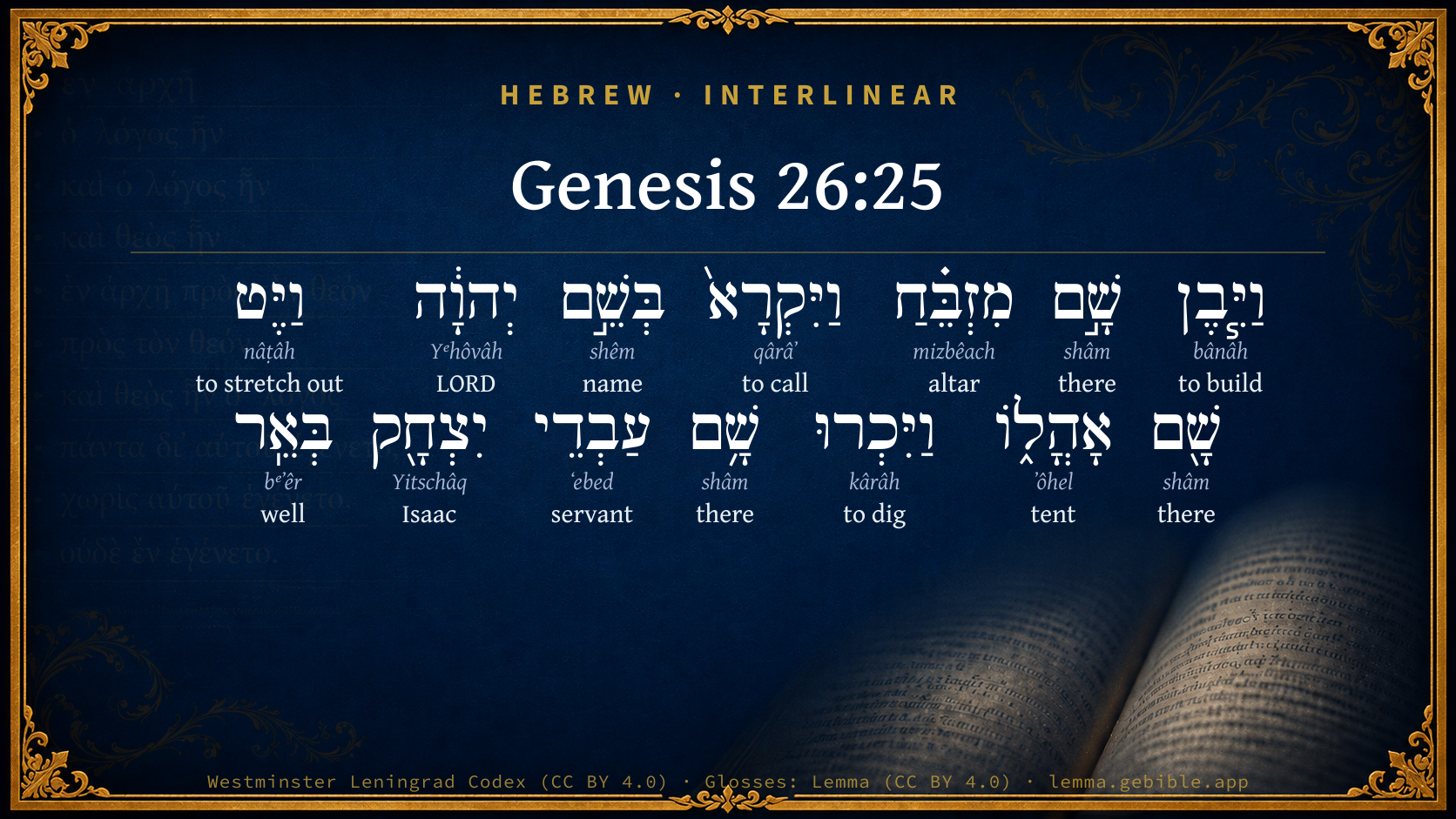
Hebrew (Westminster Leningrad Codex) Genesis 26:25 appears in the Hebrew Old Testament. The text above is from the Westminster Leningrad Codex. Each word links to its Strong’s number, a concise gloss, and parsing drawn from the Open Scriptures Hebrew Bible morphology. Click any word for its full Brown-Driver-Briggs (BDB) entry.
Download image
Cite this verse

Genesis 26:25 (World English Bible). Public Domain. Lemma interlinear Bible study tool, https://lemma.gebible.app/v/genesis/26/25.

Show BibTeX & RIS
BibTeX
RIS
English Translation
He built an altar there, and called on the name of Yahweh, and pitched his tent there. There Isaac's servants dug a well.
World English Bible · Public Domain
Highlights Full analysis ↓
Download a study sheet

One document with this verse’s original text, its word-by-word gloss line, the meaning frame, cross-references with their text, attributed commentary, and full source and license credits — printable, and it pastes into notes with its structure intact.

This verse Autodidact and up

Study sheet (.html) Plain text (.txt)

A passage Seminary Student

Up to 50 verses in one chapter. A passage sheet keeps up to 6 commentary sources and 12 cross-references per verse, in the order this page ranks them, and says so on the sheet whenever that leaves anything out. Ask for a single verse and you get the Autodidact verse sheet above.

Everything on this page stays free to read, with no account — the sheet is a download of what is already on screen, not access to it.

Want to remove ads? Support Godless Engineer
Compare translations 3

The same verse in 3 English versions, stacked beneath the original-language interlinear above. Click any original word for its lexicon entry.

Each is an independent rendering of the whole verse — the interlinear is not word-aligned to these translations.

Highlighted words mark where these versions differ — a whole-verse word diff, not a word-by-word alignment.

  • World English Bible Public Domain
    He built an altar there, and called on the name of Yahweh, and pitched his tent there. There Isaac's servants dug a well.
  • King James Version Public Domain
    And he builded an altar there, and called upon the name of the LORD, and pitched his tent there: and there Isaac's servants digged a well.
  • unfoldingWord Literal Text CC BY-SA 4.0
    Then he built an altar there and called on the name of Yahweh. And he pitched his tents there, and the servants of Isaac dug a well there.

unfoldingWord Literal Text — © unfoldingWord, licensed CC BY-SA 4.0. Word-aligned USFM3 via Door43 (git.door43.org/unfoldingWord/en_ult).

Versions to compare (up to 4)

3 of 4 selected

Show all 18 translations

Every available English version of this verse, each an independent rendering of the whole verse.

  • World English Bible Public Domain
    He built an altar there, and called on the name of Yahweh, and pitched his tent there. There Isaac's servants dug a well.
  • Berean Standard Bible Public Domain
    So Isaac built an altar there and called on the name of the LORD, and he pitched his tent there. His servants also dug a well there.
  • Majority Standard Bible Public Domain
    So Isaac built an altar there and called on the name of the LORD, and he pitched his tent there. His servants also dug a well there.
  • King James Version Public Domain
    And he builded an altar there, and called upon the name of the LORD, and pitched his tent there: and there Isaac's servants digged a well.
  • American Standard Version (1901) Public Domain
    And he builded an altar there, and called upon the name of Jehovah, and pitched his tent there. And there Isaac's servants digged a well.
  • Revised Version (1885) Public Domain
    And he builded an altar there, and called upon the name of the LORD, and pitched his tent there: and there Isaac’s servants digged a well.
  • Geneva Bible (1599) Public Domain
    Then he builte an altar there, and called vpon the Name of the Lord, and there spred his tent: where also Izhaks seruauntes digged a well.
  • Douay-Rheims (1899) Public Domain
    And he built there an altar: and called upon the name of the Lord, and pitched his tent: and commanded his servants to dig a well.
  • Young's Literal Translation Public Domain
    and he buildeth there an altar, and preacheth in the name of Jehovah, and stretcheth out there his tent, and there Isaac's servants dig a well.
  • Literal Standard Version CC BY-SA 4.0
    and he builds there an altar, and preaches in the Name of YHWH, and stretches out there his tent, and there Isaac’s servants dig a well.
  • Unlocked Literal Bible CC BY-SA 4.0
    Isaac built an altar there and called on the name of Yahweh. There he pitched his tent, and his servants dug a well.
  • unfoldingWord Literal Text CC BY-SA 4.0
    Then he built an altar there and called on the name of Yahweh. And he pitched his tents there, and the servants of Isaac dug a well there.
  • Darby Bible Public Domain
    And he built an altar there, and called upon the name of Jehovah. And he pitched his tent there; and there Isaac's servants dug a well.
  • World Messianic Bible Public Domain
    He built an altar there, and called on the LORD’s name, and pitched his tent there. There Isaac’s servants dug a well.
  • Webster's Bible Public Domain
    And he built an altar there, and called upon the name of the LORD, and pitched his tent there: and there Isaac's servants digged a well.
  • Free Bible Version CC BY-SA 4.0
    Isaac built an altar and worshiped the Lord. He also set up his tent, and his servants dug a well there.
  • Bible in Basic English Public Domain
    Then he made an altar there, and gave worship to the name of the Lord, and he put up his tents there, and there his servants made a water-hole.
  • JPS Tanakh (1917) Public Domain
    And he builded an altar there, and called upon the name of the LORD, and pitched his tent there; and there Isaac's servants digged a well.

Literal Standard Version (2020), Covenant Press — licensed CC BY-SA 4.0. Text via the HelloAO Bible API (eBible.org). Unlocked Literal Bible (unfoldingWord) — licensed CC BY-SA 4.0. Text via the HelloAO Bible API (eBible.org). unfoldingWord Literal Text — © unfoldingWord, licensed CC BY-SA 4.0. Word-aligned USFM3 via Door43 (git.door43.org/unfoldingWord/en_ult). Free Bible Version, Dr. Jonathan Gallagher — licensed CC BY-SA 4.0. Text via the HelloAO Bible API (eBible.org).

Word by word

More ways to search: Search by grammar → Find every occurrence → Compare this word →

Practice this passage: Drill this verse → Learn its vocabulary →

וַיִּכְרוּ
kârâh
H3738
“and · to dig”
Conjunction + Verb, Qal, Sequential Imperfect, 3rd Person, Masculine, Plural
Part of Speech
Conjunction + Verb
Stem
Qal
Form
Sequential Imperfect
Person
3rd Person
Gender
Masculine
Number
Plural
Full BDB Definition

Origin: a primitive root

TWOT: 1033 , 1034 , 1035

to dig, excavate, dig through - (Qal) to dig - (Niphal) to be dug - (Qal) to give a banquet or feast - (Qal) to get by trade, trade, buy
  1. וַיִּ֧בֶן bânâh H1129 “and · to build” Conjunction + Verb, Qal, Sequential Imperfect, 3rd Person, Masculine, Singular
  2. שָׁ֣ם shâm H8033 “there” Adverb
  3. מִזְבֵּ֗חַ mizbêach H4196 “altar” Noun, Common, Masculine, Singular, Absolute
  4. וַיִּקְרָא֙ qârâʼ H7121 “and · to call” Conjunction + Verb, Qal, Sequential Imperfect, 3rd Person, Masculine, Singular
  5. בְּשֵׁ֣ם shêm H8034 “in/at · name of” Preposition + Noun, Common, Masculine, Singular, Construct
  6. יְהוָ֔ה Yᵉhôvâh H3068 “LORD” Noun, Proper
  7. וַיֶּט nâṭâh H5186 “and · to stretch out” Conjunction + Verb, Qal, Sequential Imperfect, 3rd Person, Masculine, Singular
  8. שָׁ֖ם shâm H8033 “there” Adverb
  9. אָהֳל֑וֹ ʼôhel H168 “tent · his” Noun, Common, Masculine, Singular, Construct + Suffix, Personal, 3rd Person, Masculine, Singular
  10. שָׁ֥ם shâm H8033 “there” Adverb
  11. עַבְדֵי ʻebed H5650 “servants of” Noun, Common, Masculine, Plural, Construct
  12. יִצְחָ֖ק Yitschâq H3327 “Isaac” Noun, Proper
  13. בְּאֵֽר bᵉʼêr H875 “well” Noun, Common, Feminine, Singular, Absolute

About this verse

These counts appear in no published source. They are computed here, from the morphology-tagged text and Lemma’s own curated glosses. What Lemma adds →

14
words
12
distinct lemmas
Pentateuch
section

Notable vocabulary

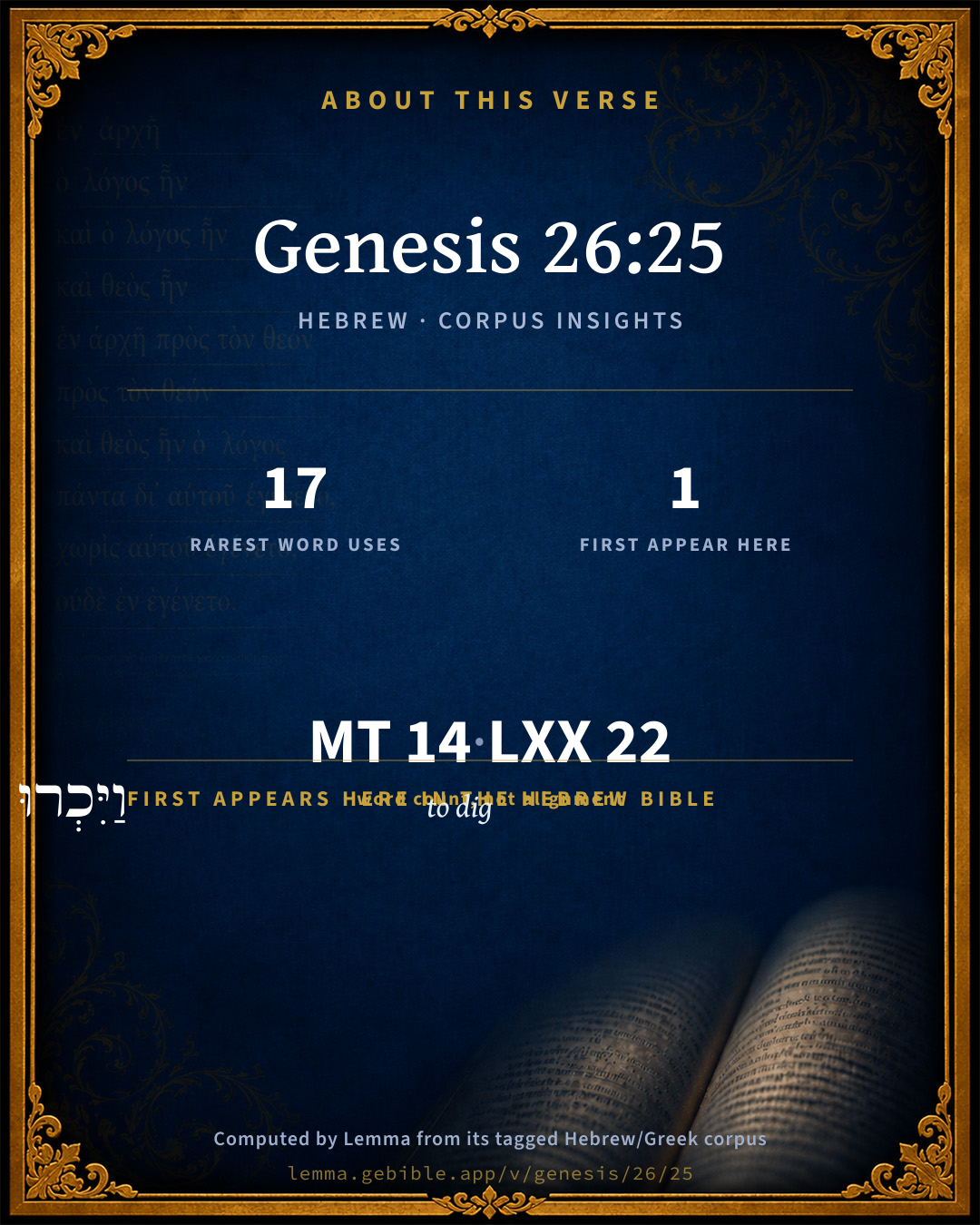
The rarest word here is וַיִּכְרוּ to dig H3738 — appearing just 17 times in the whole Hebrew Bible.

First appearance in Scripture

This word makes its first canonical appearance in the Hebrew Bible here:

  • וַיִּכְרוּ to dig H3738

Shared distinctive vocabulary

וַיִּכְרוּ to dig H3738 occurs in 17 verses of the Hebrew Bible. Also found in:

Grammatical profile

  • 4 verbs
  • 7 nouns
  • 3 adverbs

Verb forms

  • וַיִּ֧בֶן Qal · Sequential Imperfect
  • וַיִּקְרָא֙ Qal · Sequential Imperfect
  • וַיֶּט Qal · Sequential Imperfect
  • וַיִּכְרוּ Qal · Sequential Imperfect

Repetition

A word recurs within this verse — often emphatic in Hebrew:

  • שָׁ֣ם there H8033 ×3

Hebrew & Septuagint length

In English translation the verse runs 23 words from the Hebrew and 34 from the Septuagint (LXX English) — the Septuagint runs noticeably longer here. See the side-by-side →

A rough comparison of the two English renderings, which tokenize alike — not a word-level alignment.

Word counts can differ between the Hebrew and the Greek without any difference in meaning — e.g. the Hebrew direct-object marker אֵת has no separate Greek word, and Greek often adds the article ὁ.

In the original languages it is 14 Hebrew tokens and 22 Greek tokens — but the two are counted differently (Hebrew bundles its prefixes and suffixes into one token; the Greek is in lemma form), so that isn’t a like-for-like length.

Cross-references

9

Topical passages linked to Genesis 26:25 in the Treasury of Scripture Knowledge — connected by theme and wording, ordered by reader-vote popularity; previews shown in the World English Bible.

  • Genesis 13:18 Abram moved his tent, and came and lived by the oaks of Mamre, which are in Hebron, and built an altar there to Yahweh.
  • Psalms 116:17 I will offer to you the sacrifice of thanksgiving, And will call on the name of Yahweh.
  • Genesis 12:7–8 Yahweh appeared to Abram, and said, "I will give this land to your seed." He built an altar there to Yahweh, who appeared to him.
  • Genesis 8:20 Noah built an altar to Yahweh, and took of every clean animal, and of every clean bird, and offered burnt offerings on the altar.
  • Genesis 13:4 to the place of the altar, which he had made there at the first. There Abram called on the name of Yahweh.
  • Genesis 22:9 They came to the place which God had told him of. Abraham built the altar there, and laid the wood in order, bound Isaac his son, and laid him on the altar, on the wood.
  • Genesis 33:20 He erected an altar there, and called it El Elohe Israel.
  • Genesis 35:1 God said to Jacob, "Arise, go up to Bethel, and live there. Make there an altar to God, who appeared to you when you fled from the face of Esau your brother."
  • Exodus 17:15 Moses built an altar, and called the name of it Yahweh our Banner.

Cross-references courtesy of OpenBible.info (CC BY 4.0).

Hebrew and Greek witnesses Masoretic Hebrew ↔ Greek Septuagint

The same verse in the two great witnesses to the Old Testament, shown verse-for-verse.

Here the Septuagint runs noticeably longer than the Hebrew — LXX2012 (modern English Septuagint) 34 words vs World English Bible 23. A rough length comparison of the two English translations, not a word-level alignment — read both below.

These are two independent witnesses, not word-aligned to each other, and the Septuagint is shown in lemma (dictionary) form.

Hebrew Genesis 26:25 Masoretic · Westminster Leningrad Codex

וַיִּ֧בֶן שָׁ֣ם מִזְבֵּ֗חַ וַיִּקְרָא֙ בְּשֵׁ֣ם יְהוָ֔ה וַיֶּט שָׁ֖ם אָהֳל֑וֹ וַיִּכְרוּ שָׁ֥ם עַבְדֵי יִצְחָ֖ק בְּאֵֽר

He built an altar there, and called on the name of Yahweh, and pitched his tent there. There Isaac's servants dug a well.

World English Bible · Public Domain

Greek LXX Genesis 26:25 Septuagint · lemma form

καί οἰκοδομέω ἐκεῖ θυσιαστήριον καί ἐπικαλέω ὁ ὄνομα κύριος καί πήγνυμι ἐκεῖ ὁ σκηνή αὐτός ὀρύσσω δέ ἐκεῖ ὁ παῖς ισαακ φρέαρ

And he built there an altar, and called on the name of the Lord, and there he pitched his tent, and there the servants of Isaac dug a well in the valley of Gerara.

LXX2012 (modern English Septuagint) · Public Domain

Hebrew: Westminster Leningrad Codex (CC BY 4.0). Greek: Septuagint (public domain); English from LXX2012 (modern English Septuagint) (Public Domain). How the Septuagint differs from the Hebrew →

Targum (Aramaic paraphrase)

2

The Targum is the ancient Jewish Aramaic paraphrase of the Hebrew Scriptures — an interpretive translation, not the Hebrew text itself. Onkelos (literal) and Pseudo-Jonathan (expansive) render the Torah, and Jonathan the Prophets. Coverage is partial: where no permissively-licensed English translation exists for a verse, only the Aramaic is shown. This is verse-level text, not a word-by-word alignment to the Hebrew.

  1. Targum Onkelos Torah (Genesis–Deuteronomy)
    וּבְנָא תַמָּן מַדְבְּחָא וְצַלִּי בִּשְׁמָא דַּיְיָ וּפְרַס תַּמָּן מַשְׁכְּנֵהּ וּכְרוֹ תַמָּן עַבְדֵי יִצְחָק בֵּירָא

    (no public-domain English translation for this verse)

    Targum Onkelos — Aramaic: “Onkelos Genesis” (public domain); “Onkelos Exodus” (public domain); “Onkelos Leviticus” (public domain); “Onkelos Numbers” (public domain); “Onkelos Deuteronomy” (public domain). English: “Sefaria Community Translation” (CC0 1.0 (public-domain dedication)); “J.W. Etheridge. The Targums of Onkelos and Jonathan Ben Uzziel on the Pentateuch. London: Longmans, Green, 1862” (public domain). Text via Sefaria.

  2. Targum Pseudo-Jonathan Torah (Genesis–Deuteronomy)
    וּבְנָא תַמָן מַדְבְּחָא וְצַלֵי בִּשְׁמָא דַיְיָ וּפְרַס תַּמָן מַשְׁכְּנֵיהּ וַחֲפָסוּ תַּמָן עַבְדֵי יִצְחָק בֵּירָא

    And he builded there an altar, and prayed in the name of the Lord. And he spread his tabernacle there, and the servants of Izhak digged there a well.

    Targum Pseudo-Jonathan — Aramaic: “Targum Jonathan on Genesis” (public domain); “Targum Jonathan on Exodus” (public domain); “Targum Jonathan on Leviticus” (public domain); “Targum Jonathan on Numbers” (public domain); “Targum Jonathan on Deuteronomy” (public domain). English: “The Targum of Jonathan ben Uzziel, trans. J. W. Etheridge, London, 1862” (public domain). Text via Sefaria.

Commentary

Notes on Genesis 26:25 from classic Christian and Jewish commentators (each source and its license shown beneath its notes). The classic Christian expositions comment on the surrounding passage and are grouped to its opening verse, so a note may address several verses; the Jewish commentaries on the Tanakh (Rashi and others) are per-verse, so they appear only where the commentator wrote on this verse.

Lemma curates 59 commentaries, every one of them public domain or Creative Commons licensed, each selected and text-cleaned for this edition rather than reprinted as found. About our sources →

Trapp's Complete Commentary

John Trapp

Gen 26:25 And he builded an altar there, and called upon the name of the LORD, and pitched his tent there: and there Isaac’s servants digged a well.

Ver. 25. And called upon the name of the Lord.] That had made room for him; and now, by his presence and promise, comforted him. Let the streams of God’s bounty lead us, as the watercourse doth, either to the spring upward, or downward to the main ocean, to the source and fountain whence they flow. Let God taste of the fruit of his own planting. Otherwise, it is no better than the refreshing of him that standeth by a good fire, "and crieth, Aha, I am warm". {Isa 44:16} We are no better than brute beasts, if, contenting ourselves with a natural use of the creatures, we rise not up to the Author; if, instead of being temples of his praise, we become graves of his benefits. Isaac first built an altar, and then digged a well.

John Trapp, A Commentary or Exposition upon All the Books of the Old and New Testament (1647–1656) — public domain. Text from a community e-Sword module.

Geneva Bible (1599)

Geneva Bible translators

To signify that he would serve none other God, but the God of his father Abraham.

Geneva Bible (1599) marginal notes — public domain. Text via Bolls.life.

Adam Clarke's Commentary

Verse 25. Builded an altar there] That he might have a place for God's worship, as well as a place for himself and family to dwell in.

And called upon the name of the Lord] And invoked in the name of Jehovah. See Clarke on Ge 12:8; "Ge 13:15".

Adam Clarke's Commentary on the Bible (1810–1826) — public domain. Text from a community e-Sword/MySword module.

John Calvin's Commentaries

25. And he builded an altar there. From other passages we are well aware that Moses here speaks of public worship; for inward invocation of God neither requires an altar; nor has any special choice of place; and it is certain that the saints, wherever they lived, worshipped. But because religion ought to maintain a testimony before men, Isaac, having erected and consecrated an altar, professes himself a worshipper of the true and only God, and by this method separates himself from the polluted rites of heathens. He also built the altar, not for himself alone, but for his whole family; that there, with all his household, he might offer sacrifices. Moreover, since the altar was built for the external exercises of faith, the expression, he called upon God, implies as much as if Moses had said that Isaac celebrated the name of God, and gave testimony of his own faith. The visible worship of God had also another use; namely, that men, according to their infirmity, may stimulate and exercise themselves in the fear of God. Besides, since we know that sacrifices were then commanded, we must observe that Isaac did not rashly trifle in worshipping God, but adhered to the rule of faith, that he might undertake nothing without the word of God. Whence also we infer how preposterous and erroneous a thing it is to imitate the fathers, unless the Lord join us with them by means of a similar command. Meanwhile, the words of Moses clearly signify, that whatever exercises of piety the faithful undertake are to be directed to this end, namely, that God may be worshipped and invoked. To this point, therefore, all rites and ceremonies ought to have reference. But although it was the custom of the holy fathers to build an altar in whatever place they pitched their tent, we yet gather, from the connection of the words, that after God appeared to his servant Isaac, this altar was built by him in token of his gratitude.

And there Isaac’s servants digged a well. It is remarkable that whereas this place had already received its name from the well which had been dug in it, Isaac should there again have to seek water, especially since Abraham had purchased, for himself and his posterity, the right to the well from the king. Moreover, the digging itself was difficult and labourious; for Moses had a design in saying, that afterwards the servants came and said to him, We have found water. I have, therefore, no doubt, that throughout the whole of that region a conspiracy had been entered into by the inhabitants, for the purpose of expelling the holy man, through want of water; so that this well of Sheba also had been fraudulently stopped up. The context also shows, that the first care of the holy patriarch concerned the worship of God, because Moses relates that an altar was erected, before he speaks of the well. Now it is of importance to observe with what great troubles these holy fathers continually had to contend; which they never would have been able to overcome or to endure, unless they had been far removed from our delicate course of living. For how severely should we feel the loss of water, seeing that we often rage against God if we have not abundance of wine? Therefore, by such examples, let the faithful learn to accustom themselves to patient endurance: and if at any time food and other necessaries of life fail them, let them turn their eyes to Isaac, who wandered, parched with thirst, in the inheritance which had been divinely promised him.

John Calvin's Commentaries (1540-1563) — public domain. Text from the Calvin Translation Society English edition (1840s-50s) via the Christian Classics Ethereal Library (ccel.org). Calvin's coverage is partial (roughly two-thirds of the Bible); uncommented books and verses are honest gaps, never fabricated. The 19th-century editor's footnotes and remarks are omitted so the notes are faithfully Calvin's own voice.

The Cambridge Bible for Schools and Colleges

gen. ed. J. J. S. Perowne

25. builded … there] As Abraham had done, Gen_12:7, Gen_13:18.

called … Lord] See notes on Gen_4:26, Gen_21:33.

digged a well] According to Gen_21:30 a well had already been digged by Abraham. The word in the Hebrew is not the same as that used in Gen_26:22; see Gen_50:5.

The Cambridge Bible for Schools and Colleges (gen. ed. J. J. S. Perowne; Cambridge University Press, 1878–1918) — public domain. Text from a community e-Sword module.

John Gill's Exposition

And Isaac said unto them, wherefore come ye to me,.... What is the meaning of this visit? what has brought you hither? it cannot be from affection and friendship to me:

seeing ye hate me, and have sent me away from you? the latter he mentions as a proof of the former; they envied his prosperity, and hated him on that account, and therefore expelled him their country, or at least would not suffer him to dwell among them; and still more glaring proofs were given of the hatred of the men of Gerar to him, not only by stopping up his father's wells, but by striving and contending with him about those he dug in the valley after he was gone from them; one of which he called "Sitnah", from their hatred of him.

John Gill's Exposition of the Whole Bible (1746–1763) — public domain (CC PDM 1.0). Text via the HelloAO Bible API.

Whedon's Commentary on the Bible

Daniel D. Whedon

25. Altar… tent… well — Mark the order; first the altar, God’s worship before all else; next his tent, and then the well.

Daniel D. Whedon (gen. ed.), Commentary on the Old and New Testaments (1874–1909) — public domain. Text from a community e-Sword module.

The Pulpit Commentary

And he (i.e. Isaac, in grateful response to the Divine Promiser who had appeared to him) builded an altar there, the first instance of altar building ascribed to Isaac; "those erected by his father no doubt still remaining in the other places where he sojourned" (Inglis) and called upon the name of the Lord, i.e. publicly celebrated his worship in the midst of his household (vide on Gen_12:7, Gen_12:8) and pitched his tent there (the place being now to him doubly hallowed by the appearance of the Lord to himself as well as to his father): and there Isaac"s servants digged a well a necessary appendage to a flockmaster"s settlement.

The Pulpit Commentary (1880–1919), ed. H.D.M. Spence-Jones & Joseph S. Exell — public domain. Text from a community e-Sword module.

Radak

Rabbi David Kimhi (Radak)

'ויבן...ויקרא בשם ה. Just as Avraham had been in the habit of doing.

ויט שם אהלו, he fixed his abode in Beer Sheva.

ויכרו שם עבדי יצחק, just as Avraham had dug for water there, Yitzchok now ordered his servants to dig a well there. While they were engaged in digging this well and Avimelech came up from Gerar, Yitzchok’s servants came to tell him that they had met with success and had brought in a new well. All of this is reported here to show G’d’s timing was intended to demonstrate to Avimelech that Yitzchok was successful everywhere and that he better be in awe of him.

Radak on the Tanakh — English translations: “Sefaria Community Translation” (CC0 1.0 (public-domain dedication)); “Eliyahu Munk, HaChut Hameshulash” (CC BY 4.0); “Rabbi Mike Feuer, Jerusalem Anthology” (CC BY 4.0); and “R. David Kimhi on the first book of Psalms, Translated by R.G. Finch, London, 1919” (public domain). Text via Sefaria.

Lesson kit

Teaching starters — assembled from the data on this page, not authored interpretation. Every prompt links to the verse data it draws on. Edit before teaching.

Genesis, in the Pentateuch, opens this verse with 14 words (12 distinct Hebrew lemmas). Its most distinctive word is kârâh (“to dig”). The Greek Septuagint runs longer here. A historical commentator’s framing appears above. Read the whole chapter for the surrounding context.

Discussion questions

  1. What does “to dig” (kârâh) contribute to the verse as a whole?
  2. This is the first place “to dig” appears in Scripture (first appears here). What does its debut here establish?
  3. How does Genesis 50:5, which shares the word «to dig», read alongside this verse?
  4. What does the repetition of “there” (3× in this one verse) do in this verse?
  5. The Septuagint runs longer here than the Hebrew. What might account for the difference?
  6. These translations render this verse differently. What is at stake in choosing one wording over another?
  7. «וַיִּ֧בֶן» is a Qal Sequential Imperfect verb. How does that grammatical form shape the action described?
  8. Compare how Trapp's Complete Commentary and Geneva Bible (1599) read this verse. Where do they agree or differ?

Things to notice

Reading settings

Reading text

Shown beneath each verse's original-language words.

Old Testament
Old Testament edition

Read the OT as the Masoretic Hebrew (MT) or the Greek Septuagint (LXX).

English shown for the Greek Septuagint (in the Hebrew ↔ Greek comparison).

Comparing translations? Open the Compare panel on any verse page to stack up to four side by side.