Deuteronomy 16:7

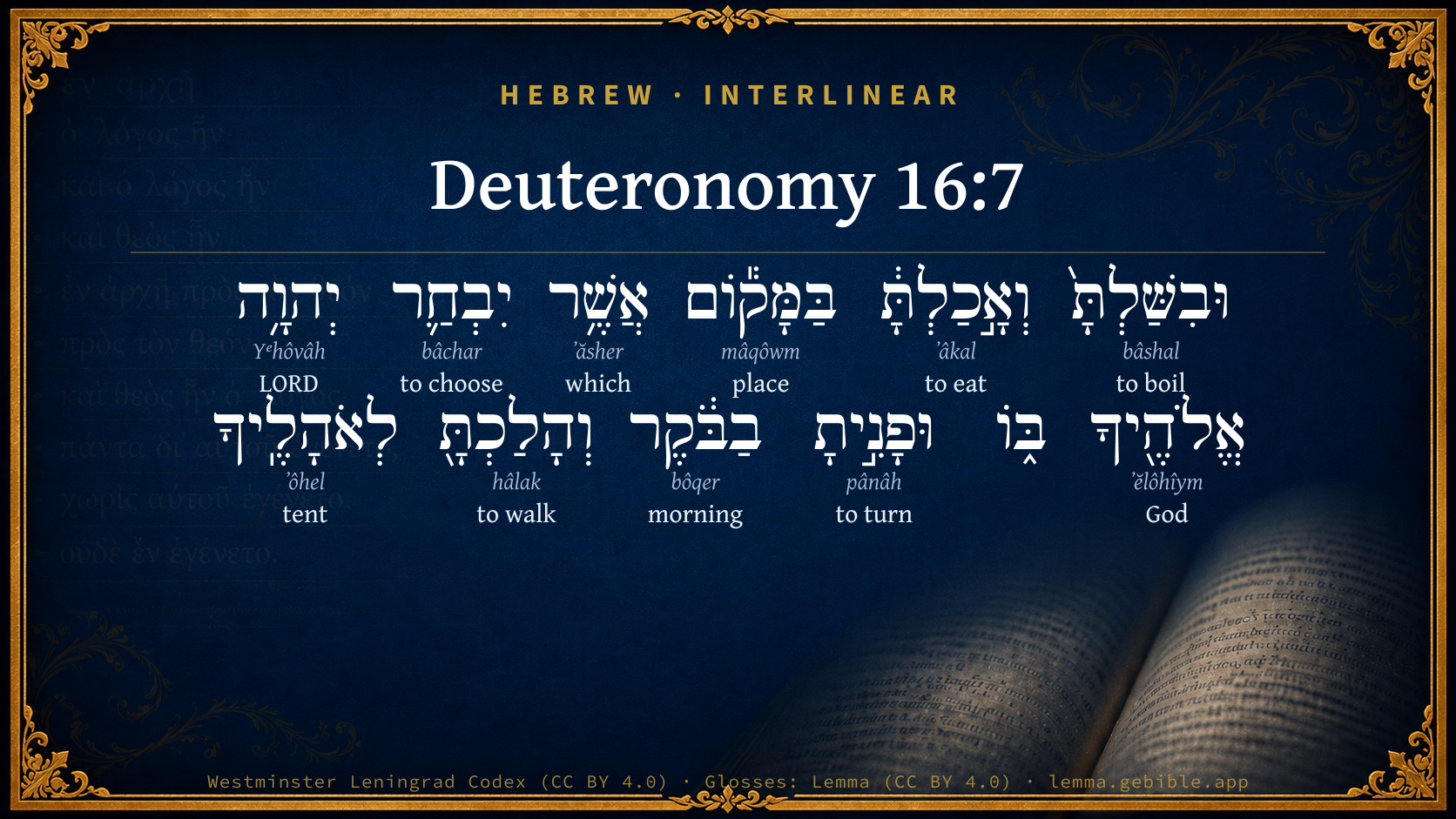
Hebrew (Westminster Leningrad Codex) Deuteronomy 16:7 appears in the Hebrew Old Testament. The text above is from the Westminster Leningrad Codex. Each word links to its Strong’s number, a concise gloss, and parsing drawn from the Open Scriptures Hebrew Bible morphology. Click any word for its full Brown-Driver-Briggs (BDB) entry.
Download image
Cite this verse

Deuteronomy 16:7 (World English Bible). Public Domain. Lemma interlinear Bible study tool, https://lemma.gebible.app/v/deuteronomy/16/7.

Show BibTeX & RIS
BibTeX
RIS
English Translation
You shall roast and eat it in the place which Yahweh your God shall choose: and you shall turn in the morning, and go to your tents.
World English Bible · Public Domain
Download a study sheet

One document with this verse’s original text, its word-by-word gloss line, the meaning frame, cross-references with their text, attributed commentary, and full source and license credits — printable, and it pastes into notes with its structure intact.

This verse Autodidact and up

Study sheet (.html) Plain text (.txt)

A passage Seminary Student

Up to 50 verses in one chapter. A passage sheet keeps up to 6 commentary sources and 12 cross-references per verse, in the order this page ranks them, and says so on the sheet whenever that leaves anything out. Ask for a single verse and you get the Autodidact verse sheet above.

Everything on this page stays free to read, with no account — the sheet is a download of what is already on screen, not access to it.

Want to remove ads? Support Godless Engineer
Compare translations 3

The same verse in 3 English versions, stacked beneath the original-language interlinear above. Click any original word for its lexicon entry.

Each is an independent rendering of the whole verse — the interlinear is not word-aligned to these translations.

Highlighted words mark where these versions differ — a whole-verse word diff, not a word-by-word alignment.

  • World English Bible Public Domain
    You shall roast and eat it in the place which Yahweh your God shall choose: and you shall turn in the morning, and go to your tents.
  • King James Version Public Domain
    And thou shalt roast and eat it in the place which the LORD thy God shall choose: and thou shalt turn in the morning, and go unto thy tents.
  • unfoldingWord Literal Text CC BY-SA 4.0
    And you shall cook and eat in the place which Yahweh your God will choose it, and in the morning you shall turn and go to your tents.

unfoldingWord Literal Text — © unfoldingWord, licensed CC BY-SA 4.0. Word-aligned USFM3 via Door43 (git.door43.org/unfoldingWord/en_ult).

Versions to compare (up to 4)

3 of 4 selected

Show all 18 translations

Every available English version of this verse, each an independent rendering of the whole verse.

  • World English Bible Public Domain
    You shall roast and eat it in the place which Yahweh your God shall choose: and you shall turn in the morning, and go to your tents.
  • Berean Standard Bible Public Domain
    And you shall roast it and eat it in the place the LORD your God will choose, and in the morning you shall return to your tents.
  • Majority Standard Bible Public Domain
    And you shall roast it and eat it in the place the LORD your God will choose, and in the morning you shall return to your tents.
  • King James Version Public Domain
    And thou shalt roast and eat it in the place which the LORD thy God shall choose: and thou shalt turn in the morning, and go unto thy tents.
  • American Standard Version (1901) Public Domain
    And thou shalt roast and eat it in the place which Jehovah thy God shall choose: and thou shalt turn in the morning, and go unto thy tents.
  • Revised Version (1885) Public Domain
    And thou shalt roast and eat it in the place which the LORD thy God shall choose: and thou shalt turn in the morning, and go unto thy tents.
  • Geneva Bible (1599) Public Domain
    And thou shalt roste and eate it in the place which the Lord thy God shall choose, and shalt returne on the morowe, and goe vnto thy tentes.
  • Douay-Rheims (1899) Public Domain
    And thou shalt dress, and eat it in the place which the Lord thy God shall choose, and in the morning rising up thou shalt go into thy dwellings.
  • Young's Literal Translation Public Domain
    and thou hast cooked and eaten in the place on which Jehovah thy God doth fix, and hast turned in the morning, and gone to thy tents;
  • Literal Standard Version CC BY-SA 4.0
    and you have cooked and eaten in the place on which your God YHWH fixes, and have turned in the morning and gone to your tents;
  • Unlocked Literal Bible CC BY-SA 4.0
    You must roast it and eat it at the place that Yahweh your God will choose; in the morning you will turn and go to your tents.
  • unfoldingWord Literal Text CC BY-SA 4.0
    And you shall cook and eat in the place which Yahweh your God will choose it, and in the morning you shall turn and go to your tents.
  • Darby Bible Public Domain
    And thou shalt cook and eat it at the place which Jehovah thy God will choose; and in the morning shalt thou turn and go unto thy tents.
  • World Messianic Bible Public Domain
    You shall roast and eat it in the place which the LORD your God chooses. In the morning you shall return to your tents.
  • Webster's Bible Public Domain
    And thou shalt roast and eat it in the place which the LORD thy God shall choose: and thou shalt turn in the morning, and go to thy tents.
  • Free Bible Version CC BY-SA 4.0
    Cook it and eat it in the place the Lord your God will choose. Then in the morning go back to your tents.
  • Bible in Basic English Public Domain
    It is to be cooked and taken as food in the place marked out by the Lord: and in the morning you are to go back to your tents.
  • JPS Tanakh (1917) Public Domain
    And thou shalt roast and eat it in the place which the LORD thy God shall choose; and thou shalt turn in the morning, and go unto thy tents.

Literal Standard Version (2020), Covenant Press — licensed CC BY-SA 4.0. Text via the HelloAO Bible API (eBible.org). Unlocked Literal Bible (unfoldingWord) — licensed CC BY-SA 4.0. Text via the HelloAO Bible API (eBible.org). unfoldingWord Literal Text — © unfoldingWord, licensed CC BY-SA 4.0. Word-aligned USFM3 via Door43 (git.door43.org/unfoldingWord/en_ult). Free Bible Version, Dr. Jonathan Gallagher — licensed CC BY-SA 4.0. Text via the HelloAO Bible API (eBible.org).

Word by word

More ways to search: Search by grammar → Find every occurrence → Compare this word →

Practice this passage: Drill this verse → Learn its vocabulary →

וּבִשַּׁלְתָּ֙
bâshal
H1310
“and · to boil”
Conjunction + Verb, Piel, Sequential Perfect, 2nd Person, Masculine, Singular
Part of Speech
Conjunction + Verb
Stem
Piel
Form
Sequential Perfect
Person
2nd Person
Gender
Masculine
Number
Singular
Full BDB Definition

Origin: a primitive root

TWOT: 292

to boil, cook, bake, roast, ripen, grow ripe - (Qal) - to boil, cook - to grow ripe, ripen - (Piel) - to boil - to cook - (Pual) - to be boiled - to be sodden - (Hiphil) - to ripen - ripen, brought to ripeness
  1. וְאָ֣כַלְתָּ֔ ʼâkal H398 “and · to eat” Conjunction + Verb, Qal, Sequential Perfect, 2nd Person, Masculine, Singular
  2. בַּמָּק֕וֹם mâqôwm H4725 “in/at the · place” Preposition, Determined + Noun, Common, Masculine, Singular, Absolute
  3. אֲשֶׁ֥ר ʼăsher H834 “which” Particle, Relative
  4. יִבְחַ֛ר bâchar H977 “to choose” Verb, Qal, Imperfect, 3rd Person, Masculine, Singular
  5. יְהוָ֥ה Yᵉhôvâh H3068 “LORD” Noun, Proper
  6. אֱלֹהֶ֖יךָ ʼĕlôhîym H430 “God(s) · your” Noun, Common, Masculine, Plural, Construct + Suffix, Personal, 2nd Person, Masculine, Singular
  7. וּפָנִ֣יתָ pânâh H6437 “and · to turn” Conjunction + Verb, Qal, Sequential Perfect, 2nd Person, Masculine, Singular
  8. בַבֹּ֔קֶר bôqer H1242 “in/at the · morning” Preposition, Determined + Noun, Common, Masculine, Singular, Absolute
  9. וְהָלַכְתָּ֖ hâlak H1980 “and · to walk” Conjunction + Verb, Qal, Sequential Perfect, 2nd Person, Masculine, Singular
  10. לְאֹהָלֶֽיךָ ʼôhel H168 “to/for · tents · your” Preposition + Noun, Common, Masculine, Plural, Construct + Suffix, Personal, 2nd Person, Masculine, Singular

About this verse

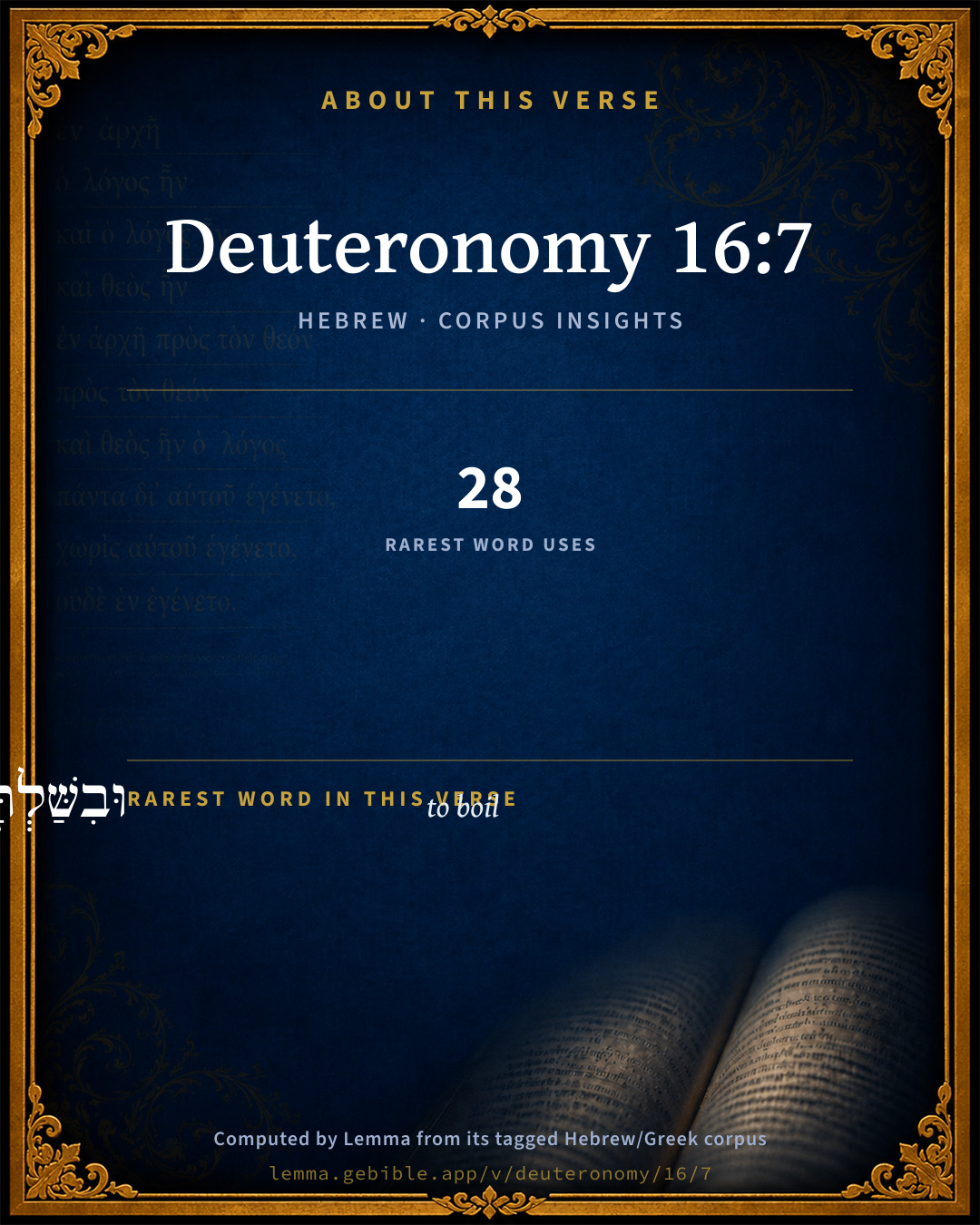
These counts appear in no published source. They are computed here, from the morphology-tagged text and Lemma’s own curated glosses. What Lemma adds →

12
words
11
distinct lemmas
Pentateuch
section

Shared distinctive vocabulary

וּבִשַּׁלְתָּ֙ to boil H1310 occurs in 24 verses of the Hebrew Bible. Also found in:

Grammatical profile

  • 5 verbs
  • 5 nouns
  • 1 preposition
  • 1 particle

Verb forms

  • וּבִשַּׁלְתָּ֙ Piel · Sequential Perfect
  • וְאָ֣כַלְתָּ֔ Qal · Sequential Perfect
  • יִבְחַ֛ר Qal · Imperfect
  • וּפָנִ֣יתָ Qal · Sequential Perfect
  • וְהָלַכְתָּ֖ Qal · Sequential Perfect

Hebrew & Septuagint length

In English translation the verse runs 27 words from the Hebrew and 31 from the Septuagint (LXX English) — closely comparable.

A rough comparison of the two English renderings, which tokenize alike — not a word-level alignment.

Word counts can differ between the Hebrew and the Greek without any difference in meaning — e.g. the Hebrew direct-object marker אֵת has no separate Greek word, and Greek often adds the article ὁ.

Cross-references

9

Topical passages linked to Deuteronomy 16:7 in the Treasury of Scripture Knowledge — connected by theme and wording, ordered by reader-vote popularity; previews shown in the World English Bible.

  • 2 Chronicles 35:13 They roasted the Passover with fire according to the ordinance: and the holy offerings boiled they in pots, and in caldrons, and in pans, and carried them quickly to all the children of the people.
  • Exodus 12:8–9 They shall eat the flesh in that night, roasted with fire, and unleavened bread. They shall eat it with bitter herbs.
  • Deuteronomy 16:2 You shall sacrifice the Passover to Yahweh your God, of the flock and the herd, in the place which Yahweh shall choose, to cause his name to dwell there.
  • Deuteronomy 16:6 but at the place which Yahweh your God shall choose, to cause his name to dwell in, there you shall sacrifice the Passover at even, at the going down of the sun, at the season that you came forth out of Egypt.
  • 2 Kings 23:23 but in the eighteenth year of king Josiah was this Passover kept to Yahweh in Jerusalem.
  • Psalms 22:14–15 I am poured out like water. All my bones are out of joint. My heart is like wax; It is melted within me.
  • John 2:13 The Passover of the Jews was at hand, and Jesus went up to Jerusalem.
  • John 2:23 Now when he was in Jerusalem at the Passover, during the feast, many believed in his name, observing his signs which he did.
  • John 11:55 Now the Passover of the Jews was at hand. Many went up from the country to Jerusalem before the Passover, to purify themselves.

Cross-references courtesy of OpenBible.info (CC BY 4.0).

Hebrew and Greek witnesses Masoretic Hebrew ↔ Greek Septuagint

The same verse in the two great witnesses to the Old Testament, shown verse-for-verse.

These are two independent witnesses, not word-aligned to each other, and the Septuagint is shown in lemma (dictionary) form.

Hebrew Deuteronomy 16:7 Masoretic · Westminster Leningrad Codex

וּבִשַּׁלְתָּ֙ וְאָ֣כַלְתָּ֔ בַּמָּק֕וֹם אֲשֶׁ֥ר יִבְחַ֛ר יְהוָ֥ה אֱלֹהֶ֖יךָ בּ֑וֹ וּפָנִ֣יתָ בַבֹּ֔קֶר וְהָלַכְתָּ֖ לְאֹהָלֶֽיךָ

You shall roast and eat it in the place which Yahweh your God shall choose: and you shall turn in the morning, and go to your tents.

World English Bible · Public Domain

Greek LXX Deuteronomy 16:7 Septuagint · lemma form

καί ἕψω καί ὀπτάω καί ἐσθίω ἐν ὁ τόπος ὅς ἐάν ἐκλέγω κύριος ὁ θεός σύ αὐτός καί ἀποστρέφω ὁ πρωΐ καί ἀποἔρχομαι εἰς ὁ οἶκος σύ

And you shall boil and roast and eat it in the place, which the Lord your God shall choose; and you shall return in the morning, and go to your house.

LXX2012 (modern English Septuagint) · Public Domain

On this verse, John Gill's Exposition discusses the Septuagint’s reading. Read the note in Commentary ↓

Hebrew: Westminster Leningrad Codex (CC BY 4.0). Greek: Septuagint (public domain); English from LXX2012 (modern English Septuagint) (Public Domain). How the Septuagint differs from the Hebrew →

Targum (Aramaic paraphrase)

2

The Targum is the ancient Jewish Aramaic paraphrase of the Hebrew Scriptures — an interpretive translation, not the Hebrew text itself. Onkelos (literal) and Pseudo-Jonathan (expansive) render the Torah, and Jonathan the Prophets. Coverage is partial: where no permissively-licensed English translation exists for a verse, only the Aramaic is shown. This is verse-level text, not a word-by-word alignment to the Hebrew.

  1. Targum Onkelos Torah (Genesis–Deuteronomy)
    וּתְבַשֵׁל וְתֵיכוּל בְּאַתְרָא דִי יִתִּרְעֵי יְיָ אֱלָהָךְ בֵּהּ וְתִתְפְּנֵי בְצַפְרָא וּתְהַךְ לְקִרְוָיךְ

    (no public-domain English translation for this verse)

    Targum Onkelos — Aramaic: “Onkelos Genesis” (public domain); “Onkelos Exodus” (public domain); “Onkelos Leviticus” (public domain); “Onkelos Numbers” (public domain); “Onkelos Deuteronomy” (public domain). English: “Sefaria Community Translation” (CC0 1.0 (public-domain dedication)); “J.W. Etheridge. The Targums of Onkelos and Jonathan Ben Uzziel on the Pentateuch. London: Longmans, Green, 1862” (public domain). Text via Sefaria.

  2. Targum Pseudo-Jonathan Torah (Genesis–Deuteronomy)
    וְתִטְווּן וְתֵיכְלוּן בְּאַתְרָא דְיִתְרְעֵי יְיָ אֱלָהָכוֹן בֵּיהּ וְתִתְפְּנֵי בְּצַפְרָא מֵיפַק חַגָא וּתְהַךְ לְקִרְוָוךְ

    And you shall dress and eat it in the place which the Lord your God will choose, and in the early morn (if need be) thou mayest return from the feast, and go to thy cities.

    Targum Pseudo-Jonathan — Aramaic: “Targum Jonathan on Genesis” (public domain); “Targum Jonathan on Exodus” (public domain); “Targum Jonathan on Leviticus” (public domain); “Targum Jonathan on Numbers” (public domain); “Targum Jonathan on Deuteronomy” (public domain). English: “The Targum of Jonathan ben Uzziel, trans. J. W. Etheridge, London, 1862” (public domain). Text via Sefaria.

Commentary

Notes on Deuteronomy 16:7 from classic Christian and Jewish commentators (each source and its license shown beneath its notes). The classic Christian expositions comment on the surrounding passage and are grouped to its opening verse, so a note may address several verses; the Jewish commentaries on the Tanakh (Rashi and others) are per-verse, so they appear only where the commentator wrote on this verse.

Lemma curates 59 commentaries, every one of them public domain or Creative Commons licensed, each selected and text-cleaned for this edition rather than reprinted as found. About our sources →

Joseph Benson's Commentary

Deu 16:7. Thou shalt turn in the morning — The words are only a permission, not an absolute command. After the solemnity was over, they might return to their several places of abode. Some think they might return, if they pleased, the very morning after the paschal lamb was killed and eaten, the priests and Levites being sufficient to carry on the rest of the week’s work. But this is evidently a mistake; for the first day of the seven was so far from being the day of their dispersion, that it was expressly appointed for a holy convocation. Nor was it their practice to disperse on that day, but to keep together the whole week, 2Ch 35:17. The meaning, therefore, is, as the paraphrase of Jonathan expounds it, In the morning, after the end of the feasts, thou shalt go to thy tents; that is, thy dwellings, which Moses calls here tents, referring to their present state, and to put them in mind afterward, when they were settled in better habitations, that there was a time when they dwelt in tents.

Joseph Benson's Commentary on the Old and New Testaments (1811–1818) — public domain. Text from a community e-Sword module.

Jamieson, Fausset & Brown

Robert Jamieson, A. R. Fausset & David Brown

thou shalt roast and eat it--(See on Exo 12:8; compare Ch2 35:13).

thou shalt turn in the morning, and go unto thy tents--The sense of this passage, on the first glance of the words, seems to point to the morning after the first day--the passover eve. Perhaps, however, the divinely appointed duration of this feast, the solemn character and important object, the journey of the people from the distant parts of the land to be present, and the recorded examples of their continuing all the time (Ch2 30:21 Ch2 35:17), (though these may be considered extraordinary, and therefore exceptional occasions), may warrant the conclusion that the leave given to the people to return home was to be on the morning after the completion of the seven days.

Jamieson, Fausset & Brown — Commentary Critical and Explanatory on the Whole Bible (1871) — public domain (CC PDM 1.0). Text via the HelloAO Bible API.

The Cambridge Bible for Schools and Colleges

gen. ed. J. J. S. Perowne

7. And thou shalt seethe] The Heb. bashal may be used in the general sense of cooking, but it usually means to boil (Deu_14:21; 1Sa_2:13; 1Sa_2:15). The R.V. roast is due to the effort to harmonise this law with that of P, Exo_12:9, which directs that the sacrifice shall be roast with fire; but P expressly adds that it shall not be boiled in water, and uses for this the same vb bashal as D does. Clearly D and P enjoin different methods of preparing the paschal lamb. Boiling appears to have been the earlier preparation of the part of victims eaten by the worshippers (Jdg_6:19 ff.; 1Sa_2:13 f.) and roasting was at first regarded as an innovation (1Sa_2:15). See however Driver’s note.

thou shalt turn] See on Deu_3:1.

and go unto thy tents] An interesting survival from the nomadic period of Israel’s history; cp. (also for the time after the settlement in towns) Jdg_7:8; Jdg_19:9 (EVV. home); 1Sa_13:2; 2Sa_19:8; 2Sa_20:22; 1Ki_12:16. The people then are to return to their homes on the morning after the Passover feast.

The Cambridge Bible for Schools and Colleges (gen. ed. J. J. S. Perowne; Cambridge University Press, 1878–1918) — public domain. Text from a community e-Sword module.

John Gill's Exposition

And thou shalt roast and eat it in the place which the Lord thy God shall choose,.... The word for "roast" signifies to "boil", and is justly so used, and so Onkelos here renders it, and the Septuagint version both roast and boil; but it is certain that the passover lamb was not to be boiled, it is expressly forbidden, Exo 12:8 wherefore some think the Chagigah is here meant, and the other offerings that were offered at this feast; and so in the times of Josiah they roasted the passover with fire, according to the ordinance of God; but the other holy offerings sod or boiled they in pots, cauldrons and pans, and divided them speedily among the people, Ch2 35:13, but the passover lamb seems plainly to be meant here by the connection of this verse with the preceding verses; wherefore Jarchi observes, that this is to be understood of roasting with fire, though expressed by this word:

and thou shalt turn in the morning, and go unto thy tents; not in the morning of the fifteenth, after the passover had been killed and eaten on the fourteenth, but in the morning, after the feast of unleavened bread, which lasted seven days, was over; though some think that they might if they would depart home after the passover had been observed, and were not obliged to stay and keep the feast of unleavened bread at Jerusalem, but march to their own cities; and so Aben Ezra observes, that some say a man may go on a feast day to his house and country, but, says he, we do not agree to it; and it appears from the observation of other feasts, which lasted as long as these, that the people did not depart to their tents till the whole was over; see Kg1 8:66 and with this agrees the Targum of Jonathan,"and thou shall turn in the morning of the going out of the feast, and go to thy cities.''Jarchi indeed interprets it afterwards of the second day.

John Gill's Exposition of the Whole Bible (1746–1763) — public domain (CC PDM 1.0). Text via the HelloAO Bible API.

Haydock's Catholic Bible Commentary

Dress, (coques.) Hebrew bashal means frequently, to boil, and sometimes to roast, as it must here, if it refer to the paschal lamb; the other victims might however be boiled, and the Septuagint use both expressions, "Thou shalt boil and roast." See 2 Paralipomenon xxxv. 13. It seems that Moses speaks only of the lamb, the method of preparing which he had abundantly explained before. (Calmet) --- Hebrew has not it, and of course the passage may be understood of all the victims offered on this solemnity. On the morning after it was concluded, people might all depart to their respective homes. The Rabbins observe, that the could not do this on the morning of the 15th Nisan, as it was a solemn festival, on which long journeys were prohibited, and they ought to wait till the end of the seventh day, to make their offering. Under Ezechias and Josias the people appear to have continued together during the whole octave, 2 Paralipomenon xxx., and xxxv. 17. (Haydock) --- Others are of opinion that the people might retire home after the 15th, (Tostat) or in the morning after they had eaten the paschal lamb. (Calmet)

George Leo Haydock (1774–1849), Haydock's Catholic Family Bible and Commentary, 1859 edition — public domain. Excludes Psalms (Douay-Rheims chapter numbering differs from Protestant) and Deuterocanonical books (Catholic canon only).

Matthew Poole's English Annotations

Thou shalt roast; so that word is used also 2Ch 35:13.

In the morning; either,

1. The morning after the seventh day, as appears, partly, by the following verse, which is added to explain and limit this ambiguous word; partly, by the express command of God that the people should come to Jerusalem to keep this feast, which by God’s appointment lasted for seven days; partly, from the examples of the people staying there the whole time of the feast, 2Ch 30:21; 35:17; and partly, from the nature and business of this feast, wherein there being so many extraordinary sacrifices to be offered, and feasts made by the people upon the sacrifices, and two days of solemn assemblies, it is not probable that they would absent themselves from these solemn services, for the performance whereof they came purposely to Jerusalem. Or,

2. The morning after the first day, and so they were permitted to go then, and possibly some that lived near Jerusalem might go and return again to the last day of the solemn assembly. But the former seems more probable.

Thy tents, i.e. thy dwellings, which he calls tents, as respecting their present state, and withal to put them in mind afterwards when they were settled in better habitations, that there was a time when they dwelt in tents.

Matthew Poole's English Annotations on the Holy Bible (1683–1685) — public domain. Text from a community e-Sword/MySword module.

Whedon's Commentary on the Bible

Daniel D. Whedon

7. Thou shalt roast — The Hebrew word בשׁל (bashal) may mean to boil, but it is also used in a general sense of preparing food for use by cooking.

Go unto thy tents — Or, dwellings. The term tents may have been used to remind them of their long dwelling in tents through the years of their wandering.

Daniel D. Whedon (gen. ed.), Commentary on the Old and New Testaments (1874–1909) — public domain. Text from a community e-Sword module.

The Pulpit Commentary

Thou shalt roast. The verb here primarily signifies to be matured by heat for eating; hence to be ripened as by the sun"s heat (Gen_40:10; Joe_3:13; Heb_4:13) and to be cooked, whether by boiling, seething, or roasting. Here it is properly rendered by roast, as it was thus only that the Paschal lamb could be cooked. And go unto thy tents; return to thy place of abode; not necessarily to thy proper home (which might be far distant), but to the place where for the time thou hast thy lodging. The phrase, "thy tents," which originally came into use while as yet Israel had no settled abodes in Canaan, came afterwards to be used as a general designation of a man"s home or usual place of abode (cf. 1Sa_13:2; 2Sa_20:1; 1Ki_8:66, etc.)

The Pulpit Commentary (1880–1919), ed. H.D.M. Spence-Jones & Joseph S. Exell — public domain. Text from a community e-Sword module.

John Wesley's Explanatory Notes

In the morning - The morning after the seventh day. Thy tents - That is, thy dwellings, which he calls tents, as respecting their present state, and to put them in mind afterwards when they were settled in better habitations, that there was a time when they dwelt in tents.

John Wesley, Explanatory Notes Upon the Whole Bible (1754–1765) — public domain. Text via the GEBible commentary corpus.

unfoldingWord translationNotes

Door43 World Missions Community

You must roast it

"You must cook it"

six days

"6 days" (See: Numbers)

seventh day

"seventh" is the ordinal number for seven. (See: Ordinal Numbers)

solemn assembly

"special gathering"

translationWords

tent

day

unleavened bread

assembly

works

unfoldingWord translationNotes — © Distant Shores Media and the Door43 World Missions Community, licensed CC BY-SA 4.0. Source: git.door43.org/Door43/en_tn.

Rashi

Rabbi Shlomo Yitzchaki (Rashi)

ובשלת is identical with צלי אש “roast with fire” mentioned in Exodus 12:9, for it (roasting) also comes under the term בשול “cooking” (Mekhilta).

ופנית בבקר AND THOU SHALT TURN IN THE MORNING [AND GO INTO THY TENTS] — i.e. in the morning of the second day of the Passover week. — It teaches us that he (the pilgrim) is required to stay in Jerusalem during the night when the festival terminates (Sifrei Devarim 134:2; Pesachim 95b; Chagigah 17).

Rashi on the Tanakh — English translations: “The Judaica Press complete Tanach with Rashi, translated by A. J. Rosenberg” (CC BY 4.0); “Pentateuch with Rashi's commentary by M. Rosenbaum and A.M. Silbermann, 1929-1934” (public domain); “The Metsudah Tanach series, Lakewood, N.J” (CC BY 4.0); and “The Book of Joshua, Metsudah Publications, 1997” (CC BY 4.0). Text via Sefaria.

Lesson kit

Teaching starters — assembled from the data on this page, not authored interpretation. Every prompt links to the verse data it draws on. Edit before teaching.

Deuteronomy, in the Pentateuch, opens this verse with 12 words (11 distinct Hebrew lemmas). Its most distinctive word is bâshal (“to boil”). A historical commentator’s framing appears above. Read the whole chapter for the surrounding context.

Discussion questions

  1. What does “to boil” (bâshal) contribute to the verse as a whole?
  2. How does Genesis 40:10, which shares the word «to boil», read alongside this verse?
  3. These translations render this verse differently. What is at stake in choosing one wording over another?
  4. «וּבִשַּׁלְתָּ֙» is a Piel Sequential Perfect verb. How does that grammatical form shape the action described?
  5. Compare how Joseph Benson's Commentary and Jamieson, Fausset & Brown read this verse. Where do they agree or differ?

Things to notice

Reading settings

Reading text

Shown beneath each verse's original-language words.

Old Testament
Old Testament edition

Read the OT as the Masoretic Hebrew (MT) or the Greek Septuagint (LXX).

English shown for the Greek Septuagint (in the Hebrew ↔ Greek comparison).

Comparing translations? Open the Compare panel on any verse page to stack up to four side by side.