
Judges 4:11

Hebrew (Westminster Leningrad Codex) Judges 4:11 appears in the Hebrew Old Testament. The text above is from the Westminster Leningrad Codex. Each word links to its Strong’s number, a concise gloss, and parsing drawn from the Open Scriptures Hebrew Bible morphology. Click any word for its full Brown-Driver-Briggs (BDB) entry.
Download image
Cite this verse

Judges 4:11 (World English Bible). Public Domain. Lemma interlinear Bible study tool, https://lemma.gebible.app/v/judges/4/11.

Show BibTeX & RIS
BibTeX
RIS
English Translation
Now Heber the Kenite had separated himself from the Kenites, even from the children of Hobab the brother-in-law of Moses, and had pitched his tent as far as the oak in Zaanannim, which is by Kedesh.
World English Bible · Public Domain
Download a study sheet

One document with this verse’s original text, its word-by-word gloss line, the meaning frame, cross-references with their text, attributed commentary, and full source and license credits — printable, and it pastes into notes with its structure intact.

This verse Autodidact and up

Study sheet (.html) Plain text (.txt)

A passage Seminary Student

Up to 50 verses in one chapter. A passage sheet keeps up to 6 commentary sources and 12 cross-references per verse, in the order this page ranks them, and says so on the sheet whenever that leaves anything out. Ask for a single verse and you get the Autodidact verse sheet above.

Everything on this page stays free to read, with no account — the sheet is a download of what is already on screen, not access to it.

Want to remove ads? Support Godless Engineer
Compare translations 3

The same verse in 3 English versions, stacked beneath the original-language interlinear above. Click any original word for its lexicon entry.

Each is an independent rendering of the whole verse — the interlinear is not word-aligned to these translations.

Highlighted words mark where these versions differ — a whole-verse word diff, not a word-by-word alignment.

  • World English Bible Public Domain
    Now Heber the Kenite had separated himself from the Kenites, even from the children of Hobab the brother-in-law of Moses, and had pitched his tent as far as the oak in Zaanannim, which is by Kedesh.
  • King James Version Public Domain
    Now Heber the Kenite, which was of the children of Hobab the father in law of Moses, had severed himself from the Kenites, and pitched his tent unto the plain of Zaanaim, which is by Kedesh.
  • unfoldingWord Literal Text CC BY-SA 4.0
    Now Heber the Kenite had separated himself from Kain, from the sons of Hobab, the father-in-law of Moses. And he had pitched his tent near an oak tree in Zaanannim, which near Kedesh.

unfoldingWord Literal Text — © unfoldingWord, licensed CC BY-SA 4.0. Word-aligned USFM3 via Door43 (git.door43.org/unfoldingWord/en_ult).

Versions to compare (up to 4)

3 of 4 selected

Show all 18 translations

Every available English version of this verse, each an independent rendering of the whole verse.

  • World English Bible Public Domain
    Now Heber the Kenite had separated himself from the Kenites, even from the children of Hobab the brother-in-law of Moses, and had pitched his tent as far as the oak in Zaanannim, which is by Kedesh.
  • Berean Standard Bible Public Domain
    Now Heber the Kenite had moved away from the Kenites, the descendants of Hobab the father-in-law of Moses, and had pitched his tent by the great tree of Zaanannim, which was near Kedesh.
  • Majority Standard Bible Public Domain
    Now Heber the Kenite had moved away from the Kenites, the descendants of Hobab the father-in-law of Moses, and had pitched his tent by the great tree of Zaanannim, which was near Kedesh.
  • King James Version Public Domain
    Now Heber the Kenite, which was of the children of Hobab the father in law of Moses, had severed himself from the Kenites, and pitched his tent unto the plain of Zaanaim, which is by Kedesh.
  • American Standard Version (1901) Public Domain
    Now Heber the Kenite had separated himself from the Kenites, even from the children of Hobab the brother-in-law of Moses, and had pitched his tent as far as the oak in Zaanannim, which is by Kedesh.
  • Revised Version (1885) Public Domain
    Now Heber the Kenite had severed himself from the Kenites, even from the children of Hobab the brother in law of Moses, and had pitched his tent as far as the oak in Zaanannim, which is by Kedesh.
  • Geneva Bible (1599) Public Domain
    (Now Heber the Kenite, which was of the children of Hobab the father in lawe of Moses, was departed from the Kenites, and pitched his tent vntill the playne of Zaanaim, which is by Kedesh)
  • Douay-Rheims (1899) Public Domain
    Now Haber the Cinite had some time before departed from the rest of the Cinites his brethren the sons of Hobab, the kinsman of Moses: and had pitched his tents unto the valley which is called Sellnim, and was near Cedes.
  • Young's Literal Translation Public Domain
    And Heber the Kenite hath been separated from the Kenite, from the sons of Hobab father-in-law of Moses, and he stretcheth out his tent unto the oak in Zaanaim, which `is' by Kedesh.
  • Literal Standard Version CC BY-SA 4.0
    And Heber the Kenite has been separated from the Kenite, from the sons of Hobab father-in-law of Moses, and he stretches out his tent to the oak in Zaanaim, which [is] by Kedesh.
  • Unlocked Literal Bible CC BY-SA 4.0
    Now Heber (the Kenite) had separated himself from the Kenites—they were the descendants of Hobab (Moses' father-in-law)—and he pitched his tent by the oak in Zaanannim near Kedesh.
  • unfoldingWord Literal Text CC BY-SA 4.0
    Now Heber the Kenite had separated himself from Kain, from the sons of Hobab, the father-in-law of Moses. And he had pitched his tent near an oak tree in Zaanannim, which near Kedesh.
  • Darby Bible Public Domain
    Now Heber the Ken'ite had separated from the Ken'ites, the descendants of Hobab the father-in-law of Moses, and had pitched his tent as far away as the oak in Za-anan'nim, which is near Kedesh.
  • World Messianic Bible Public Domain
    Now Heber the Kenite had separated himself from the Kenites, even from the children of Hobab, Moses’ brother-in-law, and had pitched his tent as far as the oak in Zaanannim, which is by Kedesh.
  • Webster's Bible Public Domain
    Now Heber the Kenite, who was of the children of Hobab the father-in-law of Moses, had severed himself from the Kenites, and pitched his tent to the plain of Zaanaim, which is by Kedesh.
  • Free Bible Version CC BY-SA 4.0
    (Heber the Kenite had separated from the other Kenites, the descendants of Hobab, the father-in-law of Moses, and had set up his tent at the large tree in Zaanannim, which is near Kedesh.)
  • Bible in Basic English Public Domain
    Now Heber the Kenite, separating himself from the rest of the Kenites, from the children of Hobab, the brother-in-law of Moses, had put up his tent as far away as the oak-tree in Zaanannim, by Kedesh.
  • JPS Tanakh (1917) Public Domain
    Now Heber the Kenite had severed himself from the Kenites, even from the children of Hobab the father-in-law of Moses, and had pitched his tent as far as Elon-bezaanannim, which is by Kedesh.

Literal Standard Version (2020), Covenant Press — licensed CC BY-SA 4.0. Text via the HelloAO Bible API (eBible.org). Unlocked Literal Bible (unfoldingWord) — licensed CC BY-SA 4.0. Text via the HelloAO Bible API (eBible.org). unfoldingWord Literal Text — © unfoldingWord, licensed CC BY-SA 4.0. Word-aligned USFM3 via Door43 (git.door43.org/unfoldingWord/en_ult). Free Bible Version, Dr. Jonathan Gallagher — licensed CC BY-SA 4.0. Text via the HelloAO Bible API (eBible.org).

Word by word

More ways to search: Search by grammar → Find every occurrence → Compare this word →

Practice this passage: Drill this verse → Learn its vocabulary →

חֹבָ֖ב
Chôbâb
H2246
“Hobab”
Noun, Proper
Part of Speech
Noun
Type
Proper
Full BDB Definition

Origin: from H2245

TWOT: None

Hobab = "cherished" - the son of Reuel, the Midianite father-in-law of Moses, also known as Jethro, and brother-in-law of Moses
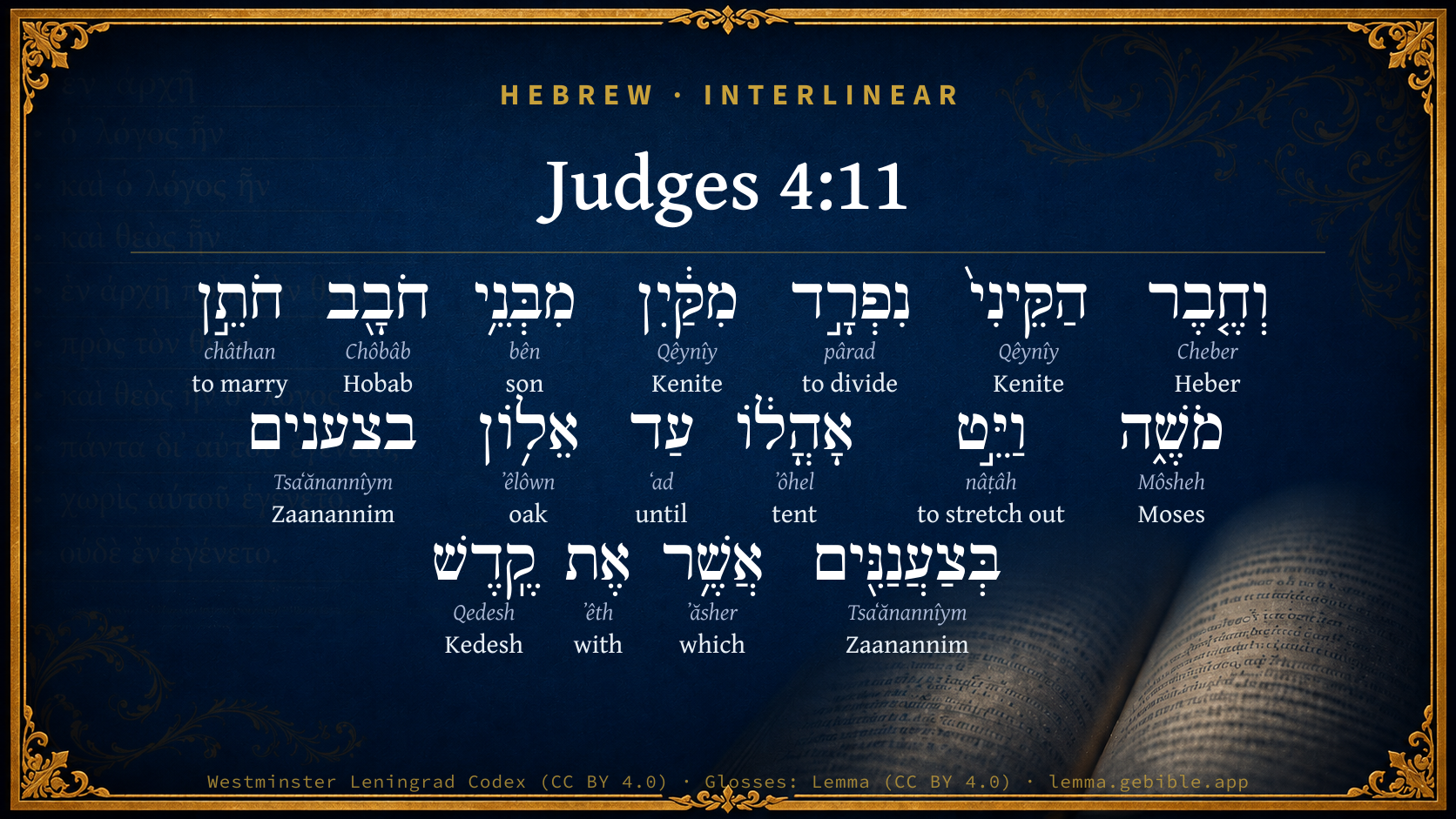
  1. וְחֶ֤בֶר Cheber H2268 “and · Heber” Conjunction + Noun, Proper
  2. הַקֵּינִי֙ Qêynîy H7017 “the · Kenite” Particle, Definite Article + Noun, Gentilic, Masculine, Singular, Absolute
  3. נִפְרָ֣ד pârad H6504 “dividing” Verb, Niphal, Participle Active, Masculine, Singular, Absolute
  4. מִקַּ֔יִן Qêynîy H7017 “from · Kenite” Preposition + Noun, Proper
  5. מִבְּנֵ֥י bên H1121 “from · sons of” Preposition + Noun, Common, Masculine, Plural, Construct
  6. חֹתֵ֣ן châthan H2859 “marrying” Verb, Qal, Participle Active, Masculine, Singular, Construct
  7. מֹשֶׁ֑ה Môsheh H4872 “Moses” Noun, Proper
  8. וַיֵּ֣ט nâṭâh H5186 “and · to stretch out” Conjunction + Verb, Qal, Sequential Imperfect, 3rd Person, Masculine, Singular
  9. אָהֳל֔וֹ ʼôhel H168 “tent · his” Noun, Common, Masculine, Singular, Construct + Suffix, Personal, 3rd Person, Masculine, Singular
  10. עַד ʻad H5704 “until” Preposition
  11. אֵל֥וֹן ʼêlôwn H436 “oak” Noun, Common, Masculine, Singular, Absolute
  12. בצענים Tsaʻănannîym H6815 “in/at · Zaanannim” Preposition + Noun, Proper
  13. בְּצַעֲנַנִּ֖ים Tsaʻănannîym H6815 “in/at · Zaanannim” Preposition + Noun, Proper
  14. אֲשֶׁ֥ר ʼăsher H834 “which” Particle, Relative
  15. אֶת ʼêth H854 “with” Preposition
  16. קֶֽדֶשׁ Qedesh H6943 “Kedesh” Noun, Proper

About this verse

These counts appear in no published source. They are computed here, from the morphology-tagged text and Lemma’s own curated glosses. What Lemma adds →

17
words
15
distinct lemmas
Historical
section

Notable vocabulary

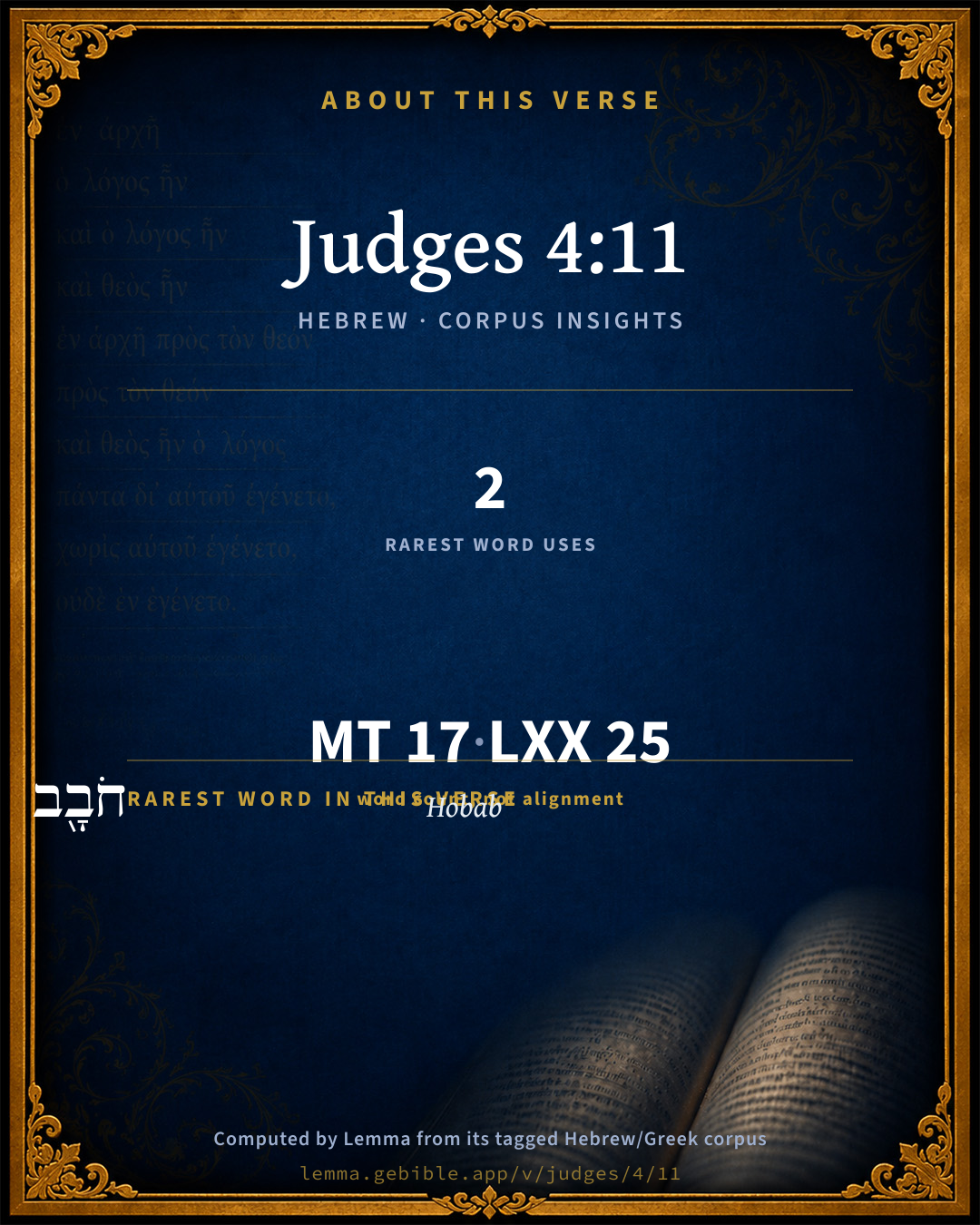
The rarest word here is חֹבָ֖ב Hobab H2246 — appearing just 2 times in the whole Hebrew Bible.

Shared distinctive vocabulary

חֹבָ֖ב Hobab H2246 occurs in 2 verses of the Hebrew Bible. Also found in:

Grammatical profile

  • 3 verbs
  • 11 nouns
  • 2 prepositions
  • 1 particle

Verb forms

  • נִפְרָ֣ד Niphal · Participle Active
  • חֹתֵ֣ן Qal · Participle Active
  • וַיֵּ֣ט Qal · Sequential Imperfect

Repetition

Words recur within this verse — often emphatic in Hebrew:

  • הַקֵּינִי֙ Kenite H7017 ×2
  • בצענים Zaanannim H6815 ×2

Hebrew & Septuagint length

In English translation the verse runs 36 words from the Hebrew and 32 from the Septuagint (LXX English) — closely comparable.

A rough comparison of the two English renderings, which tokenize alike — not a word-level alignment.

Word counts can differ between the Hebrew and the Greek without any difference in meaning — e.g. the Hebrew direct-object marker אֵת has no separate Greek word, and Greek often adds the article ὁ.

In the original languages it is 17 Hebrew tokens and 25 Greek tokens — but the two are counted differently (Hebrew bundles its prefixes and suffixes into one token; the Greek is in lemma form), so that isn’t a like-for-like length.

Cross-references

9

Topical passages linked to Judges 4:11 in the Treasury of Scripture Knowledge — connected by theme and wording, ordered by reader-vote popularity; previews shown in the World English Bible.

  • Numbers 10:29 Moses said to Hobab, the son of Reuel the Midianite, Moses' father-in-law, We are journeying to the place of which Yahweh said, I will give it you: come you with us, and we will do you good; for Yahweh has spoken good concerning Israel.
  • Joshua 19:33 Their border was from Heleph, from the oak in Zaanannim, and Adaminekeb, and Jabneel, to Lakkum; and the goings out of it were at the Jordan;
  • Judges 1:16 The children of the Kenite, Moses' brother-in-law, went up out of the city of palm trees with the children of Judah into the wilderness of Judah, which is in the south of Arad; and they went and lived with the people.
  • Joshua 19:37 and Kedesh, and Edrei, and En Hazor,
  • Exodus 3:1 Now Moses was keeping the flock of Jethro, his father-in-law, the priest of Midian, and he led the flock to the back of the wilderness, and came to God's mountain, to Horeb.
  • Exodus 2:18 When they came to Reuel, their father, he said, "How is it that you have returned so early today?"
  • Exodus 18:1 Now Jethro, the priest of Midian, Moses' father-in-law, heard of all that God had done for Moses, and for Israel his people, how that Yahweh had brought Israel out of Egypt.
  • Numbers 24:21 He looked at the Kenite, and took up his parable, and said, Strong is your dwelling-place, Your nest is set in the rock.
  • Judges 4:6 She sent and called Barak the son of Abinoam out of Kedesh-naphtali, and said to him, Hasn't Yahweh, the God of Israel, commanded, [saying], Go and draw to Mount Tabor, and take with you ten thousand men of the children of Naphtali and of the children of Zebulun?

Cross-references courtesy of OpenBible.info (CC BY 4.0).

Hebrew and Greek witnesses Masoretic Hebrew ↔ Greek Septuagint

The same verse in the two great witnesses to the Old Testament, shown verse-for-verse.

These are two independent witnesses, not word-aligned to each other, and the Septuagint is shown in lemma (dictionary) form.

Hebrew Judges 4:11 Masoretic · Westminster Leningrad Codex

וְחֶ֤בֶר הַקֵּינִי֙ נִפְרָ֣ד מִקַּ֔יִן מִבְּנֵ֥י חֹבָ֖ב חֹתֵ֣ן מֹשֶׁ֑ה וַיֵּ֣ט אָהֳל֔וֹ עַד אֵל֥וֹן בצענים בְּצַעֲנַנִּ֖ים אֲשֶׁ֥ר אֶת קֶֽדֶשׁ

Now Heber the Kenite had separated himself from the Kenites, even from the children of Hobab the brother-in-law of Moses, and had pitched his tent as far as the oak in Zaanannim, which is by Kedesh.

World English Bible · Public Domain

Greek LXX Judges 4:11 Septuagint · lemma form

καί χαβερ ὁ κιναῖος χωρίζω ἀπό καινα ἀπό ὁ υἱός ιωβαβ γαμβρός μωυσῆς καί πήγνυμι ὁ σκηνή αὐτός ἕως δρῦς πλεονεκτέω ὅς εἰμί ἔχω κεδες

And Chaber the Kenite had removed from Caina, from the sons of Jobab the father-in-law of Moses, and pitched his tent by the oak of the covetous ones, which is near Kedes.

LXX2012 (modern English Septuagint) · Public Domain

On this verse, The Cambridge Bible for Schools and Colleges discusses the Septuagint’s reading. Read the note in Commentary ↓

Hebrew: Westminster Leningrad Codex (CC BY 4.0). Greek: Septuagint (public domain); English from LXX2012 (modern English Septuagint) (Public Domain). How the Septuagint differs from the Hebrew →

Targum (Aramaic paraphrase)

1

The Targum is the ancient Jewish Aramaic paraphrase of the Hebrew Scriptures — an interpretive translation, not the Hebrew text itself. Onkelos (literal) and Pseudo-Jonathan (expansive) render the Torah, and Jonathan the Prophets. Coverage is partial: where no permissively-licensed English translation exists for a verse, only the Aramaic is shown. This is verse-level text, not a word-by-word alignment to the Hebrew.

  1. Targum Jonathan Prophets (Joshua–Malachi)
    וְחֶבֶר שַׁלְמָאָה אִתְפָּרַשׁ מִשַׁלְמָאֵי מִבְּנֵי חוֹבָב חֲמוּהִי דְמֹשֶׁה וּפַרְסֵיהּ לְמַשְׁכְּנֵיהּ עַד מֵישַׁר אַגְנַיָא דְעִם קֶדֶשׁ:

    (no public-domain English translation for this verse)

    Targum Jonathan — Aramaic: “Mikraot Gedolot” (public domain). English: “Sefaria Community Translation” (CC0 1.0 (public-domain dedication)); “London "Chaldee Paraphrase," 1871” (public domain). Text via Sefaria.

Commentary

Notes on Judges 4:11 from classic Christian and Jewish commentators (each source and its license shown beneath its notes). The classic Christian expositions comment on the surrounding passage and are grouped to its opening verse, so a note may address several verses; the Jewish commentaries on the Tanakh (Rashi and others) are per-verse, so they appear only where the commentator wrote on this verse.

Lemma curates 59 commentaries, every one of them public domain or Creative Commons licensed, each selected and text-cleaned for this edition rather than reprinted as found. About our sources →

The Cambridge Bible for Schools and Colleges

gen. ed. J. J. S. Perowne

11. Now Heber the Kenite] The verse explains, with a view to Jdg_4:17 ff., how the Kenites, who belonged properly to southern Palestine (see on Jdg_1:16), came to be in this region: the family of Heber had branched off (cf. Gen_10:5; Gen_10:32) from the main clan, and pitched their tents as far north as the Tree of Bezaanim (so read, as below), near Kedesh. The words even from the children of Hobab … Moses are a gloss on from Kain, probably derived from Jdg_1:16 in its original form. It is impossible to reconcile the geographical data in the narrative as it stands. Heber’s encampment is here said to be near Kedesh, which must be Kedesh-naphtali, judging from Jdg_4:17 b, where Heber is brought into relation with Jabin king of Hazor. But Jdg_4:18 ff. require a position for the Kenite tents in quite a different quarter, near the battle-field by the Kishon, on the route of Sisera’s flight. Kedesh and Hazor are elements in the story of Jabin (see Jdg_4:6 n.); while Jael, and from her we can hardly separate Heber, belongs to the story of Sisera; yet in Jdg_4:17 b Heber is connected with Jabin. The difficulty may be relieved by supposing that the writer who combined the two stories, the writer responsible for making Sisera the general of Jabin’s army Jdg_4:7, has here confused Kedesh in Naphtali with another place of the same name, and thus brought Heber into connexion with Jabin, though originally they had nothing to do with each other. Two alternatives as to the position of another Kedesh may be considered. (1) In 1Ch_6:72 a Kedesh in Issachar is mentioned (but Jos_19:20; Jos_21:28 give Kishion), perhaps Tell Abû Ḳudçs between Megiddo and Taanach; this would suit Jdg_4:11; Jdg_4:17 a, 18 ff. Near this must be placed the Tree of Bezaanim, doubtless a sacred tree, not necessarily an oak. The name occurs again in Jos_19:33 (see RVm.), but not in such a way as to determine its situation; it is mentioned as lying on the boundary of Naphtali, and this raises a difficulty—it could not be described as ‘near Kedesh’ in Issachar (? Abû Ḳudçs). (2) Bezaanim (so read for in Zaanannim), Βεσεμιείν Jos_19:33 LXX. B, is identified by Conder (Tent Work, p. 68 ff.), followed by G. A. Smith (Hist. Geogr., p. 395f.), with Khirbet Bessûm on the plateau W. of the lake of Tiberias; to the W. there lies a Kedesh, 12 m. from Tabor, on the lake; not far off is Dâmiyeh, perhaps the Adâmi of Jos_19:33. We thus obtain the required conditions; but the identifications are very uncertain, and if we accept them we must give up the identification of Harosheth with Ḥârithîyeh, which would then lie too far from the battle-field. There are difficulties in both explanations, fewest perhaps in (1).

The Cambridge Bible for Schools and Colleges (gen. ed. J. J. S. Perowne; Cambridge University Press, 1878–1918) — public domain. Text from a community e-Sword module.

Trapp's Complete Commentary

John Trapp

Jdg 4:11 Now Heber the Kenite, [which was] of the children of Hobab the father in law of Moses, had severed himself from the Kenites, and pitched his tent unto the plain of Zaanaim, which [is] by Kedesh.

Ver. 11. Had severed himself from the Kenites.] Who dwelt in the wilderness of Judah. {Jdg 1:16} Why he severed himself is not expressed; perhaps for better pasture’s sake, or it may be for conveniency of contemplation; for it is said in the next words, that he pitched his tent into the plain - or oak, or grove, as the Septuagint and others render it - of Zaanam. Bernard confessed of himself, that what knowledge of the Scriptures he had attained unto, he had got it in the woods and fields by meditation and prayer, Nullos se aliquando magistros habuisse nisi quercus et fagos, but the oaks and beech trees.

John Trapp, A Commentary or Exposition upon All the Books of the Old and New Testament (1647–1656) — public domain. Text from a community e-Sword module.

Joseph Benson's Commentary

Jdg 4:11-12. Now Heber the Kenite — The husband of Jael. Had severed himself from the Kenites — From the rest of his brethren, who lived in the wilderness of Judah. What the reason was of his leaving them, is not known; but there was a special providence of God in it. Pitched his tent — That is, his dwelling, which probably was in tents, as shepherds used to live. They showed Sisera — That is, his people showed him, or his spies.

Joseph Benson's Commentary on the Old and New Testaments (1811–1818) — public domain. Text from a community e-Sword module.

Geneva Bible (1599)

Geneva Bible translators

Or, posterity.

Hebrew, from Cain.

Meaning, that he possessed a great part of that country.

Geneva Bible (1599) marginal notes — public domain. Text via Bolls.life.

Jamieson, Fausset & Brown

Robert Jamieson, A. R. Fausset & David Brown

Now Heber the Kenite . . . pitched his tent--It is not uncommon, even in the present day, for pastoral tribes to feed their flocks on the extensive commons that lie in the heart of inhabited countries in the East (see on Jdg 1:16).

plain of Zaanaim--This is a mistranslation for "the oaks of the wanderers." The site of the encampment was under a grove of oaks, or terebinths, in the upland valley of Kedesh.

Jamieson, Fausset & Brown — Commentary Critical and Explanatory on the Whole Bible (1871) — public domain (CC PDM 1.0). Text via the HelloAO Bible API.

Adam Clarke's Commentary

Verse 11. Hohab the father-in-law of Moses] For a circumstantial account of this person, and the meaning of the original word חתן chothen, which is translated son-in-law in Ge 19:14, see the notes on Ex 2:15-16; Ex 2:18; Ex 3:1; Ex 4:20; Ex 4:24; Ex 18:5.

Adam Clarke's Commentary on the Bible (1810–1826) — public domain. Text from a community e-Sword/MySword module.

Ellicott's Commentary for English Readers

(11) Heber the Kenite.—See Jdg_1:16; Jdg_3:31; Num_10:29.

Which was of the children of Hobab.—Rather, had separated himself from Kain,from the children of Hobab. Nomadic settlements are constantly liable to send off these separate colonies. The life and movements of the Kenites resembled those of gipsies, except that they had flocks and herds. To this day a small Bedouin settlement presents very nearly the same aspect as a gipsy camp.

The father in law of Moses.—Rather, the brother-in-law. The names for these relationships are closely allied. (See Note on Jdg_1:16.)

Pitched his tent.—(Gen_12:8, &c.) The “tents” of the Bedouin are not the bell-shaped tents with which we are familiar, but coverings of black goats’ hair, sometimes supported on as many as nine poles. The Arab word for tent is beit, “house.”

Unto the plain of Zaanaim.—Rather, unto the terebinth in Zaanaim. (See Jos_19:33.) Great trees are often alluded to in Scripture. (Allon-Bachuth, Gen_35:8, “the oak of Tabor”; 1Sa_10:3, “the oak of the house of grace”; 1Ki_4:9, “the enchanters’ oak”; Jdg_9:37; Jos_24:26, &c.) This terebinth is again alluded to in Jos_19:33; and the size and beauty of the terebinths on the hills of Naphtali, to which we find allusion in the blessing of Jacob, probably led to its adoption as the symbol of the tribe. “Naphtali is a branching terebinth” (Gen_49:21). The word elon (אלון) is constantly rendered “plain” by our translators (Jdg_9:6-37; Gen_12:6; Gen_13:18; 1Sa_10:3, &c), because they were misled by the Targums and the Vulgate, which render it sometimes by vallis and convallis. They always render the cognate word allon by “oak,” and, in the looseness of common nomenclature, the “oak” and the “terebinth” were not always carefully distinguished. There is a large terebinth, called Sigar em-Messiah, six miles north-west of Kedes. The word Zaanaim (also written Zaannanim) means “wanderings,” or “unlading of tents,” with possible reference to this nomad settlement. The LXX. render it “the oak of the covetous,” because they follow another reading. In contrast with these “wandering tents” of the Bedouin, Jerusalem is called in Isa_33:20 “a tent that wanders not.”

Ewald, following the Targum, makes it mean “the plain of the swamp,” and this is also found in the Talmud, which seems to indicate this place by Aquizah hak-Kedesh (“swamp of the holy place”).

Which is by Kedesh.—Oaks and terebinths are still found abundantly in this neighbourhood; and such a green plain studded with trees would be a natural camping-ground for the Kenites.

A Bible Commentary for English Readers, edited by Charles John Ellicott (1878–1897) — public domain. Text from a community e-Sword module.

John Gill's Exposition

Now Heber the Kenite,.... A descendant of Kain, a principal man among the Midianites; the Targum calls him the Salmaean:

which was of the children of Hobab the father in law of Moses; who came along with the children of Israel through the wilderness into the land of Canaan, and first settled about Jericho, and then removed into the wilderness of Judah, Jdg 1:16,

had severed himself from the Kenites; which dwelt in the said wilderness; to whom he belonged when this separation was made, and on what account is not certain. Abarbinel thinks that it was done now, and with a design to help Israel, that hearing Barak was gone up to Mount Tabor, and seeing Sisera prepared to fight with him, he made as if he was disgusted with his own people, and separated from them, that Jabin, with whom he was at peace, might the more confide in him; when it was out of love to Israel, and with a view to assist them, as occasion should offer, that he removed; but this is not very likely, as these Kenites were a people that kept themselves from meddling with military affairs as much as possible:

and pitched his tent unto the plain of Zaanaim, which is by Kedesh: for these people dwelt in tents as the Midianites did, from whence they sprung, and as the Scenite Arabs; and yet near to cities, as here, and in places fit for the pasturage of their cattle, in which they were chiefly employed, and here pitched upon a plain where were fields and meadows: the Targum calls it a plain of pools, where were pools of water for the watering of their flocks; or rather it might be rendered the oak or grove of oaks of Zaanaim, the same with Alonzaanannim; see Gill on Jos 19:33. This place lay between Harosheth of the Gentiles, from whence Sisera came, and Mount Tabor, where Barak was. This little piece of history is inserted here, partly to account for it that there should be any Kenites here, when we are told before they settled in the wilderness of Judah, and partly on account of the following narrative of Sisera being slain by this man's wife.

John Gill's Exposition of the Whole Bible (1746–1763) — public domain (CC PDM 1.0). Text via the HelloAO Bible API.

Albert Barnes' Notes on the Bible

Read, “Heber the Kenitc had severed himself from the Kenites which were of the children of Hobab,” etc., “unto the oak (or terebinth tree) in Zaanaim” (or Bitzaanaim, which Conder identifies with Bessum, twelve miles southeast of Tabor, and near Kedesh on the Sea of Galilee). This migration of Heber the Kenite, with a portion of his tribe, from the south of Judah to the north of Naphtali, perhaps caused by Philistine oppression, had clearly taken place recently. It is mentioned here to account for the subsequent narrative, but possibly also because the news of the great muster of the Israelites at Kedesh had been carried to Sisera by some of the tribe Jdg 4:12, whose tents we are here informed were in the immediate neighborhood of Kedesh.

Albert Barnes' Notes on the Bible (1834–1885) — public domain. Text from a community e-Sword/MySword module.

Haydock's Catholic Bible Commentary

Valley. Hebrew elon, may denote also, (Septuagint) "a wood of oaks," (Calmet) or a plain. (Haydock) --- Haber probably left the first settlement of the Cinites near Engaddi, when his brethren went (Calmet) into the southern parts of the tribe of Juda, chap. i. 16. This is mentioned, that we might know how his wife came to be in those parts, ver. 17, &c. Whether he had given information to Jabin of these movements, as he was at peace with him, we cannot assert; but his being mentioned in this place, might seem to insinuate as much. Hebrew, ver. 12, "they told or shewed Sisara," &c. His wife, at least, did not prove unfaithful to Israel. (Haydock)

George Leo Haydock (1774–1849), Haydock's Catholic Family Bible and Commentary, 1859 edition — public domain. Excludes Psalms (Douay-Rheims chapter numbering differs from Protestant) and Deuterocanonical books (Catholic canon only).

Matthew Poole's English Annotations

Heber; the husband of Jael, Jdg 4:17.

The Kenite; of whom see Num 24:21,22; Jdg 1:16. Hobab; called also Jethro. See Num 10:29. From the Kenites; from the rest of his brethren, who lived in the wilderness of Judah, Jdg 1:16; which removal is here mentioned, lest any should wonder to find the Kenites in this place.

His tent, i.e. his dwelling, which probably was in tents, as shepherds used.

Matthew Poole's English Annotations on the Holy Bible (1683–1685) — public domain. Text from a community e-Sword/MySword module.

Whedon's Commentary on the Bible

Daniel D. Whedon

11. The Kenite — On the Kenites, see note at chap. Jdg_1:16. The Hebrew reads, And Heber the Kenite had separated himself from Kain, of the sons of Hobab. Heber’s emigration from the wilderness south of Arad, and his settlement here near Kedesh, is introduced at this point to prepare the reader for what follows in Jdg_4:17-22.

Hobab — See at Num_10:29.

Father-in-law of Moses — In Numbers he is called the son of Raguel, (Raguel or Reuel is the same person as Jethro; compare Exo_2:18, with Jdg_3:1,) and that is probably the more accurate statement. In this merely casual reference the writer does not pause for exact and detailed statements. According to Cassel “ חתן means to contract affinity by marriage; and just as in German schwaker (father-in-law) and schwager (brother-in-law) are at bottom one, so the Hebrew חתן may stand for both father in law and brother in law.”

The plain of Zaanaim — Rather, the oak in Zaanaim. The Zaanannim of Jos_19:33, was probably the same place. “The oak was probably some noted tree, perhaps a patriarch in a sacred grove, beneath or around which the nomad shepherds of those days were accustomed to pitch their tents, as Abraham pitched his by the oak of Mamre. The green pastures which abound around the ruins of Kedesh are studded to this day with large oak trees; and the writer has seen, at more than one place, the black tents of the nomad Turkman pitched beneath them. The name Zaanaim, which appears to signify removings, (as if a camping ground,) has passed away; at least no trace of it has bees discovered.” — Porter.

Daniel D. Whedon (gen. ed.), Commentary on the Old and New Testaments (1874–1909) — public domain. Text from a community e-Sword module.

The Pulpit Commentary

Translate, Now Heber the Kenite had severed himself from the Kenites, viz. , from the sons of Hobab, etc. The Kenites, as we read in Jud_1:16, had settled in the wilderness of Judah, south of Arad, in the time of Joshua. Heber, with a portion of the tribe, had migrated later to Naphtali, probably at the time When the Philistines were pressing hard upon Judah, in the days of Shamgar and Jael. (Jud_1:3:31 and Jud_1:5:5)

The Pulpit Commentary (1880–1919), ed. H.D.M. Spence-Jones & Joseph S. Exell — public domain. Text from a community e-Sword module.

John Wesley's Explanatory Notes

Heber - The husband of Jael. Of Hobab - Called also Jethro. The Kenites - From the rest of his brethren, who lived in the wilderness of Judah. His tent - That is, his dwelling, which probably was in tents, as shepherds used.

John Wesley, Explanatory Notes Upon the Whole Bible (1754–1765) — public domain. Text via the GEBible commentary corpus.

unfoldingWord translationNotes

Door43 World Missions Community

Now

This word is used here to mark a break in the main story line. Here the narrator tells background information about Heber the Kenite. (See: Background Information)

Heber ... Hobab

These are the names of men. (See: How to Translate Names)

Kenite

See how you translated this in Judges 1:16

Moses' father-in-law

"the father of Moses' wife"

Zaanannim

This is the name of a city. (See: How to Translate Names)

translationWords

descend

Moses

tent

oak

Kedesh

unfoldingWord translationNotes — © Distant Shores Media and the Door43 World Missions Community, licensed CC BY-SA 4.0. Source: git.door43.org/Door43/en_tn.

Rashi

Rabbi Shlomo Yitzchaki (Rashi)

Elon Betza'anayim. The marshland plain. A plateau area with marshes, "mariscum", "morass" in old French. This is called אַגָנַיָא—pools, similar to ditches where water settles, "entitled 'the earth's flasks.'"

Rashi on the Tanakh — English translations: “The Judaica Press complete Tanach with Rashi, translated by A. J. Rosenberg” (CC BY 4.0); “Pentateuch with Rashi's commentary by M. Rosenbaum and A.M. Silbermann, 1929-1934” (public domain); “The Metsudah Tanach series, Lakewood, N.J” (CC BY 4.0); and “The Book of Joshua, Metsudah Publications, 1997” (CC BY 4.0). Text via Sefaria.

Radak

Rabbi David Kimhi (Radak)

Separated: It is vocalized with a kamatz. The explanation is that he separated from the Judean Desert, as the Children of the Kenites had settled there when they went up from the City of Dates.

Elon-bezaanim: So is it written; but it is read, bezaanannim. Yet it is all the same content, and that is the name of a place that was called for a matter known to them. But Yonatan (in the Targum) translated [it as], the plain of marshes (agaania). It appears that they got it from betzai of water - which in the words of our Rabbis, may their memory be blessed, are holes full of water in the fields that are like pits full of water. And they, may their memory be blessed, mentioned them, as they said (Bava Kamma 61), "they are called pools (agaani) of the land."

Radak on the Tanakh — English translations: “Sefaria Community Translation” (CC0 1.0 (public-domain dedication)); “Eliyahu Munk, HaChut Hameshulash” (CC BY 4.0); “Rabbi Mike Feuer, Jerusalem Anthology” (CC BY 4.0); and “R. David Kimhi on the first book of Psalms, Translated by R.G. Finch, London, 1919” (public domain). Text via Sefaria.

Lesson kit

Teaching starters — assembled from the data on this page, not authored interpretation. Every prompt links to the verse data it draws on. Edit before teaching.

Judges, in the Historical, opens this verse with 17 words (15 distinct Hebrew lemmas). Its most distinctive word is Chôbâb (“Hobab”). A historical commentator’s framing appears above. Read the whole chapter for the surrounding context.

Discussion questions

  1. The word Chôbâb carries the sense “Hobab.” How does it shape the verse?
  2. Numbers 10:29 shares the word «Hobab» with this verse. How do the two illuminate each other?
  3. “Kenite” occurs 2× in this one verse. What is the effect of the repetition?
  4. These translations render this verse differently; the difference is in the English rendering, not the original. What questions does that raise?
  5. The verb «נִפְרָ֣ד» is Niphal Participle Active. How does its form color the action?
  6. Reading how The Cambridge Bible for Schools and Colleges and Trapp's Complete Commentary read this verse, where do the two commentators agree and where do they part?

Things to notice

Reading settings

Reading text

Shown beneath each verse's original-language words.

Old Testament
Old Testament edition

Read the OT as the Masoretic Hebrew (MT) or the Greek Septuagint (LXX).

English shown for the Greek Septuagint (in the Hebrew ↔ Greek comparison).

Comparing translations? Open the Compare panel on any verse page to stack up to four side by side.