
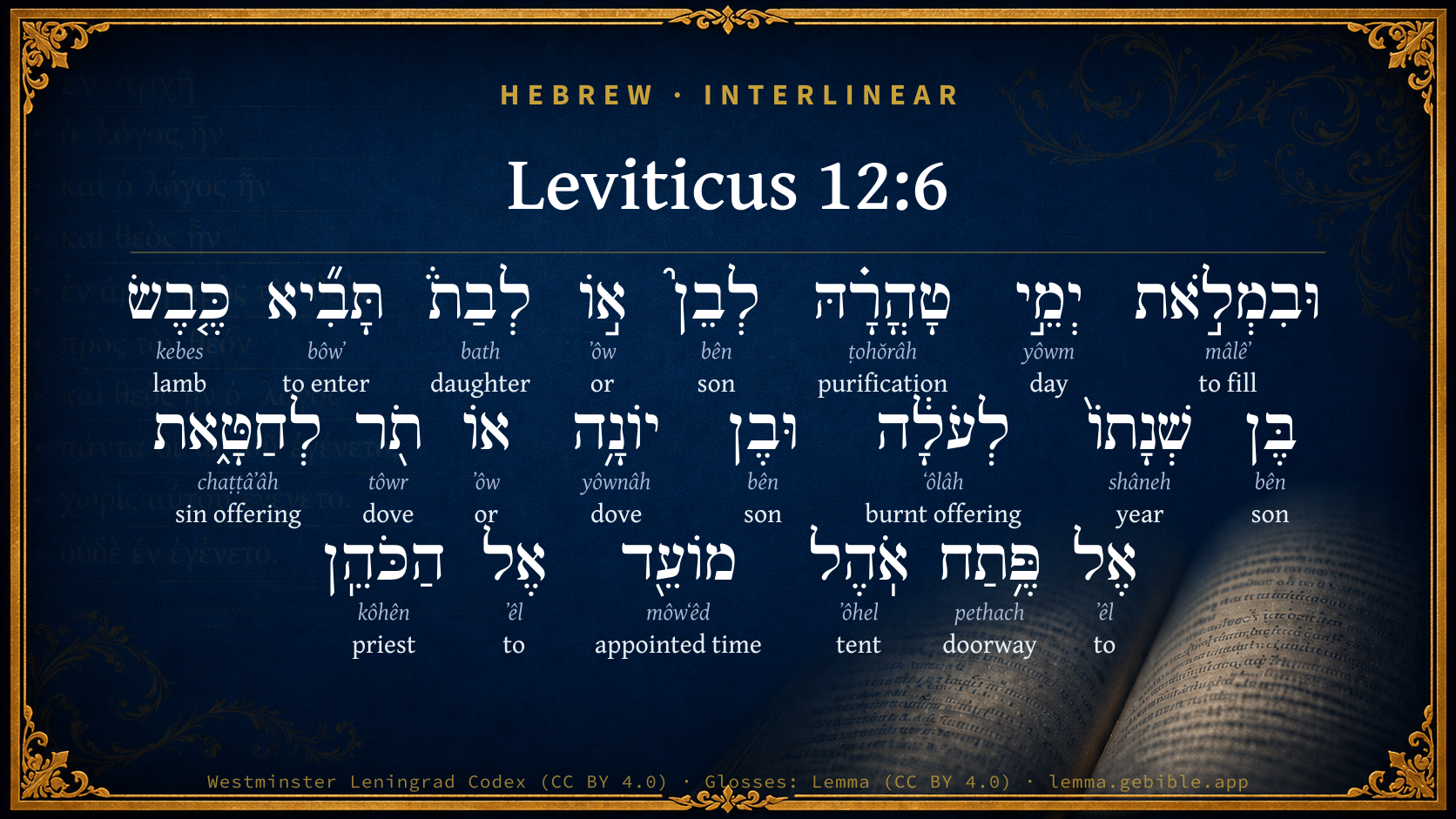
Leviticus 12:6

Hebrew (Westminster Leningrad Codex) Leviticus 12:6 appears in the Hebrew Old Testament. The text above is from the Westminster Leningrad Codex. Each word links to its Strong’s number, a concise gloss, and parsing drawn from the Open Scriptures Hebrew Bible morphology. Click any word for its full Brown-Driver-Briggs (BDB) entry.
Download image
Cite this verse

Leviticus 12:6 (World English Bible). Public Domain. Lemma interlinear Bible study tool, https://lemma.gebible.app/v/leviticus/12/6.

Show BibTeX & RIS
BibTeX
RIS
English Translation
"'When the days of her purification are completed, for a son, or for a daughter, she shall bring to the priest at the door of the Tent of Meeting, a year old lamb for a burnt offering, and a young pigeon, or a turtledove, for a sin offering:
World English Bible · Public Domain
Download a study sheet

One document with this verse’s original text, its word-by-word gloss line, the meaning frame, cross-references with their text, attributed commentary, and full source and license credits — printable, and it pastes into notes with its structure intact.

This verse Autodidact and up

Study sheet (.html) Plain text (.txt)

A passage Seminary Student

Up to 50 verses in one chapter. A passage sheet keeps up to 6 commentary sources and 12 cross-references per verse, in the order this page ranks them, and says so on the sheet whenever that leaves anything out. Ask for a single verse and you get the Autodidact verse sheet above.

Everything on this page stays free to read, with no account — the sheet is a download of what is already on screen, not access to it.

Want to remove ads? Support Godless Engineer
Compare translations 3

The same verse in 3 English versions, stacked beneath the original-language interlinear above. Click any original word for its lexicon entry.

Each is an independent rendering of the whole verse — the interlinear is not word-aligned to these translations.

Highlighted words mark where these versions differ — a whole-verse word diff, not a word-by-word alignment.

  • World English Bible Public Domain
    "'When the days of her purification are completed, for a son, or for a daughter, she shall bring to the priest at the door of the Tent of Meeting, a year old lamb for a burnt offering, and a young pigeon, or a turtledove, for a sin offering:
  • King James Version Public Domain
    And when the days of her purifying are fulfilled, for a son, or for a daughter, she shall bring a lamb of the first year for a burnt offering, and a young pigeon, or a turtledove, for a sin offering, unto the door of the tabernacle of the congregation, unto the priest:
  • unfoldingWord Literal Text CC BY-SA 4.0
    And when the days of her purification are full, for a son or for a daughter, she shall bring a lamb, a son of its year, as a burnt offering, and a son of a pigeon or dove as a sin offering, to the entrance of the tent of meeting, to the priest.

unfoldingWord Literal Text — © unfoldingWord, licensed CC BY-SA 4.0. Word-aligned USFM3 via Door43 (git.door43.org/unfoldingWord/en_ult).

Versions to compare (up to 4)

3 of 4 selected

Show all 18 translations

Every available English version of this verse, each an independent rendering of the whole verse.

  • World English Bible Public Domain
    "'When the days of her purification are completed, for a son, or for a daughter, she shall bring to the priest at the door of the Tent of Meeting, a year old lamb for a burnt offering, and a young pigeon, or a turtledove, for a sin offering:
  • Berean Standard Bible Public Domain
    When the days of her purification are complete, whether for a son or for a daughter, she is to bring to the priest at the entrance to the Tent of Meeting a year-old lamb for a burnt offering and a young pigeon or a turtledove for a sin offering.
  • Majority Standard Bible Public Domain
    When the days of her purification are complete, whether for a son or for a daughter, she is to bring to the priest at the entrance to the Tent of Meeting a year-old lamb for a burnt offering and a young pigeon or a turtledove for a sin offering.
  • King James Version Public Domain
    And when the days of her purifying are fulfilled, for a son, or for a daughter, she shall bring a lamb of the first year for a burnt offering, and a young pigeon, or a turtledove, for a sin offering, unto the door of the tabernacle of the congregation, unto the priest:
  • American Standard Version (1901) Public Domain
    And when the days of her purifying are fulfilled, for a son, or for a daughter, she shall bring a lamb a year old for a burnt-offering, and a young pigeon, or a turtle-dove, for a sin-offering, unto the door of the tent of meeting, unto the priest:
  • Revised Version (1885) Public Domain
    And when the days of her purifying are fulfilled, for a son, or for a daughter, she shall bring a lamb of the first year for a burnt offering, and a young pigeon, or a turtledove, for a sin offering, unto the door of the tent of meeting, unto the priest:
  • Geneva Bible (1599) Public Domain
    Nowe when the dayes of her purifying are out, (whether it be for a sonne or for a daughter) shee shall bring to the Priest a lambe of one yeere olde for a burnt offering, and a yong pigeon or a turtle doue for a sinne offring, vnto the doore of the Tabernacle of the Congregation,
  • Douay-Rheims (1899) Public Domain
    And when the days of her purification are expired, for a son, or for a daughter, she shall bring to the door of the tabernacle of the testimony, a lamb of a year old for a holocaust, and a young pigeon or a turtle for sin, and shall deliver them to the priest:
  • Young's Literal Translation Public Domain
    `And in the fulness of the days of her cleansing for son or for daughter she doth bring in a lamb, a son of a year, for a burnt-offering, and a young pigeon or a turtle-dove for a sin-offering, unto the opening of the tent of meeting, unto the priest;
  • Literal Standard Version CC BY-SA 4.0
    And in the fullness of the days of her cleansing for son or for daughter she brings in a lamb, a son of a year, for a burnt-offering, and a young pigeon or a turtle-dove for a sin-offering, to the opening of the Tent of Meeting, to the priest;
  • Unlocked Literal Bible CC BY-SA 4.0
    When the days of her purification are finished, for a son or for a daughter, she must bring a one year old lamb as a burnt offering, and a young pigeon or dove as a sin offering, to the entrance of the tent of meeting, to the priest.
  • unfoldingWord Literal Text CC BY-SA 4.0
    And when the days of her purification are full, for a son or for a daughter, she shall bring a lamb, a son of its year, as a burnt offering, and a son of a pigeon or dove as a sin offering, to the entrance of the tent of meeting, to the priest.
  • Darby Bible Public Domain
    And when the days of her cleansing are fulfilled, for a son or for a daughter, she shall bring a yearling lamb for a burnt-offering, and a young pigeon or a turtle-dove for a sin-offering, to the entrance of the tent of meeting, unto the priest.
  • World Messianic Bible Public Domain
    “‘When the days of her purification are completed for a son or for a daughter, she shall bring to the priest at the door of the Tent of Meeting, a year old lamb for a burnt offering, and a young pigeon or a turtledove, for a sin offering.
  • Webster's Bible Public Domain
    And when the days of her purifying are fulfilled, for a son, or for a daughter, she shall bring a lamb of the first year for a burnt-offering, and a young pigeon, or a turtle-dove, for a sin-offering, to the door of the tabernacle of the congregation, to the priest;
  • Free Bible Version CC BY-SA 4.0
    Once the time of purification is finished for either a son or a daughter, the woman must bring a year-old lamb as a burnt offering and a young pigeon or turtledove as a purification offering. She is to bring her offerings to the priest at the entrance of the Tent of Meeting.
  • Bible in Basic English Public Domain
    And when the days are ended for making her clean for a son or a daughter, let her take to the priest at the door of the Tent of meeting, a lamb of the first year for a burned offering and a young pigeon or a dove for a sin-offering:
  • JPS Tanakh (1917) Public Domain
    And when the days of her purification are fulfilled, for a son, or for a daughter, she shall bring a lamb of the first year for a burnt-offering, and a young pigeon, or a turtle-dove, for a sin-offering, unto the door of the tent of meeting, unto the priest.

Literal Standard Version (2020), Covenant Press — licensed CC BY-SA 4.0. Text via the HelloAO Bible API (eBible.org). Unlocked Literal Bible (unfoldingWord) — licensed CC BY-SA 4.0. Text via the HelloAO Bible API (eBible.org). unfoldingWord Literal Text — © unfoldingWord, licensed CC BY-SA 4.0. Word-aligned USFM3 via Door43 (git.door43.org/unfoldingWord/en_ult). Free Bible Version, Dr. Jonathan Gallagher — licensed CC BY-SA 4.0. Text via the HelloAO Bible API (eBible.org).

Word by word

More ways to search: Search by grammar → Find every occurrence → Compare this word →

Practice this passage: Drill this verse → Learn its vocabulary →

תֹ֖ר
tôwr
H8449
“dove”
Noun, Common, Both, Singular, Absolute
Part of Speech
Noun
Type
Common
Gender
Both
Number
Singular
State
Absolute
Full BDB Definition

Origin: probably the same as H8447

TWOT: 2500c

dove, turtledove
  1. וּבִמְלֹ֣את mâlêʼ H4390 “and · in/at · to fill” Conjunction + Preposition + Verb, Qal, Infinitive Construct
  2. יְמֵ֣י yôwm H3117 “days of” Noun, Common, Masculine, Plural, Construct
  3. טָהֳרָ֗הּ ṭohŏrâh H2893 “purification · her” Noun, Common, Both, Singular, Construct + Suffix, Personal, 3rd Person, Feminine, Singular
  4. לְבֵן֮ bên H1121 “to/for · son” Preposition + Noun, Common, Masculine, Singular, Absolute
  5. א֣וֹ ʼôw H176 “or” Conjunction
  6. לְבַת֒ bath H1323 “to/for · daughter” Preposition + Noun, Common, Feminine, Singular, Absolute
  7. תָּבִ֞יא bôwʼ H935 “to enter” Verb, Hiphil, Imperfect, 3rd Person, Feminine, Singular
  8. כֶּ֤בֶשׂ kebes H3532 “lamb” Noun, Common, Masculine, Singular, Absolute
  9. בֶּן bên H1121 “son of” Noun, Common, Masculine, Singular, Construct
  10. שְׁנָתוֹ֙ shâneh H8141 “year · his” Noun, Common, Feminine, Singular, Construct + Suffix, Personal, 3rd Person, Masculine, Singular
  11. לְעֹלָ֔ה ʻôlâh H5930 “to/for · burnt offering” Preposition + Noun, Common, Feminine, Singular, Absolute
  12. וּבֶן bên H1121 “and · son of” Conjunction + Noun, Common, Masculine, Singular, Construct
  13. יוֹנָ֥ה yôwnâh H3123 “dove” Noun, Common, Feminine, Singular, Absolute
  14. אוֹ ʼôw H176 “or” Conjunction
  15. לְחַטָּ֑את chaṭṭâʼâh H2403 “to/for · sin offering” Preposition + Noun, Common, Feminine, Singular, Absolute
  16. אֶל ʼêl H413 “to” Preposition
  17. פֶּ֥תַח pethach H6607 “doorway of” Noun, Common, Masculine, Singular, Construct
  18. אֹֽהֶל ʼôhel H168 “tent of” Noun, Common, Masculine, Singular, Construct
  19. מוֹעֵ֖ד môwʻêd H4150 “appointed time” Noun, Common, Masculine, Singular, Absolute
  20. אֶל ʼêl H413 “to” Preposition
  21. הַכֹּהֵֽן kôhên H3548 “the · priest” Particle, Definite Article + Noun, Common, Masculine, Singular, Absolute

About this verse

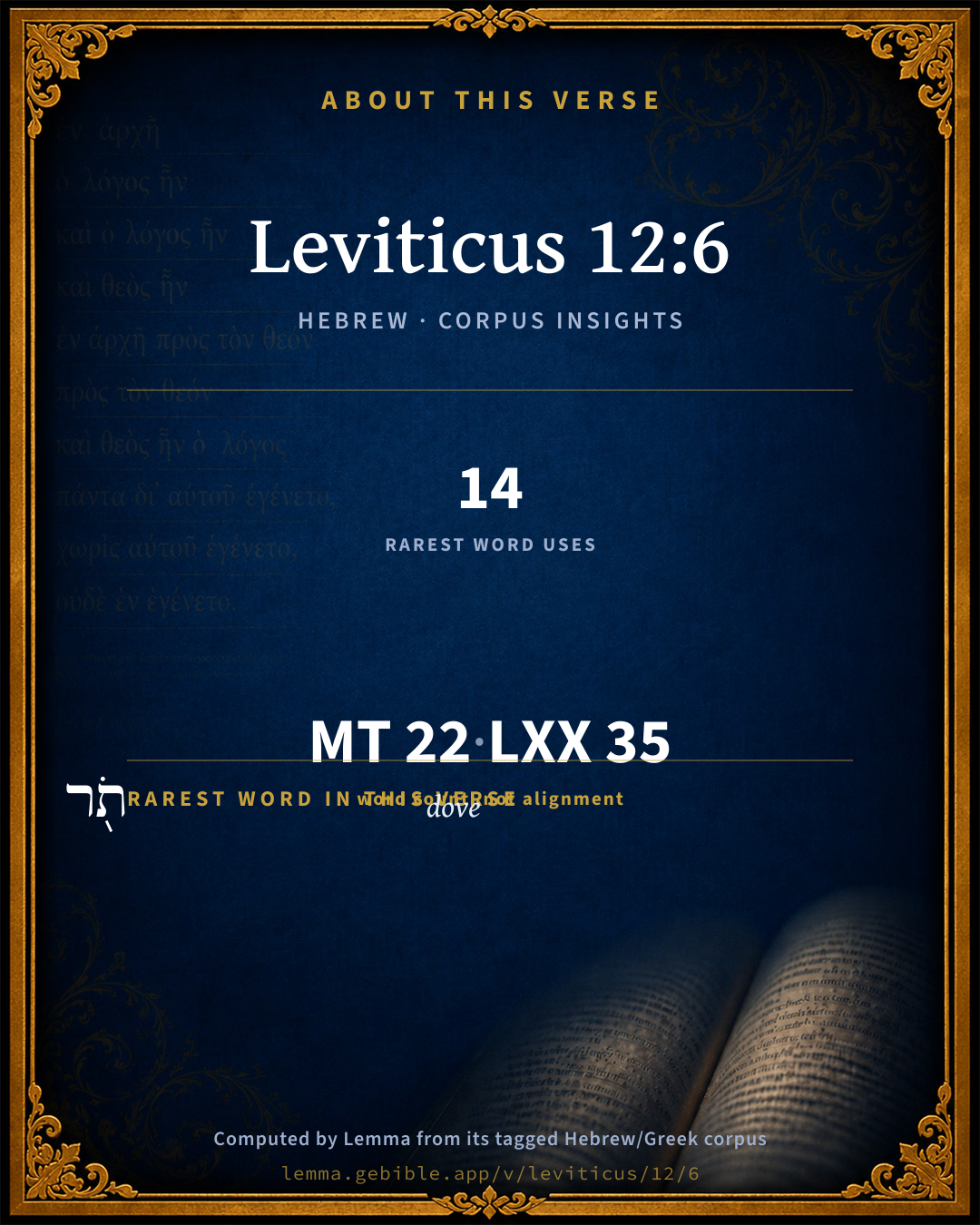
These counts appear in no published source. They are computed here, from the morphology-tagged text and Lemma’s own curated glosses. What Lemma adds →

22
words
18
distinct lemmas
Pentateuch
section

Notable vocabulary

The rarest word here is תֹ֖ר dove H8449 — appearing just 14 times in the whole Hebrew Bible.

Shared distinctive vocabulary

תֹ֖ר dove H8449 occurs in 14 verses of the Hebrew Bible. Also found in:

Grammatical profile

  • 2 verbs
  • 16 nouns
  • 2 prepositions
  • 2 conjunctions

Verb forms

  • וּבִמְלֹ֣את Qal · Infinitive Construct
  • תָּבִ֞יא Hiphil · Imperfect

Repetition

Words recur within this verse — often emphatic in Hebrew:

  • לְבֵן֮ son H1121 ×3
  • א֣וֹ or H176 ×2
  • אֶל to H413 ×2

Hebrew & Septuagint length

In English translation the verse runs 48 words from the Hebrew and 53 from the Septuagint (LXX English) — closely comparable.

A rough comparison of the two English renderings, which tokenize alike — not a word-level alignment.

Word counts can differ between the Hebrew and the Greek without any difference in meaning — e.g. the Hebrew direct-object marker אֵת has no separate Greek word, and Greek often adds the article ὁ.

In the original languages it is 22 Hebrew tokens and 35 Greek tokens — but the two are counted differently (Hebrew bundles its prefixes and suffixes into one token; the Greek is in lemma form), so that isn’t a like-for-like length.

Cross-references

12

Topical passages linked to Leviticus 12:6 in the Treasury of Scripture Knowledge — connected by theme and wording, ordered by reader-vote popularity; previews shown in the World English Bible.

  • Luke 2:22 When the days of their purification according to the law of Moses were fulfilled, they brought him up to Jerusalem, to present him to the Lord
  • Leviticus 15:29 On the eighth day she shall take two turtledoves, or two young pigeons, and bring them to the priest, to the door of the Tent of Meeting.
  • John 1:29 The next day, he saw Jesus coming to him, and said, "Behold, the Lamb of God, who takes away the sin of the world!
  • 2 Corinthians 5:21 For him who knew no sin he made to be sin on our behalf; so that in him we might become the righteousness of God.
  • 1 Peter 1:18–19 knowing that you were redeemed, not with corruptible things, with silver or gold, from the useless way of life handed down from your fathers,
  • Leviticus 1:10–13 "'If his offering is from the flock, from the sheep, or from the goats, for a burnt offering, he shall offer a male without blemish.
  • Leviticus 5:6–10 and he shall bring his trespass offering to Yahweh for his sin which he has sinned, a female from the flock, a lamb or a goat, for a sin offering; and the priest shall make atonement for him concerning his sin.
  • Leviticus 12:2 "Speak to the children of Israel, saying, 'If a woman conceives, and bears a male child, then she shall be unclean seven days; as in the days of her monthly period she shall be unclean.
  • Leviticus 14:22 and two turtledoves, or two young pigeons, such as he is able to afford; and the one shall be a sin offering, and the other a burnt offering.
  • Leviticus 15:14 "'On the eighth day he shall take two turtledoves, or two young pigeons, and come before Yahweh to the door of the Tent of Meeting, and give them to the priest:
  • Numbers 6:10 On the eighth day he shall bring two turtledoves or two young pigeons to the priest, to the door of the Tent of Meeting.
  • Hebrews 7:26 For such a high priest was fitting for us: holy, guiltless, undefiled, separated from sinners, and made higher than the heavens;

Cross-references courtesy of OpenBible.info (CC BY 4.0).

Hebrew and Greek witnesses Masoretic Hebrew ↔ Greek Septuagint

The same verse in the two great witnesses to the Old Testament, shown verse-for-verse.

These are two independent witnesses, not word-aligned to each other, and the Septuagint is shown in lemma (dictionary) form.

Hebrew Leviticus 12:6 Masoretic · Westminster Leningrad Codex

וּבִמְלֹ֣את יְמֵ֣י טָהֳרָ֗הּ לְבֵן֮ א֣וֹ לְבַת֒ תָּבִ֞יא כֶּ֤בֶשׂ בֶּן שְׁנָתוֹ֙ לְעֹלָ֔ה וּבֶן יוֹנָ֥ה אוֹ תֹ֖ר לְחַטָּ֑את אֶל פֶּ֥תַח אֹֽהֶל מוֹעֵ֖ד אֶל הַכֹּהֵֽן

"'When the days of her purification are completed, for a son, or for a daughter, she shall bring to the priest at the door of the Tent of Meeting, a year old lamb for a burnt offering, and a young pigeon, or a turtledove, for a sin offering:

World English Bible · Public Domain

Greek LXX Leviticus 12:6 Septuagint · lemma form

καί ὅταν ἀναπληρόω ὁ ἡμέρα κάθαρσις αὐτός ἐπί υἱός ἤ ἐπί θυγάτηρ προςφέρω ἀμνός ἐνιαύσιος ἄμωμος εἰς ὁλοκαύτωμα καί νεοσσός περιστερά ἤ τρυγών περί ἁμαρτία ἐπί ὁ θύρα ὁ σκηνή ὁ μαρτύριον πρός ὁ ἱερεύς

And when the days of her purification shall have been fulfilled for a son or a daughter, she shall bring a lamb of a year old without blemish for a whole burnt offering, and a young pigeon or turtle-dove for a sin-offering to the door of the tabernacle of witness, to the priest.

LXX2012 (modern English Septuagint) · Public Domain

Hebrew: Westminster Leningrad Codex (CC BY 4.0). Greek: Septuagint (public domain); English from LXX2012 (modern English Septuagint) (Public Domain). How the Septuagint differs from the Hebrew →

Targum (Aramaic paraphrase)

2

The Targum is the ancient Jewish Aramaic paraphrase of the Hebrew Scriptures — an interpretive translation, not the Hebrew text itself. Onkelos (literal) and Pseudo-Jonathan (expansive) render the Torah, and Jonathan the Prophets. Coverage is partial: where no permissively-licensed English translation exists for a verse, only the Aramaic is shown. This is verse-level text, not a word-by-word alignment to the Hebrew.

  1. Targum Onkelos Torah (Genesis–Deuteronomy)
    וּבְמִשְׁלַם יוֹמֵי דָכוּתַהּ לִבְרָא אוֹ לִבְרַתָּא תַּיְתִי אִמָר בַּר שַׁתֵּהּ לַעֲלָתָא וּבַר יוֹנָה אוֹ שַׁפְנִינָא לְחַטָאתָא לִתְרַע מַשְׁכַּן זִמְנָא לְוַת כַּהֲנָא

    (no public-domain English translation for this verse)

    Targum Onkelos — Aramaic: “Onkelos Genesis” (public domain); “Onkelos Exodus” (public domain); “Onkelos Leviticus” (public domain); “Onkelos Numbers” (public domain); “Onkelos Deuteronomy” (public domain). English: “Sefaria Community Translation” (CC0 1.0 (public-domain dedication)); “J.W. Etheridge. The Targums of Onkelos and Jonathan Ben Uzziel on the Pentateuch. London: Longmans, Green, 1862” (public domain). Text via Sefaria.

  2. Targum Pseudo-Jonathan Torah (Genesis–Deuteronomy)
    וּבְמִשְׁלַם יוֹמֵי דְכִיתָא לִבְרָא אוֹ לִבְרַתָּא תַּיְיתֵי אִימַר בַּר שַׁתְיָא לַעֲלָתָא וְגוֹזָל בַּר יוֹנָן אוֹ שַׁפְנִינָא לְחַטָאתָא לִתְרַע מַשְׁכַּן זִמְנָא לְוַת כַּהֲנָא

    And when the days of her purification are completed for the son or the daughter, she shall bring a lamb of its year for a burnt offering, and a young pigeon or a turtle dove for a sin offering, unto the priest at the door of the tabernacle of ordinance;

    Targum Pseudo-Jonathan — Aramaic: “Targum Jonathan on Genesis” (public domain); “Targum Jonathan on Exodus” (public domain); “Targum Jonathan on Leviticus” (public domain); “Targum Jonathan on Numbers” (public domain); “Targum Jonathan on Deuteronomy” (public domain). English: “The Targum of Jonathan ben Uzziel, trans. J. W. Etheridge, London, 1862” (public domain). Text via Sefaria.

Commentary

Notes on Leviticus 12:6 from classic Christian and Jewish commentators (each source and its license shown beneath its notes). The classic Christian expositions comment on the surrounding passage and are grouped to its opening verse, so a note may address several verses; the Jewish commentaries on the Tanakh (Rashi and others) are per-verse, so they appear only where the commentator wrote on this verse.

Lemma curates 59 commentaries, every one of them public domain or Creative Commons licensed, each selected and text-cleaned for this edition rather than reprinted as found. About our sources →

Matthew Henry's Commentary

A woman that had lain in, when the time set for her return to the sanctuary had come, was not to attend there empty, but must bring her offerings, Lev 12:6. 1. A burnt-offering; a lamb if she was able, if poor, a pigeon. This she was to offer in thankfulness to God for his mercy to her, in bringing her safely through the pains of child-bearing and all the perils of child-bed, and in desire and hopes of God's further favour both to her and to the child. When a child is born there is joy and there is hope, and therefore it was proper to bring this offering, which was of a general nature; for what we rejoice in we must give thanks for, and what we are in hopes of we must pray for. But, besides this, 2. She must offer a sin-offering, which must be the same for poor and rich, a turtle-dove or a young pigeon; for, whatever difference there may be between rich and poor in the sacrifices of acknowledgment, that of atonement is the same for both. This sin-offering was intended either, (1.) To complete her purification from that ceremonial uncleanness which, though it was not in itself sinful, yet was typical of moral pollution; or, (2.) To make atonement for that which was really sin, either an inordinate desire of the blessing of children or discontent or impatience under the pains of child-bearing. It is only by Christ, the great sin-offering, that the corruption of our nature is done away, and to that it is owing that we are not for ever excluded by it from the sanctuary, and from eating of the holy things. According to this law, we find that the mother of our blessed Lord, though he was not conceived in sin as others, yet accomplished the days of purification, and then presented her son to the Lord, being a first-born, and brought her own offering, a pair of turtle-doves, Luk 2:22-24. So poor were Christ's parents that they were not able to bring a lamb for a burnt-offering; and so early was Christ made under the law, to redeem those that were under it. The morality of this law obliges those women that have received mercy from God in child-bearing with all thankfulness to own God's goodness to them, acknowledging themselves unworthy of it, and (which is the best purification of women that have been saved in child-bearing, Ti1 2:15) to continue in faith, and charity, and holiness, with sobriety; for this shall please the Lord better than the turtle-doves or the young pigeons.

Matthew Henry's Commentary on the Whole Bible (1708–1710) — public domain (CC PDM 1.0). Text via the HelloAO Bible API.

Ellicott's Commentary for English Readers

(6) And when the days . . . —Having described in the previous verses the conditions of defilement arising from childbirth, the legislator now prescribes the offerings to be brought for the purification of the woman. The offerings were brought at the expiration of the fortieth day in the case of a boy, and at the end of the eightieth day in the case of a girl, that is, on the forty-first and on the eighty-first respectively.

For a son, or for a daughter.—That is, with regard to a son or a daughter, to either of which she had given birth. The purification was for herself, and was owing to the defiling discharges connected with childbirth, and not for the child to which she gave birth, since the baby was not unclean.

She shall bring a lamb of the first year.—Or, as the Margin has it, a son of his year, that is, a lamb which was within the year of its birth. This burnt offering was an expression of gratitude for the Divine mercy vouchsafed to her in the hours of sorrow and danger, or, as some ancients suggest, it was designed as a confession of impatient and reproachful thoughts harboured by the mother during her pregnancy and the time of parturition (comp. Gen_25:22); whilst the sin offering was to atone for sinful and violent expressions which she may have heedlessly uttered in the hours of labour and agony. Though when the two sacrifices are mentioned together, the sin offering generally precedes the burnt offering (see Lev_5:7; Lev_14:31; Lev_15:15; Lev_15:30; Lev_16:3; Lev_16:5, &c.), here the burnt offering takes precedence, because it is the more costly of the two. Besides the mother after child-birth (Lev_12:6; Lev_12:8), there were three other unclean persons who had to bring a sin offering for their uncleanness: the leper (Lev_14:19; Lev_14:31), the woman that had an issue (Lev_15:15), and the man that had an issue (Lev_15:30).

Unto the door of the tabernacle of the congregation.—Better, to the entrance of the tent of meeting. (See Lev_1:3.) During the time of the second Temple these sacrifices were brought to the eastern gate, called the Gate of Nicanor. Here the lying-in women were purified and the lepers cleansed. (See Lev_14:13.)

A Bible Commentary for English Readers, edited by Charles John Ellicott (1878–1897) — public domain. Text from a community e-Sword module.

Trapp's Complete Commentary

John Trapp

Lev 12:6 And when the days of her purifying are fulfilled, for a son, or for a daughter, she shall bring a lamb of the first year for a burnt offering, and a young pigeon, or a turtledove, for a sin offering, unto the door of the tabernacle of the congregation, unto the priest:

Ver. 6. And when the days of her purifying.] The Virgin Mary also observed this law, {Luk 2:21} not in conscience of any particular sin, which in the conception of our Saviour she was free from; nor in show, to satisfy the law, much less upon hypocrisy; but in conscience of her natural corruption, which by this oblation, according to the law, she did confess holily and religiously before God and his congregation, as one well observeth.

John Trapp, A Commentary or Exposition upon All the Books of the Old and New Testament (1647–1656) — public domain. Text from a community e-Sword module.

Albert Barnes' Notes on the Bible

The sacrificial act expressed an acknowledgment of sin and a dedication of herself to Yahweh. See Lev 8:14.

Lev 12:6

Of the first year - literally, as in the margin, “a son of his year.” This expression is supposed to mean one less than a year old, while the “son of a year” is one that has just completed its first year.

Lev 12:8

A lamb - Rather, one of the flock; either a sheep or a goat; it is not the same word as in Lev 12:6.

Two turtles, or two young pigeons - See the note at Lev 1:14. The Virgin Mary availed herself of the liberty which the Law allowed to the poor, and offered the inferior burnt-offering Luk 2:24.

Albert Barnes' Notes on the Bible (1834–1885) — public domain. Text from a community e-Sword/MySword module.

Joseph Benson's Commentary

Lev 12:6. For a son or a daughter — For the birth of either; but the purification was for herself, as appears from the following verses. A sin- offering — Because of her ceremonial uncleanness, which required a ceremonial expiation.

Joseph Benson's Commentary on the Old and New Testaments (1811–1818) — public domain. Text from a community e-Sword module.

Tyndale Open Study Notes

Tyndale Open Resources

12:6 purification offering: The Hebrew word is the same as that for the sin offering (khatta’t, see study note on 4:1–5:13). This leads some scholars to think that this offering dealt only with purification or decontamination, including those cases mentioned in 5:1-6. The offering here was certainly part of a purification ritual, but it seems more likely that the sin offering repaired a lack or failure. In this context, the issue is purity rather than sin, and the focus is on restoring the woman to community fellowship, not forgiving a sinner.

Tyndale Open Study Notes — © Tyndale Open Resources, licensed CC BY-SA 4.0. Text via the HelloAO Bible API.

Geneva Bible (1599)

Geneva Bible translators

Where the burnt offerings were wont to be offered.

Geneva Bible (1599) marginal notes — public domain. Text via Bolls.life.

Jamieson, Fausset & Brown

Robert Jamieson, A. R. Fausset & David Brown

the days of her purifying--Though the occasion was of a festive character, yet the sacrifices appointed were not a peace offering, but a burnt offering and sin offering, in order to impress the mind of the parent with recollections of the origin of sin, and that the child inherited a fallen and sinful nature. The offerings were to be presented the day after the period of her separation had ended--that is, forty-first for a boy, eighty-first for a girl.

Jamieson, Fausset & Brown — Commentary Critical and Explanatory on the Whole Bible (1871) — public domain (CC PDM 1.0). Text via the HelloAO Bible API.

Adam Clarke's Commentary

Verse 6. When the days of her purifying] It is not easy to account for the difference in the times of purification, after the birth of a male and female child. After the birth of a boy the mother was considered unclean for forty days; after the birth of a girl, four-score days. There is probably no physical reason for this difference, and it is difficult to assign a political one. Some of the ancient physicians assert that a woman is in the order of nature much longer in completely recovering after the birth of a female than after the birth of a male child. This assertion is not justified either by observation or matter of fact. Others think that the difference in the time of purification after the birth of a male and female is intended to mark the inferiority of the female sex. This is a miserable reason, and pitifully supported.

She shall bring - a burnt-offering, and - a sin-offering] It is likely that all these ordinances were intended to show man's natural impurity and original defilement by sin, and the necessity of an atonement to cleanse the soul from unrighteousness.

Adam Clarke's Commentary on the Bible (1810–1826) — public domain. Text from a community e-Sword/MySword module.

The Cambridge Bible for Schools and Colleges

gen. ed. J. J. S. Perowne

6. At the end of her purification she was to bring an offering. The alternative of a pigeon for the lamb of the Burnt-Offering is allowed in Lev_1:14 and also in the Sin-Offering (Lev_5:7-10), but the further alternative of a Meal-Offering (Lev_5:11-13) is not found here. The Virgin Mary (Luk_2:24) offered the sacrifices of one whose ‘means suffice not for a lamb.’

The Cambridge Bible for Schools and Colleges (gen. ed. J. J. S. Perowne; Cambridge University Press, 1878–1918) — public domain. Text from a community e-Sword module.

John Gill's Exposition

Who shall offer it before the Lord,.... Upon the altar of burnt offering:

and make an atonement for her; for whatsoever sin in connection with or that attended childbearing; as typical of the atonement by Christ both for sin original and actual:

and she shall be cleansed from the issue of her blood; in a ceremonial sense, and according to that law be pure and clean:

this is the law for her that hath born a male or a female; enjoined her, and to be observed by her; and though now with the rest of the ceremonial law it is abolished, yet it has this instruction in it; that it becomes women in such circumstances to bring the freewill offerings of their lips, their sacrifices of praise, and in a public manner signify their gratitude and thankfulness for the mercy and goodness of God vouchsafed to them, in carrying them through the whole time of childbearing, and saving them in the perilous hour.

John Gill's Exposition of the Whole Bible (1746–1763) — public domain (CC PDM 1.0). Text via the HelloAO Bible API.

Haydock's Catholic Bible Commentary

Lamb, to thank God for her happy delivery. --- Sin, or uncleanness, which was esteemed a legal offence. Perhaps this sacrifice was also designed to expiate the sins she might have fallen into, (Menochius) since she was last able to offer one; and likewise the original sin of her female offspring. That of males was effaced by circumcision. (Haydock)

George Leo Haydock (1774–1849), Haydock's Catholic Family Bible and Commentary, 1859 edition — public domain. Excludes Psalms (Douay-Rheims chapter numbering differs from Protestant) and Deuterocanonical books (Catholic canon only).

Matthew Poole's English Annotations

For a son, or for a daughter; for the birth of a son, or of a daughter; but the purification was for herself, as appears from the following verses.

For a sin-offering; either because of her ceremonial uncleanness, which required a ceremonial expiation; or for those particular sins relating to the time and state of child-bearing, of which she is justly presumed to be guilty, which might be many ways.

Matthew Poole's English Annotations on the Holy Bible (1683–1685) — public domain. Text from a community e-Sword/MySword module.

Whedon's Commentary on the Bible

Daniel D. Whedon

6. Burnt offering — Although the self-dedicatory offering is mentioned first, the real order is after the sin offering, see Introduction, (5.) We are not to suppose that a sense of guilt was in the mind of the offerer, but only the fact of ceremonial impurity, which required purgation before the woman could be an accepted worshipper. Hence the smallest of the sin offerings was required. Yet this requirement of both mother and child teaches the doctrine of original, or birth sin. On the fortieth day after his birth Jesus, in his sinless humanity, was presented at the earthly temple; on the fortieth day after his resurrection he was presented in his glorified body in the heavenly sanctuary.

Daniel D. Whedon (gen. ed.), Commentary on the Old and New Testaments (1874–1909) — public domain. Text from a community e-Sword module.

The Pulpit Commentary

Vers. 6, 7. The previous verses having stated the conditions and the term of continuance of the uncleanness arising from childbirth, the three final verses describe the offerings to be made by the woman for her purification. She shall bring a lamb of the first year for a burnt offering, and a young pigeon, or a turtledove, for a sin offering. Two things are noticeable here: first, that the burnt offering, symbolizing self-devotion, is far more costly and important than the sin offering, which had not to be offered for any individual personal sin, but only for human sin, "which had been indirectly manifested in her bodily condition" (Keil); and secondly, that in this one case the sin offering appears to succeed the burnt offering instead of preceding it. No doubt the changed order is owing to the cause just mentioned; the idea of sin, though it may not be altogether put aside, (Gen_3:16) is not to be prominent, as though it were peculiar to the special woman who was purified.

Generation, conception, and birth, not having anything sinful necessarily connected with them, the sin offering in this case is rather an intimation of original sin than an atonement for actual sin; the "sorrow" attached to childbirth being especially connected with the fall of man as a result of Eve"s share in bringing it about. (Gen_3:16) There is nothing in the Bible to countenance ascetic or Manichaean views of marriage intercourse. Where any prohibitory injunctions are given on the subject, the purpose is to avoid ceremonial, not moral, uncleanness. (Exo_19:15 1Sa_21:4; cf. Lev_15:18)

The Pulpit Commentary (1880–1919), ed. H.D.M. Spence-Jones & Joseph S. Exell — public domain. Text from a community e-Sword module.

John Wesley's Explanatory Notes

For a son or a daughter - For the birth of a son, or of a daughter: but the purification was for herself, as appears from the following verses. A sin-offering - Because of her ceremonial uncleanness, which required a ceremonial expiation.

John Wesley, Explanatory Notes Upon the Whole Bible (1754–1765) — public domain. Text via the GEBible commentary corpus.

Keil & Delitzsch

C. F. Keil & F. Delitzsch

After the expiration of the days of her purification "with regard to a son or a daughter," i.e., according as she had given birth to a son or a daughter (not for the son or daughter, for the woman needed purification for herself, and not for the child to which she had given birth, and it was the woman, not the child, that was unclean), she was to bring to the priest a yearling lamb for a burnt-offering, and a young pigeon or turtle-dove for a sin-offering, that he might make atonement for her before Jehovah and she might become clean from the course of her issue. שׁנתו בּן, lit., son of his year, which is a year old (cf. Lev 23:12; Num 6:12, Num 6:14; Num 7:15, Num 7:21, etc.), is used interchangeably with שׁנה בּן (Exo 12:5), and with שׁנה בּני in the plural (Lev 23:18-19; Exo 29:38; Num 7:17, Num 7:23, Num 7:29). דּמים דּמור, fountain of bleeding (see at Gen 4:10), equivalent to hemorrhage (cf. Lev 20:18). The purification by bathing and washing is not specially mentioned, as being a matter of course; nor is anything stated with reference to the communication of her uncleanness to persons who touched either her or her couch, since the instructions with regard to the period of menstruation no doubt applied to the first seven and fourteen days respectively. For her restoration to the Lord and His sanctuary, she was to come and be cleansed with a sin-offering and a burnt-offering, on account of the uncleanness in which the sin of nature had manifested itself; because she had been obliged to absent herself in consequence for a whole week from the sanctuary and fellowship of the Lord. But as this purification had reference, not to any special moral guilt, but only to sin which had been indirectly manifested in her bodily condition, a pigeon was sufficient for the sin-offering, that is to say, the smallest of the bleeding sacrifices; whereas a yearling lamb was required for a burnt-offering, to express the importance and strength of her surrender of herself to the Lord after so long a separation from Him. But in cases of great poverty a pigeon might be substituted for the lamb (Lev 12:8, cf. Lev 5:7, Lev 5:11).

Keil & Delitzsch — Biblical Commentary on the Old Testament (1861–1891) — public domain (CC PDM 1.0). Text via the HelloAO Bible API. (Old Testament only.)

unfoldingWord translationNotes

Door43 World Missions Community

When the days of her purification are finished

"When the days of the mother's purification are finished"

for a son or for a daughter

This refers to the different number of days for purification based on if she gave birth to a son or daughter.

translationWords

pure

lamb

burnt offering

dove

sin offering

tent of meeting

priest

unfoldingWord translationNotes — © Distant Shores Media and the Door43 World Missions Community, licensed CC BY-SA 4.0. Source: git.door43.org/Door43/en_tn.

Ibn Ezra

Rabbi Abraham ibn Ezra

In its first year. Were it not for the Oral Law, who could explain what is meant by “in its first year”? Does it mean exactly one year old and not more, or less, or in addition? Some explain that the reason a burnt offering lamb is brought is because perhaps she had improper thoughts during her childbirth due to the serious pain, and the reason for the sin offering is because perhaps she said something improper out loud.

Ibn Ezra on the Tanakh — English translations: “Sefaria Community Translation” (CC0 1.0 (public-domain dedication)); “Yalkut, Sifsei Chachomim Chumash, Metsudah Publications, 2009” (CC BY 4.0); and “Commentary of Ibn Ezra on Isaiah - trans. by M. Friedlander, 1873” (public domain). Text via Sefaria.

Lesson kit

Teaching starters — assembled from the data on this page, not authored interpretation. Every prompt links to the verse data it draws on. Edit before teaching.

Leviticus, in the Pentateuch, opens this verse with 22 words (18 distinct Hebrew lemmas). Its most distinctive word is tôwr (“dove”). A historical commentator’s framing appears above. Read the whole chapter for the surrounding context.

Discussion questions

  1. How does “dove” (tôwr) shape what this verse is saying?
  2. How does Genesis 15:9, which shares the word «dove», read alongside this verse?
  3. What does the repetition of “son” (3× in this one verse) do in this verse?
  4. These translations render this verse differently. What is at stake in choosing one wording over another?
  5. «וּבִמְלֹ֣את» is a Qal Infinitive Construct verb. How does that grammatical form shape the action described?
  6. Compare how Matthew Henry's Commentary and Ellicott's Commentary for English Readers read this verse. Where do they agree or differ?

Things to notice

Reading settings

Reading text

Shown beneath each verse's original-language words.

Old Testament
Old Testament edition

Read the OT as the Masoretic Hebrew (MT) or the Greek Septuagint (LXX).

English shown for the Greek Septuagint (in the Hebrew ↔ Greek comparison).

Comparing translations? Open the Compare panel on any verse page to stack up to four side by side.