Leviticus 8:4

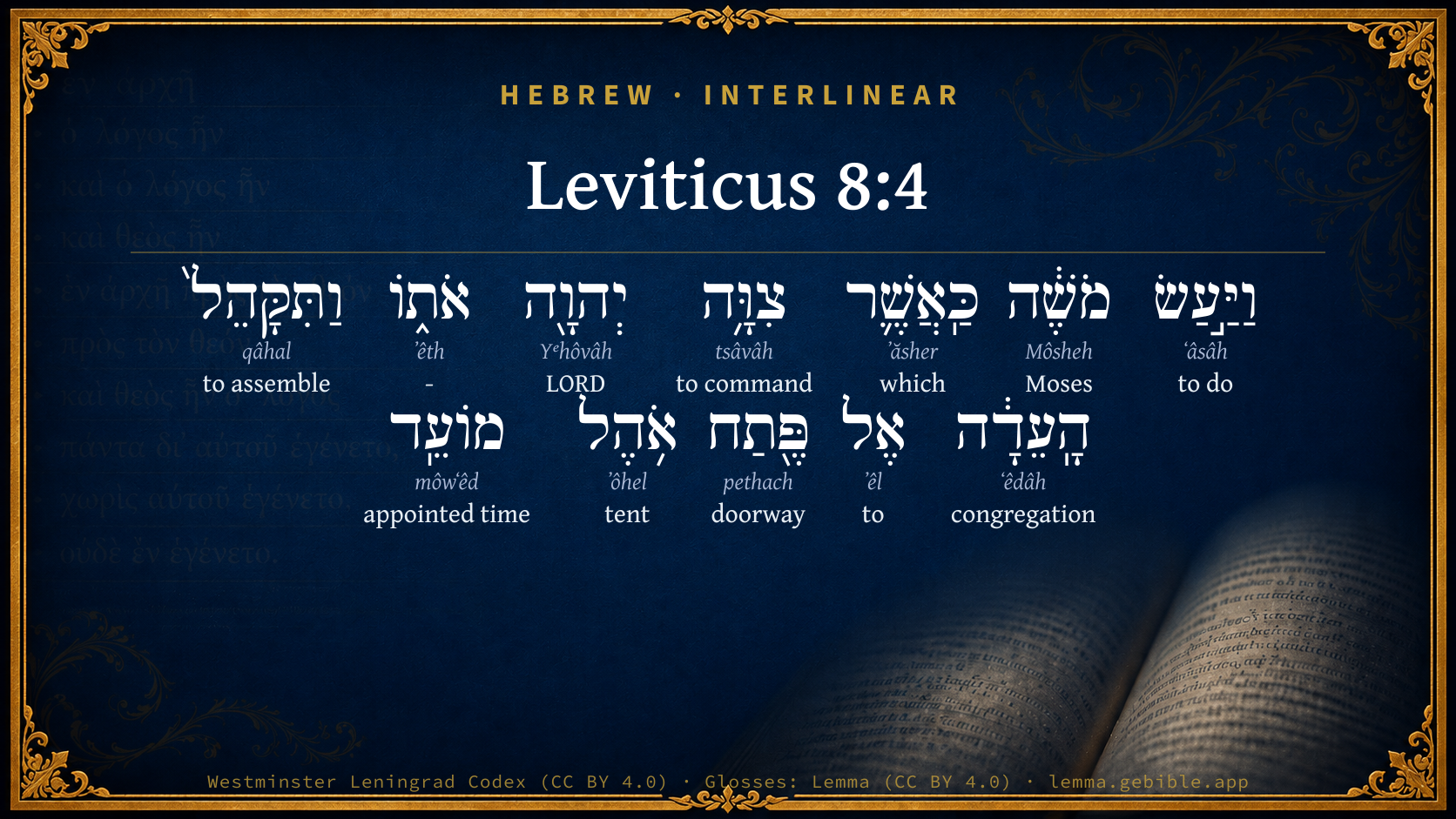
Hebrew (Westminster Leningrad Codex) Leviticus 8:4 appears in the Hebrew Old Testament. The text above is from the Westminster Leningrad Codex. Each word links to its Strong’s number, a concise gloss, and parsing drawn from the Open Scriptures Hebrew Bible morphology. Click any word for its full Brown-Driver-Briggs (BDB) entry.
Download image
Cite this verse

Leviticus 8:4 (World English Bible). Public Domain. Lemma interlinear Bible study tool, https://lemma.gebible.app/v/leviticus/8/4.

Show BibTeX & RIS
BibTeX
RIS
English Translation
Moses did as Yahweh commanded him; and the congregation was assembled at the door of the Tent of Meeting.
World English Bible · Public Domain
Download a study sheet

One document with this verse’s original text, its word-by-word gloss line, the meaning frame, cross-references with their text, attributed commentary, and full source and license credits — printable, and it pastes into notes with its structure intact.

This verse Autodidact and up

Study sheet (.html) Plain text (.txt)

A passage Seminary Student

Up to 50 verses in one chapter. A passage sheet keeps up to 6 commentary sources and 12 cross-references per verse, in the order this page ranks them, and says so on the sheet whenever that leaves anything out. Ask for a single verse and you get the Autodidact verse sheet above.

Everything on this page stays free to read, with no account — the sheet is a download of what is already on screen, not access to it.

Want to remove ads? Support Godless Engineer
Compare translations 3

The same verse in 3 English versions, stacked beneath the original-language interlinear above. Click any original word for its lexicon entry.

Each is an independent rendering of the whole verse — the interlinear is not word-aligned to these translations.

Highlighted words mark where these versions differ — a whole-verse word diff, not a word-by-word alignment.

  • World English Bible Public Domain
    Moses did as Yahweh commanded him; and the congregation was assembled at the door of the Tent of Meeting.
  • King James Version Public Domain
    And Moses did as the LORD commanded him; and the assembly was gathered together unto the door of the tabernacle of the congregation.
  • unfoldingWord Literal Text CC BY-SA 4.0
    And Moses did just as Yahweh commanded him. And the congregation assembled at the entrance of the tent of meeting.

unfoldingWord Literal Text — © unfoldingWord, licensed CC BY-SA 4.0. Word-aligned USFM3 via Door43 (git.door43.org/unfoldingWord/en_ult).

Versions to compare (up to 4)

3 of 4 selected

Show all 18 translations

Every available English version of this verse, each an independent rendering of the whole verse.

  • World English Bible Public Domain
    Moses did as Yahweh commanded him; and the congregation was assembled at the door of the Tent of Meeting.
  • Berean Standard Bible Public Domain
    So Moses did as the LORD had commanded him, and the assembly gathered at the entrance to the Tent of Meeting.
  • Majority Standard Bible Public Domain
    So Moses did as the LORD had commanded him, and the assembly gathered at the entrance to the Tent of Meeting.
  • King James Version Public Domain
    And Moses did as the LORD commanded him; and the assembly was gathered together unto the door of the tabernacle of the congregation.
  • American Standard Version (1901) Public Domain
    And Moses did as Jehovah commanded him; and the congregation was assembled at the door of the tent of meeting.
  • Revised Version (1885) Public Domain
    And Moses did as the LORD commanded him; and the congregation was assembled at the door of the tent of meeting.
  • Geneva Bible (1599) Public Domain
    So Moses did as the Lord had commanded him, and the companie was assembled at the doore of the Tabernacle of the Congregation.
  • Douay-Rheims (1899) Public Domain
    And Moses did as the Lord had commanded. And all the multitude being gathered together before the door of the tabernacle,
  • Young's Literal Translation Public Domain
    And Moses doth as Jehovah hath commanded him, and the company is assembled unto the opening of the tent of meeting,
  • Literal Standard Version CC BY-SA 4.0
    And Moses does as YHWH has commanded him, and the congregation is assembled to the opening of the Tent of Meeting,
  • Unlocked Literal Bible CC BY-SA 4.0
    So Moses did as Yahweh commanded him, and the assembly came together at the entrance to the tent of meeting.
  • unfoldingWord Literal Text CC BY-SA 4.0
    And Moses did just as Yahweh commanded him. And the congregation assembled at the entrance of the tent of meeting.
  • Darby Bible Public Domain
    And Moses did as Jehovah had commanded him; and the assembly was collected at the entrance of the tent of meeting.
  • World Messianic Bible Public Domain
    Moses did as the LORD commanded him; and the congregation was assembled at the door of the Tent of Meeting.
  • Webster's Bible Public Domain
    And Moses did as the LORD commanded him; and the assembly was gathered to the door of the tabernacle of the congregation.
  • Free Bible Version CC BY-SA 4.0
    Moses did as the Lord instructed him, and everyone gathered at the entrance to the Tent of Meeting.
  • Bible in Basic English Public Domain
    And Moses did as the Lord said, and all the people came together at the door of the Tent of meeting.
  • JPS Tanakh (1917) Public Domain
    And Moses did as the LORD commanded him; and the congregation was assembled at the door of the tent of meeting.

Literal Standard Version (2020), Covenant Press — licensed CC BY-SA 4.0. Text via the HelloAO Bible API (eBible.org). Unlocked Literal Bible (unfoldingWord) — licensed CC BY-SA 4.0. Text via the HelloAO Bible API (eBible.org). unfoldingWord Literal Text — © unfoldingWord, licensed CC BY-SA 4.0. Word-aligned USFM3 via Door43 (git.door43.org/unfoldingWord/en_ult). Free Bible Version, Dr. Jonathan Gallagher — licensed CC BY-SA 4.0. Text via the HelloAO Bible API (eBible.org).

Word by word

More ways to search: Search by grammar → Find every occurrence → Compare this word →

Practice this passage: Drill this verse → Learn its vocabulary →

וַתִּקָּהֵל֙
qâhal
H6950
“and · to assemble”
Conjunction + Verb, Niphal, Sequential Imperfect, 3rd Person, Feminine, Singular
Part of Speech
Conjunction + Verb
Stem
Niphal
Form
Sequential Imperfect
Person
3rd Person
Gender
Feminine
Number
Singular
Full BDB Definition

Origin: a primitive root

TWOT: 1991

to assemble, gather - (Niphal) to assemble - for religious reasons - for political reasons - (Hiphil) to summon an assembly - for war, judgment - for religious purposes
  1. וַיַּ֣עַשׂ ʻâsâh H6213 “and · to do” Conjunction + Verb, Qal, Sequential Imperfect, 3rd Person, Masculine, Singular
  2. מֹשֶׁ֔ה Môsheh H4872 “Moses” Noun, Proper
  3. כַּֽאֲשֶׁ֛ר ʼăsher H834 “like/as · which” Preposition + Particle, Relative
  4. צִוָּ֥ה tsâvâh H6680 “to command” Verb, Piel, Perfect, 3rd Person, Masculine, Singular
  5. יְהוָ֖ה Yᵉhôvâh H3068 “LORD” Noun, Proper
  6. אֹת֑וֹ ʼêth H853 “- · him” Particle, Direct Object + Suffix, Personal, 3rd Person, Masculine, Singular
  7. הָֽעֵדָ֔ה ʻêdâh H5712 “the · congregation” Particle, Definite Article + Noun, Common, Feminine, Singular, Absolute
  8. אֶל ʼêl H413 “to” Preposition
  9. פֶּ֖תַח pethach H6607 “doorway of” Noun, Common, Masculine, Singular, Construct
  10. אֹ֥הֶל ʼôhel H168 “tent of” Noun, Common, Masculine, Singular, Construct
  11. מוֹעֵֽד môwʻêd H4150 “appointed time” Noun, Common, Masculine, Singular, Absolute

About this verse

These counts appear in no published source. They are computed here, from the morphology-tagged text and Lemma’s own curated glosses. What Lemma adds →

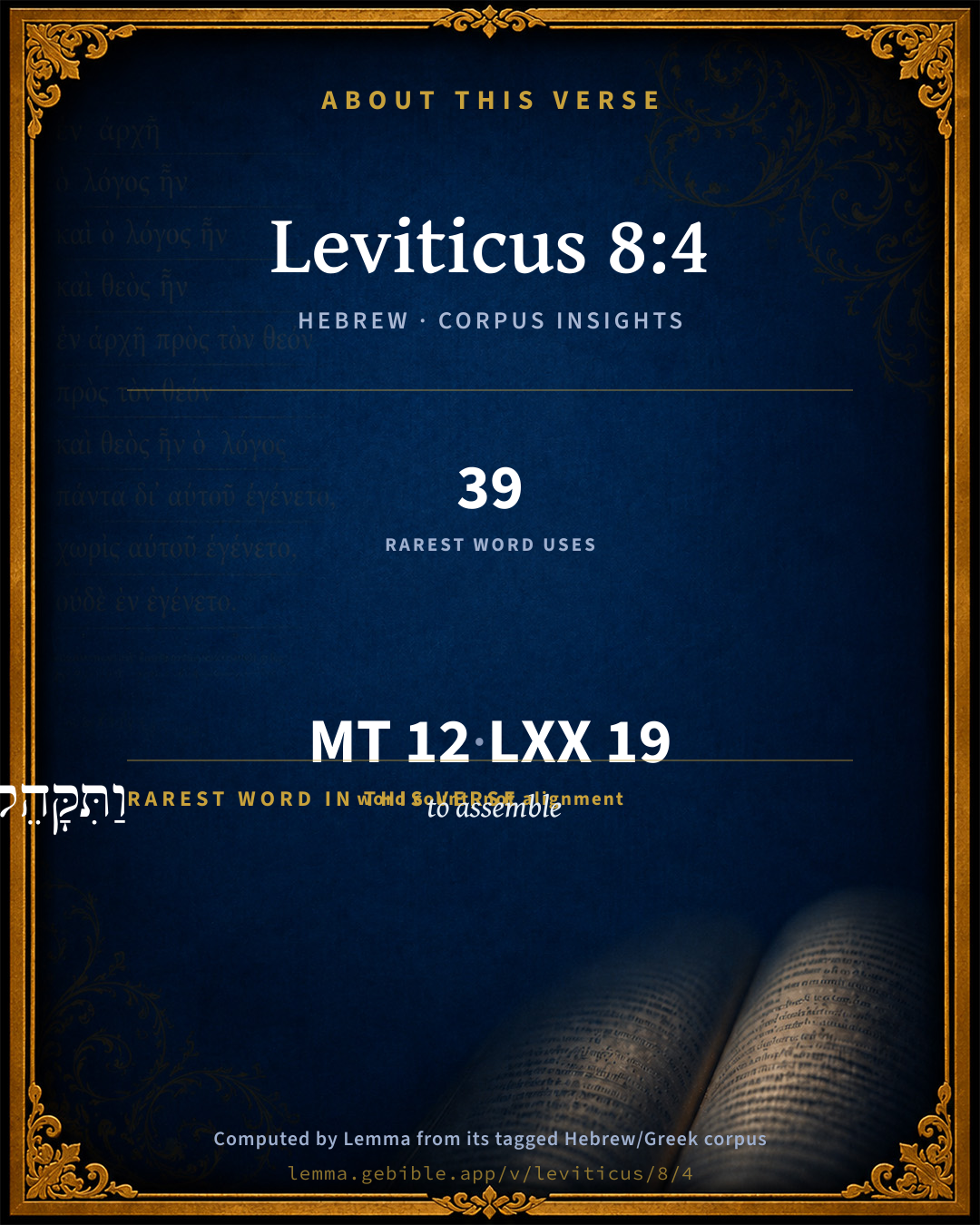
12
words
12
distinct lemmas
Pentateuch
section

Shared distinctive vocabulary

וַתִּקָּהֵל֙ to assemble H6950 occurs in 39 verses of the Hebrew Bible. Also found in:

Grammatical profile

  • 3 verbs
  • 6 nouns
  • 1 preposition
  • 2 particles

Verb forms

  • וַיַּ֣עַשׂ Qal · Sequential Imperfect
  • צִוָּ֥ה Piel · Perfect
  • וַתִּקָּהֵל֙ Niphal · Sequential Imperfect

Hebrew & Septuagint length

In English translation the verse runs 19 words from the Hebrew and 21 from the Septuagint (LXX English) — closely comparable.

A rough comparison of the two English renderings, which tokenize alike — not a word-level alignment.

Word counts can differ between the Hebrew and the Greek without any difference in meaning — e.g. the Hebrew direct-object marker אֵת has no separate Greek word, and Greek often adds the article ὁ.

In the original languages it is 12 Hebrew tokens and 19 Greek tokens — but the two are counted differently (Hebrew bundles its prefixes and suffixes into one token; the Greek is in lemma form), so that isn’t a like-for-like length.

Cross-references

17

Topical passages linked to Leviticus 8:4 in the Treasury of Scripture Knowledge — connected by theme and wording, ordered by reader-vote popularity; previews shown in the World English Bible.

  • Exodus 39:1 Of the blue, purple, and scarlet, they made finely worked garments, for ministering in the holy place, and made the holy garments for Aaron; as Yahweh commanded Moses.
  • Exodus 39:5 The skillfully woven band that was on it, with which to fasten it on, was of the same piece, like its work; of gold, of blue, purple, scarlet, and fine twined linen; as Yahweh commanded Moses.
  • Exodus 39:7 He put them on the shoulder-pieces of the ephod, to be stones of memorial for the children of Israel, as Yahweh commanded Moses.
  • Exodus 39:21 They bound the breastplate by its rings to the rings of the ephod with a lace of blue, that it might be on the skillfully woven band of the ephod, and that the breastplate might not come loose from the ephod, as Yahweh commanded Moses.
  • Exodus 39:26 a bell and a pomegranate, a bell and a pomegranate, around the skirts of the robe, to minister in, as Yahweh commanded Moses.
  • Exodus 39:29 and the sash of fine twined linen, and blue, and purple, and scarlet, the work of the embroiderer, as Yahweh commanded Moses.
  • Exodus 39:31–32 They tied to it a lace of blue, to fasten it on the turban above, as Yahweh commanded Moses.
  • Exodus 39:42–43 According to all that Yahweh commanded Moses, so the children of Israel did all the work.
  • Leviticus 8:9 He set the turban on his head; and on the turban, in front, he set the golden plate, the holy crown; as Yahweh commanded Moses.
  • Leviticus 8:13 Moses brought Aaron's sons, and clothed them with coats, and tied sashes on them, and put headbands on them; as Yahweh commanded Moses.
  • Leviticus 8:17 But the bull, and its skin, and its flesh, and its dung, he burned with fire outside the camp; as Yahweh commanded Moses.
  • Leviticus 8:29 Moses took the breast, and waved it for a wave offering before Yahweh. It was Moses' portion of the ram of consecration, as Yahweh commanded Moses.
  • Leviticus 8:35 At the door of the Tent of Meeting you shall stay day and night seven days, and keep the charge of Yahweh, that you don't die: for so I am commanded."
  • Deuteronomy 12:32 Whatever thing I command you, that shall you observe to do: you shall not add thereto, nor diminish from it.
  • Matthew 28:20 teaching them to observe all things that I commanded you. Behold, I am with you always, even to the end of the age." Amen.
  • 1 Corinthians 11:23 For I received from the Lord that which also I delivered to you, that the Lord Jesus on the night in which he was betrayed took bread.
  • 1 Corinthians 15:3 For I delivered to you first of all that which I also received: that Christ died for our sins according to the Scriptures,

Cross-references courtesy of OpenBible.info (CC BY 4.0).

Hebrew and Greek witnesses Masoretic Hebrew ↔ Greek Septuagint

The same verse in the two great witnesses to the Old Testament, shown verse-for-verse.

These are two independent witnesses, not word-aligned to each other, and the Septuagint is shown in lemma (dictionary) form.

Hebrew Leviticus 8:4 Masoretic · Westminster Leningrad Codex

וַיַּ֣עַשׂ מֹשֶׁ֔ה כַּֽאֲשֶׁ֛ר צִוָּ֥ה יְהוָ֖ה אֹת֑וֹ וַתִּקָּהֵל֙ הָֽעֵדָ֔ה אֶל פֶּ֖תַח אֹ֥הֶל מוֹעֵֽד

Moses did as Yahweh commanded him; and the congregation was assembled at the door of the Tent of Meeting.

World English Bible · Public Domain

Greek LXX Leviticus 8:4 Septuagint · lemma form

καί ποιέω μωυσῆς ὅς τρόπος συντάσσω αὐτός κύριος καί ἐκἐκκλησιάζω ὁ συναγωγή ἐπί ὁ θύρα ὁ σκηνή ὁ μαρτύριον

And Moses did as the Lord appointed him, and he assembled the congregation at the door of the tabernacle of witness.

LXX2012 (modern English Septuagint) · Public Domain

Hebrew: Westminster Leningrad Codex (CC BY 4.0). Greek: Septuagint (public domain); English from LXX2012 (modern English Septuagint) (Public Domain). How the Septuagint differs from the Hebrew →

Targum (Aramaic paraphrase)

2

The Targum is the ancient Jewish Aramaic paraphrase of the Hebrew Scriptures — an interpretive translation, not the Hebrew text itself. Onkelos (literal) and Pseudo-Jonathan (expansive) render the Torah, and Jonathan the Prophets. Coverage is partial: where no permissively-licensed English translation exists for a verse, only the Aramaic is shown. This is verse-level text, not a word-by-word alignment to the Hebrew.

  1. Targum Onkelos Torah (Genesis–Deuteronomy)
    וַעֲבַד מֹשֶׁה כְּמָא דִי פַקִיד יְיָ יָתֵהּ וְאִתְכְּנִשַׁת כְּנִשְׁתָּא לִתְרַע מַשְׁכַּן זִמְנָא

    (no public-domain English translation for this verse)

    Targum Onkelos — Aramaic: “Onkelos Genesis” (public domain); “Onkelos Exodus” (public domain); “Onkelos Leviticus” (public domain); “Onkelos Numbers” (public domain); “Onkelos Deuteronomy” (public domain). English: “Sefaria Community Translation” (CC0 1.0 (public-domain dedication)); “J.W. Etheridge. The Targums of Onkelos and Jonathan Ben Uzziel on the Pentateuch. London: Longmans, Green, 1862” (public domain). Text via Sefaria.

  2. Targum Pseudo-Jonathan Torah (Genesis–Deuteronomy)
    וַעֲבַד משֶׁה הֵיכְמָא דְפַקֵיד יְיָ וְאִתְכְּנִישַׁת כְּנִישְׁתָּא בְּעֶשְרִין וּתְלָתָא יוֹמִין לְיַרְחָא דְאָדָר לִתְרַע מַשְׁכַּן זִימְנָא

    And Mosheh did as the Lord commanded, and the congregation assembled on the twenty and third of the days of the month of Adar, at the gate of the tabernacle of ordinance.

    Targum Pseudo-Jonathan — Aramaic: “Targum Jonathan on Genesis” (public domain); “Targum Jonathan on Exodus” (public domain); “Targum Jonathan on Leviticus” (public domain); “Targum Jonathan on Numbers” (public domain); “Targum Jonathan on Deuteronomy” (public domain). English: “The Targum of Jonathan ben Uzziel, trans. J. W. Etheridge, London, 1862” (public domain). Text via Sefaria.

Commentary

Notes on Leviticus 8:4 from classic Christian and Jewish commentators (each source and its license shown beneath its notes). The classic Christian expositions comment on the surrounding passage and are grouped to its opening verse, so a note may address several verses; the Jewish commentaries on the Tanakh (Rashi and others) are per-verse, so they appear only where the commentator wrote on this verse.

Lemma curates 59 commentaries, every one of them public domain or Creative Commons licensed, each selected and text-cleaned for this edition rather than reprinted as found. About our sources →

Tyndale Open Study Notes

Tyndale Open Resources

8:4 The text repeatedly emphasizes that Moses followed the Lord’s instructions, obeying the commands given in Exod 29 (see also Lev 8:9, 13, 17, 21, 29, 36).

Tyndale Open Study Notes — © Tyndale Open Resources, licensed CC BY-SA 4.0. Text via the HelloAO Bible API.

Ellicott's Commentary for English Readers

(4) And Moses did as the Lord commanded him.—That is, he not only summoned Aaron and his sons, but had their holy vestments, the oil, and the sacrifices brought, which were necessary for the consecration.

Unto the door of the tabernacle of the congregation.—Better, to the entrance of the tent of meeting. These representatives of the people, and as many more as the place would conveniently hold, occupied the •court-yard, whilst the people at large who wished to witness the solemn consecration of the priesthood probably occupied the neighbouring places which overlooked the enclosure. According to a tradition which obtained in the time of Christ, this ceremony took place on the 23rd of the month Adar, or February.

A Bible Commentary for English Readers, edited by Charles John Ellicott (1878–1897) — public domain. Text from a community e-Sword module.

The Cambridge Bible for Schools and Colleges

gen. ed. J. J. S. Perowne

4. the congregation] A.V. by rendering ‘assembly’ obscures the fact that the Heb. word is the same as in the preceding verse.

The Cambridge Bible for Schools and Colleges (gen. ed. J. J. S. Perowne; Cambridge University Press, 1878–1918) — public domain. Text from a community e-Sword module.

John Gill's Exposition

And Moses did as the Lord commanded him,.... He convened Aaron and his sons, and the heads of the people, at the door of the tabernacle, and came himself, and brought with him the garments, the oil, and sacrifices, even everything necessary for the consecration:

and the assembly was gathered together unto the door of the tabernacle of the congregation; and this was, according to the Targum of Jonathan, on the twenty third day of the month Adar or February; but it rather seems to be later, some time in the beginning of Nisan or March, and before the passover began, see Num 9:1.

John Gill's Exposition of the Whole Bible (1746–1763) — public domain (CC PDM 1.0). Text via the HelloAO Bible API.

The Pulpit Commentary

HOMILIES BY S.R. ALDRIDGE Vers. 4, 5. The installation of Aaron.

The origin of any order of men is traced with.interest, and the account given of the appointment of a special class to wait upon the Lord in the service of his sanctuary cannot be read without profit.

I THE ASSEMBLING OF THE PEOPLE TO WITNESS THE INSTALLATION.

1. It deeply concerned them; the office was created for their benefit. We may witness the investiture of a knight of the Garter, and deem it a gorgeous scene, but one bearing no practical relationship to us. Not so with the coronation of our prince or the ordination of our pastor. By the mediation of the priests the Israelites were to find acceptance with God. And Jesus Christ has been inducted into his lofty position for the advantage of his people. Why, then, turn away and refuse to enjoy this best of privileges? He waits to intercede on our behalf. It is no idle ceremony that the Word of God records, but one having to do with our daily sins, fears, trials, troubles, joys, and blessings. The titles and qualifications of Jesus Christ are of vital moment to our welfare.

2. It was designed to impress them with a sense of the dignity and authority of the priesthood, and of the need of holiness in order to have access unto God. How important the functions to be fulfilled by men who are thus solemnly prepared for their efficient discharge? And how august the Being who could demand such qualifications in those devoted to his service! No careful student of the Gospel narratives but must be struck with the manner in which Jesus Christ was fitted for his office, "perfected" by his obedience, made a "a merciful and faithful High Priest" by his humiliation, and with "the blood of his cross" making reconciliation with God.

3. The presence and tacit concurrence of the people signified a willingness to obey the priests, to honour and support them. They were made parties to the transaction, and acquiesced in its significance. It were well that the meaning of our presence at various meetings were better realized, and that we did more fully redeem the pledges thus implicitly given. God would have all his people enter into contracts with a clear understanding. To secure a compact by concealment of the obligations imposed is no part of his plan of procedure.

II THE DECLARATION OF MOSES: "This is the thing which the Lord commanded to be done:

1. Reminds us of the caution to be exercised lest human devices should be thrust forward in religious notions or practices, Men are ready to formulate their own ideas, and to make them ordinances of God"s house or kingdom, Ready, too, to renounce what has been instituted, to abolish observances as unnecessary, or to relegate certain attitudes of the Spirit to heathenism and infancy, to make light of sin and of the need of a high priest or a sacrifice.

2. A Divine call is requisite to the undertaking of religious functions, Moses acted as the representative of Jehovah, empowered to consecrate Aaron and his sons. "So also Christ glorified not himself to be made a high priest, but he that said unto him," etc.

3. Contained an intimation that he who appointed could also dismiss the Aaronic priesthood. The legislator has power to revoke his edicts. It was God who caused the order of Aaron to be succeeded by the order of Melchizedek.

4. Indicates the intrinsic superiority of the prophetic to the priestly office. Moses institutes Aaron, the prophet consecrates the priest. Priesthood is remedial, adapted to a peculiar constitution of things. It is a sort of interregnum that is finally to pass away when "the Son shall have delivered up the kingdom to God the Father." It is connected with sin, and sin is being destroyed. Before Adam fell, he received communications from God; the prophetic revelation preceded the priestly sacrifices. The subordination of the priests is often evinced in the Hebrew records, where the denunciations of the prophets show that the priestly ceremonies were intended to be subservient to, not exclusive of, moral sentiments and duties. S.R.A.

The Pulpit Commentary (1880–1919), ed. H.D.M. Spence-Jones & Joseph S. Exell — public domain. Text from a community e-Sword module.

unfoldingWord translationNotes

Door43 World Missions Community

Yahweh has commanded to be done

This can be translated in active form. AT: "Yahweh commands us to do" (See: Active or Passive)

translationWords

Moses

Yahweh

command

assembly

tent of meeting

unfoldingWord translationNotes — © Distant Shores Media and the Door43 World Missions Community, licensed CC BY-SA 4.0. Source: git.door43.org/Door43/en_tn.

Lesson kit

Teaching starters — assembled from the data on this page, not authored interpretation. Every prompt links to the verse data it draws on. Edit before teaching.

Leviticus, in the Pentateuch, opens this verse with 12 words (12 distinct Hebrew lemmas). Its most distinctive word is qâhal (“to assemble”). A historical commentator’s framing appears above. Read the whole chapter for the surrounding context.

Discussion questions

  1. The word qâhal carries the sense “to assemble.” How does it shape the verse?
  2. Exodus 32:1 shares the word «to assemble» with this verse. How do the two illuminate each other?
  3. These translations render this verse differently; the difference is in the English rendering, not the original. What questions does that raise?
  4. The verb «וַיַּ֣עַשׂ» is Qal Sequential Imperfect. How does its form color the action?
  5. Reading how Tyndale Open Study Notes and Ellicott's Commentary for English Readers read this verse, where do the two commentators agree and where do they part?

Things to notice

Reading settings

Reading text

Shown beneath each verse's original-language words.

Old Testament
Old Testament edition

Read the OT as the Masoretic Hebrew (MT) or the Greek Septuagint (LXX).

English shown for the Greek Septuagint (in the Hebrew ↔ Greek comparison).

Comparing translations? Open the Compare panel on any verse page to stack up to four side by side.